Disclosure: airfryerkitchensupply.com is reader-supported. When you buy through links on our site, we may earn an affiliate commission at no extra cost to you.
Where to buy
The fastest way to buy any pick in this guide is through Amazon, where each listing shows its current configuration, size and colour options before you commit. Start with the shortlist below, then read the full reviews to match a pick to your space and habits. Office chairs are a fit purchase before they are a features purchase: check seat height range, arm type and the stated weight capacity on the listing against your desk height and body before ordering.
- SIHOO M18 Ergonomic Office Chair (Best Overall) — check price on Amazon
- Furmax Office Chair (Best Budget) — check price on Amazon
- BestOffice Ergonomic Office Chair (Best Value Task Chair) — check price on Amazon
- Marsail Ergonomic Office Chair (Best for Adjustable Arms) — check price on Amazon
- Steelcase Leap Office Chair (Best Premium) — check price on Amazon
- HON Ignition 2.0 Ergonomic Office Chair (Best Established-Brand Alternative) — check price on Amazon
If you are comparing the best chairs office chairs for a home desk, the honest starting point is that the category splits into three very different products wearing the same name: simple mesh task chairs built around a sponge or mesh seat and a basic tilt, ergonomic chairs with adjustable lumbar support and multi-way armrests, and long-established premium designs where the back moves with you. All six picks in this guide were verified against live Amazon listings, and every specification quoted below comes from the verified listing title — nothing is copied from a marketing round-up.
That verification matters because office-chair listings are notorious for vague language. Words like ergonomic and comfortable mean nothing until they are tied to a mechanism: an adjustable lumbar pad you can raise or lower, armrests that move in more than one direction, a headrest, a stated capacity such as 330 lb, or a named support system. This guide separates those concrete, checkable features from the adjectives, and it is blunt about the trade-offs at the budget end, where fixed armrests and basic foam seats are the norm rather than the exception.
You will also find no prices and no fixed scores printed here, on purpose. Chair prices move with promotions and configurations, and review totals change daily; what does not change is whether a chair’s lumbar support adjusts, whether its arms flip up to fit under a desk, and whether its frame is rated for your weight. Judge the picks on those mechanics, use the linked listings to check the current price on Amazon, and use the measuring steps later in this guide before anything arrives at your door.
In this guide
Quick Picks
Best Overall: SIHOO M18 Ergonomic Office Chair — mesh back, headrest, adjustable lumbar support, 2D armrests and a wide cushion, with a stated 330 lb capacity. — check price on Amazon
Best Budget: Furmax Office Chair — ergonomic mesh mid-back chair with lumbar support, adjustable height, breathable backrest and 360-degree swivel. — check price on Amazon
Best Value Task Chair: BestOffice Ergonomic Office Chair — mid-back swivel desk chair with lumbar support, adjustable height, breathable backrest, sponge seat and rolling wheels. — check price on Amazon
Best for Adjustable Arms: Marsail Ergonomic Office Chair — high-back mesh chair with adjustable lumbar support, 3D armrests, headrest and rolling swivel base. — check price on Amazon
Best Premium: Steelcase Leap Office Chair — the long-running Leap design in Onyx, with a back that supports the spine through its Natural Glide System and LiveBack technology, on wheels for carpet. — check price on Amazon
Best Established-Brand Alternative: HON Ignition 2.0 Ergonomic Office Chair — ergonomic desk chair in black with lumbar support and adjustable arms from HON’s long-running Ignition line. — check price on Amazon
How These Picks Were Chosen
Each candidate was searched by brand and model through the site’s own Amazon listing data connection, and only listings whose returned title matched the intended chair were kept. That process confirmed six chairs spanning the realistic range of the category: two straightforward mesh task chairs, two mid-range ergonomic chairs with adjustable lumbar systems, one high-capacity mesh design, and one premium chair from a long-running office furniture line.
Within that shortlist we ranked by adjustability that a buyer can verify from the listing itself — lumbar support that is described as adjustable, armrests described as 2D, 3D or flip-up, a headrest, a stated weight capacity — and by how honestly the chair’s limits can be described. A chair with fixed arms and a sponge seat is not a bad chair; it is a chair for shorter sessions and smaller budgets, and the reviews below say exactly that instead of dressing it up.
- Listing title verified on 2026-11-22; the ASIN in each link is the ASIN the listed for that exact chair.
- Adjustability judged only on mechanisms named in the listing: lumbar support, armrest movement, headrest, tilt and height.
- Stated weight capacity used where the listing provides one; where it does not, the spec box says Not stated rather than guessing.
- One chair per model — colour and pack variants of the same chair were deduplicated.
- No prices or fixed scores anywhere in the guide; budget tiers are described in words.
Key Takeaways
- Adjustable lumbar support and movable armrests are the two upgrades that most change a full workday; everything else is secondary.
- Budget mesh chairs suit shorter sessions honestly well — the compromise is fixed arms and simpler seat foam, not safety.
- Check the stated capacity: verified picks here range from unstated to a clearly listed 330 lb.
- Measure your desk height and knee space before ordering; flip-up arms exist precisely for desks that standard arms cannot slide under.
- A premium chair earns its tier through a back system that moves with you, not through thicker padding.
The 6 picks for best chairs office chairs

SIHOO M18 Ergonomic Office Chair — Best Overall
The SIHOO M18 is the pick for the reader who works full days at one desk and wants every major adjustment present without stepping into premium-brand territory. Its verified listing describes a mesh back desk chair with a headrest, adjustable lumbar support, 2D armrests, a wide cushion and tilt lock, and it states a 330 lb capacity — a combination none of the budget picks below can match on paper.
Strengths
- Adjustable lumbar support lets you place pressure where your lower back actually curves
- Headrest included, which budget mesh chairs almost never offer
- Stated 330 lb capacity gives larger users a verifiable number instead of a guess
Trade-offs
- Mesh back feel is firm and airy rather than cushioned, which not everyone likes in winter
- 2D armrests still do not slide forward and back like higher-end 4D arms
- Assembly and dial-in time is longer than a basic task chair because there is more to adjust
| Specification | Detail |
|---|---|
| Back | Mesh, with headrest |
| Lumbar support | Adjustable |
| Armrests | 2D adjustable |
| Capacity | 330 lb (as stated in listing title) |
| Tilt | Tilt lock |
| Colour in verified listing | Black |
What separates the M18 from the two budget chairs in this guide is that its support is positional. A fixed lumbar bulge helps only if it happens to land on your spine’s curve; an adjustable one can be raised or lowered until it does. The same logic applies to the 2D armrests, which move up-down and pivot so your elbows can rest without shrugging your shoulders toward the desk. The wide cushion matters for longer sessions too, spreading load across the seat instead of concentrating it. None of this makes it a luxury chair — the materials are functional mesh and moulded foam — but for a primary work chair it covers the adjustments that ergonomic advice actually asks for, and the stated capacity removes the most common sizing worry in this class.
Best for: full-time home workers who want adjustable lumbar, a headrest and a stated high capacity in one mid-range chair / Not suited for: anyone who prefers a soft, padded executive feel or needs armrests that slide in every direction
Check the current price on Amazon
Furmax Office Chair — Best Budget
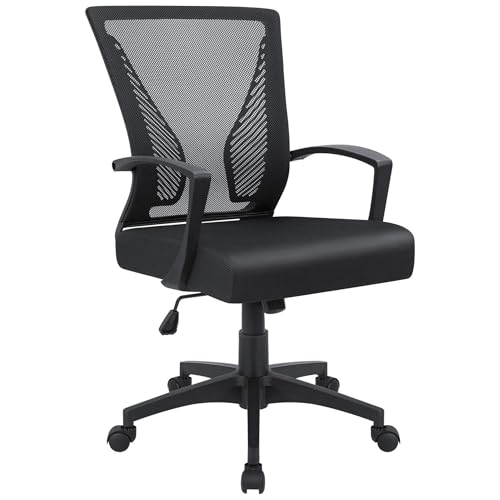
The Furmax is the straightforward answer for a first home-office chair, a spare-room desk, or a student setup where the chair will see a few hours a day rather than a full shift. The verified listing describes an ergonomic computer desk mesh chair with lumbar support, adjustable height, a breathable mid-back backrest, a 360-degree swivel and armrests, in black — a sensible, unpretentious specification at the budget tier.
Strengths
- Breathable mesh back keeps air moving during long study or work sessions
- Adjustable height and full swivel cover the basics every desk setup needs
- Simple construction means fast assembly and few parts to misalign
Trade-offs
- Lumbar support is a fixed shape in the backrest, not an adjustable mechanism
- Armrests are fixed rather than flip-up or multi-way adjustable
- Seat and materials are built for moderate daily hours, not heavy all-day use year after year
| Specification | Detail |
|---|---|
| Back | Mesh, mid-back |
| Lumbar support | Built-in (adjustability Not stated) |
| Height | Adjustable |
| Swivel | 360 degrees |
| Armrests | Fixed (type as listed) |
| Capacity | Not stated |
Budget chairs earn their keep by getting the fundamentals right, and the Furmax’s verified specification is exactly that: mesh where your back needs air, a height range that lets your feet sit flat, and a swivel base that suits both desk work and turning to a side table or printer. Where it asks you to compromise is adjustability. The lumbar shaping is moulded into the back rather than mounted on a slider, so your posture has to meet the chair instead of the chair meeting you, and fixed armrests set one elbow height for everybody. For a few hours a day, most people never notice. For eight-hour days, five days a week, the SIHOO or Marsail in this guide is the more honest recommendation, and this review would rather say so than oversell a budget chair.
Best for: students, spare desks and part-time home workers who need a breathable mesh chair at the budget tier / Not suited for: full-time workers who need adjustable lumbar support or movable armrests
Check the current price on Amazon
BestOffice Ergonomic Office Chair — Best Value Task Chair
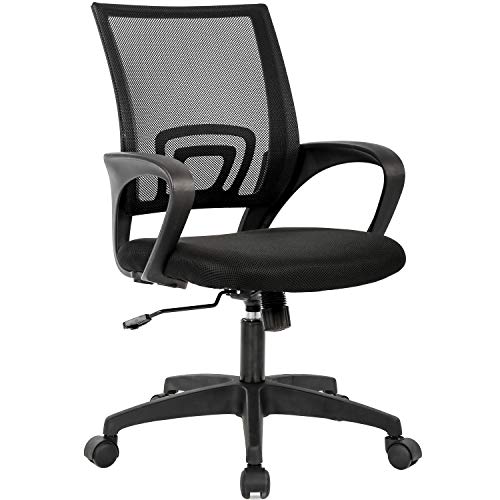
BestOffice’s ergonomic chair sits in the same budget neighbourhood as the Furmax but makes a different seat choice: its verified listing specifies a sponge seat rather than an all-mesh build, paired with a breathable backrest, lumbar support, adjustable height and rolling wheels. It suits readers who find mesh seats too firm and prefer a padded seat pan under them while keeping a cooler mesh back.
Strengths
- Sponge seat gives a softer sit than mesh-seat rivals at this tier
- Breathable backrest still handles the worst of back heat
- Rolling wheels and swivel make it easy to move between desk and storage areas
Trade-offs
- Lumbar support is built into the back shape rather than separately adjustable
- Armrests do not offer the movement of the mid-range picks
- Sponge seats compress over time faster than quality moulded foam
| Specification | Detail |
|---|---|
| Back | Breathable, mid-back |
| Seat | Sponge |
| Lumbar support | Built-in (adjustability Not stated) |
| Height | Adjustable |
| Base | Rolling wheels, swivel |
| Capacity | Not stated |
The choice between this chair and the Furmax is really a choice about the seat. A sponge seat feels welcoming in the first hour and suits people who dislike the hammock feel of tensioned mesh; the cost is that basic sponge gradually takes a set, so the chair you sit in during year two is flatter than the one you assembled. The rest of the specification is classic task-chair equipment — mid-back height that supports to the shoulder blades, height adjustment, casters for hard floors and low carpet. It is a sensible value pick for a home office that hosts one person for moderate hours, a teen’s homework desk, or a shared family computer corner where several people of different heights will use the height lever and little else.
Best for: buyers who prefer a padded sponge seat with a mesh back for moderate daily use / Not suited for: anyone needing a headrest, adjustable arms or a stated weight capacity
Check the current price on Amazon

Marsail Ergonomic Office Chair — Best for Adjustable Arms
The Marsail is for the reader whose shoulders and neck complain before their back does. Its verified listing describes a high-back mesh chair with adjustable lumbar support, a headrest and 3D armrests — arms that adjust in three directions — on a rolling swivel base. That arm adjustability is the headline: it lets you bring support to your forearms whether you type close, lean back to read, or sit slightly rotated.
Strengths
- 3D armrests offer the widest arm adjustment of any pick in this guide
- High back plus headrest supports taller torsos through the shoulders and neck
- Adjustable lumbar support pairs with the arms for a genuinely dialled-in fit
Trade-offs
- More mechanisms mean more setup time to get everything positioned well
- High-back mesh profile takes more room than a mid-back task chair
- At this specification level you are paying for adjustability, not for premium materials
| Specification | Detail |
|---|---|
| Back | Mesh, high-back, with headrest |
| Lumbar support | Adjustable |
| Armrests | 3D adjustable |
| Base | Rolling swivel |
| Capacity | Not stated |
| Colour | Not stated in verified title |
Armrest geometry is the most under-bought specification in office chairs. Arms set too high push your shoulders up all day; arms set too low might as well not exist; arms at the wrong angle force your wrists to bend around them. Three-direction adjustment does not guarantee a perfect fit, but it gives you the range to find one, and combined with an adjustable lumbar pad and a headrest it makes the Marsail the most configurable chair here after the premium pick. The honest caveat is that adjustability only pays if you use it: budget fifteen unhurried minutes after assembly to set seat height, lumbar position, arm height, width and angle, and headrest height, ideally following the measuring routine in the how-to section of this guide.
Best for: typists and taller users who want 3D armrests, a high back and a headrest / Not suited for: small rooms where a high-back chair overwhelms the desk, or buyers who never adjust anything
Check the current price on Amazon

Steelcase Leap Office Chair — Best Premium
The Steelcase Leap is the premium anchor of this guide and a different species from the mesh task chairs above it. The verified listing describes an ergonomic work chair in Onyx whose back supports the body’s unique shape through a Natural Glide System and LiveBack technology, with wheels specified for carpet. It is aimed at the reader who sits for a living, has been disappointed by cheaper chairs, and wants a design with a long track record rather than a feature list.
Strengths
- LiveBack back design flexes to follow your spine instead of forcing one fixed curve
- Natural Glide System keeps you supported as you recline rather than sliding you away from the desk
- A mature, widely serviced design from an established office furniture maker
Trade-offs
- Premium tier pricing in qualitative terms — this is the most expensive chair in the guide by a wide margin
- Wheels are specified for carpet, so hard-floor users should confirm caster suitability
- The Leap rewards adjustment; left at factory settings it feels merely good rather than exceptional
| Specification | Detail |
|---|---|
| Colour in verified listing | Onyx |
| Back system | LiveBack technology |
| Recline system | Natural Glide System |
| Wheels | For carpet (as listed) |
| Capacity | Not stated |
| Armrests | Not stated in verified title |
Premium office chairs justify themselves over years, not unboxings. The Leap’s core idea is that your spine changes shape as you move — upright for typing, curved as you recline to think — and a rigid backrest can only match one of those postures. LiveBack flexes the backrest to follow, while the glide system moves the seat as you recline so your eyes and hands stay in a natural relationship to the screen and desk. Whether that engineering is worth the premium tier depends on your hours: for two hours a day it is indulgence, for ten it is the difference between a chair you tolerate and one you forget about, which is the real goal. Note the carpet-specified wheels in the verified listing if your office has hard floors, and check the listing’s configuration options carefully before ordering.
Best for: full-time professionals upgrading from budget chairs who want a proven, posture-following back system / Not suited for: budget buyers, occasional users, or anyone unwilling to spend time dialling in adjustments
Check the current price on Amazon
HON Ignition 2.0 Ergonomic Office Chair — Best Established-Brand Alternative
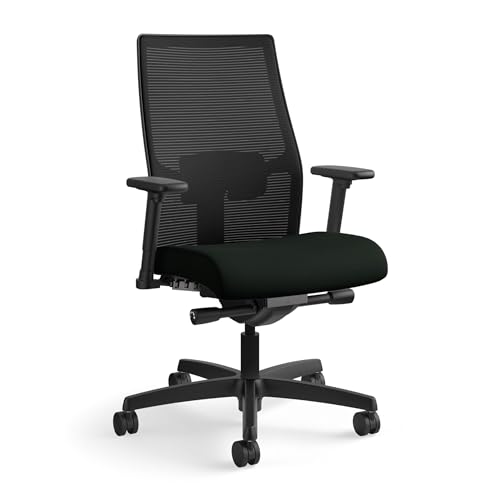
The HON Ignition 2.0 is the pick for buyers who trust established office-furniture brands but find the Steelcase tier a step too far. Its verified listing describes an ergonomic office desk chair in black with lumbar support and adjustable arms, positioned for workstation comfort and focused work. HON sells heavily into offices and institutions, and the Ignition line’s appeal is conservative, serviceable design rather than novelty.
Strengths
- Adjustable arms cover the adjustment most home workers actually use daily
- Backed by a brand with a long presence in contract office furniture
- Understated black styling fits a home office without shouting gaming chair
Trade-offs
- The verified title does not claim a headrest, so taller users should look at the SIHOO or Marsail
- Lumbar adjustability is not specified in the title — check the listing details before assuming
- Specification detail in the listing title is thinner than the mid-range rivals, so read the full listing carefully
| Specification | Detail |
|---|---|
| Colour in verified listing | Black |
| Lumbar support | Included (adjustability Not stated) |
| Armrests | Adjustable |
| Back | Not stated in verified title |
| Capacity | Not stated |
| Headrest | Not stated |
There is a real buyer for whom a shorter feature list from a known maker beats a longer one from an unfamiliar name, and the Ignition 2.0 is in this guide for them. The verified facts are lumbar support and adjustable arms — the two supports that matter most — in a chair from a company whose business is furnishing workplaces at scale. What this review will not do is invent the rest: the title we verified does not state the back material, a capacity figure or a headrest, so the spec box marks those Not stated and the listing itself is the place to confirm them. If those details check out for your needs, the Ignition is a calm, durable-feeling choice; if you want every mechanism named and adjustable, the SIHOO M18 states more of its case up front.
Best for: brand-conscious buyers who want lumbar support and adjustable arms from an established office furniture maker / Not suited for: buyers who want a headrest or fully specified mechanisms confirmed in the title
Check the current price on Amazon
Comparison Table
| Pick | Badge | Key spec | Best for |
|---|---|---|---|
| SIHOO M18 Ergonomic Office Chair | Best Overall | Adjustable lumbar, 2D arms, 330 lb stated | full-time home workers who want adjustable lumbar, a headrest and a stated high capacity in one mid-range chair |
| Furmax Office Chair | Best Budget | Mesh mid-back, adjustable height | students, spare desks and part-time home workers who need a breathable mesh chair at the budget tier |
| BestOffice Ergonomic Office Chair | Best Value Task Chair | Sponge seat, breathable back | buyers who prefer a padded sponge seat with a mesh back for moderate daily use |
| Marsail Ergonomic Office Chair | Best for Adjustable Arms | 3D armrests, high-back mesh | typists and taller users who want 3D armrests, a high back and a headrest |
| Steelcase Leap Office Chair | Best Premium | LiveBack + Natural Glide System | full-time professionals upgrading from budget chairs who want a proven, posture-following back system |
| HON Ignition 2.0 Ergonomic Office Chair | Best Established-Brand Alternative | Lumbar support, adjustable arms | brand-conscious buyers who want lumbar support and adjustable arms from an established office furniture maker |
How to Choose an Office Chair That Fits Your Body and Desk
Start with the seat, because it carries your weight for the whole session. Your feet should rest flat on the floor with your knees at roughly a right angle and a small gap between the seat edge and the back of your knees; a seat that is too deep pushes you into a slouch, and one that is too high leaves your feet dangling and your thighs compressed. Every pick in this guide adjusts for height, which covers most bodies, but if you are notably petite or tall, treat the listed height range on the product page as a hard filter rather than a detail.
Next, the back. A mid-back chair supports you to about the shoulder blades and suits shorter sessions or smaller rooms; a high-back chair with a headrest supports the neck during reclines and suits taller users and longer days. Lumbar support matters more than back height: fixed shaping is a compromise that fits average spines, while the adjustable lumbar systems on the SIHOO, Marsail and the Leap’s flexing back let the support meet your actual curve. If you already feel lower-back ache by mid-afternoon, adjustable lumbar is the single upgrade to prioritise.
Armrests are the third decision, and the most personal. Fixed arms are fine when they happen to match your elbow height and your desk lets the chair roll close. Flip-up arms solve the common problem of a chair that cannot tuck under the desk. Adjustable arms — 2D on the SIHOO, 3D on the Marsail, adjustable on the HON — earn their cost when you type for hours, because supported forearms mean relaxed shoulders. Finally, check capacity honestly: where a listing states a figure, as the SIHOO does at 330 lb, respect it; where it does not, that absence is itself information about how much the maker is promising.
Mesh, Sponge and Premium Back Systems: What the Materials Really Change
Mesh backs breathe. Air passes through the tensioned fabric, so your back stays closer to room temperature through a long session — the reason every budget and mid-range pick in this guide uses mesh on the back even when the seat differs. The trade-off is feel: mesh is supportive and slightly springy rather than soft, and in a cold room it can feel cool against a thin shirt. Mesh seats extend the same logic under your thighs, while a sponge seat like the BestOffice’s trades some of that airflow for a softer first impression.
Seat foam is where cheap chairs age fastest. Basic sponge compresses with use and gradually loses its resilience, which is why a budget chair can feel noticeably flatter in its second year. That is not a reason to avoid the tier — for moderate hours the maths still works — but it is a reason to match the chair to your hours honestly. Premium designs such as the Leap attack a different problem entirely: not softness but movement, flexing and gliding so support continues as your posture changes through the day. Buy the mechanism that matches your complaint — heat, flatness or postural fatigue — rather than the longest feature list.
Budget Tiers in Words: What Each Step Up Actually Buys
At the budget tier, represented here by the Furmax and BestOffice chairs, you get the essentials done competently: mesh or sponge comfort, height adjustment, swivel and casters. What you give up is personalisation — lumbar shaping is fixed, arms are fixed, and capacities often go unstated. For students, guest desks and part-time use, that is a rational trade, and this guide recommends those chairs for exactly those jobs without apology.
The mid-range tier — SIHOO and Marsail territory — is where adjustability arrives: lumbar pads that move, armrests that adjust in two or three directions, headrests, and in the SIHOO’s case a clearly stated 330 lb capacity. This is the tier most full-time home workers should buy, because it addresses the causes of end-of-day ache rather than its symptoms. The premium tier, the Leap, buys refinement and longevity of support: a back engineered to follow your spine and a design with a long service history. None of these tiers is the correct one in the abstract; the correct tier is the one matched to your daily hours, which is why every review in this guide names who should skip it as plainly as who should buy it.
A Workday Test: How to Judge a Chair in the First Two Weeks
However good the specification looks, a chair proves itself across real workdays, so judge it with a simple two-week protocol rather than a first impression. In week one, change only one adjustment every two days — seat height first, then lumbar position, then arm height and angle — and note at the end of each day where your body feels tired. Changing everything at once teaches you nothing, because you cannot tell which adjustment helped. By the end of week one you should know your chair’s honest range: the settings where your shoulders stay down, your feet stay planted and your lower back stops asking for attention by mid-afternoon. If a budget chair with fixed features is your pick, the same protocol still applies in miniature: vary your sitting position, your distance from the desk and your break rhythm, because with a fixed chair the variables are yours rather than the chair’s.
Week two is about the chair’s life in your room rather than at your desk. Roll it across your actual floor at your actual working weight; listen for casters that chatter on hard floors or drag on carpet, and check whether the base clears the desk legs and the rug edge you cross twenty times a day. Sit in it for a video call and notice whether the back shape pushes you into a presentable posture or lets you slump out of frame. Lean back with a book for twenty minutes, because most office chairs moonlight as reading chairs and a backrest that only works upright is half a chair. Finally, tighten every assembly bolt once at the end of week two: new chairs settle, and a chair that is quiet and solid after that first tightening is telling you its joints were well made. A chair that still creaks, wobbles or leaves you aching in the same place every day after two honest weeks is not a chair you failed to adjust — it is the wrong chair, and the return window is the feature to use.
Chair Mats, Floors and the Rest of the Desk Setup
A chair does not work alone, and the surface under it quietly decides how well its casters, base and your own pushing-off habits age. On hard floors, a chair mat or a low-pile rug under the desk protects the finish from caster traffic and stops the slow drift that makes you re-centre the chair every hour; on carpet, a firm mat restores the easy roll that deep pile steals and that your shoulders otherwise pay for. Several picks in this programme’s wider guides cover mats and under-desk rugs in their own right, and the internal links below point to them, because the correct order of purchase is chair first for fit, mat second for the floor it actually lives on. Do not let a mat purchase rescue a wrong chair, though: a mat fixes rolling and flooring, never lumbar position.
The rest of the desk deserves the same unsentimental audit once the chair is set. Your monitor should meet the eye level your adjusted chair creates, with a stand or a stack of sturdy books doing the lifting rather than your neck doing the bending. Your keyboard belongs where your forearms land when your shoulders are relaxed — which, after a proper chair setup, is often a few centimetres closer than habit placed it. A footrest is a legitimate accessory for shorter legs on a fixed-height desk, not an admission of failure. And lighting matters more than furniture catalogues admit: a screen fought against window glare produces more posture drift in an afternoon than a mid-range chair ever will. Set the chair, then set the room around the posture it creates — that sequence is the whole ergonomic method in one sentence, and it costs nothing beyond attention.
How to Set Up Your Office Chair in the Right Order
A good chair set up badly still produces a bad afternoon. Work through these steps in order — each one depends on the previous — and then sit for twenty minutes before changing anything, because your body needs a short session to give honest feedback.
- Set seat height first: sit with feet flat on the floor, knees at about ninety degrees, thighs roughly level. Adjust until that is true without a footrest.
- Position lumbar support: on adjustable models, raise or lower the pad until it fills the inward curve of your lower back; on fixed models, sit fully back so the shaping meets your spine.
- Set armrest height so your elbows rest lightly with shoulders relaxed and forearms roughly parallel to the desk; adjust width and angle on 2D and 3D arms so your wrists stay straight while typing.
- Set the headrest, where fitted, to meet the back of your head when you lean slightly back — not to push your head forward while upright.
- Match the desk and screen: your monitor top should sit near eye level and the keyboard where your adjusted arms naturally reach; move the desk items to the chair, not your posture to the items.
- Test the tuck: roll the chair fully under the desk. If fixed arms collide, note it now — flip-up or adjustable arms exist for exactly this problem.
- Re-check after a week: foam settles and habits form, so repeat steps one to three once the chair has broken in.
Keep the Allen keys and instructions from assembly in a labelled bag taped under the seat or in the desk drawer. Chairs loosen at their bolted joints over months of swivelling, and a two-minute tightening round twice a year prevents the creaks and wobbles that make people replace chairs that are actually fine. If a gas lift begins to sink, that cylinder is a replaceable part on most task chairs — a cheaper fix than a new chair, and a reason to buy designs with standard fittings.
One last setup habit separates happy chair owners from serial returners: photograph your final settings. Once seat height, lumbar position and arm angles feel right, take two phone photos of the chair from the side and front. If the chair is ever moved, cleaned or borrowed, those photos restore your fit in a minute instead of another week of fiddling.
Common Buying Mistakes
Buying for the first five minutes. Showroom comfort and fifth-hour comfort are different things. Soft sponge feels wonderful immediately and can still leave you aching by mid-afternoon if the lumbar shaping misses your back. Judge a chair by its support mechanisms and your longest typical session, not by the first sit.
Ignoring the stated capacity — or its absence. Capacity is a structural promise. Where a listing states one, as the SIHOO does, stay within it; where none is stated, understand that you are buying without that assurance and factor it into how hard and how long the chair will be used.
Letting the desk dictate bad posture. A chair adjusted perfectly is wasted if the monitor sits low on a stack of paper and the keyboard lives at the desk edge. Set the chair first, then arrange screen and keyboard around the posture it creates.
Paying for adjustments you will never touch. Some buyers genuinely will not spend fifteen minutes dialling in 3D arms and a headrest. If that is you, a simpler chair set up once is the better buy, and the budget picks in this guide exist without stigma.
Assuming wheels suit every floor. The Leap listing specifies wheels for carpet. Casters interact with flooring: hard floors may need different wheels, and any chair on a hard floor benefits from a chair mat — which also protects the floor you may one day want to sell with the house.
Final Recommendation
For most full-time home workers, the SIHOO M18 is the chair to buy first: adjustable lumbar, a headrest, 2D arms and a stated 330 lb capacity cover the widest range of bodies and desks at the mid-range tier. If arm fit is your main complaint, step sideways to the Marsail and its 3D armrests. If your hours are moderate and your budget is the constraint, the Furmax and BestOffice chairs do the basics honestly — choose mesh seat or sponge seat by preference. If you sit for a living and want the long-term answer, the Steelcase Leap is the premium pick, with the HON Ignition 2.0 as the established-brand alternative for buyers who prefer a conservative specification. Whichever you choose, spend the setup fifteen minutes; it is worth more than the next tier up.
Related guides in this programme: Best Carpet For Under Desk Chairs, Best Area Rugs For Under Office Chair, Best Chairs Affordable, Best Chairs Chronic Pain, Best Chair Mat For Carpets Rolling Chairs.
Frequently Asked Questions
How long should a budget office chair last with daily use?
Expect a budget mesh or sponge-seat chair to give a few years of moderate daily service before the seat foam noticeably flattens and joints need regular tightening. Heavier daily hours shorten that; part-time use stretches it. The honest calculation is cost against hours: a chair used eight hours a day earns a mid-range replacement sooner than a chair used for homework.
Is adjustable lumbar support really better than a fixed lumbar shape?
For most people, yes, because spines curve at different heights. A fixed bulge supports you only if it lands where your lower back curves inward; an adjustable pad can be moved until it does. If you have never felt back ache from a chair, a fixed shape may serve you fine — the difference shows up over long sessions.
Mesh seat or sponge seat — which should I choose?
Choose mesh if you run warm or sit for long stretches, since it breathes and keeps its tension well. Choose a sponge seat like the BestOffice pick if you prefer a softer, more cushioned first feel and your sessions are shorter. Either way, the back support system matters more to your posture than the seat surface.
What does a stated capacity of 330 lb actually tell me?
It tells you the maker has rated the chair — frame, lift and base — for users up to that weight, which is a verifiable structural claim rather than marketing language. Staying within a stated capacity protects both the chair and its warranty position. Where a listing states no capacity, treat that as unknown rather than unlimited.
Do I need a headrest on an office chair?
Only if you lean back to read, take calls reclined, or are tall enough that your head passes the top of a mid-back chair. For upright typing, a headrest does nothing. The SIHOO and Marsail include one; the budget picks omit it, which is a sensible saving if your work is all forward-facing.
Can I use these chairs on hard floors?
Yes, with attention to casters. The Steelcase Leap listing specifies wheels for carpet, and hard floors generally reward softer casters plus a chair mat to protect the surface and quiet the roll. Check the listing for your chosen chair, and consider a mat part of the purchase rather than an afterthought.
What is the difference between a task chair and an ergonomic chair?
In practice, a task chair covers the basics — height adjustment, swivel, a supportive back — while an ergonomic chair adds positional adjustments: movable lumbar support, multi-direction armrests, often a headrest and tilt control. The picks in this guide span both: the Furmax and BestOffice chairs are task chairs, the SIHOO and Marsail are ergonomic chairs, and the Leap’s flexing back system sits a step beyond either label. Buy the label that matches your hours, not your aspirations.


