Disclosure: airfryerkitchensupply.com is reader-supported. When you buy through links on our site, we may earn an affiliate commission at no extra cost to you.
Where to buy
Every rug below is made from fibers that grew rather than fibers that were synthesized — wool, jute, or a stated jute-cotton blend — with the material taken from the manufacturer’s own listing, verified through Amazon’s product data. ‘Natural’ is the most abused word in the rug aisle, so this guide’s rule is simple: if the listing does not name a natural fiber as the material, the rug is not here, however earthy its printed pattern looks. We print no prices or scores; use the link under each pick to check price on Amazon.
SAFAVIEH Heritage Wool Area Rug 6×9 (HG625A) — Best Overall: check price on Amazon.
SAFAVIEH Natura Wool Area Rug 8×10 (NAT801B) — Best Modern Wool: check price on Amazon.
Jaipur Art & Rugs Kilim Area Rug 3×5 — Wool & Jute — Best Small Rug: check price on Amazon.
Homespice Highland Oval Braided Rug 5×8 — Best Braided Jute: check price on Amazon.
The Knitted Co. 100% Jute Area Rug — Round, Approx. 6 ft — Best Pure Jute Round: check price on Amazon.
GRUHUM Jute Cotton Area Rug — 6 ft Round — Best Soft Round: check price on Amazon.
Introduction
The case for the best natural rugs is not nostalgia — it is how the materials behave. Wool insulates, cushions, resists flames by nature and springs back underfoot for decades. Jute brings woven texture and a matte, grounded look at a friendlier cost. Cotton softens blends and takes dye kindly. A natural rug feels like a material because it is one, and a room furnished with real materials reads differently from one furnished with photographs of them — which is what a printed ‘natural look’ synthetic rug is, however good the photograph.
This guide is the broad church of the category: wool area rugs for living rooms and bedrooms, a handwoven wool-and-jute kilim, braided and round jute rugs for texture-led spaces. Our companion guide to natural fiber rugs for the living room goes deeper on the plant fibers alone (seagrass, sisal, jute) in living-room sizes; this one ranges wider, across fibers, rooms and shapes. What unifies the picks is the verified-material rule and honest trade-offs: natural fibers shed a little, fear soaking, and ask for a pad — and in exchange they outlast and out-feel the synthetics that imitate them.
One vocabulary trap to disarm now: ‘natural’ on a rug listing can describe a color (‘natural beige’) rather than a material. Several rugs in our research were synthetic rugs in a natural colorway. Every pick below names its fiber — wool fibers, jute, wool and jute, jute and cotton — in the listing itself. If you shop beyond this guide, hold any candidate to the same test: find the fiber named as the material, or keep looking.
Key Takeaways
- Wool is the premium natural rug fiber — cushion, resilience, natural flame resistance; jute is the texture fiber; blends split the difference.
- Every pick names a real natural fiber as its material in its own listing; ‘natural’ used as a color name was treated as a disqualifier.
- The SAFAVIEH Heritage wool 6×9 is the best all-round natural rug; the Natura wool 8×10 is the modern-room pick.
- All natural rugs: pad underneath, blot spills, never soak. Those three habits decide how long they live.
In this guide
Quick Picks

SAFAVIEH Heritage Wool Area Rug 6×9 (HG625A) — Best Overall
A traditional-pattern wool rug in 6×9 with a 3/8-inch pile — the classic natural rug, in the size that fits most living rooms and large bedrooms. Wool’s spring and depth of color are why this category exists.
Check the current price on Amazon

SAFAVIEH Natura Wool Area Rug 8×10 (NAT801B) — Best Modern Wool
The same wool virtues in a modern register: an 8×10 in modern beige with a 3/8-inch pile. For rooms where a traditional red pattern would shout, this is the natural rug that whispers — texture and material instead of motif.
Check the current price on Amazon
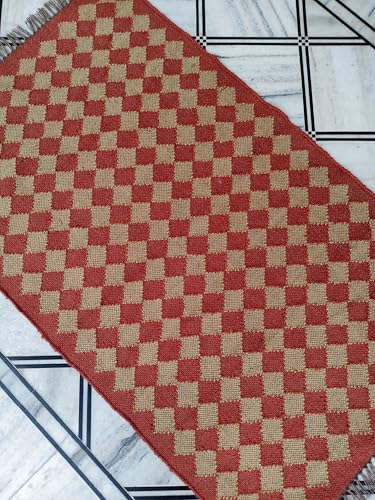
Jaipur Art & Rugs Kilim Area Rug 3×5 — Wool & Jute — Best Small Rug
A handwoven kilim flatweave in wool and jute, 3×5 and reversible, in red natural. The entryway, kitchen-adjacent and layering pick — flatwoven rugs go where pile cannot, including under doors and dining chairs.
Check the current price on Amazon

Homespice Highland Oval Braided Rug 5×8 — Best Braided Jute
An oval braided jute rug in 5×8, lodge-style multi-color, reversible and made to lay flat. The country and lodge rooms’ natural rug — braided ovals soften rectangular rooms and sit beautifully under oval and round dining tables.
Check the current price on Amazon

The Knitted Co. 100% Jute Area Rug — Round, Approx. 6 ft — Best Pure Jute Round
A round hand-woven braided rug in 100% jute — no blends, no backing story — about 6 feet across in natural white rings. The purist’s natural rug: one fiber, hand worked, for living rooms and hallways that want texture in a circle.
Check the current price on Amazon
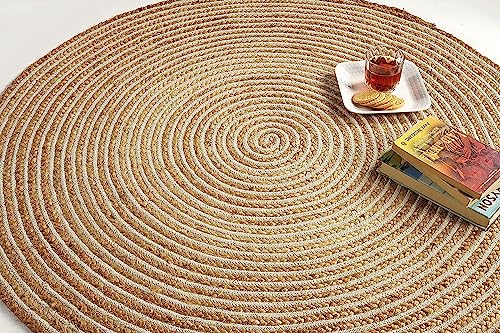
GRUHUM Jute Cotton Area Rug — 6 ft Round — Best Soft Round
The gentler round: jute braided with cotton into a 6-foot reversible rug in rustic beige, described by its listing as soft — the cotton takes jute’s edge off, making this the barefoot-friendly round for bedrooms and living rooms.
Check the current price on Amazon
How These Picks Were Chosen
Picks were chosen cache-first from rugs already verified on this site, with ASIN and full listing title cross-checked before writing. The qualifying rule: the listing had to name a natural fiber — wool, jute, or a stated natural blend — as the rug’s material.
Within the verified shortlist, the six slots span the category’s real range rather than six versions of one rug: two wool area rugs (one traditional pattern, one modern neutral), a small handwoven wool-jute kilim for entryways and layering, a braided jute 5×8, and two round jute rugs with different constructions (pure jute braid, jute-cotton handwoven). Sizes run 3×5 to 8×10 because ‘natural rugs’ is a whole-house keyword, not a single room’s.
Pile heights and constructions are printed exactly as listings state them. Wool content is described as the listings describe it — ‘wool fibers’ — without inventing percentages the listings do not state. No prices, reader scores or review tallies are printed.
The 6 Best Natural Rugs
SAFAVIEH Heritage Wool Area Rug 6×9 (HG625A) — Best Overall
If someone says ‘natural rug’ and means the real, traditional article, they mean something like this: a wool area rug with a woven traditional pattern — here in red, in a 6×9 with a 3/8-inch pile, per the listing. Wool does things no other fiber in this guide does at once: it cushions underfoot, it holds dye in deep, slightly varied tones that synthetic prints imitate badly, and its fibers spring back from furniture dents and foot traffic instead of flattening into paths.
The 6×9 size is the quiet virtue. It is large enough to anchor a living room seating group or sit under a queen bed with a border on three sides, and small enough to handle, rotate and take outside for an airing without a second person and a plan. The listing positions it across living room, bedroom, hallway and entryway, and wool’s natural resilience genuinely suits all four — including the hallway, where lesser fibers show a traffic lane within a year.
Wool’s honest costs: it sheds loose fibers for its first weeks (normal, and it settles), it is the premium fiber in this guide, and it wants prompt blotting and professional attention for serious stains rather than a soak in the tub. Wool is also naturally flame resistant and soil-hiding — the traditional pattern helps there too — so the care it asks is modest for the decades it gives. This is the natural rug against which the others are variations.
Strengths
- Wool fibers cushion, spring back and hold deep color
- 6×9 is the most versatile whole-room size here
- Traditional pattern hides soil and suits many rooms, per the listing
Trade-offs
- Sheds loose fibers in the first weeks
- Premium fiber — the considered purchase of this guide
- Serious stains want professional cleaning, never soaking
| Specifications (from the manufacturer listing) | |
|---|---|
| Fiber | Wool, stated in listing |
| Size | 6 x 9 ft |
| Pile | 3/8 in |
| Model | HG625A |
| Pattern | Traditional, red |
Best for: Living rooms and bedrooms wanting the classic natural rug / Not suited for: Buyers who want a rug they can hose down and forget
Check the current price on Amazon
SAFAVIEH Natura Wool Area Rug 8×10 (NAT801B) — Best Modern Wool
Modern rooms still want natural materials; they just want them quiet. The Natura answers with wool in a modern beige, at a full 8×10 with a 3/8-inch pile, per the listing — big enough to run the standard living room arrangement (sofa front legs on, chairs grounded) in a palette that lets wood, linen and leather be the room’s events while the rug supplies warmth and material honesty underneath.
Everything said about wool in the Heritage review applies — the spring, the dye depth (here, a subtle tonal beige rather than a pattern), the flame and soil behavior — with one modern-room bonus: a low-contrast neutral shows the texture of the weave itself, so the rug reads as crafted rather than printed. In beige, wool’s natural fiber variation is a feature you can see.
A light beige rug in a busy house is a commitment the traditional pattern is not: it will show the spills the red pattern hides, and it asks for the blot-fast discipline this guide repeats. The 8×10 size also means a two-person unroll and a pad cut to match. And like all wool, expect the early shedding weeks. Buy it because the room wants calm and real material, and accept the small care tax that light colors levy.
Strengths
- Full 8×10 in a modern neutral that suits contemporary rooms
- Wool resilience and warmth without a traditional pattern
- Weave texture reads as crafted, not printed
Trade-offs
- Light beige shows spills a pattern would hide
- Two-person handling at this size; pad required
- Early shedding, as with all new wool rugs
| Specifications (from the manufacturer listing) | |
|---|---|
| Fiber | Wool, stated in listing |
| Size | 8 x 10 ft |
| Pile | 3/8 in |
| Model | NAT801B |
| Color | Modern beige |
Best for: Modern and minimalist rooms that want natural material quietly / Not suited for: High-spill households that need a pattern to hide the evidence
Check the current price on Amazon
Jaipur Art & Rugs Kilim Area Rug 3×5 — Wool & Jute — Best Small Rug
Not every natural rug is a room anchor. The kilim is the category’s utility player: a handwoven flatweave of wool and jute, per the listing, in a 3×5 that fits entryways, hearths, kitchen work zones and the foot of a bed — and layers over a larger rug where a room wants pattern in one zone. Flatweave means no pile: doors swing over it, dining chairs slide on it, and dirt sits on the surface to be shaken out rather than sinking in.
The wool-jute blend is a considered mix. Wool brings color, softness and resilience; jute brings body and that dry, woven hand-feel; together in a kilim they produce the firm, textile character that has made flatweaves the traveler’s and trader’s rug for centuries. Reversibility doubles the working life and lets you flip a faded or spotted face down — a real feature in an entryway rug, which lives the hardest life in the house.
The listing describes it as indoor/outdoor; our advice is more conservative — treat ‘outdoor’ as a covered porch, not open weather, because wool and jute both dislike soaking, whatever a title permits. A flatweave also absolutely requires a pad to stay put, especially at 3×5, and its edges can curl until it settles. Within those terms, this is the most versatile small natural rug in the guide.
Strengths
- Handwoven wool-jute flatweave — no pile, doors and chairs glide
- Reversible: two working faces for entryway-grade wear
- 3×5 suits entries, hearths, kitchens and layering
Trade-offs
- Listing says indoor/outdoor; we advise covered areas only — natural fibers hate soaking
- Needs a pad to stay in place at this size
- Flatweave offers no cushion
| Specifications (from the manufacturer listing) | |
|---|---|
| Fiber | Wool and jute, stated in listing |
| Size | 3 x 5 ft |
| Construction | Handwoven kilim flatweave, reversible |
| Color | Red natural |
| Use | Indoor / covered outdoor, per listing with our caveat |
Best for: Entryways, hearths and layered looks needing a flat natural rug / Not suited for: Anyone wanting cushion or a rug for open weather
Check the current price on Amazon
Homespice Highland Oval Braided Rug 5×8 — Best Braided Jute
The braided oval is America’s folk rug, and the Highland is a proper one: jute braided into a 5×8 oval in lodge-style multi-colors, per the listing, reversible, and made to lay flat — the last being the braid quality that matters, since a badly made braid humps and curls at the seams forever. Under a dining table, in a country living room, or in front of a hearth, the oval does what rectangles cannot: it softens a room’s geometry.
Braided jute’s practical character suits dining and living alike. The multi-color braid hides crumbs and tracked dirt between cleanings better than any flat color in this guide, the jute body is tough under chair legs, and reversibility means the face that takes the dining chairs’ traffic can trade places with its fresher twin. The listing claims a no-shed jute construction; braids do shed less than knotted jute by construction, since the fibers are locked in the braid — though ‘no shed’ is the seller’s phrasing and a few loose ends in week one would not make it a liar.
Ovals measure differently: a 5×8 oval covers less floor than a 5×8 rectangle, with the corners given back to the room — check that your table and chairs fit within the braid’s working area. Jute’s spill rule applies (blot, never soak), and a pad under a braid protects both the rug’s underside and the floor from the braid’s texture under load. For lodge, farmhouse and country rooms, this is the natural rug with the most heritage per square foot here.
Strengths
- Braided jute oval — softens rectangular rooms, suits round and oval tables
- Multi-color braid hides dining and living dirt exceptionally well
- Reversible and made to lay flat — the braid quality that matters
Trade-offs
- Oval covers less than the same nominal rectangle size
- Jute spill rules apply — blot fast, never soak
- Lodge palette is a style commitment
| Specifications (from the manufacturer listing) | |
|---|---|
| Fiber | Jute, stated in listing |
| Size | 5 x 8 ft oval |
| Construction | Braided, reversible |
| Color | Lodge style multi color |
| Use | Living room and dining, per listing |
Best for: Country, lodge and farmhouse rooms; under dining tables / Not suited for: Rooms needing maximum rectangular coverage
Check the current price on Amazon
The Knitted Co. 100% Jute Area Rug — Round, Approx. 6 ft — Best Pure Jute Round
Some buyers want the material undiluted, and this is that rug: 100% jute, per the listing, hand woven in a braided design with natural white rings, approximately 6 feet round. There is no cotton to soften it and no synthetic to stabilize it — just jute’s own character: dry, matte, nubby, and honest. In a hallway, under a round table, or defining a reading chair’s circle, it is the most elemental object in this guide.
Pure jute braided this way has a sculptural quality the blends trade away: the rings read clearly, the texture is pronounced, and the rug has real visual grain even in a neutral color. It is also the most jute-like in behavior — the firmest underfoot of the round picks, the most inclined to shed a little early on, and the one that most rewards a pad, which keeps the circle a circle instead of letting it creep oval.
The ‘approx’ in the listing’s sizing deserves respect: hand-woven rounds vary slightly, so measure your space with tolerance, and do not expect a laser-cut edge. Natural white is also the least forgiving color for spills in this entire guide — beautiful, and a discipline. Choose it for the purity of the material and the look of the rings, in a room calm enough to deserve it.
Strengths
- 100% jute — the undiluted natural material
- Hand-woven braided rings have real sculptural texture
- Round format defines circles rectangles cannot
Trade-offs
- Approximate sizing — hand-woven variation is inherent
- Natural white shows every spill; blot discipline required
- Firmest feel of the round picks; pad essential
| Specifications (from the manufacturer listing) | |
|---|---|
| Fiber | 100% jute, stated in listing |
| Size | Approx. 6 ft round |
| Construction | Hand woven, braided design |
| Color | Natural white rings |
| Use | Living room, hallways, per listing |
Best for: Material purists and round-table or hallway placements / Not suited for: Busy, spill-prone rooms — the color forgives nothing
Check the current price on Amazon
GRUHUM Jute Cotton Area Rug — 6 ft Round — Best Soft Round
Set the GRUHUM beside the Knitted Co. pick and you have the jute decision in miniature: same round braided form, same 6-foot scale, but cotton woven into the braid — and the listing’s own word for the result is ‘soft.’ Cotton fibers in the mix give the surface a kinder hand-feel, the difference between a rug you walk on and a rug you sit on, which is why this one suits bedrooms and living rooms where the floor is furniture.
The rest of the specification is generous: handwoven, reversible, low pile, in a vintage rustic beige that hides daily life far better than natural white. The listing positions it for high-traffic indoor use across bedroom, living room and hallway, and a braided jute-cotton construction is a reasonable match for that claim — braids wear well, and the cotton content makes the rug more flexible and less prone to the stiffness of pure jute.
Softness is relative — this is still a braided plant-fiber rug, not a plush one, and anyone expecting cushion should look at the wool picks. The beige, while forgiving, is a warm rustic tone that will argue with cool grey rooms. And reversible braids still want a pad. As the round rug for actual barefoot living, though, it is the friendliest natural option here.
Strengths
- Cotton in the braid softens jute noticeably — barefoot-friendly
- Reversible, handwoven, low pile in forgiving rustic beige
- Suited to bedrooms and living rooms where floors get sat on
Trade-offs
- Softer than jute is still firm next to wool or plush
- Warm beige tone clashes with cool grey palettes
- Pad needed, as with all braids
| Specifications (from the manufacturer listing) | |
|---|---|
| Fiber | Jute and cotton, stated in listing |
| Size | 6 ft round |
| Construction | Handwoven braided, reversible, low pile |
| Color | Rustic beige |
| Use | Indoor — bedroom, living room, hallway, per listing |
Best for: Barefoot rooms — bedrooms and living rooms wanting a soft-er round / Not suited for: Anyone expecting plush cushion from a braided rug
Check the current price on Amazon
Comparison Table
| Pick | Badge | Key spec | Best for |
|---|---|---|---|
| SAFAVIEH Heritage Wool Area Rug 6×9 (HG625A) | Best Overall | Wool, 6×9, 3/8 in pile, traditional pattern | Living rooms and bedrooms wanting the classic natural rug |
| SAFAVIEH Natura Wool Area Rug 8×10 (NAT801B) | Best Modern Wool | Wool, 8×10, modern beige | Modern and minimalist rooms that want natural material quietly |
| Jaipur Art & Rugs Kilim Area Rug 3×5 — Wool & Jute | Best Small Rug | Wool-jute kilim flatweave, 3×5, reversible | Entryways, hearths and layered looks needing a flat natural rug |
| Homespice Highland Oval Braided Rug 5×8 | Best Braided Jute | Braided jute oval, 5×8, reversible | Country, lodge and farmhouse rooms; under dining tables |
| The Knitted Co. 100% Jute Area Rug — Round, Approx. 6 ft | Best Pure Jute Round | 100% jute braided round, approx. 6 ft | Material purists and round-table or hallway placements |
| GRUHUM Jute Cotton Area Rug — 6 ft Round | Best Soft Round | Jute-cotton braided round, 6 ft, reversible | Barefoot rooms — bedrooms and living rooms wanting a soft-er round |
How to Choose the Best Natural Rugs: Fiber, Room and Reality
Let the room choose the fiber. Living rooms and bedrooms that host bare feet and floor-sitting want wool’s cushion or a cotton-softened blend. High-traffic lanes, dining areas and entryways want jute’s toughness or a flatweave’s shake-it-clean practicality. Wool everywhere is lovely and expensive; jute everywhere is textural and firm. Most houses land on a mix — which is why this guide spans both, and why our living-room-specific companion guide goes deeper on plant fibers alone.
Construction is the second lens. Pile rugs (the two wool picks, 3/8-inch) cushion and insulate. Flatweaves (the kilim) slide under doors and chairs and layer over other rugs. Braids (three picks here) are the folk construction — reversible, repairable in spirit, and softer in outline, with oval and round shapes that change a room’s geometry. Match construction to furniture: dining chairs want flat or braid, never a deep pile they will trench; a reading chair wants pile or a braid under it.
Third, size by furniture footprint and shape by room shape. Rectangles anchor seating groups; rounds define circles — a chair and lamp, a round table; ovals soften dining rooms. A natural rug a size too small looks like an apology in any fiber. Fourth, the care covenant, stated once for the whole category: pad underneath (grip, cushion, abrasion protection), vacuum with suction rather than a beater bar on braids and weaves, blot spills immediately, never soak, and rotate or flip seasonally. Natural rugs reward exactly this much attention with decades of service.
And the label test, because this category needs it: find the fiber named as the material in the listing — wool, jute, cotton, sisal, seagrass. ‘Natural’ as a color name, a printed jute pattern on polypropylene, a rug that is ‘natural style’ — all synthetics in costume.
Wool vs Jute vs Blends: The Honest Trade-Off Table in Words
Wool costs the most and gives the most: cushion, resilience, color depth, natural flame resistance, and a lifespan measured in decades. Its asks: early shedding, prompt stain care, professional cleaning for serious accidents. Jute costs the least per square foot of the true naturals and gives texture, toughness and that dry woven beauty; its asks: firmness underfoot, spill discipline, and no damp rooms. Blends — wool-jute in the kilim, jute-cotton in two picks — are engineering compromises that genuinely work: the kilim gets color and body, the jute-cotton rugs get softness, each at a mid position in price and care.
What about the other naturals? Sisal and seagrass are the hard-wearing plant fibers covered in depth by our natural fiber living room guide; silk and leather rugs exist at price points and fragilities outside this guide’s scope; and coir — coconut fiber — belongs at the door as a mat, not under a sofa. A natural rug wardrobe for a whole house usually ends up: wool where you sit and sleep, jute and flatweaves where you walk and dine. That is not a rule, but it is the pattern these materials keep suggesting.
Natural Rugs Room by Room: Where Each Fiber Earns Its Place
Bedrooms are wool’s home ground. It is the room of bare feet at cold hours, of sitting on the floor to dress, of wanting the floor itself to feel like part of the bedding’s warmth — and wool pile is the only natural fiber that delivers cushion and insulation together. The Heritage 6×9 under a queen bed, border showing on three sides, is the classic arrangement; the Natura’s beige suits the pale, quiet palettes bedrooms favor. Jute in a bedroom reads beautifully and feels firm at 6 a.m.; households that choose it there usually layer a small wool or sheepskin piece at the bedside, which is layering used as triage — softness exactly at the step-out point.
Dining rooms belong to flatweaves and braids. Chairs must slide — a pile rug trenches under chair legs and fights every scoot — and spills are a certainty rather than a risk, so the surface wants to be shakeable, blottable and, ideally, reversible. The kilim and the Highland oval are this guide’s dining answers, sized and shaped for tables; the oval in particular solves the rectangular table in a rectangular room looking like a spreadsheet. Under-table sizing is the common error: the rug must contain the chairs pulled out, not just the table at rest, which usually means a size up from the one that looks right in the empty room.
Hallways and entries are the durability test track, and they sort fibers ruthlessly. Wool pile passes for decades, which is why the traditional picks list hallways among their rooms; braided jute passes with honors and hides the tracked evidence best; a flatweave kilim at the door takes the worst of the weather’s dirt in a shakeable form. What fails in entries is the delicate and the pale — save the natural white round for a calm room’s center, where its beauty is the point and its discipline is affordable.
Children’s rooms and home offices split the difference and reward honesty about their real use. A child’s floor is a play surface first: braided jute-cotton (the GRUHUM) or a wool rug with a pattern to hide the archaeology of play are the workable naturals, with the understanding that paint and glue obey no fiber’s care rules. An office chair’s casters are the office question — they trench pile and walk flatweaves around the room, so the answer is a low, dense wool or a braid under a proper chair mat. In both rooms, the natural rug’s role is the same as everywhere else in the house: real material under real life, chosen with its eyes open.
What Natural Rugs Cost Over Time: The Ownership Arithmetic
Natural rugs are usually compared by purchase price, which is the least informative number in their lives. The honest comparison is cost per year of good service, and there the category’s arithmetic is distinctive. A wool rug at a considered price, kept on a pad and rotated, serves ten to twenty years in ordinary rooms — its cost per year undercuts a cheap synthetic replaced every three years, while feeling better in every one of those years. Jute’s arithmetic is shorter but still favorable: a braided or woven jute rug gives five to ten years in living spaces, at a purchase price low enough that the per-year figure is the best in this guide. The kilim’s reversibility is an economic feature disguised as a design one — two faces, two lives, one price.
The costs that surprise owners are the small recurring ones, and they deserve naming so they can be budgeted rather than resented. The pad is a real line item — roughly a tenth to a fifth of the rug’s price, replaced perhaps once in the rug’s life. Professional cleaning for a wool rug’s serious accident is another, incurred rarely and worth every penny compared with the home-soak disaster it replaces. Everything else in the care covenant is free: blotting, rotating, snipping, airing. A natural rug’s total cost of ownership is therefore front-loaded and calm — the opposite of the synthetic cycle of cheap purchases and early disappointments.
There is a final entry in the ledger that does not fit in a spreadsheet: disposal and drift. A worn natural rug is fiber — it can be cut down into runners, demoted to a workshop or a porch, composted at the end in a way no synthetic can be. Rooms also drift toward natural materials over time in a way they rarely drift away: the household that buys one wool rug tends to furnish the next room the same way, because the material’s behavior teaches its own value. That is not an argument to overspend on a first rug. It is an argument to buy the first one honestly — real fiber, right size, pad included — and let the arithmetic introduce itself.
A closing word on mixing natural rugs with the rest of a house’s floors: the material conversation matters. A wool rug on a wood floor, a jute runner toward a stone entry, a braid under a wooden table — natural fibers rhyme with natural surfaces, and rooms furnished this way feel coherent without a single matching purchase. The friction to avoid is the opposite pairing at scale: a natural rug asked to carry a room of chrome, glass and high-gloss synthetics will look like an apology instead of a foundation. Even there, the modern beige wool in this guide was chosen to mediate — proof that the category has range when the fiber is real and the palette is calm.
A final sizing habit worth adopting from professional installers: tape the rug’s outline on the floor before you order. Painter’s tape at the stated dimensions — remembering that the braided oval’s tape should curve, not corner — and then live with the tape for a day. Walk the traffic lanes, pull the dining chairs out, open the doors. Ten minutes of tape has saved more natural rug purchases than any review ever written, because size errors in this category are almost never about the tape-measure numbers; they are about how a shape behaves in a room that is actually being lived in.
How to Place, Pad and Care for a Natural Rug
Natural rugs are forgiving of everything except water and neglect. This routine — an hour at setup, minutes a month after — is the full care contract for wool, jute and blends alike.
- Unroll and rest the rug 24–48 hours. Natural fibers arrive with roll memory and sometimes a faint material smell (wool especially) that fades in days. Weight curled edges with books; do not steam them flat.
- Pad it, sized an inch smaller than the rug. Felt-rubber for pile rugs, thinner grip pads for flatweaves and braids. The pad is grip, cushion and abrasion shield in one purchase.
- Position by furniture. Front legs of seating on the rug for area sizes; dining chairs fully on the rug when pulled out, for dining placements. Rounds center on the grouping they define, not on the room.
- Vacuum with suction; go easy on braids and weaves. A beater bar is fine for sturdy wool pile on a low setting and wrong for braids and flatweaves — use a hard-floor head there. Vacuum the pad side occasionally too.
- Blot every spill immediately, with water only if a little. Blot from the edge inward, no rubbing, no soaking, no harsh chemicals on wool or jute. Dry flat with air moving. Serious wool stains go to a professional who knows natural fibers.
- Rotate or flip with the seasons. Reversible picks (kilim, both braids) flip face for face; pile rugs rotate 180°. Traffic lanes and sun even out, and the rug ages as one object.
- Snip sprouts, never pull. Loose ends in wool and hand-woven jute are normal. Trim flush; pulling migrates the problem along the weave.
Follow that and the visible aging of a natural rug is mellowing, not deterioration — wool deepens, jute softens in tone, braids settle. The two fatal errors are soaking a natural rug to ‘clean’ it and skipping the pad; everything else is recoverable.
Common Buying Mistakes
Trusting the word ‘natural’ on the label
Natural is a color name as often as a material claim. The test takes ten seconds: find the fiber — wool, jute, cotton — named as the material in the listing. If the material is polypropylene with a natural look, it is a synthetic rug, whatever the title says.
Soaking or steam-cleaning a natural rug
Water is the enemy category-wide: jute stains and can mildew, wool felts and shrinks, braids distort. Blot spills, shake out dirt, and give serious stains to a cleaner who works with natural fibers.
Skipping the pad to save money
An unpadded natural rug creeps, abrades its underside, feels harsher, and can scuff the floor beneath it. The pad costs a fraction of the rug and doubles its comfortable life. It is part of the rug.
Putting jute in a damp room
Plant fibers and chronic moisture do not mix — a damp basement or bathroom will mildew jute no matter how well it is made. Wool tolerates ordinary rooms; chronically damp rooms need the moisture fixed or a different material entirely.
Expecting a braided or flatweave rug to cushion like pile
Braids and flatweaves are surface, not cushion. If the room’s life happens on the floor — kids playing, floor sitting — put wool pile there, or layer a soft rug over the natural base in that zone.
Final Recommendation
If you buy one natural rug from this guide, buy the Heritage wool 6×9: the classic fiber, the classic pattern family, the most versatile size. Modern rooms should take the Natura wool 8×10 instead. Entries, hearths and layers want the wool-jute kilim; lodge and dining rooms the braided Highland oval; purists the 100% jute round; and barefoot bedrooms the softer jute-cotton GRUHUM.
Hold every candidate — here or anywhere — to the same three tests: the fiber named as material, the size measured against furniture, and the care covenant accepted (pad, blot, never soak). A natural rug bought on those terms is not a purchase so much as a long tenancy.
The shortlist to start from: SAFAVIEH Heritage Wool Area Rug 6×9 (HG625A), SAFAVIEH Natura Wool Area Rug 8×10 (NAT801B), Jaipur Art & Rugs Kilim Area Rug 3×5 — Wool & Jute.
Related guides on this site: Best Natural Area Rugs Best Natural Fiber Outdoor Rugs Eco Best Braided Wool Rugs Best 8 X 10 Wool Area Rugs Best Affordable Jute Rugs Best Soft Jute Rugs
Frequently Asked Questions
What is the best natural rug material?
Wool, for most rooms: it cushions, resists wear and flame, holds color and lasts decades — it is this guide’s top fiber. Jute is the best texture-and-value material, tougher than it is soft. Blends split the difference honestly. The right answer is room-specific: wool where you sit and sleep, jute and flatweaves where you walk and dine.
Are natural rugs durable enough for pets and kids?
Wool and braided jute are genuinely hard-wearing, and patterned or multi-color surfaces hide the evidence of busy houses well. The limits are liquid and claws: blot spills fast (natural fibers should never be soaked), and keep a snip-don’t-pull habit for any loop a claw lifts. Two picks here are described by their listings as kid and pet friendly; the care rules still apply.
Do natural rugs shed?
Wool sheds loose fibers for its first weeks — normal, and it settles with vacuuming. Knotted jute sheds a little; braided jute much less, since the fibers are locked in the braid. Shedding that continues heavily after a month is a quality problem, not a category trait.
Can a natural rug go outdoors?
One pick’s listing says indoor/outdoor, and our advice is to read that as ‘covered porch.’ Wool and jute both dislike soaking and mildew in damp conditions; open-weather rugs should be synthetic and proud of it. Natural rugs live indoors, on dry floors.
How do I clean a natural rug?
Vacuum regularly (suction only on braids and flatweaves), shake small rugs outside, blot spills immediately from the edge inward, and never soak, steam or shampoo. Wool’s serious stains go to a professional cleaner experienced with natural fibers. The pad underneath gets vacuumed when you rotate the rug.
Why does my new wool rug smell, and will it fade?
A faint wool smell on unrolling is normal and fades within days in a ventilated room. Fading is sunlight’s work on any natural fiber — rotate the rug seasonally so exposure evens out, and prefer reversible rugs (three picks here) where a sun-facing side can trade places with its twin.


