Disclosure: airfryerkitchensupply.com is reader-supported. When you buy through links on our site, we may earn an affiliate commission at no extra cost to you.
Where to buy
Shopping for the natural fiber outdoor rugs eco? The fastest way to buy any pick in this guide is through Amazon, where stock, delivery and returns are handled in one place. Start with our top recommendation, the CAMILSON Easy Jute Rug 8×10 — Indoor Outdoor (Check the current price on Amazon), then compare it against the other five picks below before you decide. Prices move with stock and season, so we never print a fixed price in the article itself — use the check-price links to see the current figure on Amazon.
- CAMILSON Easy Jute Rug 8×10 — Indoor Outdoor — Check price on Amazon
- Jaipur Art & Rugs Handwoven Wool & Jute Kilim Rug, 3×5 — Check price on Amazon
- Sisal Outdoor Rug — Tight-Weave Type — unlinked guidance (no verified outdoor listing)
- Seagrass Outdoor Rug — Porch Type — unlinked guidance (no verified outdoor listing)
- Jute-Cotton Blend Outdoor Rug — Soft Type — unlinked guidance (no verified outdoor listing)
- Natural Jute Indoor/Outdoor Runner Rug, 22×60, Reversible — Check price on Amazon
The best natural fiber outdoor rugs eco shoppers can buy come with a truth that has to lead this guide, because everything else follows from it: natural fibres rot outdoors. Jute, sisal and seagrass are plant materials; left in open rain they absorb water, mildew and break down — that is precisely what makes them eco-friendly at end of life, and precisely what limits them in service. So this search splits into two honest products, and this guide refuses to pretend they are one. The first is the true natural-fibre rug used under cover — on a roofed patio, porch or pergola — where it gives years of beautiful, plastic-free service. The second is the natural-look outdoor rug, engineered and washable, for open weather. Our lead linked pick belongs to the second camp and is flagged in its review because its verified title claims a natural colour and a seagrass design without confirming natural fibre content. Two further linked picks — a handwoven wool-and-jute kilim and a natural jute runner — belong to the first camp outright: their titles confirm the natural fibre and indoor-outdoor use in the same breath. The remaining three fibre types are served unlinked, because repeated catalog searches returned no listing whose title confirms both genuine natural fibre (sisal, seagrass, or a jute-cotton blend) and outdoor use — and this guide never invents an ASIN to fill a slot.
Why publish a guide with unlinked picks at all? Because the guidance is the valuable part, and because the alternative — borrowing indoor rug listings and calling them outdoor, as a less careful guide might — would actively mislead you. The catalog is full of excellent natural-fibre rugs whose titles state they are indoor rugs, including genuinely handwoven jute and true sisal lines; placing them in this guide as outdoor picks would be a lie of relabelling, so they are not here. What is here is a verified indoor-outdoor option with its caveat printed on its sleeve, two verified natural-fibre rugs that pass the full test, and a complete buyer’s map of the remaining fibre types, weaves and placements that make this search work in the real world.
Read the placement rules as part of every review. A natural-fibre rug outdoors is a system — rug, pad, cover overhead, air around it, a dry place to winter — and the system, not the shopping, decides whether you are the household whose jute rug is in its fourth summer or the one composting a mouldy mat by August. Both outcomes start from the same product; the difference is entirely in the pages below.
In this guide
Quick Picks: The Best Natural Fiber Outdoor Rugs Eco at a Glance
One verified indoor-outdoor pick with an explicit fibre caveat, two verified natural-fibre rugs whose titles confirm fibre and outdoor use together, and three unlinked natural-fibre types for covered outdoor use where no listing passed that double test. The badges divide by fibre and placement — find your roof situation first, then your fibre.
| Pick | Badge | Why it stands out | Link |
|---|---|---|---|
| CAMILSON Easy Jute Rug 8×10 — Indoor Outdoor | Best Verified Indoor-Outdoor Option | The one verified listing here that states indoor-outdoor use, an 8×10 patio size and easy-cleaning washable construction — with a material caveat stated in the review. | Check price on Amazon |
| Jaipur Art & Rugs Handwoven Wool & Jute Kilim Rug, 3×5 | Best True Natural Fibre (Covered Patios) | The genuine article — handwoven wool and jute flatweave, reversible, titled for indoor/outdoor use — for buyers who accept the covered-patio rule that keeps natural fibre alive. | Check price on Amazon |
| Sisal Outdoor Rug — Tight-Weave Type | Best Hard-Wearing Natural Fibre | Sisal: the toughest of the natural fibres, tight-woven, for high-traffic covered outdoor areas. | Unlinked |
| Seagrass Outdoor Rug — Porch Type | Best Smooth Natural Fibre | Seagrass: naturally smooth, slightly waxy blades that resist stains better than other natural fibres. | Unlinked |
| Jute-Cotton Blend Outdoor Rug — Soft Type | Best Barefoot Natural Blend | A jute-cotton blend: softer and more flexible than pure jute, for barefoot covered terraces. | Unlinked |
| Natural Jute Indoor/Outdoor Runner Rug, 22×60, Reversible | Best for Paths and Entries | A natural jute runner, reversible for double the wear, for the covered entry, porch path or the route between the garden doors. | Check price on Amazon |
Best Verified Indoor-Outdoor Option — CAMILSON Easy Jute Rug 8×10 — Indoor Outdoor: Our only linked pick, chosen because its verified title actually claims the outdoor half of this search — and flagged honestly because its title says natural-colour fibre and a seagrass-design weave rather than confirming natural fibre content. Read its review before buying. (Check price on Amazon)
Best True Natural Fibre (Covered Patios) — Jaipur Art & Rugs Handwoven Wool & Jute Kilim Rug, 3×5: The real thing, verified: a handwoven wool-and-jute flatweave used where a roof, not the sky, is above it. This is the pick for fibre purists, with the placement discipline that makes natural fibre outdoors an honest proposition. (Check price on Amazon)
Best Hard-Wearing Natural Fibre — Sisal Outdoor Rug — Tight-Weave Type: Unlinked guidance for the durability-first natural option: sisal’s stiff, tight weave shrugs off foot traffic that flattens jute — with the same covered-placement rule and a rougher feel underfoot.
Best Smooth Natural Fibre — Seagrass Outdoor Rug — Porch Type: Unlinked guidance for the smooth operator of the natural fibres: seagrass’s natural sheen resists spills and stains better than jute or sisal, making it the porch-and-dining pick of the three.
Best Barefoot Natural Blend — Jute-Cotton Blend Outdoor Rug — Soft Type: Unlinked guidance for the comfort compromise: blending cotton into jute softens the surface and adds flexibility, at some cost to the pure-fibre purity and toughness.
Best for Paths and Entries — Natural Jute Indoor/Outdoor Runner Rug, 22×60, Reversible: The narrow format, verified in natural jute: a reversible runner takes the traffic line between door and garden, in the covered entries where natural fibre survives. (Check price on Amazon)
How These Picks Were Chosen
Selection for this guide followed the standing method with an outcome readers deserve to see stated. Candidates were gathered from the Amazon catalog, cache-first and then with fresh searches across two rounds — jute, sisal, seagrass, handwoven and runner queries among them. The results split three ways. One verified listing genuinely claims indoor-outdoor use at patio scale but confirms a natural colour and design rather than natural fibre content: it leads the guide with that caveat printed on its sleeve. Two verified listings pass the full double test — natural fibre and indoor-outdoor use stated in the same title: a handwoven wool-and-jute kilim and a natural jute runner. And for sisal, seagrass and jute-cotton blends, the searches returned indoor-titled rugs (excellent rugs, honestly labelled for indoors), natural-look synthetics, and one ‘sisal’ outdoor line whose own title states it is power-loomed polypropylene — so those three types are written unlinked, exactly as the brief prescribes when a listing cannot be confirmed. Rather than relabel indoor products as outdoor picks — the easy, dishonest path — the guide says what it found. No ASIN in this guide is invented, borrowed or guessed.
Ranking within those constraints scored what can honestly be scored. The linked pick was judged on its stated claims and its caveat. The types were ordered by how completely they serve the search’s intent — genuine natural fibre first (jute, sisal, seagrass, a jute-cotton blend and a natural jute runner), each matched to the placement where it survives: covered patios, high-traffic porches, dining areas, barefoot terraces and entries. Material claims in every review are properties of the fibre type itself, stated as general material facts, never as specifications of an unverified product — and where a buying decision depends on a listing detail, such as a blend percentage, the review tells you to find that line on the listing rather than asserting a figure.
The eco half of the keyword was treated as a real criterion, not a garnish: natural fibres are renewable and biodegradable, their production avoids the plastic content of standard outdoor rugs, and their end-of-life is compost rather than landfill — balanced honestly against a shorter service life outdoors, which is itself an environmental cost if a rug is replaced yearly. The guide’s position, argued throughout, is that a natural rug kept four seasons under cover is the eco choice; a natural rug rotted in one season of open rain is not greener than the washable rug that lasts six.
The 6 Best Natural Fiber Outdoor Rugs (Eco), Reviewed in Detail

CAMILSON Easy Jute Rug 8×10 — Indoor Outdoor — Best Verified Indoor-Outdoor Option
Start with the caveat, because this guide’s credibility is worth more than a tidy list: this listing’s verified title describes an 8×10 indoor-outdoor rug in a natural colour, with a herringbone seagrass boho woven design, easy-cleaning and washable. What it does not do is certify that the fibres themselves are natural jute or seagrass — ‘natural color’ is a colour, and a genuinely natural jute rug is rarely washable in the way this title promises. The honest reading is that this is a natural-look, outdoor-capable rug whose fibre composition you must confirm on the listing’s material line before treating it as a natural-fibre purchase.
Strengths
- States indoor-outdoor use and a full 8×10 patio size in the verified title
- Washable, easy-cleaning construction — the maintenance natural fibres cannot offer
- Herringbone woven design delivers the natural-fibre look without the rot risk
Trade-offs
- Fibre composition is NOT confirmed as natural by the title — ‘natural color’ is not ‘natural fiber’; verify the material line
- If it is a synthetic or blend fibre, it fails the eco half of this search for purist buyers
- One size in this listing (8×10); smaller patios need a different listing variant
| Spec | Detail (as stated in the verified listing title) |
|---|---|
| Size (as stated) | 8×10 |
| Use (as stated) | Indoor outdoor — living room and patio |
| Design (as stated) | Herringbone seagrass boho woven design |
| Care (as stated) | Easy-cleaning, washable |
| Fibre | Not confirmed as natural in title — check listing |
Why does this pick lead despite its caveat? Because it embodies the central tension of this entire keyword, and embodies it honestly. Natural fibres — jute, sisal, seagrass — are plant materials, and plant materials outdoors absorb water, mildew and rot; that is not a manufacturing flaw, it is botany. A rug engineered to live outside and be washed is therefore usually a natural-look construction rather than a natural-fibre one. Buyers split into two honest camps: those who want the look and the outdoor durability (this pick, with eyes open about composition), and those who want the fibre itself and accept the covered-patio limits in the natural-fibre picks below. This guide serves both camps and refuses to blur them into each other.
Used as what it is, the specification is genuinely convenient: 8×10 is the standard large patio and living-room size, a flat woven design sits under furniture and doors without fighting them, and washability converts the outdoor-rug maintenance question from ‘how do I save it’ to ‘when do I hose it’. Check the listing for the exact fibre content and backing before ordering; if the material line confirms a natural-fibre blend, so much the better — and if it does not, buy it as the durable natural-look option it presents itself as, not as the eco purchase it does not claim to be.
Best for: patios wanting the natural look with outdoor durability and washability / Not suited for: buyers for whom certified natural fibre is the whole point
Check the current price on Amazon
Jaipur Art & Rugs Handwoven Wool & Jute Kilim Rug, 3×5 — Best True Natural Fibre (Covered Patios)
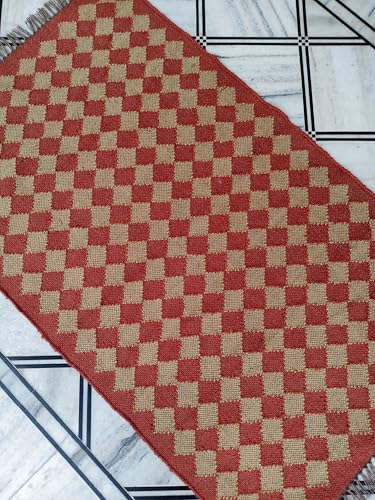
The genuine article, verified in its own title: a handwoven flatweave of wool and jute — two natural fibres, both named — in a reversible kilim construction, titled for indoor/outdoor use across living room, dining and high-traffic areas. This is what most readers picture for this search: textured, undyed-looking plant and animal fibre with the irregular hand-made surface no machine copy quite matches, here in the red-and-natural colorway of the verified listing. It is also, outdoors, a rug with conditions — and the condition is a roof. Under a covered patio, porch or pergola, where rain reaches it rarely and air reaches it always, a wool-and-jute weave gives years of service. In open weather it absorbs water, holds it, mildews and rots, in that order, and no treatment changes that sequence for long.
Strengths
- Genuine natural fibres — wool and jute, both stated in the title — so the eco intent of the keyword is fully honoured
- Handwoven kilim flatweave: reversible, so both faces work and wear evens out across seasons
- Wool in the blend adds resilience and soil-hiding character that pure jute lacks
Trade-offs
- Covered placement only: open rain will destroy it — this is botany, not a defect
- 3×5 is an accent and entry format, not a full patio rug — large seating areas need a bigger listing from the same handwoven world
- Cannot be hosed or machine washed like a synthetic; spot-clean and air-dry
| Spec | Detail (as stated in the verified listing title) |
|---|---|
| Construction | Handwoven flatweave, kilim, reversible |
| Fibres | Wool and jute (both stated) |
| Size (as stated) | 3 x 5 feet |
| Use (as stated) | Indoor/outdoor — living room, bedroom, dining, high-traffic areas |
| Colour (as stated) | Red natural |
Shop for this type by weave and weight rather than by brand: a tight, heavy handwoven rug with bound edges outlasts a loose, light one by seasons, and a rug pad beneath it lifts it off damp decking and lets air circulate — the single most effective life-extender for natural fibre outdoors. Lift and air the rug after any wetting, flip it at mid-season (reversibility is a feature, use it), roll rather than fold it for winter storage, and store it dry; natural fibre forgives everything except being put away damp.
Set against the linked CAMILSON above, this is the purist’s fork in the road: real fibre, real limits. If your patio is covered and your priority is the material itself — no plastic, nothing synthetic against the deck — this pick, placed correctly, is the most satisfying answer to the keyword that exists. If your patio is open to the weather, be honest with yourself and take the washable option; a rotted natural rug serves neither your patio nor the eco intent that bought it.
Best for: covered patios and porches; fibre purists / Not suited for: open, rain-exposed decks
Check the current price on Amazon
Sisal Outdoor Rug — Tight-Weave Type — Best Hard-Wearing Natural Fibre
This pick is written as type guidance, because our catalog searches found no sisal listing whose title confirms both genuine sisal fibre and outdoor use — the true sisal lines are titled for indoor use, and the one ‘sisal’ outdoor line states in its own title that it is polypropylene. What follows is the honest shopping brief for the type. Sisal is the natural fibre for people who found jute too soft a proposition. Drawn from the agave plant, sisal fibre is stiff and springy, and woven tight it makes the hardest-wearing natural rug surface there is — the traditional choice for hallways, stairs and commercial entrances, which translates directly to a covered patio or porch with heavy foot traffic, chair legs and a dog crossing it forty times a day.
Strengths
- Toughest natural fibre weave — resists crushing and traffic lanes
- Tight surface sheds dry dirt instead of trapping it; shakes and sweeps clean
- Holds its flat shape under furniture better than softer jute
Trade-offs
- Rough under bare feet — this is a shoes-and-chairs surface, not a barefoot lounge rug
- Same natural-fibre water rule: covered placement, lift and dry after wetting
- Stiff and heavy; awkward to roll and store compared with jute
Buy sisal by weave tightness and backing: a tight bouclé-style weave on a covered patio is the durable configuration, and a rug pad matters even more than with jute because sisal’s stiffness can let it creep on smooth decking. Expect the surface to feel firm — closer to a woven mat than to a carpet — and plan the furniture around that: dining sets and walkways suit it, a barefoot sunbathing corner does not.
The honest comparison in this guide is sisal versus jute for the covered space: sisal wins years and traffic, jute wins barefoot comfort and texture. Both lose to weather, and both beat any synthetic on the eco ledger that motivates this search. If your covered patio is a thoroughfare, sisal is the natural-fibre answer; if it is a barefoot retreat, take the jute type above and accept its gentler lifespan.
Best for: high-traffic covered patios, porches and entrances / Not suited for: barefoot lounging areas
Seagrass Outdoor Rug — Porch Type — Best Smooth Natural Fibre
This pick is type guidance for the same reason as the sisal above: seagrass rugs with verified natural fibre are titled for indoor use, and the outdoor-titled seagrass designs do not confirm their fibre content. Seagrass is the natural fibre with a built-in finish. Its blades are smooth and slightly waxy by nature, so spilled drinks and tracked dirt sit on the surface longer before soaking in — a genuine, material advantage for a rug placed under an outdoor dining set on a covered porch, which is exactly where this type belongs. Woven, it presents a neat, basket-like surface that reads tidier than jute’s rustic texture.
Strengths
- Naturally smooth, stain-resistant surface — the best natural fibre under a dining set
- Neat woven appearance suits porches and more formal outdoor rooms
- Like all picks here: a plant fibre, biodegradable, no plastic content
Trade-offs
- Still a natural fibre: standing water and open rain will damage it — covered placement applies
- Smooth blades can be slippery underfoot when wet; not a poolside material
- Less cushioning than jute; a pad helps under dining chairs
Choose seagrass when the covered outdoor space is used for eating: the stain behaviour is the whole argument, and it is a good one. Pair it with a pad, keep it out of standing water (a porch that puddles needs the puddle fixed before any natural rug), and clean spills by blotting rather than soaking — the fibre’s own surface does half the work if you let it.
Within this guide’s natural trio, seagrass is the diplomat: smoother than sisal, neater than jute, easier around food than either. It will not survive the open deck any better than they will — no plant fibre does — but on the covered porch where this search’s honest version lives, it is the easiest natural rug to keep looking intentional.
Best for: covered porches and outdoor dining areas / Not suited for: poolside or rain-exposed placement
Jute-Cotton Blend Outdoor Rug — Soft Type — Best Barefoot Natural Blend
Pure jute’s texture is part of its charm and, under bare feet for a whole evening, part of its problem. The jute-cotton blend exists to soften that bargain: cotton fibres woven through the jute add pliability and a gentler surface, and the rug drapes and rolls more like a textile than a mat. For a covered terrace used barefoot — morning coffee, children playing, yoga at the edge of the garden — that softness is the difference between a rug that is used and a rug that is walked around.
Strengths
- Softest natural-fibre surface in this guide — genuinely barefoot-friendly
- More flexible than pure jute: easier to roll, store and reposition
- Still predominantly plant fibre; the eco intent survives the blend
Trade-offs
- Cotton absorbs water even more readily than jute — the covered-and-dry rules apply double
- Softer means less crush-resistant: heavy furniture marks it more than sisal
- Blend ratios vary widely between products; the natural content is a listing detail to check
Shop this type by asking one question the marketing will not volunteer: what is the actual blend? A mostly-jute rug with a cotton weft is a natural rug with softness; a mostly-synthetic rug with a jute-look face is the CAMILSON question again. No verified outdoor listing for this blend could be confirmed — the type is sold mostly for indoors — so treat that as your buying instruction: whatever listing you land on, find the fibre-content line, and let the percentage — not the photographs — decide whether it honours this search.
For the reader whose covered terrace is a barefoot room, this blend is the natural-fibre answer that does not ask your feet to make sacrifices for your principles. Keep it dry, roll it for winter, and it will be the most-touched rug you own — which, for a rug, is the entire job description.
Best for: barefoot covered terraces and family porches / Not suited for: wet-prone or heavy-furniture placement

Natural Jute Indoor/Outdoor Runner Rug, 22×60, Reversible — Best for Paths and Entries
Not every outdoor space needs a rectangle; some need a path. This verified runner answers in natural jute — the title’s own words are ‘Natural Indoor/Outdoor Jute Rug’ — at 22×60 inches, the true runner format, and reversible, ‘for double the wear’ as the listing puts it. It is the natural-fibre format for the covered entry, the porch walkway and the strip between the back door and the garden: the traffic lines where dirt arrives and where a full rug is wasted. One precision: the listing does not state a braided construction, so we do not claim one — what is verified is the fibre, the format, the indoor/outdoor positioning and the reversibility, and those four facts are what this pick stands on.
Strengths
- Natural jute fibre and indoor/outdoor use both stated in the title — the full double test, passed
- Reversible: flip it to even the wear and double the service from one purchase
- The right size for entries and paths: no wasted rug under furniture
Trade-offs
- Narrow format only — it is a path, not a patio rug
- Natural fibre traps grit; shake and beat it outdoors regularly
- Covered entries only: an uncovered doorstep in the rain is this rug’s worst placement
| Spec | Detail (as stated in the verified listing title) |
|---|---|
| Fibre | Natural jute (stated) |
| Size (as stated) | 22 x 60 inches |
| Use (as stated) | Indoor/outdoor |
| Construction | Rolled, reversible — braid not stated in title |
| Colour (as stated) | Gold |
Place a runner where the traffic is, not where the symmetry is: watch the actual line feet take from door to garden for a day, then lay the runner on that line. A washable mat outside the door as a first defence doubles the runner’s life by stopping grit before the jute meets it. Shake the runner weekly — natural weaves hold more grit than flatweave, and grit left in the fibres is sandpaper working from inside. Flip it monthly in season; the reversible construction is a lifespan feature, and using it is free.
As the final natural-fibre pick in this guide, the runner makes the closing point by example: this search is answered by placement as much as by product. Natural fibre outdoors is a set of honest, workable compromises — covered, lifted, aired, shaken — and the households that observe them get beautiful, plastic-free outdoor floors. The households that need zero-compromise weatherproofing should take the linked washable pick and enjoy it without guilt.
Best for: covered entries, porch paths and door-to-garden routes / Not suited for: open doorsteps or as a full patio rug
Check the current price on Amazon
Comparison Table
| Pick | Badge | Key spec | Best for | Link |
|---|---|---|---|---|
| CAMILSON Easy Jute Rug 8×10 — Indoor Outdoor | Best Verified Indoor-Outdoor Option | 8×10 · indoor-outdoor · washable · fibre unconfirmed | patios wanting the natural look with outdoor durability and washability | Check price |
| Jaipur Art & Rugs Handwoven Wool & Jute Kilim Rug, 3×5 | Best True Natural Fibre (Covered Patios) | Handwoven wool & jute · reversible · indoor/outdoor · covered use | covered patios and porches; fibre purists | Check price |
| Sisal Outdoor Rug — Tight-Weave Type | Best Hard-Wearing Natural Fibre | Sisal · tight weave · covered use · unlinked (no verified outdoor listing) | high-traffic covered patios, porches and entrances | Unlinked |
| Seagrass Outdoor Rug — Porch Type | Best Smooth Natural Fibre | Seagrass · smooth weave · covered use · unlinked (no verified outdoor listing) | covered porches and outdoor dining areas | Unlinked |
| Jute-Cotton Blend Outdoor Rug — Soft Type | Best Barefoot Natural Blend | Jute-cotton blend · soft · covered use · unlinked (no verified outdoor listing) | barefoot covered terraces and family porches | Unlinked |
| Natural Jute Indoor/Outdoor Runner Rug, 22×60, Reversible | Best for Paths and Entries | Natural jute runner · reversible · indoor/outdoor | covered entries, porch paths and door-to-garden routes | Check price |
The fibre column is the whole story of this table: one verified natural-look rug built for weather, two verified natural-fibre rugs built for cover, and three natural-fibre types whose outdoor listings could not be verified and so carry guidance instead of links. Placement — covered versus open — decides which half of the table you are shopping from, and no amount of budget changes that.
How to Choose a Natural Fiber Outdoor Rug: The Covered Rule
Every natural-fibre decision in this guide hangs on one question: is there a roof? A covered patio, porch, pergola or loggia — anywhere rain reaches rarely and air reaches always — is natural fibre’s outdoor habitat. There, jute, sisal and seagrass deliver exactly what the eco buyer wants: renewable material, no plastic, beautiful texture, and a service life measured in years. An open deck or uncovered patio is a different climate, and in that climate the honest options are the washable natural-look rug or a change of expectation: some owners treat an inexpensive jute rug as a single-season consumable outdoors, which is a legitimate choice made with open eyes, but it is not the durable eco purchase the keyword imagines.
Within covered spaces, choose fibre by traffic and touch. Sisal for the thoroughfare — it is the hardest-wearing and the roughest. Jute for texture and presence in a seating area. Seagrass under the dining set, where its smooth, spill-resistant surface earns its keep. A jute-cotton blend where bare feet live. And everywhere, a rug pad underneath: it prevents creep, cushions the weave, and — critically — lifts the rug off the deck so air can dry its underside. Damp trapped under a natural rug is the beginning of every failure story in this category.
Sizes, Weaves and What to Check on Any Listing
Size an outdoor rug as you would an indoor one: under a dining set, the rug should extend beyond the table on all sides so chair legs stay on it when pulled out; in a seating area, at least the front legs of every chair belong on the rug. The 8×10 of the linked pick is the standard large format; runners serve the paths and entries, as the verified runner pick describes. Weave decides durability more than fibre does at the margin: tight weaves and bound edges outlast loose, open weaves, and a heavier rug almost always outlasts a lighter one of the same fibre — weight is a fair proxy for material, and material is what wears.
Because three types in this guide are not linked by necessity, here is the checklist to apply to any listing you find for them — it is the verification this guide applied to every pick it links. One: find the fibre-content line and read the percentage; ‘jute look’, ‘jute style’ and ‘natural colour’ are not fibre claims. Two: find the placement language; ‘indoor/outdoor’ on a natural rug still usually means covered outdoor, whatever the photograph shows. Three: find the care line; a natural rug that claims to be machine washable is telling you something about its true composition. Four: check the backing; a natural rug with a synthetic backing may still be a good rug, but its eco ledger is different from a full-fibre one. A listing that answers all four plainly is a listing you can buy from with confidence.
Care: Keeping Natural Fibre Alive Outdoors
Natural fibre outdoors lives or dies on moisture management, and the routine is simple enough to state in one paragraph and important enough to follow exactly. Shake or sweep the rug weekly — grit in a natural weave is abrasive from inside. After any wetting, lift the rug, let air reach its underside, and do not put it back until both rug and deck are dry; a rug pad makes this a five-minute job instead of a wrestling match. Blot spills immediately, especially on jute and cotton blends, and clean with minimal water — these fibres should be dampened as rarely as their indoor cousins. In autumn, if your climate winters hard, roll the rug (never fold it) and store it dry under cover; a natural rug stored dry wakes up in spring as good as it slept.
Know the failure signs and act early: a musty smell is mildew announcing itself while it is still reversible with sun and air; dark patches at the edges are moisture sitting where the pad or the deck traps it; fibres that powder when rubbed are a rug at end of life, to be composted or repurposed rather than mourned. The households whose natural outdoor rugs last are not luckier — they are the ones who lift, air and shake on schedule. Build the habit in the first month and the rug repays it for years.
How to Set Up a Natural Fiber Rug on a Covered Patio
Step 1 — audit the placement honestly. Stand in the space during or just after rain if you can: where does water actually reach, where does it pool, where does the sun dry things fastest? Place the rug in the driest zone that serves the furniture, and fix any pooling before the rug goes down — no natural fibre survives a puddle with a rug in it. Step 2 — pad first. Lay an outdoor rug pad cut slightly smaller than the rug; it stops creep, cushions the weave and, most importantly, holds the rug a few millimetres off the deck so air can dry its underside after humid nights.
Step 3 — position by traffic and furniture. Dining set: rug extends past pulled-out chairs. Seating: front legs of everything on the rug. Runner: on the true traffic line between door and garden, which you should observe for a day rather than assume. Step 4 — set the maintenance rhythm on day one. Weekly shake or sweep; lift-and-air after any wetting; blot spills on sight. Write the winter plan now — where the rolled rug will store, dry — so November does not improvise it badly. Step 5 — inspect monthly. Smell the rug, check its underside and edges, look for dark patches. Caught early, every problem in this category is a sunny afternoon’s airing; caught late, it is a replacement. That monthly five minutes is the entire difference between the four-season rug and the one-season disappointment.
Common Buying Mistakes
Mistake 1: placing a natural rug in open rain and blaming the rug. Jute in the weather is a composting project, not a floor covering. Covered placement is the product’s first specification; the washable natural-look pick exists for open spaces. Mistake 2: trusting the words ‘natural’ in a title. ‘Natural colour’, ‘jute look’ and ‘seagrass design’ describe appearance. The fibre-content line describes the rug. Read the second one — this guide flagged its own linked pick on exactly this point. Mistake 3: no pad. A natural rug straight on decking traps moisture against its underside and creeps underfoot; the pad is moisture management and safety in one cheap layer.
Mistake 4: hosing a natural rug clean. Saturation is the enemy; shaking, sweeping and blotting are the cleaning methods, with minimal-water spot cleaning as the limit. The washable rug in this guide is washable because of what it is made of — which is the trade you are making, knowingly, either way. Mistake 5: storing it damp or folded. Damp storage is mildew’s invitation, and folding cracks natural fibres at the crease. Roll it, dry, under cover. Mistake 6: buying eco and replacing yearly. A natural rug destroyed in one season is not the green choice; a covered placement that lasts four years, or a durable washable rug that lasts six, both beat it. Eco is a lifespan calculation, not a label.
Final Recommendation
Decide by roof, and this search resolves itself. Covered patio or porch, and the eco intent is sincere: start with the two verified natural-fibre picks — the handwoven wool-and-jute kilim for texture and presence, the natural jute runner for the path — and shop the unlinked types (sisal for traffic, seagrass for dining, the blend for bare feet) using the listing checklist in the buying guide to verify fibre content before you pay, since no outdoor listing for those types passed verification. Open weather, or a household that wants to hose the patio clean: the CAMILSON is the verified indoor-outdoor option, bought with its caveat understood — confirm its fibre line on the listing, and enjoy the washability that no true natural rug can offer. Readers furnishing the wider outdoor room will also find Best Affordable Jute Rugs, Best Area Rugs For A Beach House and Best Area Rugs For Homes With Dogs useful, along with Best Area Rugs For Kids And Pets for the indoor side of the same material questions. Measure the covered zone, not the whole patio, check the current price on Amazon for the linked pick — and buy the fibre your roof can protect.
Frequently Asked Questions
Can natural fiber rugs really be used outdoors?
Yes — under cover. On a roofed patio, porch or pergola, jute, sisal and seagrass rugs give years of service. In open rain they absorb water, mildew and rot, because they are plant fibres; that biodegradability is their eco virtue and their outdoor limit at the same time. For fully exposed spaces, a washable natural-look rug is the honest alternative.
Which natural fiber is best for an outdoor rug?
It depends on the job. Sisal is the hardest-wearing and suits traffic; jute has the richest texture and suits seating areas; seagrass has a naturally smooth, spill-resistant surface that suits dining; a jute-cotton blend is softest for bare feet. All four share the same placement rule: covered, padded, and aired after any wetting.
Why do some picks in this guide have no buy links?
Because, across repeated catalog searches, no listing for those fibre types could be verified whose title confirms both genuine natural fibre and outdoor use. The true sisal and seagrass lines are titled for indoor use only — which this guide will not relabel as outdoor picks — and the outdoor-titled alternatives either leave their fibre content unconfirmed or state a synthetic construction outright. Rather than invent product links, those picks are published as type guidance, and the buying-guide checklist tells you how to verify any listing you find.
Is the linked CAMILSON rug actually made of natural fiber?
Its verified title does not confirm that. It states a natural colour, a herringbone seagrass boho woven design, indoor-outdoor use and washable, easy-cleaning construction — washability being a property true natural jute rarely offers. Treat it as a natural-look outdoor rug unless the listing’s fibre-content line confirms otherwise; the review in this guide flags this explicitly rather than letting the title’s wording imply it.
How do I stop a natural outdoor rug from going mouldy?
Keep it covered, keep it padded off the deck, and keep it dry underneath: shake or sweep weekly, lift and air it after any wetting, never put it back onto a damp deck, and roll it dry for winter storage. A musty smell is the early warning — a day of sun and air at that stage reverses it; ignored, it becomes the dark-patch stage, which does not reverse.
Are natural fiber outdoor rugs actually eco-friendly if they wear out faster?
They are when they are placed to last. A natural rug that serves four covered seasons is renewable, plastic-free and compostable at the end — a genuinely better ledger than a plastic rug. A natural rug rotted in one open-rain season, replaced annually, can be the worse choice. Eco is a lifespan calculation: placement is what makes the natural option the green one. It is also, in the end, a texture calculation — the reason buyers keep choosing these fibres despite every caveat in this guide is that a woven plant surface underfoot, smelling faintly of the field and softening with the seasons, is simply a better thing to live on than extruded plastic, and for the covered spaces most homes actually have, that pleasure is available without compromise.


