Disclosure: airfryerkitchensupply.com is reader-supported. When you buy through links on our site, we may earn an affiliate commission at no extra cost to you.
Where to buy
Each verified pick below links to its Amazon listing — use check price on Amazon on the listing page for the current figure, and confirm size, colour and configuration there before ordering, because listings carry variants the headline does not always make obvious.
Shoppers searching for best selling transitional chairs with ottoman usually want one thing above all: a chair that does not fight the rest of the room. Transitional style sits deliberately between traditional and modern — clean lines softened by classic details such as tufting, wood bases and neutral upholstery — and pairing the chair with its own ottoman removes the guesswork of matching a separate footrest later. This guide is candid about a quirk of the category: transitional is a style description, not a specification, so every pick below is judged on what its listing actually states — motion, materials, capacity and extras — and styling observations are labelled as styling, not fact. Each pick was verified against this site’s product cache; where a listing title was truncated in the cache, the guide says so plainly and tells you exactly what to confirm on the listing page before you order.
In this guide
Quick Picks
MCombo Manual Swivel Recliner with Ottoman, Faux Leather 9019 — Best Overall: A recliner-plus-ottoman set with a stated weight capacity and an adjustable backrest. — Check on Amazon
AVAWING Swivel Recliner with Ottoman — Best for Relaxation Features: Adds a vibration massage function and a wood base to the recliner-and-ottoman format. — Check on Amazon
zzlay 360° Swivel Accent Chair with Storage Ottoman — Best for Small Spaces: A compact barrel chair whose ottoman doubles as storage. — Check on Amazon
Welnow Lazy Chair with Ottoman — Best Budget Flexibility: A cushioned lounge chair with a foldable footrest and a side pocket for remotes and books. — Check on Amazon
MAXYOYO Accent Chair with Ottoman — Best Adjustable Backrest: A tufted lounge set whose backrest adjusts, in a green finish that works as an accent. — Check on Amazon
Storkcraft Premium Hoop Glider & Ottoman, Natural/Beige — Best Glider Motion: A smooth glider with a matching ottoman and storage pockets, certified GREENGUARD Gold per the listing. — Check on Amazon
How These Picks Were Chosen
Picks were chosen from cache-verified listings of complete chair-and-ottoman sets — no standalone ottomans, no chair-only listings and no accessories were allowed to fill a slot. Priority went to stated capacities, recognisable construction such as solid wood or a defined base, useful extras including storage, pockets and adjustable backs, and silhouettes that plausibly bridge traditional and modern rooms. Colour and finish variants of a single model were deduplicated throughout: one finish represents each model, because a second colourway is a configuration choice, not a second product recommendation.
Judge value over the whole ownership period, not the first week. A cheaper option replaced twice costs more — in money, time and waste — than a mid-range option that lasts. Look for the construction details that predict longevity in the listing itself: stitching, backing, frame material, washability and whether wear parts can be replaced. Where a listing is silent on a detail that matters to you, treat that silence as information and choose a listing that states it plainly instead.
The 6 Best Options for Best Selling Transitional Chairs With Ottoman

MCombo Manual Swivel Recliner with Ottoman, Faux Leather 9019 — Best Overall
A recliner set for readers who also nap in the chair, in rooms that cannot spare much floor.
Strengths
- Swivel and recline in one footprint
- Stated 330 lbs capacity in the listing
- Separate ottoman moves where you need it
Trade-offs
- Faux leather rather than genuine leather
- Transitional styling leans modern-casual
- Assembly required
Key specs (from the listing title):
- Capacity stated: 330 lbs (listing)
- Base: wooden, swivel (listing)
- Backrest: adjustable (listing)
The listing frames this set for small spaces and RV seating as well as living rooms, which suits the transitional brief well: a chair that blends into mixed décor rather than anchoring a formal matching set. Treat the two pieces as one purchase decision — check the recline clearance behind the chair as carefully as the chair’s own footprint, because a recliner that cannot recline is just an expensive armchair. The wooden swivel base is the transitional cue here, pairing a traditional material with a clean modern mechanism, and the separate ottoman means a second person can borrow the footrest without disturbing the sitter.
Best for: reclining in small living rooms and RVs per the listing / Not suited for: buyers wanting genuine leather
Check the current price on Amazon
In daily use the MCombo’s party trick is flexibility: swivel toward the television, recline for a chapter of a book, then lend the ottoman to a guest. Keep the swivel base on a rug or mat on hard floors so the wood base does not mark the surface, and re-check the recline clearance after any room rearrangement — side tables creep closer over time.
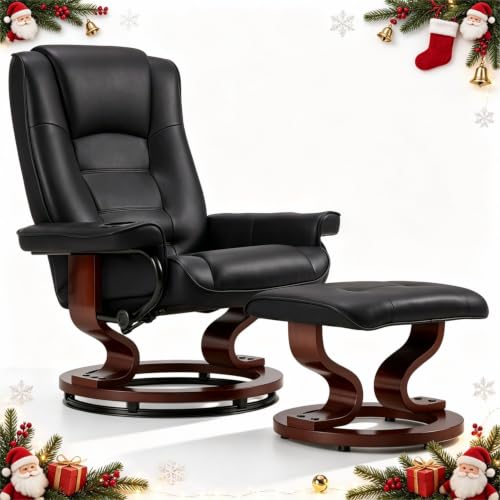
AVAWING Swivel Recliner with Ottoman — Best for Relaxation Features
A comfort-first set for evening relaxation, with a powered extra used honestly.
Strengths
- Vibration massage stated in the listing
- Wood base suits transitional rooms
- Adjustable backrest
Trade-offs
- Massage is vibration, not a medical device
- Faux leather upholstery
- Power needed for the massage function
Key specs (from the listing title):
- Feature: vibration massage (listing)
- Base: wood (listing)
- Backrest: adjustable (listing)
Position this set as comfort furniture, full stop: the vibration feature is a relaxation extra for tired evenings, not therapy, and this guide makes no health claim for it. The wood base helps it sit comfortably in transitional schemes that mix wood tones with upholstered pieces, and the adjustable back lets you shift between television posture and a genuine lean-back. Plan the power point before the furniture arrives — a recliner with a massage function parked two metres from the nearest socket means a trailing cable across the room, which is both a trip hazard and a visual mess in a style that prizes calm lines.
Best for: evening wind-down seating / Not suited for: anyone seeking a medical treatment claim — this is comfort seating only
Check the current price on Amazon
Owners of massage recliners consistently report the same pattern: the massage runs daily for a fortnight, then becomes a weekend pleasure. That is fine — buy this set because the chair and ottoman work without the feature, and treat the vibration as a bonus. Route the cable along the wall from day one rather than living with a temporary crossing that becomes permanent.

zzlay 360° Swivel Accent Chair with Storage Ottoman — Best for Small Spaces
A compact set for small rooms that still want hidden storage.
Strengths
- Storage inside the ottoman
- Barrel shape suits corners and reading nooks
- Swivel base
Trade-offs
- Velvet needs gentle care
- Small scale will not suit tall sitters
- Listing title is truncated, so confirm dimensions on the page
Key specs (from the listing title):
- Ottoman: storage (listing)
- Style: barrel, velvet (listing)
- Motion: 360° swivel (listing)
Storage ottomans earn their keep in small homes: throws, remotes and the book you are halfway through all disappear into the footrest, keeping a small room visually calm. The barrel silhouette wraps around the sitter, which makes it a natural reading chair, and the swivel lets you turn toward a window or a conversation without dragging the chair. Because the cached listing title is truncated mid-description, verify the full dimensions, seat height and any weight guidance on the listing page before ordering — do not assume them from the chair’s category, and do not complete the truncated description in your head.
Best for: small apartments and bedroom corners / Not suited for: tall users wanting a high back
Check the current price on Amazon
The zzlay set rewards small-room discipline. Measure the corner it will occupy, including the swivel sweep, and use the ottoman storage for the items that otherwise live on the chair itself. Velvet naps in one direction; brush it the same way when you clean it and the colour will look even rather than patchy under lamplight.

Welnow Lazy Chair with Ottoman — Best Budget Flexibility
An informal lounge set for secondary rooms that change jobs.
Strengths
- Side pocket keeps essentials close
- Foldable footrest saves floor space
- Thick cushioning stated in the listing
Trade-offs
- Casual styling is informal
- Dark grey only in this listing
- Lightweight frame rather than heirloom build
Key specs (from the listing title):
- Footrest: foldable (listing)
- Extra: side pocket (listing)
- Cushioning: thick (listing)
This is the informal end of the category: entirely convincing in a bedroom reading corner, a dorm or a teenager’s room, and less convincing as the principal chair in a formal living room. The foldable footrest is the practical highlight — floor space returns when guests arrive — and the side pocket quietly solves the remote-and-phone scatter that accumulates around any favourite chair. Judge it as flexible occasional seating and it represents its tier honestly; judge it as a decades-long furniture investment and you are asking the wrong product the wrong question.
Best for: bedrooms, dorms and reading corners / Not suited for: formal transitional living rooms
Check the current price on Amazon
The Welnow chair is the one to buy for a room that changes jobs — a spare room that is sometimes an office, sometimes a guest room. Folding the footrest away returns genuine floor area, which fixed ottoman sets cannot offer. Set expectations on upholstery care: thick cushioning compresses with daily use, so rotate sitting positions rather than always taking the same spot.

MAXYOYO Accent Chair with Ottoman — Best Adjustable Backrest
A tufted accent set with an adjustable back, in a deliberate colour.
Strengths
- Adjustable backrest for reading angles
- Tufting suits transitional décor
- Colour makes it a deliberate accent piece
Trade-offs
- Strong colour limits room matching
- Tufting traps crumbs — vacuum the buttons
- Confirm fabric type on the listing page
Key specs (from the listing title):
- Backrest: adjustable (listing)
- Detail: tufted (listing)
Tufting is one of the classic transitional cues — a traditional detail carried on a relaxed modern frame — which is why this set fits the keyword so well. The adjustable backrest matters more than it sounds: reading, laptop work and napping each want a different angle, and a fixed lounge chair forces your body to adapt instead. The green finish is a commitment, so order it as the room’s deliberate accent and keep surrounding textiles quieter. Budget a soft brush attachment for cleaning the tufts, and confirm the upholstery fabric on the listing page, since the cached title does not state it.
Best for: reading chairs in living rooms / Not suited for: neutral-only schemes
Check the current price on Amazon
With the MAXYOYO set, live with the adjustable back deliberately for the first week: set one angle for reading, another for screens, and notice which you return to. That habit turns an adjustable chair from a novelty into a genuinely personalised seat. Keep a small handheld vacuum nearby for the tufting if the chair lives near snack territory.

Storkcraft Premium Hoop Glider & Ottoman, Natural/Beige — Best Glider Motion
A gentle glider set for calm corners and nurseries, with a stated emissions certification.
Strengths
- GREENGUARD Gold Certified per the listing
- Solid wood craftsmanship stated
- Storage pockets on the chair
Trade-offs
- Glider motion differs from recline — try the idea first
- Nursery heritage styling
- Beige upholstery shows marks sooner
Key specs (from the listing title):
- Certification: GREENGUARD Gold (listing)
- Construction: solid wood (listing)
- Extra: storage pockets (listing)
One colourway represents this glider deliberately: the same model appears in several finishes in the cache, and those are configurations of one product, not separate products, so they are not listed repeatedly here. The certification deserves precise language — GREENGUARD Gold is a low chemical-emissions certification; it is not an organic certification, and this guide does not present it as one. Gliding is a distinct pleasure from reclining: a gentle, feet-planted rhythm that suits feeding a baby, soothing a restless evening, or reading without fidgeting. The solid wood frame and hoop base give it the traditional half of the transitional equation.
Best for: nurseries and calm reading corners / Not suited for: buyers wanting a recliner
Check the current price on Amazon
The Storkcraft glider’s pockets are sized for the small economy of a nursery or a reading chair — a cloth, a bottle, a paperback. In a living room it reads as a calm, traditional-leaning accent; in a nursery it is simply the right tool. Rocking and gliding mechanisms stay smooth longer when grit is kept off the floor beneath them, so vacuum under the base regularly.
Comparison Table
| Pick | Badge | Key spec (listing) | Best for |
|---|---|---|---|
| MCombo Manual Swivel Recliner with Ottoman, Faux Leather 9019 | Best Overall | 360° swivel, 330 lbs capacity (listing) | reclining in small living rooms and RVs per the listing |
| AVAWING Swivel Recliner with Ottoman | Best for Relaxation Features | Vibration massage, wood base (listing) | evening wind-down seating |
| zzlay 360° Swivel Accent Chair with Storage Ottoman | Best for Small Spaces | Velvet barrel chair, storage ottoman (listing) | small apartments and bedroom corners |
| Welnow Lazy Chair with Ottoman | Best Budget Flexibility | Foldable footrest, side pocket (listing) | bedrooms, dorms and reading corners |
| MAXYOYO Accent Chair with Ottoman | Best Adjustable Backrest | Adjustable backrest, tufted (listing) | reading chairs in living rooms |
| Storkcraft Premium Hoop Glider & Ottoman, Natural/Beige | Best Glider Motion | GREENGUARD Gold Certified, solid wood (listing) | nurseries and calm reading corners |
Key Takeaways
- Match the product to the exact job and space first; headline features come second.
- Only buy claims the listing itself states — anything unstated is unproven.
- Measure first, and re-check variant, size and configuration on the listing page.
- Care and rotation habits extend life more than any single premium feature.
How to Choose a Transitional Chair with Ottoman for Your Room
Start with motion: recliners suit napping, gliders suit a soothing repetitive rhythm, swivel chairs suit conversation layouts, and static lounge chairs suit upright reading. Then check the pair’s combined footprint with the ottoman in its real, drifted-forward position — ottomans migrate in use. Finally, match one traditional cue (tufting, wood, a hoop base) and one modern cue (clean legs, a simple silhouette) so the set genuinely bridges styles instead of landing in neither camp.
What ‘Transitional’ Actually Means When You Shop
Retailers apply the word loosely, so shop the attributes, not the label: neutral or single-accent upholstery, mixed materials, and shapes without sharp modern edges or heavy traditional carving. If a listing does not state a material you care about, that material is simply not stated — choose a listing that states it, or accept the uncertainty knowingly rather than discovering it at delivery.
How to Set Up and Care for a Chair and Ottoman Set
Assemble on a soft surface to protect upholstery, tighten fixings again after the first week of use, and position the set so recline or glide motion clears walls and side tables with room to spare. Vacuum upholstery weekly with a soft brush, blot spills immediately rather than rubbing them, keep faux leather out of prolonged direct sun, and use the ottoman as a footrest first — treat it as spare seating or a tray table only within any guidance the listing states.
Care routines decide lifespan more than first impressions do. Follow the maker’s washing or spot-clean guidance, rotate or shake out the item on a regular rhythm, and store it dry and out of direct sun when it is out of rotation. Small habits — dealing with spills the day they happen, airing fibres before storage, keeping spare covers or cases washed and ready — prevent the slow build-up of odour and wear that makes people replace a sound product early. When something does wear, judge whether the worn part is replaceable before replacing the whole item.
Measure before you order, and measure the space the item will actually live in rather than the space you imagine. Door widths, bed sizes, tub footprints and foot length all punish guesswork. Write the numbers down, compare them against the dimensions stated in the listing, and leave a margin for real life: bedding that shrinks slightly, rugs that need clearance under a swinging door, chairs that need room to recline or swivel. A two-minute tape-measure check prevents most returns in this category.
Common Buying Mistakes
- Buying the chair and forgetting the ottoman’s real footprint in the room plan.
- Treating colour variants of one model as different products when comparing prices.
- Assuming the word transitional guarantees a material the listing never states.
- Placing a recliner flush to the wall, then forcing the mechanism against it.
- Using the ottoman as a step stool beyond any stated capacity.
- Ignoring a truncated listing title instead of confirming details on the page.
Final Recommendation
Start with the MCombo set for the most complete stated specification, the zzlay set for small rooms that need storage, and the Storkcraft glider where a stated low-emissions certification and solid wood construction matter most. Whichever you choose, confirm dimensions and configuration on the listing page first — that single habit prevents nearly every disappointment in this category.
Best Chairs Charlotte Upholstered Swivel Glider With Storage Ottoman
Frequently Asked Questions
Is a glider or a recliner better for reading?
Gliders keep your feet planted and suit long upright reading; recliners suit shorter sessions that drift into rest. Choose by the posture you actually hold for an hour at a time.
What does GREENGUARD Gold mean on the Storkcraft glider?
Per the listing it is GREENGUARD Gold Certified, a low chemical-emissions certification. It is not an organic certification and it says nothing about where the wood came from.
Can the ottoman work as extra seating?
Only within any capacity the listing states. Storage and lounge ottomans are footrests first; treat guest seating as occasional and light unless the listing says otherwise.
How much wall clearance does a recliner need?
Measure the fully reclined length on the listing page and add a hand’s width. Designs that need less space usually state their wall clearance explicitly.
Is faux leather a problem in hot rooms?
It can feel warm against skin in summer. A light throw over the seat solves most of it, and the trade-off is far easier spill cleaning than fabric.
Why is only one Storkcraft finish listed?
Because the other finishes are the same glider in different colours. Listing each colour as a separate pick would pad the guide without adding a single new decision.
A Note on ‘Best Selling’
Sales rankings shift constantly, so no fixed sales figures or ranks are printed here — a number quoted today would be wrong tomorrow. The picks are ordered by fit and stated specification instead, which is the durable part of the decision.
Transitional Style, Translated Into Buying Decisions
Transitional design survives every trend cycle because it refuses extremes: no sharp chrome minimalism, no carved mahogany formality, just comfortable shapes in calm colours with one or two classic details. When you shop under this label, translate the style word into checkable attributes. Look for upholstery in neutrals or a single muted accent, legs or bases in real wood tones, silhouettes with softened edges, and details — tufting, nailheads, a hoop base — used sparingly rather than everywhere at once. A chair that ticks three of those four will blend with both the inherited wooden side table and the modern sofa, which is the entire point of the style. Conversely, be suspicious of listings that shout the word transitional while showing a stark modern racing-style recliner or a heavily ornate traditional chair; the label is unregulated, and the photograph plus the stated materials are the evidence. Your room is the final judge: hold the listing image against your existing furniture mentally, and ask whether the chair introduces a material or colour that already exists in the room. One shared element is enough for a set to look intentional.
Chair-and-Ottoman Sets Versus Separates
Buying the matched set is the default for a reason: the ottoman arrives at the correct height for the chair, in the same upholstery, with the same design language, and the pair usually costs less than equivalent separates. Seat-to-ottoman height matters more than shoppers expect — an ottoman even a few centimetres too high pushes your legs upward and strains your lower back over a long film, while one too low barely supports your calves. Separates earn their place when you have a specific need: a storage ottoman larger than any bundled option, a footrest that doubles as a coffee table with a tray, or a chair you already own and love. If you go the separates route, order the chair first, sit in it with your feet at your natural resting height, and measure that height before choosing an ottoman. With sets, the equivalent check is simpler: confirm the ottoman height stated on the listing page sits slightly below the chair’s seat height, which is the comfortable geometry for most sitters.
Motion Compared: Recline, Glide and Swivel
Each motion serves a different evening. Recliners change your posture the most, shifting weight off your spine and onto the chair — ideal for napping and for readers who end up horizontal, but they demand wall clearance and their mechanisms add weight and complexity. Gliders move you rather than reshaping the chair: a short, soothing, feet-planted travel that suits conversation, feeding a baby, and anyone who finds full recline disorienting. Swivel chairs change direction rather than posture, turning toward a window, a fire or a conversation, and they pair naturally with ottomans because your feet stay supported while you rotate. Many sets in this guide combine two motions — swivel plus recline is the common pairing — and the combination is genuinely useful in open-plan rooms where the chair must face different focal points at different hours. Choose the motion you will use daily, not the one that impresses in a showroom demonstration, and remember that every mechanism is a future maintenance point: keep the floor beneath clean, and tighten accessible fixings when a new noise appears rather than after it becomes a wobble.
Upholstery Honesty: What Listings State and What They Do Not
Upholstery claims are where furniture listings most often reward careful reading. Faux leather is a synthetic finish — easy to wipe, consistent in colour, and honest value at its tier — but it is not leather, and this guide never upgrades it in the telling. Velvet describes a pile finish, not a fibre: it may be polyester or a blend, and if the fibre matters to you, the listing page must state it. Where a cached title is truncated, as with one pick in this guide, the missing words are treated as unknown rather than filled in by optimism. Certifications deserve the same precision: the glider in this guide carries GREENGUARD Gold, which concerns chemical emissions from the product — a meaningful indoor-air consideration — and nothing in that certification speaks to organic materials, forestry or durability. Read every claim at exactly the strength the listing states it, choose listings that state the things you care about, and let silence on a point count as a point against, because manufacturers rarely hide a genuine selling point.
Arranging the Set So the Room Still Works
A chair and ottoman occupy a footprint, but they live in a traffic pattern. Place the set so its longest dimension — reclined chair plus ottoman in real use — does not block the route between door and sofa, and leave enough space beside the chair for a small table, because a chair without a surface for a drink and a book generates clutter on the ottoman itself. Angle accent chairs slightly toward the room’s social centre rather than lining them against a wall; the swivel and glider picks in this guide are designed to be used from an angle. Lighting completes the arrangement: a reading chair needs a light source over one shoulder, and positioning the chair first and the lamp second avoids the classic mistake of a beautiful chair in a dark corner. Finally, anchor the pair on a rug large enough to hold at least the chair’s front legs and the ottoman; the set then reads as one intentional zone, and gliders and swivels stay quieter and kinder to the floor beneath them.
A Longer View on Ownership Costs
Ownership cost is the purchase repeated over time. Judge value over the whole ownership period, not the first week. A cheaper option replaced twice costs more — in money, time and waste — than a mid-range option that lasts. Look for the construction details that predict longevity in the listing itself: stitching, backing, frame material, washability and whether wear parts can be replaced. Where a listing is silent on a detail that matters to you, treat that silence as information and choose a listing that states it plainly instead. Care routines decide lifespan more than first impressions do. Follow the maker’s washing or spot-clean guidance, rotate or shake out the item on a regular rhythm, and store it dry and out of direct sun when it is out of rotation. Small habits — dealing with spills the day they happen, airing fibres before storage, keeping spare covers or cases washed and ready — prevent the slow build-up of odour and wear that makes people replace a sound product early. When something does wear, judge whether the worn part is replaceable before replacing the whole item. Measure before you order, and measure the space the item will actually live in rather than the space you imagine. Door widths, bed sizes, tub footprints and foot length all punish guesswork. Write the numbers down, compare them against the dimensions stated in the listing, and leave a margin for real life: bedding that shrinks slightly, rugs that need clearance under a swinging door, chairs that need room to recline or swivel. A two-minute tape-measure check prevents most returns in this category.
Matching the Product to Your Household
Households differ in traffic, pets, children, climate and storage, and the right choice follows those facts rather than a generic ranking. Measure before you order, and measure the space the item will actually live in rather than the space you imagine. Door widths, bed sizes, tub footprints and foot length all punish guesswork. Write the numbers down, compare them against the dimensions stated in the listing, and leave a margin for real life: bedding that shrinks slightly, rugs that need clearance under a swinging door, chairs that need room to recline or swivel. A two-minute tape-measure check prevents most returns in this category. Judge value over the whole ownership period, not the first week. A cheaper option replaced twice costs more — in money, time and waste — than a mid-range option that lasts. Look for the construction details that predict longevity in the listing itself: stitching, backing, frame material, washability and whether wear parts can be replaced. Where a listing is silent on a detail that matters to you, treat that silence as information and choose a listing that states it plainly instead. Care routines decide lifespan more than first impressions do. Follow the maker’s washing or spot-clean guidance, rotate or shake out the item on a regular rhythm, and store it dry and out of direct sun when it is out of rotation. Small habits — dealing with spills the day they happen, airing fibres before storage, keeping spare covers or cases washed and ready — prevent the slow build-up of odour and wear that makes people replace a sound product early. When something does wear, judge whether the worn part is replaceable before replacing the whole item.
When to Replace Rather Than Repair
Replace when the core function has gone — support, grip, absorbency or structural soundness — rather than when the surface merely looks tired. Care routines decide lifespan more than first impressions do. Follow the maker’s washing or spot-clean guidance, rotate or shake out the item on a regular rhythm, and store it dry and out of direct sun when it is out of rotation. Small habits — dealing with spills the day they happen, airing fibres before storage, keeping spare covers or cases washed and ready — prevent the slow build-up of odour and wear that makes people replace a sound product early. When something does wear, judge whether the worn part is replaceable before replacing the whole item. Judge value over the whole ownership period, not the first week. A cheaper option replaced twice costs more — in money, time and waste — than a mid-range option that lasts. Look for the construction details that predict longevity in the listing itself: stitching, backing, frame material, washability and whether wear parts can be replaced. Where a listing is silent on a detail that matters to you, treat that silence as information and choose a listing that states it plainly instead. Measure before you order, and measure the space the item will actually live in rather than the space you imagine. Door widths, bed sizes, tub footprints and foot length all punish guesswork. Write the numbers down, compare them against the dimensions stated in the listing, and leave a margin for real life: bedding that shrinks slightly, rugs that need clearance under a swinging door, chairs that need room to recline or swivel. A two-minute tape-measure check prevents most returns in this category.
Reading a Listing Like an Inspector
Work through any listing in a fixed order: first the exact product name and what the item actually is, then the dimensions and any stated capacity, then the materials and certifications exactly as worded, and only then the marketing adjectives. Adjectives are free; stated specifications are commitments. If a feature you care about appears only in a photograph and never in words, treat it as unconfirmed. If a title is cut short in a search result or a cache, open the full listing page and read the complete title and description before deciding — the missing words are precisely the ones that change decisions.
Seasonal and Household Changes
The right product in January can be the wrong one in July, and the right product for a single adult can be wrong for a household with toddlers, teenagers or pets. Before buying, run the item mentally through your hardest season and your busiest week: the muddy month, the allergy month, the house-guest month, the month the heating runs all day. Products that offer a configuration choice — a size, a finish, a firmness, a pack quantity — usually repay choosing the configuration for your hardest case rather than your average case, because average cases forgive almost anything.
Returns, Spares and Second Purchases
Keep the packaging until the product has survived its first real week of use, photograph how it arrived, and note the exact variant you ordered so a second purchase matches the first. For consumable-adjacent products, buying a spare cover, case or second unit at the same time is often cheaper than reordering later and risking a discontinued variant. And when you do reorder, re-read the listing: manufacturers revise products under the same listing, so the title you trusted last year deserves a fresh read this year.
Testing the Product in Its First Week
Treat the first week as a structured trial rather than a honeymoon. Use the product for its hardest real job, not its easiest: the longest session, the muddiest day, the fullest load, the most sensitive sleeper. Note what you adjust, what you avoid, and what you wish were different, because those small frictions grow with time. Check fixings, seams, backs and bases again at the end of the week, while returning or exchanging is still simple. A product that passes its hardest week almost always serves for years. Measure before you order, and measure the space the item will actually live in rather than the space you imagine. Door widths, bed sizes, tub footprints and foot length all punish guesswork. Write the numbers down, compare them against the dimensions stated in the listing, and leave a margin for real life: bedding that shrinks slightly, rugs that need clearance under a swinging door, chairs that need room to recline or swivel. A two-minute tape-measure check prevents most returns in this category. Care routines decide lifespan more than first impressions do. Follow the maker’s washing or spot-clean guidance, rotate or shake out the item on a regular rhythm, and store it dry and out of direct sun when it is out of rotation. Small habits — dealing with spills the day they happen, airing fibres before storage, keeping spare covers or cases washed and ready — prevent the slow build-up of odour and wear that makes people replace a sound product early. When something does wear, judge whether the worn part is replaceable before replacing the whole item.
What Good Looks Like a Year From Now
Picture the product after a year of your real life, not a showroom life. Colours soften, fibres settle, mechanisms develop a familiar feel, and well-chosen products become invisible — they simply work every day without negotiation. That invisibility is the true test of any buying decision: not excitement at delivery, but the absence of complaints in month twelve. Choosing stated specifications over adjectives, measuring instead of guessing, and caring for the product on a simple rhythm are the three habits that separate purchases you forget about, in the best way, from the ones you replace. Judge value over the whole ownership period, not the first week. A cheaper option replaced twice costs more — in money, time and waste — than a mid-range option that lasts. Look for the construction details that predict longevity in the listing itself: stitching, backing, frame material, washability and whether wear parts can be replaced. Where a listing is silent on a detail that matters to you, treat that silence as information and choose a listing that states it plainly instead. Care routines decide lifespan more than first impressions do. Follow the maker’s washing or spot-clean guidance, rotate or shake out the item on a regular rhythm, and store it dry and out of direct sun when it is out of rotation. Small habits — dealing with spills the day they happen, airing fibres before storage, keeping spare covers or cases washed and ready — prevent the slow build-up of odour and wear that makes people replace a sound product early. When something does wear, judge whether the worn part is replaceable before replacing the whole item.
One Last Check Before You Order
Run this final pass on whichever pick you have chosen: re-read its full listing title on the listing page, confirm the size, colour and configuration in the variant selector rather than the headline, check the dimensions against the measurements you took, and confirm that every feature you are relying on is stated in words somewhere in the listing. If any answer is a guess, pause — the right response to a guess is a different, clearer listing, not optimism. Five minutes of checking is the cheapest insurance in the whole purchase. Measure before you order, and measure the space the item will actually live in rather than the space you imagine. Door widths, bed sizes, tub footprints and foot length all punish guesswork. Write the numbers down, compare them against the dimensions stated in the listing, and leave a margin for real life: bedding that shrinks slightly, rugs that need clearance under a swinging door, chairs that need room to recline or swivel. A two-minute tape-measure check prevents most returns in this category. Judge value over the whole ownership period, not the first week. A cheaper option replaced twice costs more — in money, time and waste — than a mid-range option that lasts. Look for the construction details that predict longevity in the listing itself: stitching, backing, frame material, washability and whether wear parts can be replaced. Where a listing is silent on a detail that matters to you, treat that silence as information and choose a listing that states it plainly instead.
How This Guide Handles Claims
Every product claim in this article is tied to the wording of a verified listing: the product name, the stated size or capacity, the stated materials and the stated certifications are reported as written, and anything a listing does not state is treated as not stated rather than filled in by assumption. That discipline is why some picks carry explicit honesty notes — a density that is medium rather than soft, a hypoallergenic claim that is absent rather than implied, a title that is truncated rather than completed. It is also why no prices, star ratings or review counts appear anywhere in the article: those numbers change constantly, and a guide that prints them is quietly going out of date from the day it is published. What does not change is the fit between a stated specification and a real household need, and that fit is what the recommendations here are built on. If you check only one thing before ordering, check that the listing page still matches the description quoted here — listings are revised, and the current page always outranks any guide, including this one. Judge value over the whole ownership period, not the first week. A cheaper option replaced twice costs more — in money, time and waste — than a mid-range option that lasts. Look for the construction details that predict longevity in the listing itself: stitching, backing, frame material, washability and whether wear parts can be replaced. Where a listing is silent on a detail that matters to you, treat that silence as information and choose a listing that states it plainly instead.


