Disclosure: airfryerkitchensupply.com is reader-supported. When you buy through links on our site, we may earn an affiliate commission at no extra cost to you.
Where to buy
All six pillows below are sold on Amazon, and each name links to the exact listing we verified. Fill blends and cover fabrics change between production runs, so confirm the fill description on the listing still matches what this guide describes, and check the current price on Amazon before ordering:
- Coop Home Goods Essence Cooling Down Alternative Pillows (Queen, Set of 2) — Best Overall
- JOLLYVOGUE Firm Pillows (Queen, Set of 2) — Best Firm Support
- CUSHYZ Shredded Talalay Latex Pillow — Best Adjustable Latex
- Beans72 Organic Buckwheat Pillow (Queen) — Best Extra-Firm and Moldable
- Turmerry Organic Latex Pillow (Queen, High Loft) — Best Certified Latex
- Amazon Basics Down Alternative Bed Pillows (Standard, 2-Pack) — Best Budget
Introduction: real support without a gram of memory foam
If you are shopping for the best bed pillows support not memory foam, you probably have a specific reason for skipping foam: memory foam sleeps warm for many people, it reacts slowly when you change position, some sleepers dislike the sinking, hugging feel, and others simply prefer the responsive push-back of fiber, latex or hull fills. The good news is that support — a pillow that holds your head and neck at a steady height all night — is a property of fill density, loft and construction, not of one material. A firm down alternative pillow, a high-loft latex pillow and a buckwheat pillow can each hold a line under your head in completely different ways.
Every pick in this guide was screened twice. First, the fill had to be confirmed non-memory-foam from the verified listing title itself — down alternative, latex, or buckwheat hulls. Listings whose titles revealed memory foam were excluded from this guide even when they were marketed as supportive, and hybrid pillows that blend memory foam with other fills were excluded too, because this search makes a clear promise. Second, the pillow had to offer genuine support character: firm or adjustable fills, meaningful loft, or a shape-holding fill — not just softness with the word support printed on the box.
The category has also quietly improved. A decade ago, avoiding memory foam meant choosing between a basic fiber pillow and an expensive solid latex block. The current market — as the verified listings behind this guide show — includes adjustable shredded latex with spare fill included, firm fiber fills with material certifications stated on the listing, and adjustable down alternative designs from the same brands that popularized adjustable foam. Avoiding foam no longer means accepting a compromise; it means choosing among three mature fill technologies, each with a distinct support physics.
One framing note: this guide talks about support as comfort and fit — how a pillow holds height, fills the shoulder gap for side sleepers, and stays consistent through the night. It makes no medical claims. If a clinician has advised you on pillow type for a specific condition, follow that advice over any shopping guide, including this one.
In this guide
Quick Picks
Best Overall — Coop Home Goods Essence Cooling Down Alternative Pillows (Queen, Set of 2): The Coop Essence is the easiest recommendation here: an adjustable down alternative fill in a queen two-pack with a cool-touch positioning that suits hot sleepers who still want real loft control. Check on Amazon
Best Firm Support — JOLLYVOGUE Firm Pillows (Queen, Set of 2): The JOLLYVOGUE Firm is the straightforward firm pillow: a queen set of two with an OEKO-TEX certified down alternative fill, built for sleepers who want the pillow to push back. Check on Amazon
Best Adjustable Latex — CUSHYZ Shredded Talalay Latex Pillow: The CUSHYZ is the latex pick for adjusters: shredded Talalay latex you can add or remove, with an extra fill pouch in the box and a gusseted side wall that keeps the shape honest. Check on Amazon
Best Extra-Firm and Moldable — Beans72 Organic Buckwheat Pillow (Queen): The Beans72 is the firmest thing in this guide: buckwheat hulls that mold to your head and then stay exactly where you put them, in a full queen footprint. Check on Amazon
Best Certified Latex — Turmerry Organic Latex Pillow (Queen, High Loft): The Turmerry is the certified-materials pick: GOLS certified Dunlop latex at a five-inch high loft, under a zippered organic cotton cover. Check on Amazon
Best Budget — Amazon Basics Down Alternative Bed Pillows (Standard, 2-Pack): The Amazon Basics set is the budget route: medium-density down alternative in a standard two-pack that even includes pillow protector cases. Check on Amazon
How These Picks Were Chosen
We started from the pillow pool already verified through the site Amazon listing data cache and applied the keyword as a hard filter. Any listing whose Amazon title named memory foam — including shredded memory foam, gel memory foam and hybrid foam-and-fiber blends — was removed, whatever its other merits. That filter is stricter than it sounds: a large share of pillows marketed for support are foam products, so the surviving pool was genuinely fiber, latex and hull fills only.
Survivors were then judged on support mechanics. For fiber pillows, that meant firmness positioning and fill density stated in the listing. For latex, it meant loft and whether the latex was solid or shredded and adjustable. For buckwheat, it meant a full bed-pillow size rather than a small travel or meditation format — meditation cushions and knee pillows that surfaced in the cache were excluded as off-intent. We deduplicated size and color variants so the six slots are six different pillows, and we kept certifications exactly as the listings state them: an OEKO-TEX certified fill is described as exactly that, and the GOLS claim attaches to the Turmerry latex only.
Finally, we spread the six slots across the three support philosophies — adjustable fiber, firm fiber, adjustable latex, molded hull, high-loft solid latex, and a budget medium-density option — so that whatever kind of non-foam support you are looking for, there is a verified pick that embodies it.
The 6 Best Bed Pillows for Support Without Memory Foam
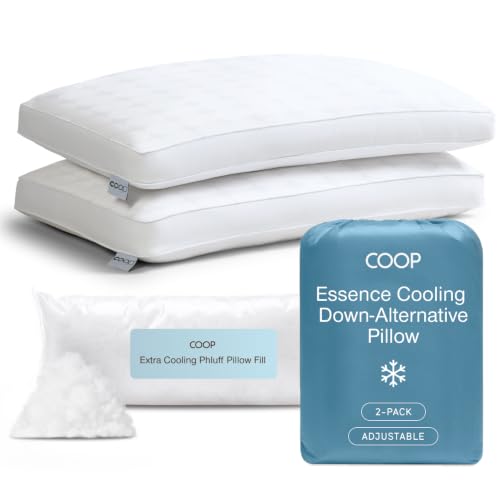
Coop Home Goods Essence Cooling Down Alternative Pillows (Queen, Set of 2) — Best Overall
The Coop Essence earns the top slot because adjustability is the most reliable route to support in a fiber pillow. The listing describes an adjustable down alternative fill in a queen two-pack, sized 27 by 17 inches, with a cool-touch positioning aimed at hot sleepers. Down alternative — a polyester fiber fill engineered to mimic the cluster feel of down — compresses more willingly than latex, so the ability to tune the fill is what turns it from a soft hotel pillow into a supportive one: side sleepers keep it full, back sleepers remove some loft, stomach sleepers flatten it further.
Strengths
- Adjustable fill lets one pillow serve side, back and stomach sleepers honestly
- Queen two-pack at a true 27 x 17 in footprint fills the shoulder gap for side sleeping
- Cool-touch positioning suits sleepers who find foam pillows warm
Trade-offs
- Fiber fills compress over months of use; expect to re-fluff and eventually top up or replace
- Down alternative will never match latex for spring-back resilience
- The listing describes a cool-touch feel, not active cooling — set expectations accordingly
| Mini spec box (from the verified listing) | |
|---|---|
| Fill | Down alternative (per listing) |
| Size listed | Queen, 27 x 17 in |
| Pack | Set of 2 |
| Adjustability | Adjustable (per listing) |
| Positioning | Cool-touch, for hot sleepers |
In practice this is the pillow for households: two sleepers with different positions can set each pillow differently on the same bed. It is also the safest first step away from memory foam, because the feel — lofty, compressible, familiar — is the opposite of foam’s slow sink, while the adjustability preserves the one foam advantage people miss, which is dialing in height. If you sleep exclusively on your side and want maximum push-back, the latex picks below push harder; if you want one pillow that adapts, this is it.
Best for: adjustable-fill seekers and mixed-position households leaving memory foam / Not suited for: sleepers who want the maximum push-back only latex gives.
Check the current price on Amazon

JOLLYVOGUE Firm Pillows (Queen, Set of 2) — Best Firm Support
The JOLLYVOGUE Firm is the honest firm fiber pillow: a queen set of two, filled with down alternative that the listing states is OEKO-TEX certified, and positioned plainly as firm and supportive for back, stomach and side sleepers. There is no adjustability story here and no cooling story — just a denser fill that holds its height better than the medium-density crowd.
Strengths
- Firm density holds loft through the night instead of collapsing by 3 a.m.
- OEKO-TEX certified fill, stated in the listing, for buyers who screen materials
- Queen two-pack makes it an easy whole-bed upgrade
Trade-offs
- Fixed fill means the loft you get is the loft you keep — no tuning
- Firm fiber is still fiber: it will soften gradually with use and washing
- Stomach sleepers who like a near-flat pillow may find it too full
| Mini spec box (from the verified listing) | |
|---|---|
| Fill | Down alternative, OEKO-TEX certified fill (per listing) |
| Firmness | Firm (per listing) |
| Size listed | Queen |
| Pack | Set of 2 |
Choose this set if your current pillow’s failure mode is going flat. Firm down alternative supports by resisting compression rather than by molding, which suits back sleepers who want a steady platform and side sleepers whose heads are heavy enough to bottom out softer fills. It is also the pick for buyers who read certification labels: the OEKO-TEX claim in the listing attaches to the fill, and we describe it as exactly that — no more, no less.
Best for: firm-pillow sleepers whose current pillow goes flat overnight / Not suited for: sleepers who need to tune loft up or down after purchase.
Check the current price on Amazon

CUSHYZ Shredded Talalay Latex Pillow — Best Adjustable Latex
The CUSHYZ brings latex into the guide in its most flexible form: shredded Talalay latex in a 28 by 16 inch rectangular pillow, with an adjustable loft, an extra fill pouch included, a gusseted side wall and a washable cotton cover. Shredded latex behaves differently from a solid latex slab — it can be scrunched and shaped like a fiber pillow while keeping latex’s characteristic spring, so the pillow pushes back instead of packing down.
Strengths
- Shredded Talalay latex combines moldability with latex resilience
- Extra fill pouch included, so loft can go up as well as down
- Gusseted side wall keeps edges structured for side sleepers
Trade-offs
- Shredded fill can feel uneven until you distribute it by hand after unboxing
- Latex has a natural scent when new that some sleepers notice for a few nights
- 28 x 16 in is a non-standard footprint — check your pillowcases
| Mini spec box (from the verified listing) | |
|---|---|
| Fill | Shredded Talalay latex (per listing) |
| Size listed | 28 x 16 in |
| Adjustability | Adjustable loft, extra fill pouch included |
| Cover | Washable cotton cover |
This is the pick for the sleeper who rejected memory foam for its slow response but still wants a pillow that can be shaped. Scrunch it into a wedge for reading, flatten the center for back sleeping, or pile the fill toward the neck edge for side sleeping — the shreds stay roughly where you put them while still springing back when you lift your head. The included extra fill is a genuinely useful touch: most adjustable pillows only let you subtract.
Best for: shapers who want latex resilience in a scrunchable, adjustable form / Not suited for: sleepers bothered by any fill texture or natural latex scent.
Check the current price on Amazon
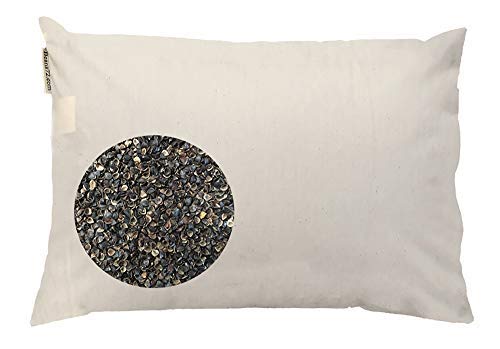
Beans72 Organic Buckwheat Pillow (Queen) — Best Extra-Firm and Moldable
The Beans72 is the support extremist of the guide, in the best sense. Buckwheat hulls do not compress like fiber or bounce like latex; they shift until they interlock, then hold that shape with almost no give. In a full queen footprint of 20 by 30 inches, that produces the firmest, most locked-in support platform here — the pillow takes the shape of your head and neck and then simply stays there until you deliberately reshape it.
Strengths
- Hull fill molds once and holds — the steadiest support platform in this guide
- Full queen size (20 x 30 in) rather than a small specialty format
- No foam, no fiber to go flat; loft is restored by redistributing hulls
Trade-offs
- Buckwheat is heavy and rustles when you move — light sleepers should know both facts
- The firmness is uncompromising; plush-pillow lovers will not convert
- Hull pillows need a different care routine than washable fiber pillows
| Mini spec box (from the verified listing) | |
|---|---|
| Fill | Buckwheat hulls (per listing) |
| Size listed | Queen, 20 x 30 in |
| Firmness character | Firm, shape-holding hull fill |
Buckwheat is a love-it-or-leave-it fill, and this guide will not pretend otherwise. Sleepers who prize a pillow that never changes height mid-night — and who run warm, since air moves freely between hulls — tend to become converts. Sleepers who toss, turn and bury their face in plushness tend to last one night. If you are curious, the queen size matters: smaller buckwheat pillows feel like a novelty, while a full-size one behaves like a real bed pillow with a genuinely different support physics.
Best for: firmness maximalists who want a mold-once, hold-all-night platform / Not suited for: plush-pillow lovers and very light sleepers sensitive to rustle.
Check the current price on Amazon
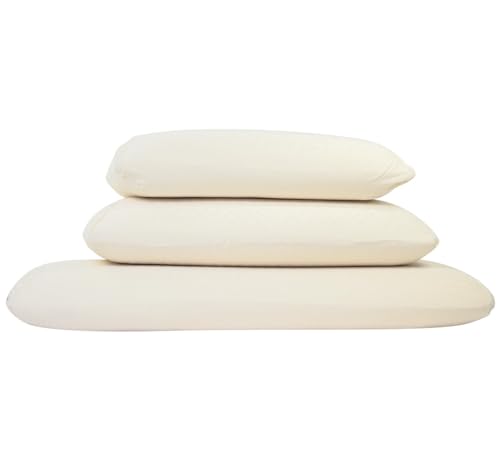
Turmerry Organic Latex Pillow (Queen, High Loft) — Best Certified Latex
The Turmerry is the materials-purist pick: a queen pillow with a high loft the listing puts at five inches, filled with Dunlop latex the listing states is GOLS certified, under a zippered organic cotton cover, with a breathable pinhole design aimed at side sleepers. Solid Dunlop latex is the densest, most platform-like of the latex family — where shredded latex molds, a solid core holds a consistent contour, which is why high-loft solid latex is the classic side-sleeper architecture.
Strengths
- GOLS certified Dunlop latex, as stated in the listing — the strongest materials claim in this guide
- Five-inch high loft suits the shoulder gap of side sleepers
- Zippered organic cotton cover is removable, which fiber pillows rarely offer
Trade-offs
- High loft is wrong for most stomach sleepers and some back sleepers — position fit matters
- Solid latex cannot be adjusted; the loft you buy is the loft you keep
- Latex is a natural material with a characteristic scent when new
| Mini spec box (from the verified listing) | |
|---|---|
| Fill | Dunlop latex, GOLS certified (per listing) |
| Loft listed | High loft, 5 in |
| Size listed | Queen |
| Cover | Zippered organic cotton cover |
Buy the Turmerry if you side-sleep, you want support that comes from structure rather than from stuffing, and you read certification labels closely. GOLS certification attaches to the latex itself — a different and more specific claim than a cover fabric certification — and the listing states it plainly, so we repeat it plainly. The five-inch loft is the decision point: measure your shoulder width against it honestly, because a high-loft pillow under a narrow-shouldered back sleeper is support in the wrong place.
Best for: side sleepers who want certified latex and structural support / Not suited for: stomach sleepers and anyone who needs adjustable loft.
Check the current price on Amazon

Amazon Basics Down Alternative Bed Pillows (Standard, 2-Pack) — Best Budget
The Amazon Basics set is the budget anchor: medium-density down alternative pillows in a standard 26 by 20 inch size, sold as a two-pack with pillow protector cases included, in a washable microfiber-shell format the listing describes as hypoallergenic. Medium density will not out-support the firm JOLLYVOGUE or either latex pick, and this guide will not claim otherwise — what it offers is honest, adequate support at the lowest commitment in the guide, plus the practical bonus of protectors in the box.
Strengths
- Two-pack with protector cases included — the most complete budget bundle here
- Medium density suits back sleepers and guest beds well
- Washable format makes it the lowest-maintenance pick in the guide
Trade-offs
- Medium density is the least supportive fill here for dedicated side sleepers
- Fiber at this tier compresses fastest; treat it as a replaceable, not a heirloom
- Standard size only in this listing — queen and king sleepers should look above
| Mini spec box (from the verified listing) | |
|---|---|
| Fill | Down alternative (per listing) |
| Density | Medium density |
| Size listed | Standard, 26 x 20 in |
| Extras | Pillow protector case set included |
| Care | Washable (per listing) |
This is the pick for guest rooms, first apartments, and anyone replacing a whole bed’s worth of tired pillows without wanting a research project. It is also a sensible trial: if you are leaving memory foam and are not yet sure whether you prefer fiber, latex or hulls, a washable medium-density set tells you cheaply whether plain fiber support is enough for your sleep — and if it is not, the firmer and springier picks above are your next step.
Best for: budget buyers, guest rooms and first replacements / Not suited for: dedicated side sleepers who need firm, high support.
Check the current price on Amazon
A last word before the head-to-head table: prices in this category move with promotions and pack configurations, and several of these pillows are sold in more than one size. Use the table to fix the fill family and model you want, then confirm the exact size and the current price on the listing itself — the link on each pick’s name takes you to the verified listing used for this guide.
Comparison Table
| Pick | Badge | Key spec | Best for |
|---|---|---|---|
| Coop Home Goods Essence Cooling Down Alternative Pillows (Queen, Set of 2) | Best Overall | Adjustable down alternative fill, cool-touch, queen set of 2 | overall |
| JOLLYVOGUE Firm Pillows (Queen, Set of 2) | Best Firm Support | Firm down alternative fill, OEKO-TEX certified fill | firm support |
| CUSHYZ Shredded Talalay Latex Pillow | Best Adjustable Latex | Shredded Talalay latex, adjustable loft with extra fill pouch | adjustable latex |
| Beans72 Organic Buckwheat Pillow (Queen) | Best Extra-Firm and Moldable | Buckwheat hull fill, queen 20 x 30 in | extra-firm and moldable |
| Turmerry Organic Latex Pillow (Queen, High Loft) | Best Certified Latex | GOLS certified Dunlop latex, 5 in high loft | certified latex |
| Amazon Basics Down Alternative Bed Pillows (Standard, 2-Pack) | Best Budget | Medium-density down alternative, standard 2-pack with protector cases | budget |
Key Takeaways
- Support is a property of density, loft and construction — not of memory foam. Firm fiber, latex and buckwheat all support, in different ways.
- Every pick here was screened by its verified listing title: no memory foam, no foam blends, in any slot.
- Adjustable fills (Coop Essence, CUSHYZ) are the safest route when you are unsure of your ideal loft.
- Certifications are stated exactly as listed: OEKO-TEX attaches to the JOLLYVOGUE fill; GOLS attaches to the Turmerry latex.
- Buckwheat is the firmest and steadiest support here — and the most polarizing. Know yourself before buying it.
How to Choose a Supportive Pillow Without Memory Foam
Match the fill to the kind of support you mean
Support is three different experiences wearing one word. Fiber supports by resistance: a firm fill pushes back and holds height until it gradually packs down. Latex supports by structure: it compresses under weight and springs back instantly, holding a consistent contour night after night. Buckwheat supports by architecture: the hulls interlock into a fixed shape that does not change until you change it. Decide which behavior you actually want — most disappointed buyers bought a fine pillow of the wrong philosophy.
Get loft right for your sleep position
Side sleepers need the most loft, because the pillow must fill the distance between the mattress and the head created by the shoulder — that is why the five-inch Turmerry and the gusseted CUSHYZ aim at them. Back sleepers need moderate loft with a stable platform. Stomach sleepers need the least: a firm, high pillow works against them, which is why adjustable fills that can be thinned down are the flexible choice for anyone who rotates positions.
Adjustable versus fixed is the second big decision
An adjustable pillow (Coop Essence, CUSHYZ) forgives uncertainty: you can tune loft over the first week as your neck gives feedback. A fixed pillow (JOLLYVOGUE, Turmerry, Beans72) gives a more consistent, engineered feel but demands you choose correctly up front. If this is your first non-foam pillow, adjustable is the lower-risk door into the category.
Read certification labels precisely
Certifications are specific claims about specific components, and this guide keeps them that way. An OEKO-TEX claim on a fill says that fill was tested under that program; a GOLS claim on latex certifies the latex as organic under that standard; a GOTS claim, where a listing makes one, concerns organic textiles. None of these is interchangeable with the others, and a certification on the cover is not a certification of the fill. Read which component the listing attaches the label to before letting it influence you.
Plan for the fill’s lifespan
Fiber pillows are consumables: even firm down alternative softens over one to two years of nightly use, which is why the budget Amazon Basics set is a rational purchase rather than a compromise. Latex is the longevity play — a latex core holds its character for years. Buckwheat hulls last a long time too and can be topped up. Match the pillow’s expected life to what you are paying, tier by tier, instead of expecting every fill to behave like latex.
How to Set Up and Maintain a Non-Foam Pillow
- Let it expand and air. Fiber and latex pillows alike benefit from a few hours of airing after unboxing; latex in particular airs out its natural new-product scent faster with airflow.
- Tune adjustable fills over three nights. Remove or add a handful at a time and sleep a full night between changes — necks judge pillows by mornings, not by the first five minutes.
- Fluff fiber daily. Thirty seconds of shaking and kneading redistributes down alternative and noticeably extends a fiber pillow’s supportive life.
- Shape buckwheat deliberately. Push hulls away from the center to form a shallow cradle, and build a small ridge under the neck edge; the hulls will hold that architecture all night.
- Use a protector. A pillow protector under the case keeps oils and moisture out of any fill; the Amazon Basics set includes protectors, and they are worth adding for the others.
- Wash by fill rules. The washable fiber picks can be laundered as their listings describe; latex and buckwheat fills should not be soaked — wash their covers instead, and air the fills.
Fill by Fill: How Non-Foam Support Actually Works
Down alternative fiber: support by resistance
A down alternative fill is a mass of fine synthetic fibers that trap air between them. Press on it and the fibers bend and the air escapes; release and the loft partly returns. In medium densities that behavior reads as softness, but in firm densities — the JOLLYVOGUE approach — the fiber mass resists compression hard enough to hold a head at height all night. The weakness is time: every compression cycle leaves the fibers slightly less springy, which is why firm fiber pillows feel wonderful for months and then quietly become ordinary ones. Daily fluffing slows that process by re-lofting the fiber mass, and an adjustable design like the Coop Essence sidesteps it entirely by letting you restore loft with fill rather than with hope.
Latex: support by spring
Latex inverts the fiber story. A latex core or a mass of latex shreds compresses under load and pushes back in direct proportion, instantly, thousands of times without meaningful fatigue. That push-back is what latex sleepers describe as support you can feel working: the pillow fills the curve under the neck because the material actively expands into it. Solid Dunlop latex, as in the Turmerry, gives the most consistent version of that behavior — a platform with a contour. Shredded Talalay, as in the CUSHYZ, trades some consistency for moldability: the shreds can be gathered where you want height and thinned where you do not, and the gusseted wall keeps those decisions in place. Neither version sleeps like foam; latex responds the moment you move, which is precisely why former memory foam owners often land here.
Buckwheat hulls: support by structure
Buckwheat is not really a cushioning material at all — it is a building material. Each hull is a small, hard, three-sided shell; poured together, the hulls flow like a liquid until pressure makes them interlock, at which point the mass behaves like a solid that happens to be exactly the shape of your head and neck. There is no compression curve and no spring: there is a shape, held. That is why buckwheat support feels absolute to the people who love it and unyielding to the people who do not. It is also why a buckwheat pillow is adjusted by architecture rather than by feel — you build a cradle and a neck ridge with your hands before you lie down, and the pillow keeps your blueprint until morning.
Matching Support to Your Sleep Position
Side sleepers carry the hardest brief: the pillow must fill the full shoulder-to-head distance while staying firm enough not to collapse into it. High loft and structure win here — the Turmerry’s five-inch latex platform, the CUSHYZ with its fill pouch used generously, or the Beans72 shaped into a thick cradle. Back sleepers need the middle path: enough loft to support the neck curve, little enough that the chin is not pushed toward the chest. The firm JOLLYVOGUE and a moderately filled Coop Essence both live in that band. Stomach sleepers need the least pillow of all; for them the adjustable picks earn their keep, because fill can come out until the pillow is a thin, soft layer rather than a support device at all.
Combination sleepers — most people — should buy adjustability and stop apologizing for it. A pillow you can re-tune as your habits change will out-serve a fixed pillow chosen for the position you happened to favor the week you ordered. That single principle explains the top of this guide: the Coop Essence first, the CUSHYZ close behind, and the fixed picks recommended to sleepers who already know their position and their preference with confidence.
Sizes, Cases and Fit
Non-standard sizes sneak into this category, so check the listing dimensions against your pillowcases before ordering. The Coop Essence lists at 27 by 17 inches, the CUSHYZ at 28 by 16, and the Beans72 and Turmerry at full queen footprints, while the Amazon Basics set is a true standard at 26 by 20. A pillow slightly smaller than its case will drift and bunch; a pillow larger will feel firmer than designed because the case compresses it. Neither is a disaster, but the pillow you evaluated in reviews is the pillow at its intended fit — match the case to the pillow, not the other way round, especially with the shaped and gusseted designs.
The First Week With a Non-Foam Pillow: What to Expect
Switching fill families has an adjustment curve, and knowing it in advance stops premature returns. Night one usually feels strange rather than bad: fiber feels loftier than expected because you have been judging height by foam’s compressed state, latex feels more present because it pushes back, and buckwheat feels like a decision. By night three, position habits start adapting — side sleepers stop scrunching an adjustable pillow that no longer needs scrunching, and back sleepers find the level where the platform holds. By the end of the first week, the honest signal arrives in the morning: you either wake up having forgotten the pillow exists, which is the goal of every support purchase, or you wake up aware of exactly one thing — too high, too low, too firm, too soft — which an adjustable fill can fix in one handful and a fixed fill cannot fix at all.
Two practical notes belong here. First, change one variable at a time: if you are also breaking in a new mattress topper or a new sleep schedule, you will not know what the pillow did. Second, keep the packaging until the week is out. Pillows are personal in a way few products are, and a return window used honestly — after a genuine trial, not a five-minute squeeze — is part of buying well in this category.
A note on temperature
Many readers arrive at this search because memory foam sleeps warm for them. The fills here behave differently: fiber traps air but does not hold heat against the head the way dense foam can, latex with pinhole construction moves air through the core, and buckwheat is effectively a ventilated fill. None of these is an active cooling technology, and this guide does not describe them as one — but as a group they run noticeably more neutral than the foam category readers are leaving, which is usually the actual requirement.
When a Non-Foam Pillow Is the Wrong Answer
Honesty about a category includes its limits. If your favorite thing about your current pillow is the slow, close contouring — the sense of the pillow wrapping and holding an exact mold — no fill in this guide reproduces that, and the companion memory foam guide exists for you. If you need a pillow for a recliner, a reading wedge or a knee spacer, those are different product shapes that surfaced in our research and were excluded here as off-intent for a bed pillow keyword. And if a clinician has specified a contoured cervical pillow for a condition you are managing, that specification outranks this entire article: buy what was recommended, in the material it was recommended in.
There is also a middle path worth naming: many sleepers who dislike solid memory foam blocks are perfectly happy with shredded latex or adjustable fiber, because what they objected to was never support itself — it was the heat, the slow response or the fixed shape. If that sounds like you, the adjustable picks at the top of this guide are not a compromise; they are the actual answer.
Protectors and Cases: The Cheapest Support Upgrade You Can Buy
A supportive pillow dies from the outside in: skin oils, moisture and dust migrate through a pillowcase and break down fills — fiber clumps, latex oxidizes faster, hulls absorb humidity. A zippered protector under the case is a barrier that costs very little and extends every fill’s supportive life, which is why the Amazon Basics bundle including protectors in the box is smarter than it looks. Cases matter to feel as well: a smooth, correctly sized case lets a gusseted or shaped pillow keep its geometry, while an undersized case quietly compresses loft you paid for. Buy the protector with the pillow, size the case to the pillow’s listed dimensions, and wash both on the schedule you actually keep — a modest routine followed beats an elaborate one abandoned.
Common Buying Mistakes
- Assuming no memory foam means no support. Firmness and structure come from density and construction; several non-foam fills out-support soft foam.
- Buying a hybrid by accident. Many pillows blend memory foam into fiber or latex. If avoiding foam is the point, read the fill line of the listing, not the headline.
- Choosing loft by firmness words alone. A firm low pillow and a firm high pillow support completely different sleepers. Match loft to your position first.
- Treating every certification as the same claim. OEKO-TEX, GOLS and GOTS certify different things about different components.
- Judging a pillow in five minutes. Especially with adjustable and buckwheat fills, give any new pillow three nights before deciding.
- Expecting fiber to last like latex. Budget fiber is a replaceable; price your expectations accordingly.
Final Recommendation
Start with the Coop Essence if you want the surest thing in this guide: adjustable, queen-sized, and friendly to every sleep position. If you already know you want firm, the JOLLYVOGUE set is the direct answer. Latex-curious sleepers should choose between the moldable CUSHYZ and the structural Turmerry by whether they like to shape their pillow or have it hold a shape for them. The Beans72 is the specialist’s firm platform, and the Amazon Basics set is the sensible budget and guest-room buy.
If you are deciding by decision tree: start with position. Side sleepers go to the Turmerry, CUSHYZ or a fully stuffed Coop Essence. Back sleepers go to the JOLLYVOGUE or a moderately filled Coop Essence. Stomach sleepers and the undecided go to an adjustable pick and thin it down. Then decide by philosophy: spring (latex), resistance (fiber) or structure (buckwheat). Then, and only then, look at price tiers — because a pillow at the right loft in the right fill family at a budget tier will serve you better than a premium pillow of the wrong family, every single night.
Comparing across fill families? See the other side of the fence in Best Bed Pillows With Memory Foam, browse Best Luxury Bed Pillows for premium options, check Best Non Allergenic Bed Pillows if materials screening is your priority, look at Best Lumbar Bed Pillows for shaped support pillows, and consider Best Decorative Bed Pillows if the bed needs a styled layer as well.
Related guides
Frequently Asked Questions
Can a pillow without memory foam really support my neck?
Yes — support means holding your head at a steady, appropriate height, and firm fiber, latex and buckwheat all do that by different mechanics: resistance, spring, and interlocked structure. What matters is matching the fill’s behavior and the pillow’s loft to your sleep position.
What is the difference between down alternative and down?
Down alternative is a synthetic fiber fill — the listings in this guide use polyester-based fills — engineered to imitate down’s softness without animal content. It is washable, widely used in hotel pillows, and in firm densities it provides genuine support, though it compresses over time in a way latex does not.
Is latex a good choice for hot sleepers?
Latex does not hold body heat the way dense memory foam can, and designs like the Turmerry’s pinhole construction encourage airflow. Buckwheat is the coolest-feeling fill here, since air moves freely between the hulls.
How long do buckwheat pillows last?
Hulls are durable and the fill can be topped up or redistributed for years. The trade-offs are weight, rustling and a firmness that some sleepers never adapt to — which is why this guide presents buckwheat as a specialist pick, not a default.
What does an OEKO-TEX or GOLS label on a pillow actually certify?
Each label certifies the specific component it is attached to, under that program’s criteria — the JOLLYVOGUE listing attaches OEKO-TEX to its fill, and the Turmerry listing attaches GOLS to its latex. They are different programs measuring different things, and neither should be read as a blanket claim about the whole pillow.
I toss and turn — which fill handles movement best?
Latex. Its instant response means the pillow is already supporting the new position when you arrive in it, whereas fiber needs a moment of resettling and buckwheat holds the shape of the previous position until you move the hulls. Restless sleepers are the natural latex audience.
Are these pillows suitable for children?
These are adult bed pillows in standard and queen sizes, chosen for adult support needs. For children, choose pillows sized and lofted for smaller frames rather than thinning down an adult pillow — loft relative to body size is what makes a pillow supportive or not.
How often should I replace a fiber pillow?
When it stops recovering its loft after fluffing, or when you fold it and it stays folded, its supportive life is over — commonly after a year or two of nightly use for fiber fills. Latex and buckwheat fills typically serve much longer.

