Disclosure: airfryerkitchensupply.com is reader-supported. When you buy through links on our site, we may earn an affiliate commission at no extra cost to you.
Where to buy
Every vacuum below was matched to a live Amazon listing before it earned a link, and the specifications quoted — control methods, suction figures, runtimes, navigation systems — come from those verified listing titles. This guide prints no product prices anywhere; each pick links out so you can check the current price on Amazon yourself.
- ILIFE V2 Robot Vacuum Cleaner — Check the current price on Amazon
- Tikom Robot Vacuum and Mop Combo, G8000 Max — Check the current price on Amazon
- Lefant M210 Robot Vacuum Cleaner — Check the current price on Amazon
- iRobot Roomba 105 Vac Robot Vacuum — Check the current price on Amazon
- Roborock Q7 L5 Robot Vacuum and Mop Combo — Check the current price on Amazon
- ILIFE V10 Robot Vacuum Cleaner — Check the current price on Amazon
The best remote vacuums are the machines that clean while you do something else — robot vacuums you direct from a physical remote, a phone app or your voice, on a schedule you set once. “Remote” in this search means control at a distance, and it comes in three flavors worth distinguishing before you buy: the handheld remote (point, press, clean — no Wi-Fi, no account, no app updates), app control (maps, schedules, no-go zones and notifications from your phone), and voice control layered on top of an app through a smart speaker. Each flavor suits a different household, and the six verified picks below are organized around that distinction as much as around suction or runtime.
Two picks put a physical remote in the title itself — the ILIFE V2 and V10 — for buyers who want robot cleaning without handing a vacuum their Wi-Fi password. One pick, the Tikom G8000 Max, lists app and remote control together, the belt-and-braces option. The Lefant M210 goes all-in on connected control with Wi-Fi, app and Alexa in its title. And the two mapping flagships — the Roomba 105 and the Roborock Q7 L5 — represent the app-ecosystem end of the market, where their verified titles emphasize LiDAR navigation and mapping; the reviews note precisely what each title does and does not say about control, because in this category the control method is the purchase.
Key Takeaways
- “Remote” comes in three distinct flavors — handheld remote, phone app, and voice via app — and the right one depends on your household’s Wi-Fi and patience, not on price.
- Two picks (ILIFE V2 and V10) state physical Remote Control in their verified titles: robot cleaning with no app or account required.
- The Tikom G8000 Max lists App & Remote Control together — the most flexible control package verified here.
- LiDAR models (Roomba 105, Roborock Q7 L5) navigate in mapped rows rather than random bounces; their titles emphasize navigation, and app ecosystems are their control route.
- Runtimes verified here run 120–150 minutes; suction figures, where titles state them, run 5,000–8,000 Pa.
- Navigation is the second decision: bounce for small simple spaces, gyro for orderly paths, LiDAR for fully mapped multi-room and multi-floor homes.
- None of the six verified picks claims a self-emptying dock — that is a deliberate tier above this guide, and the reviews say so rather than implying it.
- A robot’s first week decides its fate: floor prep, thoughtful base placement and a realistic schedule matter more than any single specification.
In this guide
Quick Picks
Best with Physical Remote — ILIFE V2 Robot Vacuum Cleaner
Remote Control stated in the title, with scheduling, 120 minutes of runtime and tangle-free suction. The no-app robot for people who want cleaning, not another account.
Check the current price on Amazon
Best App + Remote Combo — Tikom Robot Vacuum and Mop Combo, G8000 Max
App & Remote Control in one listing, 5000Pa suction, 150-minute maximum runtime, vacuum and mop. The control maximalist’s pick.
Check the current price on Amazon
Best for Pet Hair Homes — Lefant M210 Robot Vacuum Cleaner
Wi-Fi/App/Alexa control, 120 minutes, slim and low-noise, positioned for pet hair and hard floors. The connected pick for pet households.
Check the current price on Amazon
Best Brand-Backed Mapping — iRobot Roomba 105 Vac Robot Vacuum
LiDAR navigation and 7,000 Pa power-lifting suction from the category’s founding brand, cleaning in neat rows. The ecosystem pick.
Check the current price on Amazon
Best Vacuum and Mop — Roborock Q7 L5 Robot Vacuum and Mop Combo
8,000Pa suction, LiDAR navigation, multi-level mapping and a mop, with a dual anti-tangle system. The most complete floor-care package here.
Check the current price on Amazon
Best Remote with Navigation — ILIFE V10 Robot Vacuum Cleaner
Remote Control plus gyro navigation, 5000Pa suction and 120 minutes of runtime. The remote-control pick that also knows where it has been.
Check the current price on Amazon
How These Picks Were Chosen
Every candidate was verified on this site’s own Amazon connection: searched by brand and model, matched against the returned listing title, and linked only with the ASIN the listed. Eligibility required a robot vacuum whose control story could be verified — a remote control, app control or voice control stated in the title, or, for the two LiDAR flagships, a navigation-and-ecosystem proposition whose titles are quoted exactly so readers can see what is claimed. Suction and runtime figures appear in this guide only where the verified titles state them (5000Pa, 7,000 Pa, 8,000Pa; 120 and 150 minutes), and are never estimated for models whose titles omit them.
Excluded: handheld and upright vacuums with “remote” in unrelated senses, robot listings whose titles made control claims we could not verify, and duplicate variants of the same model. One deliberate editorial choice deserves naming: this guide treats the physical-remote models as first-class citizens rather than budget leftovers. For households with unreliable Wi-Fi, for older users, for rentals and offices where network access is a negotiation, a robot that answers to a handheld remote is not a lesser product — it is the correct one, and the ranking reflects that.
It is worth one more sentence on what “best” means in a category this segmented. There is no plausible world in which the ILIFE V2 and the Roborock Q7 L5 are rivals: one is an appliance, the other is a platform, and their buyers want different lives from their floors. The badges in this guide therefore rank within jobs — best with a physical remote, best dual-control, best pet-hair connected pick, best mapping options — rather than pretending a single ladder exists. Read the badge that matches your household and you are reading the ranking that was actually performed.
The 6 Best Remote Vacuums
ILIFE V2 Robot Vacuum Cleaner — Best with Physical Remote
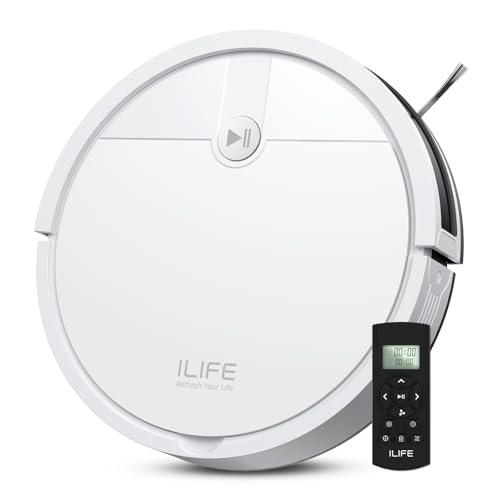
The ILIFE V2 leads this guide because it embodies the keyword most literally: its verified title lists Remote Control as a headline feature, alongside scheduling, a 120-minute runtime, tangle-free suction, a slim body and self-charging, positioned for pet hair and hard floors. The tangle-free detail matters for its audience — suction-port designs without a spinning central brush are kinder to hair and simpler to maintain — and the slim profile is the classic robot virtue, sliding under sofas and beds that uprights never reach. Set a schedule from the remote, and the V2 becomes the appliance ideal: cleaning that happens without apps, accounts or attention.
Strengths
- Physical Remote Control stated in the title — full direction without Wi-Fi, apps or accounts.
- Tangle-free suction suits pet-hair homes and low-maintenance ownership.
- 120-minute runtime with self-charging and scheduling covers real apartments in a single run.
Trade-offs
- No mapping claims in the title — expect bounced, pattern-based navigation rather than mapped rows.
- Remote control means line-of-sight direction; you cannot start it from another city.
- Positioned for hard floors and pet hair; deep carpet is not its brief.
Spec box (from the verified listing)
- Control: Remote Control, schedule (per title)
- Runtime: 120 mins
- Suction type: tangle-free suction
- Format: slim, self-charging
- Positioning: pet hair and hard floors
- Color of verified listing: white
The V2’s philosophy deserves respect in a market sprinting toward ever more connected machines: control that cannot break when the router reboots, cannot be orphaned by an app update, and can be operated by anyone who can use a television remote. For a parent setting up a robot for a grandparent, a landlord furnishing a rental, or a buyer who simply refuses one more account, this is not the compromise pick — it is the correct one, and its verified feature list (schedule, self-charge, two-hour runtime) shows how little is actually surrendered.
Best for: app-free households, older users, rentals and pet-hair hard floors. / Not suited for: buyers wanting maps, no-go zones or away-from-home control.
Check the current price on Amazon

Tikom Robot Vacuum and Mop Combo, G8000 Max — Best App + Remote Combo
The Tikom G8000 Max is the control maximalist: its verified title lists App & Remote Control in the same breath, so the household gets both interfaces — the remote for instant, anyone-can-use-it direction, the app for scheduling and settings — plus a 5000Pa suction figure, a 150-minute maximum runtime (the longest verified here), self-charging, and a vacuum-and-mop combination body positioned for hard floors, carpet and pet hair. For mixed households — one partner who lives in apps, one who wants a button — this dual-control design is not redundancy; it is peacekeeping.
Strengths
- Both control worlds in one listing: App & Remote Control, per the title.
- 150-minute maximum runtime is the longest verified in this guide.
- 5000Pa stated suction with vacuum-and-mop versatility across hard floor and carpet.
Trade-offs
- Mop functions on robot combos are maintenance mopping, not deep washing — set expectations accordingly.
- App setup is part of the deal for full features, even though the remote covers the basics.
- Navigation is not LiDAR per the title; mapping shoppers should look at the Roomba and Roborock picks.
Spec box (from the verified listing)
- Control: App & Remote Control (per title)
- Suction: 5000Pa
- Runtime: 150 min max
- Functions: vacuum and mop combo, self-charge
- Model: G8000 Max
- Positioning: hard floor, carpet, pet hair
The G8000 Max earns its badge by refusing the category’s false choice. Most robots make you pick your interface at purchase and live with it; this one ships both, which also future-proofs the household — the remote serves today, the app serves the day schedules and maps become interesting. Add the guide’s longest runtime and a stated suction figure that matches the ILIFE V10’s, and the Tikom is the most complete mid-tier package in this list for buyers who want options more than they want a famous badge.
Best for: mixed-preference households and runtime-first shoppers. / Not suited for: LiDAR-mapping purists, or anyone expecting a robot mop to replace real mopping.
Check the current price on Amazon
Lefant M210 Robot Vacuum Cleaner — Best for Pet Hair Homes
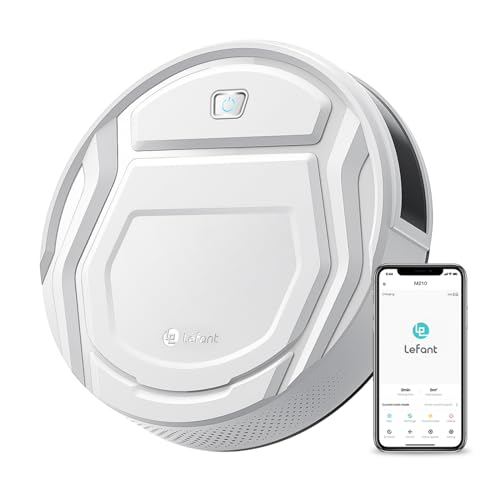
The Lefant M210 is the connected pet-home pick: its verified title lists Wi-Fi, App and Alexa control together, a 120-minute runtime, automatic self-charging, and positioning for pet hair, hard floors and daily cleaning — with slim and low-noise design called out in the same breath. That combination maps precisely onto pet households: hair is a daily, not weekly, problem; a slim robot that runs quietly every day on a schedule, started by voice when a tumbleweed of fur rolls past, is the actual solution — not a monthly deep clean. The M210 line’s brushless suction approach is also the pet-friendly architecture, since hair passes through rather than wrapping.
Strengths
- Full connected control — Wi-Fi/App/Alexa — stated in the verified title.
- Slim, low-noise design suits daily scheduled runs in occupied homes.
- Positioned explicitly for pet hair and hard floors, with 120 minutes per run.
Trade-offs
- The title states no suction figure in Pascals, so this guide quotes none — compare on control and format, not invented numbers.
- Connected control means app setup and a Wi-Fi network are part of ownership.
- Daily pet-hair duty means frequent dustbin emptying; the robot does not empty itself.
Spec box (from the verified listing)
- Control: Wi-Fi / App / Alexa (per title)
- Runtime: 120 mins
- Format: slim, low noise, automatic self-charging
- Model: M210
- Positioning: pet hair, hard floor, daily cleaning
Pet hair reframes robot value: the best machine is the one that runs most often with least friction, and friction is mostly noise, thickness and hair-wrapping. The M210’s verified brief attacks all three — low noise, slim body, pet-hair positioning — and adds the voice-control flourish that makes “run the vacuum” a spoken sentence rather than a chore. For a pet household choosing its first robot, this is the most honestly targeted listing in the guide.
Best for: pet owners wanting daily, quiet, voice-or-app-controlled cleaning. / Not suited for: app-free buyers (take the ILIFE V2), or deep-carpet homes.
Check the current price on Amazon

iRobot Roomba 105 Vac Robot Vacuum — Best Brand-Backed Mapping
The Roomba 105 represents the ecosystem end of remote control: iRobot’s verified title for it leads with 7,000 Pa power-lifting suction, LiDAR navigation, multi-surface cleaning and neat-rows cleaning behavior, with a charging base. LiDAR is the substantive claim — a laser-mapped robot knows the room’s shape, cleans in systematic rows instead of random bounces, and finishes faster with fewer missed strips. The honest documentation note: this title emphasizes navigation and suction rather than naming its control interface, and Roomba’s control route is its app ecosystem; buyers who want a physical remote in the box should take the ILIFE or Tikom picks, which say so in writing.
Strengths
- LiDAR navigation with neat-rows cleaning — systematic coverage, not random bounce.
- 7,000 Pa power-lifting suction, the second-strongest figure verified here.
- iRobot is the category’s founding brand, with the accessory and support ecosystem that implies.
Trade-offs
- Control interface is not named in the verified title — app-ecosystem control is the route, with no physical remote promised.
- This is the vacuum-only model with a charging base; self-emptying belongs to other configurations.
- Brand and navigation carry a premium over the remote-control picks; check the current price on Amazon.
Spec box (from the verified listing)
- Navigation: LiDAR, cleans in neat rows
- Suction: 7,000 Pa power-lifting
- Surfaces: multi-surface
- Base: charging base (vac-only configuration)
- Brand: iRobot
Choose the Roomba when the map is the point. In larger or furniture-dense homes, random-bounce robots spend their battery re-cleaning the same rug while a mapped robot finishes the floor plan methodically — the difference shows up as completed rooms rather than as specifications. iRobot’s long category history also means consumables, parts and troubleshooting knowledge are everywhere. Just enter with the control expectation set correctly: this is the app-ecosystem branch of “remote,” and on that branch it is the most established name in the guide.
Best for: larger homes wanting mapped, systematic cleaning from the category’s founding brand. / Not suited for: physical-remote buyers, or self-emptying seekers.
Check the current price on Amazon

Roborock Q7 L5 Robot Vacuum and Mop Combo — Best Vacuum and Mop
The Roborock Q7 L5 carries the strongest verified suction figure in this guide — 8,000Pa — together with LiDAR navigation, multi-level mapping, a dual anti-tangle system and a vacuum-and-mop combination body, upgraded from the Q5 Pro per its title. Multi-level mapping is the feature apartment-and-house households should notice: the robot remembers more than one floor plan, which is the difference between a robot per floor and a robot carried between floors. The anti-tangle system addresses the robot category’s oldest maintenance annoyance, hair wound around the brush, at the design level rather than the cleaning-the-brush level.
Strengths
- 8,000Pa — the highest suction figure stated in any verified title here.
- LiDAR navigation with multi-level mapping for multi-floor homes.
- Dual anti-tangle system plus a mop: the most complete floor-care package in the guide.
Trade-offs
- As with the Roomba, the title emphasizes navigation over control interface — app-ecosystem control is the route; no physical remote is promised.
- Combo mopping is maintenance mopping; kitchens still need real mopping sometimes.
- Feature density means app setup is a genuine first-evening project.
Spec box (from the verified listing)
- Suction: 8,000Pa
- Navigation: LiDAR, multi-level mapping
- Brush system: dual anti-tangle
- Functions: vacuum and mop combo, self-charging
- Lineage: upgraded from Q5 Pro (per title)
- Color of verified listing: black
The Q7 L5 is the pick for the household that wants one machine to own the floors entirely: vacuum with the guide’s top verified suction, mop for the daily film, maps for every level, and a brush system designed to stay out of your maintenance routine. It sits at the opposite pole from the ILIFE V2 — maximal connected capability against maximal simplicity — and this guide’s honest position is that both poles are right answers for different homes. If yours is a multi-floor, app-comfortable home, this is the pole that fits.
Best for: multi-floor homes wanting the strongest verified suction plus mapping and mopping. / Not suited for: app-free buyers or physical-remote loyalists.
Check the current price on Amazon

ILIFE V10 Robot Vacuum Cleaner — Best Remote with Navigation
The ILIFE V10 answers the V2’s one limitation: it keeps the physical Remote Control — stated in its verified title — and adds gyro navigation, so the robot cleans with spatial awareness of where it has been rather than pure bounce logic. The rest of the verified package steps up across the board: 5000Pa strong suction, 120-minute runtime, a dual anti-tangle design, self-charging and a slim body, positioned for hard floors, pet hair and carpet. For the remote-loyal buyer who watched mapping robots with envy, the V10 is the bridge: the interface stays a handheld remote, the navigation grows up.
Strengths
- Remote Control plus gyro navigation — both stated in the title, a rare pairing.
- 5000Pa suction and a dual anti-tangle design for pet-hair duty.
- 120-minute runtime with self-charging in a slim format.
Trade-offs
- Gyro navigation is a step toward mapping, not LiDAR mapping — no floor-plan memory is claimed.
- Remote control still means in-home direction, not away-from-home app control.
- Carpet positioning is general; deep pile remains upright-vacuum territory.
Spec box (from the verified listing)
- Control: Remote Control (per title)
- Navigation: gyro navigation
- Suction: 5000Pa
- Runtime: 120 mins
- Brush: dual anti-tangle design
- Color of verified listing: gray
Place the V10 and V2 side by side and the ILIFE line’s logic clarifies: the V2 is the pure appliance, the V10 is the appliance with a memory. The gyro system will not draw you a floor plan, but it disciplines the cleaning path in a way bounce navigation cannot, and for pet-hair homes the anti-tangle design protects the schedule — a robot that does not stall on its own brush is a robot that actually runs daily. Remote loyalists, this is your upgrade path that does not ask you to become an app household.
Best for: remote-control loyalists wanting better navigation and stronger suction. / Not suited for: buyers wanting true LiDAR maps or away-from-home control.
Check the current price on Amazon
Comparison Table
| Pick | Badge | Key spec (verified) | Best for |
|---|---|---|---|
| ILIFE V2 | Best with Physical Remote | Remote Control; 120 min; tangle-free suction | App-free cleaning |
| Tikom G8000 Max | Best App + Remote Combo | App & Remote; 5000Pa; 150 min; mop | Mixed-preference households |
| Lefant M210 | Best for Pet Hair Homes | Wi-Fi/App/Alexa; 120 min; slim, low noise | Daily pet-hair control |
| iRobot Roomba 105 Vac | Best Brand-Backed Mapping | LiDAR; 7,000 Pa; neat rows | Mapped cleaning, big brand |
| Roborock Q7 L5 | Best Vacuum and Mop | 8,000Pa; LiDAR multi-level mapping; mop | Multi-floor complete care |
| ILIFE V10 | Best Remote with Navigation | Remote Control; gyro nav; 5000Pa | Remote loyalists, upgraded |
The table’s organizing fact is that control and navigation vary independently. The two ILIFE picks pair the simplest control (a handheld remote) with the two simpler navigation tiers; the Tikom pairs dual control with the longest runtime; the Lefant pairs full connected control with a pet-hair format; and the two flagships pair app-ecosystem control with LiDAR. Shoppers who conflate “more features” with “better robot” end up paying for maps their studio cannot use or apps their household will not open. Shoppers who fix their control flavor and floor plan first find that the table nearly reads itself.
Apartments versus houses: the same robot, different verdicts
Space rewrites every specification’s meaning. In a studio or one-bedroom apartment, raw runtime barely matters — even the shortest verified run here, 120 minutes, covers the floor several times over — while slimness, low noise and simple control dominate, which is why the ILIFE V2 and Lefant M210 read as apartment natives. In a multi-room house, coverage discipline becomes the product: mapping stops being a luxury the day a bounce robot spends its battery re-cleaning the kitchen while the bedrooms wait. And in a multi-floor house, the Roborock’s multi-level mapping is the only feature in this guide that changes the unit count — one robot carried between floors, remembering each — versus one robot per floor. State your housing type before your budget and the shortlist will usually cut itself in half.
How to Choose a Remote-Controlled Robot Vacuum
Start with the shortlist above — the ILIFE V2 for pure remote simplicity, the Tikom G8000 Max for both interfaces, the Roborock Q7 L5 for the full connected package — then work through the four decisions below.
Choose your control flavor first
This decision outlives every other spec. A physical remote (ILIFE V2 and V10) works for anyone, forever, with zero setup — and cannot be operated from outside the home. An app (Lefant, Tikom, and the ecosystems behind the Roomba and Roborock) adds schedules, maps, notifications and away-from-home starts, at the cost of setup, accounts and Wi-Fi dependence. Voice control (Lefant’s Alexa support) is a layer on app control, not a third system. Households should choose by their least technical member: the best control system is the one everyone in the home will actually use.
Match navigation to your floor plan
Navigation tiers explain most of the price ladder. Bounce navigation (the V2’s class) cleans adequately in small, simple spaces given time. Gyro navigation (V10) adds path discipline. LiDAR mapping (Roomba 105, Q7 L5) adds room knowledge, systematic rows, faster completion and — in the Roborock’s case — memory of multiple floors. Open-plan and multi-room homes repay mapping quickly; a studio apartment may never notice its absence. Buy the tier your floor plan can perceive.
Read suction and runtime as a pair
Suction figures in this guide are quoted only where titles state them: 5000Pa (Tikom, ILIFE V10), 7,000 Pa (Roomba 105), 8,000Pa (Roborock Q7 L5). Treat them as within-brand indicators rather than laboratory rankings — test methods vary — and weigh them with runtime: 120 minutes covers most apartments; the Tikom’s 150-minute maximum serves larger single floors. A slightly weaker robot that finishes your home beats a stronger one that dies in the hallway.
Runtime deserves one more nuance: the figure in a title is a maximum under favorable conditions, achieved on hard floors at standard suction. Carpet, max-suction modes and an aging battery all shorten it, which is why this guide treats 120 minutes as ample for apartments and looks to the Tikom’s 150-minute ceiling for larger single floors rather than demanding the biggest number for every home. A robot that returns to its base mid-clean and resumes — as self-charging models do — softens the limit further, but the honest planning figure is always a discount on the headline one.
Plan the maintenance, not just the purchase
Robots trade your pushing time for their maintenance time: dustbins to empty (daily in pet homes), brushes to check (anti-tangle designs, on the Roborock and ILIFE V10, reduce this), filters to replace, mop pads to wash on the combos. Self-charging is universal in this guide’s picks; self-emptying is a further tier none of these six titles claims. Buy the maintenance rhythm you will actually keep — a robot whose bin is always full is furniture, not a vacuum.
Privacy and connectivity, stated plainly
Connected robots are network devices, and an honest buying guide should treat that as a specification rather than a footnote. App-controlled models communicate with their makers’ clouds; mapping models build and store floor plans; voice control routes commands through a smart-speaker ecosystem. None of that is disqualifying — it is the normal architecture of the category, and the Lefant, Tikom, Roomba and Roborock picks here are mainstream products — but households differ in their comfort with it, and the difference is legitimate. The remote-control ILIFEs are the structural answer for the cautious: a robot with no account, no cloud and no map is not a lesser robot, it is a differently-architected one. Choose with your household’s actual position on connectivity, not with the assumption that more connected is automatically more advanced.
A robot’s first week decides whether it becomes infrastructure or clutter, and the difference is almost never the machine. Households that prep the floor, place the base thoughtfully, supervise the first run and set a realistic schedule end up with floors that are simply always clean — the category’s actual promise. Households that unbox onto a cluttered floor and judge by the first chaotic run end up with a robot in a closet. The routine below is the first group’s whole secret, and it costs one attentive evening.
How to Set Up and Run a Remote Vacuum Routine
- Prepare the floor once, properly: pick up cables, shoelaces, small toys and anything fringe-like. Robots forgive clutter poorly, and the first run sets the routine’s reputation in the household.
- Place the charging base against a wall with clear space around it, on the floor the robot will clean most — self-charging only works if the robot can find and reach home.
- Run the first clean supervised, whatever the control type: watch where the robot struggles (thresholds, chair legs, dark rugs) and fix the room, not the robot.
- Set the schedule for when the home is empty or settled — daily short runs beat weekly marathons for pet hair and daily dust, and both remote and app picks here support scheduling.
- Empty the bin on a rhythm tied to your home (daily for pet households), and check the brush and wheels weekly — or choose the anti-tangle picks and check less often, but still check.
- For mop combos, treat the mop as maintenance: vacuum first, mop second, wash the pad after — and keep the robot off delicate rugs when the mop is attached.
Navigation Explained: Bounce, Gyro and LiDAR in Plain Terms
The three navigation tiers in this guide behave like three different animals, and knowing which animal you are buying prevents most disappointments. Bounce navigation — the ILIFE V2’s class — drives until it meets an obstacle, turns, and repeats, covering a room statistically over time. In a small, simple space with a long runtime, statistics work: the V2’s 120 minutes is partly a navigation strategy. Its failures are pattern failures — a complex floor plan can starve a corner for days — and its virtue is price and simplicity: no cameras, no lasers, nothing to map your home at all, which some households count as a privacy feature rather than a limitation.
Gyro navigation — the ILIFE V10 — adds orientation sensing, so the robot holds straighter lines and covers space more methodically, without building a true map. It is the honest middle: visibly more orderly cleaning, no floor-plan memory, no app cartography. LiDAR — the Roomba 105 and Roborock Q7 L5 — spins a laser to measure the room, builds an actual map, and cleans in planned rows, which is why the Roomba’s title can promise “neat rows” as a behavior. Mapping unlocks the app-era features: room selection, no-go zones and, in the Roborock’s multi-level case, a remembered plan per floor. It also costs the most and depends on the app ecosystem the remote picks avoid. None of the three is a scam or a miracle — they are coverage strategies at three prices, and your floor plan’s complexity is the variable that should choose among them.
The Next Tier Up: Self-Emptying, Obstacle Cameras and What You Are Not Buying Here
An honest guide should mark its own ceiling. Above this guide’s six picks sits a tier of robots with self-emptying docks — bases that vacuum the robot’s bin into a larger bag, stretching emptying intervals from days to weeks — and, above that, docks that wash mop pads and robots with camera-based obstacle recognition that steers around shoes and cables. None of the six verified titles here claims a self-emptying base (the Roomba 105 listing is explicitly the charging-base configuration), and this guide does not borrow those features by association. If your household’s maintenance tolerance is near zero — if even a daily bin empty will not happen — shop that tier deliberately, with this guide’s control-flavor logic intact: decide remote versus app first, then pay for the dock.
For most homes, though, the six picks here sit at the value inflection: they automate the pushing, which is the labor that actually fills a week, while leaving a two-minute bin routine that most households sustain without resentment. The premium tiers automate the last two minutes at a price that buys another whole robot from this list. That is not an argument against them — it is the correct frame for deciding, and it is why this guide’s ranking rewards control fit and navigation fit over feature accumulation.
Common Buying Mistakes
- Buying app control for a household that hates apps. The robot will be run twice and abandoned. The physical-remote picks exist precisely for these homes.
- Assuming “remote vacuum” means a handheld vacuum. In this search, remote means remote-controlled robots. If you want a stick vacuum, that is a different guide and a different purchase.
- Comparing Pascals across brands as laboratory truth. Suction figures are stated per brand without a shared test shown; use them as rough tiers, and weigh navigation and runtime alongside.
- Expecting a robot mop to deep-clean. Combo mops maintain hard floors between real moppings. Kitchens with cooked-on spills still need a human and a mop.
- Skipping the floor prep. Cables and clutter are the leading cause of “my robot is useless” — a room problem misdiagnosed as a robot problem.
- Ignoring bin and brush maintenance. A full bin strangles suction and a wrapped brush stalls the schedule. The routine is the product.
- Paying for maps a small home cannot use. LiDAR earns its price in multi-room and multi-floor homes; in a studio it is a feature you will never perceive. Match navigation to floor plan before matching it to budget.
- Forgetting the household’s least technical member. A robot only one person can operate is a robot that runs only when that person remembers. Control systems should be chosen for the whole household — which is why a humble handheld remote, on the right pick, beats a brilliant app nobody opens.
- Judging the robot on day one. The first run happens in an unprepared room, on a factory charge, before any schedule exists — the worst possible audition. Give the machine its prepared first week, with the floor cleared and the base placed properly, before deciding whether the category works for your home.
Final Recommendation
Decide your control flavor and the rest follows. For pure, anyone-can-use-it remote cleaning, take the ILIFE V2 — or its smarter sibling, the ILIFE V10, if you want gyro navigation with your remote. For both interfaces and the longest runtime, the Tikom G8000 Max is the flexible center of the guide. Pet households wanting daily connected cleaning should take the Lefant M210; mapping households, the Roomba 105 for the brand or the Roborock Q7 L5 for the strongest verified suction plus multi-level maps and a mop. Six robots, three control philosophies, zero pushing — choose the philosophy first and the machine will choose itself.
Whichever branch you take, hold the verification standard this guide used: the control method, suction figure and runtime in your shortlist should be traceable to the listing’s own title, not to a reviewer’s summary of it. Remote vacuums are bought on promises about a life with cleaner floors and less effort — the households that get that life are the ones whose purchase was specified as carefully as this guide specifies its picks.
Related guides in this series: Best Economy Robot Vacuums · Best Robot Vacuums Under $300 · Best Suction Robot Vacuums · Best Robot Vacuums Mops · Best Robot Vacuums For Dog Hair
Frequently Asked Questions
What does “remote vacuum” actually mean?
A vacuum you control from a distance rather than pushing: in practice, a robot vacuum directed by a handheld remote, a phone app, or voice commands through an app. This guide covers all three control flavors and labels which picks offer which — two ILIFE models state a physical Remote Control in their titles, the Tikom lists app and remote together, and the Lefant lists Wi-Fi, app and Alexa control.
Is a physical remote better than an app?
Neither — they serve different households. A remote is instant, universal and independent of Wi-Fi, but only works in the home. An app adds scheduling depth, maps and away-from-home starts, but requires setup and a network. The Tikom G8000 Max refuses the choice by including both; everyone else should choose by the least technical person who will run the robot.
How strong is 5000Pa compared with 8,000Pa?
On paper the Roborock Q7 L5’s 8,000Pa is the strongest figure verified in this guide, ahead of the Roomba’s 7,000 Pa and the 5000Pa of the Tikom and ILIFE V10. Treat cross-brand Pascal figures as approximate tiers rather than laboratory measurements — navigation, brush design and bin maintenance move real-world results as much as the headline number.
Can these robots handle carpet?
Low and medium carpet, yes — the Tikom and ILIFE V10 explicitly include carpet in their positioning, and the Roomba and Roborock are multi-surface machines. Deep or shag pile is different territory: robots ride too low for it, and a height-adjustable upright remains the right tool, as this site’s shag-rug guide covers.
Do I need Wi-Fi for a remote vacuum?
Only for the app-controlled models. The ILIFE V2 and V10 run on their handheld remotes with scheduling and self-charging, no network required. App models need Wi-Fi for setup and full features. Voice control through Alexa additionally needs the app ecosystem behind it.
Will a robot vacuum replace my regular vacuum?
For hard floors and low carpet, a robot on a daily schedule replaces most routine vacuuming — that is the category’s genuine achievement, and every pick here delivers it. What it does not replace is the deep clean: stairs beyond a Lift-Away’s reach are not in this category at all, deep pile defeats robot ground clearance, and upholstery, mattresses and car interiors still belong to a conventional machine. Most robot households keep a full-size vacuum for the monthly deep pass and let the robot own the other twenty-nine days — which is precisely the division of labor this guide’s picks are chosen for.
Do robot vacuums work in homes with stairs?
On one floor at a time. Robot vacuums carry cliff sensors that stop them at edges — they will not clean the staircase itself, and they should be carried between floors like any appliance. This is where the Roborock Q7 L5’s multi-level mapping earns its keep: one robot, carried occasionally, remembering each floor’s plan. Households that will never carry a robot should simply plan one per main floor, starting with the floor that generates the most daily debris.
How often should a robot vacuum run?
Little and often wins: daily or every-other-day runs keep pet hair and dust from ever becoming a project, and every pick here supports scheduling with runtimes of 120–150 minutes. Match the schedule to your home’s traffic, empty the bin on the same rhythm, and the robot stays a appliance rather than becoming another chore.


