Disclosure: airfryerkitchensupply.com is reader-supported. When you buy through links on our site, we may earn an affiliate commission at no extra cost to you.
Where to buy
Every one of the best office chairs for low back problems and short height below is sold on Amazon and was confirmed against Amazon’s own product data before receiving a link: the CHEJODAX Executive Desk Chair for Short & Petite Adults, the MUSSO E80 Air Petite Ergonomic Office Chair, the Nexthro Leather Office Chair for Short People, the NEO CHAIR Small Office Chair, the Ergonomic Office Chair with 3D Arms and Headrest and the LEAGOO Office Chair with Foot Rest for Short Women. Check the current price on Amazon, and check each listing’s stated height guidance against your own measurements before ordering.
Introduction
Shopping for the best office chairs for low back problems and short height usually means shopping for two problems that are secretly one problem: fit. A standard office chair is designed around an average body that shorter users do not have. The seat is too deep, so you perch on the front edge — and a perched sitter gets no back support at all, because their back never reaches the backrest. The lumbar pad, fixed at average height, presses at the wrong point of a shorter spine. The seat’s lowest setting still leaves feet dangling, which pulls the pelvis forward and rounds the lower back for eight hours a day. The chair is not badly made; it is badly matched, and the discomfort that follows is a geometry problem before it is anything else.
An honesty note that shapes this whole guide: no chair can promise to fix a back problem, and this article makes no medical claims. Persistent or serious back pain belongs in a clinician’s office, not a shopping guide. What the right chair can honestly do is remove the daily mechanical insults of a bad fit — feet supported, seat depth matched to your thighs, a backrest your back actually touches, and lumbar support positioned where your lower back actually is. That is a comfort and ergonomics brief, and it is the brief these six chairs were chosen against.
Four of the six are designed explicitly for shorter and petite users, with their target heights stated in the listings themselves — one names its range outright: 5’2″ to 5’7″. The other two earn their places through adjustability that lets a shorter user dial a standard-format chair down to a correct fit. Measure yourself before you shop (the buying guide shows how), and let the numbers, not the marketing, shortlist you.
In this guide
Quick Picks
- Best Overall Fit: CHEJODAX Executive Desk Chair — designed for short and petite adults 5’2″-5’7″, with a 4.1″ thick cushion and flip-up armrests.
- Best Adjustable Petite: MUSSO E80 Air Petite — petite ergonomic chair with 3D lumbar support, 4D headrest, retractable footrest and breathable mesh.
- Best Executive Style: Nexthro Leather Office Chair — PU leather executive chair with lumbar support, sized for short people.
- Best Compact: NEO CHAIR Small Office Chair — armless small mesh desk chair for small spaces and shorter users.
- Best Full-Featured Adjustability: Ergonomic Office Chair with 3D Arms and Headrest — adjustable lumbar support, 3D arms and headrest in a high-back format.
- Best With Footrest: LEAGOO Office Chair with Foot Rest — mid-back chair for short women with a foot rest and reclining teddy fleece comfort.
How These Picks Were Chosen
Every chair was cross-checked against Amazon listing data product data for this site: a complete office chair whose listing supports the fit claims we make. That process matters doubly in this category, because “petite” and “lumbar” are words listings use loosely. We favoured chairs whose titles state their target user (short and petite adults, small frames, short people, small spaces) or state the adjustment that substitutes for a petite design (adjustable lumbar support with a genuine range). Seat cushions, lumbar pillows and footrests sold as accessories were excluded — they are legitimate rescue tools for a chair you own, but this search asks for chairs.
Selection then weighed the four fit variables that decide a shorter user’s day: seat depth relative to thigh length, minimum seat height relative to lower-leg length, lumbar support position relative to a shorter back, and arm height relative to a standard desk. Two chairs here solve fit by design (CHEJODAX, MUSSO), two by format (the compact NEO CHAIR, the footrest-equipped LEAGOO), one by executive styling in a shorter-user size (Nexthro), and one by full adjustability (the 3D-arms ergonomic chair).
The 6 Best Office Chairs for Low Back Problems and Short Height

CHEJODAX Executive Desk Chair — Best Overall Fit
The CHEJODAX is the only chair in this guide whose verified listing states its target height range outright: an executive desk chair for short and petite adults from 5’2″ to 5’7″, in black faux leather, with 90-degree flip-up armrests, a 4.1-inch thick cushion, 120-degree rocking and a stated 300 lb capacity, designed for small spaces. That specificity is exactly what this search needs — a chair that begins from a shorter body rather than apologising to it.
Strengths
- Stated fit range (5’2″-5’7″) — the most honest sizing claim in this guide
- 4.1″ thick cushion: substantial padding in a petite-proportioned seat
- Flip-up armrests clear desks and let the chair tuck fully in small rooms
Trade-offs
- Faux leather warms up in hot rooms compared with mesh
- Users above 5’7″ should look elsewhere — the design brief is specific
- Executive styling is plush rather than athletic; mesh fans should look at the MUSSO
Key specs (from the verified listing): For short & petite adults 5’2″-5’7″; 4.1″ thick cushion; 90° flip-up armrests; 120° rocking; 300 lb stated capacity; faux leather; black.
Why does a stated range matter so much? Because every fit failure described in the introduction — the deep seat, the misplaced lumbar zone, the dangling feet — is a consequence of chairs designed for a taller default. A chair engineered for 5’2″-5’7″ starts with a seat depth a shorter thigh can use fully, which means the sitter’s back reaches the backrest, which means the backrest can do its job. That chain, not any single feature, is the product.
The flip-up arms deserve their sentence too: in the small rooms petite users often work in, arms that fold away let the chair pull fully under the desk, and a chair that parks properly is a chair whose owner sits properly in it, back against the rest, rather than perched forward to fit the furniture in.
Best for: users between 5’2″ and 5’7″ who want a petite-designed chair with executive comfort. Not suited for: taller users or mesh loyalists. Check the current price on Amazon.

MUSSO E80 Air Petite — Best Adjustable Petite
The MUSSO E80 Air is the petite category’s full-featured entry: its verified listing describes a petite ergonomic office chair for women and small frames, in pink, with 3D Bio-Wing lumbar support, a 4D headrest, 90-degree flip-up arms, a retractable footrest, 135-degree recline and breathable mesh. Where the CHEJODAX wins on stated range, the MUSSO wins on adjustment density — nearly everything on it moves.
Strengths
- Petite-specific design with breathable mesh for warm rooms
- 3D lumbar support and 4D headrest: the deepest adjustment set in this guide
- Retractable footrest answers the dangling-feet problem directly
Trade-offs
- Pink colourway will not suit every office or every user
- Feature density means a longer setup session to dial in
- Petite brief: average and tall users should choose a standard-format chair
Key specs (from the verified listing): Petite design for small frames; 3D Bio-Wing lumbar support; 4D headrest; 90° flip-up arms; retractable footrest; 135° recline; breathable mesh; Pink.
The retractable footrest is the feature shorter users should notice first. The classic petite failure — seat low enough for the desk, feet still short of comfortable floor contact — is solved mechanically: the footrest gives the feet a platform, the pelvis stays back in the seat, and the lower back keeps its contact with the lumbar support instead of sliding forward hour by hour. It retracts when not wanted, which keeps it a tool rather than furniture.
Combined with mesh breathability and a recline that reaches a genuine 135 degrees for reading and calls, the E80 is the petite chair for users who want to tune everything once and then forget the chair exists — the correct ambition for any work chair.
Best for: petite users who want maximum adjustability in a breathable mesh design. Not suited for: buyers who dislike pink or want a set-and-forget simple chair. Check the current price on Amazon.
Nexthro Leather Office Chair — Best Executive Style
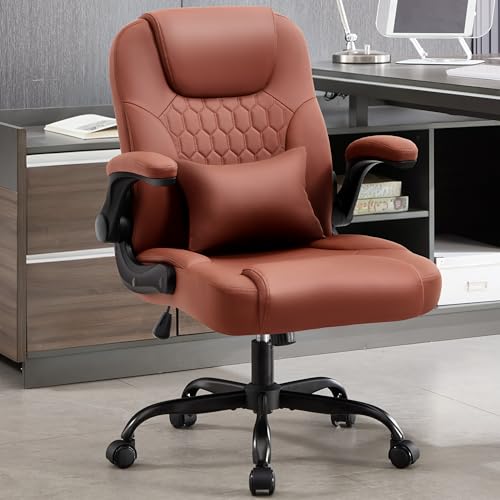
The Nexthro brings the executive format down to a shorter user’s scale: its verified listing describes a leather office chair with swivel lumbar support for short people, in brown — an executive PU leather chair with wheels, 360-degree swivel and a padded arm design, positioned as an ergonomic computer chair. It is the pick for buyers who want their chair to look like the corner office while fitting like the petite category.
Strengths
- Executive leather styling sized for short people — a rare combination
- Lumbar support built into the executive format
- Padded arms and full swivel in a composed, professional design
Trade-offs
- PU leather is warmer and less breathable than mesh
- Fewer stated adjustments than the MUSSO’s petite feature set
- Brown executive palette suits traditional offices, not every home setup
Key specs (from the verified listing): For short people; PU leather executive design; lumbar support; padded arms; 360° swivel; Brown.
Styling is not a trivial criterion in a chair you look at all day in a home you also live in. The Nexthro’s proposition is that a shorter user should not have to choose between a chair that fits and a chair that looks like success — the executive silhouette, the leather finish and the padded arms deliver the boardroom register in proportions that let a shorter sitter’s feet and back land where they should.
The honest trade is breathability and adjustment range: this is a composed, comfort-led executive chair rather than an ergonomic instrument panel. Buyers whose priority is tuning should take the MUSSO; buyers whose priority is a chair that fits a shorter frame and elevates the room should take this one.
Best for: shorter users who want executive looks without the oversized fit. Not suited for: hot rooms or adjustment maximalists. Check the current price on Amazon.

NEO CHAIR Small Office Chair — Best Compact
The NEO CHAIR takes the opposite route to fit: shrink the chair. Its verified listing describes a small office chair with wheels — an armless mesh desk chair in black, with adjustable height, positioned as a comfortable small computer chair for small spaces. Armless and compact is a legitimate ergonomic strategy for shorter users: no arms to collide with the desk or hold the elbows too high, and a footprint that suits the small rooms where shorter desks live.
Strengths
- Small-space format that suits petite users and petite rooms alike
- Armless design: nothing forces elbows up or blocks the desk approach
- Mesh back for breathability at a value tier
Trade-offs
- No armrests at all — long typing days lose forearm support
- No stated lumbar system beyond the mesh back’s shaping
- Compact brief: larger users should not apply
Key specs (from the verified listing): Small office chair; armless; mesh; adjustable height; wheels; Black. (Brand: NEO CHAIR, per the cache record.)
There is a real ergonomic argument for armless in this category. Fixed arms are sized for the average user too — too high and too wide for a petite frame — and a wrong armrest is worse than none, because it either shrugs the shoulders or holds the sitter away from the desk. The NEO CHAIR removes the variable entirely and lets the desk edge and the user’s own posture do the work, in a chair small enough that a shorter user’s feet and back meet their marks.
Its limits are equally clear: it is a compact, value-tier chair without a stated lumbar mechanism, best for moderate daily hours, students and small home offices. As a first petite-format chair — or the chair for a small second desk — it is honestly specified and honestly priced by its category.
Best for: small rooms, students and petite users who prefer armless simplicity. Not suited for: long typing days needing arm support, or larger users. Check the current price on Amazon.

Ergonomic Office Chair with 3D Arms and Headrest — Best Full-Featured Adjustability
This high-back ergonomic chair is the standard-format answer to a petite problem: its verified listing states adjustable lumbar support, 3D arms and a headrest, in a wide-seat desk chair format with wheels, in black. The listing title does not name a brand, and this guide will not invent one — what it names is the adjustment set, and the adjustment set is precisely the point for a shorter user fitting a standard chair.
Strengths
- Adjustable lumbar support: position it at a shorter back’s actual curve
- 3D armrests adjust in height, width and angle — petite shoulders included
- Headrest and high back extend its use to calls and reading
Trade-offs
- Wide seat may be too deep for the shortest users — measure before ordering
- Brand is not stated in the listing title; buy on the stated specifications
- Full-featured chairs need a deliberate setup session to earn their keep
Key specs (from the verified listing): Adjustable lumbar support; 3D arms; headrest; high back; wide seat; wheels; Black. (Brand not stated in the listing title.)
Adjustable lumbar support is the single feature that lets a standard chair serve a shorter back, because the failure it fixes is positional: a fixed pad lands where the average spine curves, and a shorter spine curves lower. A pad that travels lets you put the support at your belt line, and 3D arms complete the fit by coming inboard and down to where petite elbows actually rest. Set up with care, this chair can fit a shorter user better than a petite-labelled chair with fixed geometry.
The wide seat is the one measurement to interrogate: width is comfort, but depth is fit, and the shortest users should confirm the seat depth against their thigh length using the method in the buying guide. If the numbers work, this is the most capable all-rounder in the list.
Best for: shorter users who want a full-featured standard chair they can dial down to fit. Not suited for: the very shortest users if the seat depth measures too deep. Check the current price on Amazon.

LEAGOO Office Chair with Foot Rest — Best With Footrest
The LEAGOO closes the list with the cosiest interpretation of the petite brief: its verified listing describes a mid-back ergonomic executive chair with a foot rest — a comfy desk chair for short women, with swivel, adjustable height and a reclining teddy fleece finish for the home office, in White. The footrest is the headline for this search: supported feet are the foundation the whole fit chain stands on.
Strengths
- Built-in foot rest answers the dangling-feet problem in the product itself
- Designed for short women, per the listing — petite brief, not petite afterthought
- Teddy fleece finish makes it the comfort-first, home-friendly pick
Trade-offs
- Teddy fleece is warm and informal — not a corporate aesthetic
- White upholstery shows home-office life honestly
- Comfort-led design has fewer stated ergonomic adjustments than the MUSSO
Key specs (from the verified listing): For short women; foot rest; mid-back; adjustable height; swivel; reclining; teddy fleece; White.
The footrest deserves its headline status for a mechanical reason this guide has repeated deliberately: when feet dangle, the pelvis slides, the back leaves the backrest, and every other feature on the chair is unemployed. A chair that builds the foot platform in — rather than asking you to buy a separate footrest and trip over it — keeps the whole chain intact through the day, and lets the recline become a genuine rest position for reading and calls.
Choose the LEAGOO when the chair’s home is a bedroom-desk or a cosy study and its user values the comfort register; choose the MUSSO when the same user wants mesh, more adjustment and a more technical chair. Both take the petite brief seriously, which is rarer in this category than it should be.
Best for: shorter users who want a built-in footrest and a soft, home-first chair. Not suited for: formal offices or heat-sensitive users. Check the current price on Amazon.
Comparison Table
| Pick | Badge | Key spec | Best for |
|---|---|---|---|
| CHEJODAX Executive | Best Overall Fit | Stated 5’2″-5’7″ range, 4.1″ cushion | Petite users, executive comfort |
| MUSSO E80 Air Petite | Best Adjustable Petite | 3D lumbar, 4D headrest, footrest, mesh | Maximum tuning |
| Nexthro Leather | Best Executive Style | PU leather, lumbar support, for short people | Professional looks |
| NEO CHAIR Small | Best Compact | Armless small mesh chair | Small rooms, students |
| Ergonomic Chair 3D Arms | Best Adjustability | Adjustable lumbar, 3D arms, headrest | Dialling a standard chair down |
| LEAGOO with Foot Rest | Best With Footrest | Built-in foot rest, teddy fleece | Home comfort |
Key Takeaways
- For shorter users, discomfort is usually geometry: seat depth, seat height and lumbar position all sized for someone taller than you.
- Stated fit ranges (CHEJODAX’s 5’2″-5’7″) and petite-specific designs beat standard chairs left at their factory settings every time.
- Feet first: a footrest — built in on the MUSSO and LEAGOO — keeps the pelvis back and the whole back against the backrest.
- No chair treats a back problem; the right chair removes the daily fit insults. Persistent pain deserves a clinician’s attention, not a steeper recline.
- Measure three numbers — popliteal height, thigh length, seated belt height — and this category stops being guesswork entirely: every verdict in this guide is those numbers, applied honestly.
How to Choose an Office Chair When You Are Shorter
Measure yourself before you measure chairs
Three numbers decide everything in this category. Popliteal height: sit on a hard chair with feet flat and measure from the floor to the crease behind your knee — your seat must go at or below this, or your feet dangle. Buttock-popliteal length: from the back of your hip to that same knee crease — the chair’s seat depth must be shorter than this by about two fingers, or you will perch. Sitting lumbar height: roughly your belt line when seated — where any lumbar pad must be able to reach and rest. Take ten quiet minutes with a tape measure and this category stops being guesswork.
Seat depth: the petite deal-breaker
Of all dimensions, depth is the one that cannot be adjusted away on most chairs, which is why petite-specific designs (CHEJODAX, MUSSO, LEAGOO) lead this guide. If you are considering a standard chair like the 3D-arms ergonomic pick, its seat depth is the first number to verify against your thigh measurement. A seat two inches too deep silently converts every other feature — lumbar pad, backrest, recline — into decoration, because you will spend the day on the front edge, away from all of them.
Lumbar support: position over pressure
For a shorter back, where the support sits matters more than how firm it is. A pad that can travel (the adjustable designs here) or a backrest designed at petite scale (CHEJODAX, MUSSO) puts support at your belt line; a fixed pad on a standard chair often lands mid-back, pushing the wrong segment. Judge any chair by this test in the first sitting: with your back fully against the rest and feet supported, the pad should fill the small of your back without shoving you forward. Comfort framing only — support you can feel as gentle contact, not as a corrective force.
Arms and desk height for shorter users
Standard desks are also built for the average body, which compounds the chair problem: a shorter user may need the seat raised for the desk, which dangles the feet, which is why footrests recur throughout this guide. Arms should meet your forearms with shoulders fully relaxed; flip-up arms (CHEJODAX, MUSSO) and 3D arms (the ergonomic pick) solve the collision problems petite setups create, and the armless NEO CHAIR shows the legitimate alternative of removing the variable.
Materials for long days in small rooms
Small rooms run warm, and petite chairs are often bought for exactly those rooms. Mesh (MUSSO, NEO CHAIR) breathes through long sessions; faux leather and PU (CHEJODAX, Nexthro) bring the executive register and more warmth; teddy fleece (LEAGOO) is a deliberate comfort choice for cooler homes. Match the material to the room’s real temperature in August, not its temperature on the day you shop.
How to Set Up a Chair for a Shorter Frame
- Feet first: set seat height so your feet rest fully and flat — on the floor, or on the chair’s footrest (MUSSO, LEAGOO) if the desk demands a higher seat than your legs would choose.
- Depth check: sit fully back against the backrest; confirm roughly two fingers of clear space between the seat edge and the back of your knees.
- Back contact: your whole back should meet the backrest without leaning or stretching — if you must choose between back contact and knee comfort, the chair’s depth is simply wrong for you.
- Lumbar position: move the pad (where adjustable) until it fills the small of your back at belt height; on fixed designs, verify the pad is not pressing into your mid-back instead.
- Arms: set height so forearms rest level with shoulders dropped and relaxed; flip arms up and away if they collide with the desk edge.
- Screen: raise the monitor on books or a stand until the top third is near eye level — a petite setup fails at the screen more often than at the chair. Laptop users should treat an external keyboard as part of the chair budget: it is what allows the screen to rise without the keyboard following it out of reach.
- Move: stand and walk briefly every hour; the best-fitted chair in this guide is still a chair, and variety is part of the ergonomics. Set a timer if your work absorbs you — in a well-fitted chair it is easy to sit beautifully for three hours and call it ergonomics, when movement was the missing ingredient all along.
Common Buying Mistakes
- Buying the standard chair on sale. A discounted misfit is still a misfit at any price; fit is the product in this category, and a chair that does not fit is expensive at every price including free.
- Judging by cushion softness. A thick seat on a too-deep chair raises you further from the backrest and shortens the usable depth not at all. Depth first, padding second, softness last — the order matters because each earlier item can veto the later ones.
- Ignoring minimum seat height. Brochures celebrate ranges; check the low end against your popliteal measurement, because that is where petite users live. A chair whose range starts two inches above your measurement is not “almost right” — it is a chair plus a mandatory footrest, and it should be priced and judged that way.
- Expecting a chair to treat pain. Chairs provide fit and comfort, nothing more. Ongoing back pain needs professional assessment — buy the chair for geometry, and get qualified advice for the rest.
- Skipping the footrest question. If the desk forces a higher seat, supported feet are not optional equipment; choose a chair with one built in or budget for the accessory from the start, not after a month of dangling.
- Assuming “petite” in a title means petite in fact. Prefer listings that state a height range or petite-specific features, as the picks here do, over labels alone. When a listing gives neither a range nor a single petite-specific feature, treat the word as decoration and measure the chair as if it were standard — because it is.
Final Recommendation
Start with the chair designed for your height: the CHEJODAX for its stated 5’2″-5’7″ brief and executive comfort, or the MUSSO E80 Air Petite if you want mesh and maximum adjustment including a footrest. The LEAGOO is the comfort-first footrest pick, the Nexthro the executive look at petite scale, the NEO CHAIR the compact value, and the 3D-arms ergonomic chair the choice when you would rather dial a full-featured standard chair down to your measurements.
Related guides: Best Desk Chairs For Petite Women, Best Office Chairs For Person Small Or Petite, Best Inexpensive Office Chairs For Bad Backs, Best Ergonomic Office Chairs Back Pain, and Best Recliner Chairs For Short People.
Deep Dive: The Fit Chain, Link by Link
It helps to see a shorter user’s discomfort as a chain of small mechanical failures, each causing the next. It starts at the floor: feet unsupported, the weight of the legs pulls the pelvis forward. The pelvis rotating forward slides the sitter toward the seat’s front edge — which a too-deep seat was already encouraging. Off the backrest now, the sitter’s back rounds into a slump that no lumbar pad can reach, because the pad is behind empty air. Shoulders follow the slump forward, the head cranes toward the screen, and by mid-afternoon the whole posture is being held up by muscle effort instead of furniture. Every link in that chain is a fit variable this guide has named — seat height, foot support, seat depth, back contact, lumbar position, arm height, screen height — and every pick here was chosen because it breaks the chain at one or more links by design rather than by luck. That is also why the setup section starts at the feet: fix the first link and the rest of the chain often falls into place; fix only the last link, with an expensive chair left at the wrong height, and the chain quietly re-forms by lunchtime.
When the Chair Is Not the Problem
Honesty requires a section this category usually skips. Sometimes the chair is fine and the desk is wrong — too high, forcing the seat up and the feet off the floor; the cure may be a footrest or a lower desk, not a new chair. Sometimes the screen is the culprit, sitting at laptop height and pulling the whole upper body down toward it for years. And sometimes discomfort has nothing to do with furniture at all, which is why this guide repeats its one medical sentence without embarrassment: persistent, worsening or radiating back pain should be assessed by a clinician. Buy the chair to solve the geometry — the geometry is real, measurable and fixable — and let professionals handle everything beyond it. A guide that promises more than geometry is selling you something, and it is not a chair.
Setup Notes for Each Pick
CHEJODAX: use the flip-up arms as your desk test — if the chair cannot tuck under with arms down, work with them up rather than sitting further out. MUSSO E80: set the footrest before the lumbar; feet change pelvis position, and lumbar set against a slid pelvis is set wrong. Give the 4D headrest a week at its lowest intrusion before deciding it is not for you. Nexthro: executive padding compresses a little in the first fortnight — re-check your seat height after two weeks, because an inch of settle changes the desk relationship. NEO CHAIR: with no arms, let the desk carry your forearms and keep the chair pulled in close; its compactness is the feature, so resist pushing it back into a perch. 3D-arms ergonomic chair: measure the seat depth against your thigh before unboxing fully; then set lumbar height first, arms second, headrest last. LEAGOO: the footrest and recline are one system — set them together, upright for typing, extended for calls, and the chair will feel like two pieces of furniture in one footprint.
The Desk and Screen Half of a Petite Setup
A petite chair at a standard desk is half a solution. Desk height is the fixed variable most shorter users cannot change, so the adjustments happen around it: the seat rises to meet the desk, the footrest (built-in on two picks here, an accessory with the rest) restores foot support at that raised height, and the screen rises on a stand or a stack of books until its top third meets eye level. Keyboard position matters too — a keyboard tray or a shallower desk keeps elbows at your sides rather than reaching forward, which is the quiet cause of much shoulder tension blamed on chairs. Lighting finishes the setup: a screen you squint at pulls your head forward no matter how good the chair is. None of this is expensive, and all of it multiplies the value of the chair you choose from this guide — geometry is a system, and the chair is its most important single part, not its only part.
What We Left Out, and Why
The wider data for this category includes lumbar cushions, seat cushions and standalone footrests — useful accessories, excluded here because the search asks for chairs, and because recommending a cushion as a chair would hide the fit problem it patches. Standard ergonomic chairs without petite design or meaningful lumbar adjustment range were also passed over: in this category, an average chair is not a neutral choice but the original problem. Finally, any listing whose appeal rested on medical promises was set aside regardless of its hardware; this guide recommends geometry, and its claims stop where a clinician’s begin.
The First Week: What Correct Fit Feels Like
Expect a correctly fitted chair to feel strangely unremarkable — and to make your old chair feel remarkable in retrospect. Day one is measurement and setup, following the sequence in this guide, and most users notice the foot question first: supported feet change the whole sitting posture without any conscious effort. By day three, the tells are behavioural — you stop perching, stop crossing your legs to manufacture a footrest, and stop standing up to stretch out a stiffness you had accepted as normal. By the end of the week, judge the chair by the fit chain, not by novelty: back in contact at 4 p.m., feet still supported, lumbar pad still where you set it. If a link has failed — the pad has migrated, the seat still pushes you forward — adjust that link specifically rather than condemning the chair. And keep the honest boundary in view: a week of better geometry is a comfort outcome, and any pain that predates the chair and persists through correct fit deserves the professional assessment this guide keeps recommending.
For Students and Teenagers of Petite Build
A large share of shorter users first meet this problem at a study desk, and the economics differ from the office case: budgets are smaller, hours are long, and the user may still be growing. The NEO CHAIR’s compact value format is the natural student pick here, and the MUSSO’s adjustment range is the pick for a teenager whose measurements will change — range is future-proofing. What students should not do is inherit the household’s standard chair and a cushion and call it ergonomics; the fit chain does not care about the user’s age, and study hours are as long as office hours. Parents buying for a petite teenager should run the same three measurements from the buying guide and choose by them — a chair that fits at sixteen, with range to spare, is cheaper than two chairs that never quite did.
Related guides
Frequently Asked Questions
What seat height do I need if I am around 5’2″?
Work from your own popliteal measurement — floor to the crease behind your knee, measured sitting with feet flat — rather than from height charts. Your chair’s minimum seat height must reach that number or below. The CHEJODAX states its design range as 5’2″-5’7″, which is the kind of explicit guidance to look for; on any other chair, verify the low end of its height range before ordering. Remember the desk’s vote in this: if your desk is high, your working seat height may end up above your popliteal number no matter what the chair can do — and that is precisely the case the built-in footrests on the MUSSO and LEAGOO exist for, restoring foot support at a height the desk imposed.
Can the right chair fix my back pain?
No chair can promise that, and this guide does not claim it. A correctly fitted chair removes the daily strain of bad geometry — dangling feet, perching, unreachable backrests — which is a comfort and ergonomics improvement many shorter users feel immediately. Pain that persists, worsens or radiates needs a clinician’s assessment, not a product upgrade. Holding both ideas at once is the mature way to shop this category: take the geometry seriously, because it is real and fixable today, and take persistent pain equally seriously, because it deserves better than a purchase. The chairs here are excellent answers to the first problem and make no pretence about the second.
Is a footrest really necessary?
If your desk height forces your seat up beyond your popliteal height, yes — supported feet are what keep your pelvis back and your back in contact with the backrest. Two picks here build the footrest in (MUSSO, LEAGOO); with any other chair, a separate footrest is the highest-value accessory in this category. The test is simple: sit at your desk as you normally do and look down. If your feet are hooked around the chair’s base, tucked under you, or resting on their toes, your body has been improvising a footrest all along — give it a real one and the improvisation, and the posture it produced, can retire.
Why do standard chairs feel fine in the shop and awful by Friday?
Because a five-minute sit tests cushion, and a work week tests geometry. Perching feels alert and upright at first; the cost accumulates across hours as muscles substitute for the backrest you are not touching. Judge any chair by the fit checks in this guide — feet, depth, back contact, lumbar position — rather than by first impressions. If you are testing in a shop, simulate the week in miniature: sit for a full ten minutes, feet where they would be at your desk, and notice whether you have migrated to the front edge. Migration in ten minutes is a prophecy of migration by Friday, and it is a far more reliable signal than the softness of the first thirty seconds.
Petite-labelled chair or adjustable standard chair?
Both routes work, and this guide includes both. Petite designs (CHEJODAX, MUSSO, LEAGOO) solve depth and proportion by construction. Adjustable standard chairs (the 3D-arms pick) solve them by range — provided the seat depth, the one dimension that rarely adjusts, fits your thighs. Measure first; the tape decides which route is yours. One more consideration: households change. A petite-only chair is a commitment to one user’s measurements, while an adjustable chair can follow a teenager’s growth or a change of desk. Buy the construction if your setup is stable, the range if it is not.
What if I share the desk with a taller partner?
Choose adjustment range and speed over petite specialisation: a chair both users can re-dial in seconds, with agreed remembered settings. The full-featured ergonomic pick here is the natural shared choice, while a petite-only design will fit one of you at the cost of the other — in shared setups, range is the kindness. A practical trick for shared chairs: mark each user’s seat height with a small tape flag on the cylinder, and agree that whoever sits down resets the lumbar before working. Ten seconds of ritual preserves both users’ fit better than any memory mechanism at this tier.


