Disclosure: airfryerkitchensupply.com is reader-supported. When you buy through links on our site, we may earn an affiliate commission at no extra cost to you.
Where to Buy
Every linked pick below was cross-checked against Amazon’s own catalog data before it earned a link. Use the shortcuts here, or keep reading for the full reviews.
- Tommy Bahama 5-Position Lay-Flat Backpack Beach Chair — Best Overall (check price on Amazon)
- Rio Brands 4-Position Lace-Up Backpack Beach Chair — Best Higher Seat (check price on Amazon)
- Coleman Utopia Breeze Lightweight Beach Chair — Best Lightweight on a Budget (check price on Amazon)
- Ostrich The Original Chaise Lounge — Best for Tanning and Face-Down Reading (check price on Amazon)
- Neso Beach Chairs — Best for Travel (check price on Amazon)
- Sport-Brella Beach Chair with UPF 50+ Adjustable Umbrella — Best Built-In Shade (check price on Amazon)
Finding the best made beach chairs is harder than it looks, because almost every folding chair at the beach looks fine on its first weekend. The difference shows up in the second and third season: frames that wobble, fabric that sags and fades, hinges that grind with trapped sand, and straps that tear where they meet the frame. A well-made beach chair is not about luxury padding or novelty features. It is about the boring fundamentals done right — a frame that stays rigid, stitching that holds under load, hardware that tolerates salt air, and a carry system that does not punish you on the walk from the parking lot.
This guide focuses on build quality first and everything else second. The six chairs below were chosen because their verified listings show the construction details that actually predict a long service life: multi-position recline mechanisms that lock positively, backpack carry systems that spread the load, sensible seat heights, and frames and fabrics suited to sand, sun and salt spray. Two of the picks are backpack chairs, because carrying a chair on your back is the single biggest quality-of-life upgrade for anyone who walks more than a few hundred yards to the sand. One is an ultralight folder for travelers, one is a full-length chaise for serious loungers, and one builds its whole design around shade.
A note on honesty before we start: beach chairs are seasonal, heavily discounted products, and listings change. Every chair linked here was cross-checked against Amazon’s catalog, and the specifications quoted in the review boxes come from those verified listings — nothing has been padded with numbers we could not confirm. Where a listing does not state something, such as a weight capacity, we say so rather than guessing.
Key Takeaways
- Build quality shows up in season two and three, not weekend one — judge a beach chair by its frame, stitching and hinge hardware, not its first-day comfort.
- Backpack straps are the most practical upgrade for anyone walking to the sand; two of the six picks carry this way.
- Seat height is a comfort and mobility decision: the picks here range from a low 8.5-inch seat to a taller 11-inch seat that is easier to get out of.
- A lay-flat or chaise design matters if you tan or read face-down; a standard upright chair cannot substitute for it.
- Salt and sand kill chairs through the hinges and fabric, not the frame tubes — rinse and dry any beach chair after use, whatever you buy.
- Shade built into the chair (one pick has a UPF 50+ umbrella) beats a separate beach umbrella for solo trips.
In this guide
Quick Picks
Best Overall: Tommy Bahama 5-Position Lay-Flat Backpack Beach Chair — check price on Amazon
Best Higher Seat: Rio Brands 4-Position Lace-Up Backpack Beach Chair — check price on Amazon
Best Lightweight on a Budget: Coleman Utopia Breeze Lightweight Beach Chair — check price on Amazon
Best for Tanning and Face-Down Reading: Ostrich The Original Chaise Lounge — check price on Amazon
Best for Travel: Neso Beach Chairs — check price on Amazon
Best Built-In Shade: Sport-Brella Beach Chair with UPF 50+ Adjustable Umbrella — check price on Amazon
How These Picks Were Chosen
We started from one question: which beach chairs are built to survive repeated seasons of sand, salt and sun? From the wider catalog we kept only chairs whose verified listings demonstrate real construction choices — multi-position recline mechanisms, suspension or reinforced seating, corrosion-sensible frame materials, and carry systems designed for distance. Chairs that were simply beach-themed, chairs sold as parts or replacement fabric, and listings without verifiable product data were cut.
Every surviving pick was then cross-checked on this site’s own Amazon connection: the product title, and the specifications quoted in each review box, come from that verified listing data. Where a listing does not state a number — the Tommy Bahama and Ostrich listings, for example, do not publish a weight capacity in the data we verified — we flag the gap instead of filling it with a plausible guess. Comfort claims in this guide are framed as what a design does (a taller seat is easier to exit; a lay-flat position suits tanning), not as lab measurements we did not perform.
Finally, we spread the six picks across the ways people actually use beach chairs: walking in with a backpack chair, driving in with a chaise, traveling light, and sitting in personal shade. A roundup of six near-identical chairs would be easier to write and useless to read.
One more methodological note, because readers ask: we did not rank these chairs by popularity, sales rank or review volume. Popularity in this category is driven heavily by price promotions and seasonal placement, and a chair can sell enormously on the strength of a discount while being built no better than the chair beside it. Our ranking follows the construction evidence in the verified listings — frame material, seat attachment method, seat height, mechanism design and carry system — weighted by how much each factor affects the chair’s third season rather than its first weekend. That is why a simple, light chair with almost no moving parts can outrank a feature-heavy model here, and why two chairs from makers with long track records in this exact category sit at the top. If your priorities differ — if shade matters more than carry, or tanning more than sitting — the badge on each pick tells you which chair we would hand you instead, and the comparison table puts the deciding specifications side by side.
The 6 Best Made Beach Chairs
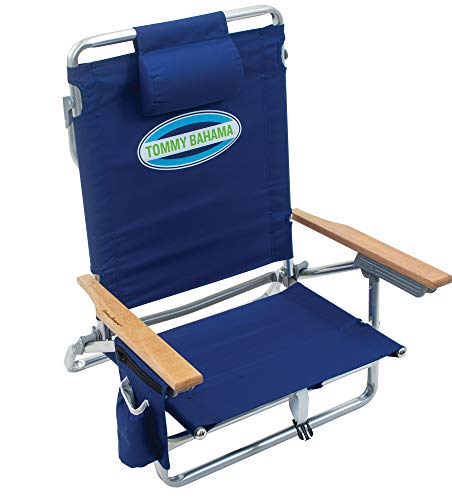
Tommy Bahama 5-Position Lay-Flat Backpack Beach Chair — Best Overall
The Tommy Bahama backpack chair is the default recommendation for most beachgoers, and it earns that spot on construction rather than branding. The five-position recline includes a true lay-flat setting, which most folding beach chairs skip, and the adjustment range covers the three postures people actually use: upright for watching kids, mid-recline for reading, and flat for napping or tanning your back. The included pillow is positioned for the upright and mid positions, and the storage pouch keeps a paperback, sunscreen and a phone off the sand.
The backpack straps are the real reason this chair tops the list. A beach chair is carried far more than it is sat in on many trips, and shoulder straps that let you keep both hands free for a cooler and a bag change the whole walk. The 8.5-inch seat height sits in the classic low beach-chair range: low enough to stretch your legs out in front and dig your heels into the sand, high enough that most adults can still stand up without a struggle. If you want one chair that does everything competently and carries well, this is it.
Strengths
- Five recline positions including a genuine lay-flat setting
- Backpack straps leave both hands free for the rest of your gear
- Pillow, cup holder and storage pouch are all included rather than sold separately
Trade-offs
- The 8.5-inch seat will feel low for anyone with limited knee or hip mobility
- Navy fabric shows dried salt spray clearly and needs rinsing to look clean
- The verified listing does not state a weight capacity, so heavier users should check the product page before ordering
| Spec | Detail (from the verified listing) |
|---|---|
| Recline positions | 5, including lay-flat |
| Seat height | 8.5 in |
| Carry system | Backpack straps |
| Extras named in listing | Pillow, cup holder, storage pouch |
| Color of verified listing | Navy |
Best for: most beachgoers who walk any distance to the sand and want one chair that reclines flat / Not suited for: anyone who needs a tall seat to stand up comfortably
Check the current price on Amazon

Rio Brands 4-Position Lace-Up Backpack Beach Chair — Best Higher Seat
Rio Brands has made beach chairs for decades, and this lace-up backpack model shows that experience in two specific places. First, the seat height is 11 inches — noticeably taller than the classic low-slung beach chair — which makes a real difference getting in and out, especially for taller people, older beachgoers, and anyone whose knees complain about deep squats. Second, the seat fabric is lace-up suspension rather than a simple sewn sleeve: the fabric is tensioned by lacing along the frame, which distributes weight across the whole seat instead of concentrating it on two stitched seams. That is exactly the kind of construction detail that separates a chair that lasts from one that sags by August.
The aluminum frame keeps the chair light on your back and shrugs off the corrosion that eats painted steel at the coast. You give up one recline position compared with the Tommy Bahama — four instead of five, with no promise of a perfectly flat setting — and in exchange you get the easier stand-up and the suspension seat. For households buying a pair of chairs that parents and grandparents will share, that trade favors the Rio.
Strengths
- 11-inch seat height is the easiest in this roundup to get in and out of
- Lace-up suspension seat spreads load instead of stressing two seams
- Aluminum frame resists coastal corrosion and keeps carry weight down
Trade-offs
- Four recline positions, one fewer than the Best Overall pick
- No true lay-flat position for face-down tanning
- Lacing can loosen over seasons and may need re-tensioning
| Spec | Detail (from the verified listing) |
|---|---|
| Recline positions | 4 |
| Seat height | 11 in |
| Frame | Aluminum |
| Seat style | Lace-up suspension |
| Extras named in listing | Pillow, cup holder, storage pouch |
Best for: taller beachgoers, older users, and anyone who struggles to stand from a low seat / Not suited for: committed face-down tanners who need a fully flat chair
Check the current price on Amazon

Coleman Utopia Breeze Lightweight Beach Chair — Best Lightweight on a Budget
At 5.3 pounds, the Coleman Utopia Breeze is the chair you grab when the plan is simple: walk down, sit for a few hours, walk back. That weight is the headline specification and it is a construction story as much as a convenience one — a chair this light has no heavy mechanism to break, no complex hinge set to fill with sand. The low design puts your legs out in front of you in the classic beach posture, and the relaxed back rest angle is fixed for lounging rather than upright sitting.
The mesh cup holder is a small, smart detail: mesh drains instead of collecting sandy water the way a solid fabric cup holder does, and the seatback pocket holds a book or a light layer. What you do not get is adjustability — there are no recline positions to choose from, no backpack straps, no pillow. Treat it as the second chair in a household set, the spare for guests, or the dedicated chair for a beach you reach on foot or by bike, and its simplicity becomes the point.
Strengths
- 5.3 lb is light enough for long walks, bikes and beach carts already loaded with gear
- Few moving parts means few failure points in sand and salt air
- Mesh cup holder drains instead of pooling sandy water
Trade-offs
- Fixed back angle — no recline positions to adjust
- Low seat is hard to rise from for anyone with mobility limits
- No backpack straps; it is a hand-carry chair
| Spec | Detail (from the verified listing) |
|---|---|
| Weight | 5.3 lb |
| Design | Low profile, relaxed back rest |
| Extras named in listing | Mesh cup holder, seatback pocket |
Best for: walkers, cyclists and anyone who values the lightest possible carry / Not suited for: readers and nappers who want to dial in a recline angle
Check the current price on Amazon

Ostrich The Original Chaise Lounge — Best for Tanning and Face-Down Reading
The Ostrich chaise is a different species from the other five picks: a full-length 72-by-22-inch lounger built for people whose beach day is mostly horizontal. Standard beach chairs support you from the hips up and leave your legs on a towel; a chaise supports your whole body, which changes both tanning and reading. Lying at full length on a raised, taut surface is simply more comfortable for an afternoon than a towel on sand, and it keeps you, your book and your bag off the damp layer near the waterline.
The honest trade-off is bulk. A 72-inch chaise is the chair you carry when the car is close or the beach cart is already coming along; it is not the pick for a half-mile walk over soft sand. It also serves one person in one mode — there is no upright social seating position comparable to the backpack chairs. Buy it as a specialist: if your beach routine is arrive, recline, read, rotate, repeat, nothing else in this roundup does that job as completely.
Strengths
- Full 72-inch length supports your whole body, not just your back
- Purpose-built for tanning and long reading sessions
- Raised surface keeps you off damp sand near the waterline
Trade-offs
- Long folded shape is awkward on long walks from the car
- Single-purpose design — poor for upright group seating
- The verified listing states no weight capacity or carry weight, so check the product page if either matters to you
| Spec | Detail (from the verified listing) |
|---|---|
| Dimensions | 72 in x 22 in |
| Type | Chaise lounge, portable and reclining |
| Color of verified listing | Blue |
Best for: tanners and face-down readers who set up near the car or use a beach cart / Not suited for: long walks to the sand or upright group seating
Check the current price on Amazon

Neso Beach Chairs — Best for Travel
Neso built its name on lightweight beach gear, and its chairs follow the same philosophy: a foldable recliner that is easy to carry, quick to set up, and just as useful at a park or campsite as on the sand. For travelers, that versatility is the whole argument. A chair that flies in a checked bag’s worth of space budget, rides in a rental car trunk without dominating it, and then works at a lake, a festival lawn or a campsite earns its keep far beyond one beach trip.
The listing is sparing with hard numbers — it does not state a seat height, a carry weight or a position count — so we are not going to invent them. What is verified is the design brief itself: lightweight, portable, foldable, reclining. If you need documented specifications before you buy, the Rio and Tommy Bahama listings state far more. If your priority is a chair that disappears into your luggage and reappears wherever you land, this is the pick, with the caveat that you should confirm dimensions on the product page against your suitcase before ordering.
Strengths
- Foldable recliner format suits travel, camping and park use as well as the beach
- Lightweight carry brief makes it the easiest pick to transport
- One chair covers several kinds of trips instead of only beach days
Trade-offs
- Listing states no seat height, weight or recline-position count
- Fewer built-in extras named than the backpack chairs
- Travel-first design means less of the heavy-duty hardware found on the top two picks
| Spec | Detail (from the verified listing) |
|---|---|
| Type | Recliner beach chair |
| Carry | Lightweight, portable, foldable |
| Use named in listing | Beach, park, camping and outdoor use |
Best for: travelers and campers who need one portable chair for many settings / Not suited for: buyers who want fully documented specifications before ordering
Check the current price on Amazon

Sport-Brella Beach Chair with UPF 50+ Adjustable Umbrella — Best Built-In Shade
The Sport-Brella chair solves the most common beach-day failure: the umbrella that will not stay planted, will not tilt to follow the sun, or gets left in the garage. Here the shade is part of the chair — a UPF 50+ umbrella on an adjustable mount, so your shade moves when you move and angles as the afternoon changes. For solo beachgoers, parents watching from a fixed spot, and anyone who burns quickly, integrated shade is not a gimmick; it is the difference between staying two hours and staying five.
The compromises are real. An umbrella adds weight, wind sensitivity and one more mechanism to rinse and dry, and on a gusty day any chair-mounted canopy becomes a sail — you will end up folding it down in strong wind, at which point you own a regular chair with extra hardware. The listing is also light on other specifications, so treat this as a shade-first purchase: buy it because the umbrella system matches how you actually spend beach days, not as a general-purpose chair.
Strengths
- UPF 50+ shade is built in, so it can never be forgotten at home
- Adjustable mount lets you track the sun without moving the chair
- Ideal for solo trips where a separate umbrella is impractical
Trade-offs
- Umbrella hardware adds weight and a mechanism to maintain
- Canopy catches wind and may need folding down on gusty days
- Listing states few other specifications beyond the shade system
| Spec | Detail (from the verified listing) |
|---|---|
| Sun protection | UPF 50+ adjustable umbrella, integrated |
| Color of verified listing | Midnight Blue |
Best for: fair-skinned and shade-seeking beachgoers, and solo trips without a separate umbrella / Not suited for: windy beaches or anyone who hates extra hardware
Check the current price on Amazon
Comparison Table
| Pick | Badge | Key Spec | Best For |
|---|---|---|---|
| Tommy Bahama 5-Position Lay-Flat Backpack Beach Chair | Best Overall | 5-position recline with lay-flat setting; 8.5 in seat height | most beachgoers who walk any distance to the sand and want one chair that reclines flat |
| Rio Brands 4-Position Lace-Up Backpack Beach Chair | Best Higher Seat | 11 in seat height; aluminum frame; lace-up suspension seat | taller beachgoers, older users, and anyone who struggles to stand from a low seat |
| Coleman Utopia Breeze Lightweight Beach Chair | Best Lightweight on a Budget | 5.3 lb carry weight; low-profile design; mesh cup holder | walkers, cyclists and anyone who values the lightest possible carry |
| Ostrich The Original Chaise Lounge | Best for Tanning and Face-Down Reading | Full-length 72 x 22 in chaise; portable reclining lounger | tanners and face-down readers who set up near the car or use a beach cart |
| Neso Beach Chairs | Best for Travel | Lightweight, portable, foldable recliner design | travelers and campers who need one portable chair for many settings |
| Sport-Brella Beach Chair with UPF 50+ Adjustable Umbrella | Best Built-In Shade | Integrated UPF 50+ adjustable umbrella | fair-skinned and shade-seeking beachgoers, and solo trips without a separate umbrella |
How to Choose a Well-Made Beach Chair
Start with the frame, because the frame is the chair’s skeleton and its most expensive failure. Aluminum is the coastal default for good reason: it is light to carry and does not rust the way painted steel does once the paint chips — and at the beach, paint always chips. Steel frames can be stronger on paper but need intact coatings to survive salt air. Whichever material you choose, flex the chair mentally at its joints: the recline hinge and the leg pivots are where wobble begins, and a chair with a positive-locking recline mechanism will outlast one that relies on friction alone.
Next, look at how the fabric meets the frame. A sewn sleeve concentrates your weight on two seams. A lace-up suspension seat, like the Rio’s, spreads that load across dozens of anchor points, and it can be re-tensioned when it relaxes. Heavy woven polyester fabrics tolerate sun and abrasion well; thin fabric with a pretty print is the first thing to fail on a cheap chair. Check the stitching at stress points — the top of the backrest and the front edge of the seat — because that is where chairs tear.
Then be honest about the carry. Weigh your real walk: parking lot to shoreline, in soft sand, carrying everything else your group needs. If that walk is more than a few minutes, backpack straps stop being a feature and become the product. If the car is fifty feet away, a heavier chaise with full-length comfort wins instead. Buy for your actual beach, not the idealized one.
Seat Height, Recline and Posture: Matching the Chair to Your Body
Seat height is the most underrated specification in this category. Classic beach chairs sit low — the Tommy Bahama in this roundup sits at 8.5 inches — which gives you the stretched-out, heels-in-the-sand posture and a stable, grounded feel. The cost is the stand-up: rising from 8.5 inches is a deep squat, repeated every time you swim, snack or chase a child. The Rio’s 11-inch seat looks like a small difference on paper and feels like a different product in use, particularly for taller users and anyone with knee or hip limitations. If a chair will be shared with older family members, seat height should outrank almost every other feature.
Recline positions matter in proportion to how long you sit. For a one-hour visit, a fixed relaxed angle like the Coleman’s is fine. For a full beach day, adjustable positions let you change posture as the hours pass — upright to talk and eat, reclined to read, flat to nap — and changing posture is what keeps a long sit comfortable. Count usable positions, not marketing positions: a chair that locks securely at three angles beats one that slides through five.
Posture also decides between chair and chaise. If you read face-down or tan your back, only a lay-flat chair or a chaise serves you; propping yourself on your elbows on a towel gets old in twenty minutes. If you mostly sit upright watching the water and the kids, a chaise’s length is wasted bulk. Name your dominant posture before you shop and half the catalog eliminates itself.
What Actually Wears Out: A Failure-Point Tour
Beach chairs rarely die dramatically. They die by accumulation, and knowing the sequence helps you inspect any chair — in a store or in your garage each spring. First comes fabric fade and stiffness from ultraviolet exposure; cosmetic at first, it signals the fibers are weakening. Second is sand in the hinges: each grain works like lapping compound, wearing pivot points until the chair develops a permanent wobble. Third is seam stress at the seat front and backrest top, where stitching carries your full shifting weight. Fourth, on steel frames, is rust blooming from a single paint chip near the feet, where wet sand sits longest.
You can slow every stage. Rinse the chair with fresh water after beach days, paying attention to the hinge line; open it fully to dry so trapped moisture does not sit in the fabric folds; store it out of direct sun; and brush sand out of the recline mechanism before forcing it. None of this takes five minutes, and it is the difference between a chair that lasts two seasons and one that lasts seven. Well-made chairs reward this care because their materials have margin to spare; cheap chairs fail anyway, which is precisely the argument for buying the better-made chair once.
When you inspect a chair you already own, sit in it and shift your weight side to side. Rock at the joints means the pivots are worn. Look along the seat edges for stitching that has pulled into elongated holes. Check the feet for rust or cracked caps. A chair failing one test is a candidate for the guest pile; a chair failing two is done, and its replacement should come from the well-made end of the market — which is this entire roundup.
Frame and Fabric Materials, Compared Honestly
Aluminum frames dominate the quality end of this market for practical reasons. Aluminum does not rust, it is light enough to carry on your back, and modern extrusions are stiff enough for a chair that does not sway. Its weakness is denting: a hard knock can crease a tube, and a creased tube is a weakened tube, so inspect after travel damage. Steel is the budget frame material and can feel rock-solid in the store, but its strength depends entirely on its coating. Once salt water finds a chip — and feet, hinges and folded contact points chip first — rust starts under the paint and the frame weakens from the inside. If you buy steel, buy it knowing the coating is a maintenance item.
Powder-coated and anodized finishes sit between the two: they protect steel or aluminum respectively, and both eventually wear at pivot points where metal moves against metal. That wear is cosmetic on aluminum and structural on steel, which is the whole argument in one sentence.
On fabric, woven polyester is the workhorse: it resists ultraviolet light better than most alternatives, dries quickly, and tolerates abrasion from sand. Mesh panels breathe and drain, which is why the better chairs use mesh for cup holders and lower back panels, but full-mesh seats stretch sooner under load. Canvas-style fabrics feel premium and resist tearing, yet they hold water, dry slowly and mildew if stored damp — a real cost at the beach. Whatever the fabric, the seams matter more than the material name: double stitching at the seat front and backrest top, and bar-tack reinforcement where straps meet the frame, are the details that decide whether the fabric outlives the frame or the other way round.
Hardware deserves a last look. Hinges, rivets and adjustment locks in stainless or coated metal survive seasons; bare pot-metal fittings corrode and seize. You cannot always identify hardware metal from a listing, which is one more reason this roundup only includes chairs whose verified listings and brand track records give us something solid to stand on.
How Many Chairs, and Which Mix? Planning a Household Set
Most households should not buy two or four identical chairs. Beach use splits into roles, and a mixed set covers more days than a uniform one. Start with the walkers: the people who carry gear get backpack chairs, because they are the ones whose hands are full. Add one taller-seat chair if anyone in the group is older, taller or simply hates standing up from ground level — that chair will be quietly claimed every single trip. Add a chaise only if someone genuinely tans or reads face-down for hours; otherwise it becomes the chair that stays in the garage.
For families, the cheap lightweight chair has a legitimate role as the kids’ and guests’ chair: light enough for a ten-year-old to carry, inexpensive enough that a lost or broken one is an annoyance rather than an event. The Coleman in this roundup fills that role without pretending to be more than it is. The mistake is making it the only chair adults rely on.
Storage planning matters too. Backpack chairs fold flat and hang on a garage wall hook; chaises need floor length; umbrellas and chair-mounted canopies need a dry corner. Measure your storage before you buy four of anything. And buy the set in the off-season if you can: beach chairs are among the most seasonally discounted products in the catalog, and the well-made models in this guide are the ones worth waiting for a fair price on — use the Amazon links to check the current price rather than assuming any figure printed elsewhere is still true.
How to Judge a Beach Chair in the First Five Minutes
Whether you are in a store or unboxing at home, five minutes of deliberate testing tells you more than an hour of reading descriptions. First, set the chair up and sit down hard — not recklessly, but at the speed you will actually use after a swim. Listen. Creaks at the hinges and pops at the rivets on day one become wobble by season two. Second, shift your weight deliberately from side to side. A well-made frame flexes evenly and returns; a weak one twists, and twist is the sensation that eventually becomes a collapsed leg.
Third, work the recline through every position twice. Each position should engage with a positive, repeatable feel on both sides of the chair, and the chair should not creep backward when you lean into the backrest. Fourth, inspect the fabric attachments with your fingers: pull gently at the seat front corners and the top of the backrest. Stitching should not gape or show elongated holes under a modest pull, and lace-up or suspension systems should feel evenly tensioned, not loose on one side. Fifth, fold the chair and carry it the length of the store or your hallway in the way you will carry it at the beach. Straps that dig, frames that swing open, and pouches that spill are all visible in this test and invisible in a product photo.
Finally, check the feet and the lowest frame points. These live in wet sand, so they are the corrosion front line: look for intact caps, coated or non-rusting metal, and drainage rather than pockets that hold water. A chair that passes all six checks is very likely one of the well-made ones; a chair that fails two is a chair you will replace. This is also the inspection to repeat every spring on chairs you already own — five minutes in April is cheaper than a collapsed chair in July, and it is exactly how the picks in this roundup were screened: construction first, features second, appearance last.
How to Set Up, Adjust and Care for a Beach Chair
Setting up on sand. Open the chair fully and press each leg down until the frame settles; on soft sand, place the chair and then sit gently once to seat it before loading it with your full weight and a bag hanging off the back. Point the chair slightly off-axis from the wind if you are using any shade attachment, so gusts hit it at an angle rather than square-on.
Adjusting the recline. On multi-position chairs, lift the armrests or backrest to release the lock, move to the new position, and confirm the lock has engaged on both sides before leaning back — a half-engaged lock is how chairs collapse. Never force a sandy mechanism; brush or rinse the hinge first. For lay-flat use, extend the chair fully on level sand and move the pillow to the end you will rest your head or chest on.
Backpack carry. Fold the chair flat, confirm loose straps and the pouch contents are secured, and carry it with both straps so the weight rides on your shoulders rather than swinging from one hand. Keep sharp-edged extras — tent stakes, umbrella tips — out of the pouch against the fabric.
End-of-day care. Shake out the sand while the chair is dry, rinse with fresh water when you get home (a garden hose is enough), and open the chair fully in the shade to dry. Store it indoors or under cover, out of direct sunlight. Once a season, work the recline mechanism through its positions and clear any grit you feel. That five-minute routine is the entire maintenance program a well-made beach chair asks for.
Common Buying Mistakes
Buying the cheapest chair every summer. Three disposable chairs cost more than one well-made chair and give you three summers of wobble and torn seams. The economics of this category reward buying once at the quality end.
Ignoring seat height. Shoppers compare colors and cup holders, then discover grandma cannot get out of an 8.5-inch seat. Match seat height to the least mobile person who will use the chair.
Assuming a stated position count means usable positions. A recline that will not lock under load is not a position. Prefer mechanisms described as locking, and test engagement on both sides.
Leaving the chair in the car or on the deck all summer. Heat, UV and trapped moisture age fabric and mechanisms faster than use does. Rinse, dry and store under cover.
Choosing a chaise for a walking beach. A 72-inch lounger is wonderful at the shoreline and miserable at the half-mile mark. Match the chair to the carry, honestly.
Trusting unverified specifications. If a listing does not state a weight capacity or a carry weight, treat it as unknown — not as unlimited. The reviews above flag every such gap we found in the verified data.
Final Recommendation
For most people, the answer is the Tommy Bahama 5-Position Lay-Flat Backpack Beach Chair: it reclines fully flat, carries on your back, and includes the pillow, cup holder and pouch as standard. If standing up easily matters more than the fifth recline position, choose the Rio Brands Lace-Up Backpack Beach Chair and its 11-inch seat. The Coleman Utopia Breeze is the light, simple second chair; the Ostrich chaise is the tanner’s specialist; the Neso is the traveler’s folder; and the Sport-Brella is the shade-seeker’s chair.
Planning the rest of your setup? These related guides from the same program may help: Best Chairs For Beaches, Best Camper Lounge Chairs, Best Car Camp Chairs, and Best Built Chairs. Each was written to the same verification standard as this one — check them before you buy the rest of the kit.
Frequently Asked Questions
What makes a beach chair “well-made” compared with a cheap one?
The frame material and joints, the way the fabric is attached, and the recline mechanism. A well-made chair uses corrosion-sensible materials such as aluminum, spreads seat loads through suspension or reinforced stitching rather than two seams, and locks its recline positions positively. Those details decide whether a chair lasts two seasons or seven.
Is a higher seat height always better?
No. A taller seat, like the Rio’s 11 inches, is easier to stand up from and suits taller or less mobile users. A lower seat, like the Tommy Bahama’s 8.5 inches, gives the classic stretched-out beach posture and a stable feel. The right choice depends on who will sit in it most.
Are backpack beach chairs worth it?
If you walk more than a few minutes from car to sand, yes — they are the single most practical upgrade in this category, because they leave both hands free for a cooler, a bag and a child’s hand. If you park beside the beach, the straps add little and a heavier chaise may serve you better.
How do I stop sand from ruining the recline mechanism?
Brush or rinse sand out of the hinge area before adjusting, never force a gritty mechanism, and rinse the whole chair with fresh water after beach days. Open it fully to dry. Five minutes of care per trip is what separates a long-lived chair from a wobbly one.
Can I leave a beach chair outside all summer?
You can, but you will shorten its life considerably. Ultraviolet light weakens fabric, trapped moisture corrodes hardware, and heat bakes everything. Even the best-made chair on this list will last far longer if it is rinsed, dried and stored under cover between trips.
What if a listing does not state a weight capacity?
Treat the capacity as unknown, not generous. Several verified listings in this roundup omit it, and we flag that in each review. Check the manufacturer’s own product page for the figure before buying if capacity is a deciding factor for you, and never assume a chair will safely hold more than its maker states in writing somewhere you can verify.


