Disclosure: airfryerkitchensupply.com is reader-supported. When you buy through links on our site, we may earn an affiliate commission at no extra cost to you.
Where to buy
The fastest way to check current availability, sizes and colours for every verified pick in this guide is Amazon. Use the links below to jump straight to a listing, or read the full reviews first and use the Check on Amazon link inside each review.
- Utopia Towels Kitchen Bar Mops (16 x 19 in, 12 Pack) — check price on Amazon
- Avalon Towels Surgical Huck Towels (17 x 26 in, 12 Pack) — check price on Amazon
- Puomue Microfiber Glass Cleaning Cloths (16 x 16 in, 6 Pack) — check price on Amazon
- Niveaya Microfiber Fish Scale Cleaning Cloths (8 Pack) — check price on Amazon
- CODOHI Extra Large Microfiber Cleaning Cloths (20 x 30 in, 6 Pcs) — check price on Amazon
- Nabob Wipers Cotton Shop Towels (14 x 14 in, 25 Pack) — check price on Amazon
The best cloth towels for cleaning are not one cloth at all — they are a small system. Cotton bar mops move liquid and survive hot laundry, huck-weave cotton finishes hard surfaces without lint, flat microfibre perfects glass, textured microfibre scrubs bathroom film, oversized cloths cover floors, and bulk shop towels absorb the greasy jobs that ruin good towels. This guide verifies six listings and assigns each one the job it is genuinely built for, so you can build the two- or three-cloth kit your home actually needs.
A note on honesty before the picks: manufacturers love the word microfibre as if it were a quality grade. It is a fibre type, not a promise — weave, size and care decide performance. Likewise, cotton is not automatically absorbent on day one; woven cotton often needs several washes to shed its mill finish. Every claim in the reviews below is limited to what the verified listing itself states about size, material and intended use, and each review names the job its pick should not be given.
Key Takeaways
- Split the work: cotton for spills and hot laundry, microfibre for finishing and glass.
- Size is a system decision — hand cloths, finishing cloths and floor cloths are different tools.
- Microfibre only performs if you wash it correctly: no fabric softener, no high heat, no cotton in the same load.
- Buy packs, not singles: cleaning cloths work by rotation, and a cloth in the wash cannot wipe anything — a household that owns exactly enough cloths for today owns none for the day the laundry is late, which is why every pack in this guide is sized with a clean reserve built in.
In this guide
Quick Picks
Utopia Towels Kitchen Bar Mops (16 x 19 in, 12 Pack) — Best Overall — check price on Amazon
The classic bar mop format: 100 percent cotton, 16 by 19 inches, sold in a dozen. This is the cloth restaurants reach for because it absorbs like a towel and scrubs like a rag, and the listing says exactly that — multi-purpose cleaning cloths for home and kitchen bars.
Avalon Towels Surgical Huck Towels (17 x 26 in, 12 Pack) — Best Lint-Free Cotton — check price on Amazon
Huck weave cotton towels, 17 by 26 inches, sold for multi-purpose cleaning including hospitals and homes. Huck is the low-lint weave used where a cloth must leave nothing behind — glass, mirrors and stainless steel.
Puomue Microfiber Glass Cleaning Cloths (16 x 16 in, 6 Pack) — Best for Glass and Mirrors — check price on Amazon
Microfibre cloths sized 16 by 16 inches for glass, windows, mirrors and stainless steel, with a lint-free positioning stated right in the listing. This is the specialist finishing cloth of the set.
Niveaya Microfiber Fish Scale Cleaning Cloths (8 Pack) — Best for Polishing and Detail Work — check price on Amazon
Fish-scale weave microfibre cloths in an eight-pack, positioned as streak-free, lint-free, quick-drying polishing cloths for windows, kitchens, showers and stainless steel. The textured weave adds light scrubbing bite.
CODOHI Extra Large Microfiber Cleaning Cloths (20 x 30 in, 6 Pcs) — Best Large-Format Cloth — check price on Amazon
Oversized 20 by 30 inch microfibre cloths in a six-pack, made for floors, offices, bathrooms and housekeeping at scale. When the surface is big, a big cloth is not a luxury — it is the difference between a system and an afternoon.
Nabob Wipers Cotton Shop Towels (14 x 14 in, 25 Pack) — Best Bulk Utility Cloth — check price on Amazon
Commercial-grade 100 percent cotton shop towels, 14 by 14 inches, in a 25-pack. The garage-grade utility cloth: absorbent, heat-proof, and cheap enough per cloth to demote without guilt when one is truly ruined.
How These Picks Were Chosen
We searched for cleaning cloths and towels across cotton and microfibre formats, then confirmed every linked listing. Listings that were actually bath towels, travel towels or car-drying towels wearing a cleaning keyword were excluded — the job here is household cleaning, and each pick’s own listing states a cleaning use.
The six survivors were assigned roles rather than ranked as rivals, because a bar mop and a glass cloth do not compete. Where two picks overlap, the review says which one to choose for which surface. Sizes, pack counts and materials are quoted only from the verified titles; where a listing does not state a dimension, the spec box says so instead of inventing one.
No prices, star ratings or review counts appear in this guide. Cloth performance depends on care habits as much as on the product, so the buying guide and how-to sections carry as much weight as the picks themselves — read them before deciding how many cloth types your home really needs.
The 6 Best Cloth Towels for Cleaning

Utopia Towels Kitchen Bar Mops (16 x 19 in, 12 Pack) — Best Overall
Ask a line cook what cloth lives on their shoulder and the answer is a bar mop. The format earned that loyalty honestly: a heavy cotton rectangle big enough to fold into a pad, absorbent enough to take a spilled litre of stock without surrendering, and cheap enough in a dozen pack that a stained one is a laundry problem, not a financial event. This Utopia Towels set is that format in its standard dimensions, 16 by 19 inches of 100 percent cotton.
For cleaning — the actual job in this search — cotton’s virtue is chemical and heat tolerance. You can run a bar mop through a genuinely hot wash, use it with the alkaline cleaners that cut kitchen grease, and even bleach a white set back toward brightness. Microfibre wins on dust and glass, but microfibre melts its own effectiveness away when it meets high dryer heat or fabric softener; a bar mop simply does not care. It also works as a trivet-adjacent grab cloth for a hot pan handle in a way no synthetic cloth should ever be asked to.
The honest costs are appearance and drying speed. White cotton records your kitchen history in stains, and a saturated bar mop hung in a still room can smell by morning if it is not dried properly. The system that makes this pick sing is rotation: four cloths in use, four in the wash, four clean in reserve. At twelve per pack, that system costs one purchase.
Strengths
- True towel weight, so it holds a full spill instead of pushing it around
- Cotton bar mop weave survives hot washes and bleach cycles that destroy microfibre
- Twelve-pack supports a use-wash-rotate system without rationing
Trade-offs
- White cotton shows stains permanently; these will look used because they are
- Thicker than a glass cloth, so it is clumsy inside narrow glasses
- Cotton dries slower than microfibre once saturated
| Specification | Detail (as stated in the verified listing title) |
|---|---|
| Size | 16 x 19 inches |
| Pack count | 12 |
| Material (as stated) | 100% cotton |
| Stated use | Multi-purpose cleaning cloths for home and kitchen |
Best for: households that want one hard-working cloth for counters, spills and stove duty / Not suited for: detail cleaners who need thin lint-free cloths for glass and screens
Check on Amazon — check the current price on Amazon before you buy, and confirm the size and colour on the listing page.

Avalon Towels Surgical Huck Towels (17 x 26 in, 12 Pack) — Best Lint-Free Cotton
Huck is a weave most shoppers have used without knowing its name: the flat, slightly textured cotton of surgical and janitorial towels, chosen in those settings because it cleans without depositing lint on the surface it just cleaned. These Avalon towels bring that weave to household size at 17 by 26 inches, a noticeably larger cloth than a bar mop, which changes how it works — fewer folds, longer strokes, whole appliance faces per pass.
On glass and stainless steel the difference between huck and terry is visible immediately. Terry leaves a constellation of fibres that only show when the light changes; huck leaves the surface. That makes this the cotton pick for the final wipe — the pass after the cleaning pass — on induction tops, oven doors, fridge fronts and bathroom mirrors. It is also the safer cotton choice around screens and glossy black appliances where lint reads as dust you just added.
What huck does not do is bulk absorbency. It is a flatter weave than a bar mop, so for a litre of spilled soup you want the Utopia set above, not this one. Think of the two as a pair: bar mops move liquid, huck towels finish surfaces. A dozen of each is the classic janitorial answer, scaled down to a home drawer.
Strengths
- Huck weave is genuinely low-lint, unlike terry which sheds for months
- Larger 17 by 26 format covers a mirror or appliance face in fewer passes
- Cotton tolerates hot washing that lint-free synthetics cannot
Trade-offs
- Thinner hand-feel than a bar mop; less satisfying for heavy spill duty
- White surgical styling looks clinical in a home kitchen
- Needs a few washes to reach full absorbency, like most woven cotton
| Specification | Detail (as stated in the verified listing title) |
|---|---|
| Size | 17 x 26 inches |
| Pack count | 12 |
| Material (as stated) | 100% cotton |
| Stated use | Multi-purpose cleaning cloths, hospitals and home |
Best for: cleaners who want cotton’s washability with near-microfibre lint behaviour / Not suited for: anyone whose main job is soaking up big wet spills
Check on Amazon — check the current price on Amazon before you buy, and confirm the size and colour on the listing page.
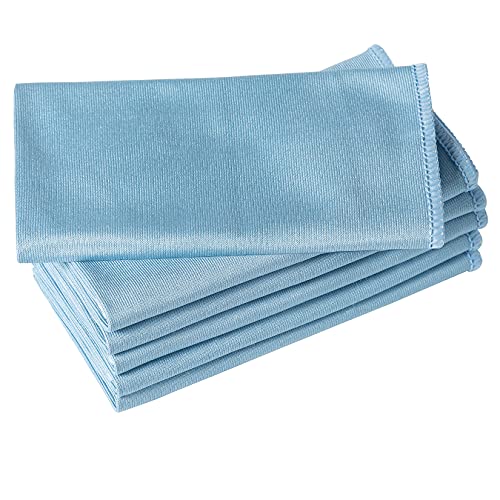
Puomue Microfiber Glass Cleaning Cloths (16 x 16 in, 6 Pack) — Best for Glass and Mirrors
Every cleaning drawer needs one cloth that exists purely to finish. The Puomue microfibre cloths are that cloth: a smooth, tight microfibre woven for glass, mirrors, windshields and stainless steel, where the enemy is not dirt but film — the greasy haze that cotton pushes from one side of a pane to the other. Split microfibres cut that film mechanically, which is why a barely damp Puomue cloth and a dry second pass outperform a wet cotton towel and a bottle of spray.
Technique matters more with microfibre than with cotton. Fold the 16-inch cloth into quarters and you have eight clean faces; work with one face until it loads, then refold. Use almost no water — damp, not wet — because excess water is what dries into streaks. On stainless steel, finish with the grain. On mirrors, finish with a completely dry face. None of this is complicated, but it is a method, and shoppers who want to grab-and-scrub will underuse what this cloth can do.
Care is the trade-off that defines microfibre ownership. Wash these separately from cotton, because cotton lint migrates into microfibre and ruins its finish; skip fabric softener entirely, because it coats the split fibres; and dry on low heat or on a line. Follow that and a six-pack lasts for years of weekly glass work. Ignore it and you own six ordinary rags within a month.
Strengths
- Microfibre’s split fibres lift grease film that cotton smears across glass
- 16-inch square is large enough to fold into an eight-surface pad
- Lint-free finish leaves mirrors and screens genuinely clean
Trade-offs
- Microfibre loses performance if washed with fabric softener or high heat
- Thin glass cloths are poor spill cloths — they polish, they do not soak
- Six cloths is a finishing set, not a whole-house cleaning supply
| Specification | Detail (as stated in the verified listing title) |
|---|---|
| Size | 16 x 16 inches |
| Pack count | 6 |
| Material (as stated) | Microfiber |
| Stated use | Window, glasses, windshields, mirrors, stainless steel |
Best for: anyone whose pain point is streaky mirrors, windows and appliance fronts / Not suited for: households wanting one cloth type for every cleaning job
Check on Amazon — check the current price on Amazon before you buy, and confirm the size and colour on the listing page.

Niveaya Microfiber Fish Scale Cleaning Cloths (8 Pack) — Best for Polishing and Detail Work
The fish-scale weave is microfibre with a pattern of overlapping scales pressed into the surface, and the pattern is functional: the scale edges act like hundreds of tiny squeegees. On shower glass, chrome taps and tiled splashbacks — surfaces where the soil is mineral spotting and soap film rather than loose dirt — that texture clears in two passes what a flat cloth smears for six. The listing positions these cloths for exactly those rooms, plus stainless steel and auto glass.
Quick drying is the second, quieter virtue. A bathroom cloth that stays damp for two days becomes a smell with a handle. A thin fish-scale cloth wrings out nearly dry and air-dries fast on a hook, which makes it realistic to keep one living in the bathroom for the daily thirty-second wipe that prevents a weekend of limescale scrubbing. Prevention is the entire economics of bathroom cleaning, and this is a prevention cloth.
Keep expectations calibrated: the texture that helps on spotting makes this a fraction less perfect on a flawless mirror finish than the flat Puomue glass cloths, and like all microfibre it wants softener-free, low-heat laundry. As the bathroom-and-detail member of a cleaning kit, though, the fish-scale format earns its drawer space on merit.
Strengths
- Fish-scale texture gives gentle scrubbing action on soap scum and water spots
- Quick-drying weave suits bathroom duty where cloths stay damp between uses
- Eight-pack lets you colour-zone cloths by room
Trade-offs
- Textured weave is slightly less glass-perfect than a flat glass cloth
- Still microfibre: same softener and heat care rules apply
- Not a bulk-absorbency cloth for large spills
| Specification | Detail (as stated in the verified listing title) |
|---|---|
| Pack count | 8 |
| Material (as stated) | Microfiber, fish scale weave |
| Stated use | Window, kitchen, shower, stainless steel, auto |
| Positioning (as stated) | Streak free, lint free, quick drying polishing cloth |
Best for: bathroom and kitchen detail cleaning — taps, shower glass, water spots / Not suited for: pure window specialists who want the flattest possible glass cloth
Check on Amazon — check the current price on Amazon before you buy, and confirm the size and colour on the listing page.

CODOHI Extra Large Microfiber Cleaning Cloths (20 x 30 in, 6 Pcs) — Best Large-Format Cloth
Most cleaning cloths are sized for hands and sinks. Floors, bath surrounds, long counters and table tops are not, and cleaning them with a 12-inch rag means dozens of overlapping passes with a cloth that saturates a third of the way through. These CODOHI cloths, at 20 by 30 inches, are the correction: laid flat they cover real territory per pass, draped over a flat-mop head they become a washable mop pad, and folded they still present as a substantial hand cloth for big jobs.
The listing names floor and mop cleaning first, and that is the right primary use. A damp XL microfibre cloth picks up the grit-and-dust film that makes hard floors look tired even after vacuuming, and because it is a cloth rather than a disposable pad, the cost per clean collapses to laundry. Six cloths is a sensible rotation: two on floors, two in the wash, two ready. In bathrooms the same cloth wraps a tub surround or shower wall in a handful of strokes.
The size cuts both ways. Inside a wine glass or around a tap base this cloth is a sail in a teacup, and a fully soaked one carries enough water weight to notice. Pair it with a small cloth for details — the fish-scale or glass cloths above — and the kit covers the whole house. Bought alone for a small flat with mostly detail cleaning, it is the wrong emphasis; bought for floors, it is the pick that changes the weekly routine.
Strengths
- 20 by 30 inches covers floor sections and bath surrounds in single passes
- Works flat as a mop pad on flat-mop frames or folded as a hand cloth
- Six large cloths replace a much larger stack of small rags
Trade-offs
- Too large for detail work inside glasses, taps and tight corners
- Microfibre care rules apply — no softener, moderate heat
- A saturated 20 by 30 cloth is heavy; wring in stages
| Specification | Detail (as stated in the verified listing title) |
|---|---|
| Size | 20 x 30 inches |
| Pack count | 6 |
| Material (as stated) | Microfiber |
| Stated use | Floor cloth rags, mop cleaning, office, bathrooms, housekeeping |
Best for: households with large hard-floor areas and anyone who flat-mops with cloths / Not suited for: detail cleaners working mostly on small surfaces
Check on Amazon — check the current price on Amazon before you buy, and confirm the size and colour on the listing page.

Nabob Wipers Cotton Shop Towels (14 x 14 in, 25 Pack) — Best Bulk Utility Cloth
Every home has a category of cleaning that destroys nice cloths: degreasing a bike chain, wiping a grill, cleaning paint brushes, mopping an oil weep in the garage. The shop towel exists for that category. Nabob Wipers’ 25-pack of 14 by 14 inch cotton towels is commercial-grade utility cloth — absorbent, fully washable, indifferent to solvents and heat, and priced by the bundle so that a cloth sacrificed to a truly foul job is a shrug, not a loss.
Cotton is the correct fibre here for reasons beyond cost. Microfibre should never meet many garage solvents, and its static and melting behaviour around heat make it a poor workshop cloth. Cotton wipes, absorbs, washes hot and returns. The 14-inch square is hand-sized on purpose: folded, it is a pad for a palm; opened, it wraps a part or a tool. Mechanics buy this format by the case for the same reason.
Inside the house, a handful of these make excellent demotion cloths — the ones that live under the sink for the jobs you would not give the good towels. They are not finishers: on glass they lint, and on a big water spill a bar mop out-absorbs them. Judged as what they are — the bulk utility layer of a complete cloth system — twenty-five honest cotton squares is one of the best-value cleaning purchases a household can make.
Strengths
- Twenty-five cloths makes colour-zoning and heavy rotation effortless
- Cotton shrugs off solvents, heat and hot washing that damage microfibre
- Small square format is ideal for hands, tools, bikes and greasy jobs
Trade-offs
- Smaller and thinner than a bar mop — not the best big-spill cloth
- Shop-towel finish is utilitarian, not a surface-finishing cloth
- White cotton records oil and grease stains permanently
| Specification | Detail (as stated in the verified listing title) |
|---|---|
| Size | 14 x 14 inches |
| Pack count | 25 |
| Material (as stated) | 100% cotton |
| Grade (as stated) | Commercial grade shop towels |
Best for: garages, workshops, bikes, grills and any genuinely greasy cleaning / Not suited for: glass and mirror finishing, where lint-free microfibre wins
Check on Amazon — check the current price on Amazon before you buy, and confirm the size and colour on the listing page.
Comparison Table
| Pick | Badge | Key spec | Best for |
|---|---|---|---|
| Utopia Towels Kitchen Bar Mops (16 x 19 in, 12 Pack) | Best Overall | 16 x 19 in, 100% cotton, 12 pack | households that want one hard-working cloth for counters, spills and stove duty |
| Avalon Towels Surgical Huck Towels (17 x 26 in, 12 Pack) | Best Lint-Free Cotton | 17 x 26 in, huck weave cotton, 12 pack | cleaners who want cotton’s washability with near-microfibre lint behaviour |
| Puomue Microfiber Glass Cleaning Cloths (16 x 16 in, 6 Pack) | Best for Glass and Mirrors | 16 x 16 in, microfiber, 6 pack | anyone whose pain point is streaky mirrors, windows and appliance fronts |
| Niveaya Microfiber Fish Scale Cleaning Cloths (8 Pack) | Best for Polishing and Detail Work | Fish scale microfiber, 8 pack | bathroom and kitchen detail cleaning — taps, shower glass, water spots |
| CODOHI Extra Large Microfiber Cleaning Cloths (20 x 30 in, 6 Pcs) | Best Large-Format Cloth | 20 x 30 in, microfiber, 6 pack | households with large hard-floor areas and anyone who flat-mops with cloths |
| Nabob Wipers Cotton Shop Towels (14 x 14 in, 25 Pack) | Best Bulk Utility Cloth | 14 x 14 in, 100% cotton, 25 pack | garages, workshops, bikes, grills and any genuinely greasy cleaning |
How to Choose Cloth Towels for Cleaning: Cotton vs Microfiber
Cotton absorbs by fibre: water moves into the cotton itself, which is why a cotton cloth keeps taking up liquid until it is heavy with it, and why it tolerates the hot, chemically aggressive washing that real kitchen soil demands. Choose cotton for spills, stove work, dishes-adjacent wiping and any job involving heat or solvents. Its weaknesses are lint — terry cotton sheds — and slow drying once saturated.
Microfibre absorbs and lifts by structure: split synthetic fibres create enormous surface area that traps grease film and fine dust, which is why microfibre finishes glass and polished surfaces better than any cotton. Choose microfibre for glass, mirrors, stainless steel, screens, dusting and bathroom film. Its weaknesses are care rules and heat: softener, high dryer heat and washing with linting cotton all degrade it.
The mature answer for most homes is both, zoned by job. A cotton layer for wet and dirty work, a microfibre layer for finishing, and a bulk utility layer for destructive jobs covers every surface in a house with three purchases. The picks above map exactly onto those layers.
Weaves Explained: Terry, Huck, Waffle, Flat and Fish Scale
Terry is loops: maximum absorbency, maximum lint when new, and a tendency to drag on smooth surfaces. It belongs in bar mops and spill cloths. Huck is a flat, fine weave with a subtle texture: low lint, good glide, the cotton choice for glass and steel finishing. Waffle weave trades some absorbency for structure and faster drying, which is why it appears in kitchen drying towels more than in cleaning cloths.
Flat microfibre — the smooth glass cloth weave — is the streak-free specialist. Fish-scale microfibre presses a textured pattern into the same fibre family, adding mechanical bite for mineral spotting and soap film at a tiny cost to mirror-perfect finishing. Plush microfibre, the deep-pile type sold for car drying, is mostly wrong for household cleaning: it holds too much water, drags on glass, and picks up grit that then scratches.
When a listing does not name its weave, judge by its stated use and photos rather than by adjectives. Every pick in this guide was chosen partly because its listing states enough — a weave, a size, a named use — to place it honestly in this framework.
Sizing and Pack Counts: Building a Rotation That Works
Hand cloths live between 12 and 19 inches. Below that range a cloth folds into too small a pad to protect your hand from a hot or chemical surface; above it, cloth bunches awkwardly around taps and inside glasses. Finishing cloths for glass work best at 16 inches square — large enough to fold into eight faces, small enough to control. Floor and large-surface cloths start at 20 by 30 inches, where a single pass covers meaningful ground.
Pack count is really a laundry-interval decision. Count the cloths you use per day, multiply by the days between washes, then add a clean reserve of the same number again. Most households land on 10 to 15 cotton cloths and 6 to 10 microfibre cloths. The packs in this guide were picked to land near those numbers without forcing you to buy two of anything.
Zone your cloths by colour or by drawer the day they arrive. Bathroom cloths, kitchen cloths and utility cloths should never rotate into each other, and a simple rule — one colour per zone, or one shelf per zone — prevents the cross-contamination that makes people distrust reusable cloths in the first place.
How to Wash Cleaning Cloths So They Keep Working
Wash cotton cleaning cloths hot, with a plain detergent, and dry them fully. Cotton forgives almost everything except being put away damp. If cotton cloths develop a stale smell, the cause is almost always residue plus damp storage; a hot wash with a thorough rinse and complete drying fixes it, and sunlight helps more than fragrance products, which merely coat the problem.
Wash microfibre separately from all cotton, in warm water, with no fabric softener and no dryer sheets, and dry it on low heat or on a line. Softener coats split fibres and converts a glass cloth into a smearing cloth within a few washes. If your microfibre already streaks, a wash in hot water with a small amount of plain detergent — and patience over two cycles — can strip some build-up, but prevention is far easier than rescue.
Retire cloths honestly. A cotton cloth that stays stiff and grey after a hot wash, or a microfibre cloth that streaks after a proper strip wash, has finished its service. Demote it to the garage, then to the bin. The pack economics in this guide assume replacement; hoarding dead cloths is how drawers fill with towels nobody trusts.
What About Disposable Wipes and Paper Towels?
Disposable wipes win exactly one contest: convenience for genuinely hazardous messes, where a cloth you must then launder is a liability. For the other ninety-five percent of household cleaning — counters, glass, floors, bathrooms — reusable cloths clean better per pass, because a wipe’s small, pre-moistened surface loads with soil almost immediately while a folded cloth presents fresh faces as you work.
The cost and waste arithmetic is not close over a year of weekly cleaning, and it is why this guide is built entirely from washable cloth. Keep a small stock of disposables for the hazardous exceptions if you wish, but build the routine on cloth: it is the system professionals use, scaled to a home.
One hybrid worth knowing: many households use microfibre dry for dusting — where its static lift genuinely beats a damp disposable — and cotton damp for wet work. That pairing covers the majority of surfaces with zero consumables beyond laundry, and both halves of it are in the picks above.
Colour-Zoning and Storage Systems That Actually Stick
The best zoning system is the one you can maintain when you are tired. Colour is the strongest signal: assign one cloth colour to bathrooms, one to kitchen surfaces, and keep utility cloths in the garage or under-sink zone physically separate. Where the packs in this guide are single-colour — white cotton especially — zone by location instead: bathroom cloths live in the bathroom, kitchen cloths in the kitchen drawer, and never the twain shall meet in the laundry basket without a hot wash between duties.
Storage matters more than it sounds. Cloths stored in a closed drawer while even faintly damp become the smell problem discussed throughout this guide. Hang in-use cloths over a rail or hook where air moves; store clean cloths loosely folded, not compressed. A small basket per zone beats a single deep drawer, because the cloth at the bottom of a deep drawer is the cloth nobody rotates — and unrotated cloths age unevenly, with two worn out and ten pristine.
Label the demotion path, too. When a kitchen cloth retires to utility duty, a permanent marker dot on the corner — the classic laundry trick — prevents it quietly migrating back to food surfaces after a wash. Systems like this sound fussy for the first week and invisible by the second month, which is exactly what a good system feels like.
A Simple Weekly Rhythm for a Cloth-Clean Home
Daily, the work is thirty seconds at a time: a cotton cloth for the stove after cooking, a fish-scale or flat microfibre pass over the bathroom basin and tap while the kettle boils. These micro-cleans are what make the weekly clean short, because soil never gets the days it needs to harden into a project.
Weekly, run the sequence in the how-to section: surfaces with cotton, finishing with microfibre, floors last with the oversized cloth. Put every used cloth into the wash that day — cotton hot, microfibre separate and softener-free — and reset each zone with clean cloths from the reserve. The rotation only works if wash day actually empties the basket.
Monthly, audit the drawer. Retire or demote any cloth that fails the smell-and-stiffness test, check that each zone still holds its full count, and top up from the bulk pack before you run short. Ten minutes a month is the entire management overhead of the system this guide describes — considerably less than the time disposable-wipe households spend restocking.
How to Clean a Whole Kitchen with Cloth Towels, Step by Step
Step one: work top to bottom with the cotton layer first. Wipe counters and the stove with a damp bar mop, folding to a fresh face as each loads. Cotton takes the bulk soil — crumbs, grease splatter, spills — and anything it misses will be visible to the finishing pass rather than smeared by it.
Step two: degrease deliberately. For the hob and splashback, use a fresh cotton cloth with your usual kitchen cleaner, then rinse-wipe with a clean damp cloth. Residue left behind is what makes the next day’s film sticky; the rinse pass is the step most people skip and the one that changes how long the clean lasts.
Step three: finish the hard surfaces with microfibre. Glass hob surfaces, the oven door, appliance fronts and the sink’s steel get a barely damp flat microfibre pass, then a dry buff. This is where huck cotton or the glass cloths earn their place: the surface should look clean in raking light, not just in the forgiving light you cleaned under.
Step four: close the system. Rinse cloths, hang them to dry fully before they go in the laundry basket — a damp cloth in a closed basket is tomorrow’s smell — and rotate fresh cloths in. Floors, if they are on today’s list, get the oversized cloth damp-mopped last, after every surface above them has finished shedding crumbs.
Common Buying Mistakes
Washing microfibre with fabric softener. One softener wash can coat split fibres enough to turn a glass cloth into a streak machine. Separate loads, plain detergent, low heat — every time.
Using one cloth for the whole house. The cloth that wiped the bathroom floor should never meet the kitchen counter. Zone by colour or drawer from day one.
Reaching for a plush towel on glass. Deep pile holds water and grit; glass wants a flat, tight weave. Match the weave to the surface, not to the softest hand-feel in the drawer.
Putting cloths away damp. Damp storage is the root cause of nearly every ‘my cloths smell’ complaint. Dry fully, then store.
Buying singles instead of a rotation. A single premium cloth spends half its life dirty or in the wash. Packs exist because cleaning is a rotation system, not a solo performance.
Using the same cloth wet for every stage. A cloth that starts on the stove should not finish on the glass, because the grease it collected in stage one becomes the film it deposits in stage three. The sequence in this guide — bulk soil with cotton, rinse, then a fresh finishing cloth — exists precisely because cloths carry what they collect. Changing cloths between stages feels extravagant until you see a mirror finished with a stove cloth; after that, the extra cloth per clean reads as the cheapest step in the whole routine, and it is why every pack size in this guide assumes you will use more than one cloth per session.
Judging cotton on its first use. New woven cotton carries a mill finish and absorbs poorly until it has been washed several times. Wash before first use and judge it on week two, not day one.
Final Recommendation
Build the system in layers: the Utopia bar mops as your cotton backbone, one microfibre finisher — Puomue for glass or Niveaya for bathrooms — and the Nabob shop towels as the sacrificial utility layer. Add the CODOHI oversized cloths if floors are your weekly battle, and the Avalon huck towels if you prefer your finishing layer in washable cotton.
Whatever combination you choose, the care rules decide whether it works in month six: separate microfibre laundry, no softener, full drying, zoned storage. The cloths are inexpensive; the habits are the actual product. Start with the two layers your home lacks most, live with them for a month, and let your own laundry rhythm — not a shopping list — tell you whether the third layer is worth its drawer. For the bread-baking side of kitchen textiles, see the companion guide linked below.
Quick links back to the verified listings: Utopia Towels Kitchen Bar Mops (16 x 19 in, 12 Pack) · Avalon Towels Surgical Huck Towels (17 x 26 in, 12 Pack) · Puomue Microfiber Glass Cleaning Cloths (16 x 16 in, 6 Pack) · Niveaya Microfiber Fish Scale Cleaning Cloths (8 Pack) · CODOHI Extra Large Microfiber Cleaning Cloths (20 x 30 in, 6 Pcs) · Nabob Wipers Cotton Shop Towels (14 x 14 in, 25 Pack)
Best Bread Towels Best Kitchen Towels For Cleaning Best Chef Kitchen Towels Best Bar Towels For Drying Glassware Best Cotton Waffle Weave Kitchen Towels
Frequently Asked Questions
What is the best cloth material for cleaning a kitchen?
Cotton for wet, greasy and hot work — it absorbs heavily and survives hot washing. Microfibre for finishing glass, steel and glossy surfaces. Most kitchens need both, zoned by job, rather than a single winner.
Why does my microfiber cloth leave streaks?
Usually care damage: fabric softener, dryer sheets, high heat, or washing with cotton that sheds lint into the fibres. Wash microfibre separately without softener; a strip wash can partially rescue coated cloths.
How many cleaning cloths does a household need?
Roughly ten to fifteen cotton cloths and six to ten microfibre cloths for a typical home — enough for daily use, a wash load, and a clean reserve. The packs in this guide are sized around that rotation.
Are bar mops and shop towels the same thing?
No. Bar mops are larger, heavier kitchen towels built for absorbency. Shop towels are smaller, cheaper utility squares built for greasy, destructive jobs. Both are cotton; they differ in size, weight and intended fate.
Can cleaning cloths be washed with regular laundry?
Cotton cloths can join a hot wash with towels, though heavily soiled cloths deserve their own load. Microfibre should always be washed separately from cotton to protect its fibres from lint and softener residue.
When should I replace a cleaning cloth?
When it stays stiff, grey or smelly after a proper hot wash (cotton), or streaks after a correct strip wash (microfibre). Demote worn cloths to utility duty before binning them — a cloth that can no longer finish a mirror can still serve a year in the garage, and that demotion path is part of the value of buying washable cloth in the first place.


