Disclosure: airfryerkitchensupply.com is reader-supported. When you buy through links on our site, we may earn an affiliate commission at no extra cost to you.
Where to buy
Every pick in this guide to the best vinyl floor vacuums was cross-checked against Amazon record before it earned a link. The figures quoted — suction in air watts or pascals, runtimes, dust cup claims — are the ones printed in the listings’ own titles, and where a title is silent about a detail that matters on vinyl, such as brush roll stiffness, the review says so and tells you what to check on the listing page. All six vacuums are sold on Amazon; use the “check price on Amazon” links throughout to see the current price and configuration for each model.
- Dyson V8 Plus Cordless Vacuum — Best Overall
- Shark Pet Cordless Stick Vacuum IX141 — Best Cordless Stick for Pet Homes
- Levoit Cordless Vacuum Cleaner LVAC-200 — Best for Reaching Under Furniture
- Bissell Hard Floor Expert Multi-Cyclonic Canister 1547 — Best Canister for Hard Floors
- Eureka Whirlwind Bagless Canister NEN110A — Best Budget Canister
- iRobot Roomba 105 Vac Robot Vacuum — Best Robot for Vinyl Floors
Vinyl flooring — luxury vinyl plank, luxury vinyl tile and sheet vinyl — has a specific enemy, and it is not dirt. It is the vacuum itself. A stiff beater bar, hard plastic wheels or grit dragged under a floor head can scuff the wear layer that protects the printed design underneath, and unlike a scratch in real wood, a scratch in vinyl cannot be sanded out. So this guide judges vacuums for vinyl the way flooring installers do: suction matters, but what touches the floor matters more. The best vinyl floor vacuums below are the verified models that clean hard floors well while giving you the best chance of keeping the surface unmarked — plus honest notes on what each title does and does not tell you about its floor head.
Key Takeaways
- On vinyl, the floor head is the decision: avoid stiff beater bars and check wheel material — titles rarely state either, so verify on the listing before buying.
- All six picks are verified and are sold as hard-floor capable; quoted suction and runtime figures come from their own listings.
- Cordless sticks (Dyson, Shark, Levoit) suit daily vinyl upkeep; canisters (Bissell, Eureka) suit deep cleans; the Roomba automates the in-between days.
- Empty the dust cup away from the floor and shake out the floor head outdoors — trapped grit under a head is the most common cause of vinyl scuffs.
- Never use a vacuum’s carpet agitation mode on vinyl unless the maker says the brush can be switched off or is safe for hard floors.
In this guide
Quick Picks
- Best Overall: Dyson V8 Plus Cordless Vacuum — a cordless cleaner stated to clean hard floors and carpets, with 115AW suction, detangling, up to 40 minutes of runtime and handheld conversion. — check price on Amazon
- Best Cordless Stick for Pet Homes: Shark Pet Cordless Stick Vacuum IX141 — a lightweight pet-focused stick with a stated 40-minute runtime, XL dust cup, LED headlights and a removable handheld. — check price on Amazon
- Best for Reaching Under Furniture: Levoit Cordless Vacuum Cleaner LVAC-200 — up to 50 minutes of runtime, an anti-tangle design for pet hair, and a 180-degree lay-flat body for getting under sofas and beds. — check price on Amazon
- Best Canister for Hard Floors: Bissell Hard Floor Expert Multi-Cyclonic Bagless Canister 1547 — a corded canister built and named for hard floors, with multi-cyclonic bagless suction that never fades as a battery would. — check price on Amazon
- Best Budget Canister: Eureka Whirlwind Bagless Canister NEN110A — a lightweight corded canister for carpets and hard floors, and the simplest, cheapest route in this guide to a full-size clean. — check price on Amazon
- Best Robot for Vinyl Floors: iRobot Roomba 105 Vac Robot Vacuum — 7,000 Pa suction with LiDAR navigation that cleans in neat rows, so vinyl gets systematic coverage instead of random bumps. — check price on Amazon
How These Picks Were Chosen
Picks were chosen from listings confirmed — cache first, so every ASIN below comes with an listed title we could read before writing. The rules were written for vinyl’s specific risks. First, the vacuum had to be a complete floor vacuum sold for hard-floor or multi-surface home use — no handheld-only spot cleaners, no replacement heads, no mop-only machines wearing a vacuum badge. Second, the listing had to state hard-floor or carpet-and-hard-floor capability in its own title; a vacuum whose title promises only deep carpet cleaning has no place on a vinyl floor guide. Third, the set had to span the three real formats vinyl owners choose between — cordless sticks for daily upkeep, corded canisters for deep cleaning, and a robot for automation — because the formats solve different problems and a guide of six sticks would dodge the comparison readers actually need.
Fourth, honesty about the floor head. Marketing titles almost never state brush stiffness or wheel material, and this guide refuses to invent either. Where a model’s head design is a known consideration — a detangling comb, an anti-tangle claim — we discuss what the title actually claims and flag what to verify. Suction figures are quoted in the units each maker chose (air watts for the Dyson, pascals for the Roomba) and are not converted or ranked across brands, because those numbers are not measured on a shared standard and pretending otherwise would be a false precision.
Finally, recall and safety screening: no pick is a recalled product, and no pick requires a wet function to justify its place — wet-dry combo machines were left out of this guide deliberately, because vinyl owners asking for a vacuum usually need the dry machine first, and because dragging liquid across vinyl seams is a separate decision with its own guidance.
The 6 Best Vinyl Floor Vacuums

Dyson V8 Plus Cordless Vacuum — Best Overall
The Dyson V8 Plus earns the lead because its listing states the exact combination vinyl owners need: it cleans hard floors and carpets, it detangles — hair is drawn off the brush bar rather than wrapping around it — it converts to a handheld for stairs and upholstery, and it delivers a stated 115AW of suction across two power modes with up to 40 minutes of runtime. For a home that is mostly vinyl with a rug or carpeted room in the mix, that is the complete daily-cleaning brief in one machine, with no cord to drag across the planks and no second vacuum to store.
The detangling point matters more on vinyl than it first appears. A brush bar wound with hair stops rotating evenly and starts skating and juddering across a hard floor — exactly the kind of uneven contact that scuffs a wear layer and leaves dirt lines behind. A head that keeps itself clear keeps its contact consistent. The two power modes matter too: vinyl’s everyday load is dust, crumbs and grit, which the standard mode handles at the longer runtime, while the higher mode is there for the rug and the doormat rather than for blasting a floor that does not need it.
Forty minutes is the honest limit of the format: enough for a flat or a floor of a house per charge, not enough for a whole large home in one pass at high power. The handheld conversion covers the vinyl owner’s other recurring jobs — grit in the entryway, crumbs under the high chair, the car footwells where half the household’s gravel seems to migrate. Judged as the single vacuum a vinyl-floored home would use every day, the V8 Plus is the most complete verified package in this guide.
Strengths
- Stated hard floor and carpet cleaning with detangling brush action
- 115AW suction with two power modes — match the power to the surface
- Converts to a handheld for stairs, entryways and cars
Trade-offs
- Up to 40 minutes of runtime caps whole-home sessions in larger houses
- Premium tier pricing — check price on Amazon
- Title does not state brush or wheel materials — check the head before first use on pale vinyl
| Suction (per listing) | 115AW |
| Runtime (per listing) | Up to 40 minutes |
| Power modes (per listing) | 2 |
| Formats (per listing) | Stick; converts to handheld |
Best for: mostly-vinyl homes wanting one cordless vacuum for daily cleaning everywhere / Not suited for: very large homes needing hour-plus continuous runtime

Shark Pet Cordless Stick Vacuum IX141 — Best Cordless Stick for Pet Homes
Pet hair is the load that defines vinyl-floor cleaning in a dog or cat household: it does not hide in vinyl the way it hides in carpet — it drifts, collects along baseboards and reappears an hour after you cleaned. The Shark IX141’s listing is written for exactly that life: a pet cordless stick with a stated 40-minute runtime, an XL dust cup, LED headlights and a removable handheld. Each of those details maps to a real pet-on-vinyl task. The XL cup means a full shedding-season session without three trips to the bin; the headlights reveal the pale hair on pale planks that ceiling light hides; the handheld handles the sofa, the pet bed and the car.
The 40-minute runtime matches the Dyson’s ceiling, and the honest comparison between the two is focus: the Dyson leads on stated suction and detangling, the Shark leads on pet-specific capacity and visibility. On vinyl specifically, the headlight is not a gimmick — grit is the scratch risk, and seeing the grit line along the skirting board before you push the head through it is genuinely protective. As with every stick in this guide, the title does not describe the brush roll’s stiffness, so pet owners with soft, matte-finish vinyl should check the listing’s hard-floor guidance and test in a corner first.
Lightweight is the other stated virtue, and on vinyl it cuts both ways in a good direction: a light stick gets grabbed for the two-minute crumb patrol that keeps grit from ever accumulating, which is the single most effective scratch-prevention habit a vinyl owner can build. A heavy upright that lives in a cupboard gets used weekly; a light stick by the kitchen gets used daily, and daily wins.
Strengths
- XL dust cup sized for shedding-season sessions
- LED headlights expose hair and grit along baseboards
- Removable handheld for furniture, pet beds and cars
Trade-offs
- 40-minute runtime ceiling, shared with the format generally
- Brush stiffness not stated in the title — verify for delicate matte vinyl
- Pet focus means fewer carpet-deep-clean credentials than a full upright
| Runtime (per listing) | 40 minutes |
| Dust cup (per listing) | XL |
| Extras (per listing) | LED headlights; removable handheld |
| Positioning (per listing) | Pet hair pickup, lightweight stick |
Best for: pet households on vinyl who clean little and often / Not suited for: buyers wanting a corded deep-clean machine for thick carpet as well
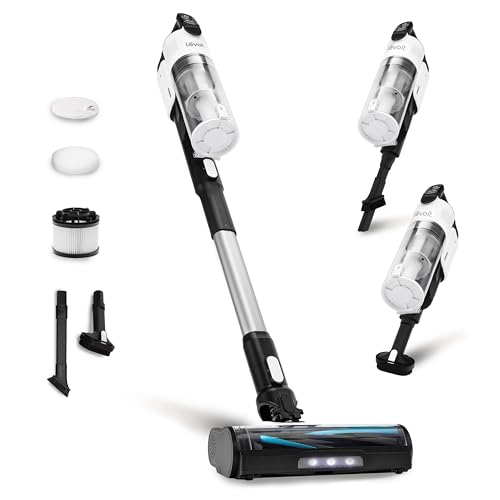
Levoit Cordless Vacuum Cleaner LVAC-200 — Best for Reaching Under Furniture
Vinyl floors show their dirt in one place above all: the strip under the sofa, the bed and the sideboard, where dust and pet hair migrate and where a standard stick’s head will not fit. The Levoit LVAC-200’s listing answers that geometry directly with a 180-degree lay-flat design — the body folds flat so the head slides under low furniture instead of stopping at its edge — alongside a stated runtime of up to 50 minutes, the longest in this guide, and an anti-tangle design aimed at pet hair on carpets and hard floors alike.
Fifty minutes changes the cleaning pattern. It is the difference between cleaning the rooms you can see and cleaning the whole floor including the under-furniture strips in the same session, on one charge — and for vinyl, those strips are not cosmetic: the grit that collects under furniture is the grit that shoes later drag across the open floor. The anti-tangle claim pairs with that: a head that resists hair wrap keeps working evenly through a long session instead of degrading halfway through the flat.
Against the Dyson and Shark, the Levoit’s trade is positioning rather than a stated deficiency: its title leads with versatility and reach rather than a headline suction figure, and it does not quote one — this guide will not invent a number to fill the gap. Buyers who rank raw stated suction first should take the Dyson; buyers whose vinyl disappears under low furniture — platform beds, low sofas, media units — will get more actual cleanliness from the lay-flat reach than from extra air watts pointed at floor they cannot reach.
Strengths
- 180-degree lay-flat design cleans the under-furniture strip other sticks miss
- Up to 50 minutes of runtime — the longest stated in this guide
- Anti-tangle design for pet hair across carpets and hard floors
Trade-offs
- No suction figure stated in the title — check the listing if that number drives your choice
- Lay-flat reach matters less in rooms with high, open furniture
- Stick format still caps dust capacity versus a canister
| Runtime (per listing) | Up to 50 minutes |
| Design (per listing) | 180-degree lay-flat; anti-tangle |
| Surfaces (per listing) | Carpets and hard floors |
| Model (per listing) | LVAC-200 |
Best for: low-furniture homes where the dirt hides underneath / Not suited for: buyers who shop by headline suction figures
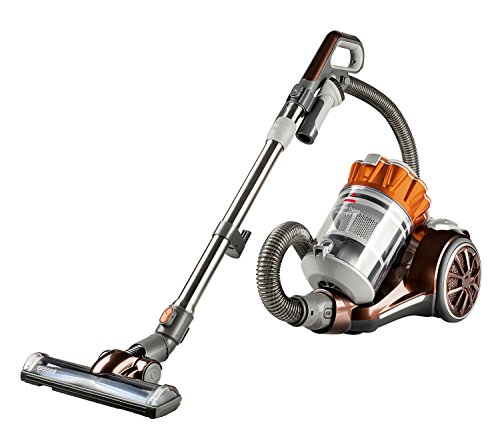
Bissell Hard Floor Expert Multi-Cyclonic Bagless Canister 1547 — Best Canister for Hard Floors
Some product names are marketing; this one is a job description. The Bissell Hard Floor Expert is a corded, multi-cyclonic, bagless canister — model 1547 — built for the floors this guide is about. The canister format brings three things no stick can match: mains power that does not fade at minute thirty-five, a dust capacity measured in litres rather than cups, and a floor head on a hose that goes wherever the wand points, including the edges, corners and stair treads where vinyl collects its grit. For a weekly deep clean of a vinyl-floored home, that combination is the professional pattern — it is why so many commercial hard-floor cleaners are canisters.
Multi-cyclonic bagless suction means the dirt is spun out of the airflow and dropped into a bin you empty, with no bags to buy and no suction loss as the bin fills within reason. On vinyl the deep-clean difference shows at the edges: a canister’s hose tools reach the baseboard line, the fridge gap and the plinth recesses that a stick’s wide head bridges over. Those edges are where grit lives, and grit at the edges becomes scratches in the middle the first time it is walked across the room.
The format’s costs are the familiar ones: a cord to manage, a body that follows you and occasionally argues with door frames, and storage space for a machine that does not hang flat on a wall. It is also a vacuum only — no mopping function is claimed in the title, and vinyl owners who want a wash should treat that as the separate purchase it is. As the deep-clean half of a vinyl cleaning kit, though, the Hard Floor Expert is the most purpose-built verified option in this guide.
Strengths
- Purpose-built for hard floors — the format and the name agree
- Corded multi-cyclonic power never fades mid-clean
- Hose and tools reach edges, gaps and stairs that sticks bridge over
Trade-offs
- Cord and canister body are less convenient for two-minute cleanups
- Takes real storage space compared with a wall-hung stick
- No wet function — vacuuming only, by design
| Format (per listing) | Corded canister, bagless |
| Suction type (per listing) | Multi-cyclonic |
| Model (per listing) | 1547 |
| Positioning (per listing) | Hard floor specialist |
Best for: the weekly deep clean — edges, corners and whole floors on mains power / Not suited for: anyone wanting a grab-and-go cordless for daily crumbs

Eureka Whirlwind Bagless Canister NEN110A — Best Budget Canister
The Eureka Whirlwind NEN110A is the canister idea at its simplest and most affordable: a lightweight, corded, bagless canister stated for carpets and hard floors, in blue, with no battery to age and no electronics beyond the job. For vinyl owners, that simplicity is a genuine virtue. A machine like this is the second vacuum in many well-run homes — the one that lives in a cupboard, comes out for the Saturday deep clean, and is still doing it a decade later because there is almost nothing in it to wear out except filters and belts.
Its cleaning pattern matches the Bissell’s at a lower tier: hose-led edges and corners, full mains suction for the open floor, a bin instead of bags. Where it concedes ground is in refinement — the title claims lightweight and multi-surface competence rather than hard-floor specialisation, so vinyl owners should do the same floor-head check advised throughout this guide: confirm the head’s underside and wheels on the listing, and make the first pass in a low-visibility area. That is not a criticism of this machine; it is the correct ritual for any vacuum meeting any vinyl floor for the first time.
Budget framing matters here, and this guide prints no prices — check price on Amazon — but the Whirlwind’s position in Eureka’s range and in this guide is the value pick: the cheapest verified route to a full-size, corded, hard-floor-capable clean. Renters with vinyl throughout, first flats, and households equipping a second floor will all recognise their brief in it.
Strengths
- Lightweight corded canister — full suction, no battery to fade or replace
- Stated for carpets and hard floors; bagless bin keeps running costs minimal
- The value route to a full-size deep clean in this guide
Trade-offs
- Generalist positioning — not a hard-floor specialist like the Bissell
- Floor head materials not stated in the title — verify before use on delicate vinyl
- Corded format, with the usual storage and trailing-body compromises
| Format (per listing) | Corded canister, bagless |
| Model (per listing) | NEN110A (Whirlwind) |
| Surfaces (per listing) | Carpets and hard floors |
| Positioning (per listing) | Lightweight |
Best for: renters and value buyers wanting a simple, durable deep-clean canister / Not suited for: buyers wanting hard-floor specialisation or cordless convenience

iRobot Roomba 105 Vac Robot Vacuum — Best Robot for Vinyl Floors
A robot vacuum is the vinyl owner’s insurance policy: the scratches come from grit that sits on the floor being ground under shoes, and a machine that removes that grit every day, whether or not anyone remembers, attacks the problem at its root. The Roomba 105 Vac’s listing states the two specifications that decide whether a robot actually does that job: 7,000 Pa of suction — a serious figure for a robot — and LiDAR navigation that cleans in neat rows. LiDAR is the detail that matters. Robots that navigate by bumping wander, re-clean the same patch and miss others; a LiDAR machine maps the floor and covers it systematically, which on hard floors is the difference between automation and theatre.
Neat rows also mean predictable behaviour around furniture legs and thresholds, and the multi-surface positioning in the title means the same run can cross from vinyl onto a low rug without a human re-planning the session. The charging base is included in the listing, so the routine is genuinely set-and-forget: schedule it for when the house is empty or asleep, empty the bin on bin day, and the floor’s baseline state becomes “recently vacuumed” permanently.
The honest limits are the format’s. A robot does not do stairs, does not reach the top of skirting, and its bin is small — in a shedding-pet home it fills fast, which is why this guide pairs it in spirit with the Shark stick rather than presenting it as a whole solution. Its brushes and wheels also deserve the standard vinyl check on the listing page. As the daily layer that keeps grit from ever settling, though, no other pick in this guide does what it does, and vinyl — flat, hard, robot-friendly — is the surface it does it best on.
Strengths
- 7,000 Pa suction with LiDAR navigation — systematic, mapped coverage
- Daily scheduled cleaning keeps grit off vinyl before shoes grind it in
- Multi-surface cleaning crosses from vinyl to low rugs in one run
Trade-offs
- No stairs, no edges above floor level — a stick or canister is still needed
- Small bin fills quickly in heavy-shedding homes
- Brush and wheel materials not stated in the title — verify for delicate vinyl
| Suction (per listing) | 7,000 Pa |
| Navigation (per listing) | LiDAR; cleans in neat rows |
| Included (per listing) | Charging base |
| Surfaces (per listing) | Multi-surface |
Best for: keeping vinyl at a permanently just-vacuumed baseline with zero daily effort / Not suited for: homes wanting a single machine that also does stairs and deep cleans
Comparison Table
| Pick | Badge | Key spec | Best for |
|---|---|---|---|
| Dyson V8 Plus Cordless Vacuum | Best Overall | 115AW, 2 modes, up to 40 min, detangling, handheld conversion (per Amazon title) | mostly-vinyl homes wanting one daily vacuum |
| Shark Pet Cordless Stick IX141 | Best Cordless Stick for Pet Homes | 40-min runtime, XL dust cup, LED headlights (per Amazon title) | pet households cleaning little and often |
| Levoit Cordless Vacuum LVAC-200 | Best for Reaching Under Furniture | Up to 50 min, 180-degree lay-flat, anti-tangle (per Amazon title) | low-furniture homes |
| Bissell Hard Floor Expert Canister 1547 | Best Canister for Hard Floors | Corded multi-cyclonic bagless canister (per Amazon title) | the weekly deep clean |
| Eureka Whirlwind Canister NEN110A | Best Budget Canister | Lightweight corded bagless canister, carpets and hard floors (per Amazon title) | renters and value buyers |
| iRobot Roomba 105 Vac | Best Robot for Vinyl Floors | 7,000 Pa, LiDAR navigation, neat rows (per Amazon title) | a permanently just-vacuumed baseline |
Format decides first: sticks for daily convenience, canisters for deep-clean power and edges, the robot for automation. Within the sticks, the split is stated suction and detangling (Dyson), pet capacity and visibility (Shark), or runtime and reach (Levoit). Within the canisters, it is specialisation (Bissell) against value (Eureka). Most vinyl homes end up with two of these six — one daily machine and one deep or automated layer — and the pairings section in the buying guide below explains which combinations cover a home completely.
How to Choose a Vacuum for Vinyl Floors
Start with the floor, not the vacuum. Vinyl’s wear layer — the clear protective coat over the printed design — is what you are protecting, and it is threatened by three things a vacuum can do: scratch it with a stiff brush roll or hard wheels, scuff it by dragging trapped grit under the head, and dull it over time with overly aggressive agitation. So the first filter is not suction at all: it is whether the machine is sold for hard floors, whether its brush can be gentled or switched for hard-floor use where the maker offers that, and whether its head and wheels look — on the listing’s photographs and specifications — like they were designed to glide rather than to dig. When a title does not settle those questions, treat them as checks to complete on the listing page, exactly as the reviews above flag.
Then match the format to your cleaning pattern, honestly. If your reality is a two-minute patrol after meals and a weekly once-over, a cordless stick is the machine you will actually use, and a used-daily stick beats a superior canister that stays in the cupboard. If your home is large, your floors are all vinyl and your standard is edges-and-corners clean, the corded canister’s unlimited runtime and hose tools are worth their inconvenience. If your problem is that cleaning simply does not happen often enough, the robot changes the baseline rather than the peak — and on vinyl, where the enemy is sitting grit, the baseline is what protects the floor.
Suction figures need a cool head. Air watts and pascals are not cross-comparable between brands, and on a hard floor almost any modern vacuum has enough suction for dust and crumbs; what separates machines on vinyl is pickup at the edges, behaviour on the grit line along baseboards, and how the head treats the surface. Runtime claims, similarly, are quoted at the gentlest setting — the “up to” in our picks’ titles is doing real work — so size your choice by your floor area at the power you will actually use.
- Protect the wear layer first: hard-floor design, gentle head, clean wheels
- Choose the format you will actually use daily, weekly or automatically
- Judge suction by edge pickup and grit behaviour, not headline units
- Read runtimes as best-case and size for your floor area
- Plan the pair: most vinyl homes need a daily machine plus a deep or robot layer
How to Vacuum Vinyl Floors Without Scratching Them
Technique protects vinyl as much as equipment does, and the routine is simple. Before the first pass with any new vacuum, inspect the floor head: run a hand under it for trapped grit, check that wheels spin freely and are clean, and confirm any brush roll is free of wrapped hair that would make it judder. Make the first passes in a low-visibility area — behind a door, under the table — and look at the floor in raking light afterwards; if the machine is going to mark vinyl, it will tell you there first.
Work in the right order. Clear the loose grit hotspots first — entryways, under the kitchen table, in front of the sink — with the crevice tool or a quick handheld pass, so the main head is not pushing a bow-wave of gravel ahead of it. Then vacuum the open floor in slow, overlapping rows, in the direction of the planks on plank vinyl, letting suction do the work instead of pressing down; downward pressure adds nothing on a hard floor except friction between head and wear layer. Slow down at edges and transitions, where dirt concentrates and where heads tilt and dig.
Afterwards, empty the bin away from the clean floor, tap the filter clean outdoors, and wipe or shake the floor head over a bin — the grit you leave in the head today is the scratch you find next week. Store sticks with the head off the floor or hung, not resting on their wheels in a gritty hallway. None of this takes more than a minute, and together with a machine chosen from this guide, it is the whole secret of vinyl that still looks new in five years: the floor was never asked to survive its own cleaning.
Vinyl Types and Vacuum Settings: Plank, Tile and Sheet
Not all vinyl asks the same of a vacuum, and the differences are worth a section because they change which pick in this guide suits you. Luxury vinyl plank — the wood-look boards that dominate new installations — has bevelled edges between planks and a textured, embossed grain. Dirt settles in the bevels and the grain, so edge suction and a head that rides the surface without tilting into the bevels matter; slow, overlapping passes along the plank direction, as the how-to section describes, lift what a fast perpendicular pass skates over. Gloss and semi-gloss plank finishes also show scuffs most readily, which is why the floor-head checks in this guide are written with plank owners in mind.
Luxury vinyl tile — the stone and ceramic lookalikes — adds grout-line geometry: either real grout in some installations or printed and embossed joints in most. The cleaning problem is the joint lines, where grit lodges below the surface plane where a wide flat head bridges. This is canister territory, or stick-plus-crevice-tool territory: the Bissell’s hose tools and the Dyson’s handheld conversion exist in this guide largely because tile-look vinyl rewards a machine that can leave its main head and work the lines directly. Sheet vinyl, the oldest form, is the most forgiving: a continuous surface with no joints at all, vulnerable mainly at its seams and edges where it can curl — vacuum seams gently, without dwelling suction on a lifted edge, and any pick in this guide will serve it well.
Finish matters as much as format. Matte and low-sheen vinyl — currently the fashionable choice — hides dust poorly and shows it honestly, which argues for frequency: the robot’s daily rows or the stick’s quick patrol. It also tends to be the finish most easily marked by aggressive brushes, so the brush-off or gentle mode advice in the FAQ applies to matte owners first. High-gloss vinyl shows every hair and footprint but shrugs off scuffs visually a little better; its owners should prioritise pickup quality and headlights — the Shark’s LEDs were designed for exactly the pale-hair-on-pale-gloss problem. Whichever vinyl you own, the through-line of this guide stands: the machine’s manners at the surface matter more than its muscle, and the six picks above were chosen because their listings support hard-floor work while their formats let you control how they touch the floor.
Stick, Canister or Robot: Building a Two-Machine Vinyl Cleaning Kit
Readers who stay with this guide to the end usually arrive at the same realisation: the six picks are not six rivals so much as three pairs of partners. Vinyl rewards a system, because its enemy — grit — arrives daily, while its deep-clean needs are weekly, and no single format is best at both rhythms. The pairings below are the combinations that cover a home completely, stated plainly so you can buy once and stop thinking about it.
The classic pairing is a daily stick plus a weekly canister. The stick — Dyson for stated suction and detangling, Shark for pet capacity, Levoit for reach and runtime — lives where life happens and handles the two-minute patrols that keep grit from ever settling. The canister — the Bissell if you want the hard-floor specialist, the Eureka if you want the value route — comes out once a week for edges, corners, stairs and the full-floor pass on mains power. Together they cost less than most flagship single machines, each does the job it is shaped for, and neither is a compromise. This is the pairing this guide recommends for larger vinyl homes and for pet households, where the daily load and the weekly standard are both high.
The modern pairing is a robot plus anything. The Roomba’s daily rows quietly change the problem: with grit removed every day, the weekly deep clean becomes lighter, and some households find the robot plus a single stick — the stick demoted to stairs, edges and spot duty — covers everything. Small flats can go further: robot plus handheld-mode stick (the Dyson and Shark both convert) is a complete kit with no full-size machine at all. The households that should not rely on the robot pairing are those with many stairs, high thresholds between rooms, or heavy shedding that fills a small bin faster than the schedule empties the floor. Choose by your floor plan and your animal, and remember the through-line: frequency protects vinyl, depth polishes it, and the best kit is the one that delivers both without asking you to become a cleaner.
Common Buying Mistakes
The first mistake is buying a carpet-first upright for a vinyl home: maximum agitation is a liability on a wear layer, and the machine spends its life being too much for the floor. The second is trusting suction numbers across brands — 115AW and 7,000 Pa are different units from different tests, and neither tells you how a head treats vinyl. Third: ignoring the head and wheels entirely because the title did not mention them; the title’s silence is a prompt to check the listing, not a reassurance. Fourth: buying a robot as the only vacuum and discovering stairs, edges and deep cleans still exist. Fifth: choosing runtime by the box’s biggest number and finding the real runtime at usable power is half of it. And sixth: wet-mopping vinyl with a combo machine before the dry grit is up — liquid plus grit plus a pad is a scouring system, and the correct order is always vacuum first, wash second, as separate decisions.
Final Recommendation
For the single best all-round answer, take the Dyson V8 Plus — stated hard-floor cleaning, detangling and handheld conversion cover a vinyl home’s whole daily pattern. Pet households should weigh the Shark IX141 for its cup capacity and headlights, and low-furniture homes the Levoit LVAC-200 for the lay-flat reach and the longest stated runtime here. For the weekly deep clean, the Bissell Hard Floor Expert is the purpose-built canister and the Eureka Whirlwind its value alternative; and for the household whose real problem is frequency, the Roomba 105 Vac quietly keeps grit off the floor every day, which is the most vinyl-protective habit of all.
Reading further in this cluster: Best Hardwood Floor Vacuums For Pet Hair covers the neighbouring hard-floor problem with animals, Best Dyson Hard Floor Vacuums compares the Dyson hard-floor range in depth, Best Robot Vacuums For Bare Floors widens the robot shortlist, Best Shark Stick Vacuums runs the full Shark stick family, and Best Bissell Canister Vacuums is the canister-only roundup.
Frequently Asked Questions
Can a vacuum scratch vinyl plank flooring?
Yes — a stiff beater bar, hard or gritty wheels, or grit trapped under the floor head can scuff vinyl’s wear layer, and the damage cannot be sanded out as it could on wood. That is why this guide favours vacuums sold for hard floors, advises checking the head and wheels on the listing before buying, and recommends a first test pass somewhere inconspicuous, followed by the technique routine in the how-to section above.
Is a cordless stick or a canister better for vinyl floors?
They do different jobs. A cordless stick is the daily machine — quick, light, always ready — and daily grit removal is what protects vinyl most. A corded canister is the deep-clean machine: unlimited runtime, bigger capacity and hose tools for edges and corners. Many vinyl homes run both; if you can only have one, choose the stick for frequency, unless your home is large enough that runtime becomes the binding constraint.
Are robot vacuums safe on vinyl floors?
Generally yes — vinyl is one of the best surfaces for a robot, being flat, hard and threshold-friendly — and a LiDAR model like the Roomba 105 in this guide covers it systematically rather than by collision. The standard cautions apply: verify the brush and wheel design on the listing, keep the brushes clean of wrapped hair and grit, and remember a robot replaces daily upkeep, not the periodic deep clean or the stairs.
How much suction does a vinyl floor actually need?
Less than a carpet does. Vinyl’s load is surface dust, crumbs, hair and grit, all of which any modern vacuum in this guide lifts easily; the differences that matter are edge pickup, head behaviour and consistency, not headline numbers. Air watts and pascals are measured differently by different brands and should not be ranked against each other — use them only to compare models within one maker’s range.
Should I turn the brush roll off on vinyl?
If your vacuum offers a brush-off or hard-floor mode, it is the safer default for vinyl, especially matte or embossed finishes — but follow the maker’s guidance for your model first, since some hard-floor heads are designed to run with a soft brush turning. What you should never do is run an aggressive carpet agitation setting on vinyl: that mode exists to beat carpet pile, and a wear layer is not carpet pile.
How often should vinyl floors be vacuumed?
Little and often beats rare and thorough. Entryways and kitchen zones benefit from a pass every day or two — a robot schedule or a two-minute stick patrol — because the goal is removing grit before shoes grind it across the surface. A full edge-to-edge clean weekly, with the canister or a careful stick session, keeps the baseline. The floor’s worst enemy is not dirt sitting still; it is dirt being walked on.


