Disclosure: airfryerkitchensupply.com is reader-supported. When you buy through links on our site, we may earn an affiliate commission at no extra cost to you.
Where to buy
Every pillow below is sold on Amazon and was cross-checked against Amazon’s catalog data before earning a link. Dimensions quoted are the makers’ stated ones from their listings; check the current price on Amazon for the size you select, since several of these come in more than one size.
- Coop Home Goods Cool+ Adjustable Pillow, Queen — Check the current price on Amazon
- Osteo Cervical Pillow, Hollow Design Memory Foam — Check the current price on Amazon
- EPABO Contour Memory Foam Pillow, Firm & Queen — Check the current price on Amazon
- DONAMA Cervical Pillow, Cooling Contour, Dual-Height — Check the current price on Amazon
- UTTU Cervical Pillow, Adjustable, Queen — Check the current price on Amazon
- Royal Therapy Memory Foam Pillow, Queen, 24x14x5 — Check the current price on Amazon
Introduction: a tight neck in the morning is usually a geometry problem
If you wake up with a tight, stiff-feeling neck, the most common culprit is not your mattress or your age — it is the angle your head spent eight hours at. A pillow that is too high pushes the head forward and holds the neck flexed all night; a pillow that has gone flat lets the head drop and bend sideways, especially for side sleepers. The pillows gathered here as the best pillows for tight neck situations attack that geometry from two directions: adjustable pillows whose fill you add or remove until the height is exactly yours, and contoured memory foam pillows whose shape — a cradle for the head, a raised roll under the neck — holds the head and neck in a neutral line while you sleep. Every pick was verified, and the features and dimensions cited are the makers’ stated ones.
An honesty note that belongs at the top of this category: a pillow is a comfort product, not a treatment. This guide makes no medical claims, and several of these products are marketed by their makers with stronger language than we use here — we evaluate them on shape, materials, adjustability, and certifications we can verify, and we describe what they do in comfort terms only. If your neck tightness comes with pain that persists, numbness, weakness, or follows an injury, that is a clinician’s territory, not a pillow guide’s, and no purchase below should delay that visit.
Key Takeaways
- Height is the master variable: adjustable fill (Coop) or dual-height contours (DONAMA, UTTU) let you land on your number instead of a stranger’s.
- Contours work by shape — head cradle plus neck roll — and suit back and side sleepers differently; match the contour to your position.
- Memory foam holds a contour’s shape through the night; shredded adjustable fill trades the molded shape for tunability.
- Certifications worth knowing precisely: CertiPUR-US covers foam content and emissions standards; GREENGUARD Gold is a low-emissions certification — neither is a medical endorsement.
- Give any new pillow a week of nights before judging it; necks adapt slowly to a corrected angle.
In this guide
Quick Picks
- Best Overall: Coop Home Goods Cool+ Adjustable Pillow, Queen — plus-shaped adjustable memory foam fill with cooling gel, tuned by adding or removing fill. Check price on Amazon
- Best Contoured Design: Osteo Cervical Pillow — a hollow-center contour that cradles the head, in odorless memory foam with a cooling case. Check price on Amazon
- Best for Side Sleepers: EPABO Contour Memory Foam Pillow, Firm & Queen — a firm ergonomic contour shaped for side, back, and stomach sleepers, pillowcase included. Check price on Amazon
- Best Cooling Contour: DONAMA Cervical Pillow — dual-height cooling contour memory foam with a removable pillowcase. Check price on Amazon
- Best Adjustable Contour: UTTU Cervical Pillow — an adjustable-height contour (5.2 in / 4.5 in per the listing) in a queen footprint. Check price on Amazon
- Best Classic Contour: Royal Therapy Memory Foam Pillow, 24x14x5 — the straightforward contour pillow in a stated size, for back, side, and stomach sleepers. Check price on Amazon
How These Picks Were Chosen
We required each candidate to address neck geometry in a way its listing could state concretely: an adjustable loft, a named contour shape, dual heights, or stated dimensions a buyer can measure against their own shoulder width and mattress. Products were verified — most from the site’s verified cache, and two (the EPABO and the DONAMA) re-fetched fresh for this guide because their cached titles were truncated; we used only full titles we could actually read. Certifications are reported precisely as listed: the Coop’s listing states CertiPUR-US and GREENGUARD Gold, and we explain what those programs do and do not certify rather than letting the badges imply more. We excluded travel neck pillows, knee and leg pillows, wedge pillows, and kids’ pillows, all of which surface in this search space and none of which answer the brief.
The 6 Best Pillows for a Tight Neck

1. Coop Home Goods Cool+ Adjustable Pillow, Queen — Best Overall
The Coop wins this category on a principle: the correct pillow height is a personal number, and this is the pillow that lets you find yours. Its listing describes a plus-shaped adjustable pillow in queen size, filled with memory foam and cooling gel, for back, stomach, or side sleepers — and “adjustable” here means the real thing: you add or remove fill until the loft matches your shoulder width, your mattress’s sink, and your position. That tunability is why it tops a list for tight necks: most people do not need a different pillow shape so much as they need their existing shape at the right height, and this is the only pick here that can be wrong on night one and exactly right by night four without buying anything else. The listing also states CertiPUR-US and GREENGUARD Gold certifications — foam standards and low-emissions credentials we explain in the buying guide — which makes it the most credentialed pick on the page as well.
Strengths
- Fully adjustable loft: add or remove fill to dial in your height
- Plus-shaped design suits back, side, and stomach sleepers per the listing
- CertiPUR-US and GREENGUARD Gold stated in the listing
Trade-offs
- Shredded fill feels different from a molded contour — less “held”, more tunable
- Dialing in takes a few nights of small adjustments
- Cooling gel helps, but hot sleepers may still prefer a dedicated cooling contour
| Spec | Detail (from maker’s listing) |
|---|---|
| Size | Queen (plus-shaped design) |
| Fill | Adjustable memory foam with cooling gel |
| Positions | Back, stomach, or side sleeper per listing |
| Certifications | CertiPUR-US / GREENGUARD Gold (as listed) |
| Loft | User-adjustable via fill |
Start with the pillow slightly overfilled and remove a handful of fill per night until your head feels level — for back sleepers, the test is that your chin is neither tucked to your chest nor tipped back; for side sleepers, that your head does not tilt toward the mattress. Keep the removed fill in its bag: if you change mattresses, you will want it back. No other pick here forgives a wrong first guess this gracefully, and for a category defined by a personal measurement, that forgiveness is the top badge.
Best for: Anyone unsure of their ideal height; combination sleepers / Not suited for: Sleepers who want a fixed molded contour that feels identical every night
Check the current price on Amazon
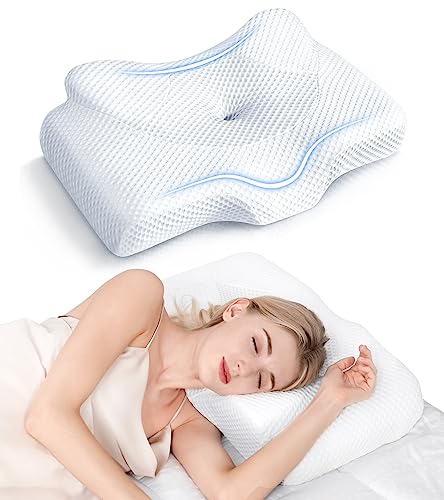
2. Osteo Cervical Pillow, Hollow Design — Best Contoured Design
The Osteo’s idea is the hollow center: its listing describes a cervical pillow with a hollow design in odorless memory foam, with a cooling case, in an adjustable-height format. The hollow cradles the back of the head so the head sits lower while the neck rests on the raised contour around it — the geometry that distinguishes a true contour pillow from a merely thick one. For back sleepers especially, that cradle is the sensation people describe as their head being “placed” rather than propped. The odorless note in the listing is worth its mention: new memory foam’s smell is the category’s most common complaint, and a maker who engineers and advertises against it is solving a real problem. The cooling case addresses the other standard memory foam complaint, heat.
Strengths
- Hollow-center cradle holds the head low while the neck is supported
- Odorless memory foam per the listing — no week of airing out
- Cooling case and adjustable format per the listing
Trade-offs
- The cradle feel is distinctive; stomach sleepers will not love it
- Contour pillows have a correct orientation — the learning curve is real
- Exact dimensions are not stated in the listing title we verified
| Spec | Detail (from maker’s listing) |
|---|---|
| Design | Cervical contour with hollow center |
| Foam | Memory foam, odorless per listing |
| Case | Cooling case |
| Adjustability | Adjustable (per listing title) |
| Dimensions | Not stated in listing title |
Give this pillow its fair trial: three to five nights, oriented as the maker directs, with your old pillow out of the room so you do not retreat at 3 a.m. Contour pillows ask the neck to unlearn a bad angle, and night one can feel strange precisely because the geometry changed. Sleepers who persist usually report the strangeness inverting — the old pillow becomes the one that feels wrong. If you are a dedicated stomach sleeper, though, skip the contour experiment entirely and take the adjustable Coop at a low fill instead.
Best for: Back sleepers and contour-curious side sleepers / Not suited for: Stomach sleepers
Check the current price on Amazon
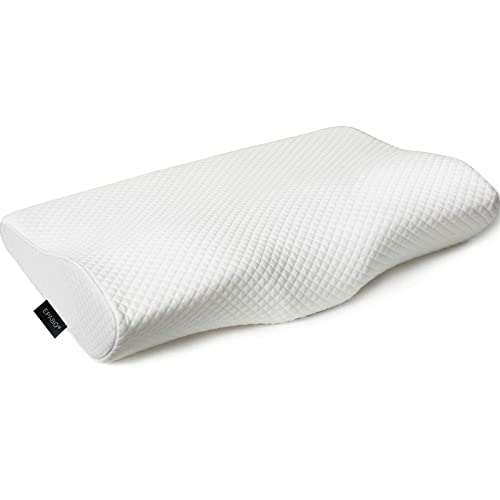
3. EPABO Contour Memory Foam Pillow, Firm & Queen — Best for Side Sleepers
The EPABO is one of the longest-running names in the contour category, and we re-fetched its full listing title fresh for this guide: a contour memory foam pillow, ergonomic cervical design, for side, back, and stomach sleepers, with a free pillowcase included, in the Firm & Queen configuration. Side sleepers are the contour category’s most demanding customers — the gap between head and mattress is the width of a shoulder, and a pillow that collapses at 3 a.m. abandons the neck at the worst angle — so a firm contour that holds its height through the night is the right flagship for them. The included pillowcase is a small, real virtue: contour shapes fit standard cases poorly, and a case made for the shape keeps the surface smooth where your face and neck actually rest.
Strengths
- Firm contour holds its height for side sleeping
- Shaped pillowcase included — fits the contour properly
- Queen configuration suits standard bedding
Trade-offs
- Firm is firm: lightweight back sleepers may find it unyielding
- Fixed shape means fixed heights — no tuning if it misses your number
- Contour orientation must be learned
| Spec | Detail (from maker’s listing) |
|---|---|
| Configuration verified | Firm & Queen |
| Design | Ergonomic cervical contour, memory foam |
| Positions | Side, back, and stomach sleepers per listing |
| Included | Pillowcase |
| Dimensions | Not stated in the full title we fetched |
A firm contour rewards a firm decision about your position: if you are genuinely a side sleeper, the EPABO’s maintained height is the feature your neck has been asking for, and the first morning your head wakes level instead of tilted is the review that matters. If you split your nights between back and side, the dual-height DONAMA below offers a compromise in one pillow. And if “firm” has historically meant “too hard” for you in other products, believe your history — the adjustable Coop is your safer door into this category.
Best for: Committed side sleepers wanting a held, firm contour / Not suited for: Anyone who has found firm pillows uncomfortable before
Check the current price on Amazon

4. DONAMA Cervical Pillow, Cooling Contour, Dual-Height — Best Cooling Contour
The DONAMA’s full title, re-fetched fresh for this guide, describes a cooling contour memory foam pillow with a dual-height ergonomic design and a removable pillowcase, for side, back, and stomach sleepers. Dual-height is the contour category’s answer to adjustability: the pillow’s two edges stand at different heights, and you rotate the pillow to choose — higher edge for side sleeping’s shoulder gap, lower for back sleeping’s shallower need. It is a simpler mechanism than removable fill, and for combination sleepers who change position nightly, it is arguably the better one, because the adjustment is a rotation, not a stuffing session. The cooling design answers memory foam’s warmth, the standing complaint that follows every foam pillow in summer.
Strengths
- Dual heights in one pillow: rotate to match your position
- Cooling contour design for warm sleepers
- Removable pillowcase for washing
Trade-offs
- Two fixed heights still may not be your exact number
- Cooling is passive — it moderates heat rather than chilling
- Contour orientation plus rotation is the most to learn here
| Spec | Detail (from maker’s listing) |
|---|---|
| Design | Cooling contour memory foam, dual-height ergonomic |
| Positions | Side, back, and stomach sleepers per listing |
| Case | Removable pillowcase |
| Heights | Two heights (figures not stated in the title we fetched) |
| Brand | DONAMA (API brand field) |
The honest frame for “cooling” pillows: no passive foam pillow refrigerates. What the good ones do — through gel infusions, phase-change-feeling covers, and ventilated designs — is delay and reduce the heat buildup that makes a sleeper flip the pillow at 2 a.m. Judge the DONAMA by that standard and it is the right pick for the warm sleeper who also wants a contour’s geometry. In a cool bedroom, its cooling is simply neutral, and the dual-height design carries the recommendation on its own.
Best for: Combination sleepers and warm sleepers wanting a contour / Not suited for: Anyone wanting one fixed, familiar pillow feel
Check the current price on Amazon

5. UTTU Cervical Pillow, Adjustable Height, Queen — Best Adjustable Contour
The UTTU splits the difference between the Coop’s fill-tuning and the fixed contours: its listing describes an adjustable contour pillow in a queen footprint of 23.6 x 13.8 inches, with heights of 5.2 and 4.5 inches — the “sandwich” adjustability in its title refers to a design whose height can be changed, giving a molded contour two working heights. Those stated dimensions make it the most measurable pick in the roundup: you can take a ruler to your current pillow, compare, and know before ordering whether the UTTU’s envelope is in your range. For the buyer who wants a contour’s shape with an escape hatch on height, and who thinks in measurements rather than adjectives, this is the pick.
Strengths
- Adjustable height in a true molded contour
- Stated dimensions (23.6 x 13.8 in; 5.2 / 4.5 in heights) for pre-purchase measuring
- Cooling contour design per the listing
Trade-offs
- Two heights, not infinite tuning like the Coop
- The 13.8-inch depth is shallower than standard pillows — measure your pillowcase expectations
- Contour learning curve applies
| Spec | Detail (from maker’s listing) |
|---|---|
| Dimensions | Queen, 23.6 x 13.8 in (per listing) |
| Heights | 5.2 in / 4.5 in (per listing) |
| Design | Adjustable contour memory foam, cooling |
| Positions | Side, back, stomach per listing |
| Brand | UTTU (API brand field) |
Use the numbers as the listing intends: if your current pillow is roughly five inches where your neck rests and your complaint is shape rather than height, the UTTU’s taller setting meets you where you live; if you have been sleeping on a flat, tired pillow, start on the 4.5 setting and let the neck adjust upward gradually. Measurement-first buyers are this category’s happiest customers, and the UTTU is the pillow that rewards them.
Best for: Measurement-minded buyers wanting an adjustable contour / Not suited for: Anyone wanting a standard-depth pillow footprint
Check the current price on Amazon

6. Royal Therapy Memory Foam Pillow, Queen, 24x14x5 — Best Classic Contour
The Royal Therapy is the contour category in its classic, unadorned form: the listing describes a queen memory foam contour pillow at stated dimensions of 24 x 14 x 5 inches, for side, back, and stomach sleepers. No gel story, no dual-height mechanism, no hollow — just the original contour geometry (head cradle, neck roll, five inches at the high edge) executed in memory foam by a brand whose name in this space is built on this single shape. There is a real argument for the classic: every mechanism added to a pillow is a thing to learn, adjust, or tire of, and a sleeper whose measurements happen to match the standard contour gets, in this pillow, exactly the geometry the category was invented to provide.
Strengths
- The classic contour geometry with nothing to adjust or learn beyond orientation
- Stated dimensions (24 x 14 x 5 in) for honest pre-purchase comparison
- Suits side, back, and stomach sleepers per the listing
Trade-offs
- Fixed 5-inch high edge: if it is wrong for you, the pillow is wrong for you
- No cooling features stated — warm sleepers should look at the DONAMA or Coop
- No adjustability story for households sharing or experimenting
| Spec | Detail (from maker’s listing) |
|---|---|
| Dimensions | 24 x 14 x 5 inches (per listing) |
| Size | Queen |
| Design | Contour cervical memory foam |
| Positions | Side, back, and stomach sleepers per listing |
| Brand | Royal Therapy (cache brand field) |
Buy this one when your measurements match its numbers and your temperament matches its simplicity — it is the pick for the sleeper who tried a contour at a friend’s house or a hotel, liked it, and wants that exact thing without a tuning project. Everyone else should enter through the adjustable doors (Coop for fill, UTTU or DONAMA for heights) and let the classic contour be the destination they arrive at once they know their number.
Best for: Sleepers whose measurements match the standard contour / Not suited for: First-time contour buyers unsure of their height
Check the current price on Amazon
Comparison Table
| Pick | Badge | Key spec | Best for |
|---|---|---|---|
| Coop Cool+ Adjustable, Queen | Best Overall | Adjustable fill, cooling gel, CertiPUR-US/GREENGUARD Gold | Finding your exact height |
| Osteo Cervical Pillow | Best Contoured Design | Hollow-center cradle, odorless foam, cooling case | Back sleepers |
| EPABO Contour, Firm Queen | Best for Side Sleepers | Firm contour, pillowcase included | Committed side sleepers |
| DONAMA Cervical Pillow | Best Cooling Contour | Dual-height, cooling, removable case | Combination + warm sleepers |
| UTTU Cervical Pillow | Best Adjustable Contour | 23.6×13.8 in, 5.2/4.5 in heights | Measurement-first buyers |
| Royal Therapy Contour | Best Classic Contour | 24x14x5 in classic contour | Standard-measurement sleepers |
How to Choose a Pillow When Your Neck Feels Tight
Measure your current setup first. Note your pillow’s height where your neck rests, your mattress’s firmness (a soft mattress lets your shoulder sink, reducing the pillow height you need), and your dominant position. Every good decision in this category starts from those three facts, and the picks with stated dimensions (UTTU, Royal Therapy) exist so you can use them.
Back sleepers need less height than they think. The goal is a level head with the neck’s curve supported, not a propped-up reading position. Contours with a cradle (Osteo) or the lower heights of the dual-height picks suit you; a too-high pillow is the classic cause of the flexed, tight morning neck.
Side sleepers need the shoulder gap filled. Your pillow must hold the head level across the shoulder’s width — that is a taller, firmer requirement, met by the EPABO’s firm contour, the UTTU’s taller setting, or a well-filled Coop. If you wake with your hand tucked under the pillow, your current pillow is too low; your hand has been volunteering as a shim.
Stomach sleepers need low and soft. Almost any high contour fights you. The Coop at low fill is the pick here; the contour picks are honest in listing stomach sleeping among their positions, but geometry favors the adjustable.
Understand the certifications precisely. CertiPUR-US means the foam was certified for content, emissions, and durability standards by that program. GREENGUARD Gold means the product was certified for low chemical emissions, with stricter limits intended for sensitive environments. Both are legitimate quality signals about materials — neither certifies that a pillow will fix a neck, and we report them as materials credentials only.
How to Set Up and Adapt to a New Pillow
- Night one: set the baseline. Adjustable fill: start full, remove a little nightly. Contours: orient the higher roll under your neck (or as the maker directs) and confirm with a mirror or a partner that your head looks level.
- Commit for a week. Keep the old pillow out of the bedroom. A changed neck angle can feel odd for two or three nights while muscles adapt; judge at night seven, not night one.
- Change one variable at a time. If you adjust fill and flip the contour and change your position in the same week, you will never learn which change helped.
- Check the mattress’s role. If a new pillow at every height still leaves your head tilted, the mattress’s shoulder sink has changed the math — re-measure before blaming the pillow.
- Use the right case. A contour in a too-large standard case bunches fabric under the neck; use the included or fitted case where one is provided.
- Retire the old pillow honestly. A foam pillow that no longer springs back, or fill that has clumped, has ended its service regardless of the calendar.
Common Buying Mistakes
- Buying the highest pillow for a “supported” feeling. Propped is not supported. Excess height flexes the neck all night and manufactures the tightness you are shopping to escape.
- Judging a contour pillow on night one. Contours change your sleeping geometry; adaptation is part of the product. A week is the fair trial.
- Ignoring your mattress. Pillow height is relative to how deep your shoulder sinks. The same pillow is tall on a firm mattress and low on a soft one.
- Believing a pillow treats a medical problem. Persistent pain, numbness, or weakness needs a clinician. A pillow is comfort equipment — buy it for geometry, not for promises.
- Keeping a dead pillow too long. Foam that stays compressed and fill that has clumped stop doing the geometry you bought. Replacement is maintenance, not indulgence.
- Skipping the stated dimensions. Two picks here publish full measurements. Use them — a tape measure prevents more returns than any review.
A final word on what success looks like, because it is quieter than the marketing in this category suggests. The right pillow does not produce a dramatic morning; it produces an unremarkable one — you wake, the neck is simply not a topic, and the day starts without the familiar inventory of stiffness. That ordinariness is the product. Judge the six picks above by their geometry, their adjustability, and their honestly stated credentials, give the winner its full week of trial nights, and let the unremarkable mornings accumulate. If they do not — if the symptoms in our clinician note describe you — the correct next purchase is not another pillow, and this guide would rather tell you that than sell you a seventh. Geometry is a small, honest lever; pulled correctly, it is surprising how much of the morning it can move — one level head, one supported curve, one ordinary waking at a time, which is all anyone is really asking a pillow for.
Final Recommendation
Start with the Coop Cool+ Adjustable unless you already know you love a molded contour: its tunability makes it the safest first purchase in a category ruled by a personal measurement. Contour-committed sleepers should choose by position — EPABO for side, Osteo for back, DONAMA for both with cooling, UTTU for measured adjustability, Royal Therapy for the classic shape at the standard size. Continue in the cluster with Best Contour Neck Pillows For Sleeping, Best Sleeping Pillows For Neck Support, Best Pillows For A Neck That Hurts, Best Foam Pillows For Neck, and Best Head And Neck Pillows.
Sleep Positions in Depth
Back sleeping is the contour category’s home turf. The head rests in the cradle, the neck roll fills the curve behind the neck, and the head stays near mattress level — the geometry every contour here was drawn for. The failure mode to avoid is stacking: a contour plus a second pillow “for comfort” re-creates the flexed-neck problem the contour exists to solve. One pillow, correctly oriented, is the whole prescription.
Side sleeping is a load-bearing problem: the pillow is a structural spacer between head and mattress across the shoulder’s width. Firmness matters as much as height, because a spacer that compresses by half at 3 a.m. is a different pillow than the one you fell asleep on. This is why the EPABO’s firmness leads for side sleepers and why the hand-under-pillow habit is diagnostic — it is your body adding the height your pillow is missing.
Stomach sleeping twists the neck by definition, and the pillow’s job is damage limitation: as low and soft as possible, so the head’s rotation is not compounded by elevation. Adjustable fill at a low setting (the Coop) is the only pick type that truly serves this position; if you are a stomach sleeper with a tight neck, the longer project is position training, and the pillow is a bridge, not the destination.
Combination sleeping is most people’s reality. The dual-height designs (DONAMA, UTTU) were invented for you: one pillow, two geometries, chosen by rotation as you change position through the night. The adjustable Coop serves you differently — set a middle height and accept a compromise that is never badly wrong.
Pillow Materials, Compared
Molded memory foam (Osteo, EPABO, DONAMA, UTTU, Royal Therapy) holds a manufactured shape indefinitely and responds to heat and pressure by softening where you touch it. It is the only material that can be a true contour. Its costs: warmth (mitigated by the cooling designs here), a distinctive slow-rebound feel some sleepers love and some cannot abide, and a lifespan after which the foam’s recovery fades.
Shredded memory foam fill (the Coop) trades the molded shape for movement and tunability: it behaves more like a traditional pillow, can be fluffed and redistributed, and its loft is whatever you decide. For necks, that trade is often worth it — a tunable almost-right beats a molded exactly-wrong.
What is not in this roundup, and why: down and down-alternative pillows compress to near-nothing under a head’s weight and cannot hold a neck-supporting height for side sleepers; buckwheat hulls (a legitimate niche with devoted fans, covered in sibling guides) offer firm, moldable support at the cost of noise and a very non-pillow feel; latex offers springy support and durability at higher prices. Each has its audience; the six picks here are the ones whose listings best matched this brief’s geometry requirements.
Beyond the Pillow: The Rest of the Sleep Setup
A pillow cannot out-argue a bad setup. Three companions decide whether your new pillow gets a fair trial. The mattress: if it sags at the shoulder, every pillow measurement shifts, and rotating or replacing a tired mattress changes more necks than any pillow swap. The pillow’s partner pillow: reading in bed on a stack is fine — sleeping on the stack is the problem, so the reading pillows leave the bed at lights-out. And the pre-sleep hour: a neck that spends the evening flexed over a phone arrives at the pillow pre-tightened, and no contour fully undoes that. None of this is medical advice; it is ergonomics, and it is the context in which the right pillow does its best work. Buy the pillow for the geometry, then give the geometry a fair room to work in.
The Trial Protocol: How to Judge a Pillow Fairly
Pillows are judged badly more often than they are made badly. Use this protocol and your verdict will mean something. Nights one and two: sleep on the new pillow exactly as it arrives or as first adjusted, and note only your morning state, in a sentence, without acting on it. Nights three and four: make your one adjustment — fill in or out, contour rotated, height setting changed — and note again. Nights five through seven: hold everything constant. At the end of the week, compare the sentences, not the sensations of any single night: a pillow that trends toward easier mornings across the week is working, whatever night two felt like. Two protocol rules matter most. Never trial two new pillows in the same week — you will credit the wrong one. And never trial a pillow during a week when something else changed (travel, a new mattress, an illness): the pillow will be blamed or praised for the other variable. Households that run this protocol keep the right pillow; households that judge on night one return good pillows and keep familiar bad ones, which is how a tight neck becomes a personality trait instead of a solvable geometry problem.
Reading This Category’s Price Tiers
We do not print prices, but the tiers here are easy to read. Classic molded contours (the Royal Therapy’s class) are the category’s accessible base — one shape, one foam, honest geometry. Mechanism pillows sit above them: dual-height designs (DONAMA, UTTU) charge for the second geometry, and the adjustable-fill Coop charges for its fill system, its cooling gel, and its certification stack. Cooling features add a further step wherever they appear. None of these steps buys a medical outcome — they buy adjustability, materials, and credentials, which is how this guide has judged them. The expensive mistake in this category is not overpaying; it is buying a fixed pillow at the wrong height and keeping it for five years because it was not cheap. An adjustable pillow at a higher tier that lands on your number is the bargain; a fixed pillow at any price that misses it is the waste.
Care: Keeping Foam Pillows Fresh
Memory foam’s one domestic rule is simple: the foam itself does not go in the washing machine. What washes is the case — several picks here include removable or included cases (the DONAMA’s removable pillowcase, the EPABO’s included one, the Osteo’s cooling case) — and a washable case, changed with the sheets, is what keeps a foam pillow hygienic across its life. Between washes, air the pillow in a ventilated room when you change the bedding; foam that breathes weekly stays fresher than foam sealed in a protector forever. Spot-clean the foam itself only as the maker directs, and dry any spot completely before the case goes back on. Protect the pillow from its two chemical enemies: high heat, which degrades foam structure, and harsh solvents, which do the same faster. Cared for this way, the picks here should hold their geometry for years; abused with heat and washing machines, even the best foam in this guide will crumble early, and the failure will look like a quality problem when it was a care one.
Guest Rooms, Second Pillows, and Travel
A tight neck does not stay home, so a word on taking the geometry with you. For a guest room you control, stock one adjustable pillow (the Coop pattern) rather than a contour: guests arrive with every shoulder width and position, and adjustability is hospitality in pillow form. For travel, the honest options are compression — some sleepers carry their own pillow’s fill in a compression sack — or triage: ask the hotel for a flatter pillow rather than stacking two, and use a rolled towel under the neck on a too-soft pillow to improvise the contour’s roll for a night or two. Neither is the home setup, and neither needs to be; the goal is to not undo a good week of geometry with one bad night on a marshmallow stack. When you return, give your neck one ordinary night before judging anything — travel tightens necks through seats and stress as much as through pillows.
Frequently Asked Questions
What pillow height is best for a tight neck?
The height that keeps your head level with your spine in your sleeping position — lower for back sleepers, higher and firmer for side sleepers, lowest for stomach sleepers. It is a personal measurement, which is why adjustable picks (the Coop’s fill, the UTTU’s and DONAMA’s dual heights) lead this guide.
Are contour pillows better than regular pillows for neck tightness?
For sleepers whose problem is geometry, a contour’s cradle-and-roll shape holds the head and neck in position through the night in a way a shapeless pillow cannot. For sleepers whose problem is simply a wrong height, an adjustable standard pillow solves it with less learning curve. Both routes are represented at the top of this list for that reason.
How long does it take to get used to a cervical pillow?
Plan on most of a week. Mild strangeness for the first two or three nights is normal adaptation to a corrected angle; if discomfort is increasing rather than fading by the end of the week, the pillow’s height or shape is wrong for you — adjust it if it is adjustable, or change it if it is not.
What do CertiPUR-US and GREENGUARD Gold actually mean?
CertiPUR-US certifies foam against standards for content, emissions, and durability. GREENGUARD Gold certifies a product for low chemical emissions under stricter limits. Both speak to materials quality; neither is a medical claim, and we list them only where a maker’s listing states them.
Can a pillow really be “cooling”?
In the passive sense: gel infusions, cooling-feel covers, and ventilated designs reduce and delay heat buildup compared with plain foam. No passive pillow actively chills. The DONAMA and the Coop (with its cooling gel fill) are this list’s warm-sleeper answers, judged by that honest standard.
How often should a memory foam pillow be replaced?
When it stops recovering: press the foam and watch it — healthy memory foam rebounds slowly and fully; tired foam stays dented or feels dead in the center where your head rests. For daily sleepers that is typically a matter of a few years, varying with foam quality and body weight. A pillow that has lost its shape has lost the geometry you bought it for.
Should both partners use the same pillow model?
Only if their measurements coincide, which is rarer than bedding sets assume. Different shoulder widths and positions mean different correct heights. Adjustable models like the Coop make a good household standard precisely because each partner tunes their own — one model, two different pillows in practice.
Why do I wake up fine some nights and tight on others, on the same pillow?
Because position varies more than pillows do. A night spent mostly on your back in a contour’s cradle and a night spent twisted toward stomach sleeping are different geometries wearing the same pillow. Before blaming the pillow, notice the pattern: if the tight mornings follow the nights you fell asleep reading or on your stomach, the pillow is reporting your position, not failing at its job.
Is a firmer pillow always better for the neck?
No — firmer holds height better, which serves side sleepers, but a firm pillow at the wrong height is worse than a soft one at the right height, because it holds the wrong angle more faithfully. Height first, firmness second, and adjustability above both if you are unsure of either.
Can I put a memory foam pillow in the washing machine?
No — machine washing breaks down memory foam’s structure and it absorbs water like a sponge it cannot release. Wash the removable case instead (several picks here include one), spot-clean the foam only as the maker directs, and air the pillow regularly. The foam’s job is geometry; the case’s job is hygiene.
When should I see a doctor instead of buying a pillow?
When tightness comes with persistent or worsening pain, numbness or tingling in the arms or hands, weakness, dizziness, or when it follows an accident or injury — or when it simply does not improve over a few weeks of sensible sleep changes. Pillows are for comfort and geometry; symptoms are for clinicians.

