Disclosure: airfryerkitchensupply.com is reader-supported. When you buy through links on our site, we may earn an affiliate commission at no extra cost to you.
Where to Buy
Every chair below was verified against its Amazon listing. Where a listing states a capacity figure or a certification, we print it, because for high-use seating those are the specifications that decide whether a chair survives its second year. Use the links to check the current price on Amazon and confirm the exact configuration before ordering.
- HON Ignition 2.0 Ergonomic Office Chair (Best Overall for High Use) — Check the current price on Amazon
- HON Ignition 2.0 Big and Tall Ergonomic Office Chair (Best Big and Tall for High Use) — Check the current price on Amazon
- MOLENTS Ergonomic Office Chair (Best Certified Mesh Chair) — Check the current price on Amazon
- Sweetcrispy Ergonomic Mesh Office Chair (Best Budget for Daily Use) — Check the current price on Amazon
- BestOffice Big and Tall 500 lb Mesh Office Chair (Best Heavy-Duty Capacity) — Check the current price on Amazon
- Big and Tall Office Chair 400lbs with Wide Seat (Best Wide-Seat Value) — Check the current price on Amazon
Introduction: “High Use” Is Where Chairs Go to Be Found Out
The best high use office chairs are not the most comfortable chairs for an afternoon — they are the chairs still working properly in year three of eight-hour days. High use is a brutal filter. It packs down foam, loosens mechanisms, cracks arm pads, flattens casters and turns small ergonomic compromises into daily irritations. A chair that charms in a showroom sit-test can be a wobbling regret by its second winter, which is why this guide reads differently from a comfort roundup: it shops for duty cycle first.
That means commercial pedigrees (two picks here come from HON’s commercial lines), independent certification (one pick carries BIFMA X5.1, the industry’s durability standard), and stated capacities in plain numbers (500 lb and 400 lb picks included, because heavier users deserve figures, not adjectives). It also means adjustability that survives sharing — lumbar supports and arms that move to meet different bodies across a week of hot-desking.
Six chairs, six answers: the commercial all-rounder, its big and tall sibling, the certified mesh chair, the honest budget chair, and two wide-seat capacity picks at different tiers. A note on language before we start: this guide talks about comfort, fit and support. It makes no medical claims for any chair, because a chair is furniture, not treatment — the right chair makes long work more comfortable, and that is a claim worth making precisely.
In this guide
Quick Picks
Six verified chairs chosen for duty cycle — commercial build, certification, stated capacity and real adjustability. Start here.
Best Overall for High Use — HON Ignition 2.0 Ergonomic Office Chair. A commercial-grade task chair from one of the biggest office furniture makers in the world — adjustable lumbar support, adjustable arms and a design built for full workdays, every workday. Check the current price on Amazon
Best Big and Tall for High Use — HON Ignition 2.0 Big and Tall Ergonomic Office Chair. The Ignition 2.0 platform scaled for bigger frames — big and tall sizing with adjustable lumbar support, so high-use comfort is not rationed by body size. Check the current price on Amazon
Best Certified Mesh Chair — MOLENTS Ergonomic Office Chair. A mesh task chair with a credential most listings only gesture at — BIFMA X5.1 certification — plus adjustable lumbar, 3D arms, tilt and a wide seat for long days. Check the current price on Amazon
Best Budget for Daily Use — Sweetcrispy Ergonomic Mesh Office Chair. A mid-back mesh chair with lumbar support, rolling swivel base and flip-up arms in grey — the honest budget route into all-day sitting, especially in smaller rooms. Check the current price on Amazon
Best Heavy-Duty Capacity — BestOffice Big and Tall 500 lb Mesh Office Chair. A mesh chair with a stated 500 lb capacity, high back, lumbar support and an extra-wide seat — the maximum-capacity option for high-use seating at home or office. Check the current price on Amazon
Best Wide-Seat Value — Big and Tall Office Chair 400lbs with Wide Seat. A 400 lb-capacity mesh executive chair with a wide seat, lumbar support and adjustable arms — the value route to big-and-tall high-use seating. Check the current price on Amazon
Key Takeaways
- High use is a durability test: commercial lines and BIFMA certification predict year three better than any sit-test.
- Stated capacity beats “heavy duty” adjectives — this list prints the figures the listings state.
- Adjustability is what makes one chair work for a full day and for shared desks: movable lumbar and arms matter most.
- Mesh breathes through long shifts; foam cushions — choose by your room and your preference.
- Set the chair up deliberately in the first week; most “uncomfortable chair” stories are unset chairs.
How These Picks Were Chosen
We verified every candidate against its Amazon listing, taking format, capacity, certification and adjustment features from the listing itself. Chairs that were actually chair mats, cushions, replacement parts or accessories — a large share of what an “office chair” search returns — were excluded, as were gaming chairs whose listings lead with styling over duty specifications, and duplicates or color variants of the same chair.
The selection test was high use. We favored, in order: commercial product lines designed for full-time fleets; independent durability certification; stated weight capacities; breathable constructions for long shifts; and adjustment ranges that let one chair fit its user — or several users — properly. Every slot answers a distinct high-use scenario, from the shared workstation to the maximum-capacity home office, so the list reads as a decision tree rather than six versions of the same chair.
A final methodological note: comfort claims in this guide are framed as comfort. Where a listing uses wellness language, we report the chair’s physical features — lumbar support, seat width, mesh, capacity — and let those speak, rather than repeating promises no chair should make.
The 6 Best High Use Office Chairs
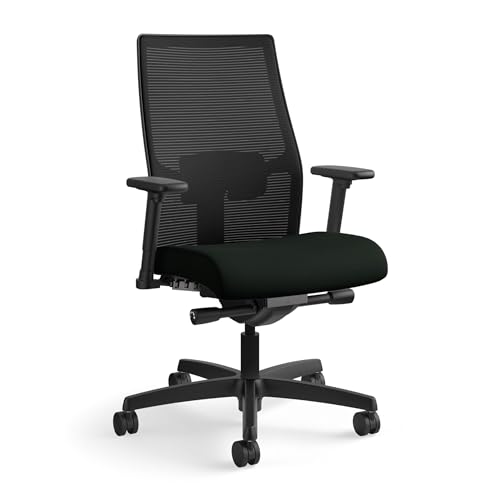
HON Ignition 2.0 Ergonomic Office Chair — Best Overall for High Use
High use is a specification, not a compliment. It means eight-plus hours a day, five days a week, often by more than one person, for years. The HON Ignition 2.0 is built for exactly that world: it is a commercial ergonomic task chair from HON, one of the largest office furniture manufacturers, with adjustable lumbar support and adjustable arms in a black, go-anywhere design. It is the chair facilities managers buy by the hundred, and that heritage is the point.
Strengths
- Commercial task-chair pedigree — designed for full-time daily use, not occasional home-office hours
- Adjustable lumbar support and adjustable arms let different users dial in their own fit
- Understated black design suits offices, shared workspaces and home setups alike
Trade-offs
- Commercial styling is functional rather than luxurious — no plush executive look
- Adjustment range is broad but each control must be set deliberately; it rewards five minutes of setup
- Sold through many channels, so confirm the exact Ignition 2.0 configuration at checkout
| Format | Ergonomic task chair |
|---|---|
| Support | Adjustable lumbar support |
| Arms | Adjustable arms |
| Color | Black |
What high use actually destroys in a cheap chair is never the part in the photograph. It is the foam, which packs down until you are sitting on the seat pan; the tilt mechanism, which develops play and then a lean; the casters, which stop rolling and start dragging; and the arm pads, which crack at the edges. Commercial chairs like the Ignition 2.0 are engineered against that list — denser foams, mechanisms rated for continuous duty, and parts designed to be serviced rather than landfilled. The adjustable lumbar is the ergonomic headline: it moves to meet your back rather than offering a fixed bump at a height chosen for somebody else. In a shared or hot-desking setting, the adjustability is what lets three different bodies use it across a week without any of them quietly hating it. If your chair is a tool of your trade, this is the class of tool professionals buy.
Best for: Full-time desk workers, shared workstations and offices equipping for years of use / Not suited for: Anyone wanting a plush executive or lounge aesthetic

HON Ignition 2.0 Big and Tall Ergonomic Office Chair — Best Big and Tall for High Use
Big and tall users get the worst of the office chair market: standard chairs that are too narrow, mechanisms stressed past their design, and “heavy duty” labels applied to chairs that are merely wide. This version of the HON Ignition 2.0 is the platform’s genuine big and tall variant — a desk chair in black with adjustable lumbar support, from the same commercial line as our best overall pick.
Strengths
- Purpose-built big and tall variant of a proven commercial platform, not a standard chair with a wider seat bolted on
- Adjustable lumbar support — rare and valuable at this size class
- Commercial HON construction aimed at daily, full-time use
Trade-offs
- Larger footprint needs a larger desk bay — measure your workspace
- Big and tall commercial chairs sit in a higher tier than standard task chairs
- Black-only, function-first styling
| Format | Big and tall ergonomic task chair |
|---|---|
| Support | Adjustable lumbar support |
| Line | HON Ignition 2.0 |
| Color | Black |
The physics of big and tall seating are unforgiving: every component — cylinder, mechanism, base, foam — works harder, and under-engineered chairs announce it within a year through sinking, wobbling and cracking. Starting from a commercial platform matters because the engineering margins are already there. The adjustable lumbar deserves emphasis at this size: back support that cannot be positioned is decoration, and larger frames vary more in where support needs to land. For a big or tall person working full days, the combination here — real capacity, real adjustability, commercial build — is the short list, and it is short because so few chairs honestly offer all three. Pair it with a desk at the right height and a monitor at eye level and the workstation stops being a daily negotiation with furniture that was designed for someone else.
Best for: Big and tall full-time desk workers / Not suited for: Small workspaces or petite users, who should choose the standard Ignition 2.0

MOLENTS Ergonomic Office Chair — Best Certified Mesh Chair
Chair listings are full of the word “ergonomic” and empty of evidence. The MOLENTS chair brings a receipt: it is BIFMA X5.1 certified, the industry test standard for office chair durability and safety. Around that credential it builds a complete high-use package — breathable mesh, adjustable lumbar support, 3D adjustable arms, tilt back and a wide seat, in obsidian black.
Strengths
- BIFMA X5.1 certified — an independent durability and safety standard, not a marketing adjective
- Full mesh construction breathes through long shifts in warm rooms
- 3D arms, adjustable lumbar and tilt give a wide fitting range for different users
Trade-offs
- Mesh feel is firmer and cooler than foam — a preference, not a universal upgrade
- Certification covers the standard’s tests; correct setup still decides your comfort
- Wide seat may feel oversized for smaller frames
| Format | Mesh ergonomic task chair |
|---|---|
| Certification | BIFMA X5.1 certified (as listed) |
| Arms | 3D adjustable |
| Seat | Wide seat |
| Color | Obsidian Black |
BIFMA X5.1 is worth explaining, because it is the closest thing this category has to an honest label. The standard subjects a chair to structured testing — load, durability, stability — designed to simulate years of office use. A chair that carries it has at least been measured against the failure modes that high use produces. The MOLENTS then adds the features long-day users actually adjust: lumbar support that moves, arms that adjust in three dimensions to meet elbows at desk height, a tilt that lets posture vary across the day, and mesh that keeps air moving during the hours when foam chairs turn warm. For a buyer who wants one verifiable credential plus a complete adjustment package at a non-flagship tier, this is the most defensible pick on the list.
Best for: Buyers who want certified durability plus full adjustability / Not suited for: Anyone who prefers deep foam cushioning to mesh

Sweetcrispy Ergonomic Mesh Office Chair — Best Budget for Daily Use
Not every high-use chair buyer can shop the commercial tier, and the Sweetcrispy is the budget pick that respects the assignment: an ergonomic mesh computer chair with comfortable lumbar support, a mid-back design, rolling swivel base and flip-up arms, in grey, aimed at home offices, bedrooms and study spaces. The flip-up arms are its quiet superpower — the chair tucks fully under a desk when the workday ends.
Strengths
- Flip-up arms let the chair push completely under the desk — a real win in small rooms
- Mesh back and lumbar support cover the all-day basics at a budget tier
- Mid-back format suits smaller users and smaller spaces than high-back chairs
Trade-offs
- Budget tier means budget duty expectations — it is a daily home-office chair, not a commercial fleet chair
- Mid-back gives up the upper-back and head support some tall users want
- Fewer adjustment dimensions than the MOLENTS or HON picks
| Format | Mesh office chair, mid-back |
|---|---|
| Arms | Flip-up arms |
| Support | Lumbar support |
| Color | Gray |
Judge the Sweetcrispy against its real competition — the no-name chairs at the bottom of the market with fixed arms, mystery foam and a lumbar pillow doing the work of a design. Against that field, a breathable mesh back, integrated lumbar support and arms that get out of the way are meaningful engineering. The flip-up arms deserve their own sentence: in apartments and shared rooms, a chair that stores under the desk returns the room to its owner every evening, and that daily courtesy is a feature people feel for years. Set expectations at the tier — this is the chair for a home worker on a budget who sits long hours and needs the fundamentals done properly — and it delivers them without pretending to be a commercial fleet chair.
Best for: Home-office workers on a budget, small rooms, students / Not suited for: Commercial fleets or users needing maximum adjustment

BestOffice Big and Tall 500 lb Mesh Office Chair — Best Heavy-Duty Capacity
When capacity is the question, the listing should answer it in numbers. This BestOffice chair states its figure plainly: a big and tall mesh office chair with a 500 lb capacity, ergonomic high back, lumbar support and an extra-wide seat, built for home office use. That stated capacity — a specification, printed here because it decides the purchase — puts it at the top of this list for heavier users who work full days.
Strengths
- Stated 500 lb capacity — the highest figure among these picks
- Extra-wide seat and high back sized for larger frames
- Mesh construction keeps long sits cooler than vinyl or foam alternatives
Trade-offs
- A chair built to this capacity is large and heavy — check doorways and desk bays
- Capacity is a maximum, not a comfort promise; fit still depends on your frame and setup
- Styling is functional; this is equipment, not decor
| Format | Big and tall mesh office chair |
|---|---|
| Capacity | 500 lb (as listed) |
| Back | High back with lumbar support |
| Seat | Extra-wide |
Heavy-duty seating fails in predictable places when it is merely marketed rather than built: cylinders that sink, bases that flex, seat foam that bottoms out. A manufacturer willing to print a 500 lb capacity on the listing is making a claim that can be checked against the chair in your room within the first month — and the supporting cast here (extra-wide seat, high back, mesh rather than heat-trapping upholstery) matches the brief of a larger person sitting long hours. The ergonomic framing is comfort framing, as it should be: lumbar support and a high back distribute a long day more evenly, and mesh keeps the seat environment bearable in warm rooms. If standard and even big-and-tall chairs have felt like borrowed furniture, this is the pick that starts from your requirements instead of asking you to adapt to its limits.
Best for: Heavier users needing the highest stated capacity for full workdays / Not suited for: Small rooms or users who do not need the capacity

Big and Tall Office Chair 400lbs with Wide Seat — Best Wide-Seat Value
Sitting between standard chairs and the maximum-capacity BestOffice is this wide-seat option: a big and tall office chair with a stated 400lbs capacity, mesh executive high back, lumbar support and adjustable arms, in black. It targets the large group of users whom standard chairs pinch and squeeze — and for whom a wide, breathable, adjustable chair at a value tier is the difference between tolerating the workday and being equipped for it.
Strengths
- Stated 400lbs capacity with a genuinely wide seat for larger frames
- Adjustable arms and lumbar support — the two fittings big users most often lose at this tier
- Mesh high back breathes through long sessions
Trade-offs
- Value tier — commercial buyers should compare the HON big and tall pick
- Executive styling is bulkier than task-chair designs
- Capacity and width exceed what average frames need; smaller users will swim in it
| Format | Big and tall mesh executive chair |
|---|---|
| Capacity | 400lbs (as listed) |
| Arms | Adjustable arms |
| Support | Lumbar support |
The wide seat is the headline and it deserves to be: seat width is where standard chairs fail larger users first, long before any mechanism does, and no amount of lumbar adjustment compensates for a seat pan that crowds the hips. This chair starts from width and capacity, then keeps the fittings that value chairs usually delete — arms that adjust rather than fix at a wrong height, lumbar support integrated into a breathable mesh back. The executive format brings a taller back and a more substantial presence, which suits a dedicated home office better than a shared nook. For the buyer whose requirement reads “wide, strong, adjustable, not flagship money,” this is the balanced answer on the list.
Best for: Larger users wanting width and adjustability at a value tier / Not suited for: Average frames, small spaces or commercial fleet buyers
Comparison Table
Compare by duty evidence first — pedigree, certification, stated capacity — then by the fit features your body and your room require.
| Pick | Badge | Key Spec | Best For |
|---|---|---|---|
| HON Ignition 2.0 Ergonomic Office Chair | Best Overall for High Use | Commercial task chair, adjustable lumbar and arms | Full-time desk workers, shared workstations and offices equipping for years of use |
| HON Ignition 2.0 Big and Tall Ergonomic Office Chair | Best Big and Tall for High Use | Big and tall, adjustable lumbar, commercial line | Big and tall full-time desk workers |
| MOLENTS Ergonomic Office Chair | Best Certified Mesh Chair | BIFMA X5.1 certified, mesh, 3D arms | Buyers who want certified durability plus full adjustability |
| Sweetcrispy Ergonomic Mesh Office Chair | Best Budget for Daily Use | Mesh mid-back, flip-up arms, budget tier | Home-office workers on a budget, small rooms, students |
| BestOffice Big and Tall 500 lb Mesh Office Chair | Best Heavy-Duty Capacity | 500 lb stated capacity, extra-wide mesh seat | Heavier users needing the highest stated capacity for full workdays |
| Big and Tall Office Chair 400lbs with Wide Seat | Best Wide-Seat Value | 400lbs stated capacity, wide seat, adjustable arms | Larger users wanting width and adjustability at a value tier |
How to Choose an Office Chair for All-Day, Every-Day Use
Shop the duty cycle, not the photograph. Ask what the chair was designed to do eight hours a day for five years. Commercial lines (HON’s Ignition family) and BIFMA-tested chairs exist because offices learned the cost of the alternative. A home worker with a full-time schedule is a fleet of one and should shop with the same seriousness.
Get your capacity with headroom. If you are near a chair’s stated limit, the chair will feel it and so will you — mechanisms work best in the middle of their range. The stated figures on this list (500 lb, 400 lb, and the big and tall HON’s class positioning) let you choose with margin instead of hope. Capacity is a specification, and any chair that will not state one has told you something.
Prioritize the two adjustments that matter most. Seat height is universal and non-negotiable — feet flat, knees at roughly a right angle. After that, lumbar position and arm height decide most of the day’s comfort. Lumbar support that moves to your back (the HONs, the MOLENTS) beats a fixed curve; arms that adjust keep shoulders down at desk height. Tilt tension and recline lock are the next tier — valuable for posture variety across a long day.
Mesh or foam is a climate decision. Mesh breathes, sits cooler and keeps its shape; it feels firmer and can feel cool in cold rooms. Foam cushions and insulates; dense commercial foam lasts, cheap foam packs down. Warm room, long shifts, warm person: mesh. Cold room or a preference for cushion: foam from a commercial line, where the density is specified for duty.
Measure the room as well as yourself. Big and tall and executive chairs need bay width, door width and desk clearance. Flip-up arms (the Sweetcrispy) exist for rooms where the chair must vanish under the desk nightly. The best chair in the wrong room becomes the room’s problem, so take three measurements before ordering: desk height, bay width, and the path the box travels to get there.
Consider the warranty and parts story as a durability signal. Without quoting any specific terms — check the listing for the current ones — the pattern is reliable: manufacturers who expect a chair to survive high use say so in their coverage and stock the parts that wear, such as casters, cylinders and arm pads. A chair with no parts ecosystem is a chair designed to be replaced whole. For a fleet buyer or a heavy user, that difference compounds; for a light user it matters less. Match the seriousness of the purchase to the seriousness of your use, which is, in one sentence, the entire philosophy of this guide.
Setting Up a High-Use Chair: The Fifteen-Minute Investment
Most chair dissatisfaction is setup dissatisfaction. Work through this sequence in your first week — ideally across two or three days of small adjustments rather than one heroic session. Set seat height so feet rest flat with thighs roughly level. Set the lumbar support to meet the small of your back when you sit fully back — not when you perch. Set arm height so elbows rest with shoulders relaxed, forearms level with the desk. Set tilt tension so you can lean back with gentle pressure and return without effort. Then live with it for two days before changing anything; bodies adapt, and the chair you tune in five-minute increments across a week ends up tuned to you rather than to a diagram. If the chair is shared, agree a reset ritual — height and arms back to neutral marks — so each user starts from a known position instead of a stranger’s settings.
How to Make a High-Use Chair Last
A good chair is a machine with moving parts, and machines respond to maintenance. These habits, none longer than a few minutes, are the difference between a five-year chair and a two-year chair.
Weekly — the thirty-second round. Brush crumbs and dust out of the mechanism area and off the casters. Hair and grit in caster wheels are the main cause of chairs that drag and scratch floors; a quick pick-out keeps them rolling.
Monthly — tighten and inspect. Check the bolts under the seat and at the arm mounts; high use vibrates fasteners loose gradually, and a quarter-turn now prevents the wobble that wears bolt holes oval later. Glance at the cylinder: a chair that slowly sinks overnight is telling you its lift is aging.
Seasonally — clean by material. Mesh: vacuum with an upholstery brush and spot-clean with mild detergent. Foam and fabric: vacuum and treat spills immediately, since a work chair meets coffee with statistical certainty. Wipe arm pads and the base; check caster axles for wound hair.
Yearly — the honest audit. Sit and assess like a buyer: foam still supportive, tilt still smooth, arms still firm, casters still silent? Commercial-line chairs reward this audit with replaceable parts; budget chairs tell you when their service is complete. Either way, knowing beats discovering mid-workday.
Always — use the chair as designed. Feet on the floor or a footrest, not on the base spokes; no standing on the seat for the high shelf; no using the arms as a step or a launch pad when standing. Most catastrophic chair failures are not defects — they are loads the chair was never built to take, applied once too often.
High Use in Shared Spaces: Hot-Desking, Shifts and Family Offices
Shared chairs live the hardest life in seating: two or three different bodies a day, adjustments made in haste, and a quiet accumulation of settings nobody chose. If your chair will be shared — between shifts, between partners, between a parent by day and a student by night — the buying criteria shift. Adjustment range matters more than peak comfort for any single user, because the chair must fit a span of heights and builds. Controls must be findable by touch and forgiving of rough handling. Upholstery must tolerate cleaning, since shared chairs meet more spills and more sanitizer.
The commercial picks lead here for structural reasons: the HON Ignition chairs were literally designed for this pattern of use, and the BIFMA-tested MOLENTS carries the durability credential that predicts survival under many hands. Whichever chair a shared space chooses, the social technology matters as much as the hardware: a laminated card on the desk showing the three adjustments and a household rule of resetting to neutral marks will do more for everyone’s comfort than any single feature. And when one user is dramatically larger than the others, honesty beats compromise — a stated-capacity chair protects both the larger user and the chair itself.
The Real Math of a Work Chair: Cost Per Year of Service
This guide prints no prices, by design, but the way to evaluate a chair purchase is arithmetic you can do with any price tag: divide the price by the years of daily service you honestly expect. A budget chair replaced three times in five years is rarely the bargain it appeared to be, once you count the repeat purchases, the assembly weekends and the months spent sitting on a chair already past its best. A commercial chair bought once and serviced with a caster swap in year four usually wins the long division — and wins it while providing the better sitting years in between.
The same math explains the capacity picks. A heavier user cycling through under-rated chairs every eighteen months is spending flagship money on budget experiences. One chair bought at the right stated capacity, with headroom, converts that churn into a single purchase and years of consistent support. None of this argues for buying the most expensive chair in every case — the Sweetcrispy tier serves a real budget honestly — but it argues for pricing the chair per year of your actual working life, not per click at checkout. Your back spends eight hours a day in the result; the spreadsheet should reflect that.
Fitting the Chair to the Workstation Around It
A chair does not work alone, and high-use comfort is a property of the whole workstation. Desk height decides whether correct arm height is even achievable: a chair adjusted perfectly at a too-high desk still leaves shoulders shrugged. Monitor height decides posture at the neck — the screen’s top third near eye level keeps the head balanced over the spine the chair is supporting. Foot support closes the chain: feet flat on the floor, or on a footrest when the desk height forces a higher seat, so the chair’s seat edge is not carrying the weight of dangling legs.
Lighting and layout play quieter roles. A chair that must twist its user toward a side monitor for eight hours defeats every lumbar feature it owns; center the screen you use most. Keyboard and mouse position decide elbow angle as surely as armrests do. None of this requires new furniture in most rooms — it requires an hour of rearranging with the same honesty you brought to choosing the chair. The buyers who report transformation from a chair upgrade usually changed the setup in the same week; give your new chair the same fair conditions before judging it.
Finally, movement is part of the equipment. No chair, however engineered, makes ten motionless hours a good idea. The tilt mechanisms on these picks exist partly to vary posture; use them. Stand for calls, walk for water, and treat the chair as the base of a working pattern rather than a cockpit to be strapped into. High use should mean high quality of use, not merely high hours.
Common Buying Mistakes
Buying by sit-test alone. Ten minutes in a showroom measures initial softness, which correlates poorly with year-two support. Duty evidence — commercial line, certification, stated capacity, foam quality — predicts the long term better than any first impression.
Ignoring stated capacity until the cylinder sinks. A chair used daily at its limit ages in fast-forward. Choose with headroom; the figures are printed on the listings here precisely so you can.
Paying for a headrest and skipping the lumbar. Accessories photograph well; fundamentals work all day. Lumbar position, seat height and arm height decide comfort at hour six. Buy the fundamentals first.
One chair, three users, zero adjustment. Shared chairs fail socially before they fail mechanically: nobody adjusts, everybody tolerates. Choose wide adjustment ranges for shared desks and agree the reset-to-neutral habit.
Forgetting the floor. Hard casters on hard floors and soft floors alike suffer; the chair, the floor or both will show it. Match caster type to your floor, or use a chair mat — and note that a dragging caster is usually a dirty caster, not a broken one.
Judging the chair before setting it up. A high-use chair arrives with every adjustment at a factory neutral that fits nobody in particular. Buyers who sit in it as-delivered and declare it uncomfortable have reviewed the shipping configuration, not the chair. The fifteen-minute setup in this guide — and two or three days of small refinements after it — is part of the product. Chairs that still disappoint after honest setup earn the return; chairs never set up never got the chance to succeed.
Final Recommendation
For a single recommendation: the HON Ignition 2.0 is the chair this guide would issue to an entire workforce — commercial build, real adjustability, no theatrics at all. Big and tall users should take its sibling, the Ignition 2.0 Big and Tall, or the stated-capacity picks. Buyers who want their durability evidence in writing should choose the BIFMA X5.1-certified MOLENTS without any hesitation.
On a budget, the Sweetcrispy covers the fundamentals honestly, and the two wide-seat chairs serve larger users at maximum capacity and value tiers respectively. Whichever you choose, spend the first week setting it up properly — in high-use seating, fit is not a feature of the chair alone but of the chair as adjusted to you, at your desk, with your screen and your floor completing the system it was bought to anchor.
Related reading from our other buying guides:
- Best Chairs Affordable
- Best Chairs Around 100
- Best Built Chairs
- Best Chair Mat For Carpets Rolling Chairs
- Best Carpet For Under Desk Chairs
Frequently Asked Questions
What makes an office chair “high use”?
A duty rating in everything but name: commercial construction, dense foam, mechanisms and casters built for eight-plus hours daily over years. Evidence includes commercial product lines like HON Ignition, BIFMA certification, and stated weight capacities. A high-use chair is defined by what survives, not by how it feels on day one. The practical test at home is equally simple: a high-use chair feels as supportive at hour eight as at hour one, rolls as freely in month twelve as in week one, and asks for nothing but an occasional bolt check and caster cleaning in between.
What is BIFMA X5.1 and should I care?
BIFMA X5.1 is the office furniture industry’s test standard for chair safety and durability — structured load and cycle testing that simulates years of use. The MOLENTS pick on this list carries it. It does not guarantee personal comfort, since comfort is personal, but it is the strongest widely used evidence that a chair was genuinely built and tested for sustained daily use rather than merely described that way in its marketing.
How much weight capacity do I need?
Choose a stated capacity comfortably above your weight so the mechanism works mid-range rather than at its limit. This list includes chairs stating 500 lb and 400 lb capacities and a big and tall commercial model, precisely so heavier users can select by figure instead of by hope. Remember that capacity interacts with hours: a chair near its limit for an occasional hour is a different proposition from the same chair at its limit for forty hours a week, which is why this guide treats headroom as a feature in itself.
Mesh or foam for eight-hour days?
Mesh breathes and holds its shape — the better default for warm rooms and warm people. Foam cushions more softly, and commercial-grade dense foam lasts well. Many long-day users prefer mesh for the back at minimum, sometimes paired with a foam seat, which splits the difference between airflow and cushion. It is a climate and preference decision, not a quality ranking — but it is a decision worth making deliberately, because you will feel its consequences every working day for years.
Can one chair work for two people sharing a desk?
Yes, if its adjustment range is wide and both users actually adjust it. Prioritize movable lumbar support and adjustable arms and height, agree a reset-to-neutral habit, and expect thirty seconds of setup per user change. The HON Ignition 2.0 and MOLENTS picks suit shared duty best here. In shift-work settings — a chair that genuinely never cools down — step up to the commercial lines without hesitation, because shared high use is the harshest duty cycle in this entire category and the one cheap chairs survive the shortest.
How long should a high-use chair last?
A commercial-line or certified chair used daily should give years of service with basic maintenance — caster cleaning, bolt checks, material-appropriate cleaning. Budget chairs serve honestly for shorter horizons. When foam bottoms out, cylinders sink or mechanisms develop play that tightening cannot fix, the chair has completed its service.
My chair wobbles — is it finished?
Usually not, so do not replace it yet. Wobble in a high-use chair is most often loose fasteners: check and tighten the bolts under the seat pan and at the arm mounts, and clear wound hair from the caster axles so the base sits level. If the wobble lives in the tilt mechanism itself and tightening changes nothing, the mechanism is worn — commercial-line chairs may offer replacement parts, while budget chairs have generally completed their service at that point.
Do I need a headrest for long days?
Most people do not, and no pick here depends on one for its core performance during a working day. A headrest helps mainly when you recline to read, think or take calls leaned back; for upright typing work it is rarely in contact with you at all. Spend first on seat height range, lumbar position and arm adjustment — the fittings that touch you for all eight hours — and treat a headrest as an optional extra for recliners-by-habit.


