Disclosure: airfryerkitchensupply.com is reader-supported. When you buy through links on our site, we may earn an affiliate commission at no extra cost to you.
Where to buy
All six pillows below are sold on Amazon. Check the current price on Amazon for each in the size you need — pillow pricing varies by size, and the right choice depends on your sleep position and preferred feel, not the week’s offer.
- Tempur-Pedic TEMPUR-Ergo Neck Pillow, Medium Profile — our Best Overall pick
- Coop Home Goods Cool+ Adjustable Pillow, Queen — the adjustable pick
- EPABO Contour Memory Foam Pillow — the value contour pick
- DONAMA Cervical Pillow, Dual-Height Contour — the two-heights pick
- Avocado Organic Green Pillow, Standard — the natural materials pick
- LOFE Buckwheat Pillow, 20×26 — the firm moldable pick
The best pillows for neck ache are about fit, height, and sleep position
Waking with a stiff, aching neck is one of the most common reasons people go looking for the best pillows for neck ache, and it is worth being straight about what a pillow can and cannot do. A pillow is a comfort product, not a medical device, and this guide makes no medical claims for any of them. What a pillow genuinely controls is the position your head and neck rest in for seven or eight hours: too high and the neck flexes all night, too low and it tilts, too soft and the head sinks until the neck is unsupported, too firm and pressure points build. When the fit is wrong, you wake up having held an awkward posture for a third of your life. When the fit is right, the neck rests in a neutral, easy alignment — and that is the honest promise of every pick here.
The six picks attack the fit problem from different directions, because sleepers differ. The Tempur-Pedic TEMPUR-Ergo is the shaped contour benchmark: a molded pillow with a medium profile designed to follow the neck’s curve. The Coop Cool+ takes the opposite route — an adjustable fill you add or remove until the height is yours. The EPABO is the value contour, the DONAMA offers two heights in one dual-height shape, the Avocado brings adjustable natural latex and kapok with serious organic certifications, and the LOFE buckwheat pillow is the firm, fully moldable traditional option. Between them, every sleep position and every firmness preference has a serious candidate.
Two disciplines run through this guide. First, certification language is reported exactly: CertiPUR-US concerns the foam’s content and emissions standards, GREENGUARD Gold concerns low chemical emissions, GOTS and GOLS are organic certifications — for textiles and latex respectively — and OEKO-TEX, where it appears, concerns harmful-substance testing. None of these is a medical endorsement, and we do not present them as one. Second, the listings for several of these pillows use the language of pain relief, as pillow listings do; those phrases appear in this guide only inside the source records, not as claims we make. Our claims are the modest, true ones: shape, height, adjustability, materials, and fit.
In this guide
Quick Picks
Best Overall — Tempur-Pedic TEMPUR-Ergo Neck Pillow, Medium Profile. A molded ergonomic neck pillow from the memory foam originators — the shaped-contour benchmark in a medium profile. Check the current price on Amazon.
Best Adjustable — Coop Home Goods Cool+ Adjustable Pillow, Queen. A plus-shaped adjustable pillow with cooling gel memory foam fill you can add or remove, with CertiPUR-US and GREENGUARD Gold certifications stated in the listing. Check the current price on Amazon.
Best Value Contour — EPABO Contour Memory Foam Pillow. An ergonomic contour memory foam pillow for side, back, and stomach sleepers at the value end of the category. Check the current price on Amazon.
Best Two Heights — DONAMA Cervical Pillow. A cooling contour memory foam pillow with a dual-height ergonomic shape — two neck-support heights in one pillow, turned end to end. Check the current price on Amazon.
Best Natural Materials — Avocado Organic Green Pillow. An adjustable-loft pillow filled with Dunlop latex and kapok, medium firm, with GOTS, GOLS, and GREENGUARD Gold certifications stated in the listing. Check the current price on Amazon.
Best Firm and Moldable — LOFE Buckwheat Pillow, 20×26. A Tartary buckwheat hull pillow with an organic cotton pillowcase — adjustable by adding or removing hulls, firm and fully shapeable. Check the current price on Amazon.
How These Picks Were Chosen
Fit mechanisms decided this list. A pillow qualified only if it offered a credible way to match the sleeper: a shaped contour in a stated profile (Tempur-Pedic), an adjustable fill (Coop, Avocado, LOFE), a dual-height shape (DONAMA), or a proven contour at a value price (EPABO). Generic flat pillows, however plush, were excluded — a pillow that cannot be fitted cannot address the problem this search describes. Sleep-position coverage was the second filter: the final six include strong options for back sleepers, side sleepers, and combination sleepers, and the reviews say plainly where each pillow does not suit.
Every product name, material, size, and certification in this guide was cross-checked against Amazon’s catalogue data before the pillow earned a link. Where a listing gives a dimension — the LOFE’s 20×26 inches, the EPABO’s class of sizing — we report it; where it does not, we do not invent measurements, because pillow height is the whole subject and a guessed number would be worse than none. Prices are not printed; check the current price on Amazon in your size. And a note on expectations that the reviews repeat: any new pillow shape takes several nights to judge, so use the settling-in guidance in the how-to section before concluding a pick is wrong for you.
The 6 Best Pillows for Neck Ache

1. Tempur-Pedic TEMPUR-Ergo Neck Pillow, Medium Profile — Best Overall
The TEMPUR-Ergo Neck Pillow is the reference design in shaped neck pillows: a molded pillow in a medium profile, shaped to follow the natural curve of the head and neck, made by the company that introduced memory foam to bedrooms. The molded shape is the point — rather than a uniform slab that compresses evenly, the contour holds the neck in its raised section and cradles the head in its lower one, so back sleepers in particular get a consistent, repeatable position night after night. Medium profile suits the broad middle of sleepers: average builds, back sleeping, and side sleeping on a mattress soft enough to let the shoulder sink.
Strengths
- Molded ergonomic contour gives a consistent, repeatable neck position
- Medium profile fits the widest range of builds and back-sleeping styles
- Tempur-Pedic’s material is the category benchmark for pressure-relieving feel
Trade-offs
- Fixed shape and height — if the profile is wrong for you, there is nothing to adjust
- Molded foam sleeps warmer than shredded or natural fills for some people
- Premium tier pricing — check the current price on Amazon
Key specs (from the listing): Type: molded neck pillow · Profile: medium · Brand: Tempur-Pedic · Model: TEMPUR-Ergo Neck Pillow · Colour shown: white
Who thrives on this pillow: the back sleeper who wakes with a stiff neck on ordinary pillows and wants the decision made for them by a proven shape. Who should hesitate: stomach sleepers, for whom any raised contour is usually too much, and very broad-shouldered side sleepers, who may need more height than a medium profile gives — those readers should look at the adjustable Coop or the dual-height DONAMA instead. Tempur-Pedic also sells this shape in other profiles; the medium listed here is the starting point, and the existence of a firmer, larger sibling in the range is worth knowing if the medium feels close but not quite. Judge it over a week, not a night: shaped pillows ask the neck to learn a new resting position, and night one is the worst evidence.
Best for: back sleepers and average builds wanting a proven contour / Not suited for: stomach sleepers or anyone who needs height adjustability
Check the current price on Amazon

2. Coop Home Goods Cool+ Adjustable Pillow, Queen — Best Adjustable
The Coop Cool+ answers the fit problem with a zipper: a queen-size pillow in a plus-shaped design, filled with cooling-gel memory foam that you add or remove until the height and feel are right for your body and your mattress. Its listing states CertiPUR-US and GREENGUARD Gold certifications — foam-content and low-emissions standards, reported here as exactly that. Adjustability is the strongest argument in this entire category, because the correct pillow height is personal: it depends on your shoulder width, your mattress’s softness, and your position, and no fixed pillow can be right for everyone who buys it.
Strengths
- Fully adjustable fill — tune the height instead of tolerating it
- Cooling gel memory foam fill in a plus-shaped design for back, stomach, or side sleeping
- CertiPUR-US and GREENGUARD Gold certifications stated in the listing
Trade-offs
- Dialing in the fill takes a few nights of experimentation
- Shredded fill feels different from a molded contour — less structured, more mouldable
- Queen size only in this listing; check the listing for other sizes if you need them
Key specs (from the listing): Size: queen · Fill: adjustable memory foam with cooling gel · Shape: plus-shaped · Certifications (as listed): CertiPUR-US, GREENGUARD Gold · Positions: back, stomach, side
Coop Home Goods built its reputation on exactly this adjustable concept, and the Cool+ is its cooling variant. The practical method: start with the pillow as shipped for two nights, then remove a handful of fill at a time — side sleepers usually remove least, back sleepers more, stomach sleepers most — keeping the removed fill in its bag, because the right answer sometimes changes with a new mattress. The plus-shaped cut is designed to give side sleepers a shoulder-friendly edge and back sleepers a supportive centre. For couples buying two different answers to the same bed, this is the easiest pick in the guide to recommend blind, because the pillow adapts to the sleeper rather than demanding the sleeper adapt to it.
Best for: combination sleepers, couples with different needs, and anyone unsure of their ideal height / Not suited for: sleepers who strongly prefer a firm molded shape
Check the current price on Amazon
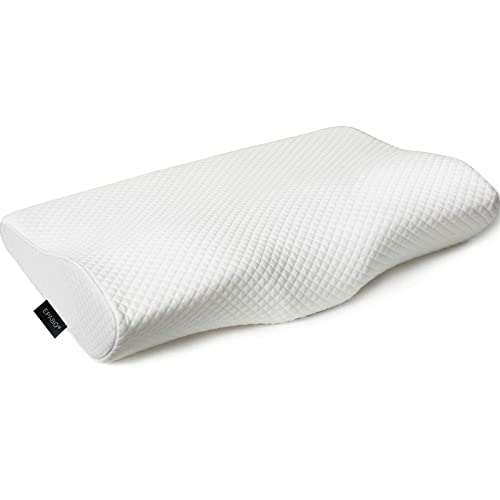
3. EPABO Contour Memory Foam Pillow — Best Value Contour
The EPABO is the shaped-contour idea at the value end: an ergonomic contour memory foam pillow, described in its listing for side, back, and stomach sleepers. The contour geometry is the familiar one — raised edges under the neck, a hollow for the head — executed in memory foam at a price tier that makes it the natural first experiment for a sleeper who suspects their flat pillow is the problem but does not want to commit premium money to find out. As a first contour pillow, it answers the essential question — does a shaped pillow suit my neck? — honestly and cheaply.
Strengths
- Proper ergonomic contour shape at a value-tier price
- Memory foam feel suits back and side sleepers transitioning from flat pillows
- The low-risk way to test whether contour sleeping works for you
Trade-offs
- Fixed shape and height, like all molded contours — no adjustment if it is not quite right
- The listing’s language leans on relief claims; judge the pillow on its shape and fit, as this guide does
- Value-tier foam and cover are serviceable rather than luxurious
Key specs (from the listing): Type: contour memory foam pillow · Shape: ergonomic cervical contour · Positions (as listed): side, back, stomach sleepers
EPABO’s contour pillows have been a fixture of the value tier for years, and the ownership pattern is consistent: most buyers discover within a week whether they are contour people. If you are, the EPABO either becomes the pillow or tells you exactly what to upgrade to — a touch higher, a touch firmer — which is valuable information either way. If you are not, you have spent value-tier money learning it. One caution from the category generally: contour pillows ship compressed and need their full expansion time before judging, and the first nights on any contour feel strange. Give it the week the how-to section prescribes before deciding.
Best for: first-time contour buyers and value-conscious back and side sleepers / Not suited for: anyone who already knows they need adjustability or premium materials
Check the current price on Amazon

4. DONAMA Cervical Pillow — Best Two Heights
The DONAMA’s idea is simple and clever: a cooling contour memory foam pillow with a dual-height ergonomic shape, so the two ends offer different neck-support heights and you choose by turning the pillow around. Neck ache is often a height problem wearing a shape problem’s clothes — the contour is right but the loft is not — and a dual-height pillow tests both heights in one purchase. The cooling contour cover addresses the other common memory foam complaint, warmth, at least at the surface where your face notices it.
Strengths
- Two support heights in one pillow — turn it end to end to change the fit
- Cooling contour design for sleepers who find memory foam warm
- Ergonomic cervical shape for side, back, and stomach positions as listed
Trade-offs
- Two fixed heights still may not include your exact ideal — the Coop adjusts continuously
- Contour shape is a commitment; flat-pillow devotees may not convert
- Listing language uses relief phrasing; this guide’s endorsement is of the dual-height design, not of medical claims
Key specs (from the listing): Type: contour memory foam pillow · Shape: dual-height ergonomic · Cover character: cooling · Positions (as listed): side, back, stomach
The dual-height design has a second, quieter use: households. A guest bed fitted with a DONAMA offers two sleepers two chances at a good fit, and a couple sharing travel plans can pack one pillow that serves either of them passably. At home, the practical routine is to sleep a few nights on each height before choosing — the difference between the two ends is exactly the variable most pillow buyers guess at and get wrong. DONAMA sits in the middle tier of this guide: more considered than the value contour, less costly than the premium names, and built around the single most useful idea in the category after adjustability itself.
Best for: sleepers unsure of their height, guest beds, and couples / Not suited for: buyers wanting continuous adjustability or natural fills
Check the current price on Amazon
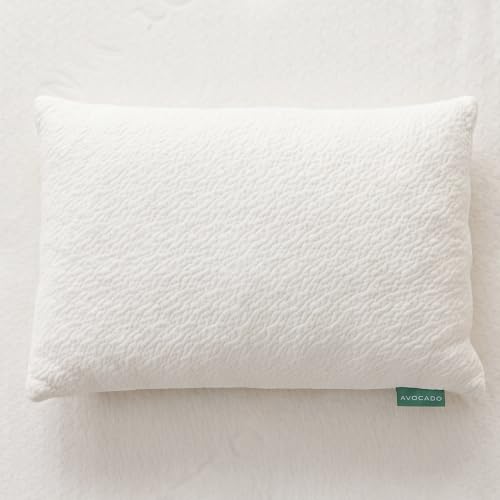
5. Avocado Organic Green Pillow — Best Natural Materials
The Avocado Green Pillow is the materials-led pick: an adjustable-loft pillow filled with Dunlop latex and kapok — you add or remove fill to set the height — in a medium firm feel, with the listing stating GOTS, GOLS, and GREENGUARD Gold certifications. Read precisely, those mean: GOTS certifies organic textile standards, GOLS certifies organic latex, and GREENGUARD Gold certifies low emissions. For buyers whose pillow decision is partly about what the pillow is made of, this is the most credentialed natural option in the guide, and the adjustable loft means the credentials do not come at the cost of fit.
Strengths
- Adjustable loft with natural latex and kapok fill — fit and materials together
- GOTS, GOLS, and GREENGUARD Gold certifications as stated in the listing
- Latex fill feels responsive and breathable compared with memory foam
Trade-offs
- Premium tier — the certifications and materials are the price
- Latex has a springier, bouncier feel that memory foam devotees may not prefer
- Standard size in this listing; check for other sizes if needed
Key specs (from the listing): Size: standard · Fill: Dunlop latex and kapok, adjustable · Feel: medium firm · Certifications (as listed): GOTS, GOLS, GREENGUARD Gold · Positions: back, side, stomach
Avocado is a known name in organic mattresses, and the pillow applies the same philosophy at smaller scale. The latex-and-kapok fill behaves differently from foam: it pushes back gently rather than moulding and holding, which some necks prefer — the head is supported on the pillow more than in it. Kapok, a silky natural fibre, softens the latex’s spring. Adjusting the loft is the same handful-at-a-time method as the Coop, with the same advice to keep removed fill. If your household is systematically replacing synthetic bedding with certified natural materials, this is the pillow that belongs in that project; if materials are indifferent to you, its premium buys you less than it buys them.
Best for: natural-materials buyers who still want adjustability / Not suited for: memory foam loyalists or tight budgets
Check the current price on Amazon

6. LOFE Buckwheat Pillow, 20×26 — Best Firm and Moldable
The LOFE is the traditionalist’s answer: a 20×26 pillow filled with Tartary buckwheat hulls, with an organic cotton pillowcase, adjustable by adding or removing hulls. Buckwheat behaves like nothing else in this guide — the hulls flow until you settle, then lock into the exact shape of your head and neck and hold it without spring or sink. The result is the firmest, most precisely fitted support here, and the coolest sleeping: air moves between hulls in a way foam never permits. Generations of sleepers in Japan and beyond have chosen this feel deliberately; it is not a compromise, it is a preference.
Strengths
- Hulls mould to your exact shape and hold it — support that does not fade overnight
- Fully adjustable firmness and height by adding or removing hulls
- Airy hull fill sleeps cool; organic cotton pillowcase included as listed
Trade-offs
- Firm is the operative word — plush-pillow sleepers may never convert
- Hulls make a soft rustling sound when you move, which light sleepers notice
- Heavy compared with foam pillows, and the fill needs occasional topping up over years
Key specs (from the listing): Size: 20×26 in · Fill: Tartary buckwheat hulls, adjustable · Pillowcase: organic cotton (as listed) · Feel: firm, moldable
The LOFE suits a specific sleeper beautifully: the one who finds every foam pillow either too high within an hour (as it warms and sinks) or too soft from the start. Hulls do not warm, sink, or rebound — the shape you make at lights-out is the shape at 3 a.m. Side sleepers often do best of all, because the fill can be pushed into the shoulder-neck gap and stays there. The rustle is real and worth weighing honestly: most owners stop hearing it within nights; a minority never do, and for them the Coop or Avocado delivers adjustability in silence. Start with the pillow slightly overfilled and remove hulls gradually — with buckwheat, small subtractions make large differences.
Best for: firm-support seekers, hot sleepers, and precise side sleepers / Not suited for: plush-pillow lovers and the lightest sleepers
Check the current price on Amazon
Comparison Table
| Pick | Badge | Key spec | Best for |
|---|---|---|---|
| Tempur-Pedic TEMPUR-Ergo Neck Pillow | Best Overall | Molded contour, medium profile | Back sleepers, proven shape |
| Coop Cool+ Adjustable Pillow | Best Adjustable | Adjustable gel foam fill, queen | Combination sleepers, couples |
| EPABO Contour Memory Foam Pillow | Best Value Contour | Ergonomic contour, memory foam | First contour, value tier |
| DONAMA Cervical Pillow | Best Two Heights | Dual-height cooling contour | Height-unsure sleepers |
| Avocado Organic Green Pillow | Best Natural Materials | Latex and kapok, adjustable, GOTS/GOLS as listed | Natural bedding projects |
| LOFE Buckwheat Pillow | Best Firm and Moldable | Buckwheat hulls, 20×26, adjustable | Firm support, hot sleepers |
Key Takeaways
- Neck comfort from a pillow is a fit question: height, shape, and sleep position matter more than softness or price.
- Adjustable pillows (Coop, Avocado, LOFE) remove the guesswork; dual-height (DONAMA) hedges it; fixed contours (Tempur-Pedic, EPABO) reward sleepers whose build matches the shape.
- Side sleepers need more height than back sleepers; stomach sleepers need the least of all.
- Certifications mean specific things — foam standards, emissions, organic content — and none of them is a medical claim.
- Judge any new pillow over at least a week of nights, adjusting as you go, before deciding it is wrong.
- Never stack two pillows to gain height — the unstable join flexes the neck at exactly the angle you are trying to avoid.
- Protect and air the pillow you choose; a protector and a weekly fluff preserve the fit you spent a week dialing in.
How to Choose a Pillow When Your Neck Aches in the Morning
Start with your sleep position — honestly
Position decides the height you need. Side sleepers need the tallest pillow: it must fill the distance from mattress to head across the shoulder, keeping the neck straight rather than tilted down toward the bed. Back sleepers need a medium height with support under the neck’s curve and a lower cradle for the head — the contour’s home ground. Stomach sleepers need the thinnest, softest option or none of these contours at all, because a raised pillow twists and extends a stomach sleeper’s neck for hours. Most people are combination sleepers; if that is you, weight the position you fall asleep in and the one you wake in, and lean toward adjustable fills, which compromise gracefully.
Height and mattress work as a pair
The correct pillow height is not a property of the pillow alone. On a soft mattress your shoulder sinks, reducing the height a side sleeper needs; on a firm mattress the shoulder rides high and the same sleeper needs more pillow. This is why fixed-height recommendations fail strangers, and why this guide’s adjustable and dual-height picks are the safer blind buys. When testing a new pillow, test it on your own bed — a shop’s display mattress tells you almost nothing — and use the first week to fine-tune rather than to deliver a verdict.
Fill types: what each actually feels like
Molded memory foam (Tempur-Pedic, EPABO, DONAMA) holds a designed shape and a slow, sinking embrace — consistent night to night, warm for some. Shredded memory foam (Coop) moulds loosely and adjusts by the handful — less structured, more tunable, cooler with gel. Latex and kapok (Avocado) feel responsive and springy, supporting on the surface rather than in a mould, and breathe better. Buckwheat hulls (LOFE) flow, lock, and hold — the firmest and coolest, with a rustle. There is no best fill; there is the fill whose behaviour matches how you sleep, and the honest descriptions above are the way to choose without buying all four.
When a pillow is not the answer
This guide sells pillows, and still: persistent, severe, or worsening neck pain, pain radiating into the arms, numbness, or symptoms after an injury are matters for a medical professional, not a buying guide. A pillow addresses posture during sleep; it does not diagnose or treat anything. Readers with ordinary morning stiffness from an old, flat, or wrong-height pillow are this guide’s audience, and for them the fit changes described here are the sensible first step — cheap, reversible, and often decisive.
How to Set Up and Settle Into a New Pillow
Step 1 — Let it expand and air. Foam pillows ship compressed; give a new pillow its full expansion time per the packaging — up to a day — and let any new-foam smell dissipate before the first night. Judging an unexpanded pillow judges a product that does not yet exist.
Step 2 — Set the starting height deliberately. Adjustable fills: start as shipped. Dual-height: start on the lower end for back sleeping, the higher for side. Contours: position the raised neck edge under your neck, not your head — the single most common setup error is using a contour pillow backwards or too high under the skull.
Step 3 — Change one variable at a time. Across the first week, adjust fill by a handful, or swap the dual-height end, every two nights — never nightly, and never two changes at once. You are running a small experiment on yourself; keep the notes mental but the method real.
Step 4 — Give it seven nights before the verdict. Necks adapt to a new resting position over days. Night one on a contour feels strange for almost everyone; night seven is the evidence. If, after a week of methodical adjustment, the pillow still feels wrong, it is wrong for you — return it within its window and take the knowledge (higher, lower, firmer, softer) to the next pick.
Step 5 — Maintain the fit. Fluff and re-level shredded and natural fills weekly, keep the removed fill for future adjustments, and replace the pillow when its material stops recovering — memory foam that stays dented and hulls that have thinned are a fit problem returning by the back door.
Common Buying Mistakes
Buying the softest, plushest pillow for a sore neck. Plush feels kind in the shop and lets the head sink unsupported by 3 a.m. Support and fit are the criteria; softness is a preference to satisfy after them.
Copying someone else’s perfect pillow. Their shoulder width, mattress, and position are not yours. A pillow that transformed a partner’s sleep can be precisely wrong for you — which is why adjustable picks top this guide’s practical advice.
Judging on night one. Every shaped or adjustable pillow in this guide needs a settling week. Returning a contour after one strange night is the category’s most common wasted purchase.
Using a contour pillow backwards. The raised edge goes under the neck. It sounds obvious; it is the most frequent setup error, and it converts a well-designed pillow into a wedge that guarantees a stiff morning.
Ignoring the mattress half of the equation. A pillow perfect on your old mattress can be wrong on a new one. Revisit height whenever the bed changes — adjustable owners, this is your moment.
Expecting a pillow to treat a medical problem. Pillows manage sleep posture and comfort. Ongoing or serious symptoms belong to a clinician, and any listing that promises cures should be read the way this guide reads them: as marketing, not medicine.
Final Recommendation
If you want the decision made by a proven shape, buy the Tempur-Pedic TEMPUR-Ergo in medium profile. If you want to make the decision yourself, handful by handful, buy the Coop Cool+ — it is the lowest-risk recommendation in the guide for an unknown sleeper. The DONAMA is the smart hedge between those philosophies, the EPABO is the inexpensive way to learn whether contours suit you, the Avocado serves the natural-materials household without surrendering adjustability, and the LOFE is the connoisseur’s firm, cool, moldable answer. Whichever arrives, run the seven-night setup honestly before judging — the pillow and the patience are a package.
A closing note on patience: the readers who succeed with this category are the ones who treat the first week as fitting, not testing — adjusting, noting, and letting the neck learn. The readers who fail are usually those who bought a fixed shape on someone else’s recommendation and judged it in a night. Everything in this guide is arranged to put you in the first group: a fitted pillow, honestly described, given the nights it needs.
Related guides for the same bedroom project: Best Pillows For Asthmatics, Best Affordable Pillows, Best Back Side Pillows, Best Affordable Firm Pillows, and Best Affordable Pillows For Stomach Sleepers.
Sleep Positions in Depth: Matching the Pick to the Sleeper
The back sleeper
Back sleeping is the contour pillow’s natural home. The neck’s curve needs filling, the head needs a shallow cradle, and the whole arrangement must stay put when you stop arranging it — which is what molded shapes do best. The Tempur-Pedic medium profile is the default recommendation; the EPABO delivers the same geometry at a value price; and the DONAMA’s lower end suits back sleepers who find standard contours push their head forward. Back sleepers who snore or who elevate for reading should note that a contour is a sleeping tool, not a propping tool — keep a cheap flat pillow for the book, and sleep on the fitted one.
The side sleeper
Side sleeping is a height problem first and a shape problem second. The gap between mattress and head, across the shoulder, is the largest any position creates, and an under-height pillow lets the neck tilt toward the bed all night — the classic side-sleeper’s morning stiffness. Side sleepers should start at the high end of whatever they buy: the DONAMA’s taller end, the Coop filled generously, the LOFE packed firmly and pushed into the shoulder gap. Broad shoulders need more; a soft mattress needs less, because the shoulder sinks in. The test is a mirror or a partner’s eye: lying on your side, your neck should continue the line of your spine, not angle down from it.
The stomach sleeper
Honesty first: none of the six picks is designed for stomach sleeping, because stomach sleeping with any substantial pillow holds the neck rotated and extended for hours — the position least compatible with waking comfortable. Stomach sleepers who find this guide should take the thinnest path available: the Coop with much of its fill removed, used low and soft, or the Avocado similarly reduced. The longer-term fix many stomach sleepers adopt is transitional — a body pillow or a half-side position that rotates the body without rotating the neck as far. If you wake with neck ache and sleep on your stomach, the pillow is the smaller half of the answer, and this guide would rather say so than sell you a contour.
The combination sleeper
Most adults change position through the night, which breaks fixed pillows: the height that suits your side tilts your back, and the contour that cradles your back is a wall when you roll. Combination sleepers are the adjustable fills’ natural constituency — the Coop’s mouldable shredded foam and the Avocado’s latex-kapok can be punched into a side shape and flattened for the back within the same night. Set the fill level for your side position, since that is the height-critical one, and let the back position make do with a reshaped hollow. It is a compromise, and it is also how most people actually sleep well.
Pillow Care: Keeping the Fit You Bought
Protect the pillow from night one. A washable protector under the pillowcase is the cheapest fit-preservation there is: it keeps sweat and oils out of foam and fills that mostly cannot be washed, and it washes in minutes. Every pick in this guide lasts longer and stays fresher behind one.
Wash what is washable, air what is not. Cases and protectors wash weekly with the bedding. Molded foam pillows themselves generally should not be machine washed — air them, spot-clean per the label, and let them rest uncovered between uses. Shredded and natural fills benefit from regular fluffing and occasional airing in daylight, which restores loft and freshness together.
Re-tune adjustable pillows seasonally. Fill settles, bodies change, mattresses get replaced. The handful of fill you removed in spring is in its bag for a reason — revisit the height twice a year with the same two-nights-per-change method as the original setup, and the pillow you bought stays the pillow that fits.
Know the retirement signs. Foam that keeps a dent, fill that will not re-loft, hulls worn thin, a contour whose raised edge has softened into the valley — each means the geometry you chose no longer exists. A pillow is a shaped tool; when the shape goes, the tool is done, and no case or protector brings it back.
Frequently Asked Questions
What pillow height is best for neck comfort?
The height that keeps your neck in line with your spine in your main sleep position: generally tallest for side sleepers (filling the shoulder gap), medium for back sleepers (supporting the neck’s curve without pushing the head forward), and lowest for stomach sleepers. Your mattress’s softness shifts all three, which is why adjustable pillows — Coop, Avocado, LOFE — and the dual-height DONAMA are the practical recommendations for anyone unsure.
Are contour pillows better than regular pillows?
For back and side sleepers whose build matches the shape, a contour gives a consistent, repeatable neck position that a flat pillow cannot — that is the Tempur-Pedic and EPABO proposition. They are not better for everyone: stomach sleepers usually find contours too high, and sleepers between sizes may fit neither fixed shape. “Better” in pillows is always “better fitted,” and the adjustable picks exist for the many sleepers a fixed contour does not fit.
How long does it take to get used to a new pillow?
Plan on a week. The first nights on a new shape or height commonly feel strange, and morning stiffness can even rise briefly as your neck adapts to a new resting position. Adjust gradually — a handful of fill, or the other height of a dual-height pillow, every couple of nights — and judge at day seven. If it is still wrong after a methodical week, it is the wrong pillow, and what you learned should steer the next choice.
Do cooling pillows actually sleep cooler?
Cooling features — the gel fill in the Coop Cool+, the cooling contour of the DONAMA — moderate the surface warmth of memory foam rather than refrigerating it; most sleepers notice a cooler first hour, not an all-night effect. The genuinely cool option in this guide is structural: the LOFE’s buckwheat hulls let air move through the pillow itself. Choose cooling foam for comfort, buckwheat for airflow, and keep expectations at the level the physics supports.
What do CertiPUR-US, GREENGUARD, GOTS, and GOLS actually mean?
Specific, limited things. CertiPUR-US certifies that a foam meets standards for content, emissions, and durability. GREENGUARD Gold certifies low chemical emissions from the product. GOTS is an organic certification for textiles; GOLS is the corresponding organic certification for latex. None of them certifies comfort, and none is a medical endorsement — this guide reports them where listings state them, as materials information for buyers who value it.
Should I use two pillows stacked if one is not high enough?
Almost never. Two pillows create an unstable slope with a ridge where they meet, and the head slides into the join during the night — the neck ends up flexed at an angle neither pillow intended. If your pillow is too low, the correct fixes are a higher single pillow, an adjustable fill topped up, or the taller end of a dual-height design. Stacking is the one arrangement this guide advises against in all positions, and it is a surprisingly common cause of the exact morning stiffness people are trying to escape.
Does my mattress affect which pillow I need?
Directly. A soft mattress lets your shoulder and torso sink, reducing the pillow height a side sleeper needs and changing the angle a back sleeper rests at; a firm mattress does the opposite. This is why the same pillow can feel perfect in a hotel and wrong at home. Whenever the mattress changes — new bed, a topper added, a move to a firmer spare room — re-run the height check from the setup section before blaming the pillow, and let adjustable owners simply re-tune.
Is a firmer pillow always better for neck support?
No — firmness and support are different things. Support means the pillow holds the head and neck at the right height and angle; a very firm pillow at the wrong height does that job worse than a medium pillow at the right one, and it adds pressure points of its own. Firmness is a feel preference to choose after height and shape are settled: the LOFE’s firmness suits sleepers who want a locked-in shape, the Avocado’s medium firm is the middle path, and the foams sit between. Buy height first, shape second, firmness third — in that order.
When should I replace my pillow?
When it stops holding its designed shape: memory foam that stays compressed, shredded fill that will not re-loft after fluffing, hulls that have thinned below a supportive fill, or any pillow you must fold or bunch to reach your height — folding is the classic sign the pillow is done. A pillow past its shape is a wrong-height pillow, whatever it once was, and replacing it is the cheapest experiment in this whole subject.

