Disclosure: airfryerkitchensupply.com is reader-supported. When you buy through links on our site, we may earn an affiliate commission at no extra cost to you.
Where to buy
Every chair below was verified against Amazon’s catalog data for this site before it earned a link in this guide: the headrest had to be present in the listing itself — a chair that merely has a tall back is not a headrest chair, and several tall-backed models from well-known brands were excluded on exactly that ground. Capacity figures, tilt ranges and armrest adjustability are quoted only where the listing states them. Comfort language is kept honest throughout: a headrest supports your head and neck while you sit; no chair in this guide is described as treating anything.
- SIHOO M18 Ergonomic Office Chair with Headrest — Check the current price on Amazon
- Marsail Ergonomic Office Chair with Headrest and 3D Armrests — Check the current price on Amazon
- GABRYLLY Ergonomic Office Chair with Headrest, Big and Tall — Check the current price on Amazon
- GTPLAYER Gaming Chair with Footrest and Headrest, Faux Leather, Black — Check the current price on Amazon
- DUMOS Ergonomic Office Chair with Headrest, Flip-Up Arms — Check the current price on Amazon
- NEO CHAIR Office Desk Chair with Adjustable Headrest, Grey — Check the current price on Amazon
The best headrest chairs solve the last unsupported segment of a seated day. A good office or gaming chair supports your feet, seat, back and arms — and then, in most models, simply stops at the shoulders, leaving your head’s weight to your neck for eight hours. A headrest closes that gap: it gives the head somewhere to rest during reclines, calls, reading and thinking pauses, and it supports the lean-back posture that a lumbar pad alone cannot complete. The six picks below all carry a headrest confirmed in their own listings, and they divide into the two families the category really contains: mesh ergonomic task chairs built for work, and padded gaming chairs built for long sessions and reclined rest.
Headrest quality is not one thing, and the differences decide satisfaction. The questions that matter: Is the headrest adjustable — in height at minimum, ideally in angle — so it meets the back of your head rather than pushing at your neck or floating above it? Is it padded or mesh, wide or narrow? And does the chair’s tilt let you actually use it, since a headrest only earns its place when the chair reclines enough to transfer head weight onto it? Each review below answers what the listing allows, and stays silent where the listing is silent — several of these chairs do not state headrest adjustability, and their spec boxes say so instead of assuming.
A note on who should skip this category entirely: if you sit bolt upright at a desk for short sessions and never recline, a headrest is furniture you will not touch, and a good headrest-free task chair serves you better for less. Headrest chairs are for the majority whose workday includes leaning back — reading, calls, video, thinking — and for anyone whose evenings end in the same chair with a game or a film. Buy for the posture you actually spend hours in, not the posture you imagine, and be honest about how many of your seated hours are truly upright.
In this guide
Quick Picks
In a hurry? The SIHOO M18 is the best all-round headrest chair for office work, the GABRYLLY is the big-and-tall pick, and the GTPLAYER is the gaming pick with a footrest for full reclines. The DUMOS is the budget entry point, and the NEO CHAIR is the one whose headrest itself adjusts — the pick for bodies that fixed headrests have failed before.
| Pick | Badge | Where to check it |
|---|---|---|
| SIHOO M18 Ergonomic Office Chair with Headrest | Best Overall | Check on Amazon |
| Marsail Ergonomic Office Chair with Headrest and 3D Armrests | Best Adjustability | Check on Amazon |
| GABRYLLY Ergonomic Office Chair with Headrest, Big and Tall | Best Big and Tall | Check on Amazon |
| GTPLAYER Gaming Chair with Footrest and Headrest, Faux Leather, Black | Best for Gaming and Reclining | Check on Amazon |
| DUMOS Ergonomic Office Chair with Headrest, Flip-Up Arms | Best Budget | Check on Amazon |
| NEO CHAIR Office Desk Chair with Adjustable Headrest, Grey | Best Adjustable Headrest | Check on Amazon |
How These Picks Were Chosen
Candidates were verified against the Amazon catalogue data for this site, with one hard filter applied first: the listing itself had to include a headrest. Tall backs, lumbar pillows and neck cushions sold separately did not qualify — a lumbar pillow is not a headrest, and a chair bundled with a loose cushion is described as exactly that where it occurs. Models whose headrest presence could not be confirmed from catalog data were excluded rather than assumed.
The roundup was then balanced across the two families and the realistic budgets: three mesh ergonomic chairs for work-first buyers, one big-and-tall ergonomic model, one gaming chair for recline-first buyers, and accessible-tier options so the category is not represented only at premium prices. One brand appears once as a pick: the gaming search returned the same GTPLAYER chair in five colors and fabrics, and those variants were deduped to a single pick — five listings of one chair are one chair, and this guide counts them that way.
Capacities and tilt ranges are quoted only where listings state them (the SIHOO’s 330 lb figure and the GABRYLLY’s 90-120° tilt are examples); where a listing does not state a capacity, the spec box records ‘not stated’ rather than estimating from the chair’s appearance. Prices were checked only as an internal sanity filter and are never printed.
- Verified listing: a headrest confirmed in the chair’s own catalog listing — tall backs alone do not qualify.
- One chair per pick: color and fabric variants of the same model deduped to a single ASIN.
- Capacity, tilt and adjustability quoted only where the listing states them; unstated specs marked ‘not stated’.
- Balance across mesh ergonomic and padded gaming families, and across the realistic price tiers a household actually shops in.
- Comfort framing only — headrests described as support for sitting and reclining, never as medical treatment or pain relief.
The 6 Best Headrest Chairs

SIHOO M18 Ergonomic Office Chair with Headrest — Best Overall
The M18 is the chair this category looks like when it is done properly at a sane tier: a breathable mesh back topped by a proper headrest, adjustable lumbar support below it, 2D armrests, a wide cushioned seat and a stated 330 lb capacity — every element of the seated chain supported, from the lumbar curve to the back of the head. It leads this roundup because it is the most complete answer for the most common buyer: someone who works full days at a desk and leans back in the same chair to read, call and think.
The pairing of adjustable lumbar and headrest is the point. Lumbar support sets the spine’s curve at the base; the headrest completes it at the top when you recline — without the headrest, the recline the lumbar invites leaves your head unsupported, and most people unconsciously stop reclining, losing the posture change that breaks up a static day. The mesh back keeps the chair cool across long sessions in a way padded chairs cannot, and the wide cushion suits the broad middle of the size distribution rather than a narrow racing bucket. Tilt lock lets you fix the recline angle where your head meets the rest, which is how a headrest is actually used — set, rested on, and forgotten.
Assembly and adjustment honesty: chairs in this class arrive as a box of parts and reward a careful first setup — spend the ten minutes dialing lumbar height, armrest position and tilt tension before judging comfort, because an unadjusted ergonomic chair is just a chair. Judged after setup, the M18 is the reference the other picks specialize away from.
Strengths
- Complete support chain: adjustable lumbar below, headrest above
- Stated 330 lb capacity and 2D armrests — specs on the table
- Breathable mesh back for long, warm workdays
Trade-offs
- Mesh-and-cushion build is work-focused, not a lounge chair
- No footrest — reclined rest is upright-leaning, not horizontal
- Headrest adjustability range not detailed in the listing title
| Back | Mesh, with headrest |
| Lumbar | Adjustable lumbar support |
| Capacity (per Amazon title) | 330 lbs |
| Armrests | 2D adjustable |
| Seat | Wide cushion |
| Tilt | Tilt lock |
Best for: Full-time desk work — the complete ergonomic package with head support / Not suited for: Anyone wanting a padded gaming-style seat or a footrest
Check on Amazon — check the current price on Amazon before you decide.

Marsail Ergonomic Office Chair with Headrest and 3D Armrests — Best Adjustability
Armrests are where ergonomic chairs quietly succeed or fail — shoulders hang from them all day — and the Marsail’s 3D armrests are its headline: height, width and angle adjustment that lets the pads meet your arms in typing, mousing and reclined postures alike. Above them sits the same work-first architecture as the SIHOO — high-back mesh, adjustable lumbar support, and a headrest completing the top of the chain — making this the pick for the user who enjoys dialing a chair in precisely and notices when it is right.
The honest spec note: the listing title does not state a weight capacity, and this guide records that rather than guessing — buyers near the top of the size range should confirm capacity on the listing or choose the GABRYLLY or SIHOO, whose listings state theirs. For the broad middle of users, the Marsail’s case is the adjustability stack: lumbar that moves, arms that move in three dimensions, and a mesh back that breathes. In shared and hot-desking setups that adjustability is worth even more, because the chair can be re-fit to a different body in a minute.
Marsail appears in the catalog data with more than one headrest model; this pick is the high-back mesh chair with 3D armrests specified above, and its sibling listing with a 2D headrest was not double-counted as a separate pick — one brand, one slot, per this guide’s dedup rule.
Strengths
- 3D armrests — the finest arm adjustment in the roundup
- Adjustable lumbar plus headrest over a breathable mesh back
- Re-fits quickly between users — good for shared desks
Trade-offs
- Weight capacity not stated in the listing title
- Adjustment-rich chairs reward setup time some buyers will not spend
- Mesh seat-back feel is firmer than padded gaming chairs
| Back | High-back mesh, with headrest |
| Lumbar | Adjustable lumbar support |
| Armrests | 3D adjustable |
| Capacity | Not stated in Amazon title |
Best for: Users who fine-tune — the most adjustable armrest setup in the roundup / Not suited for: Big-and-tall users who need a stated high capacity (not stated here)
Check on Amazon — check the current price on Amazon before you decide.

GABRYLLY Ergonomic Office Chair with Headrest, Big and Tall — Best Big and Tall
Big-and-tall users are the worst served by the standard chair market: seats pinch, backs end at the shoulder blades, and headrests — where they exist — meet the neck instead of the head. The GABRYLLY is built to that brief and says so in its listing: a high back tall enough for the headrest to reach a tall sitter’s head, a wide cushion, and big-and-tall positioning, with flip-up arms that clear the way for getting in and out and for tucking the chair under a desk. Its stated 90-120° tilt lock range covers the working recline band where a headrest is used.
The flip-up armrest is an underrated big-and-tall feature: fixed arms at standard width are a squeeze point, and arms that rotate away let the user set their own width, then restore support when wanted. The tilt range deserves a plain reading: 90° is upright work, 120° is a genuine lean-back — enough for calls, reading and rest breaks with the head on the rest, though not the near-horizontal recline of a gaming chair with a footrest. Within the office-chair family, that is the correct range, honestly stated by the listing and repeated here without inflation.
A capacity figure is not stated in the listing title for this model either, despite its big-and-tall positioning — check the full listing’s specifications before ordering if you are buying primarily for capacity, and hold the guide’s rule: a positioning phrase is not a number. The chair’s dimensions and construction are its real big-and-tall evidence.
Strengths
- High back and wide cushion genuinely sized for larger users
- Flip-up arms solve the width squeeze and desk storage
- Stated 90-120° tilt lock — the honest working recline band
Trade-offs
- Capacity figure not stated in the listing title — verify on the listing
- Too much chair for petite users
- Mesh task styling, not a padded lounge feel
| Back | High back, with headrest |
| Seat | Wide cushion |
| Tilt (per Amazon title) | 90-120° tilt lock |
| Armrests | Flip-up |
| Positioning | Big and tall |
Best for: Larger and taller users who need width and a headrest that reaches / Not suited for: Petite users, for whom the wide cushion and high back will overshoot
Check on Amazon — check the current price on Amazon before you decide.

GTPLAYER Gaming Chair with Footrest and Headrest, Faux Leather, Black — Best for Gaming and Reclining
The gaming chair answers a different question than the office picks: not ‘how do I work all day’ but ‘how do I spend four evening hours, including the reclined ones’. The GTPLAYER pairs its headrest with the feature that completes a true recline — a footrest — so the lean-back posture becomes a rest posture, head on the rest and legs up, rather than a slouch. Lumbar support is included, the seat swivels a full 360°, and the faux-leather black finish is the classic gaming look. One dedup disclosure, made plainly: this chair is sold in several colors and two fabrics under separate listings; they are the same chair, and it occupies exactly one pick here.
Padded gaming chairs trade the mesh chairs’ breathability for cushion and embrace: the winged, bolstered shape holds you in a way a flat task seat does not, which suits gaming, films and console sessions, and runs warm in summer — the honest cost of faux leather and foam. The headrest on gaming chairs is typically a cushion-style rest; combined with the footrest it makes this the only pick where a genuine nap-adjacent recline is realistic. For work-first buyers who occasionally game, the SIHOO remains the better main chair; for evening-first users, this is the one that matches the actual hours.
Height adjustability and the swivel base keep it competent at a desk for hybrid users, and the black faux leather is the easiest of its colorways to keep looking clean. Wipe-down care suits a chair that hosts snacks and headsets; condition the faux leather occasionally and it will outlast its budget-tier reputation.
Strengths
- Headrest plus footrest — the only full-recline rest posture here
- Bolstered padded build suits gaming and film sessions
- Swivel and height adjustment keep it desk-capable
Trade-offs
- Faux leather and foam run warm versus mesh
- Gaming bolsters can pinch wider users at the seat
- Color/fabric variants are the same chair — do not count them as options
| Style | Gaming chair, faux leather, black |
| Support | Headrest and lumbar support |
| Footrest | Included (retractable style typical of the model line) |
| Base | 360° swivel, height adjustable |
| Variants note | Same chair sold in multiple colors/fabrics — deduped to this ASIN |
Best for: Gamers and evening users who recline fully — headrest plus footrest rest / Not suited for: Hot rooms and mesh loyalists — faux leather padding runs warm
Check on Amazon — check the current price on Amazon before you decide.
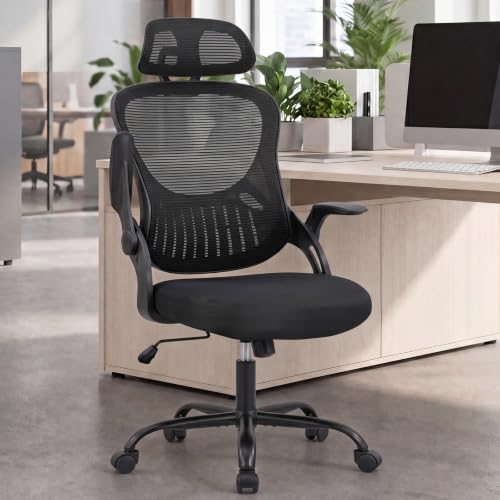
DUMOS Ergonomic Office Chair with Headrest, Flip-Up Arms — Best Budget
Not every headrest chair needs to be a flagship, and the DUMOS is the proof of concept at the accessible end: high-back mesh, a headrest, lumbar support and flip-up arms in a black task chair the listing positions for home office, gaming desk and bedroom alike. It covers the category’s defining feature — the headrest — plus the two supports that matter next (lumbar and arms that get out of the way), at the tier where a first home-office chair actually gets bought.
Budget honesty applies in both directions. The DUMOS listing does not state a capacity or the fine adjustability of the premium picks, and this guide does not pretend otherwise: expect the core geometry to be right and the refinement — armrest dimensions of adjustment, tilt tension range, headrest travel — to be simpler than the SIHOO or Marsail. For a student, a spare-room desk, or a first work-from-home setup used a few hours a day, that trade is rational. For a 250-pound user working ten-hour days, it is not, and the stated-capacity picks above exist for that reader.
Flip-up arms are the budget feature that punches above its tier: they let the chair slide fully under a desk in small rooms and spare bedrooms, which is where this chair will mostly live. Mesh keeps it cool; black keeps it invisible in a room that is not a dedicated office.
Strengths
- The defining features — headrest, lumbar, mesh — at the accessible tier
- Flip-up arms suit small rooms and multi-use spaces
- Black task styling disappears into a bedroom or spare room
Trade-offs
- Capacity and fine adjustability not stated in the listing
- Simpler refinement than the premium ergonomic picks
- Built for moderate daily hours, not the heaviest duty
| Back | High-back mesh, with headrest |
| Lumbar | Lumbar support (per listing) |
| Armrests | Flip-up |
| Capacity | Not stated in Amazon title |
Best for: A first headrest chair at an accessible tier — home office, bedroom desk, students / Not suited for: Heavy-duty daily use by larger users — capacity not stated
Check on Amazon — check the current price on Amazon before you decide.

NEO CHAIR Office Desk Chair with Adjustable Headrest, Grey — Best Adjustable Headrest
Most headrests in this category are fixed or nearly so, which makes them right for one torso length and decorative for everyone else. The NEO CHAIR’s listing leads with the exception: an adjustable headrest, paired with adjustable lumbar support, so both ends of the back’s support chain can be moved to the body in the chair. That is the correct engineering priority — a headrest that can be positioned where your head actually is — and it earns this grey mesh chair its slot as the fit-flexibility pick.
Adjustable-at-both-ends matters most for the users standard chairs fit worst: shorter users, whose heads meet a fixed headrest at the neck, and taller users, whose heads clear it entirely. With height adjustment at the headrest and the lumbar, the NEO can be set so the lumbar fills the lower curve and the rest cradles the head in the same recline — the geometry the expensive chairs achieve with more adjustments and this one achieves with the two that count. Flip-up arms and a grey finish make it an easy roommate for shared and multi-use spaces.
The listing frames the chair for extended sitting comfort while working, and the mesh construction supports that: breathable across long sessions, in a color that reads lighter than the black default of the category. Capacity is not stated in the title — the recurring caveat of this roundup’s mid-tier — so larger users should verify on the listing or default to the stated-capacity SIHOO.
Strengths
- Adjustable headrest AND adjustable lumbar — fit at both ends
- Mesh breathability in a lighter grey finish
- Flip-up arms for shared and small spaces
Trade-offs
- Capacity not stated in the listing title
- Grey only in this listing — no black colorway in the pick
- Adjustment range of the headrest not quantified in the title
| Back | High-back mesh |
| Headrest (per Amazon title) | Adjustable |
| Lumbar | Adjustable lumbar support |
| Armrests | Flip-up |
| Color | Grey |
Best for: Users between sizes — the headrest itself adjusts to meet your head / Not suited for: Anyone wanting a black chair or a padded seat aesthetic
Check on Amazon — check the current price on Amazon before you decide.
Comparison Table
| Pick | Badge | Key spec | Best for | Link |
|---|---|---|---|---|
| SIHOO M18 Ergonomic Office Chair with Headrest | Best Overall | Mesh back, headrest, adjustable lumbar, 330 lb capacity, 2D armrests | Full-time desk work — the complete ergonomic package with head support | Check on Amazon |
| Marsail Ergonomic Office Chair with Headrest and 3D Armrests | Best Adjustability | High-back mesh, headrest, adjustable lumbar, 3D armrests | Users who fine-tune — the most adjustable armrest setup in the roundup | Check on Amazon |
| GABRYLLY Ergonomic Office Chair with Headrest, Big and Tall | Best Big and Tall | High back, headrest, wide cushion, 90-120° tilt lock, flip-up arms | Larger and taller users who need width and a headrest that reaches | Check on Amazon |
| GTPLAYER Gaming Chair with Footrest and Headrest, Faux Leather, Black | Best for Gaming and Reclining | Gaming chair, headrest + lumbar support, footrest, 360° swivel | Gamers and evening users who recline fully — headrest plus footrest rest | Check on Amazon |
| DUMOS Ergonomic Office Chair with Headrest, Flip-Up Arms | Best Budget | High-back mesh, headrest, lumbar support, flip-up arms | A first headrest chair at an accessible tier — home office, bedroom desk, students | Check on Amazon |
| NEO CHAIR Office Desk Chair with Adjustable Headrest, Grey | Best Adjustable Headrest | Mesh high back, ADJUSTABLE headrest and lumbar, flip-up arms, grey | Users between sizes — the headrest itself adjusts to meet your head | Check on Amazon |
How to Choose a Headrest Chair: Fit the Rest to Your Head
The headrest has one job — to meet the back of your head when you recline — and most buying disappointment is a geometry failure, not a quality failure. Sit in your current chair and note where your head falls relative to its top: if you are tall, you need a genuinely high back (the GABRYLLY’s brief) or an adjustable headrest with real travel (the NEO’s brief); if you are shorter, a fixed headrest on a tall chair will push at your neck and be worse than none. Wherever possible, favor adjustability at the headrest itself, because torso lengths vary more than any other dimension chairs are sized by.
Then match the family to your hours. Mesh ergonomic chairs breathe, support upright and reclined work postures, and look like office furniture; they are the workday answer. Padded gaming chairs embrace, recline further, often add a footrest, and run warm; they are the evening answer. Hybrid users should decide by the longer session: the chair that fits your eight-hour day can host a two-hour game, while the chair built for the two-hour game may tax an eight-hour day.
Finally, audit the support chain as a whole, the way the picks here were chosen: seat cushion width and depth for your build, lumbar support that adjusts to your curve, armrests that meet your arms without hiking your shoulders (3D on the Marsail, flip-up where space or width demands), a tilt you can lock at your working recline, and a stated capacity with margin above your weight. A headrest on a chair that fails the lower links is a hat on a broken ladder.
Setting Up a Headrest Chair Correctly: A Fifteen-Minute Fitting
Ergonomic chairs are instruments, and most are played unadjusted. Set the seat height first: feet flat, knees at roughly ninety degrees, thighs parallel. Set the lumbar second: the pad should fill the small of your back so you feel supported contact, not a push. Set the armrests third: elbows at ninety degrees, shoulders relaxed and unhiked — if your shoulders rise, the arms are too high, the most common setup error there is.
Set the headrest last, and set it in recline, not upright: lean back to your working recline, lock the tilt, and adjust the headrest until it contacts the back of your head — the curve above the neck, not the neck itself — with light, even pressure. If it pushes your head forward, it is too low or too far forward; if you must crane back to find it, it is too high. The correct setting is the one you forget exists during a call. Revisit the whole fitting after a week: foam settles, habits form, and the second fitting is usually the true one.
- Recline and rest your head fully for one full minute during fitting — brief touches mislead.
- If two people share the chair, agree on marked settings or choose the chair that re-fits fastest.
- Lubricate nothing, force nothing: every adjustment on these chairs is designed to move by hand.
Headrest Chairs vs Headrest-Free Chairs and Add-On Cushions
The honest alternatives deserve their hearing. A headrest-free task chair is cheaper, simpler and entirely sufficient for upright, short-session work — the headrest only earns its cost when reclining is part of your day. Add-on headrest cushions and neck pillows, sold separately, are the halfway house: they can rescue a good chair that lacks a rest, but they strap on, shift, and rarely achieve the fixed geometry of an integrated, adjustable headrest. Buy them to fix a chair you love; do not buy a chair planning to fix it.
The integrated headrest’s real advantage is that it travels with the back through the tilt: as you recline, the rest stays in the same relationship to your head, which is the entire ergonomic point of the reclined posture. That is why this guide required the headrest in the chair’s own listing and excluded tall backs and bundled loose cushions from the definition — the category means a chair designed, top to bottom, to support a reclined sitter, and the six picks are the ones that verified as such.
Materials, Assembly and How Long a Headrest Chair Lasts
The mesh-versus-padding decision echoes through ownership. Mesh backs (five of the six picks) breathe, resist sagging and keep their shape for years; their failure mode is usually the seat cushion compressing long before the back gives up. Padded faux-leather builds (the GTPLAYER) feel plush and wipe clean, but the surface is the wear item: it cracks at flex points over years, faster in sun and dry heat, slower with occasional conditioning and shade. Neither material is a defect story — they are different clocks, and a buyer who knows which clock they are buying is rarely disappointed.
Assembly is the other ownership reality reviews skip. Every chair here arrives flat-packed, and the honest time budget is thirty to sixty minutes with the included tools, plus the fifteen-minute fitting from the previous section. Two assembly habits pay off for years: tighten bolts in the maker’s sequence and re-check them after the first week (new joints settle), and keep the hex key — the chair that gets its bolts snugged annually stays silent, while the chair that never does develops the squeaks and wobbles people mistake for wear. Casters and gas lifts are the standard wear parts across the whole category; both are replaceable, and a chair whose frame and headrest still fit you is worth a caster set long before it is worth replacing.
Set the lifespan expectation plainly: a mid-tier ergonomic chair in daily service typically gives five or more years before foam and fabric tire, with premium builds going longer. The headrest itself rarely fails — it is the simplest part of the chair — which is one more argument for choosing the chair by its whole support chain rather than by the rest alone.
How to Sit, Recline and Work in a Headrest Chair Through a Full Day
A headrest chair pays off through posture variety, not through one perfect position. Use the chair’s range across the day with this rhythm.
- Start the day upright: tilt near 90-100°, headrest unused, feet flat. This is your typing and focus posture, and the headrest should be invisible in it.
- For calls and reading, unlock the tilt and recline to where your head settles onto the rest; let the chair carry your head’s weight fully for the length of the call. This transfer is the headrest’s whole job — half-resting is just a new strain.
- Every hour or so, change something real: recline angle, armrest height for a different task, or stand for two minutes. The chair enables variety; it does not automate it.
- In gaming or film sessions (especially in the GTPLAYER), extend the footrest, recline fully and let the headrest and lumbar share the load — then return the chair to work settings afterward so tomorrow starts fitted.
- Watch for the two misuse patterns: perching forward off the backrest for hours (the chair cannot help a posture it is not touching) and locking the headrest so it pushes the head forward, which converts support into strain.
- End the day by resetting the chair to your fitted marks. Shared chairs drift; a thirty-second reset keeps yesterday’s fitting from becoming next month’s backache mystery.
Judged after a week of this rhythm, a headrest chair should feel less like furniture and more like a workstation that happens to include rest. If it does not, revisit the fitting section before blaming the chair — most ‘uncomfortable ergonomic chair’ stories are unadjusted-chair stories.
Common Buying Mistakes
Buying a tall back and calling it a headrest. A high back that ends in flat mesh supports your shoulder blades, not your head. If the listing does not include a headrest, the chair does not have one — the rule this guide applied to every candidate, including famous names that were excluded.
Ignoring headrest adjustability. A fixed headrest fits one torso length. If yours is not that length, the rest will push your neck or float unused. Prefer an adjustable headrest, or a chair sized to your build (big-and-tall for tall users), and set it in recline during fitting.
Counting color variants as different chairs. The GTPLAYER appears in the catalog in five colors and fabrics; it is one chair. Roundups that list variants as separate picks are padding. Check model names, not colors, when comparing any guide’s shortlist — including this one.
Skipping the setup. An unadjusted ergonomic chair delivers a fraction of its value. Fifteen minutes of fitting — seat, lumbar, arms, headrest, in that order — is part of the purchase, and the second fitting after a week is the one that counts. The pattern repeats across every category of adjustable furniture, and chairs are its purest case: the adjustments exist because bodies differ, and a chair left at its factory settings is fitted to nobody at all, least of all to the person who paid for it.
Expecting a chair to fix a posture it never touches. Perching on the seat’s edge, leaning over a laptop, or sitting sideways defeats every support in the chair. The headrest works when you recline into it; build the recline breaks into your day and let the chair do its job. The same logic applies at the other extreme: living at maximum recline all day is its own static posture, and the chair’s range exists to be moved through, not parked at either end.
Final Recommendation
For the majority of buyers, the SIHOO M18 is the answer: the complete support chain — adjustable lumbar, 2D arms, stated 330 lb capacity, mesh back and headrest — in one work-first chair. Choose the Marsail if you fine-tune armrests, the NEO if your torso length has defeated fixed headrests before, and the GABRYLLY if you are big or tall and tired of chairs sized for someone else. The GTPLAYER owns the evening brief with its footrest recline, and the DUMOS proves the category’s core features exist at an accessible tier.
Whichever you choose, hold the guide’s three checks: a headrest confirmed in the chair’s own listing, adjustability or sizing that matches your body, and fifteen minutes of honest fitting when it arrives. A headrest chair bought and fitted on those terms stops being furniture and becomes the place your working day — and its pauses — actually rest.
One last consideration for households furnishing a room rather than a workstation: these chairs are visually honest objects. Mesh task chairs read as office equipment even in grey, and a gaming chair reads as a gaming chair even in black. If the chair will live in a bedroom or a shared living space, the DUMOS and NEO’s plainer profiles disappear most easily, while the GTPLAYER makes a deliberate statement. None of that changes the ergonomics — but a chair you enjoy looking at in your own home is a chair you will keep fitted, maintained and in service, and that, in the end, is what the headrest was for.
Start with SIHOO M18 Ergonomic Office Chair with Headrest, Marsail Ergonomic Office Chair with Headrest and 3D Armrests, GABRYLLY Ergonomic Office Chair with Headrest, Big and Tall — check price on Amazon for each and compare against the notes above.
Related guides on this site: Best Desk Chairs With Headrest; Best Ergonomic Chairs With Headrests; Best Headrest Neck Pillows For Recliner Chairs; Best Desk Chairs For Extended Use.
Frequently Asked Questions
What is the point of a headrest on an office chair?
It supports your head’s weight when you recline — during calls, reading, video and thinking pauses — completing the support chain that lumbar support starts. Without it, reclining leaves your neck holding your head up, and most people unconsciously avoid reclining at all, losing the posture variety that breaks up a seated day. If you never recline, you do not need one; if your day includes lean-back time, it is the difference between resting and hovering.
Are gaming chairs or ergonomic mesh chairs better with a headrest?
They serve different hours. Mesh ergonomic chairs (SIHOO, Marsail, NEO, GABRYLLY, DUMOS) breathe better and support upright work posture — the workday choice. The padded gaming chair (GTPLAYER) reclines further, adds a footrest, and suits evening sessions. Decide by your longer session: a work chair can host a game; a gaming chair asked to host ten-hour workdays runs warm and supports less precisely.
How do I know if a headrest will fit my height?
Look for an adjustable headrest (the NEO CHAIR’s headline feature) or, if you are tall, a genuinely high back from a big-and-tall model (the GABRYLLY). A fixed headrest on a standard chair fits the average torso; shorter users risk it pushing at the neck, taller users risk it ending below the head. When a listing does not state headrest adjustability, this guide’s spec boxes say so rather than assuming.
What weight capacity should I look for?
A stated capacity with comfortable margin above your weight. Among these picks, the SIHOO M18 states 330 lbs in its listing; several others do not state a capacity in their titles, and their spec boxes here record ‘not stated’ — for those models, check the full listing specifications before ordering if capacity is a deciding factor for you.
Can I add a headrest to a chair that does not have one?
Add-on cushions exist and can improve a chair you already own, but they strap on, shift position and rarely match the geometry of an integrated headrest that moves with the back as you recline. Treat them as a rescue for a beloved chair, not as a plan when buying new — if a headrest matters to you, buy a chair designed with one, as every pick in this guide is.
How should a headrest be adjusted?
In recline, not upright: lean back to your working recline, lock the tilt, and set the headrest so it meets the back of your head — above the neck — with light, even pressure you can forget about. If it pushes your head forward it is too low or too far forward; if you have to crane back to find it, it is too high. Re-check the setting after a week of use, and again any time you change the chair’s other settings, because the headrest’s correct position is defined relative to your recline and lumbar settings, not in isolation.


