Disclosure: airfryerkitchensupply.com is reader-supported. When you buy through links on our site, we may earn an affiliate commission at no extra cost to you.
Where to buy
Every linked pick in this guide to the best pillows for back and side sleepers with neck pain was verified against Amazon’s catalog — the Coop models fresh on 2026-11-22, the rest from this program’s verified API cache — so the model names, shapes, and dimensions quoted below match the listings you will land on. Start with the Coop Home Goods Original Adjustable Pillow if you switch positions through the night, the Tempur-Pedic TEMPUR-Ergo Neck Pillow for a molded contour from the most established name in foam, or the UTTU Cervical Pillow if you want contour support whose height you can adjust. Check the current price on Amazon from any pick’s link, because sizes and case bundles change between listings.
The best pillows for back and side sleepers with neck pain start from an uncomfortable truth this guide will not hide: a pillow is a comfort product, not a medical device. No pillow in this article is presented as a treatment for neck pain, and if your pain is persistent, worsening, follows an injury, or comes with numbness or weakness in an arm or hand, the right next step is a medical professional, not a shopping cart. What a well-chosen pillow legitimately does is support your head and neck in a neutral position — not cranked forward, not dropped sideways — so your muscles can actually rest instead of holding your head up all night. For the large group of people whose morning stiffness tracks with a pillow that is too high, too flat, or too soft for their position, that support difference is real and worth shopping for carefully.
Combination sleepers — people who split the night between back and side — have the hardest brief in pillow shopping, because the two positions want different heights. On your back, a moderate loft keeps the head level. On your side, the pillow must fill the wider gap between your ear and the mattress, a gap set by your shoulder width. A pillow tuned for one position is wrong for the other, which is why this guide leans on two design answers: adjustable pillows whose fill you tune yourself, and contour pillows whose shape offers a higher edge for side sleeping and a lower center for back sleeping. Every pick below is one of those two answers, verified and described honestly — including where a listing’s own marketing language goes further than this guide is willing to.
In this guide
Quick Picks
| Pick | Badge | Why it stands out |
|---|---|---|
| Coop Home Goods Original Adjustable Pillow, Queen | Best Overall | Cross-cut memory foam fill you add or remove to tune loft for both back and side sleeping |
| Tempur-Pedic TEMPUR-Ergo Neck Pillow, Medium Profile | Best Premium Contour | Molded TEMPUR contour from the category’s most established maker, medium profile |
| UTTU Cervical Pillow | Best Adjustable Contour | Contour shape with adjustable height, queen size 23.6″ x 13.8″, dual loft 5.2″/4.5″ |
| Coop Home Goods Original Crescent Adjustable Pillow | Best for Side-Sleeper Shoulders | Crescent cut-out shape that makes room for the shoulder, adjustable fill, queen size |
| Royal Therapy Memory Foam Pillow, Queen | Best Value Contour | Contour cervical shape at 24 x 14 x 5 inches, approachable tier |
| Anvo Memory Foam Pillow | Best Firm Contour | Firm contour support for sleepers who find standard foam too yielding |
A note on language, because it matters in this category: several of these products carry words like “pain relief” and “orthopedic” in their own listing titles. Those are the manufacturers’ marketing terms, recorded in this guide’s source file, and this article deliberately does not repeat them as promises. What we evaluate is shape, height, adjustability, and firmness — the physical things a pillow actually controls.
How These Picks Were Chosen
Every pick was cross-checked against Amazon listing data before earning a link. The Coop Original and Coop Crescent were verified fresh on 2026-11-22 through this site’s own API connection; the Tempur-Pedic, UTTU, Royal Therapy, and Anvo models come from the program’s verified API cache with their check dates recorded in the source file. Dimensions, profiles, and fill types quoted here come from those verified listings; where a listing does not state a figure, this article does not invent one.
The criteria were fit criteria, not hype criteria. Loft and its adjustability came first, because the back-plus-side combination lives or dies on height. Shape came second: contour designs with a higher side-sleeping edge and a lower back-sleeping valley, or a crescent cut-out that accommodates the shoulder. Firmness came third, with a spread across the guide from medium to firm so different builds and mattress depths can match. Finally, we favored pillows whose design you can verify from the listing itself — named shapes, stated dimensions, known fill — over pillows sold on adjectives.
One more selection rule specific to this topic: no medical claims were treated as features. A listing that promised therapy earned no points; a listing that stated a dual-height contour earned several. Comfort and support are what pillows sell, and they are what this guide judges.
The 6 Best Pillows for Back and Side Sleepers with Neck Pain

Coop Home Goods Original Adjustable Pillow, Queen — Best Overall
The Coop Original is the most forgiving answer to the combination-sleeper problem, because it refuses to guess your loft: the pillow is filled with cross-cut memory foam that you add or remove until the height is right for you. That adjustability is worth more than any single “perfect” shape, because the correct loft depends on your shoulder width, your mattress’s softness, and how your position mix actually breaks down across a night — variables no factory setting can know. Set it a touch higher if you side-sleep more, a touch lower if you back-sleep more, and fine-tune over the first week as your neck gives feedback each morning.
Strengths
- Fully adjustable loft via removable cross-cut memory foam fill — the only design here that can be tuned to both positions precisely.
- Medium firm feel suits the middle of the market: supportive enough for side sleeping, yielding enough for back sleeping.
- Queen size gives combination sleepers room to shift position without running off the pillow’s edge.
Trade-offs
- Adjustability is a project: expect two or three nights of adding and removing fill before it is dialed in.
- Shredded fill feels different from a molded contour — if you specifically want a shaped neck cradle, the contour picks below suit you better.
- Removed fill needs storing, and the pillow benefits from regular fluffing to keep the fill distributed.
Key specs (from the verified listing): adjustable bed pillow; queen size; cross-cut memory foam fill; medium firm; listed for back, stomach, and side sleepers.
The Coop earns Best Overall because combination sleeping is fundamentally a tuning problem, and this is the only pick that hands you the tuner. It is also the safest recommendation for couples buying two different bodies’ worth of pillows — each person adjusts their own.
Best for: position switchers and anyone unsure of their correct loft / Not suited for: sleepers who want a fixed molded contour and zero setup
Check on Amazon — check the current price on Amazon, and note the king size option in the listing if your bed needs it.

Tempur-Pedic TEMPUR-Ergo Neck Pillow, Medium Profile — Best Premium Contour
The TEMPUR-Ergo Neck Pillow is the molded-contour establishment pick: a shaped pillow from Tempur-Pedic, in a medium profile, designed so the contour supports the neck’s curve while the head rests in the lower center. For back sleepers, that geometry is the classic answer — the neck is held, the head is not pushed forward. For side sleepers, the contour’s raised edge provides the height the shoulder gap demands. The medium profile is the right default for average builds; the line also comes in other profiles, and choosing between them is a body-size decision we walk through in the buying guide below.
Strengths
- Molded TEMPUR material holds its shape and support consistently night after night, with none of the fill-shifting of shredded designs.
- The contour geometry directly serves both positions: lower center for back sleeping, raised edge for side sleeping.
- Tempur-Pedic is the most established maker in this guide, with the manufacturing consistency that implies.
Trade-offs
- Fixed shape and height: if the medium profile is wrong for your build, there is no adjustment to make — the fit decision happens at purchase.
- Premium tier pricing, as expected from the brand.
- Dense molded foam sleeps firmer and warmer than shredded fill for some people; committed soft-pillow sleepers should look at the Coop instead.
Key specs (from the verified listing): TEMPUR-Ergo Neck Pillow; medium profile; white. The cached listing title does not state dimensions, so none are claimed here — check the listing’s size details before ordering.
Choose the TEMPUR-Ergo if you know a contour suits you — many people discover this from a previous shaped pillow or a clinician’s suggestion to try one — and you want the shape executed by the company that defined the category.
Best for: contour converts and back-first sleepers who also turn to their side / Not suited for: anyone who needs adjustability or dislikes firm molded foam
Check on Amazon — check the current price on Amazon, and compare the profile options in the listing against the fit guide below.

UTTU Cervical Pillow — Best Adjustable Contour
The UTTU is the contour pillow for people who like the contour idea but fear the fixed height: its sandwich design lets you adjust the pillow’s loft, and the verified listing gives the working numbers — queen size at 23.6″ x 13.8″, with dual heights of 5.2″ and 4.5″ depending on orientation. That dual-height contour is the combination-sleeper geometry in its purest form: the higher contour for side sleeping, the lower for back sleeping, and an adjustment layer to trim the fit further. The listing also describes a cooling design intent; as with all such claims, treat coolness as a bonus rather than a buying reason.
Strengths
- Adjustable height on a true contour shape — the two fit mechanisms other picks offer separately, combined.
- Stated dimensions and dual loft (5.2″/4.5″) let you judge the fit against your own measurements before buying.
- Queen footprint at 23.6″ wide gives position switchers room to move.
Trade-offs
- The adjustment is coarser than the Coop’s handful-of-fill method — you get steps, not a continuum.
- Contour shapes have an adaptation period; the first nights can feel strange even when the fit is right.
- At 13.8″ deep it is a compact pillow front-to-back; restless sleepers who travel across the bed may run out of pillow.
Key specs (from the verified listing): memory foam contour pillow; adjustable height (sandwich design); queen 23.6″ x 13.8″ x 5.2″/4.5″; listed for side, back, and stomach sleepers.
The UTTU is the thinking person’s contour: measurable, adjustable, and honestly specified. If you have measured your shoulder gap and want a shaped pillow you can trim to match, start here.
Best for: measured-fit shoppers who want contour plus adjustability / Not suited for: sleepers who dislike the feel of a shaped pillow entirely
Check on Amazon — check the current price on Amazon before ordering.

Coop Home Goods Original Crescent Adjustable Pillow — Best for Side-Sleeper Shoulders
The Coop Crescent is the second Coop model in this guide, included openly because its shape solves a specific problem the standard pillow cannot: the crescent cut-out gives your shoulder somewhere to go. Side sleepers with broader shoulders often find that a normal pillow’s corner pushes against the shoulder, tilting the head and compressing the gap the pillow is supposed to fill. The crescent removes that corner. Like the Original, the fill is adjustable, so the crescent sets the geometry and you set the height — a thoughtful combination for side-first sleepers who rotate to their back for part of the night. We flag the shared brand plainly: these are two different Coop designs, not a pretense of variety.
Strengths
- Crescent cut-out accommodates the shoulder directly, reducing the corner-push that tilts side sleepers’ heads.
- Adjustable fill lets you set loft for your shoulder width and still soften it for back-sleeping stretches.
- Queen size and medium firm feel match the broad middle of combination sleepers.
Trade-offs
- The cut-out is a side-sleeper feature; back-only sleepers gain nothing from the shape and should take the Original instead.
- Same shredded-fill character as the Original — fluff it regularly, and expect a short tuning period.
- Positioning matters: the crescent only works if you actually settle your shoulder into it, which takes a night or two of habit.
Key specs (from the verified listing): crescent-shaped adjustable pillow; queen size; foam fill; medium firm; listed for back and side sleepers, with shoulder, neck, and head support as its design intent.
Choose the Crescent if your side sleeping is where the night is won or lost — particularly if you recognize the shoulder-corner problem from your current pillow.
Best for: side-first combination sleepers, broader shoulders / Not suited for: back-only sleepers or molded-contour loyalists
Check on Amazon — check the current price on Amazon before ordering.

Royal Therapy Memory Foam Pillow, Queen — Best Value Contour
The Royal Therapy pillow is the contour category at an approachable tier: a shaped memory foam pillow at 24 x 14 x 5 inches in queen size, giving combination sleepers the raised-edge/lowered-center geometry without the premium brand price. Its listing uses the category’s usual therapeutic language — recorded in our source file — but what earns it this slot is simpler: a real contour, stated dimensions, and a 5-inch loft that sits in the workable middle for average builds switching between back and side.
Strengths
- True contour shape at a value tier — the cheapest honest way to test whether contour geometry suits you.
- Stated dimensions (24 x 14 x 5 in) make the fit judgeable in advance.
- Queen width suits position switchers who need room to rotate.
Trade-offs
- Fixed 5-inch loft with no adjustment: broad-shouldered side sleepers may find it low, small back sleepers may find it high.
- Value-tier foam and cover are serviceable rather than luxurious next to the Tempur-Pedic.
- Like all contours, it asks for an adaptation period before you judge it.
Key specs (from the verified listing): memory foam contour pillow; queen; 24 x 14 x 5 inches; listed for side, back, and stomach sleepers.
Think of the Royal Therapy as the contour audition: if the shape transforms your mornings, you have learned something worth eventually spending premium money on; if it does not, you have learned it at a value tier.
Best for: first-time contour buyers and value shoppers / Not suited for: anyone who already knows they need adjustability or a specific loft
Check on Amazon — check the current price on Amazon before ordering.
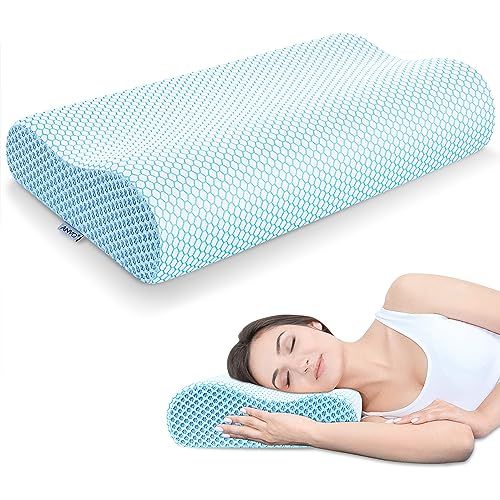
Anvo Memory Foam Pillow — Best Firm Contour
The Anvo closes the guide at the firm end of the shelf: a memory foam contour pillow the listing describes as firm, with an ergonomic design for side, back, and stomach sleepers. Firmness is a genuine preference axis in this category — sleepers on softer mattresses sink deeper, effectively lowering their pillow, and often need a firmer pillow to hold the head at height; larger builds compress soft foam to the point where support disappears. The Anvo is the pick for both groups, with the standard contour caveat that its shape must match your neck’s expectations.
Strengths
- Firm support holds loft under heavier heads and on softer mattresses where medium foam bottoms out.
- Contour geometry serves the back-and-side combination like the other shaped picks here.
- A clear, honestly stated firmness — you know exactly what feel you are buying.
Trade-offs
- Firm is unforgiving if you guess wrong; side sleepers with narrow shoulders may find it pushes the head too high.
- No adjustability — the fit is the fit.
- Smaller or lighter sleepers will usually be happier with the medium-feel picks above.
Key specs (from the verified listing): memory foam contour pillow; firm feel; ergonomic design; listed for sleeping on side, back, and stomach. Dimensions are not stated in the cached listing title and are not claimed here.
The Anvo is a deliberate niche pick: not the pillow for everyone, but the right pillow for the firm-support minority who find every “medium” pillow in this category quietly collapses by 3 a.m.
Best for: firm-pillow loyalists, larger builds, soft mattresses / Not suited for: smaller builds or anyone who finds firm foam harsh
Check on Amazon — check the current price on Amazon before ordering.
Comparison Table
| Pick | Badge | Key spec | Best for |
|---|---|---|---|
| Coop Original Adjustable, Queen | Best Overall | Adjustable cross-cut foam fill, medium firm | Position switchers, unknown loft |
| Tempur-Pedic TEMPUR-Ergo Neck, Medium | Best Premium Contour | Molded contour, medium profile | Contour converts, premium build |
| UTTU Cervical Pillow | Best Adjustable Contour | Dual loft 5.2″/4.5″, 23.6″ x 13.8″ | Measured-fit shoppers |
| Coop Crescent Adjustable | Best for Shoulders | Crescent cut-out, adjustable fill | Side-first sleepers, broad shoulders |
| Royal Therapy Contour, Queen | Best Value Contour | 24 x 14 x 5 in contour | First contour, value tier |
| Anvo Memory Foam Pillow | Best Firm Contour | Firm contour support | Firm loyalists, soft mattresses |
The table’s real message: adjustability and shape are the two roads to combination-sleeper fit. If you do not know your numbers, take an adjustable road. If you do, a contour measured against them is faster.
How to Choose a Pillow When You Sleep on Your Back and Side
Measure the gap your pillow must fill
Fit starts with one measurement: lie on your side on your mattress, in your sleeping posture, and have someone note the distance from the side of your head to the mattress surface, following the line of your shoulder. That distance — compressed by the pillow’s working loft — is what a side-sleeping pillow must fill to keep your neck straight rather than bent toward the bed. On your back, the requirement is gentler: enough loft to support the neck’s curve without pushing the chin toward the chest. Broad shoulders can need two or more inches of additional side loft over back loft, which is precisely why dual-height contours and adjustable fills dominate this guide.
Loft beats material, and adjustability beats guessing
Shoppers obsess over fill materials, but height errors cause more bad mornings than foam chemistry ever will. A pillow one inch too high bends the neck all night; one inch too low drops it. If you already know your measurements, a fixed contour with stated dimensions — the UTTU’s 5.2″/4.5″ dual loft, the Royal Therapy’s 5-inch profile — is a rational buy. If you do not, an adjustable pillow converts an expensive guess into a week of cheap experiments. This is why two of the six picks here are adjustable and a third trims its height in steps.
Your mattress is half the pillow equation
A soft mattress lets your shoulder sink, shrinking the gap a side pillow must fill; a firm mattress holds you up and demands more loft. The same pillow can be perfect on one bed and wrong on another — which is why a pillow that “worked at the hotel” disappoints at home. Judge every pick in this guide against your mattress: soft bed, lean lower and firmer in the pillow; firm bed, lean higher. The Anvo’s firmness exists for the soft-mattress case, where medium foams quietly bottom out.
If you also drift onto your stomach
Many “back and side” sleepers finish the night partly prone, and stomach sleeping is the position pillows serve worst: it asks for almost no loft and twists the neck by design. If that is you, weight your choice toward the adjustable end of this guide and tune the fill a step lower than your side position alone would suggest — or rotate a dual-height contour to its lowest edge for those stretches. Do not buy a separate thin stomach pillow unless the prone share of your night is genuinely large; for most combination sleepers it is a brief stop between the two positions this guide is actually about, and a well-tuned adjustable handles it acceptably.
Give any new pillow a fair trial
Contours and new lofts feel strange before they feel right. Muscles accustomed to a bad position protest a good one for a few nights. Give a new pillow five to seven nights — adjusting fill or orientation during the first half of that trial — before you verdict it, unless it produces sharp discomfort, which is a stop signal, not an adaptation phase. Keep your old pillow during the trial so a genuinely wrong fit does not cost you a week of sleep.
Pillow Materials Compared: Molded Foam, Shredded Foam, and the Rest
The picks in this guide are all memory foam in one of two architectures, and the difference between those architectures matters more than the foam’s brand name. Molded foam — the Tempur-Pedic, UTTU, Royal Therapy, and Anvo — is a single shaped piece. It holds a precise contour, supports consistently across its whole surface, and feels the same in month twelve as in month one, provided the foam quality is decent. Its weakness is rigidity of fit: the shape is the shape, and if your neck disagrees with it, there is nothing to adjust except orientation. Shredded or cross-cut fill — the two Coop models — is many small foam pieces inside a case. It molds around you rather than presenting a shape to you, it breathes a little better because air moves between the pieces, and above all it adjusts: handfuls in or out change the loft in fine increments. Its weaknesses are maintenance (it needs fluffing to stay even) and a less defined neck cradle.
Beyond foam, the wider market offers latex, down, and down-alternative fills, and combination sleepers should know why none headlines this guide. Latex is springy, durable, and naturally cooler-feeling, and a good latex contour is a legitimate choice — it simply did not surface in this round of verified listings for this specific back-and-side brief, and this guide links only what it verified. Down and feather pillows compress too unpredictably for sleepers who need a held height on their side; they are comfort objects for back sleepers who like to sculpt, not support tools for a two-position brief. Buckwheat hulls offer firm, moldable support that some neck-sensitive sleepers love, but the noise and weight make them a specialist taste. The honest summary: for the back-plus-side problem, foam’s two architectures — molded for shape, shredded for tuning — are where the reliable answers currently live.
What “Neutral Alignment” Actually Means (and Does Not)
The phrase behind every pick in this guide deserves a plain explanation, because it is used loosely in marketing. Picture the spine from the side while back sleeping: the goal is for the head and neck to continue the line of the upper back without the chin being pushed toward the chest (pillow too high or too thick under the head alone) or the head dropping back (pillow too low). From the front while side sleeping, the goal is a straight line from the tailbone through the neck to the head — no tilt toward the mattress, no tilt away from it. “Support” means the pillow holds that geometry at 3 a.m. as well as at 11 p.m., which is why loft retention matters more than initial plushness.
Two honest limits belong beside that picture. First, neutral alignment is a comfort framework, not a medical guarantee: bodies vary, old injuries change the geometry, and some people simply sleep best slightly “wrong” by the diagram. Your morning feedback outranks any diagram, including this one. Second, the pillow is only the top link of the chain — mattress firmness, shoulder and hip support, and even the pillow under the knees all feed into how the neck rests. This guide optimizes the link you are shopping for, and flags the others where they interact, but no pillow purchase should be expected to compensate for a mattress that has lost its own support.
How to Set Up Your Pillow for Back and Side Sleeping
- Orient the contour correctly. On shaped pillows, the higher edge goes under the neck when side sleeping; many contours are used rotated — lower edge forward — for back sleeping. Check your model’s guidance and test both orientations across your trial nights.
- Tune adjustable fill in small steps. Remove or add a small handful at a time, sleep a full night between changes, and judge by the morning: neutral and easy is the goal, not a dramatic sensation at bedtime.
- Position the pillow to the shoulders. For side sleeping, the pillow should fill from the mattress to your head with your shoulder below its edge — or settled into the crescent, on that design — not scrunched under your neck.
- Support the rest of the chain. A small pillow between the knees on your side, or under the knees on your back, keeps hips and lower back neutral so the neck is not compensating for a twisted base.
- Check your screen habits honestly. An hour of phone-in-bed with your head propped at a sharp angle can undo a good pillow’s work before sleep even starts. If you read in bed, prop your whole torso with a wedge or stacked pillows rather than bending only the neck.
- Replace on condition, not calendar. Fold the pillow in half: quality foam springs back; tired foam stays folded. Any pillow that has lost its loft or developed permanent lumps has left the job, whatever its age.
Your Position Mix Changes the Answer: Three Common Profiles
Mostly back, sometimes side (roughly 70/30)
Your pillow’s primary job is the back position: a moderate, supportive loft that cradles the neck without lifting the chin. The side intervals need “enough” height, not perfect height, because you do not spend long enough there to wake stiff from a small deficit. The molded contours earn their keep for this profile — the TEMPUR-Ergo’s medium profile or the Royal Therapy — because their back-sleeping valley is the main event and the raised edge covers the occasional turn. Adjustable owners should tune for the back first and accept the side as-is.
Mostly side, sometimes back (roughly 70/30 the other way)
Now the shoulder gap rules. Your pillow must fill that gap fully for the long side stretches, and merely avoid being absurdly high for the back intervals. This profile is the Coop Crescent’s home ground, with the UTTU’s higher 5.2″ contour as the molded alternative. Tune or choose for the side position first; a slightly high back position is the lesser error for this profile, because back intervals are shorter and the neck tolerates modest extra support better than it tolerates a dropped head on the side.
The true 50/50 rotator
If you genuinely split the night, you are the adjustable pillow’s reason to exist. Set the Coop Original’s fill at the midpoint that keeps the side position honest, and accept that the back position gets a touch more loft than a back-only sleeper would choose — or step to the UTTU and physically rotate between its two heights as you change position, a habit its dual-loft design explicitly invites. What not to do is buy a fixed medium pillow and hope: for a true rotator, “medium everything” usually means “wrong twice.”
Common Buying Mistakes
Buying a pillow to treat a medical problem. Pillows support comfort; they do not diagnose or treat. Persistent or worsening neck pain, pain after an injury, or symptoms traveling into the arm or hand belong in a clinician’s office. A good pillow is a reasonable comfort step — it is not a substitute for care, and this guide’s picks are chosen and described on that basis only.
Choosing loft by habit instead of measurement. “I like a high pillow” often means “I have adapted to a high pillow.” Measure your side-sleeping gap and let the number argue with the habit.
Ignoring the mattress pairing. The same pillow is two different pillows on a soft bed and a firm one. Any fit advice that ignores your mattress — including a friend’s glowing recommendation — is incomplete.
Judging a contour on night one. Shaped pillows ask your muscles to unlearn a position. One strange night is data, not a verdict; five nights is a verdict.
Believing the strongest marketing language. This category’s listings promise aggressively. Buy the shape, the dimensions, and the adjustability — the verifiable things — and let promises be what they are.
Buying two identical pillows for two different sleepers. Partners differ in shoulder width, mattress side, and position mix. Adjustable models exist precisely so two people can share a product name without sharing a fit.
Final Recommendation
Start with the Coop Original Adjustable unless you already know a contour suits you: adjustability is the most reliable route to a fit you cannot yet specify, and it serves both positions in one pillow. Side-first sleepers with broad shoulders should look at the Coop Crescent for its shoulder cut-out. Contour shoppers should choose by measurement: the UTTU for contour plus height adjustment, the TEMPUR-Ergo for the premium molded original, the Royal Therapy as the value audition, and the Anvo if firm support is your known preference. Related guides that pair naturally with this one: Best Contour Neck Pillows For Sleeping, Best Cooling Pillows For Back And Side Sleepers, Best King Size Pillows For Side And Back Sleepers, and Best Foam Pillows For Neck.
Care and Maintenance: Keeping the Fit You Tuned
A support pillow’s fit is perishable, and most of the decay is preventable. Shredded-fill models — the two Coops — need a proper fluff every few days: work the fill from the corners back toward the center with your hands, because fill migrates outward as you sleep and the middle quietly hollows. If your tuned loft seems to have vanished after a month, redistribute before you add fill; the foam is usually still there, just in the wrong places. Molded contours need less routine care but hate two things: heat and compression. Do not leave a molded pillow in a hot car, do not store it under heavy boxes, and never fold it sharply — molded foam remembers abuse as permanently as it remembers your neck.
Washing follows the maker’s rules and differs sharply by architecture. Cases and protectors are washable and should be laundered regularly — a protector also keeps oils and sweat out of the foam, which is the main long-term cause of foam odor and breakdown. Foam itself, molded or shredded, is generally spot-clean only unless the listing explicitly says otherwise; soaking memory foam is a reliable way to ruin its feel and invite mildew. Air any new foam pillow for a day before first use: the faint manufacturing smell of fresh memory foam is normal, fades quickly in a ventilated room, and is a poor reason to return a pillow that otherwise fits.
Reading pillow listings critically
One skill protects you in this category more than any other: separating a listing’s facts from its adjectives. Facts are dimensions, profiles, fill type, firmness rating, and adjustability — the things this guide quotes and the things you can hold a maker to. Adjectives are the therapeutic vocabulary the category is saturated with. When a listing gives you both, buy the facts and let the adjectives go. When a listing gives you only adjectives — no dimensions, no profile, no stated firmness — that absence is itself the review: a maker who will not state a pillow’s height is asking you to guess, and combination sleepers cannot afford guesses.
Related guides
- Best Recommended Pillows For Side Sleepers With Neck Problems
- Best Pillows For Back Pain And Sciatica
- Best Pillows For Back Sleeper With Back Pain
Frequently Asked Questions
What pillow height is right for combination back and side sleeping?
There is no universal number, because the right side-sleeping loft is set by your shoulder width minus how deeply your shoulder sinks into your mattress, and the right back-sleeping loft is lower than that. This is why dual-height contours and adjustable fills dominate this guide: they bridge the two positions instead of compromising both. Measure your side gap lying down, then choose — or tune — a pillow whose working loft matches it.
Can the wrong pillow actually cause morning neck stiffness?
A pillow that holds your neck bent — too high, too low, or collapsing unevenly — keeps neck muscles working or stretched all night, and morning stiffness is a common result. That is a comfort and ergonomics statement, not a medical diagnosis: stiffness has many causes, and persistent pain deserves professional evaluation. But pillow fit is the cheapest variable in the system to test, which is why it is a sensible first thing to check.
Are contour pillows better than regular pillows for combination sleepers?
They solve the two-height problem elegantly — high edge for the side, low valley for the back — and many combination sleepers swear by them. They are not automatically better: the fixed geometry must match your body, and some sleepers never adapt to the shaped feel. Adjustable shredded-fill pillows solve the same problem by tuning instead of shaping. This guide includes both because the honest answer is personal.
How long does it take to get used to a new pillow?
Typically three to seven nights for a shape or loft change, with the first two nights being the strangest. Adjust one variable at a time during the trial — fill amount or contour orientation — and judge by how your neck feels across the whole morning, not by the first five minutes in bed. Sharp pain is not part of adaptation; stop and reassess if you feel it.
Should I see a doctor about my neck pain instead of buying a pillow?
If the pain is severe, follows an accident or injury, keeps worsening, or comes with numbness, tingling, or weakness in an arm or hand — yes, promptly, and treat the pillow as a later comfort question. For ordinary morning stiffness that tracks with sleep position, testing a properly fitted pillow is a reasonable comfort step while you monitor it. Nothing in this guide is medical advice, and no pillow here is sold as a treatment.
Does pillow cooling actually matter for neck comfort?
Indirectly. A pillow that sleeps hot makes you restless, and restlessness means more position changes and more time spent in whatever awkward posture you landed in. Several picks in this guide describe cooling design elements in their listings, and shredded fill generally breathes better than dense molded foam. Treat cooling as a tiebreaker between two pillows that both fit — never as a reason to choose a pillow whose loft is wrong for you. Fit first, temperature second, always.
Can I travel with a contour or adjustable pillow?
Shredded-fill pillows compress into a stuff sack surprisingly well and re-fluff at the destination, which makes the Coop models the travel-friendly picks here — a real consideration if hotel pillows are where your neck suffers most. Molded contours travel badly: they are bulky, and crushing them into luggage is unkind to the foam. If you trial a contour at home and love it, some sleepers buy a second, inexpensive contour for the suitcase rather than risking the good one.
How often should I replace a support pillow?
When it stops holding its shape and loft — the fold test in the setup section is the quickest check. Molded foam generally holds support longer than shredded fill, which benefits from fluffing and occasional fill refresh. A pillow that leaves you at a different height than the one you tuned is no longer the pillow you chose, whatever its age — and because fit was the entire reason for buying it, a support pillow should be replaced on the evidence of your mornings, not on a birthday: when the stiffness creeps back despite good sleep habits elsewhere, check the pillow’s loft before you blame anything else in the room.

