Disclosure: airfryerkitchensupply.com is reader-supported. When you buy through links on our site, we may earn an affiliate commission at no extra cost to you.
Where to buy
All six pillows below were confirmed through Amazon data before receiving a link, and the shortlist behind the search for the best pillows for a neck that hurts is built on fit — contour shape, height, foam and sleep position — rather than on promises. A pillow is a comfort product, not a medical device, and this article treats it that way throughout. Prices move, so every pick uses a check-price link instead of a printed figure.
- EPABO Contour Memory Foam Pillow (Firm, Queen) — Check the current price on Amazon
- DONAMA Cervical Pillow (Cooling, Dual-Height) — Check the current price on Amazon
- UTTU Cervical Pillow (Adjustable Sandwich Design, Queen) — Check the current price on Amazon
- Royal Therapy Memory Foam Pillow (Queen, 24x14x5″) — Check the current price on Amazon
- Osteo Cervical Pillow (Hollow Design, Cooling Case) — Check the current price on Amazon
- Bedsure Cervical Neck Pillow (Contour Support) — Check the current price on Amazon
Waking with a stiff, aching neck sends thousands of people searching for the best pillows for a neck that hurts, and the pillow industry is happy to meet them with big promises. This article takes a calmer line. A pillow cannot diagnose or treat anything. What it can do — and this is genuinely valuable — is support your head and neck in a neutral position for your sleep style, at the right height, on a surface that stays consistent all night. For many people whose current pillow is simply the wrong height or a collapsed bag of fill, that change alone transforms their mornings.
It also matters to say what a pillow cannot fix. Neck discomfort that persists for weeks, pain that travels into the shoulder or arm, numbness or tingling in the hands, weakness, or pain after an injury are reasons to see a clinician, not reasons to buy a firmer pillow. The FAQ returns to this. Everything between here and there is about comfort, fit and sleep quality — the legitimate territory of a bedding purchase.
The six picks below are all shaped or supportive designs confirmed: wave contours, a dual-height cooling contour, an adjustable layered pillow, a classic fixed contour, a hollow-cradle design and a mainstream brand option. Their listings sometimes use strong language in their titles; this article deliberately judges them on verified shape, foam, dimensions and fit, and flags every place where a listing’s data was brief or truncated instead of filling gaps with guesses.
A note on language, because it shapes expectations: this article says “support”, “fit” and “comfort” where listings often say considerably more. That is deliberate. Comfort claims are things a pillow can honestly be judged on by its owner within a week; anything stronger belongs to a clinical conversation, and a buying guide that borrows clinical language to sell foam is not doing its readers a service.
In this guide
Quick Picks
| Pick | Badge | Best for | Check |
|---|---|---|---|
| EPABO Contour Memory Foam Pillow (Firm, Queen) | Best Overall | Side and back sleepers trying a contour pillow for the first time | Check price on Amazon |
| DONAMA Cervical Pillow (Cooling, Dual-Height) | Best Cooling Contour | Warm sleepers who want contour support without the classic memory-foam heat | Check price on Amazon |
| UTTU Cervical Pillow (Adjustable Sandwich Design, Queen) | Best Adjustable Height | Sleepers who want to tune pillow height precisely, especially side sleepers | Check price on Amazon |
| Royal Therapy Memory Foam Pillow (Queen, 24x14x5″) | Best Classic Contour | Average-framed back and side sleepers who want a classic fixed contour | Check price on Amazon |
| Osteo Cervical Pillow (Hollow Design, Cooling Case) | Best Hollow-Cradle Design | Back sleepers who find wave contours too pushy and want a cradled feel | Check price on Amazon |
| Bedsure Cervical Neck Pillow (Contour Support) | Best Familiar-Brand Option | Side and back sleepers who prefer a familiar bedding brand and a simple fixed contour | Check price on Amazon |
How These Picks Were Chosen
Selection started from geometry, not marketing. A supportive pillow has to present the right height under the neck for the sleeper’s position: higher and firmer for side sleeping (to fill the shoulder gap), lower for back sleeping, lowest for stomach sleeping. Picks were shortlisted to cover those positions with distinct shapes — wave contour, dual-height, adjustable layers, hollow cradle — so the article compares real design philosophies rather than six copies of one pillow.
Verified data was the second filter.
Finally, adaptation honesty shaped the ordering. Every shaped pillow asks for several nights of adjustment, and the picks are ordered by how forgiving they are to a first-time contour sleeper — balanced fixed contours first, adjustable and specialised geometries after — because the best pillow is the one its owner actually persists with past night three.
The 6 Best Pillows for a Neck That Hurts
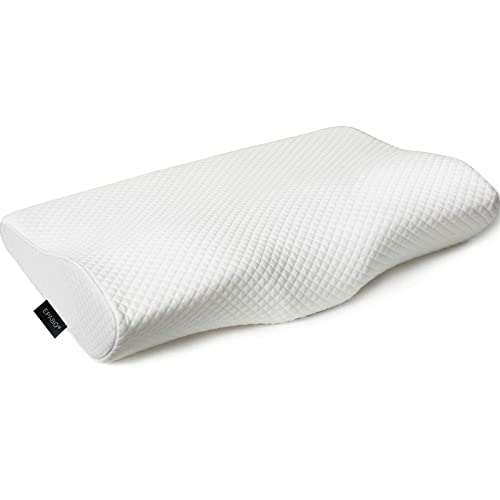
EPABO Contour Memory Foam Pillow (Firm, Queen) — Best Overall
The EPABO contour pillow is the long-running default in this category: an ergonomic contoured memory foam pillow in a firm feel and queen size, with a pillowcase included, positioned by its listing for side, back and stomach sleepers. A quick honesty note that applies to this whole article: several of these listings use strong comfort language in their titles. This review judges the pillows on shape, foam, sizing and fit — the things a pillow can actually deliver — and treats neck comfort as a matter of support and sleep position, not treatment.
Strengths
- Classic wave contour with a higher and lower edge, so back and side sleepers can each find a side that fits
- Firm feel in the verified listing — contour pillows that are too soft collapse into ordinary pillows by 3 a.m.
- Pillowcase included per the listing, and queen sizing suits standard bedding
Trade-offs
- Firm is firm: committed soft-pillow sleepers may find the first week an adjustment
- Memory foam sleeps warmer than fibre or latex alternatives, even in a contoured shape
- One fixed contour per side — sleepers between heights may prefer the adjustable UTTU below
| Shape | Ergonomic contour (wave profile) |
| Foam | Memory foam |
| Feel | Firm (per Amazon title) |
| Size | Queen (per Amazon title) |
| Included | Pillowcase (per Amazon title) |
| Positions | Side, back and stomach (per Amazon title) |
The contour idea is simple geometry. A conventional pillow is a bag of fill that pushes the head wherever it settles; a contour pillow is a shaped support with a raised edge under the neck and a dip for the head, aiming to keep the head and neck in a neutral line with the spine. Whether that helps a given sleeper depends on the match between the contour heights and that sleeper’s shoulders, mattress and position — which is why this article keeps returning to fit rather than promising outcomes.
The EPABO earns the top slot by being the balanced version of the idea: firm enough foam to hold the shape all night, two usable edges, a standard size, and a case in the box. For a first contour pillow, that balance matters more than exotic features. Give it a genuine trial — most sleepers need several nights to adapt to any new pillow shape, and the first night is the least informative one.
Who should skip it: stomach sleepers who sleep face-down most of the night usually do better with a very low pillow (the contour edges here will feel high), and anyone whose neck trouble comes with numbness, weakness or pain travelling into the arm should be assessed by a clinician rather than shopping for foam — a point this article repeats in the FAQ because it matters.
Best for: Side and back sleepers trying a contour pillow for the first time / Not suited for: Face-down stomach sleepers, or anyone with symptoms that need medical assessment

DONAMA Cervical Pillow (Cooling, Dual-Height) — Best Cooling Contour
The DONAMA pairs the contour concept with two features hot sleepers ask for: a cooling-feel case and a dual-height ergonomic profile, in contour memory foam, per its confirmed listing. The verified title data for this listing is truncated at the end, so this review relies only on the confirmed portion — cooling contour memory foam with dual-height neck support — and does not speculate about the rest.
Strengths
- Cooling case addresses the main complaint about memory foam — heat build-up against the neck and face
- Dual-height profile gives two support levels in one pillow, useful while you learn what your neck prefers
- Contour memory foam core holds its shape through the night rather than bottoming out
Trade-offs
- Cooling cases feel cool at first contact and moderate afterwards; they do not refrigerate
- The verified title is truncated, so buyers should confirm full specifications on the product page before ordering
- As with all contour pillows, the shape is a commitment — combination sleepers must be willing to reposition onto the right edge
| Shape | Contour, dual-height (per Amazon title) |
| Foam | Memory foam (per Amazon title) |
| Case | Cooling (per Amazon title) |
| Note | Full title truncated in listing data — see Sources |
Heat is the silent reason many contour pillows end up on the floor by morning. Memory foam insulates, the neck is a warm area, and a pillow that supports perfectly but cooks its owner will lose to a worse pillow that sleeps cool. The DONAMA’s cooling case is aimed squarely at that failure mode. Expect a cool first impression and a more neutral night than standard foam — a meaningful improvement, honestly described, rather than an all-night chill.
The dual-height design is the other practical win. New contour users routinely guess wrong about the height they need; a pillow with a higher and a lower edge lets the first week be an experiment instead of a verdict. Side sleepers generally start on the higher edge, back sleepers on the lower, and the right answer is the one that leaves the neck feeling neutral rather than propped or dropped.
Because the Amazon title for this listing arrived truncated, this review deliberately claims less for the DONAMA than for the other picks: shape, foam, cooling case and dual height are confirmed; everything else should be checked on the product page. That restraint is a feature of how this site verifies products, not a mark against the pillow.
Best for: Warm sleepers who want contour support without the classic memory-foam heat / Not suited for: Buyers who need every specification confirmed in advance rather than on the product page

UTTU Cervical Pillow (Adjustable Sandwich Design, Queen) — Best Adjustable Height
The UTTU solves the contour category’s biggest problem — wrong height — by making height adjustable: its listing describes an adjustable sandwich-design memory foam pillow with contour cooling, for side, back and stomach sleepers, in a queen size stated at 23.6 by 13.8 inches with 5.2 and 4.5 inch heights. Removable layers let you tune the loft instead of buying a second pillow to find out.
Strengths
- Adjustable sandwich construction per the listing — add or remove a layer to change the loft
- Stated dimensions and two heights in the listing (23.6″x13.8″, 5.2″/4.5″) make fit planning unusually concrete
- Contour with a cooling angle, positioned for side, back and stomach sleepers
Trade-offs
- Adjustability means setup: expect an evening of experimenting before the pillow is dialled in
- More layers and covers mean slightly more laundry-day complexity than a one-piece pillow
- Queen here is a compact contour-queen (23.6″ long) — check the stated size against your pillowcases
| Shape | Contour, adjustable sandwich design (per Amazon title) |
| Size | 23.6″ x 13.8″ (per Amazon title) |
| Heights | 5.2″ / 4.5″ (per Amazon title) |
| Foam | Memory foam |
| Positions | Side, back and stomach (per Amazon title) |
Height is the variable that decides whether a contour pillow feels like support or like a wedge, and it depends on shoulder width, mattress firmness and position in a way no size chart fully predicts. The UTTU’s layered build turns that gamble into a dial. Start with the full stack if you are a broad-shouldered side sleeper on a soft mattress (you sink, so the pillow must be taller); remove a layer if your head feels pushed forward or your chin tucks.
The stated dimensions deserve attention because contour “queen” sizes vary wildly between brands. At 23.6 inches long this is a personal pillow, not a wide bed pillow — which is correct for its job, since the contour is shaped for one head and neck. Measure your current favourite pillow’s height while compressed if you can; it gives the adjustment a starting point instead of a guessing game.
Of the six picks, this is the one most likely to be made right by a determined sleeper and the one most likely to be abandoned by an impatient one. If you enjoy tuning your setup, it is the strongest recommendation in the article. If you want the pillow decided for you, the EPABO’s fixed, balanced contour is the easier first step.
Best for: Sleepers who want to tune pillow height precisely, especially side sleepers / Not suited for: Anyone who wants a pillow that is right out of the box with no experimenting

Royal Therapy Memory Foam Pillow (Queen, 24x14x5″) — Best Classic Contour
The Royal Therapy pillow is the traditional contour executed plainly: memory foam, a cervical contour profile, queen sizing stated precisely in the listing at 24 by 14 by 5 inches, in white, positioned for neck and shoulder comfort across side, back and stomach sleeping. The exact dimensions in the listing-confirmed title make it one of the easiest picks here to fit-check before buying.
Strengths
- Exact stated dimensions (24″x14″x5″) in the listing — measure your needs against real numbers
- Classic single-contour design with no layers or mechanisms to manage
- Queen contour size in white, suiting standard bedroom presentation
Trade-offs
- A single fixed 5-inch loft will be too high for some back sleepers and too low for some broad side sleepers — there is no adjustment to rescue a mismatch
- Standard memory foam warmth applies; hot sleepers should weigh the DONAMA or Osteo cooling cases
- White cover shows wear and needs the case kept in rotation to stay presentable
| Size | 24″ x 14″ x 5″ (per Amazon title) |
| Foam | Memory foam |
| Shape | Contour cervical profile |
| Colour | White |
| Positions | Side, back and stomach (per Amazon title) |
There is a case for the classic. A fixed contour in honest dimensions, from a brand line that has sold this shape for years, gives a buyer predictability: the 5-inch loft is the support, take it or leave it. For an average-framed back or side sleeper on a medium mattress, that loft sits in the zone that most people find neutral, and the absence of layers means nothing to misassemble after washing.
The flip side is fit risk. Five inches is a real height; petite back sleepers may feel pushed forward, and very broad side sleepers may want more. The measurements in the listing let you sanity-check against your current setup: lie on your present pillow, note whether your neck feels level, propped or dropped, and choose accordingly. If the answer is “it depends on the night”, the adjustable UTTU is the safer purchase.
Royal Therapy also suits the second-bedroom and guest scenario well: a known shape at a known height that most visitors can sleep on comfortably for a few nights, without the host explaining a layer system. Predictability, in a pillow, is an underrated feature.
Best for: Average-framed back and side sleepers who want a classic fixed contour / Not suited for: Sleepers at the extremes of frame size, who need height adjustment
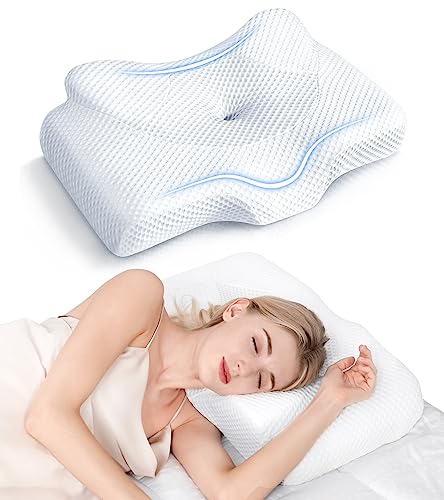
Osteo Cervical Pillow (Hollow Design, Cooling Case) — Best Hollow-Cradle Design
The Osteo takes the contour idea and hollows it: the confirmed listing describes a hollow-design, odourless memory foam pillow with a cooling case, adjustable, positioned for side and back sleepers. The central hollow cradles the back of the head while the raised surround supports the neck — a different geometry from the wave contour, aimed at back sleepers especially.
Strengths
- Hollow centre cradles the head for back sleeping, reducing the “perched” feeling of wave contours
- Adjustable per the listing, so the cradle depth can be tuned rather than accepted
- Cooling case and odourless foam callouts address the two commonest memory-foam complaints
Trade-offs
- The cradle geometry is back-sleeper first; dedicated side sleepers may prefer a classic wave contour
- Hollow designs feel unusual for the first nights — budget a real adaptation period
- As a shaped pillow it does not suit sleepers who move constantly and sleep in every position by morning
| Shape | Hollow-centre cradle contour (per Amazon title) |
| Foam | Memory foam, odourless (per Amazon title) |
| Case | Cooling case (per Amazon title) |
| Adjustable | Yes (per Amazon title) |
| Positions | Side and back (per Amazon title) |
Back sleepers are the contour category’s awkward customers: a wave pillow’s raised edge can push the head forward, while a flat pillow lets it fall back. The hollow design answers by letting the head settle into a shallow bowl while the neck rests on the raised front edge, keeping the whole arrangement closer to neutral. If you sleep on your back and have found wave contours “too much”, this geometry is the logical next experiment.
The adjustability matters because cradle depth is personal: too deep and the head feels held, too shallow and the design becomes a ordinary pillow with a dent. Tune it over several nights, changing one thing at a time. The cooling case and the odourless foam note in the listing are small quality-of-life details that remove two classic reasons people abandon new foam pillows in week one.
Side sleepers are not excluded — the listing positions the pillow for side and back sleeping, and the raised surround gives side sleepers a substantial edge to rest on — but the design’s centre of gravity is the back-sleeping cradle. Combination sleepers who favour their back will get the most from it.
Best for: Back sleepers who find wave contours too pushy and want a cradled feel / Not suited for: Restless all-position sleepers, or side-only sleepers wanting a classic wave

Bedsure Cervical Neck Pillow (Contour Support) — Best Familiar-Brand Option
Bedsure is the bedding brand many buyers already own sheets or blankets from, and its entry here is a memory foam cervical neck pillow whose confirmed listing describes a contour support design that cradles the head, for side and back sleepers. It is the mainstream option in the roundup: a recognised bedding name, a standard contour concept, and no exotic mechanism to learn.
Strengths
- Mainstream bedding brand with a broad existing customer base and support channels
- Contour support profile per the listing, shaped to cradle the head for side and back sleeping
- Memory foam construction in the standard contour category — an easy first step into shaped pillows
Trade-offs
- The verified listing title is comparatively brief, so detailed specifications should be confirmed on the product page before ordering
- Standard memory foam warmth applies, without a cooling case callout in the verified title
- Fixed contour: sleepers needing height tuning should choose the UTTU instead
| Shape | Contour support (per Amazon title) |
| Foam | Memory foam (per Amazon title) |
| Positions | Side and back (per Amazon title) |
| Note | Title comparatively brief — confirm full specs on product page |
There is real value in the familiar option. Buyers who already trust a bedding brand’s sizing, washing guidance and customer service face less friction adopting a new pillow shape from that brand, and adoption — actually sleeping on the contour for the adaptation week — is where these pillows succeed or fail. The Bedsure’s contour is the mainstream interpretation: supportive edges, a cradled centre, nothing to adjust and nothing to assemble.
The review’s honesty obligation runs the other way too: the verified title for this listing is shorter than its rivals’, so this article confirms less about it — no stated dimensions, heights or case details appear in the Amazon title data. That does not make it a lesser pillow; it makes the product page required reading before purchase, particularly for the contour height, which decides fit. Buyers who want every number confirmed in advance should weigh the UTTU or Royal Therapy, whose listings state their dimensions outright.
Positioned correctly, the Bedsure is the low-drama choice: a recognised name, a standard shape, and a gentle on-ramp to contour sleeping for side and back sleepers whose current pillow is simply the wrong height.
Best for: Side and back sleepers who prefer a familiar bedding brand and a simple fixed contour / Not suited for: Specification-first buyers who want every dimension stated in the listing
Comparison Table
| Pick | Badge | Key spec | Best for | Check |
|---|---|---|---|---|
| EPABO Contour Memory Foam Pillow (Firm, Queen) | Best Overall | Firm contour memory foam, queen | Side and back sleepers trying a contour pillow for the first time | Check price on Amazon |
| DONAMA Cervical Pillow (Cooling, Dual-Height) | Best Cooling Contour | Cooling contour foam, dual-height | Warm sleepers who want contour support without the classic memory-foam heat | Check price on Amazon |
| UTTU Cervical Pillow (Adjustable Sandwich Design, Queen) | Best Adjustable Height | Adjustable layers, 5.2″/4.5″ heights stated | Sleepers who want to tune pillow height precisely, especially side sleepers | Check price on Amazon |
| Royal Therapy Memory Foam Pillow (Queen, 24x14x5″) | Best Classic Contour | Fixed contour, 24″x14″x5″ stated | Average-framed back and side sleepers who want a classic fixed contour | Check price on Amazon |
| Osteo Cervical Pillow (Hollow Design, Cooling Case) | Best Hollow-Cradle Design | Hollow cradle, adjustable, cooling case | Back sleepers who find wave contours too pushy and want a cradled feel | Check price on Amazon |
| Bedsure Cervical Neck Pillow (Contour Support) | Best Familiar-Brand Option | Mainstream contour memory foam | Side and back sleepers who prefer a familiar bedding brand and a simple fixed contour | Check price on Amazon |
How to Choose a Pillow When Your Neck Hurts
Height is the decision
If you change one thing, change height. Side sleepers need enough loft to keep the head level with the spine across the width of a shoulder; back sleepers need less, with support concentrated under the neck’s curve; stomach sleepers need the least of all, and often do best on a low, soft pillow or by working toward side or back sleeping. Mattress firmness shifts the answer: a soft mattress lets the shoulder sink, reducing the pillow height a side sleeper needs.
This is why adjustable designs like the UTTU are so useful, and why the stated dimensions in a listing matter more than its adjectives. Where a listing states heights — 5.2 and 4.5 inches for the UTTU’s edges, a 5-inch loft for the Royal Therapy — measure your current pillow under the weight of your head and compare. Your neck is voting for a number; find out which one.
Contour shapes, translated
A wave contour raises the neck edge and dips for the head; it is the generalist shape and the right first experiment for most side and back sleepers. A dual-height wave simply offers two edges of different heights on one pillow. A hollow or cradle design centres the head for back sleeping. None of these shapes is “correct” in the abstract — each is a hypothesis about your anatomy that a week of sleep will confirm or reject.
Foam choice is the second variable. Memory foam holds a contour precisely and feels still and supportive; it also sleeps warm and punishes position changes, which is why cooling cases appear on several picks. If you are a restless sleeper who relocates hourly, a shaped foam pillow may fight you, and a high-quality conventional pillow at the right height can be the better comfort purchase.
The adaptation contract
Every shaped pillow comes with an unwritten contract: three to seven nights of mild strangeness before judgement. Muscles that have adapted to a bad pillow do not instantly prefer a better one. Commit to the trial, change one variable at a time (edge, layer, position), and keep your old pillow in the house — not as a nightly fallback, which resets adaptation, but as the control in your experiment.
Track the outcome that matters: how your neck and shoulders feel in the first hour of the morning, across a week. That simple diary, kept honestly, tells you more than any specification — and if the trend is flat or worsening after a fair trial at the right height, the answer is a professional assessment, not a seventh pillow.
Budget and buying order
Contour pillows cluster in a modest price band, and the sensible buying order is fit features before brand stories: adjustability or dual heights first (they insure against your own uncertainty), then case quality and cooling, then brand familiarity. A cheaper pillow at the right height outperforms a premium pillow at the wrong one every night of the week. If you are genuinely unsure of your height, the adjustable pick is not the expensive option — it is the option that avoids buying twice.
Sleep Position, Mattress and the Rest of the System
A pillow does not work alone. A mattress that sags in the middle tilts the whole spine, and no pillow can compensate for a hammock. If your mattress is visibly dipping, budget conversations should start there. Similarly, side sleepers who tuck a hand under the pillow are usually signalling insufficient height; back sleepers who stack two pillows are usually creating the neck flexion they are trying to escape.
Screens, chairs and the daytime neck
Most necks spend sixteen hours upright for every eight in bed, and daytime posture loads the same structures a pillow is asked to soothe at night. A screen at eye level, a chair that supports the lower back, and regular movement breaks will do more for a daytime-stiff neck than any pillow — said plainly in a pillow article, because the honest map of the problem matters more than the sale. Buy the pillow for the night shift; fix the day shift too.
Pillow Care and Replacement Timing
Memory foam itself should not be soaked and washed like fibre fill; the cases do the hygiene work, so keep them washed on a regular rhythm and air the foam core when you change bedding. A contour pillow that no longer springs back, that has developed a permanent dip where the head rests, or whose morning scores have slid over a month despite a clean case and the right configuration, has reached replacement age — foam fatigue is gradual, which is exactly why the configuration note from your first week is worth keeping.
Expect a quality foam contour to serve for a few years rather than a decade. That lifespan is normal for the material and is priced into the category; what shortens it fastest is heat, moisture and being folded or stacked under weight in storage. Store it flat, on the bed or a shelf, and it will hold its engineered shape for its full working life.
What About Pillow Materials Beyond Memory Foam?
Memory foam dominates this category because it can be moulded into precise contours, but it is not the only route to a supported night. Latex holds a shape with more bounce and better airflow, shredded-fill pillows can be hand-tuned by adding or removing fill, and a conventional quality pillow at a carefully chosen height suits restless sleepers better than any fixed geometry. The six picks here are foam contours because their listings state verifiable shapes and dimensions; a reader whose priority is natural materials or maximum airflow should treat height and position guidance from this article as transferable, and shop those materials with the same measurement-first discipline.
Whichever material you choose, the hierarchy of decisions does not change: position first, height second, shape third, material fourth, brand last. Articles that reverse that order — brand first, promises loudest — are selling something other than sleep.
How to Set Up and Test a New Contour Pillow
A methodical first week converts a contour pillow from a gamble into an experiment with a readable result. The steps below take minutes and are the difference between knowing a pillow fits and merely hoping.
- Before the first night, let a new memory foam pillow air out and expand fully as its maker directs; foam shipped compressed needs time to reach its true height, and judging it early judges the wrong pillow.
- Choose your starting configuration deliberately: side sleepers start on the higher contour edge or full layer stack, back sleepers on the lower edge or reduced stack, and note the choice in your phone.
- Lie in your actual sleep position for two minutes and check the line: a partner or a mirror can confirm whether your head sits level with your spine (side) or with your chin neither tucked nor tilted back (back). Adjust once, then sleep.
- Keep everything else constant for the trial — same mattress side, same position intentions — and score each morning simply: neck better, same, or worse, in the first hour after waking.
- Change only one variable every two nights (edge, layer, or case) until the morning scores settle. Most sleepers find their configuration inside a week.
- If scores worsen steadily, or any red-flag symptoms appear — pain into the arm, numbness, tingling, weakness — stop the experiment and get assessed. A pillow trial should never push through warning signs.
When the configuration is found, write it on the pillow’s care label or in your notes. Six months later, when the pillow feels different, that note tells you whether the pillow changed or you did.
Finally, retire the experiment mindset once the setup works. A well-fitted pillow becomes invisible — you stop thinking about your neck at breakfast, which was the entire point. Keep the morning-score habit only as an occasional check, perhaps at each season change, when mattresses rotate, bedding changes and bodies do too.
Common Buying Mistakes
Buying the tallest, firmest pillow as a show of seriousness. Support is a fit, not a maximum. A contour that is too high flexes the neck all night and manufactures the stiffness it was bought to relieve.
Judging a shaped pillow on night one. Adaptation takes nights. A fair trial at a sensible starting height is the only honest test — and the trial should stop for red-flag symptoms, not for ordinary first-night strangeness.
Ignoring sleep position. A pillow that is perfect on your back can be wrong on your side. Choose and configure for the position you actually sleep in, not the one you intend to.
Expecting a pillow to treat a medical problem. Persistent pain, radiating symptoms, numbness or weakness need a clinician. Pillows are comfort equipment; using one to postpone assessment helps no one.
Stacking a contour pillow on another pillow. Shaped pillows are designed to sit directly on the mattress at their engineered height. Stacking destroys the geometry you paid for.
Forgetting the mattress. A sagging mattress tilts the spine all night. If the bed is the problem, a new pillow is an expensive way to find out.
Final Recommendation
For a first shaped pillow, the EPABO is the balanced default: firm foam, two usable edges, standard sizing. Hot sleepers should start instead with the DONAMA’s cooling case and dual heights, accepting that its truncated listing means confirming full details on the product page. Sleepers who know height is their variable — or who have already failed with a fixed pillow — should go straight to the adjustable UTTU and tune it patiently.
Back sleepers who find wave contours pushy have their own answer in the Osteo’s hollow cradle, while the Royal Therapy serves anyone who wants the classic fixed contour in stated dimensions, and the Bedsure offers the familiar-brand route into the category with the least drama. Every pick here is a legitimate comfort purchase when matched to the right sleeper.
And the closing advice is the opening advice: fit first, promises last. Measure, trial fairly, track your mornings — and if your neck keeps hurting despite a well-fitted pillow, take that information to a professional. That is not a failed purchase; that is the purchase doing its final, honest job.
Keep the receipt and the trial terms of whichever pillow you choose, use them properly, and let a week of mornings — not a night of novelty — make the decision.
- EPABO Contour Memory Foam Pillow (Firm, Queen) (Best Overall) — Check on Amazon
- DONAMA Cervical Pillow (Cooling, Dual-Height) (Best Cooling Contour) — Check on Amazon
- UTTU Cervical Pillow (Adjustable Sandwich Design, Queen) (Best Adjustable Height) — Check on Amazon
- Royal Therapy Memory Foam Pillow (Queen, 24x14x5″) (Best Classic Contour) — Check on Amazon
- Osteo Cervical Pillow (Hollow Design, Cooling Case) (Best Hollow-Cradle Design) — Check on Amazon
- Bedsure Cervical Neck Pillow (Contour Support) (Best Familiar-Brand Option) — Check on Amazon
Related guides on this site: Best Contour Neck Pillows For Sleeping; Best Foam Pillows For Neck; Best Hypoallergenic Pillows For Neck Pain; Best Inexpensive Pillows For Neck Pain; Best Pillows For Neck Ache; Best Organic Pillows For Neck Pain.
Frequently Asked Questions
Can a pillow actually help a sore neck?
A pillow can support your head and neck in a neutral position at the right height for your sleep position, and for people whose current pillow is the wrong height or has collapsed, that change often improves morning comfort noticeably. A pillow is not a medical treatment, and no honest article can promise a clinical outcome from foam and geometry.
When should I see a doctor instead of buying a pillow?
See a clinician if pain persists for weeks despite sensible sleep changes, follows an injury, or comes with pain travelling into the shoulder or arm, numbness or tingling in the hands, weakness, fever, or unexplained weight loss. Those are assessment-first symptoms, and a pillow purchase should never delay them.
How high should my pillow be?
High enough to keep your head in line with your spine in your main sleep position: side sleepers need the most height (filling the shoulder gap), back sleepers less, stomach sleepers least. Mattress softness shifts the answer. Stated dimensions and adjustable designs exist precisely because this number is personal.
How long does it take to get used to a contour pillow?
Plan on three to seven nights. Keep the rest of your sleep setup constant, adjust one variable at a time — edge or layer — and judge by how your neck feels across the mornings of a week rather than by any single night.
Is memory foam too hot for a neck pillow?
It can be: foam insulates and the neck is a warm contact area. Cooling cases, like those on the DONAMA and Osteo picks, moderate the first-contact heat and help many hot sleepers persist with foam. If you run very hot and move a lot in the night, a lower-tech pillow at the right height may serve you better than any foam contour.
Should stomach sleepers use a contour pillow?
Mostly no. Face-down sleeping twists the neck regardless of pillow, and contour edges are generally too high for the position. A low, soft pillow — or working gradually toward side sleeping with a contour — is the kinder setup. If stomach sleeping is non-negotiable, choose the lowest configuration available and keep the pillow thin.
Can I travel with a contour pillow?
Full-size contours travel badly, and hotel pillows are a common cause of holiday neck stiffness. A practical compromise is to travel with your pillow’s configuration knowledge: ask for a second pillow to remove or add, fold a towel to tune height under the hotel pillow, and recreate your home geometry as closely as the room allows.

