Disclosure: airfryerkitchensupply.com is reader-supported. When you buy through links on our site, we may earn an affiliate commission at no extra cost to you.
Where to buy
Every linked pick below was verified against Amazon’s product data for this site before earning a link. Confirm dimensions, fabric, and color on the listing before ordering — accent and library chairs are sold in many colorways under one listing family:
- KEIKI Vintage Armchair with Nailhead Trim — check price on Amazon
- VASAGLE Button Tufted PU Leather Armchair — check price on Amazon
- Yaheetech Faux Leather Club Chairs, Set of 2 — check price on Amazon
- Garvee Barrel Accent Chair, Velvet Club Chair — check price on Amazon
- choairy Accent Chair with Side Pockets — check price on Amazon
- VINGLI Accent Chair, Chenille, 380 LBS — check price on Amazon
An honest orientation before the reviews: the classic English library chair — wingback or Chesterfield, deep-buttoned leather, rolled arms, built like furniture in a club reading room — is a premium niche, and the mainstream market’s verified offerings mostly interpret the style rather than reproduce it: nailhead trim and turned wood legs here, button tufting in leather-look upholstery there, club and barrel silhouettes throughout. This guide grades picks on how faithfully they serve the library brief — a supportive, upright-but-deep reading chair with traditional detailing — and says plainly where a pick is an interpretation. What you will not find is a dining chair, an office chair, or a recliner wearing a library costume; every pick is a genuine armchair built for sitting with a book.
Introduction: what makes a chair a library chair
If you are searching for the best english library chairs, you are picturing a specific chair even if you have never named its parts: high back, arms at reading height, a seat deep enough to settle into and structured enough to rise from, upholstery with some gravitas — leather or a serious fabric — and details that come from a pre-modern furniture vocabulary: tufting, nailheads, turned legs, rolled or sloped arms. The English library chair earned that silhouette honestly. It was designed for the longest sitting a household asks of any chair — hours with a book — in rooms where the chair was also the décor. The wingback’s wings shielded the reader from hearth-side drafts; the club chair’s low, enveloping arms suited a smaller, denser reading posture; the Chesterfield’s deep buttons and rolled arms made leather upholstery behave across a wide seat.
Modern interpretations keep the reading ergonomics and negotiate the rest. That negotiation is the real subject of this guide: which verified chairs preserve the posture — supportive back, proper arm height, a seat you can read in for a chapter and stand up from without negotiation — and which traditional details they carry honestly: genuine tufting or a tufted look, wood frames and turned legs or metal in a wood finish, leather or leather-look or linen. We judge by the listings’ own stated construction, and where a listing says PU leather we say PU leather, because the difference between leather and its imitators is a decade of aging, not a footnote. Prices are never printed here; check the current price on Amazon through the links, and measure your reading corner before falling for any silhouette — library chairs are wide, and doorways are honest.
In this guide
Quick Picks
| Pick | Badge | Why it is here | Link |
|---|---|---|---|
| KEIKI Vintage Armchair | Best Traditional Style | Linen upholstery with nailhead trim, turned legs on a solid wood frame, and a high-density foam cushion — the vintage library vocabulary in full. | Check on Amazon |
| VASAGLE Button Tufted Armchair | Best Tufted Leather-Look | Button tufting and PU leather with a thick cushion — the Chesterfield gesture at a mainstream tier. | Check on Amazon |
| Yaheetech Club Chairs, Set of 2 | Best Pair for a Reading Room | Faux leather club chairs with sloped backrests and wood arms, sold as a pair for facing-chair library layouts. | Check on Amazon |
| Garvee Barrel Accent Chair | Best Barrel Club | A velvet club chair with flared legs and an enveloping barrel back — the curl-up reader’s library chair. | Check on Amazon |
| choairy Accent Chair with Side Pockets | Best for the Working Reader | A modern reading chair whose side pockets keep the current book and tools at the chair. | Check on Amazon |
| VINGLI Accent Chair, Chenille | Best High-Capacity | A stated 380 lb capacity in a chenille reading chair — the structural promise in writing. | Check on Amazon |
How These Picks Were Chosen
The reading posture came first: a pick had to be a true armchair with a supportive back and arms at sitting height, sized for settled reading rather than perching — which excluded dining chairs with arms, desk chairs, and low lounge pieces whose posture is a recline. Second, traditional detailing had to be real as stated: tufting, nailhead trim, turned legs, club or barrel silhouettes, wood frames — named in the verified listing, not inferred from a photograph. Third, materials honesty: upholstery is described exactly as listed (linen, PU leather, faux leather, velvet, chenille), because library-chair buyers care about the leather question more than any other, and a guide that blurs it has failed its only job. Fourth, completeness: chairs only — no slipcovers, cushions, or ottomans standing in for a chair, a rule that excluded several cover-only listings that surfaced in research. All product data comes from the listings as verified connection; we print no prices and no ratings, and dimensions or capacities appear only where a listing states them.
The Best English Library Chairs, Reviewed

KEIKI Vintage Armchair with Nailhead Trim — Best Traditional Style
The KEIKI is the pick that speaks the library dialect most fluently, and its verified listing reads like the checklist: linen fabric upholstery, nailhead trim, turned legs, a solid wood frame, and a high-density foam cushion, positioned for the living room, bedroom, and reading nook. Every element there is a traditional signal doing traditional work. Nailhead trim traces the arm and frame lines the way it has on English upholstery for two centuries; turned legs put real woodworking at the chair’s base instead of a metal afterthought; the solid wood frame is the structural promise underneath the style; and linen — a natural, textured, breathable fabric — is the upholstery a library chair wears when it is not wearing leather. The verified color is blue, which suits the vintage brief better than it might sound: deep blues are a library palette staple, from bookcloth to curtain velvet.
Strengths
- The fullest traditional detail set in this guide: nailheads, turned legs, solid wood frame, natural linen.
- High-density foam cushioning suits long reading sessions better than soft, unsupportive fill.
- Easy assembly per the listing — a full armchair that does not require a furniture workshop to put together.
Trade-offs
- Linen is a fabric, not leather: it breathes and ages gracefully, but it does not deliver the leather library look or its wipe-clean practicality.
- Vintage styling is a commitment; in a starkly modern room this chair is a statement, not a blend.
- Assembly, however easy, is still assembly — buyers wanting a fully built heirloom are shopping a different tier entirely.
Spec snapshot (from the verified listing): Upholstery: linen fabric · Trim: nailhead · Frame: solid wood, turned legs · Cushion: high-density foam · Color verified: blue
Buy the KEIKI if your library corner wants the traditional vocabulary in fabric rather than leather — a reading nook, a bedroom chair, a study that leans classic. It is the most complete interpretation of the brief at a mainstream tier in this guide, and the one we would place beside a bookshelf first.
Best for: traditional reading nooks and classic interiors / Not suited for: buyers set on leather upholstery

VASAGLE Button Tufted PU Leather Armchair — Best Tufted Leather-Look
The VASAGLE makes the Chesterfield gesture — button tufting across the back, a leather-look surface, a thick cushion — in PU leather, and its review will keep those two facts in that order, because the tufting is the style and the PU is the truth about the material. PU leather (a polyurethane-coated fabric) delivers the look and the wipe-clean surface of leather at a fraction of the tier, and it does not age like leather: where hide develops patina, PU eventually wears at its coating, and a buyer should choose it as the honest trade it is — appearance and price now, against longevity later. Within that trade, the VASAGLE is a strong execution: the listing describes a thick cushion (the comfort half of the library brief), positions the chair across living room, bedroom, reading nook, and home office, and the tan colorway of the verified configuration is the classic library tan. The model belongs to the maker’s MARY collection, per the listing.
Strengths
- Button tufting delivers the defining Chesterfield visual in a mainstream chair.
- PU leather surface wipes clean — kind to a reading chair that hosts coffee and ink.
- Thick cushion and a tan colorway that fits the library palette immediately.
Trade-offs
- PU leather is not leather: no patina, a shorter surface life, and a different hand-feel — stated plainly so the choice is conscious.
- Tufting here is a style surface on a modern lounge frame; purists seeking a true Chesterfield’s rolled arms and deep-buttoned hide are shopping far above this tier.
- Synthetic upholstery breathes less than linen or hide in a warm room.
Spec snapshot (from the verified listing): Upholstery: PU leather · Detail: button tufted · Cushion: thick · Color verified: tan · Collection: MARY (per listing)
Choose the VASAGLE if the tufted, tan, leather-look silhouette is the picture in your head and your budget is a mainstream one. It is the most direct route in this guide to that picture — bought knowingly, with the material named, it disappoints no one.
Best for: the Chesterfield look at a mainstream tier / Not suited for: genuine-leather purists
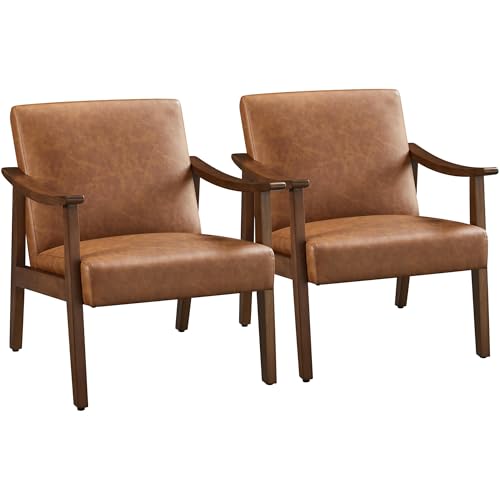
Yaheetech Faux Leather Club Chairs, Set of 2 — Best Pair for a Reading Room
Libraries are social architecture: the classic reading room arranges chairs in facing pairs across a table or a hearth, and the Yaheetech set is the only pick here sold as that pair. The verified listing describes two mid-century club chairs in brown faux leather, with cushioned seats, supportive sloped backrests, and sturdy wood arms, fitted for small living rooms, offices, and reading nooks. The club silhouette — compact, enveloping, arms continuous with the body — is one of the three historic library forms, and the sloped backrest is its reading posture: settled, slightly reclined, book at a natural angle. Wood arms deserve their sentence: on a club chair they take the wear that upholstered arms cannot, and they give the chair its furniture-like finish. Faux leather carries the same honest caveat as the VASAGLE’s PU — a leather-look surface with a synthetic lifespan — applied here to two chairs at a set price structure that makes the pair the value story of this guide.
Strengths
- A matched pair in one purchase — the facing-chairs library layout without a second decision.
- Club form with sloped backrests is a genuine historic library silhouette, sized for smaller rooms.
- Wood arms add durability and a furniture finish that all-upholstered chairs lack.
Trade-offs
- Faux leather: the look without the hide’s aging or longevity, as with all leather-look picks here.
- A pair is a commitment of floor space; single-chair corners should buy single chairs.
- Mid-century tailoring softens the traditional brief — these read as club chairs first, antiques never.
Spec snapshot (from the verified listing): Quantity: set of 2 · Style: club chairs · Upholstery: faux leather · Back: sloped · Arms: wood · Color verified: brown
Buy the pair if your room wants symmetry — two chairs, one table, a lamp between them — or if a home office needs a reading chair and a visitor’s chair that match. Sold singly, each would be a respectable club chair; sold as a set, they are the fastest route in this guide to a room that looks considered.
Best for: reading rooms, offices, and facing-pair layouts / Not suited for: single small corners, or genuine-leather buyers

Garvee Barrel Accent Chair, Velvet Club Chair — Best Barrel Club
The barrel chair is the library form that wraps: a continuous curved back that flows into the arms, enclosing the sitter in a single arc. The Garvee’s verified listing describes a velvet club chair in blue, with flared legs, upholstered for living room, waiting room, and small-space corners. Velvet is the honest luxury fabric of this guide — a genuine textile with a pile, a light-play, and a hand that synthetics imitate and linen does not attempt — and in a deep blue it is the most room-transforming upholstery here. The barrel form’s reading posture is the most enveloping of the six picks: less upright than the KEIKI’s traditional frame, more cocooned, suited to the reader who curls rather than sits. Flared legs give the base a mid-century lightness that keeps the barrel’s mass from reading as bulk.
Strengths
- Barrel/club silhouette delivers the enveloping reading posture in its purest mainstream form.
- Velvet upholstery brings real textile richness and the classic library color depth.
- Compact corner-friendly footprint per the listing — the library chair for smaller rooms.
Trade-offs
- The enveloping posture is a recline-leaning one; upright, desk-adjacent reading belongs to the KEIKI.
- Velvet asks for care — brushing, spill discipline, and sun management — beyond what leather-look surfaces demand.
- Mid-century flared legs soften the traditional brief; this is a club chair with vintage manners, not an antique reproduction.
Spec snapshot (from the verified listing): Style: barrel club chair · Upholstery: velvet · Legs: flared · Color verified: blue · Placement: living room, corner, waiting room
Choose the Garvee if your reading is a curl-up ritual and your room wants color and softness more than it wants Georgian lines. In a small apartment, it may be the only pick here that delivers a true library feeling inside a corner’s honest dimensions.
Best for: curl-up readers and small, style-led rooms / Not suited for: upright traditionalists, or spill-prone households

choairy Accent Chair with Side Pockets — Best for the Working Reader
Every library chair in this guide stores the reader; the choairy also stores the reading. Its verified listing describes a mid-century modern reading chair with side pockets, upholstered, positioned for bedroom, office, apartment, and small rooms, in blue. Side pockets sound like a gimmick until a reading corner has survived a winter: the current book, the next book, the glasses, the reading light remote, the notebook — the pocket swallows the clutter that otherwise colonizes the side table and the chair’s own arms, and it keeps the current book at the chair rather than migrating through the house. We will be honest about the styling: this is a modern chair with a reader’s feature, not a traditional chair, and it earns its place in an English library guide on function — the library is a working room, and this is the working chair. Buyers furnishing a period room should stop at the KEIKI; buyers furnishing a daily reading habit in a small modern space should read on.
Strengths
- Side pockets solve the reading corner’s real clutter problem — books and tools live at the chair.
- Compact, apartment-scaled format with an upholstered armchair’s proper reading posture.
- The most practical pick here for small spaces where a side table barely fits.
Trade-offs
- Mid-century styling: it serves the library’s function, not its traditional look.
- Pockets invite overload; a pocket used as a bookshelf sags, so treat it as a current-book holder.
- Upholstery specifics beyond “upholstered” are not detailed in the verified title — confirm fabric on the listing.
Spec snapshot (from the verified listing): Style: mid-century modern armchair · Feature: side pockets · Use: reading chair for bedroom, office, small rooms · Color verified: blue
The choairy is the pragmatist’s pick: the chair for the reader whose corner is a chair, a lamp, and a stack of books in active rotation. It will not anchor a period room, and it will be used more hours per week than any chair in this guide if its owner’s habit is daily.
Best for: daily readers in small modern spaces / Not suited for: period-room traditionalists

VINGLI Accent Chair, Chenille — Best High-Capacity Reading Chair
The VINGLI states the specification that matters most to a large share of readers and that most listings whisper: a 380 lb capacity, printed in its verified title. Around that number it builds a chenille-upholstered armchair positioned as a mid-century reading chair for living rooms, bedrooms, and small apartments, in navy blue in the verified configuration — and, notably, a sibling configuration in light brown exists under a separate listing, so confirm the colorway you are ordering. Chenille is the softness pick among these upholsteries: a tufted, caterpillar-yarn fabric with a plush hand that suits long sits, in deep navy that sits comfortably in a library palette. Capacity honesty deserves its reward in a guide: a chair whose maker states its limit lets a larger reader buy with information instead of hope, and the reading posture — the whole point of this category — is only available to bodies the chair properly supports.
Strengths
- Stated 380 lb capacity — the clearest structural promise in this guide.
- Chenille upholstery offers the plushest hand of the six picks for long reading sessions.
- Reading-chair positioning with an apartment-friendly footprint, in a library-appropriate navy.
Trade-offs
- Mid-century styling again — capacity and comfort lead, traditional detailing follows.
- Chenille’s pile shows wear patterns over years and wants gentle cleaning; it is not the wipe-clean pick.
- Colorways are separate listings in this line; the navy verified here is not interchangeable with the brown at checkout — verify before ordering.
Spec snapshot (from the verified listing): Capacity: 380 lb (stated) · Upholstery: chenille · Style: mid-century reading chair · Color verified: navy blue
Choose the VINGLI if you are a larger reader, or simply a reader who wants the structural question answered in writing before the style question. A library chair’s first duty is to hold its reader well for a thousand evenings; this is the pick that says, in numbers, that it will.
Best for: larger readers and capacity-first buyers / Not suited for: buyers seeking traditional detailing above all
Comparison Table
| Pick | Badge | Key spec | Best for | Link |
|---|---|---|---|---|
| KEIKI Vintage Armchair | Best Traditional Style | Linen, nailhead trim, turned legs, solid wood frame | Classic reading nooks | Check on Amazon |
| VASAGLE Tufted Armchair | Best Tufted Leather-Look | Button tufting, PU leather, thick cushion | Chesterfield look, mainstream tier | Check on Amazon |
| Yaheetech Club Chairs (Set of 2) | Best Pair | Faux leather club form, sloped backs, wood arms | Facing-pair layouts | Check on Amazon |
| Garvee Barrel Chair | Best Barrel Club | Velvet, barrel back, flared legs | Curl-up readers, small rooms | Check on Amazon |
| choairy Accent Chair | Best for the Working Reader | Side pockets, compact armchair | Daily readers, small spaces | Check on Amazon |
| VINGLI Accent Chair | Best High-Capacity | 380 lb stated capacity, chenille | Larger readers | Check on Amazon |
How to Choose an English Library Chair
Start with the reading posture, not the photograph. A library chair is sat in for chapters. The back should support an upright-but-settled posture; the arms should meet your forearms where a book naturally rests; the seat should be deep enough to feel enveloping and firm enough that standing up is a decision, not a project. High-density foam (the KEIKI) and thick cushions (the VASAGLE) serve the long sit better than plush sink-in fill, which reads as comfort in a showroom and as a wrestling match by page fifty.
Decide the leather question honestly. Genuine leather is the historic library material — and in the mainstream market it is scarce, which is why this guide’s leather-look picks name their materials in every review. PU and faux leather give you the silhouette and the wipe-clean surface; linen gives you a natural fabric with its own traditional pedigree; velvet and chenille give you softness and color. None is a counterfeit of another unless a listing pretends otherwise — judge each as itself, at its tier, for its aging pattern.
Measure the corner, the door, and the path between. Library chairs are among the widest single chairs in a home. Record the chair’s width from the listing, your doorway’s clear width, and the reading corner’s footprint with the side table and lamp you intend. A chair that fits the corner but not the door is a rug with ambitions. Where a listing does not state dimensions, treat the listing page’s dimension block as a required stop before ordering.
Match the detail vocabulary to the room. Nailheads and turned legs (KEIKI) lean Georgian and traditional; button tufting (VASAGLE) leans club and Chesterfield; the club silhouette (Yaheetech) is the most adaptable, reading traditional in brown and transitional in lighter colors. A library chair is a room’s anchor piece; its vocabulary sets the room’s accent, so choose the dialect you want the shelves to speak.
Mind the seat height and depth together. A library chair’s comfort is geometry: seat height decides whether your feet rest flat (they should, for an hour’s reading), and seat depth decides whether the backrest meets your back with your feet still grounded. Deeper seats suit taller readers and curl-up postures, and they punish shorter readers unless an ottoman or a cushion closes the gap. Where a listing states dimensions, do the arithmetic against your own legs before the style seduces you; where it does not, treat the listing page’s measurements as homework, not fine print. The most traditional silhouette in the world cannot redeem a chair your body cannot settle into.
Plan for the pair or the single. Reading rooms are built in both grammars: the solitary corner (one chair, one lamp, one table) and the conversational pair. Buying the Yaheetech set for a solitary corner strands a chair; buying singles twice for a pair risks a discontinued colorway between purchases. Decide the room’s grammar first.
How to Set Up a Reading Corner That Earns the Chair
The chair is half the purchase; the corner is the other half. Light first: place a reading lamp so its light falls over your shoulder onto the page — a floor lamp beside and slightly behind the chair is the classic arrangement, and no chair, however perfect, survives being read in by ceiling light alone. A surface within reach: a side table at arm height for the book stack, the glasses, and the drink; library chairs with wood arms forgive a resting cup better than upholstered ones, but a table is the civilized answer. Feet considered: an ottoman or footstool transforms a reading chair’s second hour — if your chair did not come with one, a simple upholstered stool in a kindred fabric completes the posture the chair began. Orientation: face the chair into the room’s calm — toward shelves, a hearth, or a window with the light managed — rather than at a television; a library chair pointed at a screen becomes a viewing chair with pretensions. The book supply: keep the current stack on the table and the next shelf within a stand-up’s reach; a reading corner that requires a journey for the next book is a chair that gets used for sitting, not reading. Set up this way, even a mainstream interpretation of the style delivers the thing the style was invented for: a place where an evening with a book is the plan, not the accident.
The Three Historic Silhouettes, and How the Picks Map to Them
The wingback is the silhouette most people picture first: a tall back whose side panels — the wings — project forward at head height. The wings were working parts before they were style, shielding a reader’s head from the cross-drafts of a hearth-heated room and catching the fire’s warmth around the sitter. No pick in this guide is a true wingback — an honest absence worth stating, because the genuine article, in leather, at furniture grade, lives in a premium tier that the mainstream verified market barely stocks. What the guide offers instead are the wingback’s virtues in other forms: high, supportive backs and enclosing arms. A buyer whose heart is set on wings specifically should shop the premium furniture market deliberately, with a furniture budget, rather than asking a mainstream accent chair to impersonate one. The Chesterfield is defined by deep button tufting, rolled arms level with the back, and leather — the VASAGLE borrows its tufting and its palette while changing the arms, the frame, and the material, which is why its review calls it a gesture rather than a reproduction. The club chair — low, wide, enveloping, born in French and English club rooms — is the silhouette the mainstream market actually builds well, and three picks here (the Yaheetech pair and the Garvee barrel, the barrel being the club’s curved-back cousin) live in its family. The mapping teaches the guide’s central lesson: at mainstream tiers, buy the silhouette the market builds honestly — the club — and treat wingback and Chesterfield as directions of style rather than checklists, unless your budget travels to where the genuine articles live.
How These Upholsteries Age: A Five-Year View
A library chair is bought for evenings across years, so the honest comparison is not how each fabric feels in week one but what it becomes by year five. Genuine leather — absent from these picks, as the guide has stated — ages by patina: it darkens, softens, and records its life attractively, which is the entire basis of its premium. PU and faux leather (VASAGLE, Yaheetech) age by wear: the surface stays handsome until the coating tires, typically at arms and seat edges, and then declines faster than it arrived; expect a good-looking middle-distance life rather than an heirloom one, and price your expectations accordingly. Linen (KEIKI) ages by softening: it relaxes, takes the room’s light gently, and shows honest wear as character in a traditional interior — the best aging story among these picks for a classic room. Velvet (Garvee) ages by pile: high-contact areas flatten and shine slightly, which reads as life in a jewel-toned chair and is managed by brushing and steam. Chenille (VINGLI) ages by pile-wear too, softening from plush to smooth along the seat’s working area. None of these is a disqualification; each is a future you can choose with your eyes open. The disqualifying purchase is the one made in ignorance of which future you were buying — which is why this guide has named every material, in every review, in plain words.
Arranging the Library: One Chair, a Pair, a Room
The solitary corner is the atomic library: one chair, angled slightly toward the room rather than squared to a wall, a lamp behind the reading shoulder, a table at the arm. Angle matters more than furniture catalogs admit — a chair turned fifteen degrees toward the shelves and the room’s light reads as a destination, while the same chair flat against a wall reads as storage. The pair arrangement doubles the grammar: two chairs facing across a low table or angled toward a shared hearth, with a single lamp strategy that serves both seats or a lamp per chair if the readers keep different hours. Symmetry is the pair’s pleasure and its trap; the Yaheetech set exists because matched chairs bought together simply work, while pairs assembled across years rarely quite match. The full reading room — shelves, chairs, a desk perhaps — asks the chairs to share a vocabulary rather than a model: a traditional linen chair at the desk side and a club pair at the hearth is a richer room than four identical chairs, provided the materials converse (wood tones repeat, the palette rhymes). Across all three arrangements the constant is the walkway: a library chair you must squeeze past is a chair in the wrong place, and the room’s plan should leave the reader’s approach as gracious as the reader’s seat. Measure for the arrangement, not the chair alone, and the corner you build will be the one the house actually uses.
Common Buying Mistakes
- Reading “leather-look” as leather. PU and faux leather are legitimate materials with their own trade-offs — but only when bought knowingly. This guide names them in every review; extend yourself the same courtesy everywhere else.
- Buying a dining or desk chair for reading. Arms at the wrong height and a perch posture defeat the purpose within a chapter. A library chair is an armchair, full stop.
- Skipping the doorway measurement. The widest chair in the house meets the narrowest door in the house, in that order, unless you measure first.
- Choosing sink-in softness for long reads. Plush feels luxurious for five minutes and unsupportive for fifty pages. Firm, high-density cushioning is the reader’s friend.
- Forgetting the lamp and table. A great chair in a bare corner underperforms a good chair in a finished one. Budget the corner, not just the chair.
- Buying one of a future pair. Colorways discontinue. If the room’s plan is two chairs, the set — or two singles bought together — is the safe purchase.
Final Recommendation
For the fullest traditional statement at a mainstream tier, take the KEIKI Vintage Armchair: linen, nailheads, turned legs, and a solid wood frame add up to the library vocabulary spoken fluently. For the tufted leather-look silhouette, the VASAGLE is the direct route, bought with its PU leather named and understood. For a room that wants the classic facing pair, the Yaheetech club chairs solve the layout in one purchase. Curl-up readers should look at the Garvee’s velvet barrel, daily readers in small spaces at the choairy’s pocketed practicality, and larger readers at the VINGLI, whose stated 380 lb capacity is the guide’s clearest structural promise. Whichever you choose, check the current price on Amazon, confirm the dimensions and colorway on the listing, and measure your doorway before the box ships — a library chair should be a decade’s companion, and decades begin with fit.
A closing word on what this category is really selling: not a chair, but a habit. The right library chair, in a finished corner, converts reading from something you do in leftover spaces into the room’s organizing pleasure — and that conversion is available at every tier in this guide, because it was never the tufting that made the library. It was the chair that fit the reader, the lamp that lit the page, and the corner that invited the hour. Choose those honestly and the style, as it has for three centuries, will take care of itself.
Furnishing the rest of the reading room? These companion guides from the same program cover the neighboring decisions: Best Chairs That Hold 400 Pounds and Best Chairs To Use For Long Hours Of Sitting for the long-session angle.
Frequently Asked Questions
Why is there no true wingback in this guide?
Because the verified mainstream market barely offers one, and this guide only recommends what it can verify. A genuine wingback — tall winged back, furniture-grade frame, leather or premium fabric — is a premium furniture product, and the listings that borrow the word at mainstream tiers tend to be accent chairs with a raised back panel rather than the historic form. Rather than bless an impersonation, the guide says so, grades the picks it has on the virtues they genuinely carry, and points wingback-committed buyers at the premium furniture market with a furniture budget. An honest absence beats a decorated presence.
What defines an English library chair?
A traditional armchair form built for long reading: a supportive high back, arms at reading height, a deep and structured seat, and detailing from the classic furniture vocabulary — tufting, nailhead trim, turned or tapered wood legs, rolled or sloped arms, in leather or serious fabric. The wingback, the Chesterfield, and the club chair are its three historic silhouettes, and modern picks interpret them at various fidelities, which this guide grades pick by pick.
Is PU leather a bad choice for a library chair?
It is a trade, not a failure. PU leather delivers the tufted, tan, wipe-clean look at a mainstream price, and it will not develop leather’s patina or match hide’s lifespan. Bought knowingly — as the VASAGLE’s review frames it — it is the rational route to a specific silhouette. Bought unknowingly, under the impression it is hide, it is a disappointment scheduled in advance. The material is fine; the labeling is what must be honest.
How firm should a reading chair be?
Firmer than your first impression prefers. A reading chair supports a posture for an hour or more; high-density foam and thick, structured cushions hold that posture, while soft sink-in fill lets you slump and makes standing up an effort. Sit-test mentally for page fifty, not for the showroom minute: if the cushion description emphasizes support and density, it is speaking the reader’s language.
Can one library chair work in a modern room?
Yes, as an intentional accent: a single traditional chair among modern pieces reads as a collected, personal note — the club silhouette adapts most easily, and a linen traditional chair like the KEIKI works as a textural counterpoint. What fails is the half-hearted middle: a chair traditional enough to clash and not traditional enough to anchor. Commit to the accent or choose a transitional design; the room will know the difference even if the catalog does not.
Will a library chair fit through my door?
Measure both, in inches, before ordering: the chair’s widest dimension from the listing, and your doorway’s clear width with the door open at its stop. Many armchairs pass through standard doors on a diagonal or with legs removed — several picks here assemble at home, which quietly solves the doorway problem, since parts travel where a built chair cannot. If a listing does not state dimensions, that is a stop sign: get them from the listing page or choose a pick whose footprint is documented, like the capacity-stated VINGLI approach to specifications.
How much assembly should I expect?
Mainstream armchairs in this guide’s tier typically ship flat and assemble at home — the KEIKI’s listing states easy assembly outright, and legs, backs, and arms are the usual components. Assembly is the trade that buys the price and the doorway access; the heirloom alternative — a fully built furniture-grade chair — is a different market at a different tier, with delivery to match. Judge a pick’s assembly by whether its listing treats it as a feature with instructions, not by whether it exists.
Do library chairs need an ottoman?
Not need — but the second hour of reading argues for one. An ottoman or footstool completes the posture the chair starts, particularly with the more upright traditional backs. If your chosen pick has no matching ottoman, a simple upholstered stool in a kindred fabric and height serves the same purpose; match the seat height so your knees rest level rather than dangling or jackknifed.
Is a library chair a good gift?
For a known reader, it is among the most personal furniture gifts available — provided the practicalities are handled. Confirm the recipient’s doorway and corner dimensions indirectly if you can, choose the silhouette that matches their home’s existing vocabulary, and favor the picks whose materials age gracefully in that setting. A chair is a decade-scale object; the gift version of this guide’s advice is to buy the recipient’s actual reading life — upright or curled, solitary or paired, fabric or leather-look — rather than the chair that photographs best in the listing.
How do I care for linen, PU leather, and faux leather upholstery?
Linen: vacuum with an upholstery brush, blot spills immediately, and expect graceful softening with age; it is the most breathable and the most stain-honest of the three. PU and faux leather: wipe with a damp cloth, keep out of prolonged direct sun and away from heat sources that dry the coating, and avoid solvent cleaners. All three reward the same first rule of library furniture: the book corner is a drink’s distance from a side table, not a coaster on the arm — whatever the arm is made of.


