Disclosure: airfryerkitchensupply.com is reader-supported. When you buy through links on our site, we may earn an affiliate commission at no extra cost to you.
Where to buy
Shopping for the room air purifiers for smoke? The fastest way to buy any pick in this guide is through Amazon, where stock, delivery and returns are handled in one place. Start with our top recommendation, the WINIX 5510 Air Purifier (Check the current price on Amazon), then compare it against the other five picks below before you decide. Prices move with stock and season, so we never print a fixed price in the article itself — use the check-price links to see the current figure on Amazon.
- WINIX 5510 Air Purifier — Check price on Amazon
- COWAY Airmega 400 Air Purifier (AP-2015F) — Check price on Amazon
- Levoit Core 300-P Air Purifier — Check price on Amazon
- Austin Air HealthMate Plus Air Purifier (B450) — Check price on Amazon
- BLUEAIR Blue 311i Max Air Purifier — Check price on Amazon
- Medify MA-40 Air Purifier — Check price on Amazon
Finding the best room air purifiers for smoke starts with a distinction most listings blur: smoke is particles plus gases. The haze you can see is particulate matter, and any decent HEPA filter will capture it. The smell that soaks into a room — the part still there tomorrow — is gas-phase pollution, and it only stops in activated carbon, in proportion to how much carbon the machine carries. A purifier with a token carbon sheet will clear your view and leave your grievance; that single fact explains most disappointed purifier purchases, and it is the axis this guide ranks on. One boundary before the picks: an air purifier is an air-quality and comfort appliance, not a medical device. Nothing in this guide claims to treat, prevent or improve any health condition; during severe wildfire events, follow local public-health guidance first and treat a purifier as one layer among several.
Where a title does not state a figure, this guide does not invent one. Coverage numbers also carry a universal caveat we will repeat until it sticks: they are calculated at high fan speeds, so the practical question is always how much clean air a machine delivers at a speed you can live with — which is why headroom and quietness both earn ranking weight here.
Match the machine to the smoke, and the category becomes simple. Occasional drift and cooking events need a verified compact or mid-size HEPA machine. Daily tobacco smoke needs a dedicated deodorization carbon bed. Wildfire seasons need adsorbent depth and filter longevity. Large open rooms need coverage headroom above all. The badges below assign one pick to each of those realities.
In this guide
Quick Picks: The Best Room Air Purifiers for Smoke at a Glance
The six picks at a glance. Note how the badges divide by smoke type, not by price: identify your smoke first — drift, tobacco, wildfire or fireplace — and the table narrows itself. Full reviews, a comparison table and a sizing guide follow.
| Pick | Badge | Why it stands out | Link |
|---|---|---|---|
| WINIX 5510 Air Purifier | Best Overall for Smoke | True HEPA plus a high-deodorization carbon filter, rated to 1,881 ft² in 1 hour, with app support. | Check price on Amazon |
| COWAY Airmega 400 Air Purifier (AP-2015F) | Best for Large Rooms | The biggest verified coverage here — up to 3,120 ft² — with washable pre-filter, AQI display and a 5-year warranty as stated. | Check price on Amazon |
| Levoit Core 300-P Air Purifier | Best Budget | AHAM Verified coverage to 1,073 ft², quiet HEPA sleep mode — the affordable single-room smoke answer. | Check price on Amazon |
| Austin Air HealthMate Plus Air Purifier (B450) | Best for Wildfire Smoke Seasons | Four-stage filtration with activated carbon and zeolite, coverage to 1,500 sq ft, and a stated 5-year filter life. | Check price on Amazon |
| BLUEAIR Blue 311i Max Air Purifier | Best Quiet for Bedrooms | AHAM Verified to 2,107 ft² yet stated at just 23dB, with HEPASilent filtration and a washable pre-filter. | Check price on Amazon |
| Medify MA-40 Air Purifier | Best Mid-Size All-Rounder | Coverage of 1,793 ft² in 1 hour, HEPA filtration, and a title that names smoke and wildfires outright. | Check price on Amazon |
Best Overall for Smoke — WINIX 5510 Air Purifier: The smoke specialist’s all-rounder: a True HEPA stage for particles and a high-deodorization carbon stage for the odour and gases that make smoke linger, sized for large rooms. (Check price on Amazon)
Best for Large Rooms — COWAY Airmega 400 Air Purifier (AP-2015F): The large-space pick: coverage stated to 3,120 ft², a washable pre-filter to protect the HEPA stage, air-quality readout, Auto and Sleep modes, and the longest warranty stated in this guide. (Check price on Amazon)
Best Budget — Levoit Core 300-P Air Purifier: The value pick: an AHAM Verified machine rated to 1,073 ft² with a quiet sleep mode, from the most widely owned compact purifier line in this guide. (Check price on Amazon)
Best for Wildfire Smoke Seasons — Austin Air HealthMate Plus Air Purifier (B450): The endurance pick: a four-stage machine whose carbon-and-zeolite stage is built for gas-heavy smoke, with a filter life stated in years rather than months. (Check price on Amazon)
Best Quiet for Bedrooms — BLUEAIR Blue 311i Max Air Purifier: The quiet overachiever: coverage stated to 2,107 ft² with a noise figure of just 23dB as printed, AHAM Verified, and a washable pre-filter. (Check price on Amazon)
Best Mid-Size All-Rounder — Medify MA-40 Air Purifier: The middle lane done properly: 1,793 ft² hourly coverage, HEPA filtration stated to 0.3 microns, and smoke and wildfires named in the title itself. (Check price on Amazon)
How These Picks Were Chosen
Our selection method had three gates. First, identity: every candidate was matched by brand and model against the Amazon catalog through Amazon data for this site, and only confirmed listings received purchase links — replacement filters and accessories that surfaced in searches were excluded, because a filter cartridge is not a purifier. Second, smoke relevance: a pick had to address smoke in its verified specification — a named smoke target, a True HEPA stage, a deodorization carbon stage, or adsorbent depth — rather than merely being a purifier that exists.
Ranking then weighed four things. Carbon capacity for gas-phase smoke, because odour is the lasting complaint. Delivered-air headroom — stated coverage against the room sizes readers actually have — because an undersized machine at maximum speed is loud and still behind. Noise, using stated decibel figures only, because bedroom machines live or die on whether they stay switched on. And ownership cost shape: washable pre-filters, stated filter life and stated warranty all change what a machine costs across five years, and titles that state them earned credit for stating them.
Two filters of a different kind were applied throughout. No health claims: purifiers here are discussed as air-quality appliances for comfort and odour/particle control, full stop. And no borrowed specifications: sibling models in the same line often differ in coverage and features, so nothing was transferred from one model to another — each pick stands on its own verified title alone.
The 6 Best Room Air Purifiers for Smoke, Reviewed in Detail

WINIX 5510 Air Purifier — Best Overall for Smoke
Smoke is two problems wearing one name. The visible haze is particulate — ash and tar droplets that a HEPA filter captures mechanically. The smell that survives for days is gas-phase: volatile compounds that sail straight through a particle filter and only stop in a serious bed of activated carbon. The WINIX 5510 is ranked first here because its verified title names both weapons explicitly — True HEPA and a High Deodorization Carbon Filter — and sizes the machine for large rooms up to 1,881 ft² in one hour.
Strengths
- Names both smoke tools in the title: True HEPA and high-deodorization carbon
- Large-room rating of 1,881 ft² in 1 hr covers most living spaces
- Auto Mode and app support (new generation of the 5500-2 platform)
Trade-offs
- Carbon beds saturate: heavy smoke exposure shortens filter life and raises running cost
- A 1,881 ft² one-hour rating is not the same as quiet-speed coverage — see the guide below
- Title does not state a noise figure, so we do not quote one
| Spec | Detail (as stated in the verified listing title) |
|---|---|
| Coverage (as stated) | Up to 1,881 ft² in 1 hr |
| Particle filter | True HEPA |
| Gas/odour filter | High Deodorization Carbon Filter |
| Modes | Auto Mode, app support |
Why does the carbon stage matter so much for this search? Because the complaint behind ‘air purifier for smoke’ is usually the smell — in curtains, in upholstery, in the room the morning after. Particle-only machines clear the haze and leave the grievance. A high-deodorization carbon filter is built with more carbon mass, and carbon mass is the currency of odour removal: more bed depth means more capacity before breakthrough. That is also the honest caveat — carbon is a consumable sponge, and in a heavy-smoking household or a wildfire season it fills faster, so budget for replacements as part of ownership, not as a surprise.
Auto Mode earns its place in a smoke guide for a practical reason: smoke arrives in events — a cooking incident, a neighbour’s bonfire, a wildfire drift — and a sensor-driven machine that ramps up when the air worsens and settles when it clears handles those events without you babysitting fan speeds. For a single machine to cover a main living space, this is the specification we verified that we would buy first. Rooms far beyond its rating, or whole-house smoke, need the larger COWAY below — or more than one machine.
Best for: living rooms and open-plan spaces with regular smoke exposure / Not suited for: whole houses or rooms far beyond its stated coverage
Check the current price on Amazon
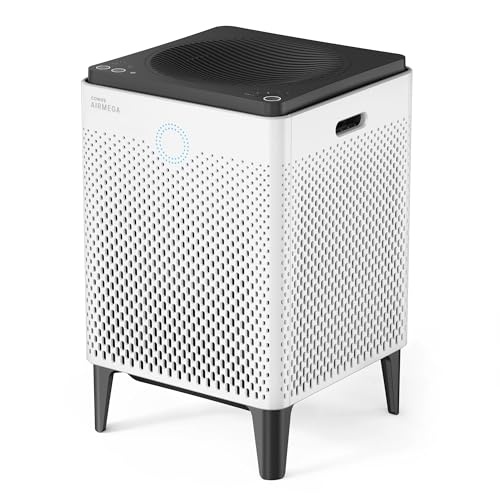
COWAY Airmega 400 Air Purifier (AP-2015F) — Best for Large Rooms
Open-plan homes defeat small purifiers: the machine cleans its corner beautifully while smoke from the kitchen or fireplace circulates untouched twenty feet away. The Airmega 400’s verified title leads with the number that solves that — coverage up to 3,120 ft² — backed by a washable pre-filter, a HEPA filter the title explicitly rates for smoke, an air-quality index display, Auto and Sleep modes, a timer, and a stated 5-year warranty.
Strengths
- Largest stated coverage in this guide at 3,120 ft²
- Washable pre-filter extends the life of the main HEPA stage
- 5-year warranty stated in the title — the longest here
Trade-offs
- Physical size and weight follow the coverage: this is furniture, not a bedside box
- Title does not itemise a dedicated high-mass carbon stage like the WINIX pick
- Oversized for a single bedroom — its capacity is wasted at low duty
| Spec | Detail (as stated in the verified listing title) |
|---|---|
| Coverage (as stated) | Up to 3,120 ft² |
| Filters | Washable pre-filter + HEPA filter |
| Display | AQI (air quality index) |
| Warranty (as stated) | 5 years |
Coverage ratings need one honest footnote, and it applies to every pick in this guide: a ‘covers X square feet’ figure is calculated at high fan speed for a set number of air changes per hour. At sleep-friendly speeds the effective coverage shrinks. The Airmega’s headroom is precisely why it suits large rooms — run at a moderate, livable speed it still moves enough air to matter, where a smaller machine at moderate speed is decorative. The AQI display supports that style of use: you can watch the number fall after a smoke event instead of guessing whether the machine is keeping up.
The washable pre-filter is a quiet running-cost feature. Pre-filters catch the coarse load — dust, hair, lint — before it mats the HEPA stage, and a washable one turns a recurring purchase into a rinse under the tap. In a smoking or fireplace household, where the coarse load includes ash, that protection is worth real money over a filter’s life. Buy this machine for a big, shared space; for one bedroom, its smaller siblings below are the proportionate spend.
Best for: open-plan homes, large living rooms and fireplace houses / Not suited for: small bedrooms or anyone short on floor space
Check the current price on Amazon

Levoit Core 300-P Air Purifier — Best Budget
Most ‘purifier for smoke’ searches are really about one room — the bedroom that smells of the neighbour’s smoking, the study that catches fireplace drift. The Core 300-P is built for exactly that scale: AHAM Verified (the title’s spelling aside, that is the industry verification programme), coverage stated to 1,073 ft², a HEPA filter the title rates for smoke among its targets, and a quiet sleep mode for overnight running.
Strengths
- AHAM Verified rating — independently standardised coverage, not just a claim
- Quiet sleep mode suits the bedroom use case it is bought for
- Compact single-room format at the budget end of this guide
Trade-offs
- Small carbon capacity: fine for drift and odour events, not a heavy-smoking room
- 1,073 ft² is its high-speed figure; overnight-quiet coverage is smaller
- One room only — it will not rescue an open-plan space
| Spec | Detail (as stated in the verified listing title) |
|---|---|
| Coverage (as stated) | Up to 1,073 ft² |
| Verification | AHAM Verified |
| Filter | HEPA (smoke listed among targets) |
| Mode highlight | Quiet HEPA Sleep Mode |
A word in defence of buying small on purpose. Smoke problems are usually local: one room downwind of the source, one bedroom that must stay clean for sleep. A verified compact machine, run continuously in that room with the door mostly closed, delivers cleaner air where you breathe for eight hours than a large machine idling in a hallway. The Core line’s popularity also has a practical consequence — replacement filters are easy to find, which matters for a device whose performance is its filter’s condition.
Its limits are the budget tier’s limits. The carbon in a compact 3-in-1 filter is a light bed: it will take the edge off cooking smoke and occasional drift, but a room where tobacco is smoked daily will exhaust it quickly and overwhelm it while fresh. That reader should start with the WINIX and its deodorization carbon. For everyone else — the far larger group — this is the sensible first purifier: verified, quiet, and honestly sized to a bedroom.
Best for: bedrooms and studies with occasional smoke drift / Not suited for: rooms where smoking happens daily indoors
Check the current price on Amazon

Austin Air HealthMate Plus Air Purifier (B450) — Best for Wildfire Smoke Seasons
Wildfire smoke is a different adversary from a cigarette. It arrives for weeks, it is heavy in gases and fine particles together, and it destroys light carbon filters — a compact machine can exhaust its odour capacity in a single bad season. The HealthMate Plus answers with mass: its verified title states four-stage filtration with activated carbon and zeolite (a mineral adsorbent that complements carbon on certain gases), coverage up to 1,500 sq ft, and a filter life stated at five years.
Strengths
- Carbon-and-zeolite stage built for gas-phase smoke load
- Stated 5-year filter life transforms running-cost maths
- Coverage to 1,500 sq ft suits a main living area
Trade-offs
- Large, heavy, utilitarian cabinet — it looks like equipment, because it is
- High purchase tier: the value case rests on filter longevity, not the sticker
- Title states ‘quiet’ without a decibel figure, so we quote no number
| Spec | Detail (as stated in the verified listing title) |
|---|---|
| Coverage (as stated) | Up to 1,500 sq ft |
| Filtration | 4-stage, activated carbon and zeolite |
| Filter life (as stated) | 5 years |
| Model | HealthMate Plus B450 |
The five-year filter claim deserves framing rather than either hype or dismissal. It is the manufacturer’s stated life under normal conditions, and ‘normal’ in a wildfire corridor is doing heavy lifting — but the direction is right: a deep adsorbent bed holds far more than the thin carbon sheets in compact filters, and zeolite adds capacity for gases carbon handles less well. For a household that has lived through two smoke seasons and is tired of emergency purchases, that depth is the product.
One clarification we insist on, here and throughout: an air purifier is a comfort and air-quality appliance, not a medical device. This guide makes no health claims for any pick, and during severe smoke events a purifier supplements — never replaces — sealing the room, limiting exertion and following local public-health guidance. Within that honest frame, for gas-heavy, weeks-long smoke, this is the machine whose specification matches the problem.
Best for: homes in wildfire-smoke regions and gas/odour-heavy air / Not suited for: style-led buyers or anyone needing a small footprint
Check the current price on Amazon

BLUEAIR Blue 311i Max Air Purifier — Best Quiet for Bedrooms
Bedroom smoke control fails on one specification more than any other: noise. A purifier that cleans brilliantly at a roar gets switched off at 2 a.m., and an off purifier cleans nothing. The 311i Max’s verified title pairs an unusually large coverage figure — up to 2,107 ft² — with a stated 23dB quiet figure, AHAM verification, WiFi and Auto Mode, and a washable pre-filter, with smoke named among the captured pollutants.
Strengths
- Stated 23dB — the quietest explicit noise figure in this guide
- AHAM Verified coverage to 2,107 ft² gives huge speed headroom
- Washable pre-filter trims consumable costs
Trade-offs
- HEPASilent is a hybrid technology, not a True HEPA stage — see the analysis
- Lowest-speed quiet and maximum coverage are different settings, as with all purifiers
- App and WiFi features are convenience, not cleaning performance
| Spec | Detail (as stated in the verified listing title) |
|---|---|
| Coverage (as stated) | Up to 2,107 ft² |
| Noise (as stated) | 23dB |
| Filtration | HEPASilent |
| Verification | AHAM Verified |
Honesty about HEPASilent: BLUEAIR’s technology combines electrostatic and mechanical filtration to move a lot of air quietly, and it is not the same construction as a sealed True HEPA filter like the WINIX’s. For smoke, what matters practically is delivered clean air at a speed you will tolerate all night — and on that measure a quiet machine with large headroom, run continuously, is a rational bedroom choice. The AHAM verification matters here precisely because it standardises the coverage claim behind the headline number.
Use the headroom intelligently: run Auto so the machine surges when smoke drifts in and settles to near-silence as the room clears, and keep the washable pre-filter clean so the main stage is not choked by household dust. If your smoke problem is a daily indoor smoker rather than drift and events, the WINIX’s dedicated deodorization carbon remains the stronger tool; if it is a bedroom that must stay fresh and quiet against outside smoke, this is the pick.
Best for: bedrooms and light sleepers facing smoke drift / Not suited for: purists who want a sealed True HEPA stage only
Check the current price on Amazon

Medify MA-40 Air Purifier — Best Mid-Size All-Rounder
Between the compact Levoit and the room-filling COWAY sits the size most living rooms actually need, and the MA-40 occupies it with a title that is admirably direct: HEPA filter, 1,793 ft² coverage in one hour, and a target list that names smoke and wildfires before pollen and pets. Particle capture is stated to 0.3 microns, which is the size range where smoke particulate lives.
Strengths
- Coverage and targets stated plainly — smoke and wildfires named
- Particle capture stated to 0.3 microns
- Mid-size footprint suits living rooms that cannot host the largest machines
Trade-offs
- Title does not detail the carbon stage’s mass, so heavy gas load is the WINIX/Austin lane
- ‘Quiet’ is claimed without a decibel figure in the title — we quote none
- White 1-pack only in this listing; finishes are a listing question, not a given
| Spec | Detail (as stated in the verified listing title) |
|---|---|
| Coverage (as stated) | 1,793 ft² in 1 hr |
| Filter | HEPA filter |
| Particle size (as stated) | To 0.3 microns |
| Targets (as stated) | Smoke, wildfires, odors, pollen, pets |
The MA-40 is the pick for the reader whose smoke is episodic and mixed: a fireplace used on weekends, cooking smoke that escapes the hob, wildfire weeks once or twice a year, a dog adding its own contribution. Its coverage figure, read with the usual high-speed caveat, means it can turn over a real living room’s air at a working pace, and its stated 0.3-micron capture covers the fine fraction that makes smoke visible and persistent indoors.
Where it cedes ground is specialisation. It does not advertise a high-mass deodorization bed, so a tobacco-heavy room will lean on it harder than on the WINIX; it does not match the Austin’s adsorbent depth for a full wildfire season. In exchange you get one machine, mid-sized and mid-priced in character, that handles the ordinary smoky life of a house without complaint. For most living rooms, ‘handles the ordinary very well’ is the correct purchase.
Best for: living rooms with mixed, episodic smoke sources / Not suited for: heavy daily tobacco smoke or season-long wildfire exposure
Check the current price on Amazon
Comparison Table
| Pick | Badge | Key spec | Best for | Link |
|---|---|---|---|---|
| WINIX 5510 Air Purifier | Best Overall for Smoke | True HEPA + deodorization carbon · 1,881 ft²/hr | living rooms and open-plan spaces with regular smoke exposure | Check price |
| COWAY Airmega 400 Air Purifier (AP-2015F) | Best for Large Rooms | 3,120 ft² · washable pre-filter · 5yr warranty as stated | open-plan homes, large living rooms and fireplace houses | Check price |
| Levoit Core 300-P Air Purifier | Best Budget | AHAM Verified · 1,073 ft² · sleep mode | bedrooms and studies with occasional smoke drift | Check price |
| Austin Air HealthMate Plus Air Purifier (B450) | Best for Wildfire Smoke Seasons | Carbon + zeolite · 1,500 sq ft · 5yr filter life as stated | homes in wildfire-smoke regions and gas/odour-heavy air | Check price |
| BLUEAIR Blue 311i Max Air Purifier | Best Quiet for Bedrooms | 23dB as stated · 2,107 ft² · AHAM Verified | bedrooms and light sleepers facing smoke drift | Check price |
| Medify MA-40 Air Purifier | Best Mid-Size All-Rounder | 1,793 ft²/hr · HEPA · 0.3 microns as stated | living rooms with mixed, episodic smoke sources | Check price |
Compare coverage figures only alongside the speed caveat: every ‘ft²’ number in this table is a high-speed, per-hour style rating as printed by the maker. The practical ranking for a bedroom is coverage-at-quiet-speed, which is why the BLUEAIR’s stated 23dB and the Levoit’s sleep mode matter as much as their headline areas. For smoke specifically, also weigh the filter column: HEPA answers particles, carbon answers smell, and the picks differ most exactly there.
How to Choose a Room Air Purifier for Smoke: Particles vs Gases
Hold the two-pollutant model in mind and every listing becomes readable. Particles — ash, soot, tar droplets — are captured by fibre filters, and the HEPA standard is the benchmark: the Levoit title in this guide states removal figures for the particle side, and the Medify states capture to 0.3 microns, the size band where smoke particles concentrate. Gases — the volatile compounds that carry smoke’s smell and sting — pass through fibre untouched and are adsorbed onto activated carbon. Adsorption is capacity-limited: a gram of carbon holds what it holds and then the smell breaks through, which is why ‘high deodorization’ carbon (WINIX’s phrase) and deep carbon-and-zeolite beds (Austin’s design) exist as separate, more serious tiers.
So interrogate any purifier with two questions. What is its particle stage — true HEPA, HEPA-type, or a hybrid like HEPASilent? And how much carbon does it actually carry — a perfumed sheet, a real filter, or a deep bed? Listings that answer only the first question are haze removers. For a smoking household, also accept the arithmetic of saturation: the heavier the smoke load, the faster any carbon fills, and replacement filters are a running cost to budget, not a defect to be surprised by.
Sizing: CADR, Air Changes and the High-Speed Caveat
Coverage claims are built from CADR — clean air delivery rate — and a target number of air changes per hour. For smoke, guidance generally aims for the room’s air to pass through the machine several times an hour, because smoke is continuously generated or infiltrating, unlike a one-off dust event. The practical method: take the stated coverage as the machine’s high-speed ceiling, then choose a machine whose ceiling is comfortably above your room — roughly double is a good rule — so that at a medium, livable speed it still achieves the air changes you need. That is the entire logic behind ranking a 3,120 ft² machine for large rooms and a 1,073 ft² machine for a bedroom: each is being bought for headroom at real speeds, not for its headline.
Room behaviour matters as much as machine size. A purifier cleans the room it is in, with the door mostly closed; it does not protect a house from a hallway. Place it where the smoke problem is — the bedroom for sleep, the living room for the fireplace — away from walls and corners that choke its intake, and let it run continuously rather than in heroic bursts. During an active smoke event, run high speed while you are out of the room or can tolerate the noise, then let Auto or a lower speed maintain the gain.
Filter Life, Running Costs and Living With the Machine
A purifier’s purchase price is the down payment; filters are the mortgage. Before buying, price the replacement set for your shortlisted model and divide by its realistic life in your smoke load — a light-drift bedroom might stretch a compact filter to its gentle maximum, while a fireplace living room will consume carbon briskly. Stated figures in this guide span the range deliberately: the Austin’s five-year stated filter life is an ownership-cost argument, while the compact machines trade short filter life for a low entry price. Washable pre-filters (COWAY, BLUEAIR) are the cheapest running-cost feature of all, because the coarse stage is the one that clogs first and costs nothing to rinse.
Daily life details decide satisfaction. Check the machine’s footprint against the floor space you actually have, not the space you wish you had. Prefer an air-quality display or sensor if you want evidence rather than faith — the COWAY’s AQI readout is the example here. And treat any purifier’s first week correctly: run it, let it work through the room’s accumulated load, and judge it on the morning-after smell test, which is the outcome this search is really about.
Placement, Doors and the Clean-Room Method
Where the machine stands changes what it delivers as surely as its filter does. Purifiers draw air from their immediate surroundings and return it cleaned; a unit wedged behind a sofa spends its life re-cleaning the same cubic metre while the rest of the room waits. Give the intake side clear space — a hand’s breadth is a minimum, more is better — keep it off deep carpet that can block a bottom intake, and never drape anything over the outlet. In a bedroom, the effective position is between the door (the infiltration path) and the bed (the breathing zone you are protecting), not in the far corner behind the wardrobe.
The clean-room method deserves its own paragraph because it is how one machine protects a person through a bad smoke week. Choose the room you sleep in. Seal its obvious leaks — window frames shut properly, a towel or draft stop at the door’s base if smoke is drifting under it. Run the purifier continuously, surging to high speed for the first hour and whenever the door has been open repeatedly. Keep the door closed as a habit, and let the rest of the house be what it is. People who try to purify an entire smoky house with one unit conclude that purifiers do not work; people who defend one room properly conclude the opposite, and the difference is method, not machinery. The picks above are sized with this method in mind: the bedroom machines are rated for a defended room, and the large-room machines for the shared space where a household gathers during the day.
How to Use a Room Air Purifier During a Smoke Event
Step 1 — seal the room you care about. Close windows and the door of the room the purifier serves; a purifier fighting an open window to a smoky street is bailing a boat with the seacocks open. In wildfire conditions, pick one ‘clean room’ — usually the bedroom — and concentrate the machine there. Step 2 — position for airflow. Place the unit on the floor or a low stand, clear of walls, curtains and furniture on its intake sides, roughly central to the room or between the smoke source and where you sit or sleep.
Step 3 — surge, then maintain. At the start of an event — the fireplace is lit, the drift arrives — run the highest speed for the first stretch to pull the room down, then drop to Auto or a medium speed to hold it. Machines with air-quality sensors do this surge automatically in Auto; use that mode if yours has it. Step 4 — protect the filters. Vacuum or rinse the pre-filter on schedule (washable ones under the tap, fully dry before refitting), because a choked pre-filter starves every stage behind it. Note the date you install a carbon filter; when odour starts breaking through despite clean particle readings, the carbon — not the HEPA — is what has expired.
Step 5 — verify with your senses and the display. A working setup shows falling particulate numbers where a display exists, and passes the practical test: clothes and bedding in the room stop picking up the smell. If they do not, the honest diagnoses are an undersized machine, a saturated carbon stage, or smoke infiltration faster than any single room unit can match — in that order, and each has a different fix.
Common Buying Mistakes
Mistake 1: buying for the haze and ignoring the smell. A particle-only machine makes smoke invisible and leaves the room smelling smoked. If odour is your complaint, carbon capacity is the specification — start with the WINIX or Austin picks. Mistake 2: sizing to the headline coverage. The printed ft² is a high-speed figure; buy roughly double your room’s area in stated coverage so medium speeds still work. Mistake 3: one machine for the whole house. Purifiers clean rooms, not buildings; two right-sized machines in the right rooms beat one giant in the wrong place.
Mistake 4: never replacing the carbon. Particle readings can look fine while a saturated carbon bed passes every gas straight through — breakthrough smell is the replacement signal. Mistake 5: switching it off at night. A loud machine gets disabled and then blamed; choose stated-quiet models for bedrooms and run continuously. Mistake 6: expecting medical outcomes. A purifier improves air quality and comfort; it is not a medical device, and smoke-event health decisions belong to public-health guidance, sealing and source control first.
Final Recommendation
Match smoke to machine and the choice makes itself. For most living rooms with regular smoke, start with the WINIX 5510 — it is the pick whose verified specification attacks both halves of smoke at once. Large and open-plan homes should take the COWAY Airmega 400 for its stated 3,120 ft² headroom. Bedrooms with drift-level smoke need only the Levoit Core 300-P, while light sleepers in bigger rooms should look at the BLUEAIR 311i Max and its stated 23dB. Wildfire country belongs to the Austin Air HealthMate Plus and its deep carbon-and-zeolite bed, and the Medify MA-40 is the honest middle for mixed, episodic smoke. Readers working through neighbouring questions will find Best Air Purifiers For Fire Smoke, Best Air Purifiers For Large Spaces and Best Air Purifiers For Living Rooms useful, along with Best Air Purifiers For Allergies Mold And Smoke for the combined-allergen version of the problem. Measure your room, double the figure, check the current price on Amazon — and buy the machine whose filter you are genuinely willing to maintain, month after month, year after year.
Frequently Asked Questions
Will an air purifier remove the smell of smoke, or just the haze?
Both are possible, but by different parts of the machine. HEPA filtration removes the particulate haze; only activated carbon adsorbs the gases that carry the smell, and its capacity is finite. For lasting odour control choose a model with a substantial carbon stage — in this guide, the WINIX’s high-deodorization carbon or the Austin’s carbon-and-zeolite bed — and replace it when odour starts breaking through.
How big an air purifier do I need for one room?
Take the room’s area and choose a machine whose stated coverage is roughly double it. Stated coverage is a high-speed figure, so doubling buys you effective cleaning at medium, livable speeds. A typical bedroom is well served by a verified compact such as the Levoit Core 300-P; a large living room needs the headroom of the WINIX 5510 or COWAY Airmega 400.
Can one purifier handle smoke for a whole house?
Not realistically. Purifiers clean the air of the room they are in, with doors mostly closed; hallways and stairwells defeat them. The effective pattern is one right-sized machine in each room that matters — usually the main bedroom and the living room — rather than a single oversized unit in a corridor.
How often will I replace filters in a smoky home?
It depends on load more than on the calendar. Pre-filters need rinsing or vacuuming every few weeks in ash-heavy air. HEPA stages last longest when the pre-filter is maintained. Carbon saturates fastest of all — in daily-smoke homes it can be months, in light-drift homes much longer. The Austin in this guide states a five-year filter life; compact machines trade shorter life for lower entry cost. Odour breakthrough is your carbon replacement signal.
Is an air purifier a medical device for smoke exposure?
No. A purifier is an air-quality and comfort appliance: it reduces particles and odours in a room, and this guide makes no health claims for any model. During severe wildfire smoke, prioritise sealing the room, limiting time outdoors and exertion, and following local public-health guidance; treat the purifier as a supporting layer.
Should I run the purifier all the time or only during smoke?
Continuously, at a low or Auto setting, with surges during events. Smoke infiltrates gradually and furnishings re-emit absorbed odour; a machine that runs steadily holds the room at a clean baseline, while one switched on only in a crisis spends its first hours just catching up. Continuous running is also why stated noise figures matter — choose a machine you can live with at 2 a.m. There is one exception to the always-on rule: if a machine will sit unused in a closed, smoky room for weeks — a holiday home between visits, say — switch it off and close the room up instead, because a saturated filter left sitting in smoky air helps nothing. For an occupied home, though, steady running at a tolerable speed is the pattern every pick in this guide was ranked to support.


