Disclosure: airfryerkitchensupply.com is reader-supported. When you buy through links on our site, we may earn an affiliate commission at no extra cost to you.
Where to buy
This guide was verified on 2026-11-22, and its central finding is one most roundups will not tell you: Holmes’s current Amazon catalog for complete, new air purifiers has narrowed to a single confirmed desktop model, surrounded by a large ecosystem of replacement filters for the many Holmes machines already in homes. One pick below carries a purchase link. The other five slots document the Holmes lines honestly, in prose, because inventing availability helps no one.
- Holmes Desktop HEPA Type Air Purifier with Optional Ionizer (HAP242B-U) — Best — Only Verified New Holmes: Check the current price on Amazon
- Holmes AER1 Tower Line (Legacy) — Legacy — Unlinked: no complete new unit in this line could be verified on 2026-11-22, so this line carries no purchase link; it is documented below for existing owners.
- Holmes HAPF600 Console Family — HAP615 / HAP625 / HAP650 (Legacy) — Legacy — Unlinked: no complete new unit in this line could be verified on 2026-11-22, so this line carries no purchase link; it is documented below for existing owners.
- Holmes HAP360W 360-Degree Purifier (Legacy) — Legacy — Unlinked: no complete new unit in this line could be verified on 2026-11-22, so this line carries no purchase link; it is documented below for existing owners.
- Holmes HAP1203 Tower (Legacy) — Legacy — Unlinked: no complete new unit in this line could be verified on 2026-11-22, so this line carries no purchase link; it is documented below for existing owners.
- Holmes Odor Grabber Compact Line — HAP115Z / HAP116Z (Legacy) — Legacy — Unlinked: no complete new unit in this line could be verified on 2026-11-22, so this line carries no purchase link; it is documented below for existing owners.
If you already own a Holmes purifier, your machine is almost certainly in the prose sections below — and the good news there is real: its filters remain widely listed, which is more than many discontinued brands can say.
Searching for the best holmes air purifiers in 2026 runs into a fact that the search results work hard to hide: Holmes, one of the oldest names in home air cleaning, now sells very few complete new purifiers through Amazon at all. What fills the results pages instead are replacement filters — page after page of them, for AER1 towers, for the HAP600-filter consoles, for the 360-degree models — because the installed base of Holmes machines is enormous and still running. A guide that pretends otherwise, and ranks six Holmes purifiers as if the catalog were full, would be lying to you with a straight face.
So this guide does the honest version of the job. Verified on 2026-11-22, exactly one complete new Holmes purifier could be confirmed: the desktop HAP242, a small-room HEPA-type machine with an optional ionizer, which takes the single linked pick below. The remaining five slots are given to the Holmes lines that matter — the AER1 tower platform, the HAPF600 console family, the 360-degree HAP360W, the HAP1203 tower and the Odor Grabber compact line — each documented in prose from the evidence of its own filter ecosystem, each clearly marked as unavailable to buy new and verified, and each genuinely useful if you own one, are offered one secondhand, or are deciding whether to keep yours running. An air purifier is a household appliance, not a medical device, and nothing in this guide treats it as one: these machines clean air; they do not treat conditions.
In this guide
Quick Picks: The Best holmes air purifiers
One verified new Holmes purifier, documented in full below, and the five Holmes lines that together define the brand’s legacy — read the badges carefully, because only the first pick is buyable new.
| Pick | Badge | Key spec | Best for |
|---|---|---|---|
| Holmes Desktop HEPA Type Air Purifier with Optional Ionizer (HAP242B-U) | Best — Only Verified New Holmes | Desktop format, HEPA-type filtration, optional ionizer, model HAP242B-U | small rooms, desks and bedside air cleaning |
| Holmes AER1 Tower Line (Legacy) | Legacy — no link | Tower format, AER1/HAPF30 filter platform | existing owners keeping a tower running |
| Holmes HAPF600 Console Family — HAP615 / HAP625 / HAP650 (Legacy) | Legacy — no link | Console format, HAPF600 filter family | existing owners of the mid-size consoles |
| Holmes HAP360W 360-Degree Purifier (Legacy) | Legacy — no link | 360-degree intake design, Type J / HAPF360 filters | existing owners; center-of-room placement fans |
| Holmes HAP1203 Tower (Legacy) | Legacy — no link | Tower format; filter listings state 188 sq ft coverage class | existing owners of the compact tower |
| Holmes Odor Grabber Compact Line — HAP115Z / HAP116Z (Legacy) | Legacy — no link | Compact odor-focused format, Filter E (HAPF115) family | existing owners using them in kitchens, litter and utility areas |
This table is the guide’s honesty in one view: one ‘Buy Verified’ badge and five ‘Legacy — Unlinked’ entries. Any other site showing you six buyable Holmes purifiers today is showing you filters, other brands, or listings it never checked.
How These Picks Were Chosen
Method first, because this guide’s shape is its method. Amazon listing data searches were run repeatedly for Holmes air purifiers — by brand, by HEPA, by tower format and by the AER1 platform — on 2026-11-22. Every result was then classified into exactly three buckets: complete new Holmes purifiers, replacement filters and parts, and purifiers from other brands. Only the first bucket may carry a purchase link in a brand guide, and it contained exactly one product.
The filter results were not discarded — they were used as evidence. Replacement filters are a fossil record of a brand’s real installed base: the AER1/HAPF30 ecosystem, the HAPF600 family, the Type J filters for the HAP360W and the Filter E line each prove that a substantial Holmes model family exists in homes, takes that filter, and is worth keeping alive. The five prose slots are built from that record, and they claim nothing the record does not support — no invented CADR figures, no invented room sizes, except where a filter listing itself states a coverage figure, which is flagged as such.
Two exclusions deserve stating plainly. First, filters themselves are not picks: a roundup of air purifiers that pads itself with replacement filters is deceiving its readers, however relevant the filters are to owners. Second, sister-brand machines — the AER1 platform continues under the Bionaire name, from the same corporate family — were not substituted into Holmes slots, because a brand guide that quietly swaps brands has stopped being a brand guide. Bionaire’s AER1 tower is noted in the FAQ for readers who want the platform’s current form, without a pick’s endorsement here.
A re-verification round was run before publication, again on 2026-11-22, with three fresh queries — “Holmes air purifier HEPA”, “Holmes tower air purifier” and “Holmes HAP242 air purifier”. It reproduced the original result exactly: the HAP242 desktop as the only complete new Holmes purifier, AER1 and HAPF-series replacement filters from several makers, the Bionaire sister-brand tower, and other brands’ machines. Two independent rounds agreeing is why this guide states its finding plainly rather than hedging it: the field of one is the catalog as it stands, not a gap in the searching.
Finally, the one verified machine was read as carefully as a full field of six would have been: its filtration type (the listing says HEPA-type, a meaningful distinction from true HEPA, explained in its review), its optional ionizer, and its desktop scale are all reported as the listing states them, because with a field of one, accuracy about the one matters more, not less.
The 6 Best holmes air purifiers
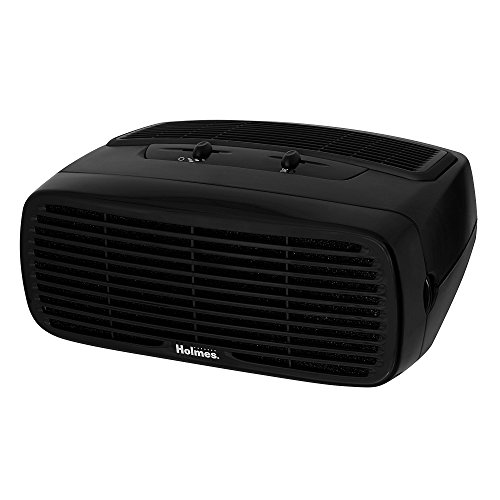
1. Holmes Desktop HEPA Type Air Purifier with Optional Ionizer (HAP242B-U) — Best — Only Verified New Holmes
The one complete, new Holmes air purifier Amazon listing data could confirm on 2026-11-22 — and fortunately, it is a sensible one. The HAP242 is a desktop HEPA-type purifier with an optional ionizer, in the small air purifier class: the bedside table, the desk, the nursery corner, the small bedroom. It is the surviving representative of a brand that once fielded a full range, and for small-room duty it remains a rational, inexpensive-category purchase from a name with decades of filter support behind it.
Strengths
- The only verified new Holmes purifier — buyable with confidence in what it is
- Desktop scale suits the small rooms most purifiers actually serve
- Its AER1/HAPF30 filter ecosystem is deep and widely stocked
Trade-offs
- HEPA-type is not true HEPA — see the review before buying on filtration grounds
- Small-room machine; it will not condition a living room
- Optional ionizer should be a deliberate choice, not a default
| Model | HAP242B-U (per Amazon title) |
|---|---|
| Format | Desktop, small air purifier (per Amazon title) |
| Filtration | HEPA type (per Amazon title) |
| Ionizer | Optional (per Amazon title) |
| Brand | HOLMES (per API brand field) |
The filtration wording deserves a full paragraph, because it is the most consequential honest detail in this guide. The listing says ‘HEPA Type’ — a recognized category meaning the filter is built in the HEPA style and captures a high proportion of fine particles, without meeting the certified true-HEPA standard’s exact test threshold. For general household dust, pollen and pet dander in a small room, HEPA-type filtration is a reasonable, widely used specification. For a buyer whose requirement is specifically certified true HEPA, this machine does not claim to be it, and this guide will not upgrade its claim. Read the badge on the box the way the maker wrote it.
The optional ionizer wants the same deliberateness. Ionizers can help particles settle and agglomerate, and some users dislike them on principle or on ozone sensitivity; Holmes making it optional is the correct design, and the correct usage is to decide once, consciously, rather than run whatever the factory default is. As for scale: a desktop purifier conditions the air near a person, in a small enclosed room, and judged on that job — the night’s air beside a bed, the day’s air beside a desk — the HAP242 is a coherent little machine. Judged as a whole-home solution it would fail, but so would every desktop purifier ever made, and the fault would be the brief’s, not the box’s.
The strongest long-term argument for this pick is its filter ecosystem. The HAP242’s AER1/HAPF30 filter family is stocked by the original channel and multiple third-party makers, in multi-packs and carbon-boosted variants — which means the consumable this machine depends on is cheap to find and likely to stay findable. A purifier is a filter-delivery system; buy the one whose filters you can still get in five years.
Best for: small rooms, desks and bedside air cleaning / Not suited for: large rooms or buyers needing true-HEPA specification
2. Holmes AER1 Tower Line (Legacy) — Legacy — no link
Status: no link. No complete new unit in this line was verified — the searches returned its replacement filters only — so this line is documented without a purchase link, for the owners who already run one.
No complete new unit in this line could be confirmed on the verification date, so — per this guide’s rules — it is covered honestly in prose, without a purchase link, rather than filled with a substitute brand or a secondhand listing. The AER1 tower platform is the most important Holmes line of the modern era: a slim tower format built around the AER1 filter system (the HAPF30 filter family), designed for whole-room cleaning in a footprint that fits a corner. If you picture a Holmes purifier of the last decade, you are probably picturing this tower.
Strengths
- Tower footprint suits corners and small floor plans
- The AER1/HAPF30 filter ecosystem is the deepest in the Holmes world
- A proven platform — the installed base is enormous
Trade-offs
- No complete new unit could be verified for this guide
- Tower fans move air less decisively than the largest consoles
- Filter variants (standard, carbon-boosted, allergen) require a moment’s care to match
The evidence for the AER1 line’s significance is written across the filter market: multiple makers stock its filters in multi-packs, in carbon-boosted odor variants, and in allergen-positioned versions, which only happens for machines that exist in homes in very large numbers. Owners of an AER1 tower should read that as good news — your machine is supportable for years, and a filter subscription is a cheaper life-extension than any replacement purifier.
For new buyers, the honest guidance is directional rather than transactional. The AER1 platform’s current complete-machine form is sold under the Bionaire name — the same corporate family’s other air-care brand — and readers determined to buy this platform new should look there, in full knowledge that it is a different brand’s listing. Within this Holmes guide it earns documentation, not a link, and the distinction is the guide’s whole standard in miniature.
Owner’s note: if your AER1 tower’s fan has grown loud, clean the intake and the filter cavity before shopping for a replacement. Towers ingest floor-level dust for years, and a remarkable share of ‘worn out’ Holmes towers are simply dirty ones.
Best for: existing owners keeping a tower running / Not suited for: new buyers — no verified new unit
3. Holmes HAPF600 Console Family — HAP615 / HAP625 / HAP650 (Legacy) — Legacy — no link
Status: no link. No complete new unit in this line was verified — the searches returned its replacement filters only — so this line is documented without a purchase link, for the owners who already run one.
No complete new unit in this line could be confirmed on the verification date, so — per this guide’s rules — it is covered honestly in prose, without a purchase link, rather than filled with a substitute brand or a secondhand listing. The HAP615, HAP625 and HAP650 consoles were Holmes’s mid-size room machines, unified by the HAPF600 filter family — the filter listings name all three models explicitly, alongside a related HAP8650 reference. These were the living-room and large-bedroom Holmes purifiers of their generation: bigger than the desktop class, built for whole rooms.
Strengths
- Whole-room console class — the serious end of the old Holmes range
- One filter family across three models simplifies keeping them alive
- Filter sets with carbon pre-filters remain listed by multiple makers
Trade-offs
- No complete new unit could be verified for this guide
- Consoles are bulky beside modern tower designs
- Aging fans and controls are the usual end-of-life points
A shared filter family across three models tells a brand-history story: Holmes built a platform, not a one-off, and platforms are what owners should hope to own, because every consumable and every piece of accumulated knowledge transfers. The HAPF600 sets listed today bundle the HEPA element with activated carbon pre-filters in a 3-in-1 arrangement — the carbon stage is the odor and household-gas handler, and it is the stage owners most often neglect, long after it has saturated into uselessness.
If you own one of these consoles and it still moves air quietly, the economics favor keeping it: a filter set costs a fraction of any new machine, and the console’s whole-room capacity exceeds what the one buyable new Holmes — a desktop — could offer your living room. The day the fan motor or the controls fail is the day to replace the machine; until then, filters are the rational spend.
Dating note for secondhand shoppers: consoles from this family appear in the used market regularly. A used unit with a healthy fan plus a new filter set is a legitimate way to own this class — but test the fan at all speeds before paying, because the motor is the one part the filter market cannot replace.
Best for: existing owners of the mid-size consoles / Not suited for: new buyers — no verified new unit
4. Holmes HAP360W 360-Degree Purifier (Legacy) — Legacy — no link
Status: no link. No complete new unit in this line was verified — the searches returned its replacement filters only — so this line is documented without a purchase link, for the owners who already run one.
No complete new unit in this line could be confirmed on the verification date, so — per this guide’s rules — it is covered honestly in prose, without a purchase link, rather than filled with a substitute brand or a secondhand listing. The HAP360W was the design-forward Holmes: a purifier that draws air from all sides — the ‘360’ of its name — using the Type J filter family (HAPF360), so it could sit in the middle of a room rather than against a wall. Filter listings confirm the model and its filter pairing explicitly, including compatibility notes shared with a Bionaire sibling model.
Strengths
- All-around intake frees placement from the wall
- A genuinely distinctive design in a category of boxes
- Its Type J filters remain stocked, including multi-packs
Trade-offs
- No complete new unit could be verified for this guide
- Center placement needs a power cord solution in real rooms
- Round-format filters are model-specific — no substitutes
The 360-degree idea deserves its posthumous respect. Conventional purifiers intake from the front or sides and exhaust upward, which quietly assumes wall placement; a machine that breathes from every direction conditions a room more evenly from the center and never has its intake smothered by a badly chosen corner. The reason the format did not conquer the category is mundane — cords, furniture plans, and rooms designed around walls — not any failure of the air cleaning itself.
Owners should note the filter specificity: the Type J/HAPF360 element is this machine’s alone, shared with one Bionaire sibling, so stock a spare set while the listings are plentiful. A discontinued machine with a stocked filter is a working appliance; the same machine the year its filter vanishes is a sculpture.
Placement tip that outlives the model: any purifier, 360 or not, performs to its specification only with clearance around its intake. The HAP360W’s design made that obvious; apply its lesson to whatever machine eventually succeeds it in your home.
Best for: existing owners; center-of-room placement fans / Not suited for: new buyers — no verified new unit
5. Holmes HAP1203 Tower (Legacy) — Legacy — no link
Status: no link. No complete new unit in this line was verified — the searches returned its replacement filters only — so this line is documented without a purchase link, for the owners who already run one.
No complete new unit in this line could be confirmed on the verification date, so — per this guide’s rules — it is covered honestly in prose, without a purchase link, rather than filled with a substitute brand or a secondhand listing. The HAP1203 was a compact Holmes tower whose filter listings state a coverage class of 188 square feet — a small-to-medium room figure, quoted here as the filter listing states it. It represents the entry end of the tower idea: corner-friendly format, modest room ambitions, and a filter ecosystem that still supports it.
Strengths
- Compact tower footprint for small rooms
- A stated coverage class helps owners judge room fit honestly
- Replacement filter sets remain listed
Trade-offs
- No complete new unit could be verified for this guide
- Small-room class — never a whole-floor machine
- Single-model filter dependency, as with all legacy lines
The 188-square-foot figure is worth pausing on, because honest coverage numbers are how purifiers should be bought and rarely are. A purifier’s job is air changes per hour in a specific volume; a compact tower rated for a small room will quietly fail in a large open-plan space while running perfectly. Owners of the HAP1203 who have moved house should re-run that arithmetic before blaming the machine — and buyers of any successor should demand the same figure, in square feet or CADR, before money changes hands.
Within its class, the story is the familiar Holmes one: a sound platform, an aging fleet, and a filter market that lets the fleet keep working. If yours runs quietly and the room is its size, fresh filters remain the highest-value purchase available for it.
A general rule the HAP1203 illustrates: when a purifier seems weak, replace the filter before replacing the machine. Airflow through a loaded filter can fall to a fraction of specification while the fan sounds perfectly healthy — the cheapest diagnostic in the category is a fresh filter.
Best for: existing owners of the compact tower / Not suited for: new buyers — no verified new unit
6. Holmes Odor Grabber Compact Line — HAP115Z / HAP116Z (Legacy) — Legacy — no link
Status: no link. No complete new unit in this line was verified — the searches returned its replacement filters only — so this line is documented without a purchase link, for the owners who already run one.
No complete new unit in this line could be confirmed on the verification date, so — per this guide’s rules — it is covered honestly in prose, without a purchase link, rather than filled with a substitute brand or a secondhand listing. The Odor Grabber compacts — the HAP115Z and HAP116Z in the filter listings — were Holmes’s specialists: small machines aimed at odor sources rather than whole rooms, taking the Filter E (HAPF115) family. Kitchens, litter-box corners, utility rooms, smoking areas of their era: the unglamorous postings where a small, dedicated air cleaner earns its keep.
Strengths
- Purpose-built for odor duty at close range
- Compact format fits the corners odors live in
- Filter E replacements remain listed by multiple makers
Trade-offs
- No complete new unit could be verified for this guide
- Odor duty saturates carbon media fast — filter discipline is the product
- Not a whole-room particulate solution and never claimed to be
Odor control is a different physical problem from dust control, and these little machines understood it: odors are gases, caught by activated carbon and similar sorbents, not by the particle filtration that headlines most purifier marketing. A compact unit placed at the source, with fresh carbon media, outperforms a large particle-focused machine across the room — placement and media freshness are the whole technology, which is why this line’s owners should treat filter replacement as the product itself, on a calendar rather than on a hunch.
As with the rest of the legacy fleet, the verdict for owners is keep-and-feed: the machines are simple, the filters persist, and the job they do has not been absorbed by any modern category — today’s small purifiers are mostly particle machines with a carbon sheet as an afterthought. The Odor Grabbers were built the other way round, and for their specific posting, that priority was correct.
Carbon honesty, applicable everywhere in this guide: activated carbon saturates, and saturated carbon does not merely stop working — in warm, humid conditions it can release what it held. Any odor-duty filter, Holmes or otherwise, belongs on a replacement schedule, not a replacement mood.
Best for: existing owners using them in kitchens, litter and utility areas / Not suited for: new buyers — no verified new unit
Comparison Table
The comparison table for a legacy brand looks different from a normal one, and it should: it compares one buyable machine against the documented fleet it succeeds.
| Pick | Badge | Key spec | Best for |
|---|---|---|---|
| Holmes Desktop HEPA Type Air Purifier with Optional Ionizer (HAP242B-U) | Best — Only Verified New Holmes | Desktop format, HEPA-type filtration, optional ionizer, model HAP242B-U | small rooms, desks and bedside air cleaning |
| Holmes AER1 Tower Line (Legacy) | Legacy — no link | Tower format, AER1/HAPF30 filter platform | existing owners keeping a tower running |
| Holmes HAPF600 Console Family — HAP615 / HAP625 / HAP650 (Legacy) | Legacy — no link | Console format, HAPF600 filter family | existing owners of the mid-size consoles |
| Holmes HAP360W 360-Degree Purifier (Legacy) | Legacy — no link | 360-degree intake design, Type J / HAPF360 filters | existing owners; center-of-room placement fans |
| Holmes HAP1203 Tower (Legacy) | Legacy — no link | Tower format; filter listings state 188 sq ft coverage class | existing owners of the compact tower |
| Holmes Odor Grabber Compact Line — HAP115Z / HAP116Z (Legacy) | Legacy — no link | Compact odor-focused format, Filter E (HAPF115) family | existing owners using them in kitchens, litter and utility areas |
Read this table as a map of a brand in transition: the desktop is the present, the towers and consoles are a large and still-supported past. If you own any row of it, your cheapest air-quality upgrade is a fresh filter. If you own none, the first row is your Holmes — or the brand’s platform continues elsewhere, as the FAQ explains.
How to Choose the Best Holmes Air Purifiers — in a Catalog of One
The honest buying process for Holmes today starts with a fork. If you want a new Holmes purifier, the verified choice is the desktop HAP242, and the decision reduces to whether a small-room, HEPA-type desktop machine is the machine you need. For a bedroom, nursery or desk, it is a coherent purchase with an unusually deep filter ecosystem behind it. For a living room or open-plan space, no new Holmes currently verified will serve you, and the correct move is to widen the brand search rather than stretch a desktop machine across a brief it cannot fill.
If you already own a Holmes — statistically the likelier position, given the fleet’s size — the choice is not which purifier to buy but whether yours deserves its next filter set. The test is mechanical: does the fan run quietly at all speeds, do the controls respond, is the housing intact? Yes means filters, which remain listed for every line in this guide. No means the machine has reached the end that no filter can postpone, and its replacement should be bought on coverage figures — CADR or stated room size — matched to your actual room.
Either way, buy filtration by specification, not by adjective. ‘HEPA-type’, ‘HEPA-style’ and ‘true HEPA’ are different claims with different test standards behind them; room coverage stated in square feet or CADR is a number you can hold a listing to; and an air purifier, Holmes or any other, is an appliance for cleaning air — comfort and household cleanliness — not a medical device, whatever the marketing around the category implies.
- New Holmes = the verified desktop HAP242; everything else is legacy documentation
- Owners: fan quiet + controls alive = buy filters, not a replacement
- Match coverage (sq ft / CADR) to the real room, always
- HEPA-type is not true HEPA — read filtration claims literally
- Carbon stages handle odors and saturate on a schedule
- A purifier is an air-cleaning appliance, not a medical device
One more consideration belongs in every Holmes decision now: consumable security. A purifier’s working life is its filter supply, and Holmes’s legacy lines currently enjoy deep third-party filter support precisely because the fleet is huge. That support is a reason to keep a Holmes running — and, when buying any brand’s machine, a reason to ask how many makers stock its filter before asking anything else.
How to Keep a Legacy Holmes Purifier Working
The routine is short and entirely decisive. Replace the main filter on the maker’s cadence for your line — AER1/HAPF30 for the towers and the desktop, HAPF600 for the consoles, Type J for the 360, Filter E for the Odor Grabbers — and replace carbon pre-filters more often, since they saturate first and strangle airflow as they load. Vacuum the intake grilles monthly; a tower that has eaten five years of floor dust is a fan blowing through a rug.
Then listen to the machine. A Holmes of this era that runs quietly is healthy; new rattles, hums or speed hunting are the fan and motor beginning their farewell, and no maintenance reverses them. Budget accordingly: filters while it is quiet, a planned replacement when it is not. And keep one spare filter set in the house — for a legacy line, the time to own the consumable is while it is listed everywhere, not the month it becomes scarce.
- Match the filter family to the model line exactly
- Carbon stages first and often — they saturate before HEPA media loads
- Vacuum intakes monthly; deep-clean the filter cavity yearly
- New fan noise is the end-of-life signal — plan, do not repair-hop
- Keep one spare filter set in reserve for any legacy machine
How to Place and Run Any Air Purifier Well
Placement decides performance more than brand does. Give the machine clearance on every intake side — a purifier pushed into a corner or behind a curtain is cleaning the corner’s air with great dedication. Put it in the room where the people are, as close to the pollution source as the room allows: the bedroom for the night’s breathing, the kitchen’s edge for cooking aerosols, the litter corner for its specialist. Run it continuously on a moderate speed rather than in heroic bursts; air cleaning is a rate, and a steady rate through the hours of occupancy beats a loud hour followed by silence.
Close the room’s door when you can — a purifier conditions a volume, and an open door makes the volume the whole house. And keep expectations calibrated to physics: a purifier reduces airborne particles and, with fresh carbon, some odors and gases. It does not clean surfaces, it does not replace ventilation, and it does not treat any health condition. Used as the appliance it is, it is a genuinely useful one — which is why a forty-year-old Holmes fleet is still out there, running, waiting only for its next filter.
Reading a Legacy Brand’s Search Results: A Field Guide
Holmes searches teach a skill every appliance category now requires. The first page mixes four different species: the one complete new machine, replacement filters photographed like machines, third-party accessories, and other brands’ purifiers placed by keyword rather than by relevance. The tells are consistent — a filter listing names the machines it fits (‘compatible with’, ‘replacement for’, model numbers in strings), its price class is a fraction of a machine’s, and its title is a sentence long. A complete machine’s listing, by contrast, leads with the product itself and its own model number.
Apply the same reading everywhere a heritage brand has thinned its catalog — which, in home appliances, is most of them. The brands endure; the catalogs fluctuate; the filter ecosystems persist longest of all, because they are the annuity the installed base pays. A buyer who can read that landscape buys the real machine, feeds the real fleet, and never pays machine money for a box of filters by mistake.
What Holmes’s History Buys You, Even Now
There is a reason this guide documents a thinned catalog at such length instead of simply redirecting you to fashionable brands: the Holmes fleet represents one of the largest bodies of accumulated, practical air-cleaning experience in the home — machines whose failure modes are known, whose filters are commoditized, whose behavior in real rooms has been observed for decades. Newer brands offer features; Holmes offers evidence. For the small-room job its surviving machine addresses, evidence is a rational thing to buy.
That is also the standard this guide would apply in reverse: when a legacy machine’s filters vanish and its fans begin to fail, the honest verdict changes, and documentation becomes a farewell. On the evidence of November 2026 — filters everywhere, one sound new desktop, a platform continuing under a sister name — Holmes is diminished, documented, and not done.
Common Buying Mistakes
Buying into a legacy brand invites a specific set of errors. These are the ones this guide was written to prevent:
- Buying a ‘Holmes purifier’ that is actually a filter. Search results for this brand are dominated by replacement filters wearing purifier-sized photography. Check that the listing is a complete machine before anything else.
- Assuming a full catalog exists. Roundups ranking six new Holmes models are recycling history. One complete new model could be verified for this guide; plan around the catalog that exists.
- Reading HEPA-type as true HEPA. They are different claims. The desktop pick states HEPA-type honestly; buyers who need the certified standard should buy a machine that states it.
- Replacing a healthy legacy machine out of age anxiety. If the fan is quiet and the filters are stocked, a filter set restores a Holmes to specification for a fraction of a replacement’s cost.
- Starving a purifier of clearance. Any brand, any price: an intake against a wall is a specification halved. Placement is free performance.
- Treating a purifier as a medical device. These machines clean air for comfort and household cleanliness. Health conditions belong to clinicians, not to appliance listings.
The thread through all six is the same: this brand now rewards readers who verify. The fleet is real, the filters are real, the one new machine is real — and everything else is a search result hoping you will not check.
Final Recommendation
If you want a new Holmes air purifier, there is one verified answer: the HAP242 desktop, a small-room HEPA-type machine with an optional ionizer and the deepest filter ecosystem in the business behind it. Buy it for a bedroom, a nursery or a desk, with its filtration claim read literally, and it is a sound purchase from a durable name. If you need whole-room cleaning from a new machine, Holmes’s verified catalog cannot currently sell you one — widen the search to current ranges, including the AER1 platform’s continuation under the Bionaire name, and buy on stated coverage.
And if you own a Holmes already — a tower, a console, a 360, an Odor Grabber — the final recommendation of this guide is unfashionable and correct: feed it. A quiet fan and a fresh filter set return it to the specification it was built to, for the smallest money in this entire category. Brands are mortal; a well-kept appliance, in a house that understands it, does not have to be. That understanding is the real subject of this guide — of the difference between a machine and its filters, between a claim and a specification, between a catalog as it is and a catalog as search results pretend it to be. Holmes in 2026 rewards exactly that understanding, and punishes its absence only with the mildest of costs: a box of filters, bought by mistake, for a machine you do not own.
- Best Air Purifiers Below 300
- Best Air Purifiers Blueair
- Best Air Purifiers For Large Spaces
- Best Air Purifiers For Living Rooms
- Best Air Purifiers For Cat Odors
- Best Air Purifiers For Baby Room
Frequently Asked Questions
How many Holmes air purifiers can I actually buy new?
As of this guide’s verification on 2026-11-22, one complete new Holmes purifier could be confirmed: the desktop HAP242. The rest of the brand’s Amazon presence is replacement filters for its large legacy fleet, plus other brands’ machines appearing in the same searches.
Is the Holmes HAP242 a true HEPA purifier?
Its listing states HEPA Type filtration, which is a distinct claim from certified true HEPA: HEPA-style media with high particle capture, without the true-HEPA test certification. For general household dust and pollen in a small room it is a reasonable specification; buyers who specifically require true HEPA should choose a machine that states it.
My Holmes tower still works. Should I replace it or buy filters?
Buy filters, if the fan runs quietly and the controls work. The AER1/HAPF30 ecosystem and the other legacy filter families in this guide remain widely listed, and a fresh set returns the machine to its designed performance for far less than any replacement. Replace the machine when the fan or controls fail — that is the wear that matters.
What happened to the Holmes AER1 tower? Can I buy that platform new?
The AER1 platform’s current complete-machine form is sold under the Bionaire brand — the same corporate family’s other air-care name — including an AER1 mini tower with true HEPA filtration and stated coverage up to 555 square feet in its listing. It is a different brand, so it is documented here rather than ranked as a Holmes pick.
Are Holmes replacement filters made by other companies as good?
The legacy filter market includes the original channel and multiple third-party makers offering standard, carbon-boosted and allergen variants. Fit is specified by the filter family — HAPF30, HAPF600, Type J, Filter E — so match the family to your model exactly, and treat carbon stages as calendar items: they saturate whether or not they look used.
Can an air purifier help with allergies or asthma?
An air purifier reduces airborne particles in the room it runs in, which many owners find makes their home more comfortable. It is an air-cleaning appliance, not a medical device, and it does not diagnose, treat or manage any condition. Health questions belong with a clinician; this guide’s claims stop at cleaner air.


