Disclosure: airfryerkitchensupply.com is reader-supported. When you buy through links on our site, we may earn an affiliate commission at no extra cost to you.
Where to buy
Every linked pick in this guide to the best microfiber drying towels was cross-checked against the Amazon catalog data available to this site before publication, and only listings we could confirm get a buy link. Prices move constantly, so we never print a fixed price here: use the links below to check the current price on Amazon for the exact size, color, or configuration you want, because options on the same listing can sit in different tiers.
- Chemical Guys Woolly Mammoth Large Microfiber Drying Towel (Best Overall) — Check the current price on Amazon
- Blackline Microfiber Car Drying Towel, 1300 GSM Twisted Loop (Best Twisted Loop) — Check the current price on Amazon
- Chemical Guys Miracle Dryer Microfiber Drying Towel (Best Dual-Pile Design) — Check the current price on Amazon
- Adam’s Polishes Ultra Plush Drying Towel, 2 Pack (Best Premium Pair) — Check the current price on Amazon
- SMINDER 2-Pack 1200 GSM Car Drying Towels (Best Value Density) — Check the current price on Amazon
- HOMEXCEL Professional Large Microfiber Car Drying Towels, 2 Pack (Best All-Purpose Large Pair) — Check the current price on Amazon
The best microfiber drying towels have a more specific job than their name suggests. This guide is about drying towels in the demanding sense — chiefly vehicle drying, where a towel must lift a whole car’s worth of water off finished paint without leaving streaks, water spots, or the fine swirl marks that poor towels install. That is why the picks are large-format, high-density microfiber from the detailing world, several stating their GSM and dimensions outright. A small general-purpose microfiber cloth is a fine thing, but it is not this product, and we have not padded the list with them.
Two architectures dominate serious drying, and the guide is organized around them. Deep plush pile drinks slowly and treats delicate paint most gently; twisted-loop pile drinks fast, wrings fast, and suits large vehicles and quick routines. Around those two poles sit the supporting specs that actually decide satisfaction: size, edge treatment (banded, soft-banded, or edgeless), pack count for rotation, and whether the maker states density honestly in GSM.
Every pick was verified against the Amazon catalog data available to this site, and claims are attributed where they belong: when a listing says a towel absorbs six times its weight or dries in one pass, that is the maker’s claim, quoted as such, with the construction underneath it assessed on its merits. We print no prices and no fixed ratings; check the current price on Amazon through each pick’s link.
In this guide
Quick Picks
Chemical Guys Woolly Mammoth Large Microfiber Drying Towel — Best Overall. A 36 x 25 inch ultra-plush oversized drying towel from the detailing aisle’s most familiar name — the deep-pile, whole-vehicle answer for owners who dry by laying and dragging a big towel across panels. Check price on Amazon.
Blackline Microfiber Car Drying Towel, 1300 GSM Twisted Loop — Best Twisted Loop. A 24″ x 36″, 1300 GSM twisted-loop towel whose listing promises one-pass drying, streak-free and scratch-safe contact, and absorption of 6x its weight — the efficiency pick for big vehicles and impatient detailers. Check price on Amazon.
Chemical Guys Miracle Dryer Microfiber Drying Towel — Best Dual-Pile Design. A 36 x 25 inch dual-pile towel — short pile on one side, high pile on the other — with soft-banded edges, sized for trucks and SUVs: two drying textures in one towel. Check price on Amazon.
Adam’s Polishes Ultra Plush Drying Towel, 2 Pack — Best Premium Pair. A two-pack of ultra plush drying towels from Adam’s Polishes, the enthusiast detailing brand — sold as a pair because serious drying is a rotation, not a single towel. Check price on Amazon.
SMINDER 2-Pack 1200 GSM Car Drying Towels — Best Value Density. Two 36″ x 24″ towels at a stated 1200 GSM with double-twist pile and an edgeless design — near-flagship density in a value two-pack, with the edge question answered by having no edge seam at all. Check price on Amazon.
HOMEXCEL Professional Large Microfiber Car Drying Towels, 2 Pack — Best All-Purpose Large Pair. A 31″ x 24″ two-pack in grey, positioned for cars, SUVs, RVs, trucks, and boats, with lint-free and scratch-free claims — the big-vehicle, big-toy household’s generalist pair. Check price on Amazon.
How These Picks Were Chosen
We shortlisted from microfiber drying towel listings verified through this site’s Amazon catalog access, searching the detailing category specifically — car drying towels from specialist brands and value makers alike. To qualify, a listing had to be a drying towel first: large format or explicitly purposed for vehicle drying. Generic cleaning cloth multi-packs, bath towels, and travel towels were excluded even where microfiber, because their size and pile are wrong for the panel-drying job this search means.
Within the category we diversified deliberately: plush versus twisted loop, banded versus edgeless, single flagship towels versus rotation pairs, and stated-density listings versus brand-led ones. Where a title omits a figure — two picks below do not state dimensions or GSM in their titles — the review says so in plain sight and tells you to check the full listing, rather than laundering a guess into a spec box.
We also treated maker claims as claims. Absorption multiples, one-pass promises, and streak-free assurances appear in this guide attributed to their listings, never as our measurements. What we assess independently is construction: pile type, size, density where stated, edge design, and pack format — the things a buyer can verify from a listing and feel in the first wash.
The 6 Best Microfiber Drying Towels
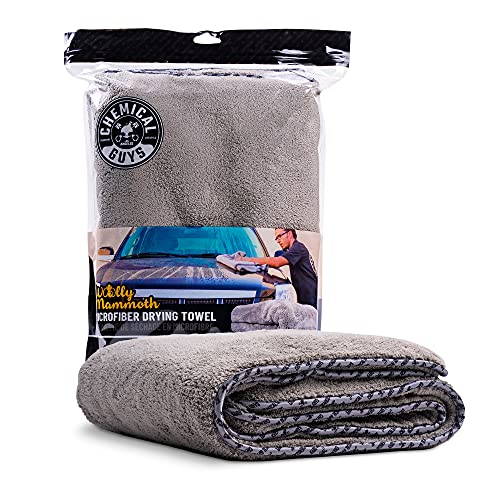
Chemical Guys Woolly Mammoth Large Microfiber Drying Towel — Best Overall
Drying is where wash mistakes become visible: drag a poor towel across clean paint and you install the swirls you just washed off. The Woolly Mammoth’s proposition is deep plush pile at a genuinely oversized 36 x 25 inches, so a panel or two of laid-and-dragged towel absorbs the water instead of pushing it around. Its listing promises exactly that job — soak up water fast to dry the whole vehicle, soft and scratch-free on paint — in the plain language of a maker that sells to people who inspect paint under lights.
Plush pile has a temperament: it drinks deeply and feels safest on delicate, dark, or freshly corrected paint, and it gives up its water more slowly when wrung, so on a big vehicle you may rotate to a second towel for the last panels. Owners of large SUVs who want one-pass twisted-loop efficiency should compare the Blackline below; owners who prioritize the gentlest possible contact will stay here.
Strengths
- Oversized 36 x 25 in format covers panels in a few passes
- Ultra-plush pile is the gentlest contact class for delicate paint
- Purpose-built as a vehicle drying towel, per its listing — not a repurposed bath or shop towel
- Chemical Guys is a detailing specialist brand with a deep towel range
Trade-offs
- Plush pile wrings out slower than twisted loop; big vehicles may want two in rotation
- Deep pile needs proper washing to stay soft — detergent residue stiffens it
- One large towel format; detailers who prefer pairs of medium towels should look below
| Size (per Amazon title) | 36 x 25 in |
| Pile (per Amazon title) | Ultra-plush, oversized |
| Use (per Amazon title) | Dry the whole vehicle; scratch-free on paint |
Technique matters more with a plush towel than with any other pick here, because the towel is designed around a method: lay it flat across a wet panel, let the pile take up the water for a few seconds, then drag slowly by the corners and lift. Rubbing in circles with a plush towel wastes its design and risks exactly the marring it exists to prevent. Used as intended, one towel of this size genuinely can dry a midsize vehicle, which is the claim its listing makes and the one owners should test it against.
Care decides whether month six feels like month one. Wash microfiber separately from cotton (lint is forever), skip fabric softener (it coats the fibers and kills absorbency), and dry low or air-dry. A plush towel ruined by softener sheets is the most common quiet tragedy in this category, and it is entirely self-inflicted.
Best for: Delicate, dark, and freshly polished paint; plush-pile devotees / Not suited for: Owners who want the fastest wring-and-continue rhythm on very large vehicles
Check on Amazon — check price on Amazon for the current configuration before you order.
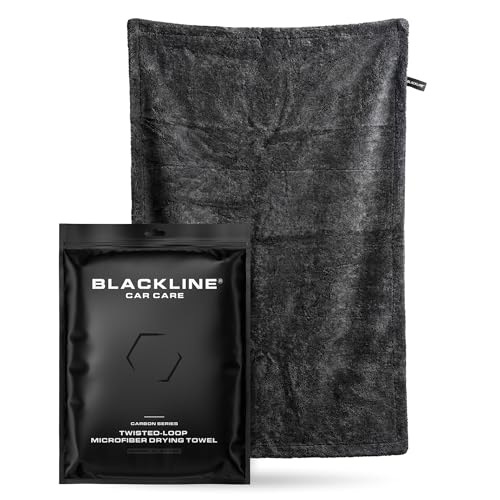
Blackline Microfiber Car Drying Towel, 1300 GSM Twisted Loop — Best Twisted Loop
Twisted loop is the other great drying architecture: long microfiber loops twisted into dense ropes that hold water inside the loop structure and release it readily when wrung. At a stated 1300 GSM — grams per square meter, the density figure this category trades in — and 24 by 36 inches, this Blackline towel is specced for the one-pass style of drying: fewer passes per panel, less contact time, faster around a large vehicle. Its listing’s claims (one pass, 6x its weight, no water spots) are the maker’s, reported here as stated; the architecture underneath them is genuinely the fast one.
The trade against plush is feel and forgiveness. Twisted loop glides less cushioned than deep plush, and its efficiency invites speed — which is safe only while the towel is clean. A twisted-loop towel that has touched a wheel arch or a dropped corner must be retired to glass or interior duty; its density will hold grit as happily as water. Discipline, not pile, is the safety system here.
Strengths
- Twisted-loop build: the fastest water uptake and wring-out rhythm in this guide
- 1300 GSM density stated in the title — a substantive spec, openly given
- Large 24″ x 36″ format suits SUVs and trucks
- Listing claims one-pass, streak-free drying and 6x-weight absorption
Trade-offs
- Less cushioned contact than deep plush on delicate paint
- Density traps grit if the towel is contaminated — strict towel discipline required
- Single-towel listing; rotation pairs cost extra
| Size (per Amazon title) | 24″ x 36″ |
| Density (per Amazon title) | 1300 GSM |
| Build (per Amazon title) | Twisted loop microfiber |
| Claim (per Amazon title) | Absorbs 6x its weight (maker claim) |
GSM deserves a buyer’s translation. It measures how much fiber is packed into the towel, and for drying, more fiber generally means more water held per pass — up to the point where the towel becomes heavy and unwieldy when saturated. A 1300 GSM twisted loop sits at the serious end of that trade, which is why this format is favored for trucks and SUVs: the towel keeps drinking across a long panel instead of saturating halfway down a door.
Judge it by the wring test in real use: a good twisted loop gives up most of its water in one firm wring and comes back thirsty, letting one towel finish a vehicle. That rhythm — pass, wring, pass — is the actual product being sold here, and it is why detailers who time their washes choose loop over plush even while conceding plush the gentler hand-feel.
Best for: Large vehicles, fast wash routines, and one-pass drying / Not suited for: Owners who will not enforce clean-towel discipline
Check on Amazon — check price on Amazon for the current configuration before you order.
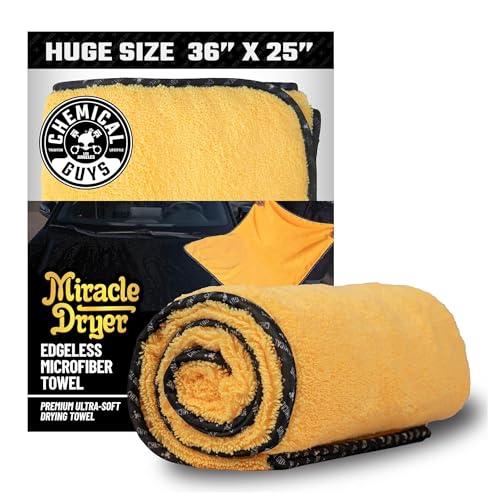
Chemical Guys Miracle Dryer Microfiber Drying Towel — Best Dual-Pile Design
Dual pile is a genuinely useful idea executed simply: one face of this towel carries a shorter pile for a firmer, more controlled wipe, the other a high pile for maximum soak-up, and the soft-banded edges address the detail everyone forgets — towel edges and tags are the scratch culprits more often than pile is. At 36 x 25 inches and positioned by its maker for trucks and SUVs, it is a big towel with a split personality, in yellow, the color that shows contamination honestly (a virtue: you can see the dirt before it sees your paint).
Who should choose it over the Woolly Mammoth from the same brand? Owners who dry different surfaces differently — plush side for the hood and doors, short side for glass-adjacent panels and lower sections — or who simply like having the choice in hand. Purists with one fixed technique will not use the second face and should buy the single-minded towel instead.
Strengths
- Dual pile: high-pile soak-up and short-pile control in one towel
- Soft-banded edges — the scratch risk lives at edges, and this design answers it
- Oversized 36 x 25 in, positioned for trucks and SUVs
- Yellow colorway shows contamination before it reaches paint
Trade-offs
- Two faces means one of them is unused by single-technique detailers
- Plush face shares the plush class’s slower wring-out
- Bright yellow shows every stain it earns — cosmetically honest, not pretty for long
| Size (per Amazon title) | 36 x 25 inches |
| Build (per Amazon title) | Dual pile — short and high pile |
| Edges (per Amazon title) | Soft-banded, scratch-free |
| Positioning (per Amazon title) | For trucks and SUVs |
Edge banding is the spec in this listing that experienced detailers will notice first. A microfiber towel’s face is engineered to be paint-safe; its edge is a stitched or banded border of different material, dragged across every panel the towel crosses. Soft banding keeps the whole perimeter in the same safety class as the face, and it is the kind of detail that separates towels designed by detailers from towels designed by textile catalogs.
The dual-pile format also solves a small workflow truth: the first pass over a soaked panel wants absorption, the final pass wants control. Flipping the towel between those passes is faster than swapping towels, and on a large vehicle those saved swaps add up to a genuinely shorter wash. It is an efficiency argument of a different kind than the twisted loop’s — fewer tool changes rather than faster drinking.
Best for: Truck and SUV owners who use different textures across a vehicle / Not suited for: Single-technique purists who will never flip the towel
Check on Amazon — check price on Amazon for the current configuration before you order.

Adam’s Polishes Ultra Plush Drying Towel, 2 Pack — Best Premium Pair
Adam’s Polishes sells to the enthusiast end of the detailing market, and this listing’s quiet statement is its pack count: two towels. That is how experienced washers actually dry — one towel working, one towel fresh — because a single towel, however good, is saturated and tired by the final panels of a full vehicle, exactly when the most visible panels (the far side, the rear) get their turn. A matched pair keeps the last panel’s towel as good as the first panel’s.
The listing title is terse — it states ultra plush drying towels in a 2-pack and nothing more — and we flag that honestly: dimensions and density are not stated in the title, so check the full listing for the figures before ordering if size matters to your technique. What the brand and format promise is the plush, gentle-contact class executed for people who wash on weekends and care about the result under garage light.
Strengths
- Two-pack format matches real drying rotation
- Ultra plush class: the gentle-contact choice for cherished paint
- Enthusiast detailing brand with a towel-focused range
- A pair keeps the final panels’ towel as fresh as the first
Trade-offs
- Size and GSM are not stated in the listing title — verify on the full listing
- Premium tier relative to generic microfiber
- Plush class care rules apply: no fabric softener, separate washing
| Pack (per Amazon title) | 2 Pack |
| Class (per Amazon title) | Ultra Plush Drying Towel |
| Note | Dimensions/GSM not stated in Amazon title — check listing |
The two-pack deserves defending as a specification, not a bundle trick. Drying quality degrades across a vehicle as a towel loads with water; the visible symptom is the faint streaking and water-spotting that appears on the last panels and gets blamed on the water. Rotating to a fresh towel mid-vehicle eliminates that gradient entirely. Buying any single premium towel and a cheap second towel does not achieve the same thing, because the cheap towel is the one that ends up on the paint you can see.
Adam’s positioning in the enthusiast market also carries a support implication: brands that sell systems (wash, towels, drying aids) tend to document care and technique for their textiles, and towel longevity in this class is mostly a care story. Follow the maker’s wash guidance, keep the pair together, and retire them to glass duty as a pair when their pile eventually tires — they will serve years across those two roles.
Best for: Enthusiasts who wash carefully and dry in rotation / Not suited for: Buyers who need stated dimensions before ordering, or one-towel minimalists
Check on Amazon — check price on Amazon for the current configuration before you order.

SMINDER 2-Pack 1200 GSM Car Drying Towels — Best Value Density
SMINDER’s specification reads like a response to this guide’s own checklist: a stated density (1200 GSM, just below the Blackline’s 1300), a stated size (36″ x 24″, the large format), a twist pile for fast uptake, two towels for rotation, and an edgeless design that removes the stitched border — the scratch suspect — entirely. For buyers who shop by spec sheet, this is the most completely specified value listing we verified.
The edgeless point deserves its moment: an edgeless towel has no border to drag, which detailers prize, with the trade that edges can fray sooner over a long life than a banded edge. At a value tier in a two-pack, that is a rational trade. The brand is a smaller name than the detailing houses above, so the listing’s claims — ultra-absorbent, streak-free, no water spots — are maker claims to be tested against your first wash, as with every pick here.
Strengths
- Stated 1200 GSM and 36″ x 24″ size — full specs in the open
- Edgeless design removes the seam-scratch question completely
- Two-pack rotation at a value tier
- Double-twist pile for fast uptake and wringing
Trade-offs
- Edgeless towels can fray at the perimeter sooner than banded ones
- Smaller brand: claims are maker-stated and unproven until your first wash
- Twist pile shares the class discipline requirement — a contaminated towel is a retired towel
| Size (per Amazon title) | 36″ x 24″ |
| Density (per Amazon title) | 1200 GSM |
| Build (per Amazon title) | Double-twist pile, edgeless design |
| Pack (per Amazon title) | 2-Pack |
Compare this listing with the Adam’s above and you see the two philosophies of the category in one guide: brand-and-system versus spec-and-value. Neither is automatically right. The spec-led route lets you verify the numbers that matter — density, size, construction — before money changes hands, and this listing provides all of them, which is more than many famous names do in their titles. The residual risk sits in consistency and longevity, which only time and washing reveal.
Practically, two 1200 GSM towels of this size will dry any vehicle a household owns, in rotation, with capacity to spare. That headroom has a hidden benefit: a towel used below its saturation point leaves less water behind per pass, which means fewer passes, which means less total contact with the paint — the real currency of swirl prevention. Value, here, buys gentleness as a side effect.
Best for: Spec-driven buyers who want density, size, and rotation at a value tier / Not suited for: Brand-loyal detailers who buy into a maker’s full system
Check on Amazon — check price on Amazon for the current configuration before you order.

HOMEXCEL Professional Large Microfiber Car Drying Towels, 2 Pack — Best All-Purpose Large Pair
HOMEXCEL’s pair is the generalist of the guide: at 31″ x 24″ it is large without being unwieldy, the grey colorway is the practical choice for towels that will also dry an RV’s flank or a boat’s gelcoat, and the listing’s own positioning spans cars through boats — a household with more than one kind of vehicle to dry. Lint-free matters beyond paint: on glass and glossy gelcoat, lint is the visible residue that makes a dried surface look undried.
Generalist is a role, not a criticism — but know its edges. The listing does not state a GSM figure, so density comparisons against the 1200–1300 GSM picks cannot be made from the title; check the full listing if that number drives your decision. And a pair shared between car and boat duty should still obey the iron rule: the towel that touches wheels, exhausts, or a waterline never returns to paint. Dedicate, label, and rotate within each vehicle class.
Strengths
- Large 31″ x 24″ format in a two-pack
- Positioned across cars, SUVs, RVs, trucks, and boats — one pair for the whole fleet
- Lint-free claim matters on glass and gelcoat as much as paint
- Grey hides the working stains of multi-vehicle duty
Trade-offs
- No GSM stated in the title — density must be checked on the full listing
- Generalist pile is not the deepest plush nor the fastest twisted loop here
- Shared-duty households must enforce towel dedication or risk cross-contamination
| Size (per Amazon title) | 31″ x 24″ |
| Pack (per Amazon title) | 2 Pack |
| Positioning (per Amazon title) | Cars, SUVs, RVs, Trucks, and Boats |
| Color (per Amazon title) | Grey |
The multi-vehicle household is underserved by detailing culture, which assumes one cherished car. In real driveways there is a daily driver, a partner’s SUV, maybe a boat or an RV that gets washed twice a year and needs towels that can handle scale. A large, lint-free, grey two-pack is the correct tool for that reality: big enough for an RV panel, expendable enough not to be precious, and consistent enough that the car still gets a proper towel.
Its most important accessory is a laundry marker. Label the pair by duty the day they arrive — paint, or everything-else — because towels migrate in wash baskets and garages, and the entire safety system of microfiber drying is knowing which towel has touched what. That ten-second habit protects more paint than any GSM figure in this guide.
Best for: Households drying several vehicle types, including RVs and boats / Not suited for: Spec-first buyers who require a stated GSM before ordering
Check on Amazon — check price on Amazon for the current configuration before you order.
Comparison Table
| Pick | Badge | Key spec | Best for |
|---|---|---|---|
| Chemical Guys Woolly Mammoth Large Microfiber Drying Towel | Best Overall | 36 x 25 in ultra-plush pile | Delicate, dark, and freshly polished paint; plush-pile devotees |
| Blackline Microfiber Car Drying Towel, 1300 GSM Twisted Loop | Best Twisted Loop | 24″ x 36″, 1300 GSM twisted loop | Large vehicles, fast wash routines, and one-pass drying |
| Chemical Guys Miracle Dryer Microfiber Drying Towel | Best Dual-Pile Design | 36 x 25 in dual pile, soft-banded edges | Truck and SUV owners who use different textures across a vehicle |
| Adam’s Polishes Ultra Plush Drying Towel, 2 Pack | Best Premium Pair | Ultra plush, 2 pack (size not stated in title) | Enthusiasts who wash carefully and dry in rotation |
| SMINDER 2-Pack 1200 GSM Car Drying Towels | Best Value Density | 36″ x 24″, 1200 GSM double-twist, edgeless, 2-pack | Spec-driven buyers who want density, size, and rotation at a value tier |
| HOMEXCEL Professional Large Microfiber Car Drying Towels, 2 Pack | Best All-Purpose Large Pair | 31″ x 24″ lint-free pair, multi-vehicle positioning | Households drying several vehicle types, including RVs and boats |
How to Choose the Best Microfiber Drying Towels
Choose pile by paint and pace. Deep plush is the gentle architecture: it cradles water and forgives technique, suiting dark colors, soft clear coats, and anyone who dries slowly and carefully. Twisted loop is the fast architecture: it loads water quickly, releases it in one wring, and keeps its appetite across a big vehicle, suiting trucks, SUVs, and washers who value rhythm. Neither is better; they are answers to different questions, and this guide’s top picks are split between them for that reason.
Size by vehicle. A towel around 36 x 25 inches drapes a door or half a hood in one placement, which is the unit of work in the lay-and-drag method; smaller towels multiply passes and contact. Very large towels, though, become heavy when saturated and clumsy on vertical panels — the 31–36 inch band in this guide is the practical sweet spot for cars through large SUVs, with the biggest formats earning their size on trucks and RVs.
Then read the supporting specs like a detailer: GSM for density (1200–1300 GSM is serious drying territory; the figure should be stated, and its absence is information), edges for safety (soft-banded or edgeless, never a scratchy stitched border), and pack count for rotation (two towels is the professional minimum for a full vehicle). A listing that states its numbers is a listing that expects to be compared — reward that.
Plush vs. Twisted Loop: The Two Drying Architectures
Plush pile is a forest of upright microfiber strands. Water wicks into the forest and is held among the strands; contact with paint is cushioned by thousands of soft fiber tips. The costs are speed — plush loads and releases water more slowly — and a tendency to feel grabby if dragged dry across a panel, which is why plush technique is lay, wait, drag slowly, lift. On cherished paint, that cushion is worth every second it costs.
Twisted loop winds long microfiber into dense ropes. The loops’ interiors hold water like tiny reservoirs, and a firm wring empties them efficiently, so the towel returns to work thirsty again and again. The contact feel is flatter and more businesslike; the safety margin comes less from cushion and more from the towel’s cleanliness and the water film it rides on. In practiced hands it is the fastest safe drying there is.
Dual-pile towels, represented here by the Miracle Dryer, hedge the bet: one face of each architecture. They suit owners who have not yet settled into a method, and households where two people dry the same car with different instincts. What they cannot do is beat a specialist towel at its own specialty — the hedge is the point, and for many driveways the hedge is correct.
GSM, Edges, and the Specs That Actually Matter
GSM — grams per square meter — measures fiber density, and in drying towels it correlates with water capacity per pass. The listings in this guide that state it cluster at 1200–1300 GSM, which is the heavyweight class. Treat GSM as a capacity figure, not a quality verdict: a well-made 900 GSM towel can out-dry a sloppy 1300, and beyond a point density just adds saturated weight. But a maker who prints the number is playing fair, and a maker who hides it is asking you to buy a feeling.
Edges are the most under-read spec in the category. Towel faces are engineered soft; edges are stitched, banded, or cut, and they cross every panel. Silk or soft banding keeps the perimeter paint-safe; edgeless construction deletes the problem and accepts earlier fraying as the price. Tags should be removed before first use regardless — a thirty-second job that has saved a great deal of paint.
One more figure deserves translation: the absorption multiples in listing titles — ‘absorbs six times its weight’ and its cousins. Treat the direction as meaningful (dense towels hold several times their weight in water; that is simply what microfiber does) and the exact multiple as marketing, since test methods vary and no standard governs the claim. The verifiable proxies for the same property are the ones this guide keeps returning to: stated GSM, stated size, and pile architecture. A towel that gives you those three numbers has told you more than any multiple can.
Finally, color is a tool. Pale and bright towels (the Miracle Dryer’s yellow) show contamination early, warning you before grit reaches paint; dark and grey towels hide working stains and suit multi-duty households. Choose by which failure you fear more — invisible dirt or visible wear — because you will get one of them.
Microfiber Care: Keeping a Drying Towel Safe for Paint
A drying towel’s working life is decided in the laundry. Wash microfiber separately from everything cotton — cotton lint embeds in microfiber permanently — with a small amount of detergent and no fabric softener or dryer sheets, which coat the fibers and quietly convert an absorbent towel into a water-pushing rag. Warm (not hot) water, an extra rinse if your machine offers it, and low-heat or air drying keep the pile standing and the fibers split and thirsty.
Dedicate and demote. A towel’s career should flow one direction: paint first, then glass and interiors when its pile tires, then wheels and engine bays, then the bin. Never reverse the flow. Label towels by role the day they arrive, store them clean and enclosed (an open garage shelf coats them in dust that becomes grit), and inspect before every wash: a towel that has hit the ground goes to the wash, not back to the paint, however clean it looks.
Replace on evidence, not age: a towel that streaks after proper washing, feels stiff despite correct care, or shows thinning pile has finished its paint career. Demoted, it still has years of honest work elsewhere in the garage — which is the final argument for buying good towels in the first place.
How to Dry a Vehicle with a Microfiber Drying Towel
Technique is half the product. This is the method the towels in this guide are designed around.
- Finish washing and rinsing in shade, on a cool panel, working quickly so water does not spot-dry before you reach it. A final gentle flood rinse (no spray nozzle) sheets most water off and leaves the towel less to do.
- Start at the top — roof, glass, hood — and work down, because gravity will keep re-wetting lower panels. Lay the towel flat over the panel, let the pile drink for a few seconds, then drag slowly by the leading corners and lift it off.
- Fold the towel into quarters and rotate to a fresh face as each face loads; this keeps a clean, thirsty surface on the paint and a manageable grip in your hands.
- Wring twisted-loop towels firmly as they saturate and continue; rotate to your second towel when a plush towel stops picking up cleanly rather than pushing water around.
- Use a separate, dedicated towel (never the paint towel) for door jambs, sills, and wheels, in that order, after the painted panels are done.
- Finish glass last with a light pass, inspect the paint under good light for streaks, and chase any remaining droplets with a fresh, dry face — not with pressure.
- Shake towels out, wash them promptly per the care guidance, and store them clean and enclosed once fully dry.
Dried this way, a vehicle should need no corrective polishing for towel marks — which is the entire point of buying towels by architecture and spec instead of by the bundle.
Beyond Cars: Boats, RVs, and Around the Home
The same physics apply anywhere a large, finished surface meets a lot of water. Boat gelcoat rewards lint-free towels (the HOMEXCEL pick’s stated virtue) and punishes grit exactly like clear coat; RVs reward the largest formats and rotation pairs because their panels are simply huge. Around the home, a retired-from-paint drying towel is the best glass, mirror, and stainless towel you will ever own — its second career is a genuine part of its value.
What these towels are not for: soaking up garage spills, drying pets after mud, or any job involving grit, grease, or the ground. Every category has its expendables; keep the drying towels out of the expendable jobs and they will repay the protection for years.
Common Buying Mistakes
Drying with a general-purpose cloth. Small cleaning cloths saturate in a panel and then push dirty water around. Drying is a capacity job: large format, high density, real pile.
Rubbing in circles with a loaded towel. Lay, wait, drag, lift. Circular scrubbing with any towel is how swirls are made, and plush towels are designed for the opposite motion.
Using fabric softener in the wash. Softener coats microfiber and destroys absorbency while leaving the towel feeling pleasant. It is the most common way good towels die young.
Letting one towel do every surface. Wheels, sills, and jambs carry grit that paint must never meet. Dedicate towels by role and never promote one back to paint.
Ignoring the edges and tags. The face is paint-safe by design; edges and tags are not guaranteed to be. Choose soft-banded or edgeless towels and remove tags before first use.
Judging a towel by its first dry of a small car. Capacity shows on the biggest, wettest job. A towel that coasts through a compact may saturate halfway down a truck — size the towel to the largest vehicle you own.
Final Recommendation
Choose the Woolly Mammoth if your paint is delicate and your technique is the lay-and-drag plush method; choose the Blackline if you dry large vehicles and want twisted-loop speed at a stated 1300 GSM. The Miracle Dryer splits the difference with two piles and soft-banded edges, the Adam’s pair serves enthusiasts who dry in rotation, the SMINDER two-pack delivers near-flagship density and an edgeless design at a value tier, and the HOMEXCEL pair covers the multi-vehicle household from car to boat.
Whichever architecture you pick, the care rules are the product’s second half: wash separately, never soften, dedicate by role, demote on evidence. A drying towel treated that way is not a consumable — it is equipment.
- Chemical Guys Woolly Mammoth Large Microfiber Drying Towel — Check on Amazon
- Blackline Microfiber Car Drying Towel, 1300 GSM Twisted Loop — Check on Amazon
- Chemical Guys Miracle Dryer Microfiber Drying Towel — Check on Amazon
- Adam’s Polishes Ultra Plush Drying Towel, 2 Pack — Check on Amazon
- SMINDER 2-Pack 1200 GSM Car Drying Towels — Check on Amazon
- HOMEXCEL Professional Large Microfiber Car Drying Towels, 2 Pack — Check on Amazon
Keep exploring the cluster: Best Microfiber Towels For Bath Best Microfiber Quickdry Towels Best Large Cleaning Towels Best Kitchen Towels Absorbent Best High Quality Towels Best Towels For Drying Your Body
Related guides
Frequently Asked Questions
What GSM is best for a car drying towel?
The serious drying class in this guide states 1200–1300 GSM — dense enough to hold a panel’s water per pass without becoming unmanageable when wet. GSM is a capacity figure rather than a quality grade, so weigh it alongside pile type, size, and edge design.
Is plush or twisted loop better for drying?
Plush is gentler and slower; twisted loop is faster and wrings out better. Choose plush for delicate or dark paint and unhurried technique, twisted loop for large vehicles and quick routines. Dual-pile towels split the difference.
How many drying towels do I need for one car?
Two in rotation is the practical standard — one working, one fresh for the final panels — which is why half this guide is sold in pairs. A single large towel can dry a small car, but the last panels will get a tired towel.
Why does my microfiber towel push water instead of absorbing it?
Usually care damage: fabric softener or dryer-sheet residue coating the fibers, or detergent build-up. Rewash without softener, add an extra rinse, and dry low. If absorbency does not return, the towel’s paint career is over — demote it to glass and interiors.
Can I use the same towel for paint and wheels?
No. Wheels and sills carry abrasive grit that a towel will hold and redeposit on paint. Dedicate towels by role, label them, and let towels flow one way through their careers: paint, glass, wheels, bin.
How long should a good drying towel last?
Years, across a paint career and a long second career on glass and interiors — if it is washed correctly, stored clean, and demoted on evidence rather than used on paint until it fails. Care, not price, is the main longevity variable.


