Disclosure: airfryerkitchensupply.com is reader-supported. When you buy through links on our site, we may earn an affiliate commission at no extra cost to you.
Where to buy
The safest place to buy best kitchen rugs for standing is Amazon, where the exact size, print, pack count and material wording can be checked on the live product page before you pay. Use the links below to check price on Amazon for each verified pick; prices are never printed in this guide because they change too often to stay honest.
- FEATOL 0.9 Inch Anti Fatigue Mat for Kitchen & Office (20 x 32, Black) (Best Cushioning): Check on Amazon
- StepRite Kitchen Mats for Floor, 2-Piece Anti-Fatigue Set (Black) (Best Two-Station Set): Check on Amazon
- ComfiLife Anti Fatigue Floor Mat (3/4 Inch Thick, 20 x 32, Black) (Best Proven Classic): Check on Amazon
- COSY HOMEER Soft Kitchen Floor Mats and Rugs (20 x 59, Dark Grey) (Best Washable Runner): Check on Amazon
- BEQHAUSE Kitchen Runner Rug (24 x 60, Blue) (Best Wide Washable Runner): Check on Amazon
- HappyTrends Kitchen Mats for Floor, Cushioned Anti-Fatigue Rugs (Best Budget Foam): Check on Amazon
The best kitchen rugs for standing solve a problem every home cook knows: hard kitchen floors punish anyone who stands through an hour of chopping, stirring and washing up. The category splits cleanly in two, and this guide keeps the halves separate. Cushioned anti-fatigue mats put foam under your feet and genuinely change how standing feels; washable woven kitchen rugs put a thin, absorbent, machine-washable layer under your feet and change how the floor behaves with spills and traffic. Both are sold as kitchen rugs for standing, but they do different jobs.
Every pick below was confirmed, with thicknesses, sizes and constructions taken from the verified listing titles. Where a mat’s title states its thickness — and the best ones do, in inches — that figure is quoted, because thickness is the specification that decides whether a cushioned mat actually cushions. Where a rug is a washable runner rather than a foam mat, the review says so plainly, so nobody orders a flatweave rug expecting foam comfort.
Your own kitchen decides which half of this guide matters. Long cooking sessions at one station argue for thick foam at that station. A galley kitchen with a sink-to-stove path argues for a washable runner. Many kitchens honestly need both, in different spots, and the final recommendation explains how the picks combine rather than forcing a single winner onto different floors.
In this guide
Quick Picks
FEATOL 0.9 Inch Anti Fatigue Mat for Kitchen & Office (20 x 32, Black) — Best Cushioning. The thickest stated cushion in the roundup at 0.9 inches, a single-station memory foam mat with beveled edges for the cook’s main standing spot. Check on Amazon
StepRite Kitchen Mats for Floor, 2-Piece Anti-Fatigue Set (Black) — Best Two-Station Set. A matched pair — a 30-inch mat and a 47-inch runner-format mat — covering the sink and the stove run in one purchase, water-resistant and easy to clean. Check on Amazon
ComfiLife Anti Fatigue Floor Mat (3/4 Inch Thick, 20 x 32, Black) — Best Proven Classic. The long-running classic of the category: three quarters of an inch of foam in the standard 20 by 32 format, stain resistant with a non-slip bottom. Check on Amazon
COSY HOMEER Soft Kitchen Floor Mats and Rugs (20 x 59, Dark Grey) — Best Washable Runner. A 59-inch washable polyester runner — thin, absorbent and machine-washable, for the sink-to-stove path rather than a single cushioned station. Check on Amazon
BEQHAUSE Kitchen Runner Rug (24 x 60, Blue) — Best Wide Washable Runner. A wider 24-inch washable runner in blue, extra absorbent and stain resistant per its title, for kitchens that want colour and coverage together. Check on Amazon
HappyTrends Kitchen Mats for Floor, Cushioned Anti-Fatigue Rugs — Best Budget Foam. A waterproof, non-slip cushioned mat positioned at the value end, with its thickness described rather than numbered in the title — noted honestly here. Check on Amazon
How These Picks Were Chosen
Candidates were searched through the airfry site’s Amazon listing data for kitchen mats and rugs intended for standing, and a pick had to state its construction in its title — cushioned anti-fatigue foam with a thickness, or a washable rug with stated dimensions. Generic floor rugs with no standing or kitchen intent were excluded.
The six picks divide evenly across the category’s real choices: the thickest foam mat, a two-piece foam set for sink and stove coverage, a classic mid-thickness foam mat, a budget foam set, and two washable runners for households that prioritise laundry over cushioning. Thickness figures are manufacturer statements from the titles and are compared as stated, not re-measured.
The 6 Best Kitchen Rugs for Standing

FEATOL 0.9 Inch Anti Fatigue Mat for Kitchen & Office (20 x 32, Black) — Best Cushioning
The FEATOL is for the cook who stands in one place for a long time — the bread baker, the meal prepper, the standing-desk worker its title also names. Its verified title states 0.9 inches of thickness, the most in this guide, in a 20 by 32 inch single mat with beveled edges, which is exactly the specification set that matters at a primary work station.
Strengths
- 0.9-inch stated thickness, the deepest cushion among these picks
- Beveled edges reduce the trip lip that square-cut thick mats create
- Single 20 x 32 format targets one main station without covering the whole floor
Trade-offs
- Thick foam at one station does nothing for the rest of the kitchen path
- Memory foam mats can feel soft-standing rather than supportive to heavier users
- Black is the verified colourway; matching a light kitchen may require checking variants on the product page
| Thickness | 0.9 inches (per Amazon title) |
| Size | 20 x 32 inches (per Amazon title) |
| Material | Memory foam (per Amazon title) |
| Edges | Beveled (per Amazon title) |
Thickness is destiny in anti-fatigue mats. Below about half an inch, a mat is a gesture; at three quarters of an inch it is a tool; at 0.9 inches, as here, standing on a hard floor genuinely changes character, because the foam has enough depth to distribute load without bottoming out under heels. The FEATOL’s title leads with that number because it is the product.
Beveled edges are the unglamorous detail that decides whether a thick mat stays in a kitchen. A near-inch slab with square edges is a toe-stubbing, trip-catching shelf; the same slab bevelled becomes a ramp your feet and your vacuum both cross without complaint. If you buy one premium foam mat for your main station, this specification pair — depth plus bevel — is the one to buy.
Place it where you stand longest, not where it looks best: for most cooks that is the prep counter or the stove, and the sink — where you stand in shorter bursts — is where a thinner or washable option can serve.
Best for: long single-station cooking and standing-desk crossovers / Not suited for: whole-kitchen coverage or buyers wanting a decorative rug look
Check on Amazon — check the current price on Amazon before you buy, because sizes, prints and pack options change the total.
StepRite Kitchen Mats for Floor, 2-Piece Anti-Fatigue Set (Black) — Best Two-Station Set
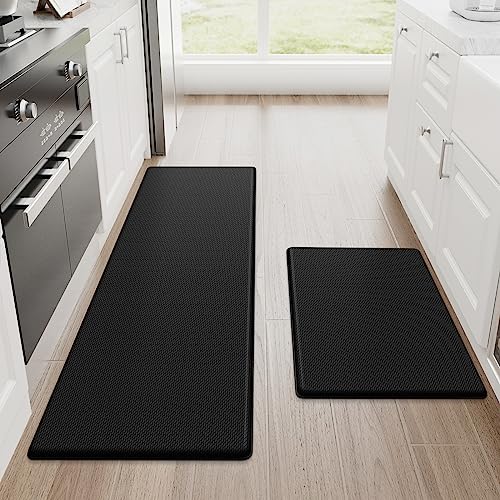
Most kitchens have two standing stations, not one: the sink and the stove or prep run. The StepRite set answers that geometry directly, pairing a 17.3 by 30 inch mat with a longer 17.3 by 47 inch piece, both cushioned, water-resistant and non-slip underneath per the verified title. It is the set to buy when a single mat would leave half your standing uncovered.
Strengths
- Two sizes in one set match real sink-plus-stove kitchen geometry
- Water-resistant surface suits the sink station, where plain foam mats suffer most
- Non-slip bottom stated in the title, essential for mats that get stepped on and off constantly
Trade-offs
- The title does not state a foam thickness, so cushion depth cannot be compared with the FEATOL on paper; expect a mid-level cushion
- Two mats mean two edges to keep clean along their borders
- Black shows flour and light crumbs readily in a working kitchen
| Pieces | 2: 17.3 x 30 in + 17.3 x 47 in (per Amazon title) |
| Surface | Water-resistant, easy to clean (per Amazon title) |
| Bottom | Non-slip (per Amazon title) |
| Thickness | Not stated in Amazon title |
The long piece is the quiet star. A 47-inch cushioned run along the stove and prep counter covers the shuffle zone where cooks actually spend their standing time, moving laterally between board, hob and sink. Single square mats force a choice of one spot; this set’s runner-format half abolishes the choice along the main run, which is how kitchens are actually used.
Water resistance matters disproportionately at the sink. Foam mats die by absorbing dishwater through cut edges and surface nicks, then staying damp. A water-resistant, wipe-clean surface — as stated here — is the difference between a mat that lasts years at the sink and one that is replaced annually, and it is why this set, rather than a thicker single mat, is the practical whole-kitchen answer.
Run the long mat along the work run and the short one at the sink, not the reverse; the sink station’s standing is stationary, while the work run’s is mobile, and mobile standing benefits most from length.
Best for: households wanting cushioned coverage at both main kitchen stations / Not suited for: buyers who want the deepest single-mat cushion regardless of coverage
Check on Amazon — check the current price on Amazon before you buy, because sizes, prints and pack options change the total.
ComfiLife Anti Fatigue Floor Mat (3/4 Inch Thick, 20 x 32, Black) — Best Proven Classic
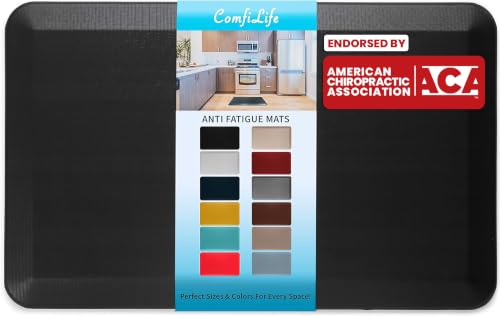
ComfiLife is the name many buyers already know in anti-fatigue mats, and this listing is its standard-bearer: 3/4-inch thickness stated in the title, the category’s standard 20 by 32 inch footprint, stain resistance and a non-slip bottom. It suits the buyer who wants the proven middle of the category rather than the thickest or the cheapest option.
Strengths
- 3/4-inch stated thickness sits in the category’s effective cushioning range
- Stain-resistant surface and non-slip bottom both stated in the title
- Standard 20 x 32 size fits a single station in almost any kitchen layout
Trade-offs
- Single mat coverage only; two-station kitchens need the set above or two singles
- Black colourway is the verified listing; other colours are separate variants to confirm
- Mid-thickness means very heavy users may prefer the 0.9-inch FEATOL
| Thickness | 3/4 inch (per Amazon title) |
| Size | 20 x 32 inches (per Amazon title) |
| Surface | Stain resistant (per Amazon title) |
| Bottom | Non-slip (per Amazon title) |
There is a reason 3/4 inch became this category’s reference thickness: it is deep enough to change standing comfort decisively, shallow enough to keep edges manageable and the mat stable underfoot. The FEATOL beats it on paper depth; the ComfiLife counters with a stain-resistant surface claim and the accumulated familiarity of a long-selling design. Between the two, choose depth if you stand for hours, and this classic if your sessions are shorter and your kitchen is spill-prone.
Stain resistance is a kitchen-specific virtue that office-first mats lack. Tomato, turmeric and oil are the daily reality under a prep station, and a surface that releases them with a wipe keeps a black mat looking intentional instead of archaeological. In a working kitchen, that surface may out-earn a few millimetres of foam.
A 20 by 39 inch variant of this mat also appears in the verified search results for cooks who want the same design with a longer run; confirm the size in the variant selector, since the two listings are separate.
Best for: the classic single-station buy for typical home cooking sessions / Not suited for: two-station coverage in one purchase or maximum-depth cushioning
Check on Amazon — check the current price on Amazon before you buy, because sizes, prints and pack options change the total.

COSY HOMEER Soft Kitchen Floor Mats and Rugs (20 x 59, Dark Grey) — Best Washable Runner
This pick represents the other honest half of the category. The COSY HOMEER is a washable polyester runner, 20 by 59 inches, described in its title as absorbent and non-slip. It will not cushion like foam, and this review will not pretend otherwise; what it does is cover a long kitchen path with a soft-underfoot, spill-absorbing layer you can put in the washing machine.
Strengths
- 59-inch runner length covers a galley path or a long sink run in one piece
- Machine-washable polyester suits homes with kids, pets and constant spills
- Absorbent surface handles sink splash that would pool on a foam mat’s edges
Trade-offs
- Thin woven construction gives minimal anti-fatigue cushioning compared with any foam pick here
- Washable rugs need regular laundering to stay fresh in a kitchen environment
- Dark Grey is the verified colourway in this listing
| Size | 20 x 59 inches (per Amazon title) |
| Material | Polyester (per Amazon title) |
| Care | Washable (per Amazon title) |
| Backing | Non-slip / non-skid (per Amazon title) |
Judge this runner by rug standards and it excels: length, absorbency, washability and a non-slip back in a kitchen-appropriate dark grey. Judge it by foam standards and it fails a test it never claimed to pass. The buyers who love washable runners are those whose kitchen problem is mess and mileage — a path walked a hundred times a day, splashed at the sink, crumbed at the stove — more than stationary standing strain.
The smart combined setup uses both halves of this guide: a foam mat at the prep station where standing is long and still, and this runner along the path where standing is brief and movement constant. Neither product substitutes for the other, and the kitchens that try to force one product into both jobs end up dissatisfied with a compromise this guide would rather you avoided deliberately.
Washable runners earn their keep only if they are actually washed; buy the size your machine can handle comfortably, because a runner too large for the drum becomes a runner that never gets laundered.
Best for: galley kitchens, sink splash zones and households prioritising washability / Not suited for: anyone whose main need is cushioned relief for long stationary standing
Check on Amazon — check the current price on Amazon before you buy, because sizes, prints and pack options change the total.

BEQHAUSE Kitchen Runner Rug (24 x 60, Blue) — Best Wide Washable Runner
The BEQHAUSE runner widens the washable option: 24 by 60 inches gives four extra inches of width over the COSY HOMEER, which matters in front of wide sink cabinets and along open-plan kitchen runs. Its title states extra absorbent and stain resistant properties and a non-slip, washable build, and the blue colourway serves kitchens tired of black and grey.
Strengths
- 24-inch width covers wide sink fronts better than standard 20-inch runners
- Extra absorbent and stain resistant properties stated in the Amazon title
- Washable format keeps a coloured rug practical in a kitchen
Trade-offs
- Like all woven runners here, cushioning is minimal next to foam mats
- Blue is a commitment; confirm it against your cabinets before ordering
- A 60-inch rug needs a machine and drying space that can handle it
| Size | 24 x 60 inches (per Amazon title) |
| Care | Washable (per Amazon title) |
| Properties | Extra absorbent, stain resistant, non-slip (per Amazon title) |
Width is the specification runner buyers most often underbuy. A 20-inch runner in front of a 36-inch sink base leaves the standing zone’s edges bare, and feet find those edges. At 24 inches, this runner covers the natural stance width of a person washing up, which is the entire point of putting anything on that floor. The extra absorbency claim suits the same spot: sink splash is a volume problem before it is a comfort problem.
Stain resistance on a coloured kitchen rug is not a luxury claim. Kitchens stain rugs professionally — oil mist, sauce, coffee — and a blue rug that resists staining and washes clean keeps the one decorative choice in this guide from becoming the first thing in the kitchen that looks tired.
Measure your sink run before choosing between the two washable runners: buy the width that covers your stance, then the length that covers your path, in that order.
Best for: wide sink fronts and buyers who want a coloured, washable kitchen runner / Not suited for: cushion-first buyers and very small kitchens where 60 inches overwhelms
Check on Amazon — check the current price on Amazon before you buy, because sizes, prints and pack options change the total.
HappyTrends Kitchen Mats for Floor, Cushioned Anti-Fatigue Rugs — Best Budget Foam
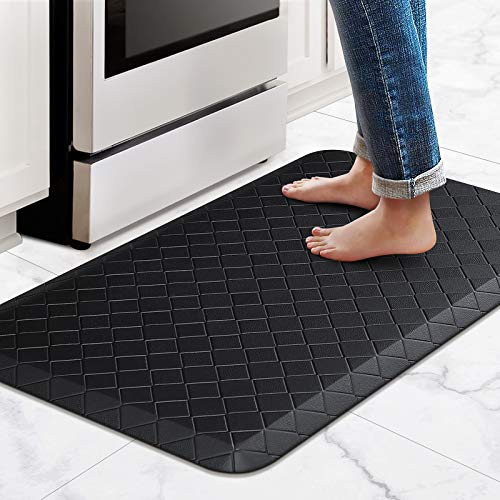
The HappyTrends mat is the value-route foam pick: cushioned and anti-fatigue per its title, waterproof and non-slip, and aimed at kitchen, office, sink and laundry use. One honesty note belongs up front: its title calls the mat thick without stating a number, so unlike the FEATOL and ComfiLife it cannot be ranked on stated depth, and buyers who care about exact thickness should choose a numbered pick.
Strengths
- Waterproof surface suits sink and laundry placement where foam usually suffers
- Non-slip design stated in the title for step-on, step-off safety
- Value positioning makes two-station coverage affordable with two singles
Trade-offs
- No stated thickness figure in the Amazon title, so cushion depth is unverified on paper
- Descriptive claims like heavy duty are maker language, not measurements
- Sizes are not stated in the title either; confirm dimensions on the product page before ordering
| Surface | Waterproof (per Amazon title) |
| Bottom | Non-slip (per Amazon title) |
| Thickness | Described as thick; no figure stated in Amazon title |
| Size | Not stated in Amazon title — confirm on product page |
Value mats earn their place when the alternative is no mat at all. A waterproof cushioned mat at the sink and another at the stove, bought at value pricing, will improve a kitchen more than one premium mat admired in a single spot — provided the buyer accepts the unknowns this review has flagged: unstated thickness and unstated size in the title, both resolvable in thirty seconds on the product page.
Waterproofing is this mat’s genuine argument. At the sink, waterproof beats thick: a thinner mat that sheds dishwater outlasts a deeper mat that drinks it. If your worst standing spot is the washing-up position rather than the prep board, this pick’s priorities may match your kitchen better than the headline depth of the FEATOL does.
Because the title omits dimensions, measure your station and match it deliberately on the product page; value mats come in many sizes under one listing family, and the variant selector decides what arrives.
Best for: budget two-mat coverage and waterproof sink-station duty / Not suited for: buyers who want a stated, comparable thickness figure before purchase
Check on Amazon — check the current price on Amazon before you buy, because sizes, prints and pack options change the total.
Comparison Table
| Pick | Badge | Key spec | Best for |
|---|---|---|---|
| FEATOL 0.9 Inch Anti Fatigue Mat for Kitchen & Office (20 x 32, Black) | Best Cushioning | 0.9 in thick memory foam, 20 x 32 in, beveled edges | long single-station cooking and standing-desk crossovers |
| StepRite Kitchen Mats for Floor, 2-Piece Anti-Fatigue Set (Black) | Best Two-Station Set | 2-piece: 17.3 x 30 + 17.3 x 47 in, cushioned, water-resistant | households wanting cushioned coverage at both main kitchen stations |
| ComfiLife Anti Fatigue Floor Mat (3/4 Inch Thick, 20 x 32, Black) | Best Proven Classic | 3/4 in thick, 20 x 32 in, stain resistant, non-slip bottom | the classic single-station buy for typical home cooking sessions |
| COSY HOMEER Soft Kitchen Floor Mats and Rugs (20 x 59, Dark Grey) | Best Washable Runner | 20 x 59 in washable polyester runner, absorbent, non-slip | galley kitchens, sink splash zones and households prioritising washability |
| BEQHAUSE Kitchen Runner Rug (24 x 60, Blue) | Best Wide Washable Runner | 24 x 60 in washable runner, extra absorbent, stain resistant | wide sink fronts and buyers who want a coloured, washable kitchen runner |
| HappyTrends Kitchen Mats for Floor, Cushioned Anti-Fatigue Rugs | Best Budget Foam | Cushioned anti-fatigue, waterproof, non-slip (thickness not stated) | budget two-mat coverage and waterproof sink-station duty |
Foam Mat or Washable Rug: The Choice Underneath This search
Anti-fatigue foam changes the physics of standing: it lets your feet sink slightly, encouraging micro-movements and spreading load across the foot instead of concentrating it at heel and ball. That is a genuine ergonomic mechanism, and it only exists in the foam half of this guide. A woven kitchen rug, however good, is a surface treatment — it warms the floor, catches spills, quiets the room and protects the flooring, but it does not meaningfully cushion a standing body.
The mistake is not choosing either one; it is choosing one while expecting the other’s benefit. Households that cook in long sessions should anchor the kitchen with foam at the main station. Households whose kitchen pain is mess, cold floors and a long walking path should anchor with washable runners. Most real kitchens, honestly assessed, place one foam mat and one runner and stop asking a single product to be both.
Standing Comfort Beyond the Mat
A mat is the biggest single lever on kitchen standing comfort, but it works inside a system. Footwear is the second lever: a cushioned house shoe or slipper with real sole support multiplies a mat’s effect, while thin socks on a mat waste part of what you bought. The cooks who report transformed kitchen comfort almost always changed both, which is worth knowing before you blame a good mat for not doing two jobs.
Posture and rhythm are the third lever. Even on the best foam, locked knees and a static stance fatigue anyone; the mat’s subtle instability encourages the weight shifts that keep standing comfortable, and a cook who leans a hip against the counter between tasks, perches on a stool for the long peeling jobs and moves around the kitchen naturally will outlast a statue on any surface. The mat enables that rhythm — it does not replace it.
Finally, the floor itself sets the ceiling. A mat over stone or porcelain tile performs a rescue; the same mat over cushioned vinyl performs a polish. If your kitchen floor is the hardest in the house, the thick picks in this guide are not indulgences — they are corrections, and they should be bought at full specification rather than apologised for.
Sizes, Layouts and the Two-Mat Strategy
Kitchen geometry is stubbornly standard: a sink run, a stove run and the path between them, usually in a galley, L or U shape. The two-mat strategy that this guide recommends maps onto it directly — one cushioned mat sized to the main standing station, one runner or second mat covering the secondary station and the start of the path. Measure both zones before shopping, in inches, because mat sizes cluster around a few standards and a four-inch shortfall at your stance is a daily annoyance, not a rounding error.
Runners deserve their length respected. A runner that ends mid-path creates a step-off edge exactly where you walk with full hands and wet floors; either cover the path fully or place shorter mats deliberately at stations and leave the path as honest floor. Half-measures in layout are how good products earn bad reviews.
Colour and pattern are the last decision, not the first, and they are mostly about crumb visibility and mood. Dark mats hide some sins and advertise flour; patterned runners hide almost everything and ask for the room’s palette to cooperate. Choose after size, thickness and surface are settled, and the kitchen will look intentional rather than accumulated.
Mats at Work: Kitchens That Double as Offices, Studios and Classrooms
The modern kitchen floor hosts more than cooking. It is a standing-desk overflow, a homework station, a craft bench and a laundry folding zone, and each of those tenants stands differently. The anti-fatigue picks in this guide — the FEATOL title literally names standing desks and all-day work — transfer directly: the mat that serves a two-hour cooking session serves a two-hour video call at the kitchen counter, and households should place mats where the standing actually happens across the whole day, not only where the stove is.
Homeschooling and craft households add a materials dimension: mats under craft stations catch the drips and drops that ruin floors, and a wipe-clean foam surface forgives paint and glue in ways woven runners cannot. Conversely, a washable runner under a child’s art chair can go in the machine after the glitter incident, which foam cannot. The category split this guide insists on — foam for feet, weave for mess — resolves most of these multi-use arguments without new purchases.
The practical conclusion is a small inventory rather than a single hero product: a deep foam mat at the main worktop, a washable runner on the traffic path, and the discipline to move neither. Kitchens that adopt it stop re-litigating their floors, which is the true end state of every good buying guide.
What Thickness Numbers Do and Do Not Tell You
This guide quotes stated thicknesses — 0.9 inches, 3/4 inch — because they are the only comparable numbers the category offers, but they deserve a footnote. Thickness measures the mat at rest; what your feet experience is thickness under load, which depends on foam density. A dense 3/4-inch mat can support a heavy cook better than a soft 0.9-inch mat that bottoms out under heels, and neither listing language nor this guide can fully settle that from titles alone. The numbers rank mats honestly within their class; they do not crown an absolute winner for every body.
Weight is the variable to bring to the tie-break. Heavier users should bias toward the deepest stated cushion and the firmest descriptions; lighter users often find mid-thickness mats more stable and pleasant, because a very soft deep mat can feel like standing in sand. Children, who weigh nothing and bounce everywhere, are indifferent to all of it and should simply be kept off the trip edges.
If you can, stand on your choice during the return window with the scepticism of a reviewer: cook one full meal, wash up standing in place, and notice your feet at the end rather than your first impression at the start. Anti-fatigue is an outcome measured in hour two, and every pick here deserves to be judged there.
Care, Replacement and Knowing When a Mat Is Done
Foam mats announce their retirement honestly: the centre compresses into a permanent valley, edges curl or crack, the surface nicks multiply, and the non-slip bottom stops gripping no matter how clean it is. At that point the mat is no longer anti-fatigue; it is a trip hazard with a biography, and replacing it is maintenance, not indulgence. Woven runners retire differently — thinning pile, a backing that crumbles or sheds, stains that survive the wash — and their replacement is cheaper and more frequent by design.
Extend both lives with the unglamorous habits: lift and dry beneath mats weekly, keep chair legs and stool feet off foam edges, sweep grit from under runners before it grinds the backing, and never drag a loaded appliance across any mat. Most kitchen mats are killed by their environment, not their materials.
When replacement time comes, buy the successor before retiring the incumbent if the mat serves a daily station; a week of bare-floor standing while a delivery wanders is how households learn what their mat was doing for them, at the price of learning it the hard way.
Renters, Landlords and Floors You Do Not Own
Renters stand on the same hard kitchens as owners but with one hand tied: the floor cannot be changed, adhesives may be unwelcome, and whatever is bought must leave with them. Mats and runners are the renter’s perfect instrument precisely because they are furniture, not fixtures — a deep foam mat transforms a landlord’s porcelain tile for the tenancy and then rolls into the moving van. Choose non-slip bottoms that grip without residue, avoid any mat that needs sticking down, and photograph the floor beneath at the start; what is under a long-laid mat can surprise both parties at checkout.
The same logic serves anyone protecting a floor they love: a runner under the sink defends hardwood against its one true enemy, standing water, and a mat under the prep station catches the oil mist that slowly varnishes everything it touches. In those houses the rug is not really for the cook at all — it is insurance for the floor, bought in the cook’s name, and it should be selected for coverage and washability first and comfort second, which is the one context where this guide cheerfully reverses its own priorities.
Small Kitchens, Honest Compromises
A small kitchen cannot host the full two-mat strategy, and pretending otherwise produces a floor paved in overlapping edges. The small-kitchen answer is hierarchy: one excellent foam mat at the single station where standing concentrates — in most small kitchens the counter run between sink and stove, where all three jobs happen within two steps — and bare, honest floor everywhere else. A runner in a tiny galley usually survives a week before its corners, caught by feet and doors, argue it back out again. Buy the one mat at full specification rather than two at half, and let the little room keep its dignity.
The Ten-Minute Test
If you are torn between two picks, settle it the way kitchens settle everything: by doing the work. Stand at your station for ten minutes on the bare floor, chopping something real, and notice where the ache gathers — heels, arches, lower back, knees. That map is your specification. Heel-dominant ache wants depth at the heel’s station; whole-foot fatigue wants coverage; a cook who discovers the ache is mostly in the walking wants a runner, not a thicker mat, whatever the advertisements said.
How to Choose Kitchen Rugs and Mats for Standing
Measure your stations before your style. Note where you stand still longest — usually the prep counter — and where you walk most — usually the sink-to-stove path. The still spot gets the thickest foam your budget allows, ideally three quarters of an inch or more with beveled edges. The walking path gets length: a runner that covers the route so you are not stepping on and off a mat’s edge fifty times a session, which is both annoying and a trip pattern.
Then interrogate the surface for your kitchen’s real enemies. Sink stations need waterproof or water-resistant surfaces, full stop. Prep stations need stain resistance against oil and pigment. Everywhere needs a non-slip bottom that works on your actual floor — tile, wood and vinyl grip differently — and a mat that creeps across sealed wood will teach you to hate it within a week regardless of its cushion.
Finally, plan the cleaning before the comfort. Foam mats wipe clean in place and ask almost nothing. Washable rugs ask for a machine cycle on a rhythm; if your laundry reality is monthly, a washable runner will spend three weeks of every month below its best, and foam’s wipe-and-done honesty may serve you better even on the walking path.
How to Place and Care for Kitchen Mats and Runners
Placement decides whether a good mat works. These steps set up a kitchen for standing comfort and keep both foam and woven picks performing.
- Stand at your main station in your cooking shoes and mark where your heels actually land; centre the foam mat on that stance, not on the cabinet front’s visual line.
- Leave a small gap between the mat and the cabinet toe-kick so the mat lies flat and crumbs can be swept from the edge rather than packed under it.
- Run washable runners along the walking path with their ends clear of door swings and dishwasher or oven door drops, which catch rug corners daily.
- Wipe foam mats in place with a damp cloth after cooking sessions that spilled, and lift them weekly to sweep and dry the floor beneath, where moisture hides.
- Launder washable runners on the rhythm your kitchen demands — for most homes, when the sink splash zone looks tired — and dry them fully before relaying to protect the floor beneath.
- Check non-slip performance monthly by pushing the mat firmly sideways with one foot; a mat that now slides needs its underside cleaned, which usually restores the grip.
Rotate two washable runners if your kitchen uses them heavily: one in service, one in laundry. The rotation is what makes the washable strategy sustainable instead of a chore that quietly stops happening.
Common Buying Mistakes
Expecting a woven rug to work like an anti-fatigue mat. Thin washable rugs protect floors and catch spills; they do not cushion standing. Buy foam for your feet and weave for your floor, knowingly.
Buying thickness without beveled edges. A deep square-cut mat is a trip edge in a busy kitchen. Depth and bevel belong together.
Covering the whole kitchen in foam. Foam everywhere catches crumbs at every border and fights every door. Cushion the stations, run the paths, leave the rest as floor.
Ignoring unstated specifications. When a title says thick without a number, treat depth as unknown and either check the product page or choose a pick that states its inches.
Never lifting the mat. Moisture and grit collect under any kitchen mat. A weekly lift, sweep and dry keeps both the mat and the floor honest.
Final Recommendation
For one-station cooks, choose between depth and pedigree: the FEATOL’s 0.9 inches for maximum cushion, the ComfiLife’s 3/4-inch classic for a stain-resistant all-rounder. For whole-kitchen coverage, the StepRite two-piece set is the coherent buy, and budget buyers can build the same idea from two HappyTrends singles. If your kitchen’s real problem is mess and mileage rather than standing strain, the COSY HOMEER and BEQHAUSE washable runners are the honest picks — and the best kitchens in this guide’s judgement run one foam mat and one runner together.
Check price on Amazon on the live listing, confirm sizes against your measured stations, and remember that the right mat in the right spot beats an expensive mat in the wrong one every time. Related kitchen topics from this programme follow below.
Best Kitchen Towels Absorbent Best Kitchen Towels For Cleaning Best Kitchen Towels Blue Best Air Purifiers With Air Quality Sensors Best Foam Pillows For Neck
Frequently Asked Questions
Do anti-fatigue kitchen mats really help with standing?
A sufficiently thick foam mat — around three quarters of an inch or more — spreads load across the foot and encourages small posture shifts, which most people experience as noticeably easier standing over long sessions. Thin rugs do not provide this effect. This guide describes comfort experiences only and makes no medical claims about any mat.
How thick should a kitchen anti-fatigue mat be?
Around 3/4 inch is the category’s proven middle, 0.9 inch is deep cushioning for long sessions, and below about 1/2 inch the effect fades toward symbolism. Whatever depth you choose, pair it with beveled edges so the mat’s edge does not become a trip point.
Are washable kitchen runners a good alternative to foam mats?
They solve a different problem. Washable runners protect floors, absorb sink splash and cover long walking paths, and they launder clean — but they provide minimal standing cushion. Many kitchens do best with a foam mat at the main station and a washable runner along the path.
Where should a kitchen mat go: sink or stove?
Wherever you stand still longest, which for most cooks is the prep counter or stove run; the sink usually involves shorter, more mobile standing. Two-piece sets and runner-format mats exist precisely because most kitchens have two stations worth covering.
How do I stop a kitchen mat from sliding?
Choose a non-slip bottom, place the mat on a clean dry floor, and clean the underside when grip fades — accumulated grease and dust are the usual cause. Runners should sit fully flat with ends clear of door swings that lift their corners.
Can anti-fatigue mats go in the washing machine?
Foam anti-fatigue mats are generally wiped clean in place rather than machine-washed; soaking degrades many foams. Woven kitchen runners in this guide are the washable format. Always follow the specific product’s care guidance on its page before laundering anything.


