Disclosure: airfryerkitchensupply.com is reader-supported. When you buy through links on our site, we may earn an affiliate commission at no extra cost to you.
Where to buy
All six machines below are sold through Amazon, where you can check the current price on Amazon and confirm the configuration on the listing — particularly whether batteries are included on cordless models, and the exact bag and attachment set on the wet/dry machines. Outdoor vacuums are sold in many bundle variants under similar names, and the difference between a bargain and a disappointment is often one line in the “what’s included” box.
- BLACK+DECKER 3-in-1 Leaf Blower, Vacuum and Mulcher (BEBL7000) — Check on Amazon
- Greenworks 40V Leaf Blower / Vacuum, 505 CFM — Check on Amazon
- WORX Trivac 3-in-1 Leaf Blower / Vacuum / Mulcher (WG509) — Check on Amazon
- CRAFTSMAN 16 Gallon Wet Dry Vac with Detachable Blower — Check on Amazon
- DEWALT 9 Gallon Wet/Dry Vacuum (DXV09PA) — Check on Amazon
- DEWALT 20V MAX 2 Gallon Wet and Dry Vacuum (DCV581H) — Check on Amazon
Introduction
The best outdoor vacuums divide into two families that share a name and almost nothing else, and the first service this guide can do is separate them cleanly. Family one is the leaf vacuum: a blower that reverses into a vacuum, sucking leaves through an impeller that shreds them into mulch and deposits them in a bag — the tool that turns a weekend of raking into an afternoon of walking the yard. Family two is the wet/dry vacuum, the shop vac: a canister machine with a hose, indifferent to whether the mess is dry sawdust, wet leaves in the gutter, a spilled bucket in the garage or grit tracked across the patio. Most outdoor households genuinely need one of each over time, but they need them for different Saturdays, and buying the wrong family for your mess is the category’s classic mistake.
Within the leaf family, the honest specification is not top blowing speed — it is vacuum airflow (CFM), mulch ratio, and how the machine handles the damp, matted, twig-contaminated leaves that real yards produce instead of the dry confetti in advertisements. Within the wet/dry family, the honest specification is tank size matched to your mess, hose diameter, and whether the machine can also blow — because a detachable blower turns one machine into the patio-and-driveway tool as well.
Below: three leaf vacuum-mulchers — corded, cordless, and a high-ratio specialist — and three wet/dry machines from portable to heavy-duty, followed by the buying guide: how to read CFM and mulch ratios, corded versus cordless outdoors, bag and filter economics, and the working techniques that keep an outdoor vacuum sucking instead of clogging.
In this guide
Quick Picks
- Best Overall Leaf Vacuum: BLACK+DECKER BEBL7000 3-in-1 — 250 mph blowing, 400 CFM delivery, backpack collection bag, corded consistency. Check the current price on Amazon
- Best Cordless Leaf Vacuum: Greenworks 40V Blower/Vacuum — 505 CFM, 12:1 mulching, with the 5.0Ah battery and charger included per the listing. Check the current price on Amazon
- Best Mulch Ratio: WORX Trivac WG509 — 18:1 mulching at 350 CFM turns eighteen bags of leaves into one. Check the current price on Amazon
- Best Wet/Dry for Garage and Yard: CRAFTSMAN 16 Gallon Wet Dry Vac — 6.5 peak HP with a detachable blower for the driveway after the cleanup. Check the current price on Amazon
- Best Heavy-Duty Wet/Dry: DEWALT DXV09PA 9 Gallon — 5 peak HP, blower function, jobsite-grade build in a manageable size. Check the current price on Amazon
- Best Portable Wet/Dry: DEWALT DCV581H 2 Gallon — cordless or corded, HEPA-filtered, the grab-and-go answer for cars, boats and small spills. Check the current price on Amazon
How These Picks Were Chosen
For leaf vacuums we required a genuine three-function design (blow, vacuum, mulch) with published airflow and a collection bag in the box, and we favored metal or otherwise durable impellers where the listing supports it, because the impeller is where leaf vacuums go to die. Backpack versus shoulder bags, corded consistency versus cordless freedom, and mulch ratio were weighed as the real-world differences they are.
For wet/dry machines we required true wet capability with the float shutoff that protects the motor, a blower function or detachable blower on the larger models, and hose and accessory sets suited to outdoor debris rather than only workshop dust. Tank sizes were matched to honest use classes — portable spot cleanup, garage-and-yard standard, heavy-duty — instead of pretending one size serves all. Across both families, we discounted headline numbers that do no work: blowing mph without CFM, peak horsepower without context, and person-review enthusiasm in place of specifications.
The 6 Best Outdoor Vacuums
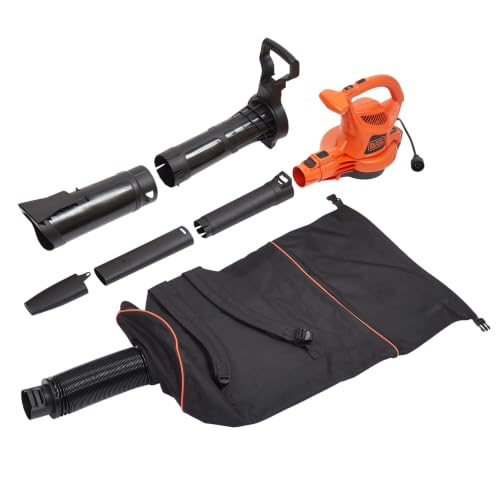
BLACK+DECKER 3-in-1 Leaf Blower, Vacuum and Mulcher (BEBL7000) — Best Overall Leaf Vacuum
The BEBL7000 is the leaf vacuum we hand to the typical suburban yard, and its listing numbers explain the choice: up to 250 mph airflow for blowing, 400 CFM of delivery power for vacuuming, a reusable collection bag, and a backpack-style bag arrangement that takes the weight of a long session off one shoulder and puts it on your back where it belongs. That bag design is the difference between a tool you use for twenty minutes and a tool you finish the yard with — a full bag of mulched leaves is heavy, and how the machine carries it decides your afternoon.
As a corded machine it offers the corded bargain in its purest form: full power from the first leaf to the last, no battery anxiety in a big yard, and a lighter tool in the hand because the motor carries no battery. The price of that bargain is the cord itself — an extension cord to manage, a working radius around your outdoor outlets, and the discipline of blowing leaves toward your power source rather than away from it. For yards up to a typical suburban lot with outdoor outlets sensibly placed, that trade is overwhelmingly worth it, which is why this machine, rather than a cordless flagship, takes Best Overall.
Strengths
- 400 CFM vacuum delivery with 250 mph blowing — balanced power for both directions
- Backpack collection bag carries a long session’s weight properly
- Corded consistency: full power all afternoon, lighter in hand
Trade-offs
- The cord limits radius and demands management around beds and fences
- Reusable bag still needs emptying several times in a heavy leaf fall
- Like all leaf vacs, it prefers dry leaves; sodden mats slow it down
Best for: typical suburban yards with outdoor outlets and a real autumn leaf load. Not suited for: large properties beyond cord reach, or buyers who refuse cords on principle. Check the current price on Amazon

Greenworks 40V Leaf Blower / Vacuum — Best Cordless Leaf Vacuum
The Greenworks 40V is the cordless answer done responsibly: 505 CFM of airflow — stronger vacuum delivery on paper than our corded Best Overall — a 12:1 mulch ratio that turns twelve bags of leaves into one, and, critically, the listing includes the 5.0Ah battery and charger. That inclusion matters because cordless outdoor tools are ecosystems; a vacuum that arrives with a real battery is a tool, while a bare tool is a down payment. Owners already in Greenworks’ 40V line gain the usual bonus: the battery serves the mower, the trimmer and the rest of the shed.
Cordless freedom outdoors is genuinely transformative for the vacuum function specifically. Vacuuming is a wandering job — around the shrubs, along the fence line, under the deck stairs — exactly the movement pattern a cord punishes most. The honest limit is runtime under vacuum load, which is the heaviest load these machines pull: expect to work in focused sessions, and expect a big yard in peak leaf fall to want a second battery. Within a session, though, this is the most pleasant leaf-vacuuming experience in the guide, and for small-to-medium yards it is simply the right machine.
Strengths
- 505 CFM with 12:1 mulching — real vacuum strength without a cord
- Battery and charger included per the listing; joins the Greenworks 40V ecosystem
- Freedom to vacuum the yard’s awkward corners without cord planning
Trade-offs
- Vacuum mode drains batteries fast; large yards need a second pack
- 12:1 mulch ratio trails the WORX’s 18:1 for pure volume reduction
- Heavier in hand than corded rivals once the battery is aboard
Best for: small-to-medium yards, cord-haters, and Greenworks 40V households. Not suited for: acreage in peak leaf season on a single battery. Check the current price on Amazon

WORX Trivac 3-in-1 (WG509) — Best Mulch Ratio
The Trivac’s headline is a ratio: 18:1 mulching, the best in this guide, at 350 CFM and 210 mph from a corded electric platform. Eighteen-to-one is not a marginal edge — in a yard whose autumn produces thirty bags of loose leaves, it is the difference between two bags of mulch and a small mountain of bags awaiting collection, or, if you mulch into your beds and compost as we recommend, between a manageable resource and an overwhelming one. WORX built the Trivac around a metal impeller concept for exactly this shredding work, and the ratio is the result.
The trade is raw sweeping power: 350 CFM vacuums respectably but will not inhale a wet, matted drift the way the BLACK+DECKER’s 400 CFM will, and its blowing is a yard tool rather than a driveway-clearing event. The Trivac is therefore the specialist’s pick — for the gardener whose goal is mulch production, whose leaves are mostly dry, and whose beds and compost are waiting to receive them. If your goal is simply disappearance of leaves into bags for collection, the ratio matters less and the BEBL7000’s balance matters more; if your goal is turning the yard’s output into the garden’s input, nothing here touches the Trivac.
Strengths
- 18:1 mulch ratio — the finest shredding in this guide
- Corded consistency for long mulching sessions
- Built for gardeners who use their mulch, not just bag it
Trade-offs
- 350 CFM is adequate, not mighty, on wet matted leaves
- Cord management, as with all corded picks
- Blowing performance is the weakest of the leaf trio
Best for: gardeners who mulch into beds and compost, with mostly dry leaf fall. Not suited for: wet-leaf yards or buyers prioritizing blowing power. Check the current price on Amazon

CRAFTSMAN 16 Gallon Wet Dry Vac with Detachable Blower — Best Wet/Dry for Garage and Yard
The second family begins with its most versatile member. The Craftsman is a 16-gallon, 6.5 peak HP wet/dry vacuum whose listing includes the feature that doubles its outdoor value: a detachable blower. In vacuum mode it is the garage-and-yard standard — big enough to swallow a gutter’s worth of wet leaves, a workshop’s sawdust season and a flooded corner without constant emptying — and when the cleanup ends, the blower detaches to clear the patio, the driveway and the garage floor itself. Two outdoor tools, one motor, one storage footprint.
Sixteen gallons is the right size for households whose messes are real but whose storage is not infinite: it rolls, it empties without heroics when only partly full of water (a full 16 gallons of water is a heavy lift — empty wet loads early and often, a technique note that applies to every big wet/dry), and its accessory set is aimed at garage and outdoor cleaning per the listing. The honest compromises are bulk and noise: this is a machine you wheel out for a job, not one that lives under a bench unnoticed, and like all big shop vacs it announces itself to the neighborhood. For the Saturday-cleanup household, it remains the wet/dry benchmark of this guide.
Strengths
- 16-gallon capacity with 6.5 peak HP for serious garage and yard messes
- Detachable blower doubles the machine’s outdoor usefulness
- Filter, dust bag, hose and attachments included per the listing
Trade-offs
- Big and loud — a job machine, not a quick-grab tool
- A full wet tank is heavy; empty in stages
- Storage footprint is real in a crowded garage
Best for: garages, workshops, gutters, patios and post-storm cleanup. Not suited for: small spot jobs, where the DEWALT 2-gallon wins, or noise-sensitive quick tasks. Check the current price on Amazon
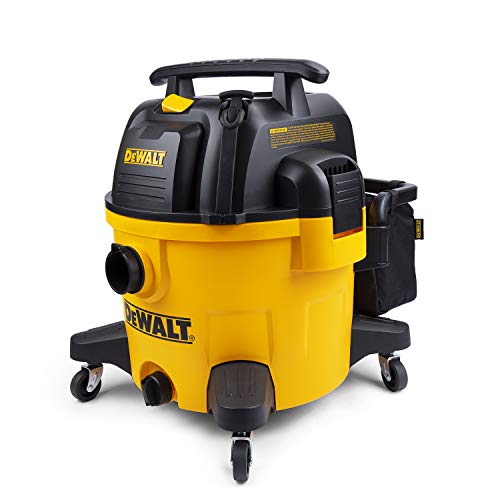
DEWALT 9 Gallon Wet/Dry Vacuum (DXV09PA) — Best Heavy-Duty Wet/Dry
The DEWALT DXV09PA occupies the sweet spot its 9 gallons suggest: jobsite-grade construction and a 5 peak HP motor with blower function, in a canister that one person can carry up steps, load into a vehicle, and store without dedicating a garage bay to it. DEWALT’s wet/dry line is built for people who use these machines as tools rather than appliances, and the details show in the class’s expectations — sturdy latches, a real hose, attachments that survive being stepped on. For outdoor duty — clearing a flooded patio corner, vacuuming the boat, the gutters’ lower reaches, the car’s winter grit in one session — it is the heavy-duty pick that does not punish you for choosing it.
Nine gallons versus the Craftsman’s sixteen is a philosophy choice, not a deficiency: the DEWALT empties more often on huge jobs and wins every day on handling, transport and storage. Its blower function (via the exhaust port arrangement typical of the class) handles the patio-clearing role adequately, if without the Craftsman’s detachable elegance. If your outdoor vacuum life is one big annual cleanup, buy capacity; if it is fifty medium jobs a year, buy the machine you will actually enjoy fetching — this one.
Strengths
- Jobsite-grade build in a one-person-portable 9-gallon size
- 5 peak HP with blower function for patio and driveway finishing
- The heavy-duty pick that stores and travels like a tool, not furniture
Trade-offs
- Smaller tank empties more often on the biggest jobs
- Blower arrangement is less elegant than a detachable blower
- DEWALT tier pricing for the durability
Best for: frequent medium jobs, vehicles, boats, and buyers who value build quality. Not suited for: single massive cleanups where 16 gallons earns its bulk. Check the current price on Amazon
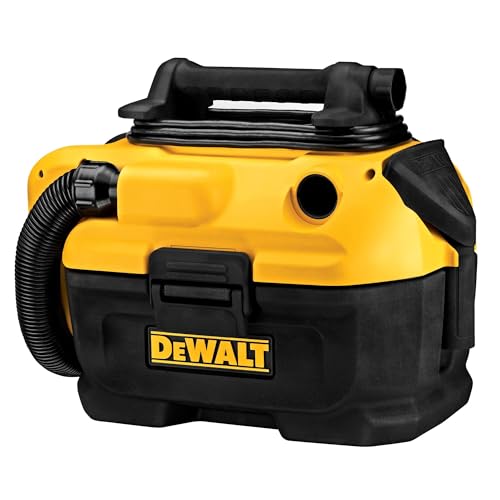
DEWALT 20V MAX 2 Gallon Wet and Dry Vacuum (DCV581H) — Best Portable Wet/Dry
At the small end, the DCV581H makes a different argument: the best outdoor vacuum is often the one already in your hand. This 2-gallon machine runs cordless on DEWALT’s 20V MAX batteries or corded when an outlet is near, carries a HEPA filter — unusual and welcome in this class, since it means the exhaust is not redistributing fine dust over your car interior or patio furniture — and handles wet and dry pickup with a wide nozzle and a size that lives in a trunk, a boat locker or a garage shelf corner.
Its jobs are the small, frequent ones that big machines make you skip: the spilled potting soil on the patio, the car’s floor after the beach, the grill area’s ash-adjacent grit (cold ash only, and with care), the tent floor, the boat’s bilge-adjacent damp. Two gallons fills fast — that is the honest limit — and suction is portable-class, not canister-class. But outdoor cleanliness is mostly a game of small jobs done promptly, and a vacuum that asks nothing — no cord hunt, no wheel-out ceremony — wins that game. DEWALT 20V households will find it the easiest purchase in this guide to justify.
Strengths
- Cordless or corded flexibility with HEPA filtration in a 2-gallon grab-and-go size
- Wet and dry pickup for cars, boats, patios and small spills
- Lives where the jobs are — trunk, locker, shelf — not in a garage bay
Trade-offs
- 2-gallon tank fills quickly; not a leaf or flood machine
- Portable-class suction only
- Battery not the point of the listing — DEWALT 20V owners are best served
Best for: cars, boats, patios, camping and prompt small messes. Not suited for: yard leaves, big garage cleanups or any flood beyond a bucket’s worth. Check the current price on Amazon
Comparison Table
| Pick | Badge | Key spec | Best for |
|---|---|---|---|
| BLACK+DECKER BEBL7000 | Best Overall Leaf Vacuum | 400 CFM, 250 mph, backpack bag, corded | Suburban leaf season |
| Greenworks 40V Blower/Vacuum | Best Cordless | 505 CFM, 12:1 mulch, battery included | Small-medium yards, no cords |
| WORX Trivac WG509 | Best Mulch Ratio | 350 CFM, 18:1 mulch, corded | Gardeners who use mulch |
| CRAFTSMAN 16 Gal Wet/Dry | Best Wet/Dry Garage/Yard | 6.5 peak HP, detachable blower | Big cleanups + patio blowing |
| DEWALT DXV09PA 9 Gal | Best Heavy-Duty Wet/Dry | 5 peak HP, blower function, jobsite build | Frequent medium jobs |
| DEWALT DCV581H 2 Gal | Best Portable | 20V/corded, HEPA, wet/dry | Cars, boats, spot messes |
How to Choose an Outdoor Vacuum
Start with the mess, not the machine. Dry leaves on lawns and beds: leaf vacuum family. Wet debris, garage floors, gutters, vehicles, spills: wet/dry family. Mixed properties with both problems should sequence purchases by pain — the family whose mess currently costs you weekends goes first — and this guide’s picks are chosen so a leaf machine and a wet/dry machine from it complement rather than overlap.
Read leaf-vacuum numbers in the right order. CFM (air volume) is the vacuuming number: it decides whether matted leaves lift. MPH (air speed) is the blowing number: it decides how far debris scatters and clears. Mulch ratio is the reduction number: 12:1 and 18:1 are both useful, and the difference shows in bag trips, not in kind. A machine boasting mph without CFM is telling you it blows better than it vacuums — fine if that is your job, fatal if it is not. Bag design is the fourth number that is not a number: backpack beats shoulder over a long session, every time.
Corded versus cordless is a yard-size question. Corded machines deliver unlimited, undiminishing power and lighter weight, at the cost of radius and cord handling; they suit yards up to the reach of sensible outdoor outlets. Cordless machines deliver freedom and pay for it in runtime under vacuum load — the heaviest load in the category. Small-to-medium yards, or yards vacuumed in sections across days, suit cordless beautifully; a large yard in a single autumn push wants corded power or a two-battery cordless plan.
Size a wet/dry by your biggest regular job, then check the weight of water. Gallons measure volume, but water weighs about eight pounds per gallon, and you will carry or roll every one of them to the drain. A 16-gallon machine emptied at half-full is a better servant than a 9-gallon machine overfilled — buy the tank for the debris volume, and discipline the wet loads. Hose diameter decides what debris passes without clogging; wider hoses suit leaves and grit, narrower nozzles suit crevices and cars. HEPA filtration, as on the little DEWALT, matters when the exhaust blows near people and interiors; for open-yard work it is a bonus rather than a requirement.
How to Vacuum Leaves and Outdoor Messes Without Clogging
Technique decides whether an outdoor vacuum feels powerful or pathetic, and the rules are learnable in one session. For leaf vacuuming: work dry when you can — a morning’s dew is enough to mat leaves and halve your machine’s appetite, so late morning after the sun has done its work is prime time. Rake or blow leaves into loose, shallow drifts and vacuum the drift’s edges, letting the machine sip rather than gulp; jamming the nozzle into a packed pile is how impellers clog and bags burst their seams. Keep twigs above finger thickness out of the intake — pick them up by hand as you go — because one stick across the impeller housing stops the whole operation. Empty the bag at two-thirds full: a stuffed bag strangles airflow, and the last third of capacity costs more time than the emptying trip saves.
For wet/dry work outdoors: remove or protect the dry filter per the manual before wet pickup — most machines want the paper filter out and the foam sleeve on for liquids — and let the float shutoff do its job rather than overfilling past it. Vacuum wet leaves in short passes, checking the hose’s low point where slurry settles and clogs. Rinse the tank after wet jobs and leave it open to dry; a sealed damp shop vac grows a smell that will outlive the season. After any session, knock the filter clean outdoors, check the impeller area on leaf machines for wrapped stems, and coil cords and hoses loosely — outdoor tools die of storage abuse more often than of work.
Common Buying Mistakes
- Buying a leaf vacuum for wet messes, or a shop vac for leaf season. The families are specialists. Match the machine to the mess that costs you weekends.
- Judging by mph alone. Blowing speed is not vacuuming power. CFM and mulch ratio do the leaf work.
- Vacuuming wet, matted leaves and blaming the machine. Timing is a feature: dry leaves, shallow drifts, edges first.
- Ignoring bag ergonomics. A shoulder bag on a big yard is an injury with a schedule. Backpack or smaller loads.
- Filling a wet tank to the brim. Water is heavy and floats shut off suction for a reason. Empty in stages.
- Forgetting the filter in wet mode. A soaked paper filter ruins both suction and the filter. Follow the wet-pickup configuration in the manual.
Final Recommendation
For leaf season on a typical yard, the BLACK+DECKER BEBL7000 is the balanced buy — check the current price on Amazon — with the Greenworks 40V for cordless freedom on smaller yards and the WORX Trivac for gardeners who mulch in earnest. For the wet and gritty half of outdoor life, the Craftsman 16-gallon is the garage standard, the DEWALT 9-gallon the heavy-duty handler, and the little DEWALT 2-gallon the portable that will, honestly, see the most use of any machine here. Buy by mess, respect the dry-leaf rule, and autumn becomes an afternoon again.
More in this cluster: Best Lightweight Vacuums With Bags, Best Residential Vacuums, Best Ranked Vacuums, Best Portable Vacuums.
Safety and Courtesy: The Outdoor Vacuum Rules That Matter
Outdoor vacuums are power tools working in an uncontrolled environment, and a short list of habits keeps them safe and neighborly. Eye protection when blowing or vacuuming dry debris — grit leaves a nozzle at speed and does not ask permission. Hearing protection for long sessions: leaf machines and shop vacs both operate at volumes that accumulate. Never vacuum anything burning or smoldering, and treat fireplace and grill ash as a specialist job for cold ash only with a machine rated for it — none of the picks here is an ash vacuum, and hot embers in a bag of dry mulch is a fire written in advance. Keep cords out of standing water, use outdoor-rated extension cords, and let GFCI protection do its work around wet jobs. Finally, courtesy: these are loud machines with a social radius, so run them at hours your neighborhood forgives, and blow debris onto your own property, not the street or the neighbor’s drive. The best outdoor vacuum in the world is a poor purchase if it costs you goodwill on the street where you live.
Leaf Strategy: Mulch in Place, Vacuum, or Tarp?
The vacuum is one instrument in a leaf strategy, and yards go better when the strategy comes first. Mulching in place — running a mower over leaves and leaving the confetti to feed the lawn — is the lowest-effort answer for light-to-moderate leaf fall on grass, and ecologically the kindest. Its limits are volume and location: heavy fall smothers turf even when shredded, and leaves in beds, on patios, in gravel and against fences gain nothing from a mower. Vacuuming owns exactly that territory: the non-lawn surfaces, the corners and edges, the beds where you want the mulch collected for redistribution rather than left where it fell. A leaf vacuum with a strong mulch ratio turns those zones’ liability into the garden’s asset — shredded leaves are the classic, free, soil-building mulch — which is why the Trivac’s ratio matters to gardeners out of proportion to its spec-sheet modesty.
The tarp remains undefeated for one job: bulk transport of whole leaves over distance, to a compost heap or a collection point, when the leaves are dry and the distance is short. It asks nothing of electricity and everything of your back. The mature yard usually runs all three systems in one afternoon — mower-mulch the lawn’s light cover, vacuum the beds, patios and drifts (shredding as it goes), tarp the overflow to the compost — and the machines in this guide were picked to slot into that combined routine rather than to replace it. Judge any outdoor vacuum purchase by which third of that routine it relieves for you; buy for the bottleneck, and the whole afternoon speeds up.
Wet/Dry Ownership: Bags, Filters and Storage
A wet/dry vacuum’s running costs are small but real, and knowing them prevents the slow decline that makes owners call a good machine weak. Dust bags, used for dry fine work, are the secret to filter longevity: a bag captures the load before the filter sees it, suction stays strong for months, and emptying is a clean lift-out rather than a dust-cloud ritual — for garage and workshop duty they are worth their modest cost many times over. The cartridge filter itself wants a knock-clean outdoors after dusty sessions and a replacement when its pleats stay gray after cleaning. Foam sleeves serve wet pickup and wash clean in a bucket. None of this is expensive; all of it is the difference between a machine that performs in year three and one that wheezes in month nine.
Storage is the other half of ownership, and outdoor tools suffer storage more than indoor ones. Coil the hose in a wide loop rather than tight wraps that set kinks; store the tank empty, rinsed after wet work and latched loosely so seals do not take a permanent compression; keep attachments in the machine’s onboard storage or a single bin, because a wet/dry vacuum separated from its crevice tool is half a tool. Leaf machines want the same respect plus one addition: clear the impeller housing before storage, since a forgotten wad of damp mulch will ferment against the housing all winter and greet you in spring as corrosion and smell. Ten minutes of end-of-season care is the cheapest performance upgrade in this entire category.
Matching the Machine to the Property
The townhouse patio. Your outdoor world is a patio, a small bed area and a garage corner. The DEWALT 2-gallon is your vacuum — cars, patio grit, potting messes, the occasional spill — and a leaf vacuum is likely overkill unless one determined tree owns your patio, in which case the Greenworks cordless, used in short sessions, is the proportionate answer. Storage is your binding constraint; buy accordingly.
The typical suburban lot. This is the BEBL7000’s home ground: a lawn with real trees, beds, a driveway, a garage that collects life’s debris. Pair it with the Craftsman 16-gallon when the garage and gutters enter the picture, and you own the complete suburban answer. Corded power is an asset here, because the lot fits inside a sensible extension cord’s ambition.
The gardener’s yard. Where beds, compost and soil-building lead the priorities, the Trivac’s 18:1 ratio is the strategic purchase — every pass produces next season’s mulch — and a mid-size wet/dry like the DEWALT 9-gallon covers the potting bench, the greenhouse floor and the water features’ maintenance. Your vacuum is a harvest tool; buy it like one.
The large or wooded property. Scale changes the answers. Cordless leaf vacuuming becomes a sectional hobby rather than a cleanup method; corded machines run out of cord; the honest toolkit adds a powerful blower for moving volume and reserves vacuuming — the BEBL7000 near the house, the big Craftsman for the outbuildings — for the zones where collection matters. Wet/dry capacity also scales: gutters, barns and workshops on a large property are 16-gallon territory, and the portable DEWALT still earns its place in the vehicle that connects it all.
The boat, RV and campsite life. Here the DCV581H stands alone in this guide: battery-or-cord flexibility, HEPA-filtered exhaust that respects interiors, wet pickup for the bilge-adjacent and the spilled cooler, and a size that stows in the spaces these lives actually have. If your outdoors is mobile, your outdoor vacuum should be too.
The Cost of Ownership, Honestly Totaled
Outdoor vacuums are cheap to buy and cheaper to run, but “cheaper” is not “free,” and the honest ledger helps you choose between the families. A corded leaf vacuum’s running costs are electricity and bags if you use them — close to negligible — plus the impeller’s eventual wear, which technique (keeping sticks out) stretches across many seasons. A cordless machine adds the battery reality: packs age in years whether used or not, and a vacuum that outlives its battery is only as good as the ecosystem’s willingness to sell you another — one more argument for the Greenworks’ inclusion of a real battery and a large 40V family behind it. A wet/dry vacuum’s ledger is bags, filters and the occasional hose: budget a small annual amount, use dust bags for fine dry work so the cartridge filter lasts, and the machine’s suction in year four will resemble its suction in week one. The pattern across all three: the purchase price buys the machine, and a modest, predictable trickle buys its performance. Owners who resent the trickle end up with clogged, wheezing tools and conclude the category is weak; owners who pay it conclude the opposite, about the same machines.
Winter and Storm Duty: The Outdoor Vacuum’s Hardest Weeks
Two seasons test outdoor vacuums beyond the autumn routine. Winter brings the wet/dry machine to the front: entryway slush and grit, the garage’s melt-water puddles, burst-pipe and water-heater incidents where a wet vacuum is the difference between a mop marathon and a managed cleanup. Keep the big wet/dry accessible in winter rather than stored behind the summer equipment, with its foam sleeve fitted and its dry filter bag stored dry and separate — the machine you can deploy in two minutes is the one that saves the floor. Storm season is the second test: after wind and rain, the yard holds the wettest, heaviest debris of the year, and the correct sequence is patience first — let the sun work for a day — then the wet/dry for gutters, drains and hard surfaces, then the leaf vacuum for what has dried. Owners who force the leaf vacuum into storm debris on day one clog it, curse it, and learn the sequence anyway; the machines in this guide are durable, but they are durable within their physics, and the calendar is part of the technique.
Frequently Asked Questions
Can a leaf vacuum handle wet leaves?
Poorly, and it is not the machine’s fault: wet leaves mat together, weigh several times their dry weight, and clog intakes and impellers. The professional answer is timing — vacuum after sun and wind have dried the leaf layer, and rake stubborn wet mats loose first. A wet/dry vacuum can take small quantities of damp debris, but bulk wet-leaf removal is a rake-and-tarp job in any honest yard.
What mulch ratio do I need?
Anything from 10:1 upward transforms the bagging problem; 12:1 (Greenworks) is a strong all-round figure and 18:1 (WORX) is for gardeners maximizing mulch per leaf. If your leaves go to municipal collection in bags, ratio matters less than vacuum strength; if they go to your beds and compost, ratio is the feature.
Is a shop vac a substitute for a leaf vacuum?
No. A wet/dry vacuum with a hose is slow, clog-prone work across a leaf-covered lawn, and its tank fills in minutes. Conversely, a leaf vacuum cannot touch a wet garage mess. The families complement each other, which is why this guide picks three of each rather than crowning one machine for all outdoor suction.
Corded or cordless for a half-acre yard?
At half an acre, plan honestly: corded with well-placed outdoor outlets, or cordless with two batteries and a sectional approach across a weekend. A single-battery cordless plan for a half-acre in peak fall is the category’s most common disappointment, and it is entirely avoidable at the buying stage.
How do I stop the leaf vacuum bag from clogging the airflow?
Empty at two-thirds full, shake the bag out fully rather than just removing the top layer, and keep damp leaves out of the bag where possible — a bag lined with wet mulch breathes badly and weighs double. If airflow fades mid-session, the bag and the impeller housing are the first two places to look, in that order.
Can I use a leaf vacuum on gravel or mulch beds?
With care and modest expectations. A leaf vacuum will happily inhale gravel, bark and mulch along with the leaves — the intake does not discriminate — so work with the nozzle held higher, use lower power where the machine offers it, and accept that some surface material joins the bag. On gravel drives, most owners blow leaves onto a lawn or tarp first and vacuum from there. In bark beds, a light touch at the bed’s edges works; deep in the bed, a hand rake remains the honest tool. Knowing where the vacuum should not go is part of owning one happily.
How loud are outdoor vacuums, really?
Loud enough that hearing protection is standard advice for sessions beyond a few minutes, and loud enough that timing matters socially. Corded leaf machines and big shop vacs sit at the assertive end of garden-tool noise; cordless machines are not automatically quieter under vacuum load. The practical approach: keep sessions compact and purposeful, avoid early mornings and late evenings, and treat ear protection as part of the tool — the picks in this guide reward efficient technique partly because efficient technique is also shorter, quieter technique.
What happens if a stick goes through a leaf vacuum?
Usually a jam at the impeller housing: the machine’s note changes, vibration rises, and suction falls. Stop, unplug or remove the battery, and clear the housing per the manual — never reach into an impeller area on a connected machine. Small twigs are the tax every leaf vacuum charges; the technique section’s rule — hand-pick anything thicker than a finger as you work — keeps the tax low. Repeated jams with noise changes afterward are a reason to inspect the impeller for damage before the next session.
How long do leaf vacuum bags last?
A quality reusable bag serves for seasons if it is emptied before it is stuffed, shaken fully clean, and stored dry — damp mulch left in a bag over winter is the usual killer, rotting fabric and seeding the smell that greets you in spring. Inspect the zipper and seams at each season’s start; a bag that leaks dust at the seams is telling you its service is done. Replacement bags are a normal, inexpensive consumable in this category, and owning a spare converts a mid-season bag failure from a stopped weekend into a two-minute swap.
Is an outdoor vacuum worth it for a small yard?
For the wet/dry portable end, almost always yes — small yards still produce cars, patios and spills. For a dedicated leaf vacuum, the honest threshold is one mature tree: below that, a rake and tarp win on cost; at and above it, the vacuum’s shredding starts paying for itself in bag trips saved every single autumn.
Can I vacuum my gutters with a wet/dry vacuum?
From the ground with gutter attachments, or carefully from a ladder with a helper managing the machine, wet/dry vacuums are the standard tool for gutter debris — the Craftsman and DEWALT sizes here suit it well. Ladder safety outranks gutter cleanliness: keep three points of contact, never overreach, and let the hose do the traveling.


