Disclosure: airfryerkitchensupply.com is reader-supported. When you buy through links on our site, we may earn an affiliate commission at no extra cost to you.
Where to buy
Every vacuum below was confirmed through Amazon’s catalog data before being included, and the links point to the exact models reviewed. Bags and filters are the running cost of this category — check the listing for the consumables each model uses.
- BISSELL Pet Hair Eraser Turbo Plus Lightweight Vacuum, 24613 — Check on Amazon
- Kenmore Intuition Bagged Upright Vacuum BU4022 — Check on Amazon
- Simplicity Vacuums S20EZM Allergy Bagged Upright — Check on Amazon
- Hoover WindTunnel 3 Max Performance Pet Vacuum — Check on Amazon
- Shark Navigator Lift-Away Vacuum NV352 — Check on Amazon
- Kenmore 600 Series Bagged Canister Vacuum 81615 — Check on Amazon
The best hypoallergenic vacuums for pets are defined by one engineering question: what happens to the finest particles — the dander and dust that ride along with pet hair — after the vacuum picks them up? Every pet vacuum can grab visible hair. The hypoallergenic difference is containment: a sealed system that forces all exhaust air through HEPA-level filtration, and a dirt-disposal method that does not puff the collected allergens back into the room when you empty it. That is why this guide is dominated by bagged machines and sealed bagless designs, and why it talks about filtration systems rather than suction numbers. A framing note, stated once and meant seriously: this guide uses “hypoallergenic” in its practical household sense — vacuums designed to capture and contain pet-related particles and keep indoor air more comfortable. No vacuum treats allergies or any medical condition, and none is recommended here on that basis; what these machines honestly do is remove pet hair and dander from floors and furniture and keep them out of the air you vacuum in, which is the comfort outcome pet households are actually shopping for.
The six picks cover the containment strategies that work. The BISSELL Pet Hair Eraser Turbo Plus is the sealed bagless option, with its SmartSeal Allergen System and tangle-free brush for homes that will not buy bags. The Kenmore Intuition and the Simplicity S20EZM are the bagged uprights — the Intuition with HEPA filtration and a lift-up design, the Simplicity with certified HEPA media and bags that seal the dirt away at disposal. The Hoover WindTunnel 3 Max Performance Pet brings HEPA media filtration to the budget tier. The Shark Navigator NV352 is the lift-away all-rounder with full HEPA filtration at a mid-tier price. And the Kenmore 600 Series canister is the pet-household heavy tool, with a powered Pet PowerMate tool for upholstery and stairs. Prices are not printed anywhere in this guide; each pick is placed honestly in its tier, and bags and filters — the genuine running costs of containment — are priced into the buying guide’s advice further down, because a vacuum’s sticker is the smallest number in its five-year story and the consumables are where honest budgeting happens.
In this guide
Quick Picks
- Best Overall: BISSELL Pet Hair Eraser Turbo Plus — sealed allergen system, tangle-free brush roll, and specialised pet tools in a lightweight upright. Check on Amazon
- Best Bagged Upright: Kenmore Intuition BU4022 — HEPA-filtered bagged containment with a lift-up body and a pet hand tool. Check on Amazon
- Best Certified HEPA: Simplicity S20EZM Allergy — certified HEPA filtration in a bagged upright built for multi-surface homes. Check on Amazon
- Best Budget: Hoover WindTunnel 3 Max Performance Pet — HEPA media filtration and pet tools at a budget-tier price. Check on Amazon
- Best Lift-Away: Shark Navigator Lift-Away NV352 — full HEPA filtration in a lift-away design that detaches for stairs and furniture. Check on Amazon
- Best Canister for Pets: Kenmore 600 Series 81615 — bagged canister with HEPA and a powered Pet PowerMate for upholstery. Check on Amazon
How These Picks Were Chosen
Containment was the filter, applied before brand, price, or suction claims. A candidate needed a credible allergen-containment story: either a bagged system where the bag itself is the primary filter and disposal is sealed, or a bagless system explicitly designed and marketed as sealed with HEPA filtration of the exhaust. Ordinary bagless cyclones with a foam filter and an open dirt cup — however strong their suction — were excluded, because emptying them re-aerosolises exactly the particles this search cares about. Each surviving model was confirmed against Amazon’s catalog data so the filtration system, tools, and format in this guide match the listing a buyer receives.
We also applied a reality check drawn from how pet homes actually fail their vacuums. The commonest failure is not weak suction on day one; it is the slow strangulation of a machine by its own harvest — brush rolls wrapped solid, filters loaded grey, bags stretched past full — until a good vacuum performs like a bad one and the household blames the purchase instead of the maintenance. So we favoured machines whose designs resist that decline (tangle-free rolls, generous cups and bags, accessible filters) and we wrote the maintenance into this guide as part of the product, because for this search the maintained machine and the hypoallergenic machine are the same machine.
Pet capability was the second filter, and it is more than a sticker: a powered or turbo tool for upholstery, a brush roll that resists hair wrap (or is easy to clear), and the reach to do stairs and car interiors, where pet hair concentrates. We balanced formats deliberately — bagless for the bag-averse, bagged uprights for the containment purists, a canister for homes with stairs and furniture — because the right hypoallergenic vacuum is the one whose disposal routine the household will actually perform without dread. No medical claims were used as criteria, and none are made in the reviews.
The 6 Best Hypoallergenic Vacuums for Pets

BISSELL Pet Hair Eraser Turbo Plus Lightweight Vacuum, 24613 — Best Overall
The Pet Hair Eraser Turbo Plus is the bagless answer to the containment question, and it answers with a named system: BISSELL’s SmartSeal Allergen System, which seals the dirt cup’s air path through its filtration so the exhaust is filtered rather than leaked. Around that core it is a thoroughly pet-literate machine — a tangle-free brush roll that sheds the hair wrap which strangles ordinary brush rolls within a month of pet ownership, an easy-empty dirt tank designed to minimise the dust puff at disposal, and the specialised pet tools (including a turbo brush for upholstery) that decide whether the sofa and the stairs actually get done. It is lightweight for an upright of this capability, which matters in the homes that vacuum most: the ones with a shedding dog and a daily schedule.
Strengths
- SmartSeal Allergen System — sealed, filtered exhaust in a bagless design
- Tangle-free brush roll resists the hair wrap that slows pet vacuuming
- Specialised pet tools included; lightweight and easy to empty
Trade-offs
- Bagless disposal, however well designed, still asks more care than dropping a sealed bag
- Filters need regular washing/replacement to keep the seal story true
- Lightweight build trades some of the planted feel of heavier uprights on thick carpet
BISSELL’s pet focus is not a marketing veneer — the company builds for pet charities and pet households as its core identity, and it shows in the details other brands skip: the brush that does not wrap, the cup that empties without a cloud, the tool that fits the stair tread. For the pet household that refuses bags on principle or on cost, this is the containment-honest way to refuse them.
Best for: pet households wanting sealed-system containment without buying bags / Not suited for: anyone who wants disposal to be a fully sealed, touch-free event — that is the bagged picks’ party
Sits in the mid-range tier. Check the current price on Amazon

Kenmore Intuition Bagged Upright Vacuum BU4022 — Best Bagged Upright
The Intuition is the modern bagged upright done right, and its argument is the bag itself: dirt, hair, and dander are collected into a sealed bag that is also a filtration stage, the exhaust passes HEPA filtration, and when the bag is full you drop it in the bin — no cup to shake, no cloud, no contact. Around that containment core, Kenmore adds the features that keep a bagged machine from feeling like a museum piece: a lift-up body that detaches for stairs and above-floor work, a two-motor system that keeps brush and suction in their lanes, and a HandiMate pet tool for the furniture where dander actually settles. For households whose priority order is containment first, convenience second, this is the pick that respects both.
Strengths
- Bagged containment plus HEPA filter — the cleanest disposal in this guide
- Lift-up detachable body for stairs and above-floor cleaning
- Pet HandiMate tool and two-motor power for carpet and hard floors
Trade-offs
- Bags are a recurring purchase — the price of sealed disposal
- Heavier in the hand than the lightweight BISSELL
- Bagged capacity means performance gently declines as the bag fills; change on schedule
There is a quiet satisfaction to the bagged routine that bagless converts rediscover: the vacuum always smells of nothing, the filter area stays clean for months, and the weekly pet-hair harvest leaves the house in a sealed package rather than a bin-side dust event. If your household’s vacuuming has been limited by who can stand the emptying, the Intuition removes the excuse.
Best for: containment-first pet households, especially those who hate emptying dirt cups / Not suited for: buyers who refuse ongoing bag costs on principle
Sits in the mid-range tier. Check the current price on Amazon

Simplicity Vacuums S20EZM Allergy Bagged Upright — Best Certified HEPA
Simplicity is a dealer-brand name that rarely shouts, and the S20EZM’s headline credential is the one this search should care about most: certified HEPA filtration, in a bagged upright designed for the multi-surface reality of pet homes — carpet, rugs, and hardwood in the same circuit. The bagged system keeps disposal sealed, the certified HEPA stage keeps the exhaust honest, and the machine’s whole brief — it carries “Allergy” in its model name, in the household-comfort sense this guide uses — is containment without drama. It is the connoisseur’s pick in this list: less famous than the BISSELL and Shark, more single-minded than either.
Strengths
- Certified HEPA filtration — the strongest filtration credential here
- Bagged containment with sealed disposal
- Multi-surface design for carpet, rugs, and hard floors
Trade-offs
- Dealer-brand distribution means bags and parts come from fewer sellers — stock up
- Fewer lifestyle features than the big-brand picks (no lift-away party tricks)
- Mid-to-premium tier pricing for the certification and build
Choose the Simplicity when filtration paperwork matters to you — when you want the word “certified” to be a standard met rather than an adjective applied. In a home with wall-to-wall pet presence and a household member who simply feels better in a freshly vacuumed room, it is the machine whose engineering brief matches the shopping brief most exactly.
Best for: filtration-first buyers wanting certified HEPA in a bagged upright / Not suited for: buyers wanting maximum features or the cheapest consumables
Sits in the mid-to-premium tier. Check the current price on Amazon

Hoover WindTunnel 3 Max Performance Pet Vacuum — Best Budget
Hoover’s WindTunnel 3 Max Performance Pet is the proof that containment does not require a premium tier. Its HEPA media filtration captures the fine particles that ordinary budget vacuums exhaust back into the room, its WindTunnel 3 channels are built to resist the suction loss that pet hair causes as it loads the system, and the QuickPass brushroll is designed to clean a carpet pass in fewer strokes — a feature pet owners feel in their shoulders by the third room. It is a corded bagless upright, so its disposal is the dirt-cup kind, and this guide will not pretend otherwise; but at its tier, with HEPA media in the exhaust path and pet tools in the box, it is the budget pick that respects the keyword.
Strengths
- HEPA media filtration at a budget-tier price
- WindTunnel design resists suction loss under pet-hair load
- QuickPass brushroll reduces the passes each room needs
Trade-offs
- Bagless cup disposal — empty it outside or into a bag, slowly, to keep the puff down
- Corded, full-size upright — storage and stairs take effort
- HEPA media is not a sealed-system certification; the bagged picks contain more completely
Hoover’s long history in this tier shows in the unglamorous parts: the filters are stocked everywhere, the belt and brush are owner-serviceable, and the machine’s weight distribution suits the push-and-pull of real rooms rather than a showroom lap. A budget vacuum that can be maintained with parts from any large retailer will out-contain a fancier machine orphaned by its own consumables, and that maintainability is a genuine part of this pick’s hypoallergenic story.
The honest role of this pick is the gateway: the first vacuum a pet household buys when it learns that filtration is the point, at a price that does not require a committee. Households that later graduate to bagged containment will still respect what the Hoover did for the money; households that stay will get years of genuinely filtered service for the cost of filter care.
Best for: budget-conscious pet households wanting real HEPA media filtration / Not suited for: buyers wanting the cleanest possible disposal — choose bagged
Sits in the budget tier. Check the current price on Amazon

Shark Navigator Lift-Away Vacuum NV352 — Best Lift-Away
The NV352 is one of the best-selling vacuums of its era, and the pet-household case for it is completeness: full HEPA filtration in its exhaust path, a lift-away pod that detaches so the canister comes with you up the stairs and across the car seats, swivel steering that threads between the furniture pets colonise, and brushroll shutoff so the same machine that digs hair out of carpet can cross to hard floors without scattering litter. Its dust cup is XL for a lift-away, which in a shedding household translates directly into fewer emptying events per session — and fewer emptying events is a containment feature in its own right.
Strengths
- HEPA filtration with lift-away versatility for stairs, furniture, and cars
- Swivel steering and brushroll shutoff for mixed-floor pet homes
- Generous dust cup means fewer disposal events per clean
Trade-offs
- Bagless disposal — the usual care at the bin applies
- The design is a generation old; no tangle-free brush technology
- Filters need their washing rhythm kept to protect suction and filtration
Versatility is this pick’s containment argument: dander settles everywhere the pet goes, and the vacuum that can follow — stairs, sofa, car, curtains’ lower hems — removes more of it than a stronger machine that only does floors. If your pet’s territory is the whole house rather than a room, the Navigator is the tool shaped like the territory.
Best for: whole-house pet territory — stairs, upholstery, cars, mixed floors / Not suited for: buyers who want sealed-bag disposal or the newest brush technology
Sits in the mid-range tier. Check the current price on Amazon
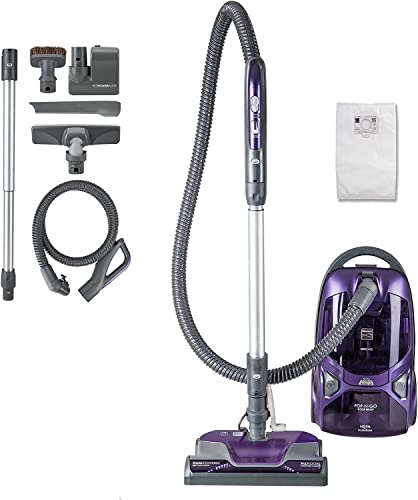
Kenmore 600 Series Bagged Canister Vacuum 81615 — Best Canister for Pets
Canisters are the connoisseur’s format for pet homes with stairs and furniture, and the Kenmore 600 Series is the format’s argument in full: a bagged canister with HEPA filtration, a separate powered floor head, and the Pet PowerMate — a motorised miniature tool that does for sofa cushions, stair treads, and car upholstery what the main head does for floors, pulling embedded hair out of fabric rather than skating over it. The canister body trails behind you, so the weight in the hand is the wand’s, not the machine’s; the retractable cord and two-motor system keep the operation tidy; and the bag keeps the whole harvest sealed from brush to bin.
Strengths
- Pet PowerMate motorised tool — the best upholstery and stair weapon here
- Bagged HEPA containment with canister manoeuvrability
- Light in the hand; the body follows, the wand works
Trade-offs
- Canisters store less neatly than uprights and trail a cord and hose
- Bags and filters are ongoing costs, as with all sealed containment
- The format has a learning curve for lifelong upright users
There is also a storage-and-stairs choreography to canister life that owners either love or tolerate: the body parks in a cupboard, the hose coils, and on stairs the canister sits on a tread below you while the wand works above — a posture upright users find odd for exactly one clean and natural ever after. The 600’s retractable cord removes the most annoying canister ritual, the manual rewind, and its tool caddy keeps the PowerMate where your hand expects it. Judge the format by your house, not by habit: homes with more furniture than floor are canister homes that have not admitted it yet.
Choose the 600 Series when the pet hair problem in your home is vertical — stairs, sofas, beds, car seats — as much as horizontal. Uprights rule floors; this canister rules the furnished house, and in a home with a dog on the sofa and a cat on the stairs, the furnished house is where the dander lives.
Best for: furnished, stair-heavy pet homes needing powered upholstery cleaning / Not suited for: buyers wanting upright simplicity and closet-friendly storage
Sits in the mid-to-premium tier. Check the current price on Amazon
Comparison Table
| Pick | Badge | Key spec | Best for |
|---|---|---|---|
| BISSELL Pet Hair Eraser Turbo Plus | Best Overall | SmartSeal allergen system, tangle-free brush | Bag-free containment, daily pet hair |
| Kenmore Intuition BU4022 | Best Bagged Upright | Bagged + HEPA, lift-up body, HandiMate | Cleanest disposal, mixed floors |
| Simplicity S20EZM | Best Certified HEPA | Certified HEPA, bagged, multi-surface | Filtration-first households |
| Hoover WindTunnel 3 Pet | Best Budget | HEPA media filtration, QuickPass brushroll | Budget-tier filtered cleaning |
| Shark Navigator NV352 | Best Lift-Away | HEPA, detachable pod, swivel steering | Stairs, cars, whole-house pets |
| Kenmore 600 Series 81615 | Best Canister | Bagged HEPA canister, Pet PowerMate | Upholstery, stairs, furnished homes |
The table’s dividing line is disposal philosophy: bagged picks seal the harvest away; sealed bagless picks filter the exhaust and ask care at the bin. Both are honest containment; the right one is the routine your household will keep for years.
How to Choose a Hypoallergenic Vacuum for Pets
Start with the containment system, because it is the keyword. In descending order of disposal cleanliness: a bagged machine with HEPA filtration (the bag is a sealed filter you throw away whole) is the gold standard; a certified-HEPA bagged machine adds paperwork to the same virtue; a sealed bagless system with HEPA exhaust filtration (the BISSELL) is the strong bag-free answer; and HEPA media in an otherwise conventional bagless machine (the Hoover) is the budget expression of the idea. What does not belong on this list at any price is a vacuum whose filtration is an afterthought — a foam pad and a prayer — because its exhaust returns the finest fraction of what it collected to the room, which is precisely the fraction this purchase exists to control.
Second, audit the pet tools with your home in mind. Hair on floors is the easy half; the dander-rich zones are upholstery, stairs, pet beds, and car interiors. A powered or turbo upholstery tool — the Kenmore’s PowerMate and HandiMate, BISSELL’s pet tools — is worth more than a second floor head. Brush-roll design matters over months: tangle-free designs (BISSELL) save the monthly ritual of cutting wrapped hair off a roller with scissors, a ritual that itself shakes collected debris back into the air you were protecting.
Third, match format to architecture. Uprights own wall-to-wall carpet and open floors. Lift-aways own stairs and mixed territory. Canisters own furnished homes where the work is as much on sofas and treads as on floors. Corded machines — all six picks — own unlimited runtime, which in a full pet-house clean is worth more than cordless convenience; the whole-house deep clean is not a ten-minute job, and a battery’s deadline is a containment compromise of its own.
Finally, budget the consumables with open eyes. Bags cost a little, regularly, forever — and buy sealed disposal with that money. Bagless filters cost less often but demand washing discipline; a neglected filter quietly converts a sealed system into a leaky one. Neither is a reason to avoid a pick; both are reasons to choose the routine your household will actually keep, because a hypoallergenic vacuum’s performance in year two is its maintenance, faithfully done.
How to Vacuum a Pet Home for Maximum Particle Control
Technique multiplies machinery. Vacuum in slow, overlapping passes — a fast sweep skims hair and leaves the fine fraction in the pile, while a slow pass lets airflow do the extraction; on carpet, a second pass at right angles to the first lifts what the pile’s direction protected. Work the room in the order that keeps cleaned areas clean — top to bottom, so anything dislodged lands on floor that has not been done yet: furniture and stairs first with the tools, floors last, and empty or change nothing mid-room — disposal happens once, at the end, ideally at an outdoor bin, with the bag sealed or the cup lowered gently into a lined bin rather than shaken.
Frequency beats intensity. Pet dander and hair accumulate daily, and two moderate vacuums a week hold a home at a lower particle level than one heroic Saturday clean that peaks and decays. Between sessions, the highest-value targets are the pet’s own geography: the bed’s surroundings, the sofa’s front edge, the sunny spot where the cat grooms — a five-minute tool pass over the pet map does more for the room’s air than a full pass over empty floor. Wash or replace filters on the maker’s rhythm, brush the brush roll clear before it wraps solid, and the machine you bought will still be the machine described in this guide in year three.
Common Buying Mistakes
- Judging by suction alone. Suction collects; containment keeps. A powerful vacuum with leaky filtration returns the finest particles to the room it just cleaned.
- Assuming “pet” on the box means hypoallergenic. Pet models add tools for hair; hypoallergenic models add sealed, HEPA-level containment. The picks here are chosen for having both.
- Emptying a dirt cup indoors, fast. The disposal puff can undo a room’s worth of filtering. Empty slowly, low in the bin, outdoors where possible — or choose bagged.
- Neglecting filters and bags. A full bag or clogged filter strangles airflow and stresses every seal. The maintenance schedule is the performance schedule.
- Ignoring upholstery. Floors are half the pet’s territory. Without a powered or turbo tool, the sofa and stairs — where dander concentrates — stay loaded.
- Buying the vacuum your friend with different floors loves. Carpet-dominant and hard-floor-dominant pet homes stress different parts of the machine. Match the pick to your surfaces and your pet’s territory, not to someone else’s.
- Expecting a vacuum to be a medical intervention. These machines make pet homes cleaner and more comfortable. Health questions belong to clinicians, not vacuum listings.
Final Recommendation
For most pet households, buy the BISSELL Pet Hair Eraser Turbo Plus: its sealed allergen system, tangle-free brush, and pet tools answer the whole brief without a bag subscription. If disposal cleanliness is your top priority — and for many households it should be — buy the Kenmore Intuition and enjoy the sealed-bag routine, or the Simplicity S20EZM if certified HEPA is the credential you want on the box. Budget buyers get real filtration from the Hoover WindTunnel 3 Pet; whole-house pet territory belongs to the Shark Navigator NV352; and furnished, stair-heavy homes belong to the Kenmore 600 Series canister and its PowerMate. Contain first, tool up for the furniture, maintain the filters — a pet home vacuumed this way is a cleaner, more comfortable home, and that is the honest promise of every pick here.
A last word for households at the start of pet ownership, because this purchase is often made in the first overwhelmed month: the shedding does become routine, and the vacuum is what makes it routine. The homes that cope best are not the ones with the strongest machine but the ones whose machine, rhythm, and disposal method fit together without friction — containment they trust, tools that reach the sofa, a bin routine nobody avoids. Choose from this page on that fit, keep the small maintenance faithfully, and the pet hair will become what it is in every settled pet home: a chore, briefly done, in a house that smells and feels like the animals are a pleasure rather than a weather system.
Related reading in this program: Best Vacuums For Pet Hair · Best Bagged Vacuums · Best Vacuums With Hepa Filters · Best Canister Vacuums For Pet Hair · Best Handheld Vacuums For Pet Hair
Bagged vs Sealed Bagless: The Containment Debate, Settled
Every pet household eventually argues this out, so here is the honest scoring. During cleaning, a well-sealed bagless machine and a bagged machine are closer than their fans admit: both pull exhaust through HEPA-level media, and both keep the room’s air cleaner than they found it. The bagged machine’s filtration is, if anything, more consistent across its life, because the bag’s large media area clogs slowly and evenly, while a bagless filter’s small area loads faster and its performance depends on the owner’s washing rhythm. The decisive moment is disposal. A bag leaves the house sealed, at arm’s length, in seconds. A cup must be opened, inverted, and usually persuaded, and even the best-designed cup — the BISSELL’s easy-empty is genuinely the class of its kind — asks for the slow, low, outdoor technique this guide teaches to approach the bag’s cleanliness.
Cost argues the other way over years: bags are a steady small spend, while bagless filters are an occasional larger one, and households differ in which rhythm they prefer. Mess tolerance argues by person: the household member who gags at the dirt cup is not being precious — they are the reason the vacuum does not get used, and a vacuum unused has a containment rating of zero. The verdict this guide actually gives households is therefore personal, not technical: if anyone in the home avoids emptying the cup, buy bagged and remove the friction; if the cup bothers no one, the sealed bagless picks will serve you faithfully and the money saved on bags buys the filters that keep them sealed. What neither side of the debate may do is skip the filtration — an unsealed, unfiltered machine is not a contestant, whatever its suction.
The Cleaning System Around the Vacuum
A vacuum, however well chosen, is one instrument in a pet home’s particle strategy, and the households that feel the most benefit treat it that way. Hard floors matter first: hair and dander on hard surfaces become airborne with every footstep, so the vacuum’s hard-floor passes — or a quick pass with the hose and floor tool — are air-quality work, not cosmetic work, and the picks with brushroll shutoff or canister floor heads do them without scattering. Soft furnishings come second: curtains’ lower hems, the sofa’s skirts, and the pet bed itself hold a reservoir that re-seeds the room between vacuums, and the powered upholstery tools in this guide exist because that reservoir is unreachable by floor heads.
Grooming is the third instrument, and the cheapest: hair brushed off the dog outdoors is hair that never enters the vacuum’s economy at all, and households that groom weekly report the vacuum’s job shrinking by a visible fraction. Laundry is the fourth — pet blankets and bed covers washed on a rhythm keep the reservoir from compounding — and the fifth is the doormat principle applied indoors: a washable rug at the pet’s favourite entrance catches the outdoor dust the paws import. None of this diminishes the vacuum’s role; it explains it. The vacuum is the heavy artillery of the system, called on twice a week to reset floors and furniture, while the lighter instruments keep the interval between resets from refilling the room. Buy the vacuum for containment, build the small habits around it, and the pet home’s air stays as comfortable as a home with a shedding animal honestly can — which, visitors will tell you, is very comfortable indeed.
Shedding Seasons and Multi-Pet Homes: Scaling the Advice
Twice a year, most double-coated dogs hold a shedding event that changes the arithmetic of everything in this guide: bags fill in days, brush rolls wrap in a single session, and the household that vacuumed twice a week discovers it is a daily household for a fortnight. The machines here scale differently through that season. The bagged picks simply eat bags — stock them before the season, not during — while the bagless picks ask for mid-session cup checks, because a cup packed past its line stops separating and starts leaking performance. The tangle-free BISSELL earns its keep most visibly in these weeks, and the canister’s PowerMate becomes the stair tool of the season, since stairs collect the migration of hair like a river delta.
Multi-pet homes should read every capacity figure in this guide as a per-pet division. Two large dogs are not a slightly bigger problem than one; they are a different maintenance class, and the correct responses are the unglamorous ones: the XL cup or the bagged format, a spare filter so a washing filter never idles the machine, and a standing weekly rhythm that does not depend on anyone’s motivation. Households with both cats and dogs should note the split personality of the debris — dog hair in volume, cat dander in fineness — which is precisely the combination the containment-first picks were chosen for: tools for the visible, filtration for the invisible. Scale the consumables, keep the rhythm, and even a three-pet house stays on the comfortable side of the line these six machines draw.
A Note on the Word “Hypoallergenic”
Because this search carries the word, the guide owes readers a precise account of what it can and cannot mean on a vacuum. “Hypoallergenic” is not a regulated certification for vacuums; no authority stamps it. What exists are measurable components: HEPA filtration has a standard behind it, sealed-system design is an engineering fact a maker can demonstrate, and bagged containment is a physical property of the format. The picks in this guide were chosen on those components — the word is used here as shorthand for “built from the components that reduce airborne pet particles and keep them contained,” and the Simplicity’s certified HEPA is highlighted precisely because certification, where it exists, outranks adjectives.
Read other listings with that lens and the market sorts itself quickly. A vacuum that names its filter standard, describes its seal, and offers a disposal method that keeps hands and air away from the harvest is making a checkable claim. A vacuum that prints “hypoallergenic” beside a foam filter and an open cup is making a wish. The six machines above were held to the first standard; hold every future candidate to it too, and the keyword will keep meaning something when you shop.
Related guides
Frequently Asked Questions
Are bagged vacuums really better for containing pet allergens?
For disposal, yes — the sealed bag removes the collected hair and dander from the house without a dust puff, and the bag itself acts as a filtration stage. Sealed bagless systems with HEPA exhaust, like the BISSELL pick, close most of the gap during cleaning; the remaining difference is the emptying moment.
What does HEPA filtration actually do in a vacuum?
It filters the exhaust air to a fine-particle standard, capturing the small fraction — dander and fine dust — that coarser filters pass back into the room. In this guide’s terms, it is the difference between moving particles around and removing them from the home’s air.
How often should I vacuum with pets?
Two moderate sessions a week hold most pet homes at a steady, comfortable level, with quick tool passes over the pet’s favourite spots between. Frequency beats intensity because accumulation is daily and a vacuum can only remove what has not yet been ground deep into pile. During shedding season, double the rhythm for the fortnight it lasts and return to normal after — the schedule flexes with the dog, and the households that flex with it stop experiencing shedding season as a crisis and start experiencing it as a calendar entry with extra bags on the shopping list.
Can these vacuums handle litter and scattered debris?
Yes — all six handle hard-floor debris, and brushroll shutoff models like the Shark cross from carpet to hard floors without scattering. Pick up the largest clumps first, as with any vacuum, and let the machine do the fine work it is built for. Around litter stations specifically, a slow first pass with the brushroll off collects the scatter without flinging it, and a mat under the box shrinks the territory the vacuum must patrol.
Corded or cordless for a pet home?
For the deep clean this guide is about, corded — which is why all six picks plug in. A full pet-house clean with tools, stairs, and furniture routinely runs past a battery’s comfortable life, and a vacuum that fades mid-clean teaches the household to clean less, which is the opposite of containment. Cordless sticks earn their place as the daily skim between deep cleans, especially at the litter station and the food bowls; treat them as the complement described in the robot-vacuum answer above, not the main instrument. If your home is small enough that a cordless genuinely finishes the whole job on one charge, the containment rules still apply unchanged: sealed system, HEPA exhaust, careful disposal.
Do I still need an air purifier if I buy one of these vacuums?
They do different jobs: the vacuum removes particles from surfaces before they become airborne, and a purifier scrubs the air that remains. Many pet households run both — vacuum on the schedule in this guide, a small purifier in the bedroom — and the combination is the complete comfort system.
Is a robot vacuum a substitute for one of these?
No — it is a complement with a different containment class. Robot vacuums excel at daily surface maintenance between deep cleans, and pet households love them for it, but their small bins fill fast with hair, their filtration is typically a step below the sealed HEPA systems in this guide, and emptying them is a frequent, close-contact job. The pattern that works is robot for the daily skim, one of these six for the twice-weekly deep clean and all the furniture and stairs the robot will never meet. Households choosing only one should choose from this page: the deep clean is the containment event, and the skim is optional in a way it is not.
What should I do if my vacuum starts smelling like dog?
The smell lives in the consumables and the brush roll, in that order. Change the bag or wash and fully dry the filters — a filter reinstalled damp is a smell factory — clear the brush roll of its wrapped hair, which bakes a little with every use, and wipe the dirt cup or bag chamber. If the smell survives all four, it has moved into the hose; a rinse of a detachable hose, dried completely before reassembly, finishes the job. Prevention is the rhythm in this guide: the pet home whose vacuum is maintained smells of nothing, which is the correct smell for the machine in charge of the home’s air.
How long do bags and filters last?
Bags last weeks to a couple of months depending on the pet’s shedding; washable filters want a rinse on the maker’s rhythm and replacement on its schedule. Performance decline is the signal — when suction or freshness fades, the consumable is asking, and answering promptly is the cheapest performance upgrade in the category.
