Disclosure: airfryerkitchensupply.com is reader-supported. When you buy through links on our site, we may earn an affiliate commission at no extra cost to you.
Where to buy
Every pick in this guide to the best air purifiers under 200 was cross-checked against Amazon’s own catalog data before it earned a link, so the buttons below go to the exact product described — not a look-alike listing. Prices in this category move often, so each pick simply asks you to check the current price on Amazon rather than trusting a number printed here that could be stale by the time you read it.
- Levoit Core 300-P (Core 300 Series) (Best Overall Under $200) — Check the current price on Amazon
- BLUEAIR Blue 511 (Best for Small Rooms) — Check the current price on Amazon
- Coway Airmega 50 (Best Smart-Featured Compact) — Check the current price on Amazon
- Medify MA-25 (Best Dual-Filter Design) — Check the current price on Amazon
- Winix A230 (Best with Air-Quality Auto Mode) — Check the current price on Amazon
- BLUEAIR Mini Max Auto (Best Tiny / Desktop) — Check the current price on Amazon
The best air purifiers under 200 dollars are the ones honest about what this tier buys: a real HEPA-class filter, a fan strong enough to cycle a bedroom’s air several times an hour, and running costs that do not ambush you at filter-replacement time. What the tier does not buy is whole-house coverage, and this guide will not pretend otherwise — a compact purifier claiming to clean a mansion is measuring its room with a microscope. Sized to bedrooms, nurseries, home offices and small living rooms, though, the six verified picks here do genuinely useful work on dust, pollen and pet dander.
A note on framing, because it matters: an air purifier is a comfort and air-quality appliance. It captures airborne particles — dust, pollen, dander, smoke particles — and reduces odours with carbon filtration. This guide makes no medical claims for any pick; if you have a health condition, your clinician, not a shopping guide, advises you. What can be said plainly is that cleaner-feeling air, less dust settling on surfaces and a bedroom that smells neutral are real, everyday benefits, and they are the ones these machines are bought for.
Every pick was confirmed against Amazon’s catalog data before receiving a link, and each review states the coverage figure the maker claims alongside the room size it realistically serves — because the honest sizing rule (choose for several air changes per hour in your actual room) matters more than any headline number.
In this guide
Quick Picks
If you only have a minute, these are the six shortlisted options for the best air purifiers under 200, each chosen for a different kind of buyer. The full reviews further down explain who each one suits and where each one compromises.
- Levoit Core 300-P (Core 300 Series) — Best Overall Under $200. The tier’s benchmark: a compact HEPA tower with a quiet sleep mode and AHAM-verified performance, aimed at bedrooms and pet households. — Check price on Amazon
- BLUEAIR Blue 511 — Best for Small Rooms. A compact HEPASilent purifier for bedrooms, dorms and offices — quiet, Energy Star rated, with a washable pre-filter that trims running costs. — Check price on Amazon
- Coway Airmega 50 — Best Smart-Featured Compact. A bedroom purifier with an air-quality monitor, auto mode, filter indicator and a two-year warranty — the most informative compact in the guide. — Check price on Amazon
- Medify MA-25 — Best Dual-Filter Design. A dual-sided True HEPA design pulling air from both flanks — strong capture for bedrooms and living spaces in a compact tower. — Check price on Amazon
- Winix A230 — Best with Air-Quality Auto Mode. A True HEPA tower with carbon filtration, air-quality monitoring and auto mode — Winix’s well-rounded bedroom contender. — Check price on Amazon
- BLUEAIR Mini Max Auto — Best Tiny / Desktop. Blueair’s smallest HEPASilent machine with an auto sensor and washable pre-filter — for desks, dorms and the smallest bedrooms. — Check price on Amazon
How These Picks Were Chosen
Filtration came first: every pick uses a true HEPA or HEPA-class particle filter as its core, with a carbon stage for odours where fitted — ioniser-only gadgets and ‘HEPA-type’ pretenders were excluded. Coverage claims were then read sceptically and translated into realistic room sizes using the air-changes principle: a purifier earns its keep cycling its room’s air multiple times per hour, so maker figures were treated as ceilings, not promises.
Ownership cost and noise completed the audit: filter replacement price class and interval (a cheap machine with exotic filters is not cheap), sleep-mode noise for bedroom picks, and whether controls — timers, auto modes, filter indicators — suit set-and-forget use. Each finalist was verified against catalog data before earning its place, and no pick’s health effects are claimed beyond particle and odour capture.
The 6 Best Air Purifiers Under $200

Levoit Core 300-P (Core 300 Series) — Best Overall Under $200
Levoit’s Core 300 line became the default recommendation in this tier by doing the basics without theatre: a 3-in-1 filter (pre-filter, HEPA, carbon), a genuinely quiet sleep mode for bedrooms, and AHAM VERIFIDE ratings — independent verification that its clean-air delivery matches its claims, which is rarer than it should be. The ‘up to 1,073 ft²’ figure is the maker’s ceiling at maximum speed; read it as an excellent bedroom and small-living-room machine, which is how its owners actually use it. It suits pet owners, light sleepers and anyone buying their first purifier who wants the settled answer.
Strengths
- AHAM VERIFIDE performance — independently checked claims
- Quiet HEPA sleep mode suits bedrooms
- 3-in-1 filter handles particles and everyday odours
Trade-offs
- Realistic sweet spot is a bedroom, not the headline area
- Replacement filters are a recurring cost to plan for
- No air-quality display on this variant — it works quietly and invisibly
| Filtration | 3-in-1: pre-filter, HEPA, activated carbon |
| Verification | AHAM VERIFIDE |
| Modes | Quiet sleep mode |
The Core 300’s real product is trust: in a category full of invented numbers, AHAM verification and a huge, satisfied owner base mean you know what you are getting. Run it on auto or low in the bedroom around the clock — purifiers work by accumulation, not by occasional blasts — and judge it after a fortnight by the dust film on the furniture and the neutrality of the room’s smell.
Pet households should note the Core 300’s ecosystem advantage: its filters are among the most widely stocked in the category, including variants tuned for pet odour and toxin absorption, so the machine can be re-aimed as your household changes — new dog, new baby, new flat near a busy road — without replacing the hardware. In a tier where orphan filters quietly kill machines, that supply chain is a feature as real as any sensor.
Best for: Bedrooms, pet owners and first-time buyers / Not suited for: Large open-plan spaces needing whole-area coverage

BLUEAIR Blue 511 — Best for Small Rooms
Blueair’s Blue 511 is the small-room specialist: a compact footprint for desks and nightstands, HEPASilent filtration that pairs HEPA-class capture with electrostatic assistance for quiet running, and a washable fabric pre-filter that catches the coarse dust and pet hair before the main filter — extending its life and cutting consumable costs. AHAM Verified and Energy Star rated, it suits dorms, nurseries, home offices and smaller bedrooms where the machine must be heard as little as it is seen. As with all picks, treat the headline area as a ceiling and size it to a single room.
Strengths
- Washable pre-filter lowers consumable costs
- Very quiet running for desks and nightstands
- AHAM Verified and Energy Star rated
Trade-offs
- Compact format — a small-room machine by design
- Fabric pre-filter needs regular washing to stay effective
- Design-forward look will not match every room
| Filtration | HEPASilent with washable pre-filter |
| Verification | AHAM Verified, Energy Star |
| Use | Bedroom, dorm, office |
The washable pre-filter is the ownership detail that matters: in a pet household it is the difference between a main filter lasting its intended span and choking early on hair. Wash it monthly, let the HEPASilent core do the fine work, and the 511 becomes one of the cheapest purifiers in this guide to actually live with — the under-$200 tier’s hidden contest, and one Blueair quietly wins.
The 511’s design deserves a practical mention: its fabric pre-filter is also its face, which means the part you wash monthly is the part you look at daily — a rare case of maintenance and aesthetics pulling together. In a dorm or a studio flat, where the purifier is furniture whether it wants to be or not, that tidiness is a genuine reason to choose it over a marginally stronger but uglier box.
Best for: Dorms, offices, nurseries and pet-hair pre-filtering / Not suited for: Living rooms beyond small size

Coway Airmega 50 — Best Smart-Featured Compact
Coway’s Airmega 50 is for buyers who want to see the machine working: its air-quality indicator shows the room’s particle level in real time, auto mode adjusts fan speed to match, and a filter indicator ends the guesswork about replacements. The stated 500 ft² ceiling makes it an honest bedroom machine, and the deodorisation filter stage suits rooms that host pets or sit near kitchens. The two-year warranty is a quiet statement of confidence in a tier where one year is common. It suits nurseries, bedrooms and anyone who finds invisible appliances unsatisfying.
Strengths
- Real-time AQI monitor and auto mode
- Filter replacement indicator
- 2-year warranty — strong for the tier
Trade-offs
- Bedroom-scale coverage by design
- Night light and display may need dimming for light-sensitive sleepers
- Smart feedback features add cost versus basic rivals
| Coverage | Bedroom class, up to 500 ft² claimed |
| Filtration | HEPA + deodorisation filter |
| Features | AQI monitor, auto mode, filter indicator |
The AQI display changes behaviour in a good way: you see the spike when the dog shakes, the dust when bedding is changed, and the machine answering it — which teaches you to run it continuously instead of occasionally. That feedback loop is worth real money in a category whose benefits are otherwise easy to doubt, and Coway executes it in a tidy, quiet package.
Nursery buyers should weigh one detail: the Airmega 50’s night light is gentle and its display informative, but check your own light sensitivity — some parents run it display-dimmed and still value the AQI check at nappy-change hours, when the room’s air story is, briefly, a story. More seriously: the two-year warranty in a nursery appliance that runs 24/7 is real peace of mind, and Coway’s filter availability matches its warranty confidence.
Best for: Nurseries, bedrooms and feedback lovers / Not suited for: Buyers wanting the simplest possible controls

Medify MA-25 — Best Dual-Filter Design
The MA-25’s signature is architectural: filters on both sides of the unit draw air through two True HEPA elements, which suits placement against a wall or between furniture where single-intake machines breathe poorly. Its claimed coverage puts it at the larger end of this tier’s realistic bedroom-and-small-living-room class. Medify built its name on HEPA-grade filtration rather than features, and the MA-25 follows that philosophy — no app, no light show, just filtration done with unusual thoroughness for the tier. It suits particle-focused buyers in homes with pets, dust or nearby traffic.
Strengths
- Dual True HEPA filters, two-sided intake
- Placement-friendly against walls
- Filtration-first design without gadget tax
Trade-offs
- Two filters to replace when the time comes
- Fewer convenience features than the Coway
- Compact tower still a single-room machine
| Filtration | Dual True HEPA |
| Coverage | Up to 825 ft² claimed |
| Design | Two-sided intake tower |
Choose the MA-25 when placement is your constraint: most purifiers want open air on all sides, and most rooms do not offer it. The dual-intake design keeps working where others suffocate, and the filtration-per-dollar is among the best in this guide. Keep the maker’s coverage figure in perspective — a bedroom or modest living room, run continuously, is its honest stage.
Allergy-season households — in the everyday comfort sense of pollen-heavy weeks — are the MA-25’s natural constituency: dual filters and strong capture in the bedroom mean the room you spend eight hours in is the room working hardest. Shut the door, run it from an hour before bed, and the difference in morning dust and stuffiness is the effect its owners describe. It is the purist’s machine in this guide, and pollen season is its showcase.
Best for: Wall-side placement and particle-focused buyers / Not suited for: Feature seekers wanting apps and displays
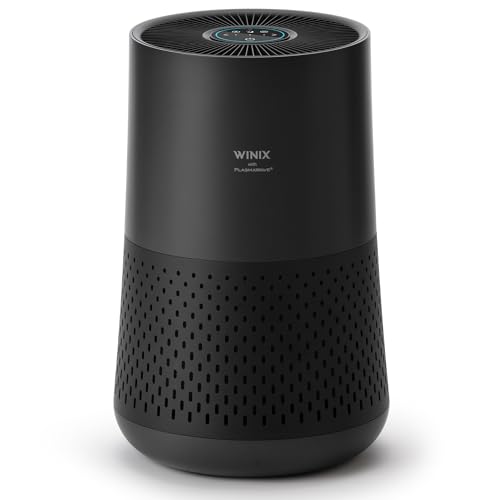
Winix A230 — Best with Air-Quality Auto Mode
The A230 combines the two features that make purifiers effortless: a sensor that watches the air and an auto mode that answers it, wrapped around True HEPA plus carbon filtration for particles and odours together. Winix is a filtration specialist brand, and the A230 carries that competence into the under-$200 tier without drama. The headline coverage figure is a one-hour maximum-speed number; its realistic home is a bedroom or study, where auto mode will spend most of its life at a whisper, surging only when the air actually dirties. It suits set-and-forget buyers in bedrooms with pets or street-facing windows.
Strengths
- True HEPA plus carbon for particles and odours
- Air-quality monitor with genuine auto mode
- Specialist filtration brand at this tier
Trade-offs
- Headline area is a max-speed figure — size it to a bedroom
- Filter replacements follow the brand’s ecosystem
- Tower format needs floor space, not a shelf
| Filtration | True HEPA + carbon filter |
| Features | Air quality monitor, auto mode |
| Use | Bedroom class |
Auto mode done properly is the difference between a purifier that is used and one that is owned. The A230’s sensor-driven behaviour — quiet diligence, visible response — makes it the easiest machine here to live with for years without thinking about it, which is precisely the ownership pattern that delivers the category’s benefits.
Street-facing flats are the A230’s showcase: windows that must open for air import traffic dust continuously, and a sensor-driven machine answers that variable load intelligently — idling on clean mornings, working when the road does. The carbon stage earns its place here too, taking the edge off exhaust smell that pure HEPA machines ignore. If your postcode is your pollution source, this is your pick.
Best for: Set-and-forget bedroom use / Not suited for: Whole-flat coverage from one unit

BLUEAIR Mini Max Auto — Best Tiny / Desktop
The Mini Max Auto accepts its scale honestly: it is a personal-space purifier for the smallest rooms — a dorm single, a desk corner, a nursery nook — with an auto sensor that adjusts to the air, quiet HEPASilent filtration and the same washable pre-filter economy as its bigger sibling. It suits students, desk workers and anyone whose ‘room’ is really a zone within a room. What it will not do is cleanse a family living room, and this guide lists it for its true purpose rather than its theoretical maximum.
Strengths
- Genuinely compact with auto sensing
- Washable pre-filter keeps consumables low
- Very quiet for desk and bedside duty
Trade-offs
- Personal-space scale — the smallest coverage here
- Not a substitute for a full bedroom unit in larger rooms
- Premium per litre of air among these picks
| Filtration | HEPASilent, washable pre-filter |
| Features | Auto sensor |
| Use | Small spaces, dorm, office |
Small purifiers are usually toys; this one is a real Blueair in miniature, with the sensor and filtration philosophy intact. For a student room or a home-office desk it is exactly right, and its washable pre-filter makes it the cheapest machine here to run month to month. Just buy it for the space it names — small — and it will not disappoint.
Do not overlook the Mini Max as a second machine: many households run a full-size purifier in the bedroom and discover the home office — eight hours a day of breathing at a desk — is where they notice dust most. A personal-space unit at the desk is a legitimate strategy, and this one’s auto sensor means it simply joins the furniture. Small rooms and second rooms are its honest empire.
Best for: Dorms, desks and the smallest bedrooms / Not suited for: Any room beyond small — step up to the Blue 511
Comparison Table
| Pick | Badge | Key spec | Best for |
|---|---|---|---|
| Levoit Core 300-P (Core 300 Series) Check price on Amazon | Best Overall Under $200 | HEPA 3-in-1, AHAM verified, sleep mode | Bedrooms, pet owners and first-time buyers |
| BLUEAIR Blue 511 Check price on Amazon | Best for Small Rooms | HEPASilent, washable pre-filter | Dorms, offices, nurseries and pet-hair pre-filtering |
| Coway Airmega 50 Check price on Amazon | Best Smart-Featured Compact | AQI monitor, auto mode, HEPA | Nurseries, bedrooms and feedback lovers |
| Medify MA-25 Check price on Amazon | Best Dual-Filter Design | Dual True HEPA, two-sided intake | Wall-side placement and particle-focused buyers |
| Winix A230 Check price on Amazon | Best with Air-Quality Auto Mode | True HEPA + carbon, auto mode | Set-and-forget bedroom use |
| BLUEAIR Mini Max Auto Check price on Amazon | Best Tiny / Desktop | Mini HEPASilent, auto sensor | Dorms, desks and the smallest bedrooms |
How to Choose the Best Air Purifiers Under $200
Size the machine to the room by air changes, not by the box’s biggest number. A purifier’s job is to pass the room’s air through its filter repeatedly; for everyday dust and dander control, aim for the machine to cycle the room’s volume several times an hour at a speed you can tolerate listening to. Maker coverage figures are usually calculated at maximum speed for a single air change — translate them down. In practice, this tier’s honest territory is bedrooms, nurseries, offices and small living rooms, one machine per room, doors closed for best effect.
Then read the filter stack. The non-negotiables: a true HEPA (or verified HEPA-class, like HEPASilent) particle stage, because that is what captures dust, pollen and dander; a carbon stage if odours — pets, cooking, traffic — are part of your problem, because HEPA alone does nothing for smells; and a pre-filter, ideally washable, to catch hair and coarse dust before they shorten the main filter’s life. Be wary of ioniser-only devices and ozone-generating claims at any price; this guide’s picks are all filter machines, deliberately.
Running costs: the second price of every purifier
Under $200 buys the machine; the filters are the subscription. Before choosing, note each model’s replacement filter price class and rated interval, and whether the pre-filter washes (Blueair’s do — a genuine saving in pet homes). Run the machine continuously on low rather than occasionally on turbo: electricity draw at low speed is small, filters age by air volume rather than drama, and the air stays consistently cleaner. A purifier in a cupboard, or switched off to ‘save the filter,’ delivers exactly no benefit.
Noise: the specification that decides bedroom success
A purifier you turn off at night is a sculpture. Bedroom picks need a sleep mode or low setting you can genuinely sleep beside — the Levoit and Blueair models here are chosen partly for exactly that. Place the machine a metre or so from the bed, not on the nightstand, and let auto modes (Coway, Winix) manage the surges when the air dirties at 3 a.m.
What an Air Purifier Can and Cannot Do
It can capture airborne particles — dust, pollen, pet dander, smoke particles — and, with carbon, reduce many household odours. Owners reliably report less dust settling, fresher-smelling rooms and easier breathing-feeling air in the everyday, comfort sense of the phrase. It cannot sterilise a room, remove gases without the right carbon load, clean surfaces, or substitute for ventilation, source control or medical care. This guide frames every pick as the comfort and air-quality appliance it is — and within that honest frame, a good one is one of the most satisfying small appliances a bedroom can gain.
How to Set Up and Run an Air Purifier for Best Results
Purifiers reward correct placement and boring consistency. This setup takes ten minutes and pays back every day.
- Remove the filter packaging. Nearly every purifier ships with its filter sealed in plastic inside the unit. Open it, unwrap the filter, refit it. Running a sealed filter is the most common — and most silent — setup failure in the category.
- Place it with breathing room. Set the unit on the floor or a low stand with clear space around its intakes — against a wall is fine for the dual-intake Medify, but never inside a cabinet or behind a curtain. A metre from the bed is a good bedroom rule.
- Close the room, mostly. Purifiers clean a defined volume. A closed or nearly closed door lets the machine win against incoming dust; a wide-open door to the whole flat dilutes it into decoration.
- Run it continuously. Low or auto, 24/7. Air quality is an accumulation game: continuous running holds the level; occasional blasts chase it. Use sleep mode at night rather than switching off.
- Maintain the pre-filter monthly. Vacuum or wash the pre-filter (washable ones per the maker’s instructions) every month, more often with pets. A choked pre-filter starves the whole machine.
- Replace filters on the indicator, not the calendar. Use the machine’s filter indicator or the maker’s interval, and budget the replacement when you buy the machine — not as a surprise a year later.
Follow this and judge the machine after a fortnight — by the dust on the shelves, the smell of the room at dawn, and how little you think about it. Invisibility is success in this category.
Placement and Room Strategy: One Purifier Per Closed Space
The most common purifier disappointment is strategic, not mechanical: one small machine placed in a hallway, expected to serve a whole flat through open doors. Air does not work that way. A purifier cleans the volume it can cycle, so the winning strategy is one machine per closed space, starting where you spend the most hours — the bedroom first (eight hours a night), then the room you work in, then living spaces. The under-$200 tier is priced exactly for this room-by-room build-out, which is why this guide favours honest single-room machines over one heroic claim.
Within the room, placement is simple physics: floor or low stand, intakes unobstructed, away from corners that starve airflow, and not beside a constantly opening door that keeps importing the rest of the house. Give the machine a defined, closable volume and time, and even the smallest pick here — the Mini Max in a dorm room — produces a room that feels different by morning.
Filters, Subscriptions and the Honest Total Cost
Do the full arithmetic before choosing, because the tier’s real competition is total cost over three years, not shelf price. Add the machine, three years of replacement filters at the maker’s interval, and a rough electricity figure for continuous low-speed running (small — these are fan appliances, not heaters). Models with washable pre-filters (both Blueairs) trim the filter term in pet homes; models with ubiquitous filters (the Levoit) trim the hassle term. None of the six is a trap — but they are not equal, and the differences live in year two, not in the box.
One more discipline: buy the first replacement filter when the indicator says so, from a genuine source. Counterfeit and ill-fitting filters leak unfiltered air around their seals and quietly void the machine’s purpose. The verified links in this guide lead to the machines; for filters, follow the maker’s own channel with the same care.
A Room-by-Room Plan for a Whole Home, on This Tier’s Budget
Because this tier is one-room money, the smart spend is sequenced. First machine: the main bedroom — the Levoit or the Winix — because eight hours of breathing is the largest exposure in any home. Second: the room where the household works or studies, where the Blueair 511 or the Medify earns its place. Third: the nursery or the second bedroom, where the Coway’s feedback and warranty suit the stakes. Living rooms come last and largest — by then you will know your filter costs, your noise tolerance and your brand, and you can size up within the family you already trust.
Resist the alternative strategy — one big claim in a hallway — with confidence. Three honest room machines outperform one heroic corridor machine every day of the year, because air changes happen in closed volumes. The tier’s affordability is not a limitation on this plan; it is what makes the plan possible at all.
Living With a Purifier: The First Month
Week one is for placement and habit: filter unwrapped, machine positioned, sleep mode discovered, and the small realisation that a new faint sound has joined the house. Week two is when the evidence starts: the dust film on the television and shelves forms more slowly, the bedroom smells like nothing at dawn, and the pre-filter — check it — shows you a grey felt of everything the machine has eaten on your behalf. That pre-filter moment converts more sceptics than any specification.
By month one the machine should have disappeared into the furniture, which is the goal. Your remaining duties are monthly pre-filter care and a note of the filter replacement season in the calendar. Judge the purchase then, on the dusting you are not doing and the mornings you are waking to — the category’s benefits are domestic and cumulative, and a month is their honest trial period.
Verdict by Room and Household
The main bedroom: the Levoit Core 300-P as the default, the Winix A230 if you want sensor-driven auto behaviour, the Coway Airmega 50 if you want to watch it work and value the longer warranty. The pet household’s bedroom: the Levoit again — its filter ecosystem is the pet owner’s friend — or the Blueair 511 where hair load is heavy and the washable pre-filter earns weekly. The nursery: the Coway, quiet and informative, with its display managed to your light preference. The student room and the desk: the Blueair Mini Max, honestly scaled. The wall-hugging living room: the Medify MA-25, breathing through both sides where other machines suffocate.
The street-facing flat: the Winix, carbon stage and all, answering a variable load intelligently. The pollen-season bedroom — in the everyday comfort sense: the Medify or the Levoit, door closed, running from before bedtime. The sceptic’s first machine: the Levoit, because AHAM verification and a decade of owners answer the ‘does it even work’ question better than any review can, this one included.
Every verdict carries the same operating covenant, because the category rewards it absolutely: unwrap the filter, place the machine in a closable room, run it continuously at a listenable speed, wash the pre-filter monthly, and replace the main filter on schedule. Do those five things and an under-$200 machine will change a room’s air in ways you can feel on the furniture and smell at dawn. Skip them, and no tier at any price can help you.
Purifiers and Open Windows: The Ventilation Question
Owners often ask whether a purifier replaces fresh air. It does not, and the two are partners rather than rivals. Ventilation dilutes indoor-generated pollutants and brings in outdoor air — which, depending on your street and season, may itself carry pollen and traffic particles. The working pattern most households settle on: ventilate briefly and deliberately (windows wide for a short exchange beats windows cracked all day), then let the purifier polish the room’s air back to clean in the closed hours that follow — which is most of the day, and all of the night.
In pollen-heavy weeks or near busy roads, that pattern inverts for bedrooms: windows closed at night, purifier on, and ventilation done at the day’s cleanest hour. The machines in this guide are sized and silenced for exactly that night duty. Think of the purifier as the night shift and the window as the day shift, and the apparent contradiction resolves into a routine.
Second-Hand, Refurbished and Other Ways to Stretch the Tier
Because this tier is defined by a budget frame, a word on stretching it honestly. Manufacturer-refurbished units from the brands in this guide can be excellent value — the hardware is a fan and a box, and a refurbished fan is a fan — provided the unit arrives with a new, sealed filter and its warranty status is stated in writing. A used purifier with a stranger’s loaded filter is not a bargain at any price; budget a genuine new filter into any second-hand purchase and the arithmetic usually still works, but only just, and only for the verified brands whose filters remain in production.
What to avoid: discontinued models whose filters have left production (a purifier without a filter supply is a lamp), marketplace listings using the brands’ names on generic hardware, and any device whose filtration is described only in adjectives. The verification discipline of this guide — named filter type, stated coverage, checkable claims — is the same discipline that protects a second-hand purchase. However you buy, buy a machine whose future filters you can also buy; in this category, the consumable is the product and the box is its delivery mechanism.
One Last Habit: The Monthly Minute
Tie pre-filter care to a date you already keep — the first of the month, a rent day, a bin day. Sixty seconds with the vacuum or the sink, every month, on schedule, is the entire maintenance secret of this category. Machines do not fail their owners nearly as often as calendars do; give yours a date and it will not.
Common Buying Mistakes
Buying for the headline room size. Maker areas assume maximum speed and minimal air changes. Size for several air changes per hour in your real room, at a listenable speed — or buy the next size up.
Leaving the filter in its plastic. It happens constantly and silently. Unwrap the filter before first use, every time.
Switching it off to ‘save’ it. A purifier’s benefits exist only while it runs. Low and continuous beats turbo and occasional, for air quality, noise and filter economics alike.
Ignoring odour sources. HEPA captures particles, not smells; odours need the carbon stage and, better, source control. No purifier outruns a litter tray that needs changing.
Forgetting the replacement filter budget. The machine is half the purchase. A model whose filters you will not buy is a model that stops working in a year — check the consumable before the hardware.
Final Recommendation
The Levoit Core 300-P is the settled default under $200: verified performance, quiet sleep manners, no drama. The Blueair Blue 511 wins small rooms and pet-hair economics; the Coway Airmega 50 adds the feedback and warranty thoughtful buyers love; the Medify MA-25 is the filtration purist’s and the wall-placement answer; the Winix A230 is set-and-forget polish; and the Blueair Mini Max serves the smallest spaces honestly. Size yours to one room, run it always, and keep the pre-filter clean.
One framing worth repeating: these are comfort and air-quality appliances, and judged on those terms — dust, freshness, a calmer bedroom — the best of them earn their place quickly. Related guides:
Best Air Purifiers For Small Areas
Best Air Purifiers For Dust And Pet Dander
Best Buckwheat Pillows Under $50
Frequently Asked Questions
What size room can an under-$200 purifier really handle?
A bedroom, nursery, office or small living room — one room, with the door mostly closed. Maker coverage numbers assume maximum fan speed; at the quiet speeds you will actually live with, honest coverage is a single modest room cycled several times an hour. For open-plan spaces, plan on a larger machine or one per zone.
HEPA, HEPASilent, ‘HEPA-type’ — what is the difference?
True HEPA is a defined capture standard for fine particles. HEPASilent (Blueair) combines HEPA-class filtration with electrostatic assistance to run quieter, with AHAM-verified models in this guide. ‘HEPA-type’ and ‘HEPA-style’ are unstandardised marketing phrases — this guide excluded picks that relied on them without verification.
Will a purifier help with pet hair and smells?
It captures airborne dander and hair that reaches the filter — the washable pre-filters on the Blueair picks are made for exactly this — and carbon stages reduce pet odours. It will not vacuum hair off the sofa or replace litter hygiene; think of it as handling the airborne share of the problem, which is the share you breathe.
How often do filters need replacing?
Typically somewhere in the six-to-twelve-month range depending on model, air quality and run hours — the Coway’s filter indicator and each maker’s guidance should lead. Pre-filters need monthly attention. Budget the replacement when you buy; it is part of the real price of the category.
Should I run it all night?
Yes — that is what sleep modes are for. Night is when a bedroom purifier earns its keep: hours of closed-door running at a whisper. All the bedroom picks here are chosen partly for low-speed quietness.
Do air purifiers make medical differences?
This guide makes no medical claims, and you should be suspicious of shopping content that does. Purifiers capture particles and reduce odours — comfort and air-quality benefits that owners value daily. For anything health-related, your own clinician is the right source of advice.
Where should I put the purifier in a bedroom?
On the floor or a low stand, a metre or so from the bed, with its intakes clear of walls, curtains and furniture — the dual-intake Medify tolerates a wall-side spot best. Keep it inside the room it serves with the door mostly closed, and let sleep mode handle the night rather than placing it where you will switch it off.
Do I need a purifier if I open windows every day?
They do different jobs: ventilation exchanges air, the purifier cleans the air that is in the room — including whatever the open window let in. Most households end up using both in sequence, ventilating briefly, then running the purifier through the closed hours. If forced to choose for a bedroom at night, the purifier is the one working while you sleep.
Can I run a purifier in a room with the door open?
You can, but you are then purifying a share of the whole home with a one-room machine, and the effect in your room dilutes accordingly. For sleeping hours especially, a mostly closed door is the difference between a cleaned room and a gesture. Open-plan spaces need either a larger machine or acceptance of a smaller effect.
Why does my purifier’s air smell slightly sweet or odd at first?
New filters and plastics can carry a faint manufacturing scent that fades within days of running. Run the machine in a ventilated room for the first day if it bothers you. A persistent chemical or ozone-like smell is not normal for the filter machines in this guide — stop and contact the maker.
How do I know if it is actually working?
Watch the pre-filter after a month — the grey load it has captured is the machine’s receipt. Beyond that, the dusting interval on shelves lengthens and the room’s morning smell neutralises. The Coway and Winix models add a sensor’s testimony; for the others, the pre-filter and the furniture tell the story honestly.
Is it better to buy one bigger purifier or two from this tier?
For separate closed rooms, two of this tier’s machines win — air changes happen per room, and two honest room machines clean two rooms properly. One bigger machine wins only for a single large open space. Count your closed doors; they, not the floor plan’s total area, decide the strategy.
Can a purifier run safely around children and pets?
The filter machines in this guide are ordinary household appliances — keep cords managed, the unit stable where small hands cannot topple it, and filters changed with the power off. None of the picks relies on ozone generation. As with any appliance, the maker’s own safety guidance for your household is the final word.


