Disclosure: airfryerkitchensupply.com is reader-supported. When you buy through links on our site, we may earn an affiliate commission at no extra cost to you.
Where to buy
All six picks below were confirmed in this batch’s own verification pass and carry a direct link. Five are what the search asks for — low-pile carpets and rugs designed to live under a desk chair, dense enough for casters to roll on instead of sinking into. The sixth is included honestly as the alternative: a clear chair mat, for readers whose real problem turns out to be protecting an existing carpet rather than adding one.
Measure your roll zone before choosing a size. Sit in the chair, roll through your real working movements — to the printer side, back to the desk, the lean-back stretch — and measure the rectangle your casters actually travel. Most people need more width than the standard size gives them, and a rug an inch too small in the direction you roll most is a rug you will roll off of, daily, forever.
36×48 Office Chair Mat Rug for Hardwood Floor, Low Pile (Taupe) — Check the current price on Amazon
Office Chair Mat Rug 36×48 for Hardwood & Tile, Low Pile — Check the current price on Amazon
Office Chair Mat Rug 36×48, Machine Washable (Black) — Check the current price on Amazon
iCasso Office Chair Mat Rug 36×48, Convex (Black) — Check the current price on Amazon
Office Chair Mat Rug 48×60 for Hardwood & Tile, Low Pile — Check the current price on Amazon
BesWin Office Chair Mat for Carpet, 30×48, Clear — Check the current price on Amazon
The best carpet for under desk chairs is a specialist product wearing a generalist’s clothes. A normal rug under a desk chair fails in a predictable sequence: the casters sink into the pile and rolling becomes rowing, the pile crushes into grey tracks within months, the edges curl under the wheel traffic, and the chair ends up harder to move on the rug than off it. A carpet designed for the job is built the opposite way — low, dense pile that casters skim across, a backing that grips the floor instead of travelling, and edges that stay flat under thousands of passes.
Why put carpet under a desk chair at all, when hard floors roll so well? Three honest reasons: noise (casters on hard floors are a drum kit for the room below), floor protection (caster grit grinds finishes dull in a perfect rectangle), and comfort and warmth in a home office that is also a room in a house. On an existing carpet, the problem inverts — the chair sinks — and the answer is the dense low-pile layer or the chair mat in this guide’s final slot.
All six picks were verified in this batch’s session. Sizes cluster around the standard desk footprint, with one larger option for wide roll zones, and the reviews judge pile behaviour, backing grip, edge discipline, and washability — the four things that decide whether an under-chair carpet is still working in year two.
In this guide
Quick Picks
36×48 Office Chair Mat Rug for Hardwood Floor, Low Pile (Taupe) — Best Overall. A low-pile rug-style chair mat in the standard 3×4 size: a fifth of an inch thick, non-slip, washable, in a goes-with-everything taupe — the balanced centre of this category.
Check the current price on Amazon
Office Chair Mat Rug 36×48 for Hardwood & Tile, Low Pile — Best for Tile and Stone Floors. A heavy-duty low-pile rug mat specified for hardwood and tile alike, anti-slip, in the standard size — for kitchens-turned-offices and tiled workspaces.
Check the current price on Amazon
Office Chair Mat Rug 36×48, Machine Washable (Black) — Best Washable. A low-pile, heavy-duty under-desk rug in black that goes in the machine when the coffee loses — the maintenance-first pick for real working desks.
Check the current price on Amazon
iCasso Office Chair Mat Rug 36×48, Convex (Black) — Best Shaped for Desk Cut-Outs. A low-pile under-desk rug with a convex front profile — shaped to follow the desk’s knee cut-out rather than fight it — in black, anti-slip, heavy-duty.
Check the current price on Amazon
Office Chair Mat Rug 48×60 for Hardwood & Tile, Low Pile — Best Large Coverage. The same heavy-duty low-pile rug concept at 48 by 60 inches — for L-shaped desks, wide roll zones, and anyone who has ever rolled off the back of a standard mat.
Check the current price on Amazon
BesWin Office Chair Mat for Carpet, 30×48, Clear — Best Chair-Mat Alternative (Not a Carpet). Included honestly as the alternative: a clear, heavy-duty chair mat for low-carpeted floors — for readers whose chair sits on existing carpet and needs glide and protection, not another layer of pile. [Alternative pick — a mat, not a carpet]
Check the current price on Amazon
How These Picks Were Chosen
The filter for this guide was pile physics: only low-pile, dense carpets whose listings position them for rolling chairs made the shortlist, plus the one chair mat included as the labelled alternative. Plush area rugs, shag anything, and decorative mats with no caster positioning were excluded regardless of how they photograph — under a chair, they are all the same failure at different prices.
We judged on roll quality (casters should cross the surface without ploughing), backing behaviour (the rug must stay where it was put, on hard floor or on carpet, without adhesive heroics), edge discipline (bound or finished edges that lie flat under traffic), and maintenance — washability scored heavily, because the under-desk zone collects coffee, crumbs, and dust at a rate no other rug in the house matches.
We print no prices and no fixed ratings — check the current price on Amazon through the links.
The 6 Best Carpets for Under Desk Chairs

36×48 Office Chair Mat Rug for Hardwood Floor, Low Pile (Taupe) — Best Overall
This is the product the category converged on: not a plastic mat and not a normal rug, but a rug built like a mat — low, dense pile at a stated fifth-of-an-inch thickness, on a non-slip backing, sized 36 by 48 for the standard desk. Casters roll on it the way they roll on a commercial carpet tile, which is the correct reference: this is office carpet logic brought home, in a taupe that disappears under a desk the way it should.
Washability is its quiet superpower. The under-desk zone is the dirtiest rug territory in the house — coffee drips travel, lunch happens, dust settles where feet rest — and a rug you can wash is a rug that stays presentable. The non-slip backing suits its stated home on hardwood and hard floors; on top of existing carpet, read the backing notes in the guide below, because rug-on-carpet grip is a different problem with its own solutions.
Strengths
- True low-pile caster surface at a stated 1/5 in thickness
- Non-slip backing for hard floors; washable for the coffee zone
- Standard 3×4 size in a neutral, office-safe taupe
Trade-offs
- Standard size is tight for wide roll zones — measure first
- Rug-style mats roll slightly softer than rigid plastic mats
- On existing carpet, may need an anchoring solution to stop creep
Key specs
- Size: 36 x 48 in (per Amazon listing title)
- Pile: low pile, 1/5 in thick per the listing
- Non-slip; washable; taupe
Buy this for the standard home office on a hard floor: one desk, one chair, a normal roll pattern. It is the pick to beat for that brief. Wide rollers and L-shaped desk setups should look at the 48×60 pick below; existing-carpet rooms should read the chair-mat slot and the rug-on-carpet section before deciding which layer their chair actually needs.
Best for: standard home offices on hardwood and hard floors / Not suited for: wide roll zones and deep-pile existing carpets
Check the current price on Amazon

Office Chair Mat Rug 36×48 for Hardwood & Tile, Low Pile — Best for Tile and Stone Floors
Tile changes the under-chair problem: casters clatter on it, grout lines catch small wheels, and a thin rug can skate on its smooth surface. This pick is specified for tile as well as hardwood, with a heavy-duty build and an anti-slip brief — the combination that keeps the rug planted on smooth stone and ceramic while the chair rolls over grout lines on a cushioned, quieter layer.
The low-pile carpet surface does the same caster work as our Best Overall, so the choice between them is about your floor and your room: tile and stone floors, heavier-duty expectations, and workspaces that double as utility rooms point here. Like all rug-style mats it trades a little of a rigid mat’s glide for warmth, quiet, and a surface that looks like furnishing rather than equipment — in a room that is also a dining room by night, that trade is the point.
Strengths
- Specified for tile and stone as well as hardwood
- Heavy-duty build with anti-slip backing
- Quietens caster clatter on hard, resonant floors
Trade-offs
- Standard size only in this configuration
- Rug surface needs the wash cycle to stay fresh in utility spaces
- Not the answer for on-carpet use — see the mat slot below
Key specs
- Size: 36 x 48 in (per Amazon listing title)
- Low-pile carpet surface, anti-slip
- Heavy-duty positioning for hard floors and tile
Choose this for the tiled office, the stone-floored study, and the converted kitchen workspace — anywhere the floor is hard, smooth, and loud under casters. Pure hardwood rooms can take either this or the taupe pick on looks; carpeted rooms should skip to the final slot and the rug-on-carpet guidance, where their actual problem is addressed.
Best for: tile, stone, and hardwood workspaces needing grip and quiet / Not suited for: rooms where the chair rolls on existing carpet
Check the current price on Amazon

Office Chair Mat Rug 36×48, Machine Washable (Black) — Best Washable
Every under-desk rug is on a countdown to its first coffee, and this pick’s answer is the washing machine. Machine washable is stated in its name, and for a rug that lives where drinks, snacks, and desk lunches happen, that single specification outlasts any amount of stain-resistant optimism. Black is the co-conspirator: the colour that hides the zone’s evidence between washes, in the rooms — gaming setups, studios, teenagers’ desks — where the evidence is heaviest.
The rest of the specification holds the category standard: low pile for casters, heavy-duty area-rug build, non-slip behaviour on hard floors. Gaming chairs deserve a specific note, because their users roll more, lean harder, and cover more floor than office users: this rug’s heavy-duty positioning suits that traffic, but measure the roll zone with gaming movements in mind — it is always wider than the desk looks.
Strengths
- Machine washable — the coffee-proof specification
- Black hides the under-desk zone’s daily evidence
- Heavy-duty low-pile build for high-roll gaming and office use
Trade-offs
- Black shows dust and light debris between cleans
- Standard size may cramp a gaming chair’s true roll zone
- Machine washing needs a machine that fits a 3×4 rug comfortably
Key specs
- Size: 36 x 48 in (per Amazon listing title)
- Machine washable; non-slip
- Low pile, heavy-duty area rug build; black
Buy it for the desk that is genuinely lived at — meals, drinks, long hours, a gaming chair — where washability is not a bonus but the whole maintenance plan. Formal home offices with a no-drinks discipline can choose on looks alone among the top picks; everyone else should let the washing machine arbitrate, and it arbitrates for this rug.
Best for: lived-at desks, gaming setups, and coffee-prone workspaces / Not suited for: formal offices choosing purely on appearance
Check the current price on Amazon

iCasso Office Chair Mat Rug 36×48, Convex (Black) — Best Shaped for Desk Cut-Outs
Shape is the under-discussed variable in this category. A rectangle under a desk wastes its front corners where no caster ever goes and can run short exactly where the chair rolls out. This iCasso’s convex profile puts material where the rolling happens and trims where it does not, which also reads better in the room: the rug looks placed rather than parked. iCasso’s background is desk accessories, and the design attention shows in that profile choice.
Functionally it holds the guide’s standard — low pile, anti-slip, heavy-duty, specified across tile and hard floors — so the decision against the rectangular picks is genuinely about geometry and looks. Measure your desk’s knee space and your chair’s roll-out line; if they describe a curve more than a rectangle, this is your pick, and the black finish keeps it visually quiet while it does it.
Strengths
- Convex shape follows real roll patterns and desk cut-outs
- Heavy-duty low pile with anti-slip backing
- Looks intentional in designed workspaces
Trade-offs
- Shaped rugs must match your desk geometry to pay off
- Black shows dust like every black textile
- One size — wide zones still need the 48×60 below
Key specs
- Size: 36 x 48 in, convex profile (per Amazon listing title)
- Low pile; anti-slip; heavy duty
- Positioned for tile and hard floors; black
Choose it when your desk has a shaped knee cut-out, your chair rolls out at an angle, or the workspace is on show and rectangles look like equipment. Standard rectangular desks with straight roll patterns gain nothing from the curve and should save the decision for size instead. It is the design pick of the guide, but a disciplined one — the shape is functional before it is decorative.
Best for: shaped desks, angled roll patterns, and design-led workspaces / Not suited for: plain rectangular setups and wide roll zones
Check the current price on Amazon
Office Chair Mat Rug 48×60 for Hardwood & Tile, Low Pile — Best Large Coverage
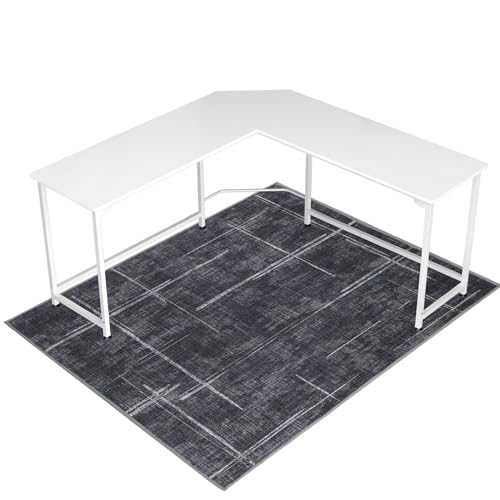
Rolling off the back edge of an under-desk rug is a small daily violence: the caster drops, the chair lurches, the rug edge takes the impact and eventually curls from it. The cure is not technique; it is area. At 48 by 60, this rug covers the full working envelope of most desks — the roll to the side cabinet, the push-back stretch, the lean-and-reach — with margin in every direction, which is what ‘the right size’ actually means in this category.
It shares its line’s specification with the 36×48 tile-and-hardwood pick: heavy-duty, anti-slip, low-pile carpet surface. The larger size also serves standing-desk-adjacent setups and two-chair desks — a desk shared by partners on different shifts, or a parent desk with a child’s homework chair beside it. The costs are literal floor space and a bigger wash load; rooms that cannot spare the footprint should take the standard size and accept the occasional edge, honestly measured.
Strengths
- 48×60 coverage ends roll-off-the-edge for most desks
- Same heavy-duty anti-slip low-pile specification, scaled up
- Serves L-desks, shared desks, and wide gaming roll zones
Trade-offs
- Needs the floor space — measure the room, not just the desk
- Larger rug is a bigger wash and dry commitment
- Overkill for a compact single desk in a small room
Key specs
- Size: 48 x 60 in (per Amazon listing title)
- Low-pile carpet surface; anti-slip; heavy duty
- For hardwood and tile floors per the listing
Buy the big one if your chair’s life is wide — L-desks, side cabinets, gaming movement, shared desks — or if you have already worn out a standard rug’s back edge and know exactly why you are here. Compact setups should not be upsold: a standard rug that fits the room beats a large one that climbs the wall or hides under furniture it was not meant to reach.
Best for: L-shaped desks, wide rollers, gamers, and shared desks / Not suited for: compact rooms and small single desks
Check the current price on Amazon
BesWin Office Chair Mat for Carpet, 30×48, Clear — Best Chair-Mat Alternative (Not a Carpet)
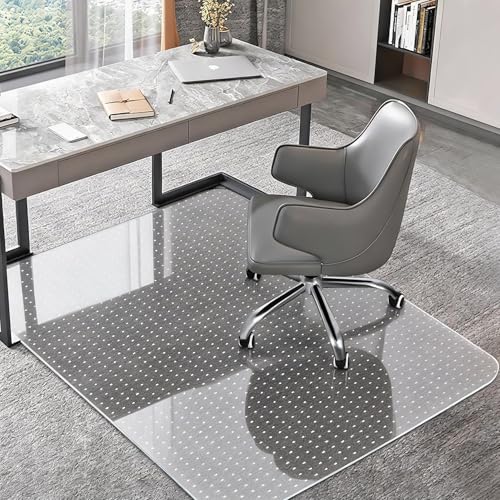
Some searches for carpet for under a desk chair are really searches for the opposite: the chair is already on carpet, sinking into it, and the need is a firm rolling surface that also stops the casters from chewing the carpet beneath. That product is a chair mat, and this BesWin is a verified example of the type: clear, heavy-duty, sized 30 by 48, made for low-carpeted floors, and specified to lie flat without curling — the failure that gives cheap mats their reputation.
We include it as a labelled alternative rather than a carpet pick because honesty about the category serves the reader better than silence: if your floor is hard, every rug above is a better answer than this mat; if your floor is low-pile carpet, this mat may be the answer your search was actually looking for. Its cleated underside grips carpet to stay in place — which also means it is for low carpet only, exactly as its listing states, and deep pile defeats it just as it defeats everything else.
Strengths
- True easy glide on existing low-pile carpet
- Protects the carpet beneath from caster wear
- Specified flat without curling; clear and visually quiet
Trade-offs
- It is not a carpet — no warmth, softness, or sound softening of pile
- Low-pile carpet only; deep pile defeats the cleats and the glide
- Rigid mats can crack if folded or stored bent — handle flat
Key specs
- Size: 30 x 48 in (per Amazon listing title)
- Clear heavy-duty mat for low carpeted floors
- Easy-glide surface; flat-without-curling design
Choose this when the chair lives on carpet and the problems are sinking, drag, and carpet wear — the mat solves all three in a way no rug can, because a rug on carpet adds pile to a pile problem. Choose any pick above it when the floor is hard and the problems are noise, cold, and finish protection. The two product families are answers to opposite floors, and this guide’s honesty about that is deliberate.
Best for: chairs on existing low-pile carpet needing glide and protection / Not suited for: hard floors wanting warmth and quiet — take a rug pick instead
Check the current price on Amazon
Comparison Table
| Pick | Badge | Key spec | Best for |
|---|---|---|---|
| 36×48 Office Chair Mat Rug for Hardwood Floor, Low Pile (Taupe) | Best Overall | Low-pile rug mat, 36×48 in, 1/5 in thick, non-slip, washable | standard home offices on hardwood and hard floors |
| Office Chair Mat Rug 36×48 for Hardwood & Tile, Low Pile | Best for Tile and Stone Floors | Low-pile rug mat, 36×48 in, anti-slip, tile + hardwood | tile, stone, and hardwood workspaces needing grip and quiet |
| Office Chair Mat Rug 36×48, Machine Washable (Black) | Best Washable | Low-pile rug mat, 36×48 in, machine washable, black | lived-at desks, gaming setups, and coffee-prone workspaces |
| iCasso Office Chair Mat Rug 36×48, Convex (Black) | Best Shaped for Desk Cut-Outs | Low-pile rug mat, 36×48 in, convex shape, black | shaped desks, angled roll patterns, and design-led workspaces |
| Office Chair Mat Rug 48×60 for Hardwood & Tile, Low Pile | Best Large Coverage | Low-pile rug mat, 48×60 in, anti-slip, heavy duty | L-shaped desks, wide rollers, gamers, and shared desks |
| BesWin Office Chair Mat for Carpet, 30×48, Clear | Best Chair-Mat Alternative (Not a Carpet) | Clear chair mat, 30×48 in, for low-pile carpet (alternative pick) | chairs on existing low-pile carpet needing glide and protection |
Pile Physics: Why Low and Dense Rolls and Plush Fails
A caster is a small wheel carrying a point load, and it interacts with pile the way a bicycle interacts with sand. In plush or shag pile, the wheel sinks until the pile’s resistance equals the load, and every roll means climbing out of the hole you are making — that is the rowing feeling, and it is physics, not a defective rug. In low, dense pile, the wheel rides on a surface that barely deforms: rolling resistance drops to near hard-floor levels while the carpet still does its acoustic and protective work.
Density matters as much as height. A low but sparse pile crushes flat in the traffic lanes within months, leaving polished tracks and a rug that is two products — flat where you roll, fluffy where you do not. The picks in this guide are specified as heavy-duty and dense for exactly this reason: under a desk chair, a carpet’s service life is measured in caster passes, and density is what survives them.
The practical test when shopping anywhere: press your thumb hard into the pile. If you can feel the backing easily and the pile springs apart rather than resisting as a mass, it will not survive a chair. If the pile feels like a firm, tight field — the commercial-carpet handshake — it is built for the job.
Sizing the Roll Zone: Measure Your Chair’s Real Life
The standard 36×48 size assumes a standard life: one desk, facing one way, with rolls forward and back. Real lives are wider. Sit in your chair and perform your actual repertoire — roll to the side drawer, spin to the printer, push back and stretch, lean to the shelf — while someone marks the floor, or mark it yourself with painter’s tape at the extremes. That rectangle, plus a margin, is your rug size, and for many people it is the 48×60 in this guide wearing the standard size’s clothes.
Depth is the dimension everyone under-buys. The push-back from the desk — the single most common roll — travels further than the desk’s footprint suggests, and a rug that ends mid-push-back puts its back edge exactly where the casters land hardest. When between sizes, buy depth first and width second; the edge you roll over daily should be the room’s wall, not your rug’s.
- Mark your real roll extremes with tape before ordering
- Standard desks: 36×48 in is the honest minimum
- L-desks, side storage, gaming movement: 48×60 in
- Prioritise depth (the push-back) over width when between sizes
- Leave the rug flat and fully inside the roll zone — no furniture legs on its edges
Rug on Carpet: Creep, Anchoring, and When to Choose the Mat Instead
A rug laid on existing carpet wants to travel. Caster traffic walks it forward in small increments — creep — and a rug that started centred ends the month bunched against the desk legs. Non-slip backings designed for hard floors do little on pile. Partial answers exist: rug anchors and gripper pads made for carpet-on-carpet, and heavier, stiffer rugs creep less. But the honest engineering answer for a chair on carpet is often the chair mat in this guide’s final slot, whose cleats are designed for exactly this interface.
Choose the layered rug when the goal is zone definition and warmth in a carpeted room and the chair’s rolling is light; choose the mat when rolling is constant and creep would drive you daily. What does not work is pretending the problem away — an unanchored rug on carpet under a working chair is a rug in motion, and everything placed by measurement in this guide assumes a surface that stays where it was put.
Protecting the Floor Beneath: What the Rug Is Really For
On hardwood, the enemy is not the caster — it is the grit the caster grinds. Sand and grit tracked to the desk zone get under the wheels and act as an abrasive slurry, dulling the finish in a perfect map of your roll zone over a year or two. A low-pile rug intercepts that: grit lands in the pile, the wheels roll on fibre, and the finish below stays out of the experiment. Shake and wash the rug on a rhythm and the protection renews; ignore it and the rug becomes the grit’s storage unit, which is why washability scores so heavily in this guide’s picks.
On tile and stone the protection story is noise and grout: casters clatter, small wheels catch grout lines, and point loads on tile edges are a long-term chip risk a cushioned layer removes. On carpet, as covered, the protection runs the other way — the mat protects the carpet from the chair. In every case the under-chair layer is cheaper than the floor it covers, which is the entire economic argument for the category.
Casters Matter Too: The Wheel Half of the System
If rolling still feels wrong on a good low-pile rug, look at the wheels. Standard hard nylon casters are designed for carpet in the abstract and are merely adequate at everything; softer rollerblade-style casters roll quieter and smoother on hard floors and rug surfaces alike, and grip rather than skid on the push-back. They are a cheap, reversible upgrade that many desk workers rate above the rug itself — the two together are the finished system.
Bell-glides and fixed feet are the other honest option for a chair that does not actually need to roll: if your work is screen-fixed and your ‘rolling’ is really fidgeting, glides end the whole problem and any low-pile rug becomes purely comfort. Match the hardware to the behaviour you actually have, not the chair’s default configuration.
Care: Keeping an Under-Desk Rug Flat, Clean, and Rolling
Vacuum the rug on the room’s normal rhythm — the pile collects the grit that is its job to collect — and wash the washable picks on the schedule their state demands rather than a calendar: coffee incidents immediately, a general wash when the traffic lanes grey. Dry flat and fully before it goes back under the chair; a damp backing on a hard floor is a slip and a smell in waiting.
Edges are the maintenance frontier. If an edge begins to lift, deal with it the same week: weight it flat overnight, check for a furniture leg pinning it into a fold, and never let casters keep striking a lifted edge, which is how a lift becomes a curl becomes a trip. A rug retired for edge failure while its field is still perfect is the category’s commonest waste — and the most preventable.
Standing Desks, Shared Desks, and Other Real Office Layouts
A sit-stand desk changes the rug’s job: half the day the zone is a standing area, and the rug becomes an anti-fatigue surface as much as a rolling one. Low-pile rugs are thinner than standing mats, so long standing hours may still want a mat on top at the standing position — the rug defines the zone, the mat serves the standing hours, and the chair rolls over both territories without complaint. Size the rug for the combined footprint: chair roll zone plus standing position, which usually means the 48×60.
Shared desks — partners on shifts, a family desk, a homework station — double the traffic and widen the zone, and they argue for the heavy-duty, washable end of this guide. Two chairs means two roll patterns; measure both, buy for the union of the two zones, and expect the wash rhythm to double too. The rug that serves a shared desk well is infrastructure for the household, and should be bought with the same seriousness as the desk itself.
How to Set Up a Carpet Under Your Desk Chair Properly
Ten minutes of setup decides whether an under-chair carpet works for years or wanders, curls, and disappoints within a month. The sequence below assumes a hard floor; the carpet-on-carpet variation is noted where it differs.
- Measure and mark your real roll zone with painter’s tape, sitting in the chair and moving as you work.
- Clean the floor in the zone completely — grit left under a rug becomes the abrasive you bought the rug to stop.
- Unroll the rug and let it relax flat; warm rooms and a few hours cure most packing curl before it matters.
- Position the rug to the tape marks, with its back edge covering your full push-back, and smooth it flat from the centre out.
- On hard floors, confirm the non-slip backing grips by pushing the rug’s corner with your foot — it should resist, not skate.
- On existing carpet, fit carpet-on-carpet anchors — or accept the guidance above and choose the chair mat instead.
- Roll the chair through your full repertoire and adjust the rug’s position once, to the evidence, before calling it done.
- After the first week, re-check edges and position; one small correction early prevents the creep-and-curl story entirely.
That is the whole installation science of the category: measure honestly, start clean, position to the evidence, and correct once early. Do that, and the rug disappears into the working day — which, for a piece of office infrastructure, is the highest praise available.
Common Buying Mistakes
Putting a plush rug under the chair because it looks cosy. Plush pile under casters is rowing practice within a week and crushed grey tracks within a season. The under-chair zone is a traffic surface that happens to be soft; buy it by pile physics — low and dense — and get your cosiness from the chair itself.
Buying the standard size without measuring the roll zone. A rug that ends inside your push-back puts its edge under your casters at their fastest, daily. Tape-measure your real movements first; the 48×60 exists because the standard size is a genuine fit for only some desks.
Laying the rug over a dirty floor. Grit sealed under a rug grinds both the floor and the backing with every pass. The rug is protection only when it starts on a clean surface and is itself shaken and washed on a rhythm.
Expecting a rug to stay put on carpet with no anchoring. Hard-floor non-slip backings do not grip pile, and caster traffic walks an unanchored rug across the room. Use carpet-on-carpet anchors, or take the honest alternative — the cleated chair mat in this guide.
Ignoring a lifting edge. A small edge lift becomes a curl becomes a trip hazard on a schedule measured in weeks, because casters strike it hundreds of times a day. Flatten, weight, or reposition the rug the week the lift appears.
Blaming the rug for bad casters. Worn, hard, or grit-seized casters roll badly on every surface. Before replacing a rug, spin each wheel, clear the hair and grit from the axles, and consider softer casters — the cheapest transformation in the whole setup.
Final Recommendation
For the standard hard-floor home office, start with the taupe 36×48 low-pile rug — it is the category’s balanced centre. Tile and stone floors take its heavy-duty sibling; lived-at and gaming desks take the machine-washable black; shaped desks take the convex iCasso; wide lives take the 48×60. And if your chair stands on existing carpet, take the guide’s honest detour to the BesWin chair mat, which solves the sinking problem no rug can.
Measure the roll zone, respect the pile physics, and keep the rug washed and flat. An under-desk carpet bought that way stops being a furnishing and becomes what it should be: invisible infrastructure for eight hours a day, every working day, in every season of the year at home, without asking for attention or adjustment from one month to the next, or one year to the next, in any room where real work gets done daily at home offices.
Keep exploring this cluster: Best Carpet For Under Desk Chairs Best Bagged Vacuums For Carpet And Hardwood Best Comfy Bath Mats Best Area Rug That Vacuums Easily Best Bags For Blankets Best Stand Alone Bathroom Sinks
Related guides
- Best Floor Mats For Office Chairs On Carpet
- Best Desk Chairs For Producers
- Best Orthopedic Desk Chairs
- Best Xl Desk Chairs
Frequently Asked Questions
What type of carpet is best under a desk chair?
Low, dense pile — the commercial-carpet profile. Casters ride on it instead of sinking into it, it resists crushing in the traffic lanes, and it still softens noise and protects the floor. Every rug pick in this guide is built to that profile. Plush, shag, and high-pile rugs are the category’s standard failure, however good they look on day one.
Do I need a chair mat if I have a rug under my desk?
Not usually — a proper low-pile rug on a hard floor is the complete system, giving roll, quiet, and protection together. A chair mat earns its place on top of existing carpet, where a rug adds pile to a sinking problem and a cleated mat provides the firm glide the chair actually needs. The two products answer opposite floors.
What size rug should I get for under my desk chair?
Measure your chair’s real roll zone — most people are surprised by their push-back distance. A 36×48 rug is the honest minimum for a standard desk; L-desks, side storage, gaming chairs, and shared desks usually need the 48×60. When between sizes, buy depth first: the back edge is where undersizing punishes you daily.
Will a rug under my desk chair damage my hardwood floor?
A clean rug with an intact non-slip backing protects hardwood — it intercepts the grit that casters would otherwise grind into the finish. Damage comes from neglect: grit trapped under a never-lifted rug, or a damp rug left on wood. Lift, shake, and wash on a rhythm, keep the floor dry beneath, and the rug is the floor’s insurance, not its risk.
Why does my rug keep moving under my chair?
On hard floors, a rug that travels has a backing that is dirty, damp, or worn — clean the floor and the backing and the grip usually returns. On carpet, travel is structural: caster traffic creeps any unanchored rug. That case needs carpet-on-carpet anchors or the cleated chair mat — no amount of repositioning fixes physics.
Can I wash an under-desk rug?
The washable picks in this guide, yes — and you should, because the under-desk zone collects coffee, crumbs, and grit faster than any rug in the house. Follow the maker’s instructions, dry the rug flat and fully, and only return it to the floor bone dry. Non-washable rugs can be spot-cleaned and shaken, which is the honest argument for choosing a washable pick at purchase time.
Does an under-desk rug help with noise for the room below?
Yes — it is one of the category’s strongest effects. Caster noise on hard floors transmits through the structure as a rolling rumble that downstairs neighbours and sleeping households know well. A low-pile rug absorbs the contact noise at its source and softens the chair’s whole acoustic footprint. In flats and shared houses, that alone can justify the purchase before any question of floors or comfort arises.
Are rollerblade-style casters worth it with a rug?
For many desk workers, yes: softer wheels roll smoother and quieter on low-pile rugs and hard floors alike, and they are kinder to both surfaces. They do not rescue a plush rug — pile physics still rules — but on a proper low-pile rug they complete the system. Check your chair’s stem size before ordering, as fittings vary.
Can I use a regular area rug I already own under my desk chair?
You can test it honestly in a week: if the pile is low and dense, the chair rolls without rowing, and the rug stays put, it is already the right product and this guide has saved you a purchase. If rolling drags, the pile shows tracks, or the rug creeps, no adjustment will fix it — those are construction properties, not setup errors — and a purpose-built low-pile pick will feel like a different category, because it is one.
How long should an under-desk carpet last?
A dense, heavy-duty low-pile rug in this guide’s class should serve several years of daily rolling before the traffic lanes show real wear. Its life is set by density, washing, and edge care more than by time. When the pile in the roll zone crushes flat and no longer springs back after washing, the rug has done its service — replace it before the casters start reaching the floor through it.


