Disclosure: airfryerkitchensupply.com is reader-supported. When you buy through links on our site, we may earn an affiliate commission at no extra cost to you.
Where to buy
Every model in this guide is sold through Amazon, and the fastest way to compare the current filter bundles and configurations is to check each pick at the retailer directly: the WINIX 5510 for most homes, the Rabbit Air MinusA2 for serious litter-box odor, the Levoit Core 300-P for bedrooms, the LEVOIT Vital 200S-P if you want app control, the BLUEAIR Blue 211i Max for big open-plan rooms, and the COWAY Airmega 50 for small spaces. Check the current price on Amazon for each one, and confirm that the listing includes the genuine filter set the model ships with, because third-party filter bundles change what you actually receive.
Cat odor is a different problem from cat hair, and it is worth saying that plainly before any product names. The best air purifiers for cat odors have to do two separate jobs at once: trap the airborne particles a cat sheds — dander, hair fragments, litter dust — and absorb the gases that actually smell, which come mainly from the litter box, from urine accidents that were cleaned but not fully neutralized, and from the general ammonia-and-organic-compound haze of a multi-cat home. A purifier that only does the first job will leave the room clearer but still smelling like a litter box. A purifier that only claims odor control without real particle filtration will perfume the problem rather than solve it. This guide is built around that split, and every pick below was chosen because it addresses both sides with a genuine HEPA stage plus a meaningful activated-carbon stage, sized honestly for the room it claims to cover.
There is also a limit worth knowing up front. No air purifier cleans a litter box. If the box itself is the source and it is scooped once a week, the best machine in this list will spend its life fighting a losing battle a few feet from the source. Purifiers handle the odor that escapes into the room air; source habits — daily scooping, litter choice, box placement — decide how much escapes in the first place. The how-to section later in this guide covers placement and habits in detail, because with cat odor the machine is only about half of the result.
In this guide
Quick Picks
- Best Overall — WINIX 5510: a true HEPA stage paired with a heavy deodorization carbon filter and an auto mode that reacts when the litter box gets used. Check on Amazon
- Best for Stubborn Litter Box Odor — Rabbit Air MinusA2 SPA-780A: a customizable filter system with a dedicated odor-remover filter option, wall-mountable so it can sit right in the room where the box lives. Check on Amazon
- Best for Bedrooms — Levoit Core 300-P: a compact pet-focused unit with a quiet sleep mode, sized for the room where you actually notice odor at night. Check on Amazon
- Best Smart Pick — LEVOIT Vital 200S-P: app control, an air quality monitor, and a washable pre-filter that catches the hair before it loads the main filter. Check on Amazon
- Best for Large Open-Plan Homes — BLUEAIR Blue 211i Max: the biggest coverage in this guide for homes where the litter area shares air with the living space. Check on Amazon
- Best Compact for Small Rooms — COWAY Airmega 50: a small-footprint unit with a dedicated deodorization filter, made for a single room, a studio, or a laundry-room litter corner. Check on Amazon
How These Picks Were Chosen
Cat odor is mostly gas, not particles, so the first filter applied to every candidate was the carbon question: does this model carry a substantial activated-carbon stage, or just a thin carbon sheet behind the HEPA filter that saturates in a few weeks? Models with a dedicated deodorization filter, a pelletized carbon bed, or a customizable odor filter option ranked highest, because ammonia and the organic compounds from a litter box are exactly what activated carbon is built to adsorb. The second filter was particle performance: a genuine HEPA stage, since dander is the allergen most cat households are also fighting, and dander control and odor control are usually wanted by the same buyer.
Room sizing was checked against honest math rather than marketing math. Manufacturers quote coverage for one air change per hour at best; for odor work you want the purifier to cycle the room air several times an hour on a medium setting you can live with, so each pick below is matched to a realistic room size smaller than its headline number. Noise mattered because odor control only works when the machine is actually running, and a unit that gets switched off for being loud is a unit that does nothing. Filter replacement cost and availability were weighed as ownership factors — a purifier is a subscription in disguise, and cat homes load filters faster than average because of hair. Finally, every product here was cross-checked against Amazon’s catalog data before receiving a link; models that could not be confirmed were left out rather than guessed at.
One more selection note: scented solutions were excluded on principle. Machines that fight odor by adding fragrance — or that rely on ionizers and ozone as their main odor mechanism — mask the problem or introduce a respiratory irritant into a home with an animal whose lungs are smaller and more sensitive than yours. Every pick below works by physically removing particles and adsorbing gases, which is the approach that keeps working the same way in month six as it did in week one.
The 6 Best Air Purifiers for Cat Odors

WINIX 5510 — Best Overall
The WINIX 5510 is the successor to one of the most recommended purifiers in the category, and for a cat household the important part of its design is the pairing: a true HEPA filter for dander and litter dust, plus a high-deodorization carbon filter that is substantially heavier than the token carbon sheets found in cheaper machines. That carbon stage is what makes it the overall pick here. In a typical one- or two-cat home, the odor load is intermittent — worst right after the box is used, noticeable again when you come home after a closed-up day — and the 5510’s auto mode, driven by its air quality sensor, ramps the fan up when it detects a change and settles back down afterward. That behavior matches the actual rhythm of litter-box odor better than a fixed speed does.
Strengths
- Heavy deodorization carbon filter aimed at exactly the gases a litter box produces, not just generic smoke odor.
- Auto mode with a responsive sensor, so the machine works hardest in the minutes after the box is used.
- App support on this generation, letting you check filter life and change modes without walking to the unit.
Trade-offs
- Sized for a living room or large bedroom; in a small room it is more machine than you need.
- The carbon filter is a consumable with a real replacement cost, and heavy litter odor shortens its useful life.
- On its highest setting it is plainly audible — the auto mode exists partly so you rarely need that setting.
The 5510 suits the most common version of this problem: one or two cats, a litter box in a bathroom, laundry room, or corner of a living space, and a household that wants to stop noticing it. It is less suited to a dedicated multi-cat room with several boxes, where a customizable odor-focused system like the Rabbit Air below gives you more targeted options, and it is oversized for a studio corner where the COWAY Airmega 50 does the same job in half the footprint. For everyone in between, this is the machine to start with.
Best for: most one- and two-cat homes with a living-room or large-bedroom litter setup / Not suited for: tiny single rooms or dedicated multi-box cat rooms
Check on Amazon — check price on Amazon and confirm the current filter bundle before ordering.
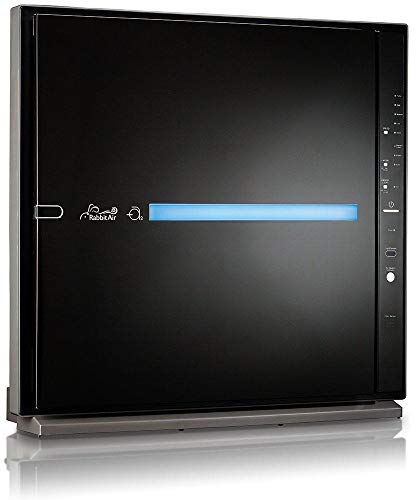
Rabbit Air MinusA2 SPA-780A — Best for Stubborn Litter Box Odor
The Rabbit Air MinusA2 takes a different approach from every other pick here: its filter system is customizable, and one of the filter options is a dedicated odor-remover stage built for exactly the gases that make a litter room smell like a litter room. That matters because stubborn cat odor — the kind that survives regular scooping and a standard purifier — is usually a gas problem concentrated in one room, and a generic carbon sheet is not enough tool for it. The MinusA2 also mounts on a wall, which is more useful than it sounds: in a laundry room or cat room, floor space is where the boxes, the litter bin, and the food bowls already are, and getting the purifier up on the wall puts its intake in the air path instead of behind a storage bin.
Strengths
- Customizable filter set with a dedicated odor-remover option aimed at pet and household gases.
- Wall-mountable slim design that fits the room where the litter box actually lives.
- Very quiet low settings, so it can run continuously in a cat room or adjacent bedroom.
Trade-offs
- Premium positioning: both the unit and its replacement filters sit in the upper tier of this guide.
- Coverage suits one room well rather than a whole open-plan floor.
- The customizable filter system asks you to choose correctly at replacement time; the odor filter is the one cat homes want.
Choose the MinusA2 when the problem is concentrated and persistent — a dedicated cat room, a litter box in a small bathroom with the door usually closed, a multi-cat household where guests notice the smell before you do. Skip it if your odor issue is mild and spread across a large living area, where the WINIX or BLUEAIR move more air for the same ownership effort. It is the specialist in this list, and specialists earn their place when the generalists have already been tried.
Best for: concentrated, stubborn litter-box odor in one room / Not suited for: whole-floor coverage on a tight budget
Check on Amazon — check price on Amazon and look for the odor-remover filter configuration.

Levoit Core 300-P — Best for Bedrooms
The Core 300-P is the pet variant of one of the most common bedroom purifiers sold, and the pet variant is the one to get for this job: its filter is tuned for pet hair, dander, and pet odor rather than the standard dust-and-pollen mix. Bedrooms are where cat odor bothers people most per hour of exposure, because you are lying still in the air for eight hours and because cats so often sleep on the bed itself, depositing dander into the bedding and the room air together. A compact unit that runs quietly all night does more for that experience than a big living-room machine down the hall.
Strengths
- Pet-specific filter configuration targeting hair, dander, and pet odor in one cartridge.
- Quiet sleep mode with the display dimmed, designed to run beside a bed all night.
- Small footprint that fits a nightstand-adjacent corner in rooms where floor space is tight.
Trade-offs
- Honest working range is one bedroom; it will not rescue a living room with the box in it.
- The carbon content is lighter than the WINIX or Rabbit Air, so it manages everyday odor rather than attacking a severe one.
- Filters load faster in homes where the cat sleeps in the same room — budget for replacement on the shorter end of the schedule.
This is the right pick when the litter box is not in the bedroom but the cat is — the dander-and-faint-smell combination that settles into a sleeping space. It is also a sensible second unit: many cat homes end up with a main purifier near the box and a Core 300-P in the bedroom, which is a more effective layout than one oversized machine trying to cover both through doorways. If your only problem room is the bedroom, start here and skip the bigger machines entirely.
Best for: bedrooms where the cat sleeps and dander settles / Not suited for: treating the litter-box room itself
Check on Amazon — check price on Amazon; the P in the name is the pet filter version you want.

LEVOIT Vital 200S-P — Best Smart Pick
The Vital 200S-P is the pick for the owner who wants to see what the purifier is doing. Its air quality monitor displays the particle level in the room, the app adds scheduling and remote control, and — the detail that matters most in a cat home — its pre-filter is washable. Hair is the silent filter-killer in pet households: it mats over the intake and the pre-filter long before the HEPA stage is spent, and a washable pre-filter you can rinse or vacuum monthly keeps the expensive cartridge behind it working at full flow for its full life. The P configuration again denotes the pet filter, aimed at hair, dander, and odor.
Strengths
- Washable pre-filter that intercepts cat hair before it chokes the main cartridge — a real running-cost advantage.
- Air quality display and app control, so you can verify the machine is reacting when the box is used.
- Covers a large bedroom or medium living room, a step up in honest range from the Core 300-P.
Trade-offs
- Smart features are only valuable if you will use them; the app is a means, not the point.
- Carbon capacity is mid-pack — good for ordinary litter odor, not the tool for a severe multi-cat room.
- Slightly larger footprint than the Core series, which matters in a small bedroom.
Pick the Vital 200S-P if your cat sheds heavily, if the purifier will live in the room with the box, or if you are the kind of owner who will actually act on a filter-life notification. The washable pre-filter is the practical headline here: in a heavy-shedding household it can be the difference between a cartridge that lasts its rated life and one that is strangled by hair in half the time. Owners who want set-and-forget simplicity over feedback should look at the WINIX instead.
Best for: heavy-shedding cats and owners who want monitoring and app control / Not suited for: buyers who will never open the app
Check on Amazon — check price on Amazon and confirm the pet filter configuration.

BLUEAIR Blue 211i Max — Best for Large Open-Plan Homes
Open-plan homes defeat small purifiers for a simple physical reason: the litter corner, the kitchen, and the sofa all share one large volume of air, and a bedroom-sized unit cycling one corner of it barely dents the whole. The Blue 211i Max is rated for very large rooms and is the only pick here honestly matched to a big combined living space. Its HEPASilent approach pairs mechanical filtration with electrostatic charging, which lets it move a lot of air at lower noise than a conventional fan-and-filter design of the same output — useful when the machine shares the room with the television. The washable fabric pre-filter also catches a meaningful amount of hair and comes in colors, a small thing that matters when the unit is furniture-sized and permanently on display.
Strengths
- The largest honest coverage in this guide, matched to open-plan living areas where odor spreads.
- Quiet for its output class, so it can run during the evening in the room everyone sits in.
- Washable pre-filter handles the hair load of a living-space cat better than disposable screens.
Trade-offs
- Its carbon stage is integrated rather than a heavy dedicated bed; for a severe box-room problem the Rabbit Air is more targeted.
- Physical size is substantial — measure the corner you intend for it.
- Upper-tier pricing and filter costs, justified only if you genuinely have the large space.
Choose the 211i Max when there is no door between the litter area and the living area — loft-style apartments, open kitchen-living layouts, finished basements where the cat has the run of the space. In a conventional house with doors, two smaller units placed at the source and in the bedroom will usually outperform it for similar money. Its job is the big shared volume, and at that job it is the strongest option here.
Best for: open-plan homes where the litter area shares air with living space / Not suited for: small closed rooms or severe single-room odor
Check on Amazon — check price on Amazon before ordering; replacement filter cost is worth checking at the same time.

COWAY Airmega 50 — Best Compact for Small Rooms
The Airmega 50 is built for the smallest version of the problem: a litter box in a studio bathroom, a laundry corner, a home office the cat has claimed, or a first apartment where the box is unavoidably near where you live. It pairs a HEPA filter with a dedicated deodorization filter — the pairing this whole guide is built around — in a unit small enough to sit on a shelf or a washing machine. Its air quality indicator and auto mode mean it can be left to react on its own in a room you are not always in, and the night light and compact shape suit it to small-space living.
Strengths
- Dedicated deodorization filter in a genuinely compact body — the pairing small units often skip.
- Auto mode and an air quality indicator, so it works unattended in a utility space.
- Two-year warranty backing, longer than most of this category offers.
Trade-offs
- Honest range is a small room only; it will not scale if you move the box to a bigger space.
- Small filters saturate faster under heavy odor load — replacements come sooner in a busy litter corner.
- No app control; if remote scheduling matters, the Vital 200S-P is the step up.
The Airmega 50 is the right answer when the question is small: one cat, one box, one small room, and a need for the smell to stop greeting you at the door. It is also a good utility-room companion to a larger main unit elsewhere in the house. What it is not is a whole-apartment solution, and buying it as one is the most common way buyers end up disappointed with compact purifiers in general.
Best for: studios, small bathrooms, laundry corners, and single-cat small rooms / Not suited for: living rooms or multi-cat open spaces
Check on Amazon — check price on Amazon and note the filter replacement model number for later.
Comparison Table
| Pick | Badge | Key spec | Best for |
|---|---|---|---|
| WINIX 5510 | Best Overall | True HEPA + high-deodorization carbon, auto mode, app support | Most one- and two-cat homes |
| Rabbit Air MinusA2 SPA-780A | Best for Stubborn Litter Box Odor | Customizable filters with dedicated odor-remover option, wall-mountable | Concentrated cat-room odor |
| Levoit Core 300-P | Best for Bedrooms | Pet filter cartridge, quiet sleep mode | Bedrooms where the cat sleeps |
| LEVOIT Vital 200S-P | Best Smart Pick | Washable pre-filter, air quality monitor, app control | Heavy shedders, monitored rooms |
| BLUEAIR Blue 211i Max | Best for Large Open-Plan Homes | Largest coverage in guide, HEPASilent filtration | Open-plan living spaces |
| COWAY Airmega 50 | Best Compact for Small Rooms | HEPA + deodorization filter, compact body, auto mode | Studios and litter corners |
How to Choose an Air Purifier for Cat Odors
Start with the carbon, because that is where cat odor is won or lost. Odor molecules are gases, far smaller than the particles a HEPA filter traps, and they pass straight through a HEPA stage untouched. Activated carbon adsorbs them into its pore structure, but the amount of carbon matters enormously: a thin carbon-impregnated sheet has a small fraction of the capacity of a thick filter or pellet bed, and in a litter-box room the thin sheet can saturate — stop adsorbing and start simply being a filter-shaped object — within weeks. When you compare models, look for language like deodorization filter, odor-remover filter, or high-capacity carbon, and treat a purifier whose carbon is never mentioned as a particle machine that will not solve your actual problem.
Then size for air changes, not for the box-copy room size. The headline coverage figure on most purifiers assumes roughly one air change per hour on the highest, loudest setting. For odor control you want the air in the litter room exchanged several times per hour on a medium setting you can tolerate all day. In practice that means choosing a unit whose rated coverage is two to three times your room’s actual area, or accepting that a smaller unit must live in a smaller room. A purifier matched this way can run on medium, stay quiet, and still keep ahead of the odor the box generates between scoopings.
Consider where the machine will live as carefully as which machine it is. A purifier does its best work in the room with the box, near the source, with clearance around its intake and outlet. If the box is in a bathroom with the door closed, the purifier belongs in that bathroom or just outside the door — not in the living room hoping the air will migrate. Homes with both a box room and a cat-occupied bedroom often do better with two modest units in those two places than with one large unit in the hallway, because air does not turn corners through closed doors on its own.
Noise deserves one more pass, because it decides whether all the other specifications ever get used. A purifier’s cleaning rate climbs with fan speed, and so does its sound; the figures that matter are not the whisper number quoted for the lowest setting but the sound level at the medium setting you sized the machine around. If the purifier lives in a laundry room, this barely matters. If it shares a bedroom or a living room, a machine that is pleasant on medium will run for years, while a louder one gets turned down or off within a month — and a purifier that is off removes nothing at all. When two models otherwise tie, choose the quieter one at working speed, and prefer auto modes with good sensors, because they spend most of the day at their quietest while still surging when the box is used.
Finally, price the filters before you price the machine. Every purifier in this guide is a long-term commitment to a specific replacement cartridge, and cat households run through carbon faster than the schedule printed on the box, because the litter room is a heavier odor environment than the average living room the schedule assumes. Check the replacement filter’s availability and cost at the same time as the unit, look for a washable pre-filter if your cat sheds heavily, and treat a purifier with discontinued or hard-to-find filters as a poor buy no matter how well it performs in month one.
How to Set Up a Purifier for Litter Box Odor
Placement comes first. Put the purifier in the same room as the litter box, a short distance from it rather than directly beside it — close enough that room air passes the box zone and then the intake, far enough that litter dust kicked up during digging does not blast straight into the pre-filter. Keep clearance on all sides; a purifier pushed flush into a corner behind the litter bin is filtering the corner, not the room. If the box is in a bathroom, keep the unit clear of the shower’s direct steam path and plugged into an outlet that stays live — a purifier on a switched outlet that dies with the light does nothing overnight.
Run it continuously. Odor control is a rate problem: the box generates odor in bursts, and the purifier removes it over time. A machine that runs around the clock on auto or a quiet medium setting keeps the room at a steady, low level, while a machine switched on when you notice a smell is always working from behind. Use the auto mode if your model has one, and for the first week, run a higher setting than you think you need — it clears the accumulated load in the room’s soft furnishings faster, after which the maintenance setting has a much easier job.
Maintain the front of the filter stack. Vacuum or rinse the pre-filter monthly in a cat home, more often if you can see a hair mat forming — a clogged pre-filter starves the whole machine. Note the date you install each main filter, because carbon saturation is invisible; the sign is simply that odor starts lingering again despite the machine running. And keep the source habits in step: scoop daily, replace litter on the maker’s schedule, and wash the box itself periodically, since odor baked into scratched plastic is beyond any purifier’s reach.
Common Buying Mistakes
The most common mistake is buying a particle machine for a gas problem — choosing by HEPA claims alone and discovering a month later that the air is clearer but the room still smells. The second is undersizing: trusting the headline room figure, placing a small unit in a large or open space, and concluding that purifiers do not work. The third is placement by furniture logic instead of airflow logic, hiding the unit behind a door or across the house from the box. A fourth is ignoring filter economics — a bargain unit with expensive, short-lived cartridges costs more by year two than the mid-tier machine it undercut. Finally, buyers often expect the purifier to compensate for source habits it cannot fix: an unscooped box, an old plastic box saturated with odor, or a covered box that concentrates smell and then releases it in a burst every time the cat exits. Fix the source first, then let the machine handle what escapes.
Final Recommendation
For most cat homes, buy the WINIX 5510 and put it in the room with the litter box; it is the most complete balance of carbon capacity, particle filtration, and automatic behavior in this guide. If the odor is concentrated and stubborn, step up to the Rabbit Air MinusA2 and its odor-focused filter. For the bedroom, add or choose the Levoit Core 300-P; for monitoring and heavy shedding, the LEVOIT Vital 200S-P; for an open-plan space, the BLUEAIR Blue 211i Max; and for a small room or studio corner, the COWAY Airmega 50. If you are comparing related needs, see our guides to Best Air Purifiers For Cat Dander, Best Air Purifiers For Odor Elimination, Best Hepa Air Purifiers For Cat Allergies, and Best Air Purifiers For Dust And Pet Dander for the allergy-focused side of the same problem.
Cat Odor Room by Room: Where the Smell Actually Lives
It helps to think about cat odor as three separate problems wearing one name, because each responds to a different part of the purifier. The first is the litter box itself and the few feet of air around it. This is the highest-concentration zone, dominated by ammonia from urine and the volatile compounds from waste, and it is worst in the hour after the box is used and in warm, still air. A purifier in this room works on the highest concentration, which is exactly where carbon adsorption is most efficient — carbon removes a greater share of what passes through it when the incoming air carries more of the target gas. This is why source-room placement beats any other layout.
The second problem is the trail: the air path between the box room and the rest of the home. Cats track litter dust on their paws, shake it loose where they jump and groom, and carry dander on fur that ends up on every soft surface they touch. Odor in this zone is weaker but more widespread, and it clings to upholstery, curtains, and bedding, which then re-release it into the room slowly. A purifier cannot extract odor from a sofa cushion, but by keeping the room air clean it stops the cycle of deposition — fabrics absorb far less odor from clean air, and over a few weeks of continuous running, rooms often smell better than the machine’s airflow alone would explain, simply because the soft furnishings are no longer being re-charged every day.
The third problem is the bedroom, and it is mostly a dander-and-exposure problem rather than a box problem. You spend a third of your life in that room, breathing its air at close range, with bedding that collects everything the cat deposits during the day. This is why this guide separates the bedroom pick from the box-room pick: the bedroom unit’s job is particle control at low noise for eight continuous hours, while the box-room unit’s job is gas control at high capacity. Households that try to make one machine do both jobs through a doorway usually end up with both jobs done at half strength.
Understanding Carbon Saturation, the Invisible Deadline
Every activated-carbon filter in every purifier in this guide is slowly filling up. Adsorption is a surface process: odor molecules stick to the carbon’s internal surfaces, and once those surfaces are occupied, additional molecules pass through untouched. There is no gauge on most machines that can measure this, because the filter-life timers count hours, not molecules — and a litter room pushes molecules at the carbon far faster than the average living room the timer was calibrated for. The practical consequence is that cat homes should treat the manufacturer’s filter interval as a ceiling, not a promise, and should learn the real signal: the smell test. When you notice litter odor lingering in a room where the purifier runs and the box is freshly scooped, the carbon is the first suspect, ahead of the HEPA filter, which announces its own exhaustion differently, through reduced airflow and rising noise as the fan works harder.
A few habits slow saturation down. Keeping the box scooped daily reduces the total gas load the carbon must absorb — carbon spent on a neglected box is carbon wasted. Ventilating the box room when weather allows gives the purifier free help. And storing a spare carbon filter dry and sealed keeps it fresh until the day it is needed; an unsealed spare sitting in the litter room is adsorbing odor on the shelf and spending its life before it ever reaches the machine. Buyers comparing two similar models should also weigh carbon format: thick beds and dedicated deodorization cartridges hold more than thin sheets, and in a cat home that difference shows up as months of extra effective life, which is a real ownership cost even though it never appears on the product page.
The Source Matters More Than the Machine: Litter, Boxes, and Habits
Every purifier in this guide performs better or worse depending on decisions that have nothing to do with the purifier, and honest advice has to cover them, because a household that fixes the source often finds a mid-tier machine is suddenly plenty. Start with the box count and placement. The standard guidance of one box per cat plus one extra exists because a box that is occupied or dirty when a cat needs it produces accidents, and accidents outside the box are the single worst odor event in a cat home — urine in carpet padding or upholstery foam is a reservoir no air purifier can reach. Boxes belong in ventilated, accessible places the cat will actually use, not in the dampest corner of the basement where odor concentrates and the cat dislikes going.
Litter choice changes the purifier’s workload more than any machine setting. A litter that clumps hard and is scooped daily removes most odor at the source, in solid form, before it ever becomes airborne. Unscented litters are generally the better partner for a purifier: heavily perfumed litters add their own volatile compounds to the room air, and the purifier then spends carbon capacity adsorbing perfume instead of ammonia — and many cats dislike strong scents enough to avoid the box, trading an air problem for a floor problem. If you switch litters, do it gradually over a week of mixing, because an abrupt change is a common trigger for a cat refusing the box entirely.
The box itself has a lifespan. Plastic litter boxes accumulate scratches from digging and claws, and those scratches harbor odor that washing only partly removes; a box that still smells after a thorough wash is telling you its surface is saturated, and replacing it is cheaper than upgrading a purifier to fight it. Covered boxes deserve a specific warning: they contain odor while closed, which pleases owners, but they concentrate it for the cat, and some cats respond by choosing somewhere else. If your cat is reliable with a covered box, the purifier’s job is easier; if accidents start, the cover is a suspect. Finally, build the daily rhythm: scoop once a day at minimum, top up litter to a consistent depth, wash the box on a regular cycle, and let the purifier run continuously in between. That combination — source discipline plus steady carbon — is what actually produces a cat home that does not smell like one, and it is achievable with any of the six machines above.
Frequently Asked Questions
Will an air purifier completely remove litter box smell?
It will reduce it substantially in the room where the purifier runs, provided the carbon stage is substantial and the unit is sized generously for the room. It will not make a neglected box smell clean, and it will not help rooms it is not in. Think of it as keeping pace with a well-kept box, not rescuing a neglected one.
What is the difference between a purifier for cat odor and one for cat dander?
Dander is a particle, handled by the HEPA stage. Odor is a gas, handled by activated carbon. Most good pet purifiers include both, but the emphasis differs: dander-focused models stress HEPA performance, while odor-focused models carry heavier carbon. Cat homes usually want both, which is why this guide required both in every pick.
Where should I place the purifier relative to the litter box?
In the same room, a short distance from the box, with clear space around the intake and outlet. Not touching the box, not hidden behind furniture, and not in a different room behind a closed door. If the cat sleeps in your bedroom, a second smaller unit there handles the dander side.
How often will I replace filters in a cat home?
Faster than the schedule on the box, especially the carbon stage in the litter room. Watch for the practical sign — odor lingering again despite the machine running — and keep the pre-filter vacuumed or washed monthly so hair does not shorten the main filter’s life.
Are ozone-generating purifiers a good idea around cats?
No. Ozone is a respiratory irritant for cats and people, and it is not needed for this job: HEPA plus activated carbon handles both halves of the cat-odor problem without it. Every pick in this guide works without generating ozone.
How long before I notice a difference?
In the box room itself, most owners notice the air is fresher within the first day of continuous running, because the machine is working on the room’s standing odor load the whole time. The slower improvement is the background smell in soft furnishings elsewhere in the home, which fades over a few weeks as clean air stops re-charging fabrics with odor. If a full week of continuous running in the box room changes nothing, check placement and pre-filter condition before blaming the machine — and check whether the carbon filter in a secondhand or long-stored unit was already partly spent.
Can one purifier handle a multi-cat home?
One well-sized unit in the box room can handle the source for a multi-cat home if the boxes are together. If boxes are in different rooms, each room needs its own unit or the untreated room will keep its smell. Multi-cat homes also saturate carbon faster, so expect shorter filter intervals.


