Disclosure: airfryerkitchensupply.com is reader-supported. When you buy through links on our site, we may earn an affiliate commission at no extra cost to you.
Where to buy
Each vanity below is sold through Amazon, where the listing shows the available sizes, finishes, and delivery options for that model. Check the current price on Amazon for each pick, and confirm your exact width and sink configuration on the listing before ordering:
- DKB Beckford 72 Inch Double Sink Vanity — check price on Amazon
- DELUXE LIVING 60 Inch Double Sink Vanity — check price on Amazon
- LUXOAK 61 Inch Farmhouse Barn Door Double Vanity — check price on Amazon
- DELUXE LIVING 36 Inch Modern Vanity — check price on Amazon
- LIKIMIO 30 Inch Bathroom Vanity with Sink — check price on Amazon
- Concho 30 Inch Farmhouse Vanity with Vessel Sink — check price on Amazon
People searching for the best custom bathroom vanities usually want one of two things: a vanity built to an exact width for an awkward bathroom, or a vanity that simply looks like it was made for the room rather than pulled off a warehouse shelf. Here is the honest starting point for this guide: true bespoke cabinetry — a cabinet shop building to your millimeter, your wood species, your finish — is not sold through Amazon, and any listing implying otherwise is stretching the word “custom.” What is sold, and what this guide covers, is the semi-custom tier: vanities built in furniture-grade materials with real configuration choices (width, single or double sink, countertop material, finish, hardware) that deliver most of the custom look and function without the cabinet-shop timeline or the full custom price structure. For most bathrooms, that tier is the smart buy — and this guide treats it with the seriousness a cabinet shop would, because the difference between a good and a bad semi-custom purchase is measured in decades of daily use. For a genuinely odd space — a 47-inch alcove, a sloped ceiling, plumbing that cannot move — we say plainly in the buying guide when a local cabinet shop is the better answer.
The six vanities below were chosen to span the realistic semi-custom range: two large double-sink pieces for primary bathrooms, a farmhouse statement vanity, two compact vanities that bring furniture-grade details to small bathrooms, and a rustic vessel-sink design for buyers whose “custom” means character rather than dimensions. Each was verified against its current Amazon listing before earning a link, and each review is candid about construction — because in this category, construction is the difference between a vanity that anchors a bathroom for twenty years and one that swells, sags, and loosens by the third. We also note, for each pick, who should walk past it: a guide that recommends everything to everyone is a catalog, not a guide, and the fastest way to a vanity you love is eliminating the ones built for someone else’s bathroom, budget, or taste — dovetail drawers versus stapled boxes, solid wood frames versus all-MDF — because construction is where semi-custom earns or loses its name.
In this guide
Quick Picks
- DKB Beckford 72 Inch Double Vanity — Best Overall Semi-Custom. Pure white quartz top, dovetail drawers, soft-close everything, in the full primary-bathroom width. Check the current price on Amazon
- DELUXE LIVING 60 Inch Double Vanity — Best Fully Assembled. Solid wood frame and marble top, delivered assembled — no flat-pack weekend required. Check the current price on Amazon
- LUXOAK 61 Inch Farmhouse Double Vanity — Best Custom Character. Sliding barn doors and reclaimed barnwood styling for farmhouse remodels. Check the current price on Amazon
- DELUXE LIVING 36 Inch Modern Vanity — Best Mid-Size. A single-sink vanity with soft-close storage and an integral sink for hall bathrooms. Check the current price on Amazon
- LIKIMIO 30 Inch Vanity — Best Small-Bathroom Value. Integrated ceramic sink and soft-close doors in a compact freestanding cabinet. Check the current price on Amazon
- Concho 30 Inch Farmhouse Vessel Vanity — Best Rustic Statement. Tempered vessel sink, barn door, and LED accent light in a compact footprint. Check the current price on Amazon
How These Picks Were Chosen
Because “custom” is the most abused word in the vanity category, we filtered by the things a cabinet shop would brag about. Drawer construction came first: dovetail joinery and soft-close hardware signal a builder who expects the vanity to be used for twenty years, while stapled drawer boxes and friction slides signal the opposite. Frame material came second — solid wood frames with plywood or furniture-board panels behave well in bathroom humidity, while thin all-MDF cabinets swell at the first plumbing leak. Countertops came third: quartz and marble tops with backsplashes included ranked above vanities that leave the top as a second purchase. Fourth, we required the sink to be included or integrated in most picks, because a “vanity” that is only a cabinet is half a product.
One more consideration shaped the list: the total cost of ownership. A vanity is plumbed furniture, which means its enemies are water and repetition. We favored models whose specifications defend against both — stone or integral tops that cannot delaminate, hardware rated for daily cycling, frames that tolerate a humid room — over models that win the first photograph and lose the fifth year. Where a pick trades some of that durability for price or character, the review says so directly, because a knowingly chosen trade-off is good shopping and an unknowing one is a future complaint.
We also spread the list across the widths real bathrooms need — 30, 36, 60/61, and 72 inches — and across the two honest price postures of the category: assembled furniture-grade pieces that cost more and ask nothing of your weekend, and compact pieces that trade some material richness for accessibility.
The 6 Best Custom Bathroom Vanities

DKB Beckford 72 Inch Bathroom Vanity Double Sink — Best Overall Semi-Custom
The Beckford is what semi-custom looks like when it is done properly. At 72 inches it fills a primary-bathroom wall the way a built-in would, and the specification reads like a cabinet shop’s: a pure white quartz countertop with a thick 1.5-inch edge profile and backsplash, four soft-close doors, and six dovetail drawers — the drawer count matters, because drawers are what make a double vanity actually work for two people getting ready at once. Each user gets a sink, a bank of drawers, and a door cabinet, which is the entire functional promise of a 72-inch vanity, kept.
It suits primary bathrooms with a full 72-inch run, couples who share a morning routine, and remodels aiming for a built-in look without commissioning cabinetry. It is less suited to bathrooms under about 60 inches of available width, to tight staircases and narrow doorways (a 72-inch assembled vanity needs a delivery path), and to buyers who want a bold color — the Beckford’s white-on-white palette is classic rather than adventurous.
Strengths
- Dovetail drawers and soft-close hardware throughout — genuine furniture-grade construction
- Quartz top with backsplash included; no second purchase to complete the vanity
- Six drawers give two users real, divided storage
Trade-offs
- Large and heavy — plan the delivery path and a second pair of hands
- White palette only in this configuration; not a color-customizable line
- Faucets are a separate purchase, as with nearly all vanities in this class
The deeper point about this pick: quartz plus dovetails plus soft-close is the exact trio that separates vanities that photograph well from vanities that age well. Quartz shrugs off the toothpaste, cosmetics, and hard-water routine that etches lesser tops; dovetail drawers survive the ten-thousandth open-close cycle. If your remodel budget concentrates anywhere, concentrate it here — the vanity is the bathroom’s most-touched furniture, and this one is built like it.
Best for: primary bathrooms wanting a built-in, furniture-grade result / Not suited for: small bathrooms or narrow delivery paths
Check the current price on Amazon

DELUXE LIVING 60 Inch Bathroom Vanity with Double Sink — Best Fully Assembled
The DELUXE LIVING 60-inch vanity’s headline feature is invisible in photos: it arrives fully assembled. Behind that convenience sits a solid wood frame, a marble top with backsplash, four soft-closing doors, and five dovetail drawers — a specification that matches or beats most flat-pack competitors — but the assembled delivery is what changes the ownership experience. No cam locks, no mis-drilled holes, no Sunday afternoon discovering that panel C was packed twice and panel D not at all. For remodels on a schedule, and for buyers who know their limits with a hex key, that has real value beyond the wood and stone.
It suits primary and large hall bathrooms at the 60-inch width, buyers who value their weekends, and rental-property owners upgrading a unit between tenants. The greige finish is a genuinely versatile neutral — warmer than white, calmer than grey. It is less suited to buyers who need to carry a vanity up a tight switchback staircase piece by piece (assembled is a commitment), and to those who want to choose their own countertop separately.
Strengths
- Fully assembled solid wood frame — installation is placement and plumbing, not construction
- Marble top and backsplash included
- Five dovetail drawers and soft-close doors at a mainstream width
Trade-offs
- Assembled 60-inch cabinet needs a clear, wide delivery route
- Marble needs sealing and more care than quartz — it can etch from acidic products
- Greige may not suit stark-white or very dark design schemes
On the marble question, be honest with yourself: marble is beautiful and slightly demanding. If your household leaves cosmetics and hair products standing on the counter, quartz (the Beckford above) is the forgiving choice. If you wipe down as you go and love natural stone’s veining, this vanity gives you the real material at a width most primary bathrooms can actually fit.
Best for: buyers who want furniture-grade construction without assembly / Not suited for: tight delivery routes or zero-maintenance countertop expectations
Check the current price on Amazon

LUXOAK 61 Inch Farmhouse Sliding Barn Door Double Vanity — Best Custom Character
If your version of “custom” means “looks like it was made for our farmhouse,” the LUXOAK is the pick. Sliding barn doors on a 61-inch double vanity, a reclaimed barnwood finish, metal handles, and drawers alongside the door cabinets give it the crafted, one-off character that flat contemporary vanities cannot imitate. The barn door format is not just styling, either: sliding doors need no swing clearance, which helps in bathrooms where a door cabinet would open into a toilet or a linen tower.
It suits farmhouse, rustic, and transitional remodels; primary bathrooms at roughly 60 inches; and buyers furnishing a home with a coherent wood-and-metal story. It is less suited to minimalist or high-gloss modern schemes, and to buyers who dislike visible wood grain and tonal variation — reclaimed styling is deliberately imperfect, and each piece’s finish varies slightly, which is either the charm or the problem depending on your taste.
Strengths
- Barn doors deliver genuine custom character and need no swing clearance
- Double-sink combo at a true primary-bathroom width
- Drawers plus cabinets give mixed storage for two users
Trade-offs
- Sliding doors never seal as tightly as hinged doors — fine for storage, noticeable to perfectionists
- Rustic finish variation is inherent; do not expect showroom uniformity
- Style-specific: it commits the room to a farmhouse direction
Styling commitment deserves a sentence of its own. A vanity this distinctive should be chosen early in the remodel, with faucets, mirror frames, and lighting picked to support it — matte black or oil-rubbed bronze hardware, simple mirrors, warm lighting. Chosen late, as an afterthought among chrome fixtures, it can look stranded. Chosen as the room’s anchor, it is the piece guests will ask about.
Best for: farmhouse remodels wanting a made-for-the-room centerpiece / Not suited for: modern minimalist bathrooms
Check the current price on Amazon

DELUXE LIVING 36 Inch Modern Bathroom Vanity — Best Mid-Size
Thirty-six inches is the forgotten width: too big for the powder-room catalog, too small for the double-vanity catalog, and exactly right for millions of hall bathrooms. This DELUXE LIVING model treats the width seriously — a modern single-sink cabinet in grey with soft-close doors and drawers, an integral SMC sink top, and adjustable feet that forgive the slightly unlevel floors of older houses. The integral sink deserves emphasis at this size: a one-piece top-and-basin has no seam to caulk, no rim to trap grime, and it wipes down in seconds, which is what a family hall bathroom actually needs.
It suits hall bathrooms, guest bathrooms with bathing facilities, and older homes whose floors are not perfectly level. It is less suited to couples who need two sinks (step up to the 60-inch picks), and to buyers wanting a stone top — the integral SMC top is practical and durable rather than luxurious.
Strengths
- Integral sink top — seamless, fast to clean, nothing to caulk
- Soft-close doors and drawers in a mid-size footprint
- Adjustable feet handle real-world unlevel floors
Trade-offs
- Single sink only — not a sharing solution for couples
- SMC top is a practical material, not a prestige one
- Grey finish narrows the palette it coordinates with
The honest framing: this is the vanity for the bathroom that works hardest and gets designed least. It will not be photographed for a magazine, but its drawers will close softly ten thousand times, its top will never need resealing, and its feet will keep it level in a house that settled decades ago. In the mid-size class, that is the correct definition of quality.
Best for: hall and guest bathrooms at the 36-inch width / Not suited for: couples needing double sinks
Check the current price on Amazon
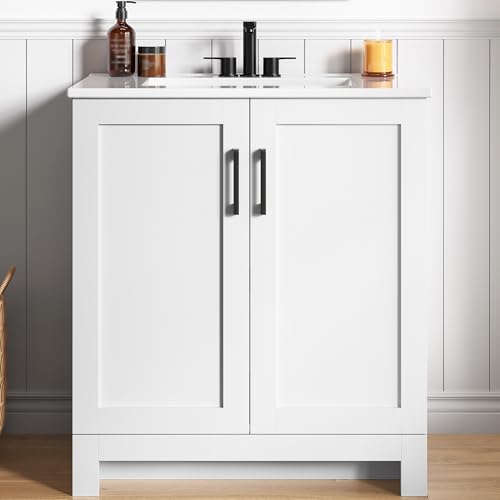
LIKIMIO 30 Inch Bathroom Vanity with Sink — Best Small-Bathroom Value
Small bathrooms are where vanity compromises hurt most, because every inch of storage is contested. The LIKIMIO packs a freestanding cabinet with two soft-close doors and an integrated ceramic sink into 30 inches, and markets it — accurately — as easy to assemble. Ceramic is the right sink material at this tier: harder and more stain-resistant than resin composites, with a gloss that survives years of toothpaste and cleaning. The freestanding format also matters in small rooms, because it installs against any wall without the structural anchoring a floating vanity demands.
It suits powder rooms, small full baths, basement bathroom additions, and first remodels on a controlled budget. It is less suited to households needing drawer storage specifically — this cabinet is door storage, so small items need organizer inserts — and to buyers wanting furniture-grade materials throughout; this is a value construction executed well, not a Beckford in miniature.
Strengths
- Integrated ceramic sink — durable, stain-resistant, easy to clean
- Soft-close doors at a value tier where they are often skipped
- Compact freestanding design installs almost anywhere
Trade-offs
- Door cabinet only — budget for drawer organizers for small items
- Value-tier materials; keep plumbing leak-free to protect the cabinet
- Assembly required, though genuinely straightforward
A practical upgrade path: spend a small amount on a good interior organizer and a quality faucet, and this vanity’s daily experience rises well above its tier. Small bathrooms reward exactly that kind of targeted spending, because the room has so few elements that each one carries more weight.
Best for: small bathrooms and powder rooms on a budget / Not suited for: buyers needing drawer-based storage
Check the current price on Amazon

Concho 30 Inch Farmhouse Bathroom Vanity with Vessel Sink — Best Rustic Statement
The Concho takes the compact 30-inch footprint and goes for personality: a rustic brown farmhouse cabinet with a sliding barn door, a tempered-glass vessel sink rising above the counter, three drawers of storage, an adjustable shelf, side hooks, and even an LED accent light. A vessel sink changes a small bathroom’s proportions — the basin becomes sculpture, and the counter beneath it stays usable as a surface, which in a 30-inch vanity is a genuine functional gain. The hooks and shelf show a designer thinking about how small bathrooms actually fail: nowhere to put anything.
It suits powder rooms and guest baths where a statement matters more than storage volume, rustic and farmhouse schemes, and homeowners who entertain — this is a conversation piece in the room guests use. It is less suited to family bathrooms where children will haul themselves up by the vessel rim, and to buyers who dislike cleaning around a vessel’s base, where water and dust collect in the ring where basin meets counter.
Strengths
- Vessel sink frees counter surface and creates a focal point
- Three drawers plus adjustable shelf — unusually complete storage at 30 inches
- Barn door, hooks, and LED light deliver designed-in character
Trade-offs
- Vessel basins need a taller or wall-mount faucet — check your faucet plan
- The basin-to-counter junction needs regular wiping
- Rustic styling is a commitment, as with the LUXOAK
Choose this vanity when the bathroom’s job includes delight. A powder room has one fixture that matters, and it is the vanity; spending the room’s entire personality budget there, as the Concho does, is sound design economics. Just confirm your faucet’s height against the vessel before the plumber arrives.
Best for: powder rooms and guest baths wanting rustic character / Not suited for: heavy family use by small children
Check the current price on Amazon
Comparison Table
| Pick | Badge | Key spec | Best for |
|---|---|---|---|
| DKB Beckford 72 Inch | Best Overall Semi-Custom | Quartz top, 6 dovetail drawers, double sink | Primary bathrooms |
| DELUXE LIVING 60 Inch | Best Fully Assembled | Solid wood frame, marble top, assembled delivery | Schedule-driven remodels |
| LUXOAK 61 Inch Barn Door | Best Custom Character | Sliding barn doors, reclaimed barnwood finish | Farmhouse remodels |
| DELUXE LIVING 36 Inch | Best Mid-Size | Integral SMC sink, soft-close, adjustable feet | Hall bathrooms |
| LIKIMIO 30 Inch | Best Small-Bathroom Value | Integrated ceramic sink, soft-close doors | Small baths, budgets |
| Concho 30 Inch Vessel | Best Rustic Statement | Tempered vessel sink, 3 drawers, LED light | Powder rooms |
How to Choose a Custom or Semi-Custom Bathroom Vanity
Begin by deciding which kind of “custom” you actually need. If your space is a standard width — 30, 36, 48, 60, or 72 inches — and your plumbing is where vanities expect it, semi-custom pieces like the picks above will fit, look intentional, and arrive in days. Commission a true custom build when the space itself is non-standard: an alcove between standard sizes, a corner installation, a sloped ceiling line, a historic home whose walls are not square, or a design that needs the vanity to match other cabinetry exactly. A good rule: if the problem is fit, go custom; if the problem is look and quality, semi-custom solves it for less money and far less time.
Next, measure like a cabinetmaker. Record the total width available wall to wall, the depth you can spare without crowding the toilet or the door swing (standard vanity depth is about 21 inches; compact models run shallower), and the locations of your water supplies and drain — a vanity’s drawers must clear the trap, which is why many double vanities use U-shaped top drawers or place drawers at the sides. Note baseboards, chair rails, and any trim the cabinet must scribe against. Photograph the plumbing wall before you order; the photo will answer questions that memory will not.
Then interrogate construction, because this is where the category separates. Ask what the frame is made of, how the drawers are joined, whether the slides and hinges are soft-close and name-brand, and what the finish is — a catalyzed or conversion-varnish finish survives bathroom humidity in a way a thin lacquer does not. For the top, know your materials: quartz is the low-maintenance champion; marble is beautiful and needs sealing and forgiveness; cultured marble and SMC integral tops are seamless and practical; ceramic integral tops are hard, glossy, and chip-prone only under real abuse. There is no wrong answer, only mismatched expectations.
Budget tiers in this category buy identifiable things, and knowing the ladder keeps you from overpaying for the wrong rung. The value tier buys a clean cabinet with an integral top and basic hardware — the LIKIMIO’s territory — and it is the right spend for secondary bathrooms. The mid tier adds soft-close hardware, better finishes, and more durable top materials. The upper semi-custom tier buys the cabinet-shop markers: solid frames, dovetail drawers, stone or quartz tops, assembled delivery. True custom sits above all of it, buying exact fit and design freedom at a multiple of the semi-custom price and timeline. The mistake is not choosing any particular rung; it is paying upper-tier money for a value-tier cabinet because the listing used the word “custom.” The construction checks in this guide are how you tell which rung you are actually on.
Storage planning is the step most buyers skip and most regret. Count what your current vanity holds, sort it honestly into daily, weekly, and never, and check the candidate vanity can house the daily and weekly groups in drawers or divided cabinets — drawers beat doors for almost everything except tall bottles and cleaning supplies. If two people share the vanity, divided storage is not a luxury; it is the entire point of going wide. Finally, plan the ensemble: faucets (deck-mount or wall-mount, and their hole spacing), mirror size relative to the vanity width, and lighting that lands in front of faces rather than above them. A semi-custom vanity chosen as part of an ensemble reads as custom to everyone who walks in — which, for most buyers, was the goal all along.
Vanity Materials in Depth: What You Are Actually Paying For
Because semi-custom vanities span a wide quality range behind similar photographs, it pays to understand the four material decisions inside every cabinet. The frame is the skeleton: solid wood frames resist the racking forces of daily use and hold screws and hinges through decades of adjustment, while frames built entirely from particleboard or thin MDF depend on their panel skins for rigidity and loosen as fasteners work in the soft material. Panels themselves are best as plywood or furniture-grade MDF with a proper finish — plywood wins near the floor and around plumbing, where a leak’s first victim is the cabinet’s lowest edge. This is why experienced buyers crouch down and look at the bottom and back of a vanity, not the front: the front is styled for the photograph; the bottom tells the truth.
Drawer boxes are the second tell. A dovetail joint mechanically locks the box’s sides together, so the box survives being yanked open by its front ten thousand times; a stapled butt joint survives until it doesn’t, usually in year two or three of family use. Slides matter as much: undermount soft-close slides carry weight smoothly and hide the hardware, while basic side-mount rollers announce their cheapness every time a drawer closes. Hinges follow the same logic. None of this is visible in a listing’s hero image, which is why the reviews above call out construction explicitly for every pick — and why a vanity with dovetails and soft-close throughout, like the Beckford, justifies its tier over a prettier photograph with staples inside.
The finish is the third decision, and bathrooms are its harshest test short of a kitchen. A quality finish system — stained or painted, then sealed with a moisture-resistant topcoat — keeps steam and splashes out of the wood. Painted finishes in white and grey dominate the semi-custom market because they are consistent and repairable; stained finishes show the wood and vary piece to piece, which farmhouse buyers want and minimalists may not. Whichever you choose, ask how it behaves at the sink’s splash zone and around the base, where mops and puddles live. A vanity whose finish fails at the base in year three was never semi-custom, whatever the listing said.
Countertops complete the picture, and the guide above has already compared quartz, marble, and integral tops. One addition: the backsplash. Tops that include a matching backsplash, as the Beckford and DELUXE LIVING picks do, protect the wall joint — the single most common water-damage site in any vanity installation — and save you sourcing a matching piece later, which is harder than it sounds once dye lots change. When a top excludes the backsplash, plan its material and source at purchase time, not at installation time.
Designing the Ensemble: Mirrors, Lighting, and Hardware
A vanity reads as “custom” when the elements around it agree with it. The mirror should relate to the vanity’s width — a common designer rule is a mirror or pair of mirrors totaling somewhat less than the vanity’s width, centered over each sink — and its frame, or deliberate framelessness, should echo the vanity’s finish story. On a farmhouse piece like the LUXOAK or Concho, a wood or matte-black framed mirror completes the sentence; on the Beckford’s white classicism, a simple framed or beveled mirror keeps the room calm. Lighting belongs at face height, flanking the mirror or as a bar above it, because overhead-only lighting shadows every face that uses the vanity — the room can be beautiful and still fail at its one daily job.
Hardware is the smallest decision with the largest leverage. Faucet finish, drawer pulls, towel bars, and the shower trim beyond should share a finish family; mixing one chrome faucet into a matte-black room draws the eye for the wrong reason. If your vanity arrives with handles, as the LUXOAK does, treat them as the room’s hardware reference and match outward from them. Finally, leave the countertop some negative space. The vanities in this guide offer real storage precisely so the top does not have to hold everything; a clear stretch of quartz or marble is what makes a semi-custom vanity look like furniture rather than shelving, and it is free.
How to Install a Freestanding Vanity (and When to Call a Plumber)
Freestanding vanities like the picks here are among the friendliest large fixtures to install, and confident DIYers handle them routinely. The sequence that avoids trouble:
- Shut off the water supplies, remove the old vanity, and inspect the wall and floor for water damage — repair before the new cabinet hides it again.
- Mark the new vanity’s position, confirm the drain and supplies land inside the cabinet’s open back or cutouts, and check the floor for level; shim or use adjustable feet so the top sits dead level, because an unlevel top pools water toward one side of the sink.
- Set the cabinet, anchor it to wall studs through its back rail — freestanding means floor-supported, not unsecured — and then set or confirm the top and sink per the manufacturer’s order of operations.
- Connect supplies with new braided lines and the trap with fresh washers; hand-tight plus a quarter turn is the discipline that prevents both leaks and cracked fittings.
- Run water, fill and drain the sink repeatedly, and inspect every joint with a dry paper towel — it reveals drips your fingers miss. Check again the next day.
- Caulk the backsplash-to-wall joint with bathroom silicone, never the cabinet-to-floor joint — you want a leak under the cabinet to show itself, not to be sealed in.
Call a plumber when the drain or supplies must move, when shutoff valves are corroded or absent, when the vanity is a 60- or 72-inch assembled piece that needs setting by a crew, or when anything about the wall’s interior is a mystery. The money is well spent exactly at the points where a mistake hides inside a wall.
Floating vs Freestanding: A Brief, Honest Word
All six picks in this guide are freestanding, and that reflects where the semi-custom value sits rather than a verdict against floating vanities. A wall-mounted vanity gives a bathroom a spacious, modern feel and makes floor cleaning effortless, but it demands solid wall structure — ideally blocking installed inside the wall — and it gives up the toe-kick storage zone and some cabinet volume. It also concentrates all of the vanity’s loaded weight on its mounting rail, which is why quality floating models cost what they do. If your remodel already opens the walls, floating is a legitimate and beautiful choice, and our companion guide below covers the verified options. If your walls stay closed, freestanding is the structurally honest choice — and, as the Beckford and LUXOAK demonstrate, it does not have to look any less designed.
Common Buying Mistakes
Paying for “custom” without checking construction. The word appears on stapled-MDF cabinets every day. Dovetails, frame material, and hardware quality are the truth; the label is marketing.
Measuring width and forgetting depth and door swing. A vanity that fits the wall but blocks the bathroom door or crowds the toilet’s clearance is a daily irritation for a decade.
Ignoring the plumbing’s position. Drawers collide with traps in vanities bought by photograph. Confirm your drain height and lateral position against the cabinet’s interior layout.
Choosing marble with a quartz household’s habits. Stone tops are honest about what they need. If the counter will hold hair dye, colored cosmetics, and standing water, choose quartz or an integral top and be happy.
Forgetting faucets, mirrors, and lighting in the budget. The vanity is often only half the project’s fixture cost. Price the ensemble before committing to a tier.
Buying double sinks for a narrow vanity. Two cramped basins in 48 inches serve two people worse than one generous basin. Doubles earn their keep at 60 inches and above.
Final Recommendation
For a primary bathroom, the DKB Beckford 72 Inch is the closest thing to a cabinet-shop result you can order: quartz, dovetails, and storage that respects two people’s routines. If assembly is your obstacle, the DELUXE LIVING 60 Inch delivers solid wood and marble already built. Farmhouse remodels should anchor on the LUXOAK barn door vanity; hall bathrooms on the DELUXE LIVING 36 Inch; small bathrooms on the LIKIMIO 30 Inch; and powder rooms that deserve a little theatre on the Concho vessel vanity. Whichever you choose, order with the full picture in hand: the vanity’s exact width against your measured wall, the faucet spread against the top’s drilling, and the delivery path walked once with a tape measure. Semi-custom rewards buyers who verify those three things and punishes, with return freight and lost weeks, buyers who assume them. And if your space is genuinely non-standard — the odd alcove, the unmovable plumbing — take the measurements from this guide to a local cabinet shop with a clear conscience: knowing when true custom is the right tool is part of shopping well.
Related guides in this series: Best Bathroom Vanities With Sinks · Best Floating Bathroom Vanities · Best Narrow Bathroom Sinks · Best Storage Containers For Bathroom Counters
A last piece of honest guidance: the vanity is the wrong place to chase a trend you merely like. It is plumbed, heavy, and semi-permanent, and it will outlast several paint colors and two generations of towels. Choose the construction tier first, the size second, and the style third, in the finish family your household has consistently liked — and the result will still look intentional long after the trend that tempted you has dated everyone else’s bathroom.
Frequently Asked Questions
What is the difference between custom, semi-custom, and stock vanities?
Stock vanities come in fixed sizes and finishes, ready to ship. Semi-custom vanities — the tier in this guide — offer furniture-grade construction with configuration choices like width, top material, and finish, still produced in a factory line. Fully custom vanities are built to order by a cabinet shop for an exact space. Most bathrooms are served best by semi-custom: the quality and look of custom, without the months-long timeline.
Do I need to anchor a freestanding vanity to the wall?
Yes. Freestanding describes how the vanity carries its weight — through its legs or base to the floor — not permission to leave it unsecured. Anchoring the cabinet’s back rail to wall studs prevents tipping, keeps the plumbing connections unstressed, and stops the micro-movement that breaks caulk lines. It takes minutes during installation and should never be skipped, especially in homes with children who will eventually climb or pull on a drawer.
What vanity width should I choose?
Match the width to the wall and the users. Thirty inches serves one person in a small bath; 36 to 48 inches gives one person generous room; 60 inches is the practical minimum for a true double; 72 inches is a comfortable double with real drawer storage. Never force a width that crowds door swing or toilet clearance — a slightly narrower vanity installed well beats a wider one wedged in.
Are faucets included with these vanities?
Generally no — in the furniture-grade tier, faucets are chosen separately so you can match your finish and style, and the vanity tops are drilled for a standard faucet spread. Confirm the hole configuration on the listing for your chosen model, and budget faucets, supply lines, and a drain assembly into the project.
Quartz or marble countertop — which is better?
Quartz is harder, non-porous, and needs no sealing; it tolerates cosmetics and hard water gracefully, making it the practical default. Marble is natural stone with unmatched veining, but it is porous, needs periodic sealing, and can etch from acidic products. Choose marble for its look with open eyes; choose quartz for low-maintenance certainty.
Can a vanity be installed without moving plumbing?
Usually yes, if the new vanity’s cabinet layout clears your existing drain and supplies — which is why measuring their position matters. Most freestanding vanities have open backs or generous cutouts for standard rough-ins. Moving a drain a few inches is a modest plumber visit; moving it across the room is a project. The picks in this guide are all freestanding designs chosen partly for installation friendliness.
How long does a semi-custom vanity take to arrive compared with true custom?
Semi-custom vanities are manufactured lines, so they ship on ordinary furniture timelines — typically days to a few weeks depending on the model and freight. A true custom commission involves design consultation, shop queue time, building, and finishing, and commonly runs many weeks to months from deposit to delivery. If your remodel has a contractor scheduled, that difference alone often decides the tier: a semi-custom vanity can be ordered to meet a fixed installation date with confidence.
Is a double vanity worth it for resale?
In a primary bathroom, generally yes — double vanities are among the features buyers consistently look for, and a furniture-grade double like the 60- and 72-inch picks here presents as a genuine upgrade. The exception is a small primary bathroom where forcing a double sacrifices counter space and storage to squeeze in two basins; a well-appointed single at 48 inches often shows and lives better. Buy for your own daily use first and let resale follow — the two usually agree.
What should I check on delivery day?
Inspect before the driver leaves if possible: corners and edges for shipping damage, the countertop for cracks (especially marble), drawer and door operation, and that every listed component — backsplash, hardware, sink — is present. Photograph any damage immediately. Large furniture-grade vanities are heavy and occasionally arrive with transit wounds; catching them at delivery makes replacement straightforward, while discovering them at installation, with the old vanity already removed, turns a small problem into a schedule problem.
How do I keep a wood vanity safe from bathroom moisture?
Ventilation first: run the exhaust fan during and after showers. Wipe standing water off the top and cabinet rather than leaving it to sit, fix supply or trap drips immediately (a slow drip under a cabinet does more damage than years of steam), and renew the backsplash caulk when it lifts. A quality finish on solid wood or furniture-grade panels handles normal bathroom humidity for decades when those basics are observed.
