Disclosure: airfryerkitchensupply.com is reader-supported. When you buy through links on our site, we may earn an affiliate commission at no extra cost to you.
Where to buy
All six sinks below are sold through Amazon, where each listing shows the exact exterior and interior bowl dimensions — the numbers that decide everything in this category. Check the current price on Amazon for each pick, and verify the cutout dimensions against your countertop before ordering:
- DeerValley Undermount Bathroom Sink 18×13 — check price on Amazon
- Hugsleek Undermount Bathroom Sink 18×13 — check price on Amazon
- 16 Inch Undermount Bathroom Sink with Overflow — check price on Amazon
- KARAMAG Undermount Sink 18.3×13 — check price on Amazon
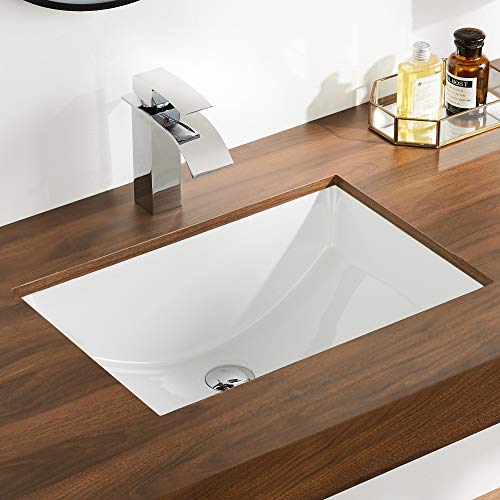
- DeerValley Undermount Bathroom Sink 21×15 — check price on Amazon
- ADA Compliant Undermount Bathroom Sink 20×15 — check price on Amazon
The best narrow bathroom sinks solve a problem that standard sinks create: a bathroom — or a vanity within it — that is too shallow front-to-back for a conventional basin. Narrow here means depth, the dimension from the wall to the front edge of the counter. A standard bathroom sink wants a vanity around 21 inches deep; narrow bathrooms, converted closets, half baths tucked under stairs, and slim console vanities often offer only 16 to 19 inches, and every inch of sink depth you save is an inch of standing room, door swing, or counter you get back. The six picks in this guide are compact rectangular undermount sinks, the format that works best in narrow installations, because an undermount basin spends none of its depth on a rim: the counter’s front edge and the bowl’s front wall are the same line, and the faucet can mount on the counter or the wall behind whatever bowl depth remains.
An honest framing before the picks: narrow sinks come in four families — compact undermounts (this guide’s picks), wall-mounted sinks, pedestal sinks, and narrow vessel sinks. Wall-mount and pedestal models are excellent where there is no vanity at all, and the buying guide below explains when to choose them; but for the most common narrow-bathroom project — a slim vanity or a shallow countertop that still needs storage beneath — a compact undermount is the professional’s default, and it is the family we could verify model by model for this guide. Narrow bathrooms also reward a particular kind of honesty from their owners: the room will never behave like a large one, and the goal is not to disguise it but to make every inch perform. A well-chosen narrow sink is the clearest example of that philosophy — it gives up the inches the room cannot spare and protects, fiercely, the functions the room must keep: a comfortable wash, a dry counter, a cabinet that still stores things. Buyers who approach the category in that spirit tend to end up with small bathrooms that work better than plenty of large ones. Each sink below was checked against its current Amazon listing before receiving a link, and the dimension that matters most, the bowl’s footprint, is in each pick’s name.
In this guide
Quick Picks
- DeerValley Undermount Sink 18×13 — Best Overall Narrow Sink. Premium ceramic, built-in overflow, and a splash-conscious depth in the most useful compact size. Check the current price on Amazon
- Hugsleek Undermount Sink 18×13 — Best Value. A straightforward porcelain undermount at the same footprint, for budget remodels. Check the current price on Amazon
- 16 Inch Undermount Sink — Best for the Tightest Counters. The smallest bowl here, with overflow, made for genuinely shallow vanities. Check the current price on Amazon
- KARAMAG Undermount Sink 18.3×13 — Best Vitreous Ceramic Build. A durable vitreous ceramic lavatory sink with a crisp rectangular form. Check the current price on Amazon
- DeerValley Undermount Sink 21×15 — Best Roomier Narrow Option. For counters that are narrow-ish rather than tiny, with the same overflow and depth design. Check the current price on Amazon
- ADA Compliant Undermount Sink 20×15 — Best Accessible Choice. A shallower-profile undermount designed for ADA-compliant installations and knee clearance. Check the current price on Amazon
How These Picks Were Chosen
We filtered first on footprint: every pick fits a counter depth that a standard sink cannot serve, with exterior dimensions between roughly 16×12 and 21×15 inches. Second, material: all six are ceramic or porcelain — vitreous ceramic in the KARAMAG’s case — because in a small sink that will be used hard and cleaned often, glazed ceramic’s resistance to staining, scratching, and cleaning chemicals beats resin and composite alternatives, and its gloss survives the decade. Third, overflow: a narrow sink holds less water and sits closer to its user, so an overflow channel is a more meaningful safety feature here than in a big basin; most picks include one, and the reviews note where to confirm it. Fourth, drain compatibility: all use standard drain sizing, so you are not locked into proprietary hardware.
We also weighed how each sink behaves at the extremes of its working life: the Monday-morning rush, when the bowl takes toothpaste, shaving water, and a dropped razor in five minutes; and the guest visit, when the sink must look clean with ten seconds of wiping. Ceramic glazes and simple rectangular geometry score well on both, which is part of why the list looks the way it does — narrow bathrooms forgive nothing, because there is no spare space in which a flaw can hide. A stain shows. A splash lands on you, not on a distant counter. A rim that traps grime is at elbow height in front of a mirror. The picks that survived this filter are, without exception, sinks whose daily behavior we could defend in the smallest room in the house.
We deliberately did not pad the list with wall-mount or pedestal models we could not verify for this batch, even though those families matter to narrow bathrooms; they are covered honestly in the buying guide, without links, rather than recommended blind.
The 6 Best Narrow Bathroom Sinks

DeerValley Undermount Bathroom Sink 18×13 — Best Overall Narrow Sink
The 18×13 footprint is the narrow-sink sweet spot: small enough for an 18- to 19-inch-deep vanity, large enough to wash hands and face without wearing the water. DeerValley’s version earns the top slot on the details that separate a good small sink from a merely small one — premium ceramic construction, a built-in overflow, a standard drain, and what the listing calls splash-proof depth: the bowl is deep enough, and its walls angled well enough, that a faucet’s stream lands in the basin instead of ricocheting onto the counter. Splash behavior is the hidden test of every narrow sink, because a shallow bowl under a standard faucet throws water exactly where you stand.
It suits slim vanities in half baths and small full baths, replacement projects where a countertop is being cut fresh, and anyone who wants the safest all-around compact choice. In daily use it behaves the way a good small sink should: hands wash without knuckles finding the bowl’s sides, the stream from a standard faucet lands quietly, and the counter around it stays dry enough that the morning wipe-down is a formality rather than a chore. That ordinariness is the achievement — compact sinks that call attention to themselves, by splashing or crowding, have failed at the one thing they were bought for. It is less suited to counters shallower than about 17 inches (the 16-inch pick below exists for those), and to buyers who want a visible design statement — an undermount’s job is to disappear gracefully under the counter’s edge.
Strengths
- Splash-conscious bowl depth — the detail that decides daily satisfaction in a small sink
- Built-in overflow and standard drain keep hardware simple
- Premium ceramic glaze resists stains and cleans easily
Trade-offs
- Needs a countertop with a proper cutout — not a drop-in replacement for a top-mount sink without new counter work
- 18-inch width is compact for face-washing; enthusiastic splashing still escapes
- Undermount installation needs clips, adhesive, and a helper — plan the install
Pairing advice: in an 18-inch-deep vanity, mount the faucet on the counter behind the bowl only if the counter’s back strip is genuinely wide enough for the faucet body; otherwise use a wall-mount faucet and reclaim the entire counter depth for the bowl and a hand-soap landing zone. That single decision is what makes a narrow installation feel designed rather than squeezed, and this sink supports either layout.
Best for: most narrow vanities and small-bathroom remodels / Not suited for: the very shallowest counters
Check the current price on Amazon

Hugsleek Undermount Bathroom Sink 18×13 — Best Value
The Hugsleek offers the same 18×13 undermount format in white porcelain ceramic, positioned for buyers whose budget is being spent across a whole bathroom rather than concentrated on the sink. Its listing specifies an interior bowl of 18×13 with the under-counter exterior to match, which is the honest way to sell a small sink — the interior is what you wash in. For a rental upgrade, a basement half bath, or a first remodel, this is the pick that gets a proper ceramic undermount into the project without drama.
It suits value-driven remodels, secondary bathrooms, and projects where the countertop and faucet are the splurge and the basin simply needs to be good. It is less suited to buyers who want the deepest anti-splash bowl shaping — confirm overflow inclusion on the listing for your configuration — and to design-led projects where a named brand’s glaze consistency across multiple sinks matters.
Strengths
- Full ceramic undermount at the most useful compact size, at a value tier
- Interior dimensions stated clearly — no guesswork about usable bowl size
- Clean white porcelain suits any counter material
Trade-offs
- Confirm overflow on the listing before ordering if that feature is essential to you
- Value positioning means simpler packaging — inspect on arrival before your installer is scheduled
- Brand support network is thinner than the heritage plumbing names
The value case in one line: an undermount sink is mostly hidden, working geometry — bowl shape, glaze, and a true rim that seals flat. The Hugsleek spends its money on exactly those, and in a category where the expensive versions differentiate on refinement rather than function, that is a rational place to save.
Best for: budget remodels and secondary bathrooms / Not suited for: buyers wanting every premium refinement
Check the current price on Amazon

16 Inch Undermount Bathroom Sink with Overflow — Best for the Tightest Counters
Some counters are not merely narrow but truly shallow — a 16- or 17-inch-deep vanity in a converted closet bath, a slim console in a powder room — and for those, this is the pick: a small rectangular undermount whose exterior runs about 15.7×11.7 inches, with a built-in overflow despite its size. That overflow matters more, not less, at this scale, because a small bowl fills fast and its user is standing close. The white ceramic construction keeps it feeling like a real sink rather than a compromise object.
It suits powder rooms, closet conversions, under-stair half baths, and any vanity shallower than 18 inches. It is less suited to primary bathrooms where adults wash faces and brush with enthusiasm — the bowl is genuinely small, and a tall faucet arc will splash it — and to households that fill the sink for soaking anything larger than a washcloth.
Strengths
- Smallest footprint here — fits counters standard compact sinks cannot
- Overflow included even at this size
- Ceramic build, not plastic or thin composite
Trade-offs
- Small bowl demands a short, low-arc faucet to control splashing
- Not a face-washing sink for splash-prone users
- Generic-brand listing — verify the cutout template dimensions on arrival before the counter is cut
Faucet pairing is destiny at this size. Choose a faucet whose spout reach lands the stream near the bowl’s center at a modest height, and test the pairing with a bucket before the counter is drilled if you can. Get it right and a 16-inch sink is a small marvel of planning; get it wrong and no sink at this size would have saved the installation.
Best for: the shallowest vanities and powder rooms / Not suited for: primary-bathroom daily face washing
Check the current price on Amazon

KARAMAG Undermount Sink 18.3×13 — Best Vitreous Ceramic Build
KARAMAG’s entry is a vitreous ceramic lavatory sink at 18.3×13 inches, and the material word is the point. Vitreous ceramic is fired to a glass-like, non-porous finish that shrugs off the staining agents of a bathroom — toothpaste pigments, cosmetics, hard-water minerals — and keeps its gloss through years of cleaning. The rectangular form is crisp and architectural, suiting modern counters, and the pure white finish is the reference white that other fixtures try to match.
It suits design-conscious small bathrooms, hard-water homes where glaze quality decides how a sink ages, and remodels pairing the sink with a stone or quartz counter where a cheap basin would cheapen the whole run. It is less suited to buyers who need the absolute smallest footprint, and to installations wanting a softer, rounded bowl aesthetic.
Strengths
- Vitreous ceramic surface — the most stain- and chemical-resistant glaze class here
- Crisp rectangular geometry suits modern and transitional counters
- Standard undermount format with a footprint in the compact sweet spot
Trade-offs
- Squarish corners need a touch more attention when cleaning than a fully rounded bowl
- Confirm overflow configuration on the listing for your build
- Slightly larger than the tightest 18×13 class — measure the cutout zone
Think of this pick as the materials-first choice. In a small bathroom, the sink is touched and seen more than any other fixture, and its surface is where years accumulate visibly. A glaze that refuses to stain is not a luxury specification; it is the difference between a sink that looks new at year five and one that looks tired at year two.
Best for: hard-water homes and design-led small bathrooms / Not suited for: the very tightest counters
Check the current price on Amazon
DeerValley Undermount Bathroom Sink 21×15 — Best Roomier Narrow Option
Not every “narrow” bathroom is tiny — some are standard rooms with a slightly shallow vanity run, or long, thin rooms where depth is limited but width is generous. The 21×15 DeerValley serves that middle case: the same premium ceramic, built-in overflow, and splash-proof depth design as its smaller sibling, in a bowl that gives adults real elbow room and a comfortable face-washing experience. If your counter depth is around 19 to 21 inches, this is the sink that keeps the installation feeling like a normal bathroom that happens to be efficient, rather than a small bathroom making do.
It suits primary bathrooms with modest depth, double-checking households where the “narrow” constraint is about the room’s proportions rather than a tiny vanity, and buyers stepping down from a standard sink who fear the compact class will feel cramped. It is less suited to genuinely shallow counters under about 19 inches, where its cutout simply will not fit with safe margins.
Strengths
- Most usable bowl volume in this guide while staying in the narrow class
- Overflow, standard drain, and depth shaping carried over from the smaller model
- Premium ceramic construction
Trade-offs
- Requires the deepest counter of any pick here — verify before ordering
- Solves depth constraints, not width constraints
- Undermount install effort as with the rest of the guide
The strategic advice: buy the largest sink your counter honestly fits, with proper cutout margins, because no one has ever complained that a bathroom sink was slightly too generous. This pick is the ceiling of the narrow class — if it fits, it is very hard to regret.
Best for: modest-depth primary bathrooms / Not suited for: counters under roughly 19 inches deep
Check the current price on Amazon

ADA Compliant Undermount Bathroom Sink 20×15 — Best Accessible Choice
Accessibility changes sink geometry: a wheelchair user needs knee clearance beneath the basin, which means a shallower bowl profile and careful drain placement, and the ADA standards describe exactly that envelope. This 20×15 ceramic undermount is built and listed for ADA-compliant installations, giving remodelers a verified starting point for accessible bathrooms, aging-in-place projects, and commercial-style guest baths where compliance is required rather than aspirational. Its 20×15 footprint also happens to suit narrow counters, which is why it belongs in this guide on both counts.
It suits accessible remodels, multigenerational homes planning ahead, and narrow bathrooms where a shallower bowl profile helps the cabinet below keep usable storage. It is less suited to buyers wanting a deep soaking-style basin, and any compliance-critical installation should have its full design — clear floor space, faucet reach, pipe insulation — reviewed against the current standards, since a compliant sink is one component of a compliant room.
Strengths
- Designed and listed for ADA-compliant installations
- Shallower profile preserves knee clearance and cabinet room
- Ceramic construction with overflow
Trade-offs
- Shallower bowl splashes more readily — pair with a controlled-flow faucet
- Compliance depends on the whole installation, not the sink alone
- Less basin depth for buyers who like to fill the sink
Aging-in-place note: the cheapest time to make a bathroom accessible is during a remodel you are already doing. Choosing a sink profile that preserves knee clearance, and lever-handle faucets while you are at it, costs little now and can be worth a great deal later — a perspective this pick makes easy to act on.
Best for: accessible and aging-in-place bathrooms / Not suited for: deep-basin preferences
Check the current price on Amazon
Comparison Table
| Pick | Badge | Key spec | Best for |
|---|---|---|---|
| DeerValley 18×13 | Best Overall | Premium ceramic, overflow, splash-proof depth | Most narrow vanities |
| Hugsleek 18×13 | Best Value | Porcelain ceramic, clear interior dimensions | Budget remodels |
| 16 Inch Undermount | Best for Tightest Counters | ~15.7×11.7 exterior, overflow included | Powder rooms, closet baths |
| KARAMAG 18.3×13 | Best Vitreous Ceramic | Non-porous vitreous glaze, rectangular form | Hard-water homes |
| DeerValley 21×15 | Best Roomier Option | Largest bowl in class, overflow | Modest-depth primary baths |
| ADA Compliant 20×15 | Best Accessible | Shallow profile for knee clearance, overflow | Accessible remodels |
How to Choose a Narrow Bathroom Sink
Start with the counter, because the counter is destiny. Measure its depth front to back, then subtract the margins an undermount needs: enough material in front of the cutout to stay strong (a couple of inches at minimum on stone and quartz), room behind the bowl for a counter-mount faucet if you plan one, and the cabinet’s interior clearance below. What remains is your maximum bowl footprint, and the picks above are organized by exactly that number — roughly 12 inches of depth for the tightest, 13 for the sweet spot, 15 for the roomier end. If the arithmetic leaves you under 12 inches, an undermount is the wrong family: that is wall-mount territory, where the sink hangs on the wall with no counter at all.
That raises the family question honestly. Choose a compact undermount when you have or want a vanity — storage matters in small bathrooms, and a vanity hides plumbing and holds the counter your routine needs. Choose a wall-mount sink when floor space is the scarcest resource, when the bathroom is a true half bath used briefly, or when an accessible installation benefits from fully open knee space. Choose a pedestal when the room is period-styled and storage lives elsewhere. Choose a narrow vessel when counter surface matters more than bowl containment and the look justifies the splash management. Each family is a legitimate answer; the error is choosing by photograph before measuring the room’s actual constraint, which in narrow bathrooms is always depth first, then width, then everything else.
Faucet geometry is the second discipline. In a narrow installation the faucet’s spout reach and height decide whether water lands in the bowl or on you. Short-reach, moderate-height faucets suit compact bowls; tall vessel faucets over a shallow undermount are a splash machine. Wall-mount faucets are the narrow bathroom’s secret weapon — they free the counter’s back strip entirely and let you position the spout precisely over the bowl — at the cost of plumbing inside the wall, which is cheap during a remodel and expensive after one. Decide the faucet when you decide the sink, not after the counter is drilled.
Storage thinking belongs in a sink decision more than most buyers expect. The bowl you choose determines what the cabinet beneath can be: a deep bowl over a standard trap consumes the cabinet’s upper half, pushing storage into a single low shelf; a shallower bowl — or a trap routed tight to the wall — can return room for a U-shaped drawer that keeps daily items at hand height. In a narrow bathroom, where the vanity may be the only storage in the room, that trade deserves to be made deliberately. Sketch the cabinet’s interior with the sink’s underside drawn in, and choose the configuration that stores your actual routine, not an idealized one.
Finally, respect the splash physics of small bowls. A compact sink under a high-flow faucet at full pressure will decorate your counter daily. Aerators that shape a clear, non-splashing stream, moderate flow rates, and bowl depth with well-angled walls — the design point DeerValley markets as splash-proof depth — all push in the right direction. In a narrow bathroom you stand closer to the sink than in a large one, so these details are not refinements; they are the difference between a room that feels cleverly planned and one that feels like a compromise you wipe down twice a day.
Narrow Sinks Room by Room: Matching the Bowl to the Space
The powder room is the narrow sink’s natural home, and its demands are the lightest: hand washing, a mirror check, nothing more. Here the smallest picks shine, and the design priority is proportion — a bowl that leaves the little room feeling planned rather than apologetic. Pair the 16-inch undermount or the 18×13 class with a compact faucet, and spend the saved counter depth on a slightly deeper mirror cabinet, which returns storage the vanity gave up.
The small full bathroom is harder, because it must serve showers, teeth, faces, and often two people in sequence. Here the guidance reverses: take the largest bowl the counter honestly fits — the DeerValley 21×15 if depth allows, an 18×13 if it does not — and treat splash control as a first-class requirement, because this sink will be used at full morning speed. The hall bathroom serving children adds one more demand: durability of the glaze against dropped toothbrushes, toy boats, and enthusiastic cleaning, which is where vitreous ceramic like the KARAMAG quietly earns its tier.
The converted space — closet bath, under-stair bath, attic bath with a sloped ceiling — is where narrow sinks stop being a preference and become the enabling technology. In these rooms, measure not just the counter but the user’s standing envelope: knees, elbows, and the door’s swing all compete for the same inches the sink wants. A shallower bowl buys back standing comfort directly, and a wall-mount faucet buys back counter. These are the rooms where an inch of sink depth is worth more than any finish upgrade, and where the tightest picks in this guide justify their existence completely.
Finally, the accessible bathroom, covered by the ADA pick above, deserves its room-specific note: narrow and accessible are natural partners, because the shallow bowl profile that saves depth is the same profile that preserves knee clearance. Design the two goals together — lever faucets, clear floor space, reachable storage — and a small bathroom can end up more usable than a large careless one.
What Narrow Sinks Ask of Your Countertop and Cabinet
An undermount sink is a partnership between the basin and everything around it, and narrow installations tighten every tolerance in that partnership. The countertop material must carry the sink’s hung weight at a cutout whose margins are thinner than standard; stone, quartz, and quality solid-surface handle this well, while thin or water-sensitive tops deserve a fabricator’s honest opinion before you commit. Ask for the cutout edge to be sealed and polished, because on an undermount that edge is a working surface — toothpaste, water, and cleaning cloths cross it daily.
Below the counter, the cabinet’s interior must be planned as one mechanical system. The bowl’s underside, the trap’s arc, the supply stops, and any drawers all occupy the same shallow box. This is why so many slim vanities pair a door cabinet with a false drawer front at sink level, or use U-shaped drawers that wrap the trap. Before ordering a vanity-and-sink combination, sketch the stack on paper with real dimensions — bowl depth from the listing, trap position from your wall — and confirm nothing collides. Ten minutes with a tape measure and the listing’s dimension diagram prevents the most common narrow-bathroom failure: beautiful components that cannot physically coexist.
One last partnership: the backsplash and wall. In a narrow installation the faucet sits close to the wall and the user’s hands work close to the bowl’s back edge, so the wall joint gets splashed constantly. A backsplash of even a few inches, sealed properly, protects the wall’s finish and the counter’s back edge — a small detail that decides whether a narrow bathroom looks crisp at year five or water-stained at year two.
How to Install an Undermount Sink in a Narrow Vanity
Undermount installation is a sequence where order matters more than strength:
- Confirm the countertop’s cutout against the sink’s template before anything is glued — on a narrow counter, a half-inch of template drift can eat the front margin entirely.
- Dry-fit the sink under the counter with its mounting clips loose, check the rim sits flat and even all the way around, and confirm the drain hole aligns with the trap below.
- Clean both bonding surfaces, run a continuous bead of sanitary silicone on the rim, and raise the sink into place with a support — a simple board-and-bucket jack or a helper’s hands — then tighten clips evenly, alternating sides like lug nuts, so the rim pulls up square.
- Wipe squeezed-out silicone immediately with a damp cloth; cured silicone on a glazed rim is a nuisance to remove cleanly.
- Let the adhesive cure for the manufacturer’s stated time before connecting the drain and putting weight or water in the bowl. Rushing this step is how undermounts end up resting on their drain pipes.
- Connect the drain and supplies, fill the bowl, and check the rim joint and every fitting with a dry paper towel. On a narrow vanity, also confirm the trap clears the cabinet’s drawers through their full travel.
If your countertop is being fabricated, give the fabricator the physical sink or its exact template — never just a model name — and ask them to polish the cutout edge, since on an undermount that edge is visible and touched daily. It is a small charge that makes a narrow installation look intentional.
Keeping a Narrow Ceramic Sink Looking New
Ceramic’s glaze is the reason these sinks age gracefully, and it asks only for reasonable care. Daily, a rinse and a wipe of the bowl after the morning routine prevents the toothpaste-and-soap film that dulls any sink; in a narrow bathroom this takes five seconds because there is simply less sink. Weekly, a non-abrasive cleaner handles the rest. The enemies to keep away are scouring powders and steel wool, which micro-scratch the glaze and give future stains a foothold, and heavily pigmented products left standing in the bowl overnight — hair dye above all, which can mark even good ceramic if it sits. Hard-water homes should dry the bowl’s drain area occasionally to keep mineral rings from establishing; a vinegar-dampened cloth left on a ring for fifteen minutes lifts most deposits without chemicals.
The undermount rim deserves one habit of its own: run a cloth along the joint where bowl meets counter once a week. That seam is where moisture and grime collect invisibly, and in a small bathroom it is close to eye level. If the silicone at the counter’s top edge ever darkens or lifts, renew it promptly — in a narrow installation the splash zone is concentrated, and a failed seal lets that concentrated water into the counter’s core, which is a far more expensive problem than a tube of silicone. Attended to at this light level, every sink in this guide should look essentially new for as long as the bathroom around it does.
Common Buying Mistakes
Measuring the vanity’s width and forgetting its depth. Narrow-sink shopping is depth shopping. The bowl, the cutout margins, and the faucet all live inside the counter’s front-to-back inches.
Pairing a compact sink with a tall, long-reach faucet. The stream overshoots or ricochets, and the counter lives wet. Match spout reach and height to the bowl.
Skipping the overflow in a small sink. Small bowls fill fast, and the user is close. An overflow is cheap insurance that most picks here include.
Cutting the counter from the listing’s headline dimensions. Headline numbers are nominal. Work from the template and the physical sink, and verify the delivered unit before the saw starts.
Choosing a vessel to save depth. A vessel sits on the counter and adds its own height and splash behavior; it solves a style problem, not a depth problem, unless the counter itself is the constraint being removed.
Forgetting the cabinet below. Drawers, traps, and supply lines share the same small box. Confirm the whole stack — bowl depth, trap position, drawer travel — before ordering any of it.
Final Recommendation
For most narrow bathrooms, buy the DeerValley 18×13: its footprint fits the slim-vanity mainstream, and its depth shaping and overflow handle the daily realities of a small sink. Budget projects get the same format for less with the Hugsleek 18×13. The genuinely shallow counters — under 18 inches — belong to the 16 Inch undermount, paired with a disciplined faucet choice. Hard-water and design-led homes should look at the KARAMAG’s vitreous ceramic; rooms with a little more depth should take the extra room of the DeerValley 21×15; and accessible projects should start from the ADA Compliant 20×15 and design the room around it properly.
Related guides in this series: Best Custom Bathroom Vanities · Best Bathroom Vanities With Sinks · Best Storage Containers For Bathroom Counters · Best Bathtubs For Bathrooms
To close the recommendation plainly: in narrow bathrooms, generosity is a trap and fit is the luxury. The sink that respects your counter’s real depth, your faucet’s real geometry, and your cabinet’s real interior will feel like a custom solution every single day — which is precisely what the best narrow bathroom sinks are: standard comfort, honestly engineered into fewer inches — and a small bathroom that finally works the way it should.
Frequently Asked Questions
What counts as a narrow bathroom sink?
Depth is the defining dimension: a narrow sink fits a counter or vanity shallower than the standard roughly 21 inches — typically bowls with footprints in the 16-to-18-inch depth range and below, like the 13-inch-deep models that anchor this guide. Width matters secondarily; a sink can be usefully narrow front-to-back while still offering comfortable width, as the 21×15 pick shows.
Can I install an undermount sink in an existing vanity?
Only if the countertop supports it. Undermounts need a solid-surface, stone, quartz, or properly sealed counter with a cutout sized to the sink; most laminate tops with existing top-mount cutouts cannot convert cleanly. If your counter is staying and has a top-mount hole, measure that hole and shop for a drop-in that matches it instead — or treat the counter replacement as part of the project, which is what most narrow-bathroom remodels end up doing.
Wall-mount or undermount for a very small bathroom?
If you need any storage or counter space, undermount in a slim vanity wins — a wall-mount sink gives you a basin and nothing else. If the room is a true half bath where floor area is precious and storage lives elsewhere, a wall-mount frees the floor completely and can be the more comfortable room. The deciding question is where your toiletries and towels will live.
Why does my small sink splash so much?
Usually the faucet, not the sink: a spout that is too high or reaches too far fires the stream into the bowl’s far wall, and a small bowl cannot absorb the energy. Lower the faucet’s height, shorten its reach, fit a stream-shaping aerator, and reduce flow. Bowl depth and wall angle help — which is why the picks here emphasize depth design — but faucet geometry is the first fix.
How deep should a narrow sink bowl be?
Deep enough to contain your faucet’s stream at working pressure — for most compact sinks that means an interior depth in the five-to-seven-inch class, with walls angled to deflect water downward rather than back at you. Shallower than that, splash management falls entirely on the faucet; deeper, and the bowl starts stealing the cabinet space below. The picks in this guide sit in that working band, and the ADA model shows the deliberate exception: a shallower profile traded knowingly for knee clearance.
Does an undermount sink need special support?
Yes — it hangs from the counter, so it needs the manufacturer’s clip system plus adhesive, installed evenly and cured fully before use, and a counter material strong enough at the cutout margins. In narrow counters those margins are thinner, which is another reason to confirm cutout placement against the template before committing. A properly mounted ceramic undermount is a decades-long installation; a rushed one rests on its plumbing and eventually announces the fact.
Are narrow sinks comfortable for everyday use?
For hand washing and tooth brushing, entirely — those tasks need far less bowl than tradition assumes. Face washing is the honest test: a compact bowl with good depth shaping handles it well for most people, especially with a sensibly chosen faucet, while the very smallest bowls reward a slightly more careful technique. Most households adapt within a week and stop noticing; the ones who struggle usually have a faucet mismatch, not a sink problem, which is why this guide returns to faucet geometry so often.
What is the difference between exterior and interior sink dimensions?
The exterior is the full footprint the cutout and cabinet must accommodate; the interior is the bowl you actually wash in, and it is always smaller — sometimes by several inches once rim width and wall thickness are counted. Listings headline whichever number flatters them, so compare interiors when judging usable size and exteriors when judging fit. The picks in this guide were chosen with both in view, and the Hugsleek’s listing is a good example of the transparency to look for, since it states its interior bowl size directly.
Can two people share a narrow bathroom sink?
Not simultaneously in any meaningful sense — and that is true of most standard single sinks too. What a well-chosen narrow sink does preserve is a fast, comfortable solo routine and enough counter for a second person’s essentials to wait their turn. If two people genuinely get ready at the same time every morning, the honest solutions are a double vanity in standard sizes or staggered schedules, not a heroic single narrow sink.
What faucet drilling should I plan for a narrow counter?
Decide before the counter is cut. A single-hole faucet on the counter’s back strip is the most space-efficient deck option, provided the strip is wide enough for the faucet body; a wall-mount faucet needs no counter space at all and is often the cleanest narrow solution; widespread faucets consume the most counter and suit only the roomier end of the narrow class. Coordinate the choice with your sink pick, since the bowl’s position and the spout’s landing point are one geometry problem, not two.