Disclosure: airfryerkitchensupply.com is reader-supported. When you buy through links on our site, we may earn an affiliate commission at no extra cost to you.
Where to buy
Every mat in this guide is sold through Amazon, which is where the current sizing and color options are easiest to compare side by side. Use the links below to check the current price on Amazon for each pick before you order, because bath mat prices shift with color and size selection:
- OLANLY Thick Memory Foam Bath Mat 30×20 — check price on Amazon
- GORILLA GRIP Chenille Bath Rug 24×17 — check price on Amazon
- OLANLY Microfiber Bath Rug 30×20 — check price on Amazon
- Yimobra Memory Foam Bath Mat 31.5×20 — check price on Amazon
- OLANLY Chenille Bath Rug 30×20 — check price on Amazon
- GORILLA GRIP Memory Foam Bath Rug 36×24 — check price on Amazon
If you are shopping for the best water absorbent bath mats, you have probably already discovered the dirty secret of this category: almost every mat on the market calls itself “super absorbent,” yet plenty of them simply move water from your feet onto the floor beneath them, where it sits trapped against the tile. A genuinely absorbent bath mat does three separate jobs at once. It pulls water off wet feet quickly, it holds that water inside its fibers or foam instead of letting it pool, and then it releases the moisture to the air fast enough that the mat is dry — or at least dry-ish — before the next person showers. Mats that fail at any one of those three steps end up feeling damp, smelling musty, or quietly soaking the grout lines underneath them.
This guide focuses on absorbency first, because that is the job you are actually hiring a bath mat to do. Cushioning, grip, washability, and looks all matter, and each pick below is scored on them, but a plush mat that leaves a puddle is worse than a plain mat that drinks up water properly. We looked at the three construction families that dominate the absorbent-mat market — memory foam mats with absorbent microfiber covers, chenille pile mats, and flat microfiber mats — and picked the strongest example of each style, plus size and grip variations for households whose bathrooms demand them. Whether your problem is a family of five taking back-to-back showers, a small rental bathroom with poor ventilation, or a slick tile floor that turns dangerous when wet, one of the six mats below is built for your situation. Each one was verified against its current manufacturer listing before it earned a link here, and each is covered in a full review below with its strengths, its honest trade-offs, and the specific household it fits best — because the right absorbent mat depends as much on your bathroom’s airflow and your family’s shower schedule as on the mat itself.
In this guide
Quick Picks
- OLANLY Thick Memory Foam Bath Mat 30×20 — Best Overall. A thick memory foam core under a soft absorbent cover, quick to drink up shower runoff and quick to dry afterward. Check the current price on Amazon
- GORILLA GRIP Chenille Bath Rug 24×17 — Best Grip. Dense chenille pile on a strong rubber backing that stays planted on smooth tile, in a compact size for tight bathrooms. Check the current price on Amazon
- OLANLY Microfiber Bath Rug 30×20 — Best Budget. A plush microfiber surface with rubber backing and machine-washable construction at the wallet-friendly end of the range. Check the current price on Amazon
- Yimobra Memory Foam Bath Mat 31.5×20 — Best for Heavy Shower Traffic. An extra-soft, extra-absorbent foam mat sized for busy family bathrooms where the mat rarely gets a full day to dry. Check the current price on Amazon
- OLANLY Chenille Bath Rug 30×20 — Best Plush Feel. Deep chenille pile that traps water inside thousands of microfiber strands while feeling like a carpet underfoot. Check the current price on Amazon
- GORILLA GRIP Memory Foam Bath Rug 36×24 — Best Large Mat. A generously sized memory foam mat with grip dots on the underside, made for double vanities and wide tub aprons. Check the current price on Amazon
How These Picks Were Chosen
Absorbency claims are cheap to print on a listing and hard to verify from a photo, so we filtered this category by construction rather than by marketing language. First, every pick had to use a fiber or foam system with a real mechanism for holding water: microfiber (whose split strands create enormous surface area), chenille pile (whose raised loops trap water between strands), or memory foam under an absorbent cover (which works like a sponge you stand on). Thin decorative mats, cotton mats with no backing structure, and stone mats were evaluated separately — stone diatomite mats absorb well but feel completely different underfoot, and none of the stone options we cross-checked for this batch came back with a confirmed match, so they are discussed honestly in the buying guide rather than listed as picks.
Second, each pick needed a backing strategy. An absorbent top on a mat that slides is a safety problem, and an absorbent top on a mat whose backing traps water against the floor is a mold problem. We favored rubber backings and grip-dot undersides that hold position while still letting you lift and hang the mat to dry. Third, every mat had to be machine washable, because an absorbent mat that cannot be washed becomes a smell problem within a month. Finally, we spread the six picks across sizes and budgets so the list works for a small apartment bathroom and a family bathroom alike, rather than naming six near-identical mats.
The 6 Best Water Absorbent Bath Mats

OLANLY Thick Memory Foam Bath Mat 30×20 — Best Overall
This is the mat we would hand to someone who said “just tell me which one to buy.” The OLANLY thick memory foam mat pairs a dense foam core with a soft, absorbent top layer, and that combination handles the full absorbency cycle better than most single-material mats. When you step out of the shower, the cover pulls water off your feet on contact; the foam beneath compresses under your weight and works like a reservoir, holding the moisture in the mat instead of letting it spread sideways onto the tile. When you step away, the foam rebounds and air moves back through the structure, which is why this mat dries faster between showers than its thickness would suggest.
It suits households with two to four regular shower users, bathrooms with average ventilation, and anyone who wants one mat that does everything well rather than a specialist mat that does one thing brilliantly. It is less suited to very small bathrooms where a 30×20 footprint crowds the door swing, and to buyers who specifically want the deep-pile carpet feel of chenille — this mat feels smooth and cushioned rather than shaggy.
Strengths
- Foam core absorbs and holds a full shower’s worth of foot water without it pooling on the surface
- Quick-dry behavior for a thick mat — the rebound of the foam pushes air through the cover between uses
- Non-slip underside keeps the mat planted when you step on it with wet feet
Trade-offs
- Thicker profile can catch on low-clearance bathroom doors
- Smooth cover shows lint and pet hair more visibly than a pile surface
- Foam mats need full air-drying after washing; they should not go straight from the washer back to a damp floor
Beyond the basics, what earns this mat the top slot is consistency across the whole day. The first shower of the morning and the fourth shower of the evening both end with dry feet and a dry floor, because the mat’s capacity is sized for real family use rather than a single demonstration pour. The edges lie flat instead of curling, which matters more than it sounds: curled edges are where mats stop absorbing and start tripping people. If your household’s current complaint is “the mat is always soggy,” this is the most direct fix on the list.
Best for: most households wanting one dependable absorbent mat / Not suited for: very tight bathrooms with low door clearance
Check the current price on Amazon

GORILLA GRIP Chenille Bath Rug 24×17 — Best Grip
Gorilla Grip built its name on the backing, and this compact chenille rug shows why. The underside is a strong rubber grip layer that holds the rug firmly on smooth surfaces — glossy tile, polished stone, and vinyl plank — where foam mats with light texture sometimes skate. On top, dense chenille pile does the absorbing: thousands of soft microfiber strands wick water off your feet and hold it in the pile, off the floor. The 24×17 size is the smallest in this guide, and that is deliberate. Powder rooms, half baths, small apartment bathrooms, and the space in front of a single pedestal sink are exactly where a full-size mat bunches, folds, or blocks the door.
This rug suits safety-first buyers: households with older adults, kids who launch themselves out of the tub, or anyone whose bathroom floor is genuinely slippery when wet. It is also the easiest pick here to own in multiples — one in use, one in the wash. It is less suited to large bathrooms, where its small footprint leaves most of the wet zone uncovered, and to buyers who want thick cushioning; chenille pile is soft, but it is not a foam pad.
Strengths
- Rubber grip backing is the most secure on this list for smooth, slick floors
- Chenille pile absorbs quickly and hides water marks between washes
- Compact size fits powder rooms and small bathrooms where standard mats overwhelm the floor
Trade-offs
- Small coverage area — pair two or size up for double vanities
- Pile feel is plush but offers less joint cushioning than memory foam
- Rubber backing lasts longest when the mat is air-dried rather than tumble-dried hot
The safety case deserves emphasis, because it changes how you should think about this category. The most absorbent mat in the world is a bad buy if it slides when a wet foot lands on it at an angle. This rug’s grip means the absorbency actually gets a chance to work: your foot stays where it lands, the pile takes the water, and the floor around the rug stays dry. For a guest bathroom where visitors will not know the floor is slick, that combination is worth more than extra inches of coverage.
Best for: slick floors, small bathrooms, safety-conscious households / Not suited for: covering a large wet zone with a single mat
Check the current price on Amazon

OLANLY Microfiber Bath Rug 30×20 — Best Budget
Not every absorbent mat needs a foam core. This OLANLY rug uses a plush microfiber surface — the same split-fiber technology that makes microfiber towels so thirsty — over a rubber backing, and it delivers most of the absorbency of the premium picks at the budget end of the category. Microfiber’s advantage is speed: the strands pull water off skin almost instantly, so your feet feel dry after a step or two rather than after a shuffle. The rug format also dries faster than thick foam, because there is simply less material for moisture to hide in, which makes this a smart pick for bathrooms with weak ventilation where thick mats can stay damp.
It suits renters, first-apartment buyers, guest bathrooms that see occasional use, and anyone who wants to buy two mats and rotate them through the wash. It is less suited to buyers who stand at the vanity for long stretches and want real cushioning underfoot, and to households that run the mat through heavy-duty hot washes weekly — gentler cycles keep microfiber performing at its best.
Strengths
- Fastest surface absorbency feel on this list — feet feel dry almost immediately
- Dries quickly between uses, a real advantage in humid or windowless bathrooms
- Machine washable with a rubber backing that keeps it in place
Trade-offs
- Thinner underfoot than the foam picks; less comfortable for long standing sessions
- Microfiber pile flattens gradually in the highest-traffic spot in front of the tub
- Budget construction means the backing is the first thing to age — inspect it every few months
The honest way to frame this pick: it gives up cushion and some long-term plushness, and in return gives you fast absorbency, fast drying, and a price point where replacing it every couple of years is no hardship. For a lot of bathrooms — especially a second bathroom that does not need the flagship treatment — that trade is the right one. It is also the pick we would choose for a college apartment or a first rental, where it will be washed often, moved often, and expected to just work.
Best for: tight budgets, renters, guest baths, humid bathrooms / Not suited for: buyers who prioritize thick cushioning
Check the current price on Amazon

Yimobra Memory Foam Bath Mat 31.5×20 — Best for Heavy Shower Traffic
The Yimobra mat is built around softness and capacity. Its memory foam core is noticeably cushioned — the listing describes it as several times softer than standard mats — and the absorbent surface pulls in water while the foam holds it. The slightly larger 31.5×20 footprint gives wet feet more landing area, which matters in a busy family bathroom: when three people shower in sequence, the mat does not get a recovery window, so both capacity and coverage determine whether the last person’s feet stay dry. This is the pick that handles that scenario best.
It suits families, shared bathrooms, and anyone who takes long, steamy showers that leave a lot of water on the floor. It is also a kind pick for sore feet and aching knees, because stepping onto it from a hard tile floor is a genuine relief. It is less suited to small bathrooms (measure your door swing), and to buyers who dislike the slow-rebound feel of memory foam underfoot.
Strengths
- High absorbency capacity sized for back-to-back showers
- Deep cushioning that tired feet and knees will notice immediately
- Non-slip backing and machine-washable construction keep daily ownership simple
Trade-offs
- Thick foam takes the longest of these picks to dry fully after a wash — hang it, do not fold it away damp
- Larger footprint can crowd compact bathrooms
- Very soft foam can feel unstable to users who prefer a firm stance
A practical tip if you choose this mat for a high-traffic bathroom: flip it up against the tub or hang it over the shower door after the morning rush. Ten seconds of effort doubles the airflow across the surface and is the difference between a mat that is dry by evening and one that never quite gets there. Paired with that small habit, the Yimobra’s capacity makes it the most forgiving mat here for real family life, where nobody is counting how many showers the mat has absorbed today.
Best for: families and shared bathrooms with heavy daily use / Not suited for: tiny bathrooms or buyers who want a firm, thin mat
Check the current price on Amazon

OLANLY Chenille Bath Rug 30×20 — Best Plush Feel
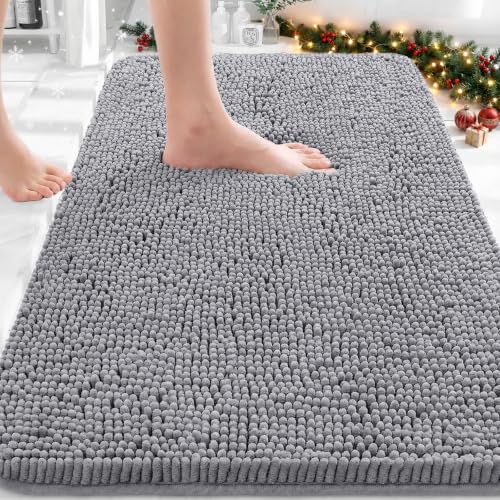
Chenille earns its place in an absorbency guide because of how its pile is built. Each strand is a tiny tufted loop of microfiber, and a full mat contains thousands of them standing upright. Water landing on that surface does not sit on top — it wicks down between the strands and is held in the pile, which is why chenille mats feel dry to the touch even after they have absorbed a full shower’s runoff. This OLANLY rug combines that pile with a quick-drying rubber backing and a full 30×20 footprint, and it adds the most carpet-like feel of any pick here: warm, soft, and quiet underfoot on a cold morning.
It suits buyers who hate the cold-shock of tile, bathrooms in colder climates, and anyone furnishing a primary bathroom where the mat is part of the room’s comfort, not just a utility item. The beige tone of this version also hides the in-between-wash look better than stark white. It is less suited to buyers who want the absolute fastest dry time — pile holds water longer than flat microfiber — and to households with shedding pets, whose hair weaves into chenille pile and needs a lint pass before washing.
Strengths
- Deep pile traps water below the surface, so the top feels dry underfoot
- Warmest, most carpet-like feel of the six picks
- Rubber backing and machine-washable build keep it practical, not just plush
Trade-offs
- Slower to dry fully than flat microfiber after heavy use or washing
- Pile can trap hair and lint; shake it out outdoors before laundering
- Plush texture shows footprints, which some buyers love and others do not
Where this rug quietly outperforms is the morning-after test. A flat mat that absorbed well at 7 a.m. can still feel cool and damp at 7 p.m.; the chenille pile, because it stores water deep in the strands and exposes so much fiber surface to the air, usually feels dry again by the next shower while still having done its job. If your household showers once or twice a day rather than in a long queue, that rhythm fits chenille perfectly.
Best for: comfort-first buyers and cold floors / Not suited for: the fastest possible dry time or heavy pet-hair homes
Check the current price on Amazon

GORILLA GRIP Memory Foam Bath Rug 36×24 — Best Large Mat
Coverage is an absorbency feature. A mat that is too small for its spot forces wet feet onto bare tile at the edges, and the water that misses the mat is the water that ends up on the floor. At 36×24, this Gorilla Grip memory foam rug covers the full apron of a standard tub or the whole frontage of a double vanity, so the entire step-out zone is absorbent and cushioned. The velvet-soft top layer takes up water on contact, the foam core stores it, and grip dots across the underside keep a mat of this size from creeping — a real issue with large foam mats, which can slowly travel across smooth floors.
It suits primary bathrooms, double-sink households, and anyone who has been annoyed by a standard mat that covers only half the tub. It is less suited to small bathrooms (it will dominate the floor), and buyers should confirm the door clears its thickness. In a big bathroom, though, one large mat beats two small ones: no gap in the middle, no mismatched wear, and a single item to wash.
Strengths
- Largest coverage here — the whole step-out zone is absorbent, no wet edges
- Grip-dot underside prevents the slow creep large foam mats are known for
- Velvet-soft surface over foam gives the most luxurious step-out of the foam picks
Trade-offs
- Needs a big washer or a tub soak to launder comfortably
- Oversized for powder rooms and small apartment baths
- Foam this size takes longer to air-dry after washing — plan a backup mat for wash day
Think of this pick as the primary-bathroom anchor. In the bathroom you use most, the mat is effectively flooring for the wettest square meters of the room, and sizing it properly pays off every single day: fewer wet footprints tracked to the bedroom, less water sitting in grout lines, and a step out of the shower that feels like the end of the shower rather than a cold surprise. Measure your tub apron or vanity frontage before ordering — if the number is anywhere near three feet, this is your mat.
Best for: primary bathrooms, double vanities, wide tub aprons / Not suited for: small bathrooms or small washing machines
Check the current price on Amazon
Comparison Table
| Pick | Badge | Key spec | Best for |
|---|---|---|---|
| OLANLY Thick Memory Foam 30×20 | Best Overall | Memory foam core, absorbent cover, non-slip underside | Most households |
| GORILLA GRIP Chenille 24×17 | Best Grip | Chenille pile, strong rubber grip backing | Slick floors, small baths |
| OLANLY Microfiber 30×20 | Best Budget | Plush microfiber surface, rubber backing | Renters, guest baths |
| Yimobra Memory Foam 31.5×20 | Best for Heavy Traffic | Extra-soft foam, larger footprint | Families, back-to-back showers |
| OLANLY Chenille 30×20 | Best Plush Feel | Deep chenille pile, rubber backing | Cold floors, comfort-first buyers |
| GORILLA GRIP Memory Foam 36×24 | Best Large Mat | Oversized foam, grip-dot underside | Double vanities, wide tubs |
How to Choose a Water Absorbent Bath Mat
Start with the material, because material is absorbency. Microfiber works by surface area: each fiber is split into microscopic channels that pull water in by capillary action, which is why microfiber surfaces feel dry so fast. Chenille is microfiber arranged as upright pile, trading a little surface speed for storage — water is held between strands, away from your feet and the floor. Memory foam mats store water in the foam and in their absorbent covers; they offer the most capacity and cushioning but ask for the most drying time. Cotton, the traditional bath mat material, absorbs well when new but dries slowly and loses performance as its fibers pack down, which is why no plain cotton mat made this list. Diatomite stone mats are the fifth option: they absorb almost instantly and dry in minutes, but they feel like standing on a cool stone slab, they can crack if dropped, and they need occasional sanding to refresh the surface. Buyers who prioritize dry speed above comfort should consider stone; buyers who want comfort should stay with fiber and foam.
Next, match capacity to your household’s shower pattern. A mat’s absorbency rating in a listing is usually a single-pour number; your real test is cumulative. One shower a day asks little of any mat here. Four showers before 9 a.m. asks a lot, and that is where foam capacity (the Yimobra or the large Gorilla Grip) earns its keep. If your bathroom has a window or a strong exhaust fan, drying is fast and you can choose freely. If it is an interior bathroom with a weak fan, drying is your bottleneck — favor microfiber or chenille, and build the hang-to-dry habit described below.
Then check the backing honestly against your floor. Rubber backings grip best on smooth tile, stone, and vinyl. Grip dots are a close second and flex better on slightly uneven floors. Bare foam or fabric undersides are the weakest option on glossy tile. Whatever you choose, lift the mat weekly and look underneath: the floor should be dry. A damp floor under a mat means the mat is storing water it cannot release, and the fix is more airflow — hang the mat over the tub edge between uses — not a thicker mat.
Budget deserves a direct word, because this category spans a wide range for what looks like a simple product. At the budget tier you get honest microfiber absorbency and a serviceable backing — enough for guest baths and rentals. The mid tier buys you foam capacity, better backings, and construction that survives weekly washing for years. The premium tier mostly buys size, denser pile, and finish quality rather than a different absorbency mechanism. Spend first on the material that matches your drying conditions, then on size, and only then on looks; a beautiful mat that stays damp is the worst value at any tier.
Finally, size the mat to the wet zone, not to the room. Measure from the tub edge or shower door to where your feet actually land, and across the full width you step through. The mat should cover that rectangle completely. A mat that is two inches too narrow on the door side will leak water exactly where you walk away, every day, and no amount of absorbency elsewhere compensates.
Where the Water Actually Goes: Absorbency, Step by Step
It helps to follow a single shower’s worth of water through a mat, because each stage is a place where cheap mats fail. Stage one is contact: you step out with wet feet, and roughly a shot-glass of water is on your skin and dripping from your legs. A good surface — microfiber or chenille — pulls most of that off in the first two steps through capillary action, the same force that draws water up a paper towel. A poor surface, like a worn cotton mat or a decorative mat with a sealed finish, lets the water bead and run off the sides, which is why puddles form beside mats that are supposedly absorbent.
Stage two is storage. Water that has been wicked into the mat has to live somewhere while you dry off and leave. In a chenille mat it sits in the pile, held between thousands of strands. In a foam mat it sits in the cover and the upper foam. In a thin microfiber rug it sits in the fabric itself, which is why thin rugs saturate fastest: their storage is small, and once it is full, stage one stops working — there is nowhere for new water to go. This is the mechanical reason capacity matters for families and barely matters for a single person in a guest bath.
Stage three is release, and it is the stage buyers think about least. Stored water leaves only by evaporation, and evaporation needs air movement across wet fiber. A mat lying flat on a floor has exactly one exposed face; a mat hung over a tub edge has two, plus gravity helping drainage toward the lower edge. That is why the same mat can be “always damp” in one household and perfectly dry in another — the mat did not change, the release conditions did. Every pick in this guide was chosen with release in mind: none uses a fully sealed waterproof backing that would trap moisture inside the mat with nowhere to go, and all can be hung without damage.
There is also a fourth, invisible stage: the water that never reaches the mat at all. Shower doors that swing outward drip on the floor beyond the mat’s edge; tubs splash at the ends. If your floor gets wet in a crescent beyond the mat, the answer is placement and size — a longer mat, or a mat positioned to cover the door’s drip arc — not a more absorbent material. Diagnose which stage is failing in your bathroom before you buy, and you will pick the right mat the first time.
Sizing and Placement for Maximum Absorbency
The standard 30×20 mat is standard because it fits the apron of a standard tub, but standard is not always right. For a tub, the mat should run at least two-thirds of the tub’s length, because people step out wherever the shower head ends, not where the mat begins. For a walk-in shower, place the mat so its near edge sits directly at the door’s drip line and its far edge reaches the spot where you stop to reach for a towel — usually a deeper rectangle than the tub layout. In front of a vanity, absorbency matters less than in the step-out zone, and a thinner rug that dries fast is often the better choice there, which is why many households end up with a foam or chenille mat at the tub and a flat microfiber rug at the sink.
Two smaller mats are not a substitute for one correctly sized mat in the step-out zone: the seam between them is exactly where water escapes. Conversely, one oversized mat in a small bathroom can be worse than a right-sized one if its edges fold up against the wall or the vanity toe-kick — folded edges cannot absorb, and they trap water underneath. Measure the flat floor area, subtract an inch on each side for clearance, and buy to that number. Every pick in this guide lists its dimensions in its name for exactly this reason.
How to Keep an Absorbent Bath Mat Drying Properly
An absorbent mat’s worst enemy is a still, humid bathroom. These habits keep any of the picks above performing like new:
- After the last shower of a session, drape the mat over the tub edge, shower door, or a towel bar for at least a few hours. Air on both sides cuts drying time dramatically.
- Run the exhaust fan during showers and for twenty to thirty minutes afterward. If your bathroom has a window, crack it when weather allows.
- Wash weekly in a busy household, every two weeks in a light-use one. Use warm water and a mild detergent; skip fabric softener, which coats microfiber and chenille and measurably reduces absorbency.
- Dry flat or hang to dry. If you tumble-dry, use low heat — high heat is what cracks and ages rubber backings.
- Rotate two mats if your household showers heavily. Rotation is the single most effective fix for a mat that “never dries.”
- Every month or so, check the backing for cracking and the surface for flat spots. A mat that stays damp after a full day of hanging has reached the end of its absorbent life and should be replaced.
Common Buying Mistakes
Buying by thickness alone. Thickness is cushioning, not absorbency. A thick mat with a sealed or low-quality cover can shed water while a thinner microfiber rug drinks it. Judge by material and construction, not by how plush the product photo looks.
Ignoring the backing until the first slide. The time to think about grip is before a wet foot lands at an angle. If your floor is glossy tile or polished stone, a rubber backing or grip dots are not optional features.
Never washing with the right products, or washing with the wrong ones. Fabric softener and dryer sheets coat absorbent fibers with a waxy film. The mat comes out smelling lovely and absorbing noticeably worse. Mild detergent only.
Leaving the mat flat on a wet floor all day. This is how good mats develop musty smells and how grout develops mildew. The mat is a sponge; give it air.
Sizing for the room instead of the step-out zone. A beautiful mat that leaves six inches of bare tile at the shower door has failed at its one job. Measure the wet zone first.
Expecting one mat to serve a five-person shower queue without help. Capacity is finite. In heavy-use homes, the correct purchase is often two good mats in rotation, not one expensive mat worked to death.
Final Recommendation
For most buyers, start with the OLANLY Thick Memory Foam Bath Mat: it balances absorbency, drying speed, cushioning, and size better than anything else we cross-checked for this guide. If your floor is slick or your bathroom is small, the GORILLA GRIP Chenille Rug is the safer, smarter buy. If budget leads the decision, the OLANLY Microfiber Rug delivers honest absorbency for the least commitment. Families running back-to-back showers should go straight to the Yimobra Memory Foam Mat, comfort-first buyers to the OLANLY Chenille Rug, and primary bathrooms with wide tubs or double vanities to the GORILLA GRIP 36×24 Memory Foam Rug. Whichever you choose, pair it with the hang-to-dry habit — absorbency is a system of mat plus airflow, not a product alone.
Related guides in this series: Best Bath Mats For Carpeted Bathroom · Best Bath Rugs For Large Bathrooms · Best Non Slip Bath Mats For Seniors · Best Bath Mats For Small Bathrooms
Related guides
Frequently Asked Questions
What makes a bath mat truly water absorbent?
Three things working together: a fiber or foam structure with high surface area to pull water off your feet, enough internal capacity to hold that water without it spreading to the floor, and enough airflow through the material for the stored water to evaporate before the next use. Microfiber and chenille excel at the first step, memory foam at the second, and thin constructions of any material at the third — which is why the best mats combine approaches.
Are memory foam bath mats more absorbent than chenille?
They store more water overall, thanks to the foam reservoir, but chenille often feels drier to the touch because its pile holds water below the surface your foot contacts. For back-to-back showers, foam capacity wins. For one or two showers a day with a premium on a dry feel, chenille is at least as good in practice.
How often should I wash an absorbent bath mat?
Weekly for a mat used daily by multiple people; every two weeks for light use. Wash in warm water with mild detergent, never use fabric softener, and hang or dry low. A mat that smells musty even after washing has usually been left damp too long — a wash with a cup of white vinegar in the rinse can reset it once, but repeated mustiness means the rotation habit needs fixing.
Why does my bath mat stay damp all day?
Almost always airflow, not the mat. Interior bathrooms with weak fans can hold humidity for hours. Hang the mat over the tub or shower door after use, run the fan longer, and consider a thinner microfiber mat, which dries fastest of all. If the floor under the mat is wet, the mat is saturated — rotate two mats.
Do absorbent bath mats work on carpeted bathrooms?
They work, but choose carefully: you want a mat whose backing will not trap moisture against carpet pile. A rubber-backed mat lifted and hung daily is fine; a mat left flat for weeks can mildew the carpet beneath. Our companion guide covers that scenario in depth — see the internal links above.
Are stone (diatomite) bath mats more absorbent than fabric ones?
Stone mats absorb surface water almost instantly and feel dry within minutes, which makes them excellent on pure absorbency speed. The trade-offs are comfort and care: the surface is hard and cool, the mat can crack if dropped on tile, and the pores gradually clog with soap and skin oils until the mat is refreshed with light sanding. We did not list a stone mat among the picks because we could not confirm a specific model through the verification step for this batch, and we never link to an unverified product. If you prefer stone, buy it for a low-traffic bathroom where its hardness will not bother bare feet first thing in the morning, and treat fabric mats as the better choice for families and anyone who lingers at the vanity.
Can I put an absorbent bath mat over heated floors?
Yes, with one caution: gentle radiant heat actually helps a mat dry between uses, and foam and chenille mats tolerate typical bathroom floor temperatures well. Avoid leaving a rubber-backed mat on a floor set to unusually high temperatures for long periods, since sustained heat ages rubber faster. If your floor runs hot, the flat microfiber pick in this guide is the safest match, and lifting the mat weekly to check the backing is a good habit in any heated-floor bathroom.
Why does my new mat absorb worse after a few washes?
The usual culprit is residue. Fabric softener, dryer sheets, and even excess detergent coat the fibers that do the absorbing, and microfiber and chenille are especially sensitive because their absorbency depends on clean, split fiber surfaces. Wash the mat once with a cup of white vinegar and no detergent to strip the coating, then return to mild detergent in modest amounts. If absorbency does not recover, the fibers themselves have worn flat, and it is replacement time.
When should I replace a bath mat?
When the backing cracks or flakes, when the surface stays flat and slow to absorb after a proper wash, or when a full day of hanging no longer gets it dry. For a daily-use mat in a family bathroom, expect roughly one to two years of strong performance from the picks in this guide.