Disclosure: airfryerkitchensupply.com is reader-supported. When you buy through links on our site, we may earn an affiliate commission at no extra cost to you.
Where to buy
Buy the mat for the exact spot it will serve — inside the tub, outside it, or both are different products wearing similar names — and test it in place before it is relied on. The linked mats below were confirmed cache; the in-tub and specialist slots are described without a link, because no listing for them could be confirmed in this batch’s verification pass.
OLANLY Chenille Bath Rug 30×20 with Rubber Backing, Grey — Check the current price on Amazon
Yimobra Memory Foam Bath Mat 31.5×20, Grey — Check the current price on Amazon
OLANLY Thick Chenille Bath Mat 30×20, Grey — Check the current price on Amazon
Extra-long suction-cup bath mat for inside the tub — unlinked pick in this guide; check price on Amazon by searching the exact product name, because we could not confirm a listing through our verification pass for this batch.
Rubber-backed bath runner for beside the tub — unlinked pick in this guide; check price on Amazon by searching the exact product name, because we could not confirm a listing through our verification pass for this batch.
Quick-dry woven bath mat for carers and shared bathrooms — unlinked pick in this guide; check price on Amazon by searching the exact product name, because we could not confirm a listing through our verification pass for this batch.
The best non-slip bath mats for seniors come in two families that are constantly confused: mats that go inside the tub or shower tray, gripping with suction cups and giving feet a textured surface, and rugs that go outside it, gripping the floor with a backing. A senior who showers seated needs the first kind fitted properly; a senior stepping out onto tile needs the second; many households need both and buy one, then wonder why the problem persists. This guide covers the step-out side with verified picks, specifies the in-tub side honestly in prose, and explains how to test whichever you buy so ‘non-slip’ is a fact about your bathroom, not a phrase on a box.
In this guide
Quick Picks
OLANLY Chenille Bath Rug 30×20 with Rubber Backing, Grey — Best Step-Out Mat. The verified step-out default: absorbent chenille over a full rubber backing, sized for a standard shower door or tub side.
Check the current price on Amazon
Yimobra Memory Foam Bath Mat 31.5×20, Grey — Best for Seated Showers and Sore Feet. A thick, soft landing with a non-slip backing — kind to sore feet and to the long stand at the sink that follows a shower.
Check the current price on Amazon
OLANLY Thick Chenille Bath Mat 30×20, Grey — Best for Splash-Heavy Showers. The deep-pile option for showers that soak the floor — handheld showerheads, walk-ins without doors, and enthusiastic rinsers.
Check the current price on Amazon
Extra-long suction-cup bath mat for inside the tub — Best In-Tub Specification. The in-tub specification to shop for: a long mat with dense suction cups across its whole underside and drainage holes, sized to cover a seated bather’s feet and the standing zone together.
Rubber-backed bath runner for beside the tub — Best for Long Landings. A runner specification for the bathroom where the senior walks along the tub — to the grab bar, to the shower chair stored at the far end, to the towel.
Quick-dry woven bath mat for carers and shared bathrooms — Best for Shared Bathrooms. A thin, fast-drying woven specification for the bathroom used by a senior, a carer, and the rest of the household in quick succession.
How These Picks Were Chosen
For the step-out mats we required a real backing — continuous rubber or a stated non-slip underside — a profile low enough for shuffling steps and shower-chair legs, absorbency matched to how much water actually escapes, and machine washability, because grip is maintained in the wash. For the in-tub specifications we required full suction coverage, drainage that does not leave the mat floating, and materials that can be rinsed and hung after every use.
The 6 Best Non-Slip Bath Mats for Seniors
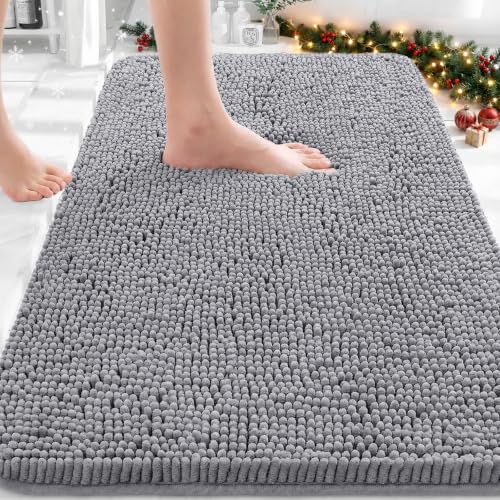
OLANLY Chenille Bath Rug 30×20 with Rubber Backing, Grey — Best Step-Out Mat
Check the current price on Amazon
Most senior shower routines end the same way — a seated or standing shower, then a careful step onto the floor, often with one hand on a grab bar and attention divided. This rug makes that landing soft, dry, and fixed in place: the pile takes the water, the rubber backing takes the floor, and neither asks the person stepping out to think about their feet.
Strengths
- Full rubber backing holds the rug on smooth bathroom flooring
- Chenille pile absorbs the step-out water instead of spreading it
- Machine washable, so the backing’s grip can be maintained properly
Trade-offs
- 30×20 inches suits a standard step-out; wide two-foot landings need the runner thinking in the guide
- Pile needs a full dry between showers in a busy bathroom
- Grey is the verified configuration in this pass
Key details: 30 x 20 inches, chenille pile, rubber backing, machine washable (from the Amazon listing title).
Pair this rug with the routine, not just the shower. Position it where the foot lands after the grab-bar hand is set — usually a few inches toward the bar from the shower door’s centre — and press it down across its whole surface each time it is relaid after washing. A shower chair’s user transfers weight differently from a standing bather, stepping closer to the chair’s side; watch one real shower, adjust the rug to the real landing spot, and only then call the setup finished. Check the backing monthly for cracking and the corners for lift, and wash on schedule rather than on appearance.
Best for: most seniors stepping out of a tub or shower onto tile or laminate / Not suited for: in-tub use — this is a floor rug, not a suction mat

Yimobra Memory Foam Bath Mat 31.5×20, Grey — Best for Seated Showers and Sore Feet
Check the current price on Amazon
After a seated shower, the standing that follows — drying, dressing, the sink — can be the tiring part. This foam mat cushions that whole post-shower stand, spreading weight so heels and the balls of the feet are not pressing through to hard tile. Its slightly longer size covers a wider landing beside a tub.
Strengths
- Thick memory foam cushions prolonged standing after the shower
- Non-slip backing stated in the listing
- 31.5-inch length covers a wider landing zone than standard mats
Trade-offs
- The foam edge is higher than a flat rug — test it with support at hand before relying on it
- Foam dries slowly after a soaking; hang it between uses
- A soft surface is not everyone’s preference for a first step out
Key details: 31.5 x 20 inches, memory foam, non-slip backing, machine washable (from the Amazon listing title).
Place this mat where the standing happens, which for many seniors is as much the vanity as the shower door. If one mat must serve both, bias it toward the shower — a wet landing matters more than a dry one — and consider a second, smaller mat at the sink later. Hang the foam over the tub edge after the morning routine; foam that dries fully keeps both its cushion and its backing grip, while foam left flat on a damp floor loses both slowly and then suddenly.
Best for: seniors who shower seated and then stand to dry and dress, and anyone with sore feet / Not suited for: a high tub step-over, where a flatter mat is the safer landing

OLANLY Thick Chenille Bath Mat 30×20, Grey — Best for Splash-Heavy Showers
Check the current price on Amazon
A handheld showerhead in a senior’s routine — often used seated, aimed carefully — still sends a surprising amount of water past a curtain or screen. This thicker chenille is the mop built into the landing: more pile to hold more water, on the same full rubber backing as the standard version.
Strengths
- Deep pile absorbs generous splash and step-out water
- Rubber backing keeps a heavier, wetter mat in place
- Machine washable and dryable for a realistic care routine
Trade-offs
- Heavier when wet — someone must be able to lift and hang it
- Thicker pile raises the edge a little over the standard mat
- Needs open hanging to dry; it will not dry folded over a rail doubled up
Key details: 30 x 20 inches, thick chenille, rubber backing, machine wash and dry (from the Amazon listing title).
In a splash-heavy bathroom, check the floor beyond the mat as part of the routine: water that lands past any mat is a slip waiting for the second step. If the wet patch regularly extends beyond this mat’s edge, the answer is a bigger footprint or a runner, not a thicker pile — absorbency cannot help water it never touches. Wash this mat before its pile mats down; once chenille flattens and stops springing back after a wash, its capacity is spent and replacement, not another wash, is the fix.
Best for: walk-in and handheld-shower routines that soak the floor / Not suited for: anyone who cannot lift a heavy wet mat to hang it
Extra-long suction-cup bath mat for inside the tub — Best In-Tub Specification
Inside the tub, the product is different in kind: it must grip a curved, wet, soapy surface and give the bather’s feet texture to push against during a seated transfer. Length matters — a mat that covers only the middle of the tub leaves the feet’s working area, near the end where a seated bather pushes up, uncovered.
Strengths
- Dense suction coverage holds on smooth tub surfaces when fitted to a clean tub
- Drainage holes stop the mat floating and let water escape
- Textured top gives seated transfers something to push against
Trade-offs
- Suction mats do not work on textured or refinished tub surfaces — check yours first
- They must be lifted, rinsed, and hung after use or they grow mildew underneath
- No confirmed listing in this guide; count the cups and check the length on the listing yourself
Fitting is the product. Clean the tub, wet the cups, lay the mat, and press down every section firmly before the shower — then test it by pushing with a foot while holding the grab bar, before any bather trusts it. A mat that lifts at a corner in the test will lift in the shower. After each use, pull it up, rinse the underside, and hang it over the tub side; a suction mat left down permanently is a mildew farm with a safety product on top. Replace it when cups tear or stop holding on a clean tub.
Best for: seated bathers and standing shower-over-tub users on smooth tub surfaces / Not suited for: textured, tiled, or refinished shower trays where suction cannot seal
Unlinked pick — no confirmed Amazon listing was available through our verification pass for this batch, so no purchase link is included. Search the exact name on Amazon and compare the listing carefully before buying.
Rubber-backed bath runner for beside the tub — Best for Long Landings
Movement along the tub is the pattern small mats fail: step one is covered, steps two and three are on wet tile. A rubber-backed runner with a low, bound edge covers the whole line of travel, and its single long footprint has fewer edges to catch a shuffling foot than two small mats placed end to end.
Strengths
- Continuous coverage along the tub for multi-step movement
- Bound edges resist curling and keep the profile low
- One piece means no gap between mats to step into
Trade-offs
- Check it fits your washing machine before buying — runners are the hardest mats to launder
- Traps moisture beneath; lift it to dry the floor regularly
- No confirmed listing here, so verify the backing is continuous rubber, not dots
Measure from the shower door or tub step-out to the furthest point of the routine — usually the towel rail or the chair’s parking spot — and buy that length, not the length that looks tidy. Train a new runner flat before use by reverse-rolling it, and never let its first flattening happen under a senior’s feet. If the runner must pass a door swing, check the clearance with the door fully in motion; a runner edge caught by a door becomes a lifted edge, and a lifted edge is the hazard the runner was bought to remove.
Best for: long tubs and routines that travel along the bathroom / Not suited for: small bathrooms or anyone who cannot launder a large mat
Unlinked pick — no confirmed Amazon listing was available through our verification pass for this batch, so no purchase link is included. Search the exact name on Amazon and compare the listing carefully before buying.
Quick-dry woven bath mat for carers and shared bathrooms — Best for Shared Bathrooms
Shared bathrooms defeat thick mats: three showers in an hour leave any deep pile soaked and its landing slick. A thin woven mat absorbs less per use but dries between users, stays low underfoot for every age of walker, and washes and dries in a light load — the practical choice when the mat’s users include a visiting carer in outdoor shoes half the day.
Strengths
- Dries between back-to-back uses instead of staying soaked
- Thin profile is the easiest edge for every kind of foot and footwear
- Light to lift, wash, and hang — realistic for a carer to manage daily
Trade-offs
- Least cushion and least absorbency of any slot in this guide
- Grip depends heavily on its underside — inspect the backing type on the listing
- No confirmed listing in this guide; verify size against your landing zone
In a shared bathroom, judge the mat at the third shower, not the first. If it is still giving a dry, fixed landing to the last user of the morning, it is the right product for that house, whatever its thinness suggests in the shop. Keep a second one in rotation so wash day never leaves the floor bare, and brief anyone helping in the house on the sideways-push test: a mat that has started to creep should be washed or replaced, not straightened and forgotten.
Best for: shared and carer-visited bathrooms with back-to-back showers / Not suited for: a single senior who showers once and wants maximum cushion
Unlinked pick — no confirmed Amazon listing was available through our verification pass for this batch, so no purchase link is included. Search the exact name on Amazon and compare the listing carefully before buying.
Comparison Table
| Pick | Badge | Key detail | Best for |
|---|---|---|---|
| OLANLY Chenille Bath Rug 30×20 with Rubber Backing, Grey | Best Step-Out Mat | Rubber-backed chenille, 30×20 in | most seniors stepping out of a tub or shower onto tile or laminate |
| Yimobra Memory Foam Bath Mat 31.5×20, Grey | Best for Seated Showers and Sore Feet | Memory foam, 31.5×20 in | seniors who shower seated and then stand to dry and dress, and anyone with sore feet |
| OLANLY Thick Chenille Bath Mat 30×20, Grey | Best for Splash-Heavy Showers | Thick chenille, rubber backing | walk-in and handheld-shower routines that soak the floor |
| Extra-long suction-cup bath mat for inside the tub | Best In-Tub Specification | In-tub, dense suction cups, drainage holes | seated bathers and standing shower-over-tub users on smooth tub surfaces |
| Rubber-backed bath runner for beside the tub | Best for Long Landings | Runner, continuous rubber backing | long tubs and routines that travel along the bathroom |
| Quick-dry woven bath mat for carers and shared bathrooms | Best for Shared Bathrooms | Thin woven, fastest drying | shared and carer-visited bathrooms with back-to-back showers |
OLANLY Chenille Bath Rug 30×20 with Rubber Backing, Grey — check price on Amazon
Yimobra Memory Foam Bath Mat 31.5×20, Grey — check price on Amazon
OLANLY Thick Chenille Bath Mat 30×20, Grey — check price on Amazon
How to Choose a Non-Slip Bath Mat for a Senior’s Actual Routine
Start by naming the surface the mat must protect. Inside the tub, the answer is a suction mat fitted to a smooth tub. Outside it, the answer is a backed floor mat. On a shower tray with texture, suction fails and the honest options are a tray-specific textured surface or professional advice — do not let a listing’s confidence override your tray’s reality. Most buying mistakes in this category are family mistakes: the right product bought for the wrong surface.
Then watch one real shower routine and mark the landing. Where does the first foot land, where does the second go, which hand is on which bar, and where does the person stand to dry? Buy coverage for those coordinates. A mat centred decoratively on the tub protects the photograph, not the person; a mat centred on the landing, even if it sits slightly askew to the eye, is fitted equipment.
Weigh the edge against the absorbency. Thick, thirsty mats cushion and soak, and raise the step; thin mats keep the step low and dry fast, and soak less. For a confident walker with sore feet, thickness usually wins. For a shuffling gait, a shower-chair transfer, or a shared bathroom, low and quick-drying usually wins. There is no universal answer, which is why this guide badges by situation instead of crowning one mat.
Finally, assign the maintenance before you buy. Suction mats need lifting and rinsing after every use; backed rugs need scheduled washing and monthly backing checks. If a carer or family member handles laundry, heavier mats are fine. If the senior manages alone, choose the mat whose upkeep they can genuinely sustain — the safest mat is the one that is still being maintained in month six.
The Sideways-Push Test — and Other Checks That Matter
Every mat in this guide should pass one test on your floor, in your bathroom, before it is trusted: standing with a hand on support, push it sideways with a foot, drag it toward you, and step on and off repeatedly. Movement means the pairing fails — clean the floor and the backing and retest once, and if it still moves, return or replace it. Repeat the test after every wash and monthly otherwise, because grip fails gradually and announces itself only to people who check. Add two more habits: lift any mat weekly to dry and inspect the floor beneath, and retire suction cups that tear and backings that crack without negotiation. These checks take two minutes and are the difference between owning a safety product and owning a mat-shaped assumption.
How to Fit and Maintain Bath Mats in a Senior’s Bathroom
Clean before you fit. Mop the landing zone, rinse away detergent residue, and let the floor dry fully; for an in-tub mat, scrub the tub surface so the cups meet enamel, not soap film.
Fit to the landing, not the layout. Position the floor mat on the real step-out spot and press it down from the centre outward; press an in-tub mat’s cups down section by section, then run the sideways-push test on both.
Set the wash rhythm on day one. Floor mats: wash every one to two weeks and hang fully open to dry. In-tub mats: lift, rinse the underside, and hang after every use — no exceptions for tired evenings, because that is when the habit forms.
Inspect monthly. Check rubber backings for cracking, corners for lift, suction cups for tears, and pile for flattening. Any of these is a replacement trigger, not a cleaning trigger.
Keep the rest of the floor honest. A mat cannot protect the walk to the toilet at 3 a.m.; keep that path clear, dry, and — if the household agrees — lit, so the mat is one part of a safe bathroom rather than the whole plan.
Common Buying Mistakes
Using a floor rug inside the tub, or a suction mat outside it. The two families grip different surfaces by different mechanisms. Each fails quietly in the other’s place, and the failure looks like the product’s fault when it is the placement’s.
Buying one mat when the routine needs two. A perfect step-out rug does nothing for a slippery tub floor during a seated transfer, and vice versa. Map the whole routine and cover both surfaces if both are used.
Leaving a suction mat down permanently. Trapped moisture underneath grows mildew and degrades the cups, and the mat that was fitted in January is a loose mat by spring. Lift, rinse, and hang after every use.
Centring the mat on the tub instead of the landing. Real step-outs land off-centre, toward the grab bar and the turn. A decoratively centred mat can miss the actual footfall by half its width.
Skipping the push test because the mat ‘feels grippy’. Hands judge grip badly; feet under body weight, with soap and water involved, are the real conditions. Test as the guide describes, and retest after every wash.
Final Recommendation
For the standard step-out onto tile, start with the OLANLY rubber-backed chenille rug; choose the Yimobra foam mat when sore feet and a long post-shower stand dominate, and the thicker OLANLY when splash soaks the floor. Shop the in-tub suction specification if the transfer inside the tub is the risky moment, the runner if the routine travels along the tub, and the quick-dry woven specification if the bathroom is shared back-to-back. Whichever combination you buy, fit it to the real landing, test it underfoot, and maintain it on schedule. Related reading in this programme:
Start with the OLANLY Chenille Bath Rug 30×20 with Rubber Backing, Grey if it matches your situation — check price on Amazon and confirm the size, finish, or configuration on the listing before ordering.
Start with the Yimobra Memory Foam Bath Mat 31.5×20, Grey if it matches your situation — check price on Amazon and confirm the size, finish, or configuration on the listing before ordering.
Start with the OLANLY Thick Chenille Bath Mat 30×20, Grey if it matches your situation — check price on Amazon and confirm the size, finish, or configuration on the listing before ordering.
Best Absolutely Non-slip Bathroom Rugs For Elderly Best Bath Mats For Carpeted Bathroom Best Antifungal Bath Towels Best Bathroom Storage For Small Apartment
Fitting Mats to Different Senior Households
For a senior bathing entirely alone, simplicity and forgiveness rule: a backed floor mat that grips without any fitting ritual, washed on a fixed day, and — if the tub is used — a suction mat whose fitting has been practised until it is automatic. In this household, avoid any product whose safety depends on a step that can be skipped when tired; the mat that is safe on the worst evening, not the best morning, is the right mat.
For a senior with a visiting carer, add communication to the equipment: the carer should know the push test, the wash day, and the replacement triggers, because a fresh pair of eyes notices a creeping mat or a cracking backing that daily familiarity has stopped seeing. A note on the bathroom door’s inside — wash day, test day — sounds excessive until the first time it catches a failing mat a month early.
For a couple where one partner is steadier than the other, fit the bathroom to the less steady routine and let the steadier partner enjoy the margin. That means the landing position follows the less steady person’s step-out, the in-tub mat is fitted before every shower rather than left to chance, and mat choices favour the lower edge and the surer backing even when the other partner would prefer the plush foam. Safety equipment is household equipment; it is specified to the most vulnerable user.
For a bathroom with a walk-in shower and a seat, the mat question shifts: the step-out is small but the floor is wet over a wide area, and the seated person’s feet work hard on the tray during transfers. Prioritise the tray surface and a wide, quick-drying floor mat across the drying zone, and check that a wheelchair or rollator, if either visits the room, can cross the mat’s edge without catching — a test that takes ten seconds and changes which specification is right.
For a senior who hosts grandchildren, expect the mats to be tested by small, fast, wet feet running where adults walk. In that house, margins matter: the larger footprint, the backing checked more often, and a house rule that the bath mat is not a toy or a raft. The same visit is a good prompt for the monthly inspection — grandchildren are, among their other talents, an unscheduled safety audit.
And for the senior who has had a fall already, treat this purchase as part of a wider refit rather than a single fix: mats, yes, fitted and tested — and grab bars where the routine reaches, a shower seat if standing is the strain, lighting on the night path, and a conversation with an occupational therapist if one is available. A mat is a layer. After a fall, layers are the point, and no single product in this guide should be asked to carry the whole responsibility.
Inside the Tub: Getting Suction Mats Right
The in-tub mat fails in two ways: it never truly fitted, or it fitted and was left down until it didn’t. Fitting begins with a clean tub — scrub the surface, rinse away cleaner residue, and let the mat meet enamel rather than film. Wet the cups, lay the mat where the bather’s feet work, and press every section down firmly, working from the centre out so air is expelled rather than trapped. Then test under load with a hand on the bar, exactly as the guide’s push test describes, before the first real shower trusts it.
Leaving-down is the slower failure. A suction mat left in place traps a permanent damp layer against the tub, grows mildew on its underside, and its cups gradually take a set that holds less each week. The lift-rinse-hang habit after every shower is not fastidiousness; it is the maintenance schedule the product’s safety depends on, as surely as a backed rug’s wash day. When cups begin to tear or the mat lifts at a corner on a clean tub despite correct fitting, retire it — an in-tub mat is inexpensive, and its job is unforgiving.
Questions to Ask Before You Spend Anything
Ask which moment worries you, and let the answer spend the money. If it is the step out — the wet foot meeting the floor — the backed rug is the purchase. If it is the transfer inside the tub — the push up from the seat, the turn under the shower — the suction mat is the purchase. If it is both, it is both, and buying one excellent product for the wrong moment is the most common waste in this category. Name the moment out loud before you shop; the rest of the decision gets easier immediately.
Ask what the surfaces are, both of them. The tub’s inside: smooth or textured, enamel or acrylic, original or refinished — suction’s fate is decided there. The floor outside: glossy tile, textured tile, vinyl, laminate — the backing’s fate is decided there. A household that can answer both questions in one sentence can shop this whole category in ten minutes; a household guessing at either is buying a return.
Ask who maintains it, because in this category maintenance is not housekeeping, it is the safety mechanism renewing itself. The suction mat’s daily lift and rinse, the rug’s fortnightly wash and monthly backing check — whose hands do these, on the tired evenings as well as the good ones? Choose the products whose upkeep the household can sustain at its worst, and write the rhythm down where the person doing it will see it.
Ask how the bather moves, in the specific choreography of your bathroom: which hand reaches for which bar, which foot leads, where the towel hangs relative to the step, whether a chair is involved and where its legs stand. Mats fitted to that choreography protect; mats fitted to the room’s symmetry decorate. Watch one shower — with permission and dignity preserved — and you will know more than any listing can tell you.
Ask what ‘good’ will look like in three months, so you can recognise drift: the rug unmoved and flat, the suction mat lifting away cleanly each day and holding fast each morning, the floor beneath dry and unmarked, the routine unremarkable. Boredom is the success state of safety equipment. The moment a mat becomes interesting — a slide noticed, a corner fought with, a smell from underneath — it is asking for the inspection, the wash, or the replacement it is due.
And ask what else in the bathroom is carrying risk that a mat cannot touch: the loose bath-side rug in the night path, the bar that was never fitted, the shower stool with one wobbling leg, the medication that makes mornings dizzy. A mat purchase is a fine prompt for a ten-minute audit of the whole room, and the audit, honestly done, is worth more than any single product in this guide.
Key Takeaways for a Safer Senior Bathroom
Two surfaces, two products, one routine: the suction mat inside the tub and the backed rug outside it protect different moments, and most senior bathrooms need both, fitted to the actual surfaces and the actual choreography of the person bathing. Buying one superb product for the wrong moment is the category’s standard disappointment, and it is entirely avoidable by naming the risky moment first.
Fitting is a procedure, not a placement. Clean surfaces, pressed-down cups, a rug centred on the landing rather than the layout, and the sideways-push test passed under load before trust is given — then repeated after every wash and every month, because grip is a condition that expires rather than a property that persists.
Maintenance is the safety mechanism renewing itself: the suction mat lifted and rinsed after every use, the rug washed on its day and inspected for cracking and curl. Choose products whose upkeep the household can sustain on its worst evening, and write the rhythm where it will be seen.
And keep the mat in perspective as one layer among several — bars, seating, lighting, a clear night path, and professional advice after any fall. A bathroom made safer layer by layer is the real product this guide is selling; the mats, chosen and kept as described, are simply where that project most easily begins.
A Final Word on Value in This Category
Value in senior bath mats is measured in uneventful showers, and by that measure the category is the best bargain in the bathroom: the full kit — a fitted suction mat, a backed rug, the wash rhythm that maintains both — costs less than almost any other safety measure in the home and is used, and useful, every single day. The expensive version of this purchase is the one that was never fitted, never tested, or bought for the wrong surface.
Spend first on the moment that worries you most, and fit that product properly before buying the second. A household that masters one surface — fits it, tests it, maintains it for a month — has learned the discipline that makes the second surface easy. The reverse order, everything bought at once and nothing quite fitted, is how good products end up blamed for a process that never happened.
Resist the false economy of the unbranded miracle mat whose grip claims cannot be checked and whose backing cannot be inspected in a photograph. In safety equipment, verifiable ordinariness — a named backing, a countable field of suction cups, a wash label that permits real washing — is the quality. The picks and specifications in this guide were chosen on exactly that principle.
Buy plainly, fit carefully, test honestly, and replace without sentiment when the triggers say so. The reward is a bathroom that stops being a place the household worries about — and that quiet, repeated every morning, is worth far more than the mats cost.
One last practical note before the questions below: involve the senior in every decision this guide describes. It is their bathroom, their routine, and their footing; a mat chosen for them without them — however well specified — arrives as an instruction, while a mat chosen with them arrives as equipment. Walk the routine together, let them run the push test with their own foot, let them choose between the foam’s softness and the flat rug’s sureness where both are safe, and write the wash day on a calendar they keep. Dignity is not a soft extra in safety work; it is the mechanism by which safety equipment gets used, maintained, and reported on when it starts to fail. The households where these products work for years are the households where the person they protect is the person in charge of them — with family and carers as the inspection team, never as the replacement decision-maker. Start there, and the rest of this guide is just technique.
A closing thought on timing: fit new mats on a calm morning, not on the day of a hospital discharge, a house move, or a family visit, however pressing those days make the purchase feel. New equipment deserves a practised routine around it, and routines are built on ordinary days. Buy ahead of need where you can — the bathroom refitted in peacetime, tested at leisure, is the one that performs on the difficult day it was always for.
In short: measure the surfaces, name the moment, fit the product, test it underfoot, and keep the rhythm. Five small disciplines, none of them expensive, all of them repeatable — that is the whole method, and it works in any senior bathroom in any house.
Frequently Asked Questions
What is the difference between a bath mat and a bath rug for seniors?
In this guide, a mat for inside the tub grips with suction cups and gives feet texture during the shower; a rug for outside grips the floor with a backing and absorbs the step-out. They solve different moments of the same routine, and many senior bathrooms need both.
Do suction-cup mats work in every shower?
No. They need a smooth surface to seal against — most standard tubs qualify, while textured trays, tiled floors, and some refinished surfaces do not. If the cups will not hold during a firm push test on a clean tub, do not rely on them.
How big should the step-out mat be?
Big enough to cover the whole landing: the first step, the turn, and the shuffle toward the grab bar or towel. For most standard tubs that starts at a 30-inch mat and grows to a runner when the routine travels along the tub.
Are memory foam mats a good choice for seniors?
For sore feet and long stands at the sink, often yes — with the cautions that the edge is higher and the surface softer, so they suit low shower entries better than high tub step-overs. Test the edge with a hand on support before relying on it.
How often should a senior’s bath mat be washed or replaced?
Floor mats every one to two weeks; in-tub mats rinsed after every use and washed regularly. Replace either kind when its grip fails the push test on a clean surface, when backings crack, or when suction cups tear — grip failure is end of life.
Can a non-slip mat replace grab bars or a shower chair?
No. Mats manage the surface underfoot; bars and chairs manage balance and weight transfer. A safe senior bathroom usually combines them, each doing the job the others cannot.

