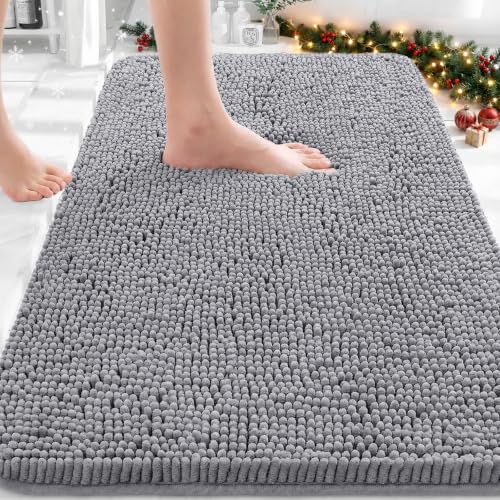
Disclosure: airfryerkitchensupply.com is reader-supported. When you buy through links on our site, we may earn an affiliate commission at no extra cost to you.
Where to buy
Every mat below earns the description water resistant in a specific, honest way — stone that evaporates water instead of storing it, rubber and PVC that water cannot enter at all, and teak that shrugs off daily soaking — and each was cross-checked against Amazon’s catalog data before it earned a link. Use the Check on Amazon buttons to confirm the exact size in the listing title; bath mats are sold in families of sizes, and the right material in the wrong footprint still disappoints. Measure the space in front of your tub or shower before ordering.
- Stone Bath Mat, Diatomaceous Earth, Grey — Check price on Amazon
- Extra Large Stone Bath Mat, Diatomaceous Earth, 28 x 16 — Check price on Amazon
- TOSORO Stone Bath Mat, Diatomaceous Earth (23.5 x 15, Sandstone) — Check price on Amazon
- GORILLA GRIP Bath Tub Shower Mat, 35 x 16, Clear — Check price on Amazon
- Utoplike Teak Wood Bath Mat, 24 x 18 — Check price on Amazon
- LuxStep PVC Loofah Bath Mat, 24 x 16 — Check price on Amazon
The best water resistant bath mats exist because the ordinary bath mat has a dirty secret: it is a sponge with good PR. A fabric mat absorbs the water from every shower, holds it against the floor for hours, and becomes — within weeks in a busy bathroom — a damp, heavy rectangle that smells faintly of mildew and needs washing more often than anyone actually washes it. A water resistant mat refuses that whole arrangement. It either sheds water, evaporates it, or drains it, so the surface you step onto is dry, the floor beneath stays dry, and the mat itself never becomes the wettest object in the room.
Three technologies deliver that promise, and this guide’s six verified picks span all of them. Diatomaceous earth stone mats drink water off your feet and evaporate it into the air within minutes, leaving a surface that feels dry almost immediately. Rubber and PVC mats are simply impermeable — water runs off or through them, and they rinse clean in seconds. Teak mats take the spa route: slatted hardwood that water passes through, raised off the floor so everything dries. Each technology has a room it suits and a user it annoys, and the reviews below are blunt about both.
One clarification before the picks, because the category abuses language: ‘water resistant’ here means the mat does not absorb and harbour water — it is not a claim that the mat is a waterproof barrier for a leaking floor, and no bath mat of any kind fixes a plumbing problem. What these mats fix is the daily litre of shower water that an absorbent mat would otherwise store against your floorboards. That is a real fix, and it is the one this search is shopping for.
In this guide
Quick Picks
Stone Bath Mat, Diatomaceous Earth, Grey — Best Overall: The category’s headline act: step out of the shower onto stone, watch the wet footprints evaporate in minutes, and never own a soggy mat again. Check price on Amazon
Extra Large Stone Bath Mat, Diatomaceous Earth, 28 x 16 — Best Large: The stone idea at full width: 28 by 16 inches of quick-dry diatomaceous earth for double step-outs, big tubs and households that shower back-to-back. Check price on Amazon
TOSORO Stone Bath Mat, Diatomaceous Earth (23.5 x 15, Sandstone) — Best Value Stone: Stone performance at the accessible end: a 23.5 by 15 diatomite mat in a warm sandstone tone for buyers who want the technology without the flagship spend. Check price on Amazon
GORILLA GRIP Bath Tub Shower Mat, 35 x 16, Clear — Best In-Tub: The in-tub specialist: a waterproof mat that lives inside the bath, gripping with suction cups, draining through holes, and making a slippery tub floor safe. Check price on Amazon
Utoplike Teak Wood Bath Mat, 24 x 18 — Best Wood / Spa: The spa route: solid teak slats that water falls through, raised off the floor on non-slip pads — warm underfoot, dry in minutes, beautiful for years. Check price on Amazon
LuxStep PVC Loofah Bath Mat, 24 x 16 — Best Cushioned Waterproof: The soft impermeable: a PVC loofah-textured mat that water runs through, with a cushioned scrub feel underfoot — comfort without absorbency. Check price on Amazon
How These Picks Were Chosen
We shortlisted mats whose water behaviour is structural, not a coating claim: stone mats made of diatomaceous earth, solid rubber and PVC mats, and solid teak — then verified each model against Amazon’s catalog data so sizes and constructions in this guide match the listings. Fabric mats with ‘quick dry’ marketing were excluded unless the construction genuinely prevents absorption, because a thin sponge is still a sponge, and this guide’s promise is in its title.
Within the list we weighted dryness speed first — how soon after a shower the surface feels dry to the next person’s bare feet — because that is the entire point of the category. Grip came second, and it cuts two ways: the mat must not slide on the floor, and your feet must not slide on the mat, and different technologies win each half of that test. Third came maintenance honesty: stone mats need an occasional sanding to refresh their absorbency, teak wants a rinse and air, rubber wants a wash and a shake — the reviews state each one’s actual routine rather than pretending any of them is maintenance-free.
We also separated floor mats from in-tub mats deliberately and labelled them, because the two jobs share a name and nothing else. The Gorilla Grip pick is an in-tub safety mat; the rest stand on the floor outside. Mixing them up is the category’s most common buying error, and this guide refuses to make it.
The 6 Best Water Resistant Bath Mats
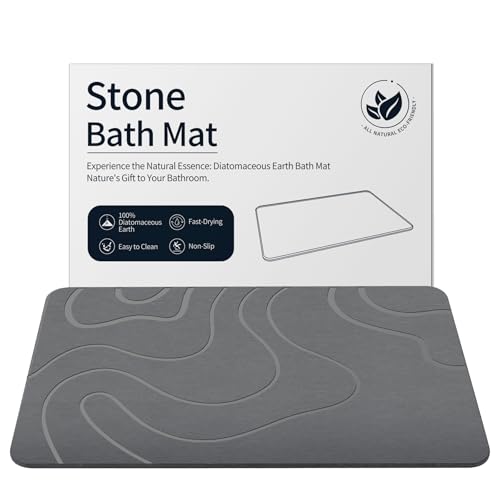
Stone Bath Mat, Diatomaceous Earth, Grey — Best Overall
The first use of a diatomaceous earth mat feels like a magic trick with a geological explanation. You step onto the grey stone surface with wet feet, leave dark footprints — and then watch them fade as the stone’s microscopic pore structure pulls the water in and evaporates it back into the room. The surface under the next person’s feet is dry. The mat never gets cold-and-clammy the way fabric does, never smells of mildew, and never needs a wash cycle: an occasional rinse, and a light sanding with the kind of fine abrasive pad these mats ship with when absorbency eventually dulls, restores it.
It suits bathrooms where the mat’s job is the step-out zone in front of a shower or tub, households tired of laundering fabric mats, and anyone whose bathroom ventilation is weak — a room where a fabric mat never truly dries is exactly where stone wins biggest. The honest trade-offs are feel and fragility: the surface is hard, like standing on smooth stone, because it is stone; bathers who want cushion underfoot should look at the PVC loofah pick. And a stone mat dropped on a tile floor can chip or crack, so it is placed once and left, not carried around the house.
Strengths
- Wet footprints evaporate in minutes — surface stays dry
- No mildew, no laundry, no soggy-mat smell, ever
- Firm, cool, spa-like feel that suits modern bathrooms
Trade-offs
- Hard surface — no cushion for sore feet
- Can chip if dropped on hard floors
- Absorbency needs an occasional refresh sanding
| Detail | What to know |
|---|---|
| Material | Natural diatomaceous earth stone |
| Behaviour | Fast drying, super absorbent, per the verified listing title |
| Design | Non-slip design, easy to clean |
Placement is the whole setup: flat floor, fully supported, out of the direct shower spray — it is a drying mat, not a shower floor. Households with two showers in a row will notice it keeps up; a household that floods the floor with every shower should fix the flood and still buy the mat. Of all six picks, this is the one that most completely delivers the search’s promise, and the one guests ask about — usually while watching their own footprints disappear.
Best for: Step-out zones, weak-ventilation bathrooms, laundry-weary households / Not suited for: Bathers wanting a soft, cushioned landing

Extra Large Stone Bath Mat, Diatomaceous Earth, 28 x 16 — Best Large
Stone mats have one recurring complaint — the standard size fits one person’s step-out and no more — and this 28-by-16 answers it directly. The extra width covers the long side of a tub, gives two feet room to land and turn, and keeps up with the back-to-back shower traffic of a family bathroom, where a smaller stone mat can saturate at the surface during the third consecutive shower and need a minute to catch up. The verified listing positions it for the bathroom floor and outside the shower, which is exactly its territory.
It suits family bathrooms, long tubs, walk-in shower exits, and anyone whose step-out zone is a thoroughfare rather than a spot. Everything said about stone applies — the evaporating footprints, the hard cool surface, the rinse-and-occasionally-sand care — scaled to a mat that feels generous rather than precise. Check the floor run before ordering: 28 inches wants an unobstructed stretch, and a stone mat must sit fully flat and supported, never bridging a floor register or a wonky tile.
Strengths
- Extra width covers tubs and double step-outs properly
- Same fast-evaporating stone behaviour, more capacity
- Non-slip positioning for bathroom floor and shower exit
Trade-offs
- Needs a long, flat, unobstructed floor run
- Heavier and more fragile to move than standard stone
- Hard surface feel, as with all stone mats
| Detail | What to know |
|---|---|
| Dimensions | 28 x 16 inches |
| Material | Diatomaceous earth |
| Behaviour | Quick-drying, super absorbent, easy to clean and store, per the verified listing title |
Think of the size choice as traffic planning. Solo bathroom, standard stone. Shared bathroom, this one — the difference shows up precisely at 7 a.m., when the mat’s job is not one person’s comfort but a household’s rhythm. It is also the better pick in front of a freestanding tub, where the step-out can happen along the whole long side and a small mat becomes a guessing game played with wet feet.
Best for: Family bathrooms, long tubs and walk-in shower exits / Not suited for: Small bathrooms or cushioned-landing seekers

TOSORO Stone Bath Mat, Diatomaceous Earth (23.5 x 15, Sandstone) — Best Value Stone
The TOSORO brings the diatomaceous earth idea down to the price-conscious end of the shelf without changing the physics: the same porous stone behaviour — water pulled in, footprints evaporating, surface dry — in the standard 23.5-by-15 footprint and a sandstone colour that suits warm-toned bathrooms better than the usual greys. It is the pick for the second bathroom, the rental upgrade, and the sceptic who wants to test whether stone mats suit their life before committing to the category’s bigger names.
It suits exactly those buyers, and its limits are the value tier’s honest ones: expect to refresh its absorbency with a sanding a little sooner, place it with the same flat-floor care, and do not drop it. In daily use — step out, dry feet, dry surface — it performs the category’s central trick indistinguishably from pricier stone, which is why it earns a badge rather than a footnote. The stone mat market’s dirty secret is that the material does most of the work; the TOSORO is the proof.
Strengths
- Full stone-mat behaviour at a value position
- Warm sandstone tone suits beige and wood bathrooms
- Standard size fits most step-out zones
Trade-offs
- May need absorbency refresh sooner than premium stone
- Same drop-fragility as all stone mats
- Standard size only — no extra-large option in this pick
| Detail | What to know |
|---|---|
| Dimensions | 23.5 x 15 inches |
| Material | Diatomite (diatomaceous earth) stone |
| Behaviour | Non-slip, super absorbent, quick drying, easy to clean, per the verified listing title |
Buy it as the experiment that usually becomes permanent. Households that start with a value stone mat in the guest bathroom tend to end with stone in every bathroom, because the comparison with the surviving fabric mat becomes embarrassing within a month. If the experiment fails — if your household simply prefers softness — you have learned it at the lowest cost the category offers, and the mat retires gracefully to the kitchen sink or the pet bowls, where its absorbency is equally welcome.
Best for: Second bathrooms, rentals and stone-mat first-timers / Not suited for: High-traffic family step-outs needing the large size

GORILLA GRIP Bath Tub Shower Mat, 35 x 16, Clear — Best In-Tub
This pick does a different job from the other five, and the guide labels it plainly: it goes inside the tub. The Gorilla Grip is a waterproof floor liner for the bath itself — 35 by 16 inches of it — held by suction cups, perforated with drain holes so water never pools on its surface, and soft enough underfoot to make standing showers in a slick enamel tub a calmer experience. For households with children, older relatives, or a tub whose floor is simply treacherous, this is not an accessory; it is the safety equipment.
It suits smooth tub floors — suction needs a smooth surface to grip, and the pebble-textured listing variants in this market always carry that warning for a reason. It is machine washable, which separates it from the mould-prone in-tub mats of memory: lift it, hang it to dry between uses if your bathroom is humid, and wash it on a rotation. What it is not is a step-out mat — it does not belong on the bathroom floor, and using it there wastes its grip and invites a slide. Inside its proper home, it is the category standard.
Strengths
- Suction grip transforms a slippery tub floor
- Drain holes stop water pooling on the surface
- Machine washable — defeats the in-tub mould problem
Trade-offs
- For smooth tub floors only — textured tubs defeat suction
- Must be lifted and dried in humid bathrooms
- In-tub only; not a floor mat
| Detail | What to know |
|---|---|
| Dimensions | 35 x 16 inches |
| Fixing | Suction cups with drain holes, per the verified listing title |
| Care | Machine washable, soft on feet |
Pair it with one of the floor picks and the bathroom’s whole water map is covered: grip inside the tub, dryness outside it. Households often buy the floor mat first and this second, after the first slip reminds them where the danger actually lives. If anyone in the house is unsteady, reverse that order — this is the safety purchase, and the stone mats are the comfort one.
Best for: Slippery tubs, children and older bathers / Not suited for: Textured tub floors or use as a floor mat
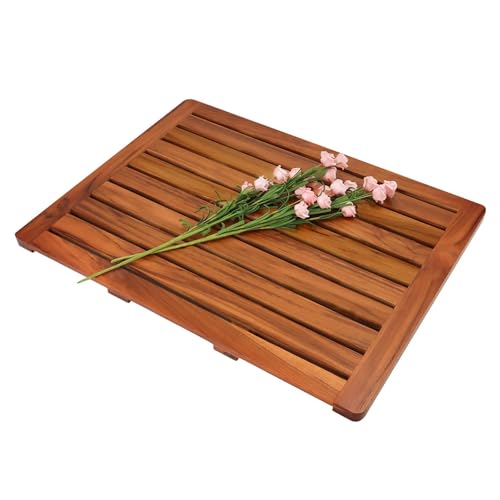
Utoplike Teak Wood Bath Mat, 24 x 18 — Best Wood / Spa
Teak is what spas and boat decks use where water lives, because the wood’s natural oils make it indifferent to soaking that would rot or swell lesser timber. A slatted teak mat turns that material into a bath mat by geometry: water falls between the slats instead of pooling, the mat stands raised on non-slip pads so air circulates beneath, and your feet land on warm wood rather than cold tile or damp fabric. At 24 by 18 inches this Utoplike suits a shower exit or a tub side in a standard bathroom, and its listing covers indoor and outdoor shower use — a hint at how unbothered the material is by weather, let alone bathwater.
It suits bathrooms with a natural, warm or spa aesthetic — the one pick here that actively improves how the room looks — and bathers who dislike stone’s hardness and fabric’s dampness equally. The care is real but pleasant: rinse it, let it dry standing in air occasionally, and expect the colour to silver gracefully outdoors or stay rich indoors with the occasional oiling if you care to. What it will not do is cushion: it is a platform, firm and warm, and bathers wanting softness should take the loofah pick below.
Strengths
- Water drains through slats — nothing stays wet
- Teak shrugs off daily soaking for years
- Warm, beautiful, spa-grade presence in the room
Trade-offs
- Firm platform feel — no cushioning
- Wants an occasional airing and rinse routine
- Wood tone is a style commitment for the room
| Detail | What to know |
|---|---|
| Dimensions | 24 x 18 inches |
| Material | Solid teak wood |
| Fixing | Non-slip pads, per the verified listing title |
Teak is also the longevity pick: a stone mat can chip, a PVC mat will eventually tire, but a solid teak mat in a bathroom is measured in decades and improves in character as it goes. Buy it when the bathroom renovation has a natural material story to tell, or when you simply want the mat question settled permanently. It is the connoisseur’s answer in a category of consumables.
Best for: Spa and natural-style bathrooms, long-term owners / Not suited for: Cushion seekers or cold minimalist schemes

LuxStep PVC Loofah Bath Mat, 24 x 16 — Best Cushioned Waterproof
The loofah mat is the answer for bathers who want softness without sponge. Its PVC construction is a tangle of textured loops: water passes through the mat to the drain or the floor beneath rather than being stored in it, the loops give a gently scrubbing, cushioned feel that stone and teak cannot offer, and the whole thing rinses clean under the shower in seconds and dries fast because there is nothing in it to hold water. The verified listing specifies phthalate-free PVC, a detail worth having in a product that lives wet against bare skin.
It suits inside-shower floors and step-out zones alike — it is the most position-flexible pick here — plus sore feet, older bathers who want a yielding surface, and anyone whose bathroom aesthetic cannot face stone or wood. Its limits are texture and temperament: the loofah feel divides people instantly, some finding it invigorating and others simply scratchy, and a PVC mat is a functional object that will never be the room’s beauty. It also needs its rinse — soap film can lodge in the loops of a neglected one, which the quick-drying design makes a thirty-second job rather than a chore.
Strengths
- Cushioned, scrubbing feel with zero absorbency
- Water drains through; rinses clean in seconds
- Works inside the shower or as a step-out mat
Trade-offs
- Loofah texture divides opinion — not for sensitive feet
- Purely functional looks
- Needs its quick rinse to keep the loops fresh
| Detail | What to know |
|---|---|
| Dimensions | 24 x 16 inches |
| Material | PVC loofah, phthalate free, per the verified listing title |
| Behaviour | Non-slip with drain, quick drying |
This is the pick that ends the stone-versus-soft argument for a large group of buyers: the household that wants a dry bathroom and a kind landing buys the loofah and stops shopping. It is also the travel and rental hero of the list — light, unbreakable, indifferent to being rolled and packed — which earns it a place in more bathrooms than its looks would predict.
Best for: Sore feet, inside-shower use, rentals and travel / Not suited for: Texture-sensitive bathers or design-led rooms
Comparison Table
| Pick | Badge | Key spec | Best for |
|---|---|---|---|
| Stone Bath Mat, Diatomaceous Earth, Grey | {p[“badge”]} | {p[“keyspec”]} | {p[“bestfor”]} |
| Extra Large Stone Bath Mat, Diatomaceous Earth, 28 x 16 | {p[“badge”]} | {p[“keyspec”]} | {p[“bestfor”]} |
| TOSORO Stone Bath Mat, Diatomaceous Earth (23.5 x 15, Sandstone) | {p[“badge”]} | {p[“keyspec”]} | {p[“bestfor”]} |
| GORILLA GRIP Bath Tub Shower Mat, 35 x 16, Clear | {p[“badge”]} | {p[“keyspec”]} | {p[“bestfor”]} |
| Utoplike Teak Wood Bath Mat, 24 x 18 | {p[“badge”]} | {p[“keyspec”]} | {p[“bestfor”]} |
| LuxStep PVC Loofah Bath Mat, 24 x 16 | {p[“badge”]} | {p[“keyspec”]} | {p[“bestfor”]} |
How to Choose a Water Resistant Bath Mat
Decide the mat’s station first, because the category hides two jobs under one name. Inside the tub or shower floor, the job is grip on a wet, smooth surface: suction-cup rubber and PVC mats, and only those — a floor mat inside a shower is a slide waiting for a victim. Outside, at the step-out, the job is water management: the mat receives a wet bather and must dispose of roughly a cup of water per shower without storing it. Stone disposes by evaporation, teak by drainage and air, PVC loofah by pass-through. Choose the disposal method that suits your bathroom’s ventilation and your household’s traffic: a steamy, windowless bathroom punishes anything that relies on ambient drying and rewards stone’s active evaporation; a well-ventilated room lets every technology work.
Size second. The mat must cover the step-out stride — one full step and a turn — which in practice means at least the standard 24-inch class for a shower door and the long side of a tub for a tub exit. A beautiful mat placed six inches too far from the tub is a decoration next to a puddle. Third, feel: this is a barefoot purchase, the most tactile in the house, and the stone-versus-wood-versus-loofah question is answered honestly only by your own feet’s preferences. Buy the feel you will enjoy at 7 a.m. in February, not the one that photographs best.
Finally, interrogate the maintenance before it interrogates you. Every technology here has a small routine — stone’s occasional sanding, teak’s airing, PVC’s rinse, rubber’s wash — and the right mat is the one whose routine fits your actual habits. A water resistant mat neglected is still better than a fabric mat neglected, which is the category’s quiet mercy, but the routines are short enough that choosing the one you will actually do is easy and worth it.
Why Fabric Bath Mats Fail, and What Replaces Them
A fabric bath mat fails by succeeding at its design: it absorbs. Each shower loads it with water it cannot evaporate in a typical bathroom’s humidity, so it spends its life damp. Damp fabric against a floor grows the mildew smell that no wash fully evicts, holds moisture against wood and laminate floors long enough to mark them, and turns the step-out — the moment of maximum slip risk — into a landing on a cold, heavy, shifting pad. The laundry cycle that would save it is the one nobody sustains, because a bath mat is always the last item in the wash queue. The failure is not the owner’s; it is the material’s brief, which is why this guide’s category exists.
The replacements succeed by refusing absorption in three different ways, and the differences matter. Evaporation — the stone mats — is the only method that actively dries the bather’s feet as well as itself, which is why stone feels like an upgrade rather than a substitution. Drainage — teak and loofah — moves water through the mat to the floor or drain and then relies on air; it works best where the floor beneath is itself waterproof, as bathroom floors should be. Impermeability — rubber in-tub mats — simply gives water nowhere to go but away, which inside a tub is exactly right. Choose the refusal that matches your room, and the soggy rectangle’s reign ends.
Grip: The Safety Half of Water Resistance
A dry mat that slides is a hazard wearing a halo, so grip deserves its own audit. There are two interfaces: mat-to-floor and foot-to-mat. Stone wins the second by texture and can lose the first on a dusty floor, which is why placement on a clean, flat surface is a safety instruction and not fussiness. Teak answers with non-slip pads beneath and slats above — grip in both directions, provided the pads meet the floor fully. Loofah PVC grips feet by texture and floors by weight and friction, and improves as it gets wet, which is the correct direction for a safety product. Rubber in-tub mats replace the question entirely with suction: the strongest grip in the guide, on the surface that needs it most, provided the tub is smooth enough to hold the cups.
Test any new mat the same way: place it, wet it, and step on it with intent before the household’s most vulnerable member does. A mat that passes a dry shuffle in the shop can still skate on your tile with your water pressure behind it. The two minutes of testing is the cheapest safety work in the bathroom, and this category — bought partly for safety — deserves it.
Keeping a Water Resistant Mat Performing for Years
Stone mats ask for the least and give a warning when they need it: when footprints start lingering instead of fading, the pores are loaded with soap and mineral film, and the fix is the refresh the makers describe — a light sanding of the surface with a fine abrasive, a rinse, and the mat drinks again. Do it over a bin, outside if you can, and never use bleach or harsh chemicals that load the pores further. Teak asks for air: stand it on edge after the morning rush once in a while, rinse the slats when soap film dulls them, and let the wood’s own oils do the rest — detergent theatre shortens its life, not neglect’s opposite.
Rubber and PVC ask for motion: lift them, shake them, hang them where air reaches both sides, and wash on the household’s towel rotation rather than a special occasion. The in-tub mat especially must not live permanently flat and wet against the tub in a humid bathroom, because the one surface in this guide that can grow a film is the underside of a mat that never dries. None of these routines exceeds two minutes, and all of them together are less work than the fabric mat’s eternal laundry — which was, from the beginning, the point.
Water Resistant Mats in Rentals, Gyms and Guest Bathrooms
Some bathrooms argue for this category louder than the family bath. Rentals are the first: a landlord fitting a bathroom that tenants will not launder for has every reason to choose a mat that cannot become a mildew exhibit — stone or PVC, wiped in seconds between tenancies, with no fabric to replace. Guest bathrooms are the second: a mat that is dry and fresh for a guest’s first shower, without the host remembering a wash cycle, is hospitality in material form, and the teak pick in particular makes a guest bathroom feel considered rather than merely equipped.
Home gyms, pool changing areas and pet-washing stations are the third territory, and they explain several of these products’ second lives: a stone mat under the dog bowls, a loofah mat at the gym shower, a teak mat by the pool door. The common thread is water arriving regularly in a place nobody wants to launder — which describes more of modern life than the bathroom alone, and is why a good water resistant mat is one of those purchases that quietly multiplies around a house.
Stone vs Teak vs PVC: The Feel Test
Stand on all three in your imagination at 7 a.m. Stone is cool, firm and faintly mineral — the feel of a good hotel bathroom floor — and it wakes your feet as much as dries them; some bathers love the alertness, others want kindness. Teak is warm — wood holds room temperature kindly — firm but yielding in perception, with the slats giving your feet information and grip; it is the feel of a spa and the least ‘product-like’ of the three. PVC loofah is the only cushioned one, a springy scrub that massages as it drains, and the only one whose feel is genuinely divisive: try it with an open mind and a returns window.
There is no hierarchy here, only matching. Cold-tile bathrooms forgive stone’s coolness least and reward teak most. Barefoot traditionalists who hate texture should avoid the loofah. Households that cannot decide should buy the stone for the main bathroom — it is the category’s centre — and let experience argue for the second mat. Feel is a legitimate specification in a product your bare feet meet twice a day; this guide treats it as one.
How to Set Up a Bath Mat Zone That Stays Dry
Build the zone in three decisions. Position: the mat’s centre belongs where the first foot lands — directly outside the shower door’s swing or along the tub’s long side at the point where bathers actually climb out, which is usually toward the tap end, not the middle. Test it with one supervised wet exit before committing; a mat placed by eye is placed wrong in most bathrooms. Clearance: stone and teak must sit fully flat on a clean floor — sweep the spot first, because a stone mat rocking on a grit particle is a stone mat learning to chip, and a teak mat’s pads need full contact to grip.
Then the routine: after the last shower of the morning, the zone gets ten seconds — in-tub mat lifted to drain, loofah shaken, stone left exactly where it is to do its evaporating. Once a week, the floor beneath the mat gets wiped, not because the mats leak but because bathrooms are humid rooms and the floor deserves the inspection. That is the whole system. A water resistant mat is not a product so much as a small discipline with a product at its centre, and the discipline is what ‘dry bathroom’ actually consists of.
One refinement for stone owners: rotate your expectations with the seasons. In a humid summer bathroom, evaporation slows for everything, stone included, and the mat may want its surface refreshed and the room aired more often; in a heated winter bathroom it performs at its sparkling best. Judge the technology across a week, not a single steamy morning — the comparison that matters is not stone versus an ideal, but stone versus the fabric mat it replaced, on the same floor, in the same week.
Common Buying Mistakes
Putting a floor mat inside the shower. Floor mats lack suction grip and become rafts. Inside the wet zone belongs an in-tub mat with cups, like the Gorilla Grip pick — the distinction is safety, not pedantry.
Buying the standard size for a family step-out. One person’s landing is not a household’s. Back-to-back showers want the extra-large stone or a generous teak, sized to the traffic.
Dropping or dragging a stone mat. Diatomaceous earth is stone: strong in compression, vulnerable to impact. Place it once, lift it vertically when you must, and never slide it across grit.
Leaving an in-tub mat flat and wet for weeks. The mat is waterproof; the film that grows under a never-dried mat does not care. Lift, hang, wash on rotation.
Expecting a mat to fix a wet floor problem. If water escapes the shower enclosure itself, the enclosure needs attention. Mats manage the bather’s water, not the plumbing’s.
Cleaning stone with bleach or oils. Both load the pores that do the absorbing. Rinse with water; refresh with the maker’s sanding method when footprints linger.
Final Recommendation
For most bathrooms the answer is stone: the diatomaceous earth mat is the best water resistant bath mat here — dry feet, dry surface, no laundry — with the extra-large version for family traffic and the TOSORO proving the technology at a value price. Add the Gorilla Grip inside the tub wherever a foot could slip, choose teak when the room wants warmth and decades, and take the LuxStep loofah when your feet demand cushion that water cannot ruin. Each pick solves the same problem by a different route, and the routes are labelled honestly.
Measure your step-out, confirm the size on the listing, and check the current price on Amazon from the review above. Then enjoy the small daily miracle of a bathroom floor that is dry at midnight — the miracle this whole category exists to deliver, and that a fabric mat never once managed.
If the household cannot agree on a technology, let the bathrooms vote separately: stone where the morning traffic is, teak where the long showers are, loofah where the feet are tender. These mats do not need a house style — they need the right physics in the right room, and a mixed fleet is a sign of a household that read the guide properly.
Related guides in this programme: Best Bath Mats · Best Stone Bath Mats · Best Bath Mats For Small Bathrooms · Best Non Slip Bath Mats
Frequently Asked Questions
Are stone bath mats really water resistant?
They work differently from a waterproof mat: diatomaceous earth is a porous stone that pulls water off your feet into its pore structure and evaporates it into the air, so the surface dries within minutes and the mat never stays wet. It is water-resistant in the sense that matters for a bath mat — it does not absorb and store water the way fabric does. It is not a waterproof sheet, and standing water left on it indefinitely will saturate the surface until it can evaporate.
Do water resistant bath mats stop mould and mildew?
They remove the main cause: a permanently damp fabric mat is the bathroom’s mildew farm, and stone, teak, PVC and rubber give mould almost nothing to live on. Almost is the honest word — soap film under a never-lifted in-tub mat can still grow a layer, which is why the care routine in this guide is lift, rinse and air. With that two-minute discipline, these mats stay fresh in a way fabric never does.
Are stone bath mats slippery when wet?
The stone surface itself provides good barefoot grip — it is matte and fine-textured, and the verified picks here are designed with non-slip positioning for the floor beneath. The greater risk is a stone mat on a dusty or uneven floor, where the whole mat can shift; place it flat on a clean floor as the how-to section describes. Inside the shower itself, stone is the wrong tool — that is the in-tub mat’s job.
How long does a diatomaceous earth bath mat last?
Years, with the refresh routine: the stone does not wear out, but its pores gradually load with soap and minerals until footprints linger, at which point a light sanding of the surface restores absorbency. The realistic failure mode is physical — a dropped mat can chip or crack — so treat it as a fixture, not a textile. Handled that way it outlasts a shelf of fabric mats.
Can I use a teak bath mat inside the shower?
Yes — teak is the classic shower-floor material, and the Utoplike pick’s listing covers inside-shower use. The slats let water drain through, the wood tolerates permanent wet duty, and the non-slip pads keep it planted. Rinse it and let it air on edge occasionally so the underside dries too. Inside a tub, rather than a shower stall, the in-tub suction mat remains the right choice.
What size bath mat do I need?
Cover the step-out stride: for a shower door, the standard 24-inch class is the minimum and the mat should sit where the first foot lands; for a tub, run the mat along the long side — the extra-large stone pick exists for exactly this — because bathers exit along the tub’s length. When in doubt, size up: an oversized mat still works, while an undersized one decorates the edge of a puddle.
Can a water resistant mat go on heated bathroom floors?
Stone and teak sit happily on gentle underfloor heating — both are dimensionally stable materials, and the warmth even speeds the evaporation of the stone. PVC and rubber mats vary: check the listing, keep temperatures moderate, and lift any mat periodically to inspect the floor beneath, as you should on any heated floor with anything resting on it long-term.