Disclosure: airfryerkitchensupply.com is reader-supported. When you buy through links on our site, we may earn an affiliate commission at no extra cost to you.
Where to buy
A note on how this guide works: every product we recommend is verified against Amazon’s catalog before it receives a purchase link, and this guide’s verification pass is still being completed. The six picks below are therefore marked as pick slots — each describes the exact chair profile that earned the slot, the badge it carries and the specifications to hold the verified product to when the link is added. We do not guess product identities or product codes to fill space. The buying guidance, measuring method and care instructions in the rest of the article are complete and usable today, and with chairs — where fit, seat height and materials decide everything — they are the part of the purchase that matters most.
- Best Overall — DUMOS Dining Chairs Set of 2, Fabric, Beige — Check the current price on Amazon
- Best Budget — NAFORT Walnut Wood Dining Chairs Set of 4 — Check the current price on Amazon
- Best for Small Breakfast Nooks — DUHOME Wood Dining Chairs Set of 4, Farmhouse Cross Back — Check the current price on Amazon
- Best Comfort for Long Sits — MALOL Upholstered Dining Chairs Set of 2 with High-Back — Check the current price on Amazon
- Best Easy-Clean for Families — Yaheetech Dining Chairs Set of 4, Faux Leather, Black — Check the current price on Amazon
- Best Host Chairs — WUTUTUEE Dining Chairs with Arms, Set of 2, Beige Linen — Check the current price on Amazon
Introduction: Breakfast Chairs Are Not Dining Chairs
The search for the best breakfast chairs deserves its own guide because the breakfast chair lives a different life from the dining chair it resembles. A dining chair hosts occasions: it is sat in for an hour, in good clothes, over food that mostly stays on plates. A breakfast chair hosts Tuesday. It is pulled out half-asleep at 6 a.m., sat in by children with jam on their hands, used as a homework desk, a laptop office, a step to the top shelf (it should not be, and everyone does it), and a drying rack for school bags. It gets more sits in a month than a dining chair gets in a year, in the room with the most spills, the most sunlight and the hardest floors in the house.
That working life rewrites the buying criteria. Formal dining priorities — silhouette, matching sets, delicate finishes — give way to wipeable surfaces, joints that survive being dragged sideways ten thousand times, seat heights that suit both a kitchen table and a six-year-old, and footprints small enough for the nook most breakfast eating actually happens in. The six slots in this guide are organized by those realities: the all-round upholstered chair for most tables, the budget set that survives family volume, the compact chair for true nooks, the comfort chair for households that linger, the easy-clean chair for the jam years, and the host armchair that finishes a table’s composition.
One measurement governs the whole category and it is not the chair’s width: seat height against table height. The comfortable difference between a table’s underside and a chair’s seat is a narrow band, and breakfast tables vary — farmhouse aprons hang low, pedestal tables open up knee room, counters masquerade as tables at heights no standard chair serves. This guide returns to that arithmetic in the buying section because it is where breakfast chair purchases succeed or fail, quietly, before style is even consulted. Get the arithmetic right and any of the six profiles below will serve you for years; get it wrong and the prettiest chair in the world is a perch nobody chooses.
In this guide
Quick Picks: The Best Breakfast Chairs
- Best Overall — DUMOS Dining Chairs Set of 2: the upholstered side chair with wooden legs, a padded seat and a high back — comfortable at breakfast, presentable at dinner, sized for standard tables, sold in pairs. — check price on Amazon
- Best Budget — NAFORT Walnut Wood Dining Chairs Set of 4: the honest wood set: four solid-wood ladder-back chairs with non-slip foot pads, simple lines, replaceable without tears when the household’s roughest years are done. — check price on Amazon
- Best for Small Breakfast Nooks — DUHOME Cross Back Chairs Set of 4: the compact armless chair — its listing names the breakfast nook outright — that tucks under the table, buying back floor space in the nook every single day. — check price on Amazon
- Best Comfort for Long Sits — MALOL Upholstered High-Back Chairs Set of 2: the high-back, padded chair for households where breakfast becomes coffee, coffee becomes work, and the chair is a seat in the full sense. — check price on Amazon
- Best Easy-Clean for Families — Yaheetech Faux Leather Chairs Set of 4: the wipeable-surface chair that treats spills as a cloth-and-water event instead of a stain, on solid wood legs with adjustable footpads. — check price on Amazon
- Best Host Chairs — WUTUTUEE Dining Chairs with Arms, Set of 2: the armchair pair for the table’s ends — tufted linen, nailhead trim, solid wood legs — sized so the arms clear the tabletop and the sitter gets the room’s best seat. — check price on Amazon
How These Picks Were Chosen
The framework for this guide starts from use, not looks. Breakfast chairs were slotted by the household job they do — all-round, budget-volume, small-space, long-sit, easy-clean, host — because a chair that is perfect for a childless couple’s sunny nook is a poor answer for a family of five, and a guide that ranks one chair “best” for both has understood neither. Within each slot, the profile specifies the construction that job demands: joint and leg construction for dragged-daily chairs, surface material for spill-zone chairs, footprint and tuck-under geometry for nook chairs, cushion depth and back height for lingering chairs.
Four criteria ran across all slots. Seat-height honesty: profiles are written for standard table heights, with the guide’s measuring section as the arbiter — a chair is only a breakfast chair relative to a specific table. Surface realism: kitchen chairs meet grease vapor, sunlight and daily wiping, so materials were judged on how they age under cleaning, not how they photograph new. Set economics: breakfast seating is bought in fours and sixes, so profiles consider the set as the unit of purchase and the per-chair logic that follows. And floor sense: kitchen and nook floors are hard and unforgiving, so leg ends, glides and drag behavior are treated as specifications, not afterthoughts.
On verification: picks in our guides are linked only after the product’s identity is confirmed against Amazon’s catalog — brand, model and listing matched; all six picks below were confirmed in the 2026-11-22 verification pass (five from this site’s verified product cache, the host-chair pick verified fresh). Every other part of this article — measurements, materials, arrangement, care — stands on its own.
The 6 Best Breakfast Chairs

Best Overall — DUMOS Dining Chairs Set of 2, Fabric, Beige
The all-around breakfast chair, the one most households should buy, is the upholstered side chair — and the DUMOS set of 2 is its honest representative: fabric upholstery over a padded seat, a high back, wooden legs, and an armless profile in a farmhouse beige that suits a kitchen as easily as a dining room. It wins the slot because breakfast is a posture problem before it is a style problem — people sit at kitchen tables to eat, drink coffee, read, work and talk, in sits ranging from four minutes to four hours, and a padded chair is the only profile that serves all of those without negotiation. The wooden legs are the durability half of the brief: breakfast chairs are dragged, not lifted, and leg construction is where dragged chairs go to die.
Strengths
- Padded seat and high back serve both the four-minute coffee and the long Sunday breakfast.
- Armless sides slide under most tables and let sitters of every size settle without arm interference.
- The most style-flexible pick in the guide — kitchen-casual and dining-presentable in the same week.
Trade-offs
- Fabric upholstery in a spill zone needs prompt wiping; households in the peak spill years should take the easy-clean pick instead.
- Sold as a set of 2, so a six-seat table means three sets and a bigger single decision.
- Padded chairs are bulkier to store than the budget wood profile.
| Format | Upholstered dining chairs, set of 2 (per Amazon listing) |
| Frame | Wooden legs; padded seat; high back; armless |
| Style | Farmhouse fabric, beige |
The press test deserves emphasis because it is the whole quality question of this slot in one gesture. A breakfast chair’s cushion is sat on more in a year than a dining chair’s in five, and foam that bottoms out under a thumb will bottom out under a sitter by spring. When this set arrives, press every seat before the packaging goes out — that cushion construction is the specification to check first, before fabric, before color, before everything.
Best for: most households and most tables — the default breakfast chair. / Not suited for: households in the peak spill years who should take the easy-clean pick, or nooks too small for a padded chair’s footprint.
Check on Amazon — check the current price on Amazon before you decide.
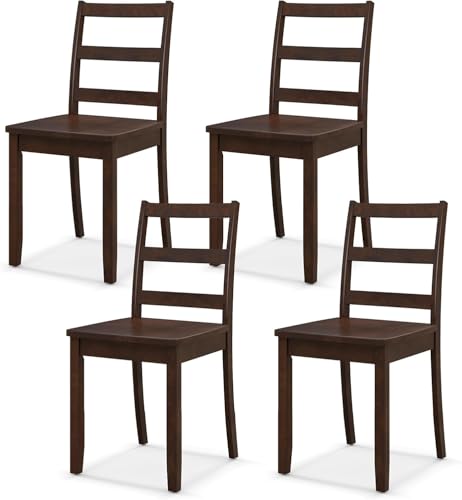
Best Budget — NAFORT Walnut Wood Dining Chairs Set of 4
The budget slot goes to solid wood, because at the lowest tier wood is the material that fails slowest. The NAFORT set of 4 is a walnut-finish ladder-back chair on solid rubber wood legs, with non-slip foot pads and a stated maximum load of 400 pounds — specifications that read like they were written by someone who knows how budget chairs actually die: at the legs, at the joints, and by skating across the floor. Four chairs in one box is also the right budget arithmetic: breakfast seating is bought in sets, and a set priced as a set beats four singles bought in hope.
Strengths
- Solid rubber wood legs and a 400 lb stated load rating — durability specified, not implied.
- Non-slip foot pads protect hard kitchen floors from day one, no aftermarket felt required.
- No upholstery to stain, tear or re-cover through the household’s roughest years.
Trade-offs
- A bare wood seat is a short-sit seat; long breakfasts will want a cushion pad added.
- Ladder-back farmhouse styling commits the room to a direction.
- Wood finishes show rings and knife marks honestly — this set will carry its history visibly.
| Format | Wood dining chairs, set of 4 (per Amazon listing) |
| Legs | Solid rubber wood, non-slip foot pads |
| Stated load | 400 lb maximum |
Buy this set as the honest foundation it is: four chairs that will survive being dragged, climbed on and wiped down daily, at the tier where survival is the whole brief. Add seat pads when the household starts lingering, and the budget set quietly becomes the comfort set without a second purchase of chairs.
Best for: full tables on a strict budget, rentals and first homes. / Not suited for: households that linger for hours at the table without adding pads.
Check on Amazon — check the current price on Amazon before you decide.

Best for Small Breakfast Nooks — DUHOME Wood Dining Chairs Set of 4, Farmhouse Cross Back
Some picks announce themselves: the DUHOME listing names the breakfast nook in its own title, and the chair earns it — an armless cross-back design in a vintage walnut finish, sold as a set of 4, sized for the small tables where breakfast actually happens in most homes. Armless is the operative word in a nook: without arms, the chair tucks fully under the table, the walkway stays clear, and sitters slide in from the side instead of performing the arm-versus-apron negotiation that makes armed chairs fail in tight rooms. The cross back keeps the footprint light visually as well as physically, which in a small nook is the same virtue twice.
Strengths
- Armless profile tucks fully under the table — floor space returned every single day.
- Cross-back farmhouse design reads light in a small room instead of crowding it.
- A set of 4 covers the standard nook table in one purchase.
Trade-offs
- Wood seat without upholstery — lingerers will add pads, as with the budget pick.
- Cross-back chairs flex more than solid-back designs; heavy daily use should check joints seasonally.
- The vintage walnut finish is a specific look that will not blend into every kitchen.
| Format | Wood dining chairs, set of 4, armless (per Amazon listing) |
| Back | Farmhouse cross back |
| Named for | Home kitchen, breakfast nook, dining room, bistro |
Measure the nook before ordering, with the table in place: the chair’s job is to disappear under it. If the DUHOME’s footprint clears your apron and leaves the walkway honest, it is the rare pick that makes a small room feel bigger every morning rather than merely fitting into it.
Best for: breakfast nooks, small kitchens and bistro corners. / Not suited for: large formal tables, or sitters who need arms to rise from the chair.
Check on Amazon — check the current price on Amazon before you decide.

Best Comfort for Long Sits — MALOL Upholstered Dining Chairs Set of 2 with High-Back
Some households do not leave the breakfast table: breakfast becomes coffee, coffee becomes the laptop, and the chair is a workplace by 9 a.m. The MALOL set of 2 is built for that household — upholstered chairs with a high back and a padded seat on wood legs, in a beige that suits the dining room, restaurant and café settings its listing names. The high back is the comfort specification that matters: it supports the sitter through the shoulder blades rather than ending at the waist, which is the difference between a chair you sit in and a chair you perch on for the second hour.
Strengths
- High back supports long sits — the breakfast-to-work chair in this guide.
- Padded seat and upholstered back soften the two contact zones that decide comfort.
- Wood legs keep the dragged-daily durability the category demands.
Trade-offs
- A high back is a bigger visual presence — in a tiny nook it can crowd the composition.
- Upholstery needs the spill discipline every fabric chair in a kitchen needs.
- Set of 2 pricing means furnishing a long table is a deliberate investment.
| Format | Upholstered dining chairs, set of 2 (per Amazon listing) |
| Back | High-back, padded |
| Legs | Wood |
Judge this pick by your household’s clock, not its taste: if the table’s longest daily sit is under twenty minutes, the overall pick serves you and this one is surplus. If someone in the house works, reads or homeschools at that table, the high back stops being a style choice and becomes the purchase.
Best for: long-sit households — table-as-desk, lingering breakfasts, homework headquarters. / Not suited for: very small nooks, or quick-coffee households that never linger.
Check on Amazon — check the current price on Amazon before you decide.

Best Easy-Clean for Families — Yaheetech Dining Chairs Set of 4, Faux Leather, Black
The spill years need a surface, not a fabric, and the Yaheetech set of 4 answers with faux leather: a wipeable, high-back parson-style chair on solid wood legs with adjustable footpads, in black. Jam, milk, marker and the mysterious sticky patch all meet the same fate here — a damp cloth, thirty seconds, done — where a fabric chair would carry each one as a permanent record. The adjustable footpads are the quiet second virtue: kitchen floors are rarely level, and a chair that can be leveled stops the wobble that spills more drinks than children do.
Strengths
- Faux leather surface wipes clean — spills are an event, not a stain.
- Adjustable footpads level the chair on uneven kitchen floors.
- High-back parson profile looks composed at the dining table too, so the family set need not hide when guests come.
Trade-offs
- Faux leather can feel warm against skin in summer and cold in an unheated kitchen in winter.
- Black shows dust and flour handprints readily — the wiping is easy, but it is frequent.
- Vinyl surfaces eventually crack at flex points; this is a years-long pick, not a decades-long one.
| Format | Upholstered dining chairs, set of 4, armless parson style (per Amazon listing) |
| Surface | Faux leather, high back |
| Legs | Solid wood, adjustable footpads |
For families, this pick changes the emotional arithmetic of the kitchen table: when a spill costs thirty seconds instead of a stain, nobody hovers, nobody scolds, and breakfast stays breakfast. That peace is the actual product; the chairs are how it is delivered.
Best for: families in the spill years, and any household that eats every meal at one table. / Not suited for: buyers who want natural materials, or formal rooms where vinyl reads wrong.
Check on Amazon — check the current price on Amazon before you decide.

Best Host Chairs — WUTUTUEE Dining Chairs with Arms, Set of 2, Beige Linen
The host chair finishes the table: a pair of armchairs for the ends, more composed than the side chairs, that tells the person seated there that their seat was considered. The WUTUTUEE set of 2 is the genuine article — upholstered high-back armchairs in beige linen with button tufting, nailhead trim and solid wood legs, in the parson profile its listing names for kitchen and dining use. The tufting and nailheads are not decoration for its own sake: they are the visual signals that separate the host’s chair from the row, which is the entire job of a table-end chair.
Strengths
- Real arms and a high, tufted back — the composed silhouette a table end demands.
- Nailhead trim and linen upholstery pair with most side-chair fabrics without matching them slavishly.
- Solid wood legs match the construction standard of the rest of this guide.
Trade-offs
- Arms must clear the table’s apron — measure arm height against your table before ordering, as the buying section insists.
- Linen upholstery at the table’s end still meets food; this is a considered seat, not a spill-proof one.
- Two armchairs anchor a composition — buy them last, after the side chairs have set the room’s direction.
| Format | Upholstered dining armchairs, set of 2 (per Amazon listing) |
| Upholstery | Beige linen, button tufted, nailhead trim |
| Legs | Solid wood |
Buy the host pair the way this guide’s closing note advises: last. Seat the table with its side chairs, live with the room for a few mornings, measure the apron clearance twice — and then let this pair finish a composition you already understand.
Best for: entertainers and any table whose ends deserve a finished seat. / Not suited for: tables with low aprons that arms cannot clear, or nooks where armchairs crowd the room.
Check on Amazon — check the current price on Amazon before you decide.
Comparison Table
| Pick | Badge | Key spec | Best for |
|---|---|---|---|
| DUMOS Dining Chairs Set of 2 | Best Overall | Upholstered side chair, wooden legs, padded seat, high back | Most households, standard tables |
| NAFORT Walnut Wood Dining Chairs Set of 4 | Best Budget | Solid wood set, ladder back, non-slip foot pads, 400 lb stated load | Full tables on a strict budget |
| DUHOME Cross Back Dining Chairs Set of 4 | Best for Small Nooks | Compact armless wood chair, full tuck-under | Breakfast nooks, small kitchens |
| MALOL Upholstered Dining Chairs Set of 2 | Best Comfort | High back, padded seat and back | Long sits, table-as-desk households |
| Yaheetech Dining Chairs Set of 4 | Best Easy-Clean | Faux leather surface, adjustable footpads | Families in the spill years |
| WUTUTUEE Dining Chairs with Arms, Set of 2 | Best Host Chairs | Tufted linen armchairs, nailhead trim, solid wood legs | Table ends, entertainers |
How to Choose Breakfast Chairs
Do the table arithmetic first. Measure your table’s height, then the height of its underside — the apron or structure beneath the top. A comfortable seat sits roughly a foot below the tabletop’s underside zone: in practice, standard tables around 30 inches pair with seats around 18 inches, and the sitter’s thighs need a few inches of clearance beneath the apron. If your table is a counter-height surface, none of the standard profiles in this guide apply — that is stool territory. If your table has a deep farmhouse apron, the apron, not the top, is the measurement that decides both thigh room and chair tuck. Write the two numbers down and let them veto chairs before style gets a vote.
Count seats by width, not by hope. Each sitter needs roughly two feet of table edge to eat without elbow diplomacy. Divide your table’s length by that allowance and you have the honest per-side count; multiply the chairs’ widths to confirm they fit the span without touching. Nook buyers should add the third dimension: the room behind the chair for a person to pass while someone sits. These three numbers — height, width per sitter, passing room — define the feasible set of chairs for your room more completely than any style guide.
Choose the surface for your household’s spill reality. Rank your table’s actual hazards: toddler meals, coffee culture, art supplies, pets, red wine at breakfast-adjacent brunches. High hazard argues for the easy-clean slot’s surfaces; low hazard frees you to choose upholstery by comfort and looks. Be honest about the cleaning you will do: a fabric that needs prompt blotting in a house that blots next Tuesday is a stain in escrow. The surface decision, made honestly, prevents more regret than any other in this category.
Interrogate the construction, because breakfast chairs are dragged. The daily motion of this furniture is a sideways drag across a hard floor, thousands of times, often one-handed with a child on the other arm. Joints loosen under exactly that load. Prefer chairs whose legs are joined with screws, glue and stretchers or corner blocks; be suspicious of any chair whose assembly is a mystery. Check the stated weight capacity with real margin for your household’s largest regular sitter, and plan on felt glides from day one — they protect the floor, quiet the drag and slightly reduce the joint shock of every pull-out.
Buy the set as a system, including the odd chair. Households change: a chair breaks, a guest count grows, a child graduates from a booster. Sets bought from ongoing lines can be added to; orphan designs cannot. If your table seats five — the awkward, common number — buy six and store the spare rather than hunting a match in three years. And sit in one chair before the set ships whenever the seller’s terms allow: five minutes of sitting settles questions that five hours of listing-reading cannot.
Pair chairs with banquettes and benches deliberately. Many breakfast nooks run a bench or banquette on the wall side and chairs on the room side, and the pairing has rules. The chairs carry the room’s traffic — they are pulled, dragged and sat in by guests — while the banquette serves the household’s regulars, especially children, who tolerate its slide-in entry happily. Seat heights must match across the pairing or the table serves two different postures at once, and the chairs should be the lighter, tougher profile of the two, because they absorb the movement. If your nook has a banquette, the compact and budget slots are your natural chair partners; if it does not, the chairs carry the whole seating job and the comfort slot deserves a longer look.
Use seat pads as a system, not an apology. A good pad converts the budget profile’s hard seat into an all-morning chair, refreshes a flattened cushion for another year, and lets a household change the nook’s colors seasonally for the price of a pizza. Choose pads with ties or a non-slip base — a pad that migrates is worse than none — in the same wipeable spirit as the chair strategy they join, and thick enough to matter: a pad you cannot feel is decoration. Pads also solve the slippery-seat problem for small children on easy-clean chairs, which makes them part of the family system rather than an accessory afterthought.
Mixing chairs is allowed; mismatching heights is not. The collected look — different chairs around one table — works in breakfast rooms precisely because the room is casual, and it is how many households absorb a beloved single chair or a partial set. The discipline that makes it work is dimensional: seat heights within a narrow band of each other, so every sitter meets the table at the same posture, and a shared material or color thread so the mix reads as chosen rather than accumulated. Break the height rule and the table feels broken at every meal, however charming the chairs are individually.
How to Set Up and Care for Breakfast Chairs
- Assemble on a soft surface, and do not fully tighten until all bolts are started. Chairs rack out of square when one corner is locked before the others are seated. Start every fastener, square the chair on a flat floor, then tighten in a cross pattern.
- Fit glides before the first drag. Felt or nylon glides on every leg, sized to the leg’s foot. This is the single highest-value ten minutes in a chair’s life: floors keep their finish, and the chair’s joints absorb less shock on every move.
- Level and wobble-check each chair. A wobble is a joint asking for attention. Tighten, and if the wobble is a short leg rather than a loose joint, a glide of differing thickness corrects it without surgery.
- Set the table arrangement by traffic, not symmetry. Place the most-used chairs where the room’s flow is easiest, keep a passing lane behind at least one side, and let the host chairs take the ends only if the arm clearance you measured says they truly fit.
- Clean by surface, on a rhythm. Wipeable surfaces: a damp cloth after messy meals, a mild cleaner weekly. Upholstery: vacuum the seams weekly — crumbs in seams are the breakfast chair’s internal erosion — and treat spills immediately by blotting, never rubbing. Wood: a damp cloth and prompt drying; standing water on joints is the enemy.
- Re-tighten on a schedule. Every six months, flip each chair and check every fastener. Dragging loosens hardware slowly and silently; the two-minute check is what separates a ten-year chair from a two-year chair with a wobble nobody fixed until it failed.
Sunlight deserves a final word in this room above all others: breakfast nooks are sunny by design, and sun fades fabric, dries wood and ages faux leather from the window side. Rotate chairs between the sunny and shaded sides every few months so the set ages as a set, and if one position takes brutal direct sun, let the budget or easy-clean profile take that seat — they wear sunlight most gracefully.
Plan the fifth chair before you need it. Breakfast sets live hard lives, and the household that buys four chairs for a four-person table has no answer for the first broken rung, the first irrecoverable stain, or the first extra teenager at breakfast. Where the budget allows, buy the set one chair beyond your count — or confirm, before ordering, that the same chair remains sold singly or in pairs so a replacement can match years later. Production runs change finishes quietly; a chair bought in the same season is the only guaranteed match. The spare lives in a corner as the homework chair until the day it is promoted, and on that day it pays for itself in one morning.
Rotate the set like tires. Every breakfast table has a favorite seat — the sunny one, the one facing the room — and that chair will age years faster than its siblings if it is sat in by the heaviest sitter at every meal. Rotating the chairs’ positions monthly evens the wear across cushions, joints and finishes, so the set ages as a set instead of as one tired chair and three fresh ones. Rotation also surfaces problems early: the wobble that was invisible at the wall position announces itself at the head of the table, while it is still a tightening job rather than a repair. Two minutes, once a month, is the cheapest maintenance in this entire guide.
Test one chair before the set is final. Where a set is sold in pairs, order one pair first and live with it for a week of real mornings: the sit, the drag, the wipe-down, the tuck-under. A chair that passes a week of Tuesdays will pass a decade of them; a chair that fails teaches you so while the return is still easy and the rest of the set is still unopened. This is slower than ordering everything at once, and it is the single most reliable habit in furniture buying.
Common Buying Mistakes
Buying dining chairs for a breakfast life. Delicate finishes, formal fabrics and occasion construction meet jam, laptops and daily dragging. The categories look alike and age oppositely; buy for the room’s real life.
Skipping the apron measurement. The tabletop height is the number everyone measures; the apron beneath it decides thigh room, arm clearance and tuck. Chairs that “fit the table” and collide with its apron are this category’s most returned purchase.
Counting seats the table cannot hold. Six chairs around a four-person table is not hospitality, it is storage arranged in a circle. Do the width arithmetic and let it set the count.
Choosing fabric by the photograph. Listing photos are taken in clean rooms with no children in them. Choose by surface behavior — wipe, blot, vacuum — matched to your household’s documented spill history.
Buying for the photograph instead of the morning. Showroom and listing images stage chairs in empty, sunlit space at artful angles. Your chairs will live crowded around a table, in lamplight at 6 a.m., with a school bag hanging off one. Judge them at the table’s scale and in the room’s real light — order a single chair first when you can — because the composition that matters is the one you eat in.
Ignoring the drag. A chair carried carefully in a showroom is dragged carelessly at home. If the construction cannot survive the drag, the showroom impression is worthless. Joints first, looks second.
Forgetting the floor. Bare chair legs on hardwood or tile score the floor a little more every day, and the damage is discovered all at once, late. Glides are not an accessory; they are part of the chair.
Finally, a note on timing: breakfast chairs are among the worst furniture to buy in a hurry and among the best to buy after living with a table for a month. The table teaches you its apron depth, its traffic side, its sunny seat and its true sitter count, and a chair purchase made after those lessons lands once. If you have just moved or just bought the table, seat it temporarily with whatever you own, take the measurements this guide asks for with real mornings behind them, and then buy the set once, correctly. The households that love their breakfast chairs are rarely the ones that bought fastest; they are the ones that bought informed.
Final Recommendation
For most households, the upholstered side chair in the Best Overall slot is the answer: padded, armless, solid-legged, matched to the table by the arithmetic in this guide. Families in the spill years should override that default with the easy-clean slot and enjoy the peace it buys; nooks should take the compact slot and the daily gift of a clear floor; households that live at the table should invest in the comfort slot; strict budgets are honestly served by the wood or molded set; and entertainers finish the composition with host chairs — bought last, after the room has taught you what it needs.
If your breakfast project extends beyond chairs, the neighboring decisions in this series are the table itself and the light above it — and the chair arithmetic in this guide (seat height, apron clearance, width per sitter) is the groundwork every one of those decisions stands on. Measure once, and the whole room comes together in the right order.
For style-specific shortlists already live on this site, see Best Parsons Dining Chairs for the upholstered profile in depth, Best Wicker Dining Chairs for the natural-material direction, and Best Blue Dining Chairs if color is the brief.
Related guides
Frequently Asked Questions
What is the difference between breakfast chairs and dining chairs?
Use, mostly. Breakfast chairs are built and chosen for daily, casual, high-frequency sitting in a spill-prone room: wipeable or forgiving surfaces, durable joints for constant dragging, and footprints sized for nooks and kitchen tables. Dining chairs prioritize occasion seating and formal style. The profiles overlap — a good upholstered side chair serves both — but when they conflict, breakfast rewards durability and cleanability over formality.
What seat height do breakfast chairs need?
For a standard table around 30 inches high, a seat around 18 inches is the classic pairing, leaving comfortable thigh clearance beneath the tabletop and its apron. The rule that matters is the gap: roughly a foot between the seat and the table’s top surface, adjusted for your household’s leg length and the apron’s depth. Counter-height tables need stools, not chairs — no standard breakfast chair serves them.
How many chairs fit around a breakfast table?
Allow roughly two feet of table edge per sitter and do the division honestly. A 48-inch table seats two per side comfortably; a 60-inch table seats three per side at a squeeze that daily life will resent. Then check the room: chairs need their own depth plus passing space behind them, and a nook that cannot provide it seats fewer people than the table suggests.
What is the easiest breakfast chair to keep clean?
Smooth, wipeable surfaces — quality faux leather and performance fabrics — release spills to a damp cloth and deny crumbs a weave to hide in. Among hard surfaces, molded and wood chairs clean fastest of all but offer no cushion. The easy-clean slot exists because for families in the high-spill years, cleanability is not a feature among others; it is the feature the whole purchase turns on.
Can breakfast chairs be used at a dining table?
Yes, when the seat heights match the table — the arithmetic is identical. Casual profiles will read casual in a formal dining room, which is a style judgment, not a functional one. Many households run one set of sturdy upholstered side chairs for both rooms and add host armchairs where formality is wanted; it is a sound system, provided the chairs’ construction suits the higher-frequency room.
Should breakfast chairs match the table exactly?
No — they should converse with it. Exact matching sets are one valid look, but breakfast rooms tolerate and even reward contrast: painted chairs with a wood table, upholstered chairs with a metal one. The non-negotiables are dimensional (seat height against the table, arm clearance, tuck geometry) and practical (surfaces that suit the room’s spill reality). Match the measurements precisely and the materials loosely, and the room will look intentional.
Are armless chairs always better for breakfast nooks?
For the sides of the table, usually: armless chairs tuck further, seat more people per span and let sitters slide in from the side, which is how nook seating is actually entered. Arms earn their place at the table’s ends, where entry is from behind and the sitter stays longest. The exception is the household whose members use arms to stand — older sitters often rely on them — in which case an armed chair at the easiest-entry position is a safety feature, not a style choice.
How long should breakfast chairs last?
A well-built chair in this category should serve a decade of daily use, and the difference between two years and ten is usually maintenance, not manufacture: glides fitted from day one, fasteners re-tightened twice a year, spills treated promptly, and sunlight rotated. Buy construction you can maintain — accessible bolts, replaceable glides, cleanable surfaces — and the chair’s lifespan becomes largely your decision.


