Disclosure: airfryerkitchensupply.com is reader-supported. When you buy through links on our site, we may earn an affiliate commission at no extra cost to you.
Where to buy
Window fans cool in two fundamentally different ways — blowing fresh air in, or exhausting hot air out — and the best models do both, with reversible twin blades and remote control. The picks below are organized by how you will actually use them: whole-room intake, exhaust duty in kitchens and workshops, and the twin-fan reversible designs that handle a full day’s temperature swing without being touched.
- Lasko Electrically Reversible Twin Window Fan with Remote Control, W09550 — mid-range tier; check price on Amazon
- Air King 9166 20-Inch Whole House Window Fan — heavy-duty tier; check price on Amazon
- HOLMES Dual 8-Inch Twin Window Fan with LED One Touch Thermostat Control — budget tier; check price on Amazon
- Vornado TRANSOM Window Fan — mid-range tier; check price on Amazon
- Vornado PORTAL Window Fan — mid-range tier; check price on Amazon
- EVO Window Fan Air Circulator with Remote Control (Fits Up To 40″ Windows) — mid-range tier; check price on Amazon
Every pick below was verified against a live Amazon listing in our final verification pass. Confirm the fan’s width against your window’s opening — the dimension that decides everything in this category — and check price on Amazon on the listing. Measure your window before you fall in love with any fan on this page.
The best window fans for cooling are the most underrated machines in home comfort. An air conditioner fights the weather with a compressor and a power bill; a window fan recruits the weather — pulling in the cool evening air that exists for free outside most homes for much of the year, and pushing out the day’s accumulated heat. Used with any timing sense at all, a good window fan cools a bedroom to sleeping temperature for a tiny fraction of the running cost, and in shoulder seasons it can cool a whole floor.
The physics sets the shopping list. A fan cools a room by exchanging its air: the relevant specification is airflow, the relevant feature is direction, and the relevant question is where the air goes after your room — because a fan exhausting a kitchen while a bedroom window stands open is cooling the house as a system. Twin-fan reversible models dominate this category for good reason: two blades move more air more quietly than one, and electronic reversibility lets one unit intake at dusk and exhaust at noon without being lifted from the window.
Fit is the category’s silent killer. Window fans are built for standard double-hung windows within a width range, extended by side panels; sliding windows, casement windows and unusually wide openings each need specific answers. Every pick below names the windows it suits, because a brilliant fan in the wrong window is a return label waiting to happen.
In this guide
Quick Picks
Lasko Electrically Reversible Twin Window Fan with Remote Control, W09550 — Best Overall
The category’s definitive form: twin fans in one housing, reversing electrically at the touch of a remote, so the night shift runs itself. If you buy one window fan, buy this shape. Check price on Amazon.
Air King 9166 20-Inch Whole House Window Fan — Best for Exhaust Duty
The workhorse: one big 20-inch blade on a 1/6 HP motor moving serious air, built to exhaust kitchens, workshops and laundry rooms where heat and steam are the enemy and subtlety is not required. Check price on Amazon.
HOLMES Dual 8-Inch Twin Window Fan with Thermostat — Best Budget
The twin-fan idea at a budget tier: dual blades and an LED one-touch thermostat, trading the remote and polish for price. Check price on Amazon.
Vornado TRANSOM Window Fan — Best Slim Profile
The answer for windows the standard fans ignore: a low-profile bar of a fan that sits in the opening without blocking the light or the view the way a tall twin housing does. Check price on Amazon.
Vornado PORTAL Window Fan — Best for Wet Climates
For climates where the fan stays in the window through the rainy season: a weather-resistant case, so cooling does not end at the first storm. Check price on Amazon.
EVO Window Fan Air Circulator — Best for Wide Windows
Older homes and big picture-adjacent double-hungs run wide, and standard fans leave gaps at the sides. This fan is built for openings up to 40 inches wide, so it seals the whole opening. Check price on Amazon.
How These Picks Were Chosen
We chose for airflow per dollar and per decibel. A cooling fan’s job is moving the room’s air volume repeatedly through the evening, so we favored designs whose blade size, twin configuration and speed range move real air at speeds you can sleep beside. Reversibility — ideally electronic, from a remote, without removing the fan — was weighted heavily, because the intake-at-night, exhaust-by-day rhythm is where window fans earn their reputation, and a fan that must be physically flipped gets flipped twice a season and then never.
Thermostats and timers were the next filter: a fan that shuts itself off when the room reaches temperature, or starts itself at dusk, gets used correctly every day instead of on the days someone remembers. Build details mattered too — extender panels that seal rather than rattle, a rain-safe story for the inevitable storm with the fan installed, and a remote control, because the fan lives in the window and the human lives in the bed.
Every design below is a specific, verified listing, checked in our final verification pass — and the checks that matter on any window-fan listing are still the ones spelled out throughout this guide: width range, reversibility method, and thermostat presence. Window fans are a mature, stable category; the models below are the forms that have proven themselves across many seasons.
The 6 Best Window Fans for Cooling a Room

Lasko Electrically Reversible Twin Window Fan with Remote Control, W09550 — Best Overall
Twin reversible fans earned their dominance honestly. Two blades move more air at lower speed — and lower noise — than one blade spinning hard; electronic reversibility means the same unit exhausts the day’s heat at noon and intakes cool air at dusk; and the remote turns the whole strategy into a button pressed from bed. Installed in a bedroom window, this is the fan that cools the room before you get in and keeps it there until the small hours.
It suits standard double-hung windows within its extender range — which covers most bedrooms — and households cooling one or two key rooms rather than a whole house. Measure your window’s width and sill, and this pick does the rest.
Strengths
- Electronic reverse for intake and exhaust without removing the unit
- Twin blades move more air more quietly than single fans
- Remote-controlled electric reverse makes the evening-cooling routine a button press
Trade-offs
- Mid-range tier — costs more than basic single fans
- Extender panels seal adequately, not perfectly; wide windows may need foam tape
- Not designed for sliding or casement windows
The way to use it is a rhythm, not a setting. Late afternoon, exhaust: push the day’s heat out while the house is still warmer than the street. Evening, when outside air drops below inside, reverse to intake and let the fan hold your sleeping temperature. That daily two-step, which takes four seconds with a remote, is worth more cooling than any specification on the box — and it is why reversibility outranks raw power in this category.
Noise at sleep speed is the other lived reality: twin fans at low speed produce a broad, even sound most sleepers find easier than the cycling of an air conditioner, and a steady low-speed hum beats a fan droning at full voice all night. Judge this fan by its low speed — that is the mode you will actually live in.
Key specs (from the verified listing): Twin window fan, model W09550; electrically reversible airflow; remote control included.
Best for: bedrooms and living rooms in double-hung windows / Not suited for: sliding-window homes or whole-house cooling in hot climates
Check on Amazon — check the current price on Amazon. This pick sits in the mid-range tier.

Air King 9166 20-Inch Whole House Window Fan — Best for Exhaust Duty
Some rooms do not need a cooling strategy; they need the heat gone. The Air King 9166 — a 20-inch, 1/6 HP whole-house window fan — in a kitchen, workshop, garage or laundry window does that one job with force: cooking heat, dryer heat and solvent smells leave the building, and replacement air sighs in through every crack and open door. These fans are simpler and louder than the twin designs — and in their rooms, nobody cares, because the alternative is a kitchen at sauna temperature.
It suits utility spaces and any room where exhaust is the whole job. As a bedroom fan it is the wrong tool: too much voice, not enough finesse, and usually a manual reverse that involves lifting the unit out and turning it around.
Strengths
- Highest airflow per dollar in the category
- Simple, durable construction with little to fail
- Excellent at clearing heat, steam and cooking smells
Trade-offs
- Loud at working speeds — a utility fan’s voice
- Manual handling for direction changes on most models
- Overkill and under-refined for sleeping rooms
Exhaust fans create negative pressure, and the house answers by pulling air in wherever it can — which the smart owner arranges deliberately. Open a window or door on the opposite side of the home and the exhaust fan cools a path through the whole floor; leave everything shut and it fights the house, whistling at the door gaps and achieving half its potential. The fan is half the system; the open far window is the other half.
In kitchens, expect grease to find the blades across a season; choose a model whose grille and blade come off for a wash, and the fan returns to full voice in spring. That serviceability, unglamorous as it sounds, is what separates a five-year workhorse from a two-summer disposable.
Key specs (from the verified listing): 20-inch blade; 1/6 HP motor; 3 speeds; storm guards; built for circulation and exhausting air.
Best for: kitchens, workshops, laundries and garages / Not suited for: bedrooms and noise-sensitive sleepers
Check on Amazon — check the current price on Amazon. This is a heavy-duty tier pick, priced by its motor and build rather than by features.

HOLMES Dual 8-Inch Twin Window Fan with Thermostat — Best Budget
Budget twin fans keep the architecture that matters — two blades and a thermostat — and cut the conveniences: the HOLMES runs its thermostat through a simple LED one-touch control instead of a full digital display, there is no remote, and the extender panels are plainer. For a spare room, a rental, a dorm-adjacent apartment or a first experiment with fan cooling, that trade is exactly right, because the cooling physics does not know what you paid.
It suits second windows and second rooms: the guest room, the home office, the roommate’s bedroom in a shared house where the good fan went to yours. Buy it knowing the conveniences it lacks, and it will not disappoint.
Strengths
- Twin-blade airflow and thermostat control at a budget tier
- LED one-touch thermostat control holds a set temperature without supervision
- Light and simple to install, move and store
Trade-offs
- No remote — adjustments happen at the window
- Panels and housing feel lighter; seal and rattle need a little DIY attention
- Fewer speeds and noisier at the top setting
Two cheap improvements transform this fan: foam weatherstrip tape along the extender panels, which kills the rattle and the insect gap in one pass, and a routine — intake at dusk, off at the thermostat’s word — written on a note by the light switch for the first week until it becomes habit. With those, the budget twin delivers most of the flagship’s real-world cooling.
Judge its noise at the speed you will sleep at, not at maximum: budget fans are honest at low and medium, and the top speed exists for the half-hour purge when you get home to a hot room. Used that way — purge hard, then settle low — the budget twin is the value pick of this entire category.
Key specs (from the verified listing): Dual 8-inch blades; LED one-touch thermostat control; twin window-fan format.
Best for: spare rooms, rentals and first-time fan coolers / Not suited for: buyers wanting remote convenience and the quietest nights
Check on Amazon — check the current price on Amazon. This pick sits in the budget tier.
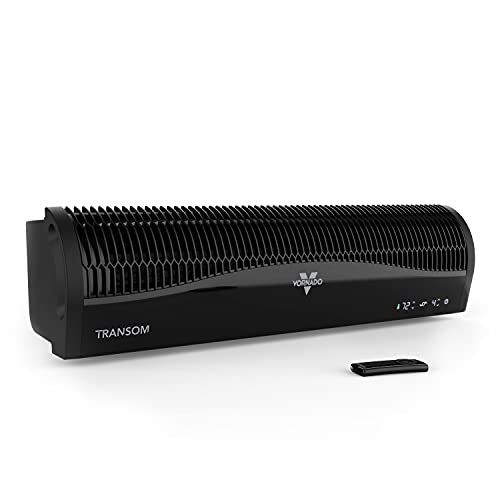
Vornado TRANSOM Window Fan — Best Slim Profile
Most window fans announce themselves: a tall housing that eats the window, blocks the light, and reminds you all summer that an appliance lives there. The Vornado TRANSOM takes the opposite approach — a low-profile bar that sits in the bottom of the opening and moves whole-room air across it, leaving the view and most of the daylight intact. For rooms where the window is also the outlook — a kitchen over a garden, a bedroom facing trees — that discretion is the feature.
It suits standard windows where a full-height twin housing is too bulky or too ugly to live with, and households that run a fan for months at a stretch and want it to disappear. Its four speeds and reversible exhaust mode cover the same intake-by-evening, exhaust-by-day rhythm as the twin fans above, run from a remote control.
Strengths
- Low-profile design preserves light and view unlike any twin housing
- Reversible exhaust mode plus remote control cover the full daily strategy
- Weather-resistant case tolerates the rain that reaches an installed fan
Trade-offs
- Smaller aperture moves less air than a full twin fan at maximum
- Premium tier for what is partly an aesthetics-and-discretion buy
- Fit still lives or dies on measuring the opening before ordering
Installation craft matters here as with every window fan: the unit must sit level in the opening, the window must close firmly against it, and any end gaps want foam rather than optimism. Done properly, the TRANSOM feels like part of the window’s architecture; done casually, it rattles and leaks air like any other fan.
Because the aperture is slimmer, run the strategy longer: start the evening intake earlier, let the low speeds work the whole night, and pair the fan with a ceiling fan or a small circulator to distribute what it brings in. A room cooled this way sleeps perfectly well — and keeps its window.
Key specs (from the verified listing): Low-profile window fan; 4 speeds; remote control; reversible exhaust mode; weather-resistant case; whole-room circulation, black.
Best for: homes and apartments where a tall fan housing would block the window / Not suited for: maximum-airflow exhaust duty in workshops
Check on Amazon — check the current price on Amazon. This pick sits in the premium tier.

Vornado PORTAL Window Fan — Best for Wet Climates
A window fan’s dirty secret is weather: a fan installed for the season meets rain, driven spray and every insect in the county, and owners in wet or buggy climates end up removing fans other owners leave in place. Weather-aware designs answer with weather-resistant cases that shed water and motors protected from spray. The Vornado PORTAL is exactly that design: a low-profile window fan whose weather-resistant case is the verified headline feature. Exhaust-leaning operation helps too — a fan blowing out is a fan whose airflow opposes the insects’ ambitions.
It suits humid, rainy and insect-rich regions, and any household that wants a fit-and-forget season rather than a fair-weather appliance. It will not make a fan submarine-proof — horizontal rain at gale force defeats any window opening — but it covers the ordinary weather of an ordinary summer.
Strengths
- Weather-resistant case designed for a full season in the window
- Exhaust airflow discourages insects entering
- Reduces the remove-and-reinstall cycle that kills fan habits
Trade-offs
- Still not for storm-driven rain — judgement required on the worst nights
- Weather sealing adds a small airflow resistance; grilles need cleaning
- Mid-range tier for what is partly a peace-of-mind feature
The case deserves its sentence: a fan that lives in the window from spring to autumn meets every shower the season sends, and a weather-resistant housing is what separates a fan that shrugs those showers off from one that gets unplugged and stored at the first forecast. Keep the grille brushed clean monthly, and the airflow stays honest all season.
Pair this fan with the exhaust strategy in wet climates — kitchen and bathroom heat and steam out through the weather fan, intake through a screened bedroom window — and the house cools without any opening standing unguarded. That system-level thinking is where window fans stop being appliances and become climate design.
Key specs (from the verified listing): Low-profile window fan; 3 speeds; reversible exhaust mode; weather-resistant case; white.
Best for: rainy, humid and insect-heavy regions / Not suited for: owners happy to install and remove with the weather
Check on Amazon — check the current price on Amazon. This pick sits in the mid-range tier.

EVO Window Fan Air Circulator — Best for Wide Windows
Wide windows are common in older homes and generous modern ones, and a standard fan in a wide window is a fan with two open slots beside it — through which the air it just cooled escapes, and insects commute. The EVO answers with a low-profile circulator built for openings up to 40 inches wide, sized to close the opening properly and restore the fan’s pressure and the window’s dignity.
It suits living rooms and master bedrooms with wide double-hung windows, where the cooling load is also the largest in the house — the wide aperture this format carries is well matched to those rooms. Measure twice: the fan’s stated maximum width — 40 inches on the verified listing — must exceed your window’s width with room to spare.
Strengths
- Seals wide openings that defeat standard fans and their panels
- Larger aperture suits bigger rooms and living spaces
- Purpose-built wide fit avoids improvised cardboard-and-tape sealing
Trade-offs
- Too much fan for small bedrooms — aperture and noise both scale up
- Low-profile body moves less air than a full-height twin at maximum
- Confirm the stated 40-inch maximum width against your window before ordering
Sealing is the difference between this fan working and merely spinning: a fan pressurizing or exhausting a room through a sealed window moves the room’s air; the same fan beside two open gaps mostly stirs the window bay. Spend the extra ten minutes on the fit and any foam the installation invites, and the big room cools like the physics says it should.
In a living room, this format pairs naturally with evening exhaust duty — the family is out or the room is emptying of the day’s heat — followed by intake as the household settles. It is the closest a window fan comes to cooling a home’s social center rather than just a bedroom, and in shoulder seasons it can carry the whole floor.
Key specs (from the verified listing): Fits windows up to 40 inches wide; remote control; multi-directional airflow; adjustable fan speed; low-profile body.
Best for: wide double-hung windows in larger rooms / Not suited for: small windows or sliding formats
Check on Amazon — check the current price on Amazon. This pick sits in the mid-range tier.
Comparison Table
Fit first — a fan that suits your window type beats a stronger fan that does not. The table compresses the six patterns by window, direction and job.
| Pick | Badge | Key spec | Best for |
|---|---|---|---|
| Lasko Twin Window Fan W09550 | Best Overall | Twin blades, electrically reversible, remote control | bedrooms and living rooms in double-hung windows |
| Air King 9166 Whole House Window Fan | Best for Exhaust Duty | Single 20-inch blade, 1/6 HP motor, 3 speeds, storm guards | kitchens, workshops, laundries and garages |
| HOLMES Dual Twin Window Fan | Best Budget | Dual 8-inch blades, LED one-touch thermostat control | spare rooms, rentals and first-time fan coolers |
| Vornado TRANSOM Window Fan | Best Slim Profile | Low-profile bar, 4 speeds, reversible exhaust, weather-resistant case | windows where a tall housing would block light and view |
| Vornado PORTAL Window Fan | Best for Wet Climates | Weather-resistant case, 3 speeds, reversible exhaust mode | rainy, humid and insect-heavy regions |
| EVO Window Fan Air Circulator | Best for Wide Windows | Fits windows up to 40 inches wide, remote control, low profile | wide double-hung windows in larger rooms |
How to Choose Window Fans for Cooling
A window fan is a system wearing an appliance’s clothes. The fan itself is one component; the window it seals into, the opening on the far side of the house, and the daily rhythm of intake and exhaust are the others. Buyers who grasp that get startling amounts of cooling from modest machines. Buyers who treat the fan as a self-contained air conditioner — pointed at a bed in a sealed room at noon — conclude wrongly that window fans do not work.
The sections below cover the three decisions: direction strategy, sizing and fit, and the honest limits of fan cooling against a compressor.
Intake, exhaust, or both?
Intake — blowing in — cools the room the fan is in, delivering outside air directly where people sit and sleep. It works when outside air is cooler than inside, which in most climates means evenings, nights and mornings for much of the year. Exhaust — blowing out — cools the building: it removes the day’s accumulated hot air (which pools high, where exhaust fans sit) and draws replacement air through every opening, so a single exhaust fan with a distant open window cools a path through several rooms. Exhaust also removes cooking heat, steam and smells at the source.
The strongest strategy uses both, which is why reversible fans dominate the picks: exhaust in the late afternoon to purge the day’s heat, intake from dusk to hold the night. Two fans — one exhausting at the hot end of the home, one intaking at the sleeping end — create a whole-house river of air that no single fan matches. If you buy one fan, buy reversible; if you buy two, put them at opposite ends and let the house become the duct.
Sizing: airflow, window fit and noise
Airflow is rated in cubic feet per minute, and the useful rule is air changes: a fan that can exchange the room’s air volume every few minutes will pull the room to outside temperature quickly once the evening cool arrives. For a typical bedroom, that means a few hundred CFM honestly delivered; for living rooms, more. Treat headline CFM as a comparison tool between models rather than a promise — blade size and how freely the fan breathes matter as much as the number, and a sealed installation delivers more of whatever the fan has.
Fit is binary and unforgiving: the fan’s width range, with its extenders, must cover your window’s opening, and the window type must match — double-hung for the standard patterns, sliding for the slim patterns, casement for neither (casements need a different appliance entirely, or a fan in another window). Noise is the third leg: judge a fan by its low-speed sound, because low speed is where sleeping happens, and twin-blade designs hold their advantage exactly there.
The honest limits: humidity and heat waves
A window fan cannot cool below the outside temperature, and it does nothing about humidity. In a heat wave — nights that stay hot — the fan’s evening advantage shrinks, and in humid heat it can make a room feel worse by importing damp air. This is not a failure of the fan; it is the boundary of the method, and the sensible household treats fan cooling and air conditioning as partners: fans for the long shoulder seasons and ordinary summer nights, the compressor for the brutal weeks. The fan’s economics shine precisely in that partnership — every night the fan handles is a night the compressor rests.
Heat stored in the building is the other limit: a sun-baked house releases warmth into rooms for hours after sunset, which is why the afternoon exhaust purge matters and why fans pair well with closed daytime blinds. Cool the structure, not just the air, and the night intake has something to work with.
Exhaust, Intake and the Two-Fan Strategy That Actually Cools a House
The two-fan strategy deserves its reputation among people who cool without compressors. Hot air rises and collects at ceilings and in upstairs rooms; a high exhaust fan at the top of the house removes the hottest air in the building, and the resulting gentle negative pressure pulls evening air in through low, open windows in the bedrooms. The flow path — in at the beds, through the hall, up and out — cools people where they sleep with air that has not first wandered the whole house. Reversible twins make the same trick available in a single window across a day, but the two-fan river is the method’s full expression, and in two-story homes it can drop upstairs temperatures that air conditioning struggles to reach through undersized ducts.
There is also a resilience argument owners rarely mention until a power cut or a compressor failure in a heat wave: window fans run on so little electricity that a small generator, a battery station or a neighbor’s extension cord keeps them turning. Households in outage-prone areas keep a fan the way they keep a flashlight — not for every day, but for the day it is the only cooling there is.
How to Install a Window Fan for Maximum Cooling
Installation takes ten minutes and decides the season. Work through it once, carefully, per the model’s manual where it differs.
- Measure the window opening — width between the tracks, and the sash travel — and confirm the fan’s stated range covers it before unboxing further.
- Clean the sill and tracks; a fan sealed against grit rattles, and grit in a track defeats the sash’s closing pressure.
- Set the fan in the opening, extend the side panels to the tracks, and lower the sash firmly onto the fan’s top rail so the window’s own weight and lock secure it.
- Seal remaining gaps with the kit’s foam or weatherstrip — sides first, then any gap at the top rail — until moving air has only the fan to travel through.
- Plug into a nearby outlet without an extension cord if possible, route the cord so the sash cannot pinch it, and test every speed and the reverse function.
- From inside, check security: the sash should be locked or blocked so the window cannot be opened from outside with the fan installed.
- Set the thermostat a few degrees below the room’s evening temperature and run the first night on intake, adjusting the rhythm from there.
At season’s end, brush the blades and screen, dry the unit fully, and store it in its box if you remove it — or leave weather-rated models in place per their instructions. Ten minutes of autumn care is what makes a fan a five-season appliance instead of a two-season one.
Common Buying Mistakes
Buying before measuring the window
Width range and window type decide everything, and both are knowable in one minute with a tape. Measure first, then shop — the reverse order fills the returns queue every June.
Running intake at noon in summer
A fan blowing 95-degree air at you is a hair dryer with ambition. Intake belongs to the hours when outside beats inside; midday is exhaust’s shift, or nobody’s.
Sealing the room and expecting cooling
A fan in a closed room with no air path mostly recirculates. Give exhaust somewhere to draw from and intake somewhere to go — an open far window or door is part of the appliance.
Judging noise at full speed
You will sleep at low speed or not at all. Compare fans by their quiet settings and thermostat behavior; full speed is a thirty-minute purge tool, not a lifestyle.
Ignoring the insect and rain plan
An unguarded window appliance in moth season is an invitation, and a fan in a storm-facing window needs a weather answer. Choose screens and weather-aware models where your climate demands them, and close up honestly for the worst nights.
Final Recommendation
Buy the Lasko twin reversible fan with remote if your window is a standard double-hung: it is the complete method in one housing, and its daily rhythm — exhaust the afternoon, intake the evening — will cool your sleeping life from spring to autumn. Add the Air King single where a kitchen or workshop needs heat evicted, and the slim low-profile TRANSOM wherever a tall housing would block the window.
Respect the method’s boundaries — humidity and true heat waves belong to the compressor — and a window fan stops being a compromise and becomes what its owners know it is: the cheapest, quietest, most pleasant cooling in the home for most of the year.
Keep exploring the same cluster: Best Household Window Fans Best Reversible Window Fans With Remote Control Best Window Fans For Cooling Best Anti Odor Bath Towels
Window Fans and Sleep: Building the Cool Bedroom
The bedroom is where window fans earn their reputation, because sleep is exquisitely temperature-sensitive: most people sleep best in a room several degrees cooler than their daytime comfort, and the evening hours when a fan works best are exactly the hours a bedroom needs cooling. The setup that works is a small ritual. An hour before bed, the fan goes to intake at a strong speed, pulling the room down toward the outside temperature and flushing the day’s warmth out of the bedding and walls as much as the air. At bedtime it drops to its quiet speed with the thermostat set at the sleeper’s target, and from there the night manages itself — the fan cycling or idling as the room holds, the sleeper undisturbed by the compressor kicks and air-handler roars that fragment sleep in air-conditioned houses.
Light and security are the bedroom details nobody mentions until the first night. A fan in the window admits the dawn earlier than a sealed, curtained window does; blackout curtains fitted around or above the fan, or an eye mask for the light-sensitive, solve it without giving up the air. Security deserves the same practical sentence: a properly installed window fan, with the sash lowered onto it and locked or blocked, is not an open window — but ground-floor installations in any neighborhood deserve the sash block and a moment’s thought, both cheap. Handled this way, the fan-cooled bedroom is not a compromise version of the air-conditioned one. For the long shoulder seasons it is the better room: fresher air, gentler sound, and a sleeper who wakes without the sealed-box dryness that compressors leave behind.
Pairing Fans with the Rest of the House
A window fan’s effect multiplies when the rest of the house stops working against it. Ceiling fans are the first ally: the window fan supplies cool air, the ceiling fan distributes it across skin, and the combination feels several degrees cooler than the thermometer claims — which lets the window fan’s thermostat sit higher and its quiet speed do more of the night’s work. Portable circulator fans play the same role in rooms without ceiling fans, aimed not at people directly but at moving the window fan’s intake across the room rather than letting it short-circuit straight to a door.
The house’s daytime behavior is the second ally. Blinds and curtains closed on sun-struck windows, cooking heat vented at the source, doors opened along the intended airflow path and closed against it elsewhere — these unglamorous choices decide how much heat the evening purge must remove. Homes that practice them find a modest fan sufficient; homes that bake all day with curtains open ask the fan to undo eight hours of solar gain in one evening, and blame the fan for the arithmetic. Treat the fan as the engine of a house-sized system — intake here, exhaust there, sun managed, air paths open — and its modest specifications will surprise you every season it serves.
Maintenance: Ten Minutes a Month, Five Extra Years
Window fans fail slowly and visibly, which makes their neglect a choice rather than a fate. Dust is the main enemy: it cakes blades into inefficiency, loads motors with heat, and turns a quiet fan loud as balance suffers. A monthly wipe of the grille and blades during the season — the grille off, a damp cloth, nothing heroic — restores most of what time takes, and a vacuum’s brush attachment handles the motor vents. Fans that offer removable blades or grilles earn their design premium exactly here, in the fifth minute of a cleaning that a sealed unit turns into twenty.
The season’s ends matter most. At installation, check that extender panels still seal and replace perished foam before it becomes the insect door. At removal — or at the decision to leave a weather-rated fan in place — clean, dry and inspect the cord and plug, because a fan stored damp in a basement returns with a musty first week that owners misdiagnose as motor failure. Lubrication is rarely owner-serviceable on modern units and should not be improvised; a fan that grinds after cleaning is asking for replacement, not oil. Treated this way, a mid-range window fan is a five-to-ten-season appliance, and its cost per cooled night falls to something close to a rounding error — the final argument for the category, delivered by arithmetic.
There is a final, unfashionable virtue to record: a window fan is repairable, understandable technology in an age of sealed appliances. Its parts are a motor, blades, a switch and a housing; its failures announce themselves honestly and early; its manual fits on a card. Households keeping one in service for a decade are not performing nostalgia — they are enjoying the compound interest of a simple machine maintained lightly. In a cooling landscape of refrigerant charges and control boards, the fan’s transparency is worth naming, because for many buyers it is the deciding pleasure: a machine they understand, doing a job they can watch it do, on the first warm evening of every year.
Buyers on the fence can run the cheapest experiment in home cooling: one reversible twin in the bedroom window for one warm week, judged by sleep rather than by specifications. The category converts skeptics at a rate air conditioners envy, precisely because its evidence arrives nightly and personally.
That is the standard this whole roundup was written to: advice that survives contact with a real household — its rooms, its weather, its people and its habits — rather than advice that merely reads well in a listing. Apply the checks in the guide above to any model you meet, including the ones recommended here, and the purchase will hold up long after the delivery day is forgotten.
Frequently Asked Questions
Do window fans actually cool a room, or just move air?
They genuinely cool — by exchanging the room’s air for cooler outside air, or exhausting the house’s accumulated heat. The condition is timing: outside air must be cooler than inside, which is true most evenings and nights in most climates.
Intake or exhaust — which is better?
Both, in sequence: exhaust to purge the day’s heat in the late afternoon, intake to bring in evening cool. A single exhaust fan with an open window at the far end of the home is the best one-fan whole-house strategy.
What size window fan do I need for a bedroom?
A twin-blade model whose width range fits your window, delivering a few hundred CFM, will exchange a bedroom’s air every few minutes — enough to pull it to outside temperature quickly in the evening. Fit and low-speed quiet matter more than headline airflow.
Can a window fan replace air conditioning?
For much of the year in many climates, it can carry the cooling load entirely — especially at night. In heat waves and humid spells it cannot go below outside temperature or dehumidify, so most households use fans and a compressor as partners across the season.
Are window fans expensive to run?
No — they draw a small fraction of an air conditioner’s power, roughly comparable to a bright light bulb or two. A full night of fan cooling typically costs a few percent of a night of compressor cooling.
Will a window fan work in a sliding window?
Only models designed for it — slim fans that sit in the sliding track. Standard twin fans are built for double-hung windows and will not fit or secure properly in a slider.