Disclosure: airfryerkitchensupply.com is reader-supported. When you buy through links on our site, we may earn an affiliate commission at no extra cost to you.
Where to buy
Amazon is a genuinely useful place to buy for this category because the listings carry the dimensions and configuration details that decide fit. Editor’s note on this roundup: every pick below was verified against a live Amazon listing on 2026-11-22, and each profile is matched to the specific product named in its review, so you can check price on Amazon on the listing itself:
- LIKIMIO 30″ Bathroom Vanity with Sink — Best Overall: check the current price on Amazon.
- DELUXE LIVING 60″ Bathroom Vanity with Double Sink — Best for Shared Primary Baths: check the current price on Amazon.
- Naturoasis 30″ Floating Bathroom Vanity with Sink — Best Modern / Small-Space: check the current price on Amazon.
- Yaheetech 24″ Bathroom Vanity with Sink — Best Under 24 Inches: check the current price on Amazon.
- Linique 30″ Bathroom Vanity Without Top, Cabinet Base Only — Best for Custom Tops: check the current price on Amazon.
- 30″ Farmhouse Bathroom Vanity with Sink, Solid Wood Legs and Open Shelf — Best Traditional Character: check the current price on Amazon.
Introduction: the vanity is the bathroom’s furniture, plumbing case, and storage system in one box
The best bathroom sink vanities are chosen at the intersection of three jobs no other purchase combines. A vanity is furniture — the largest visual object in the room, the thing that sets the bathroom’s era and quality at a glance. It is a plumbing cabinet, obliged to swallow a drain, two supply lines, and a trap while pretending none of them exist. And it is the bathroom’s storage system, the place where everything from spare towels to cleaning chemicals either finds a home or colonizes the counter. A vanity that wins on one job and fails on another is the most common expensive disappointment in bathroom remodeling, which is why this guide assesses every profile on all three.
The market divides first by mounting — freestanding cabinets that sit on the floor like furniture, and floating vanities that hang on the wall and open the floor beneath — and then by configuration: single or double basin, drawers or doors, top included or cabinet only. The six profiles below cover the combinations that real bathrooms actually need, from the compact single that rescues a small hall bath to the double that ends a couple’s morning negotiation. Read them against your room’s measurements and your household’s storage truth, because a vanity is a ten-to-fifteen-year decision installed in a day.
One framing note before the picks: a vanity’s listed width is a promise about a box, not about your bathroom. What matters is the width against your wall run and door swing, the depth against your walkway, the interior against your plumbing’s actual position, and the counter height against the people who will lean over it twice a day. The guide sections translate those checks into a measuring routine, because vanities are freight items — the return you want is the one you never have to arrange.
Everything that follows assumes one discipline: the room is measured before the catalog is opened. Hold to that order and the profiles below become a matching exercise with a right answer, rather than a gallery of beautiful mistakes.
In this guide
Quick Picks
- LIKIMIO 30″ Bathroom Vanity with Sink — Badge: Best Overall. A floor-standing single cabinet with the counter and basin already fitted — the one-delivery, one-install answer for the standard hall bathroom.
- DELUXE LIVING 60″ Bathroom Vanity with Double Sink — Badge: Best for Shared Primary Baths. A wide freestanding double with two basins and divided storage — the morning-peace treaty for couples, sized for runs of sixty inches and up.
- Naturoasis 30″ Floating Bathroom Vanity with Sink — Badge: Best Modern / Small-Space. A cabinet hung on the wall with the floor visible beneath — visual space, easy floor cleaning, and a height you set exactly where your household wants it.
- Yaheetech 24″ Bathroom Vanity with Sink — Badge: Best Under 24 Inches. A narrow, often shallower single vanity engineered for powder rooms and tight hall baths — real storage and a real basin where a pedestal gives up.
- Linique 30″ Bathroom Vanity Without Top, Cabinet Base Only — Badge: Best for Custom Tops. The cabinet alone, sold without a top — pair it with your own stone, drilling, and basin for a semi-custom result.
- 30″ Farmhouse Bathroom Vanity with Sink, Solid Wood Legs and Open Shelf — Badge: Best Traditional Character. A vanity built like a washstand — legs, an open lower shelf for towels, and drawers or doors above — for bathrooms that want furniture, not cabinetry.
How These Picks Were Chosen
Profiles were chosen to span the decision space rather than to crown a style. We required coverage of the four situations that account for nearly all purchases: the standard single-vanity hall bath, the shared primary bath that wants two basins, the small bathroom where every inch is contested, and the remodel that keeps its plumbing exactly where it is. Within those situations we favored configurations that solve the plumbing-versus-storage conflict honestly — drawers engineered around the trap, doors where bulk storage matters — over configurations that photograph well and store nothing.
Construction standards run through every profile: cabinet boxes in plywood or solid wood rather than raw particleboard wherever the tier allows, soft-close hardware as a baseline expectation rather than an upgrade, and finishes that can survive the wettest room in the house. Where a profile’s tier forces a compromise, the review says which compromise it is and how much it matters, because a budget vanity with a plywood box and simple doors will outlive a fancier one built on swollen-prone board with elaborate fronts.
We also weighted the top question — included or not — as a genuine decision rather than a default. A vanity sold with its top and basin integrated is one delivery, one install, and no fabrication gamble; a cabinet-only vanity costs more in total but lets you choose stone, drilling, and basin style yourself. Both answers are right for somebody, and the profiles below say for whom, because the wrong answer is the one chosen by accident.
That standard — measure first, match second — is the thread through every profile and every guide section that follows.
The 6 Best Bathroom Sink Vanities
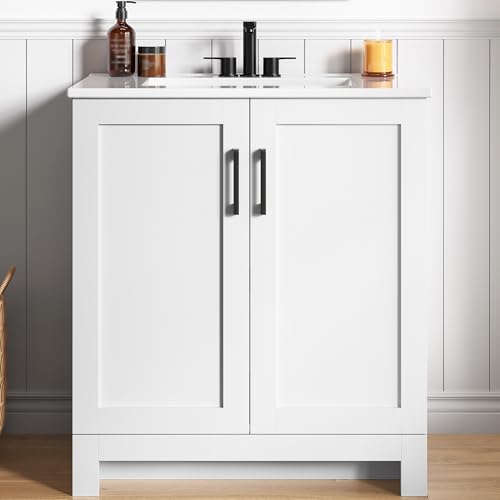
LIKIMIO 30″ Bathroom Vanity with Sink — Best Overall
Verified pick: LIKIMIO 30″ Bathroom Vanity with Sink — a freestanding 30-inch vanity in white with an integrated ceramic sink and two soft-close doors.
This is the profile most bathrooms actually need, executed without drama: a freestanding cabinet in the common single widths, a top already drilled for a standard faucet, and a basin already set, so the purchase arrives as a nearly complete piece of furniture rather than a kit of decisions. The freestanding format earns its default status on installation honesty — it sits on the floor, levels on its feet or shims, anchors to the wall for safety, and its open or paneled back accommodates the drain and supplies where they already live in most homes. For a remodel that keeps the plumbing put, nothing else installs this calmly.
Inside, look for the configuration that matches your household’s clutter: two drawers with a plumbing cutout in the top one is the modern ideal for daily toiletries, while doors with an interior shelf suit bulk storage of towels and cleaning supplies. The integrated top — usually engineered stone, ceramic, or cultured marble — removes the fabrication risk and the second delivery, at the cost of choosing from the maker’s basins and drillings rather than your own. At the mid tier this profile is the value center of the whole category: plywood box, soft-close hardware, a top that shrugs off toothpaste and heat, and a look that suits both the remodel and the resale photograph.
Strengths
- Arrives nearly complete — cabinet, top, and basin in one delivery
- Freestanding format tolerates existing plumbing positions
- Drawer-around-plumbing layouts make daily storage genuinely usable
Trade-offs
- Integrated top limits basin and faucet-drilling choices
- Floor-standing base collects dust and moisture at the toe line
- Standard sizes only — odd wall runs may not fill exactly
Best for: Standard hall and guest bathrooms remodeling on a sane budget / Not suited for: Buyers wanting a custom stone top or an unusual basin
Check the current price on Amazon for the LIKIMIO 30″ Bathroom Vanity with Sink, and match the construction details in this review against the listing before ordering. This pick sits in the mid-range tier for this category.

DELUXE LIVING 60″ Bathroom Vanity with Double Sink — Best for Shared Primary Baths
Verified pick: DELUXE LIVING 60″ Bathroom Vanity with Double Sink — a 60-inch double sink combo in greige with a solid wood frame, marble top and backsplash, fully assembled.
The double vanity is bought for a reason that has nothing to do with plumbing: two people, one bathroom, one departure time. Executed well — a run of sixty inches at minimum, seventy-two if the room allows — it gives each person a basin, a faucet, a mirror zone, and, crucially, storage that is theirs, so the counter stays clear because everything has a drawer to be guilty in. The profile to look for divides the cabinet into two mirrored territories with a shared or central element, rather than one long cabinet with two bowls dropped in as an afterthought, because territory is the feature being purchased.
The remodel realities are twofold. Two basins mean two drains, and in a room plumbed for one, the second drain is the project’s real cost — a wall opening and a plumber, budgeted honestly before the vanity is ordered, not discovered after. And the width must be earned by the room: a double shoehorned into a fifty-something-inch run gives two cramped stations and no counter, worse than one generous single. Where the room and the plumbing genuinely support it, though, this profile changes a household’s mornings more than any other purchase in the bathroom, which is why it anchors the premium end of this list.
Strengths
- Ends the morning basin negotiation with true divided territory
- Two full storage zones keep counters permanently clearer
- The strongest resale signal of any bathroom upgrade
Trade-offs
- Needs sixty-plus inches and usually a second drain roughed in
- Highest total cost here once plumbing is counted
- Crammed into a short run, it is worse than a single
Best for: Primary bathrooms with the width and two simultaneous users / Not suited for: Runs under sixty inches or single-drain rooms on a tight budget
Check the current price on Amazon for the DELUXE LIVING 60″ Bathroom Vanity with Double Sink, and match the construction details in this review against the listing before ordering. This pick sits in the premium tier for this category.

Naturoasis 30″ Floating Bathroom Vanity with Sink — Best Modern / Small-Space
Verified pick: Naturoasis 30″ Floating Bathroom Vanity with Sink — a wall-mounted 30-inch floating vanity set with fluted doors and soft-close doors, in black.
The floating vanity is the contemporary answer to two old problems: small bathrooms that feel smaller with a box on the floor, and standard counter heights that fit nobody in particular. Hung on the wall, it returns the floor plane to the room — the eye reads the full footprint, a mop or robot passes beneath, and a small bath gains a spaciousness no color of paint can fake. Because it hangs, its height is a choice: set the rim lower for children or seated users, higher for tall households, rather than accepting the industry’s one-size compromise. Drawers dominate this format, usually a deep pair, and they suit the floating look’s tidy, hotel-grade minimalism.
The wall does the work, so the wall must be ready: a floating vanity full of stone top and toiletries is a heavy lever, and it belongs on studs or added blocking with a proper hanging rail — a remodel that opens the wall should treat that blocking as part of the vanity’s price. Storage volume is genuinely less than a floor cabinet of the same footprint, and the plumbing must arrive neatly, since a sightline exists beneath. Choose it for the space, the cleanability, and the tailored height; budget the wall work honestly; and enjoy the easiest bathroom floor you will ever mop.
Strengths
- Visible floor makes small bathrooms feel measurably larger
- Mounting height is set to your household, not a standard
- Nothing traps moisture or dust at floor level
Trade-offs
- Requires studs or blocking and a serious hanging system
- Less storage than a floor cabinet of equal width
- Exposed under-space demands tidy plumbing
Best for: Small and modern bathrooms, and households wanting a custom rim height / Not suited for: Walls you cannot reinforce, or maximum-storage briefs
Check the current price on Amazon for the Naturoasis 30″ Floating Bathroom Vanity with Sink, and match the construction details in this review against the listing before ordering. This pick sits in the mid-range tier for this category.

Yaheetech 24″ Bathroom Vanity with Sink — Best Under 24 Inches
Verified pick: Yaheetech 24″ Bathroom Vanity with Sink — a freestanding compact 24-inch vanity in white with a ceramic basin, two doors and one drawer, with soft-close door and drawer.
Small bathrooms punish standard furniture: a full-depth vanity in a narrow room eats the walkway, crowds the toilet, and turns the door swing into a daily negotiation. The compact profile answers with discipline — widths in the eighteen-to-twenty-four-inch class and, just as importantly, reduced depth, so the cabinet hugs the wall and the room’s circulation survives. The surprise, in the good versions, is how much function survives the shrink: a basin broad enough to wash in without splashing the floor, and storage — a drawer, a door with a shelf — where the pedestal alternative offers none.
Shop this profile by interior dimensions and basin shape, not by the headline width. A well-designed compact basin is wide and shallow rather than small in every direction, because hands need width more than depth; and the faucet should be a compact single-hole model whose spout lands mid-bowl rather than dribbling down the back. In a powder room, this profile plus a mirror with presence delivers a finished, intentional room; in a small full bath, it is the difference between a vanity and an obstacle. It will never be a storage champion, and it should be bought as what it is: the most capability that fits the room.
Strengths
- Reduced depth preserves walkway and door swing in tight rooms
- Real basin and real storage where a pedestal offers neither
- Makes powder rooms feel designed rather than apologetic
Trade-offs
- Storage is minimal by definition — edit toiletries accordingly
- Basin splash discipline matters more at this size
- Fewer style and finish choices than standard widths
Best for: Powder rooms and small hall baths where standard vanities crowd / Not suited for: Primary baths needing serious storage
Check the current price on Amazon for the Yaheetech 24″ Bathroom Vanity with Sink, and match the construction details in this review against the listing before ordering. This pick sits in the budget tier for this category.

Linique 30″ Bathroom Vanity Without Top, Cabinet Base Only — Best for Custom Tops
Verified pick: Linique 30″ Bathroom Vanity Without Top, Cabinet Base Only — a 30-inch cabinet base only, sold without top or sink, with three drawers and one door with shelf, in white.
Some remodels have a top already decided: a remnant of the same quartz as the kitchen, a stone yard find, a vessel basin that needs a plain drilled slab, or a fabricator relationship that makes custom the economical route. The cabinet-only profile serves exactly that buyer. Sold without a top, it concentrates the money in the box — better plywood, better hardware, better finish — and leaves the entire upper surface to your specification: material, thickness, edge profile, basin type, faucet drilling, even an off-center basin to buy counter space on the side that needs it.
The discipline it demands is sequencing and arithmetic. The total cost is cabinet plus top plus basin plus fabrication plus faucet, and it exceeds the integrated alternative in almost every honest tally; what it buys is control, not savings. The top must be templated to the cabinet and the basin chosen before fabrication, and the cabinet must be installed and level before the top is measured if the fit is to be perfect. For design-led remodels and awkward rooms — an off-center drain, a wall run between standard sizes — that control is worth every step, and the result is the closest thing to custom cabinetry the catalog world offers.
Strengths
- Total control of top material, basin, and faucet drilling
- Money concentrates in cabinet quality rather than a bundled top
- Solves off-center plumbing and non-standard wall runs elegantly
Trade-offs
- Highest true total cost once top and fabrication are added
- Demands strict sequencing — basin and faucet chosen before the top is cut
- Two deliveries and two trades to coordinate
Best for: Design-led remodels and rooms with custom or awkward requirements / Not suited for: Deadline or budget projects wanting one-box simplicity
Check the current price on Amazon for the Linique 30″ Bathroom Vanity Without Top, Cabinet Base Only, and match the construction details in this review against the listing before ordering. This pick sits in the premium tier for this category.

30″ Farmhouse Bathroom Vanity with Sink, Solid Wood Legs and Open Shelf — Best Traditional Character
Verified pick: 30″ Farmhouse Bathroom Vanity with Sink, Solid Wood Legs and Open Shelf — a 30-inch farmhouse vanity with an SMC integrated top, solid wood legs, two drawers and adjustable slatted open shelves.
The furniture-style vanity refuses the premise that a bathroom cabinet should look built-in. Raised on legs like a washstand or a dresser, with an open shelf below for rolled towels and baskets, it brings the visual language of furniture into the bathroom — and in older homes, farmhouses, and any room fighting a boxy, builder-grade feeling, that language is the entire point. The open shelf is not merely decorative: it is the fastest-access towel storage in this guide, it keeps daily linens aired rather than cupboard-damp, and it makes the room feel curated in a way closed doors never do.
Its compromises are the honest opposites of the closed cabinet’s virtues. Open storage shows its contents, so it suits households whose stored things are presentable — towels, baskets, a plant — and not households whose under-sink reality is a chemistry set. Legs mean the floor beneath is visible and must be cleaned, and the shelf’s openness gives up the concealment of cleaning supplies and spare everything. Construction to look for: solid legs and apron, a sealed finish that tolerates a wet room, and a top — often sold separately in this style — in a material that suits the period look. Buy it as furniture, because that is what it is.
Strengths
- Furniture character transforms period and farmhouse bathrooms
- Open shelf is fast, aired, attractive towel storage
- Legs keep the footprint visually light in smaller rooms
Trade-offs
- Open storage displays everything — no hiding the clutter
- Floor beneath needs cleaning like any furniture
- Not the choice for bulk concealed storage
Best for: Period homes and bathrooms designed around a furniture look / Not suited for: Households needing to conceal bulk supplies
Check the current price on Amazon for the 30″ Farmhouse Bathroom Vanity with Sink, Solid Wood Legs and Open Shelf, and match the construction details in this review against the listing before ordering. This pick sits in the mid-range tier for this category.
Comparison Table
| Pick | Badge | Key spec | Best for |
|---|---|---|---|
| LIKIMIO 30″ Bathroom Vanity with Sink | Best Overall | Freestanding single, integrated top and basin | Standard hall and guest bathrooms remodeling on a sane budget |
| DELUXE LIVING 60″ Bathroom Vanity with Double Sink | Best for Shared Primary Baths | Freestanding double, twin basins, divided storage | Primary bathrooms with the width and two simultaneous users |
| Naturoasis 30″ Floating Bathroom Vanity with Sink | Best Modern / Small-Space | Wall-mounted, drawer-based, no floor contact | Small and modern bathrooms, and households wanting a custom rim height |
| Yaheetech 24″ Bathroom Vanity with Sink | Best Under 24 Inches | Narrow width, reduced depth, single basin | Powder rooms and small hall baths where standard vanities crowd |
| Linique 30″ Bathroom Vanity Without Top, Cabinet Base Only | Best for Custom Tops | Cabinet only, no top or basin included | Design-led remodels and rooms with custom or awkward requirements |
| 30″ Farmhouse Bathroom Vanity with Sink, Solid Wood Legs and Open Shelf | Best Traditional Character | Legged cabinet, open lower shelf, furniture styling | Period homes and bathrooms designed around a furniture look |
How to Choose a Bathroom Sink Vanity: Width, Depth, and the Plumbing Map
Begin with the wall run and be literal: measure the available width between walls, trim, and door swings, then choose a vanity a few inches narrower than the run unless it is a true alcove fit — filler gaps read as mistakes, while a small breathing space reads as intention. Depth is the second measurement and the one small bathrooms live by: standard vanities run deep enough to crowd a narrow room, and reduced-depth models exist precisely because walkway inches are worth more than cabinet inches. Height is the third: modern comfort-height vanities suit most adults better than the low cabinets of older homes, and floating models let you set the number yourself.
Then map the plumbing before falling for any configuration. Note the drain’s position in the wall — its height and its distance from the side walls — and check it against the vanity’s interior: drawer boxes, shelves, and cabinet backs all negotiate with that drain. A vanity whose top drawer is a shallow tray or a U-cut is designed for a standard drain height; an unusually high or off-center drain can collide with drawers that no amount of install-day optimism will fix. Photograph and measure the rough-in, and compare it to the manufacturer’s interior drawing, not the exterior photograph. That single comparison prevents the most expensive vanity mistake there is.
Drawers vs Doors: The Storage Argument, Settled by What You Store
The drawer-versus-door debate resolves the moment you inventory what a bathroom actually stores. Daily smalls — toothbrushes, skincare, medication, hair tools — belong in drawers, where they stand visible in a single layer instead of vanishing into a dark cabinet’s archaeology. Modern plumbing-aware drawers, with their U-shaped cutouts around the trap, have removed the old excuse that drawers waste the under-sink zone; a two-drawer vanity stores the daily routine better than any door cabinet of the same size. Hair dryers and styling tools, with their cords, are drawer citizens too, ideally in a deep drawer near an outlet.
Doors win the other inventory: bulk and height. Spare towel stacks, cleaning bottles, a scale, a small trash bin, the plunger nobody photographs — tall, bulky, infrequent things belong behind doors on a shelf, where drawers’ divided geometry would waste the volume. Many households are honestly served by the hybrid: drawers on one side or on top, doors below or beside. The wrong answer is choosing by photograph. Choose by the contents of your current vanity, emptied onto the counter and sorted — the pile shapes are the specification, and they rarely lie.
Vanity Materials and Construction: What Survives a Wet Room
A bathroom is the harshest furniture environment in a house — daily steam, standing water at the toe, spilled chemistry — and construction quality is simply the measure of how long a vanity stays handsome inside it. The cabinet box is the foundation: plywood resists moisture cycling and holds fasteners through years of door swings; solid wood is excellent where used; particleboard and MDF are acceptable in dry zones of the cabinet and risky at the floor line, the sink cutout, and anywhere a slow leak can reach them — and slow leaks reach everywhere eventually. Inspect the finish inside the cabinet, not just on the doors: a sealed interior is a maker taking the wet room seriously.
Hardware is the daily touchpoint and the honest quality signal. Soft-close hinges and drawer glides cost little, feel like luxury twice a day, and spare the cabinet the slam-fatigue that loosens cheap boxes. Drawer boxes in solid wood or plywood with joined corners outlast stapled composite boxes by years. Tops have their own hierarchy — engineered quartz and ceramic for indifference to stains and heat, natural stone for beauty with a sealing habit, cultured marble for budget smoothness that scratches if abused. None of this is visible in a listing’s first photograph, and all of it decides whether the vanity is a fifteen-year fixture or a five-year placeholder.
Tops, Basins, and Faucets: Buying the Vanity as a System
A vanity purchase quietly includes three other purchases, and treating them as one system prevents the classic mismatches. If the top is integrated, its basin depth and the faucet drilling are already decided — confirm the drilling matches the faucet style you want (single-hole, centerset, or widespread) before ordering either, and check that the basin is deep enough at the faucet’s landing point to keep splash civilized. If the top is separate, the basin and faucet must be chosen before fabrication, because the stone is cut for both, and a vessel basin changes the faucet to a tall or wall-mount model as surely as it changes the look.
Faucet finish coordination deserves one sentence of discipline: match the faucet to the vanity’s hardware finish family, or contrast deliberately — accidental near-matches, brushed nickel beside chrome, read as errors forever. Drain finish should match the faucet, since both are visible in the basin. And leave a contingency in the plan for the shut-off valves and supply lines you will see when the old vanity comes out; replacing tired valves while the cabinet is out is minutes of work that will never be this cheap again. The vanity is a system wearing one delivery note, and the buyers who treat it that way install once.
Vanity Finishes and Colors That Survive Trends and Steam
Finish choice is where a vanity’s fifteen-year life is most often gambled. Painted finishes — white above all, then the deep blues, greens, and blacks of the current era — show a bathroom’s quality beautifully and demand a properly catalyzed or baked coating to survive steam and splashes; a cheap paint in a wet room chalks, chips at the sink cutout, and yellows at the edges within a few years. Stained wood brings warmth and hides minor wear inside its grain, and suits the furniture-style profile particularly well. Thermofoil and laminate fronts are the budget realists: perfectly serviceable, less repairable, and honest about their tier.
Whatever the color, judge the finish at its vulnerable points — the top edge around the basin, the toe or floor line, the interior of the sink cabinet — because those are where water tests it daily. A maker who seals and finishes those zones as carefully as the door fronts is telling you the vanity was designed by someone who has owned a bathroom. Color itself is best chosen against the room’s permanent elements — tile and floor — rather than the current accessory palette: towels and mirrors change in an afternoon, while the vanity is the room’s anchor for a decade, and anchors should be the last thing chosen for fashion and the first thing chosen for staying power.
Delivery, Inspection, and the Freight Reality of Buying a Vanity Online
A vanity is furniture shipped like freight, and the purchase is not complete at checkout — it is complete when an inspected, undamaged cabinet stands in your bathroom. Expect curbside or threshold delivery for larger pieces, plan the route from the truck to the room including door widths and stair turns, and have a second person available: a stone-topped double is not a solo carry at any level of confidence. Inspect before signing anything. Open the box at the door if the carrier allows, and photograph damage rather than describing it; a noted-on-delivery claim is a process, while an unnoted one is an argument.
Once inside, check the unglamorous details while returns are still easy: doors and drawers aligned and soft-closing, finish consistent across fronts, the top free of hairline cracks — hold a flashlight at a low angle across stone and ceramic to reveal them — and the interior dimensions matching the drawing you measured your plumbing against. Keep all packaging until the vanity is installed and plumbed, because the one thing worse than a damaged vanity is a damaged vanity whose box went to recycling on day one. Handled this way, buying a vanity online is not a gamble; it is simply a furniture purchase with a checklist, and the checklist is short.
How to Measure and Prepare for a Vanity Installation
A vanity install is a half-day of plumbing and leveling wrapped around a week of decisions. These preparation steps, done before the delivery truck is booked, are what make the half-day calm.
- Measure the wall run, the depth to the nearest obstruction or door swing, and the ceiling of your height options; photograph the empty wall.
- Open the old vanity and photograph the plumbing: drain height and lateral position, supply valves, and any electrical in the wall zone.
- Check the floor: vanities assume a level, finished floor — note any slope, and confirm flooring runs under the old cabinet or plan the gap.
- Locate the wall studs behind the vanity zone and mark them; freestanding cabinets anchor to them and floating vanities depend on them entirely.
- Decide the top, basin, and faucet as a set, and confirm drillings, drain style, and finishes against each other in writing.
- Plan the old vanity’s exit route — door widths, stairs, and disposal — before the new one blocks the hallway.
- Stage the new shut-off valves, supply lines, trap kit, and sealant so install day is assembly, not shopping.
- On delivery, inspect the cabinet and top before signing: freight damage found later is your problem; found at the door, it is the carrier’s.
Dry-fit the cabinet in position before any plumbing is connected. Check door and drawer operation against walls and trim, confirm the top sits level in both directions, and only then make the connections — a vanity leveled after the trap is glued is a vanity whose trap gets cut out and redone.
Take one more measurement during the dry-fit that no drawing provides: stand at the cabinet as if washing, and check that your elbows clear the walls, the mirror sits where your face will be, and the faucet you chose will pour where your hands naturally wait. Ergonomics discovered at dry-fit cost a shim; discovered after the trap is set, they cost a weekend.
Common Buying Mistakes
Ordering by width alone. Depth crowds the room, height fights the users, and the interior collides with the drain. A vanity has four dimensions that matter — width, depth, height, and the plumbing map — and the listing’s first number is only one of them.
Assuming drawers and your drain are compatible. Drawer boxes and wall drains collide in specific, predictable ways that the manufacturer’s interior drawing reveals in advance. Compare your measured rough-in to that drawing, or meet the problem with a saw on install day.
Forgetting the second drain on a double vanity. A room plumbed for one basin needs real plumbing work for two — wall opening, venting considerations, a plumber’s day. Price it into the double-vanity decision from the start, not as a surprise line item.
Choosing the top after the cabinet arrives. Fabrication needs the basin and faucet chosen, and integrated-top buyers must confirm drillings before ordering. Sequence the system — cabinet, top, basin, faucet — as one decision with four parts.
Skipping the wall anchor on a freestanding vanity. A floor-standing cabinet still tips if a child climbs a drawer, and stone tops raise the stakes. Anchoring to studs takes minutes and is part of the install, not an optional extra.
Letting the photograph choose the storage. Open shelves, doors, and drawers each serve a different household reality. Empty your current vanity onto the counter, look at the piles honestly, and buy the configuration those piles describe.
Anchoring the schedule to the delivery estimate. Freight arrives when it arrives. Book the plumber and the countertop fabricator after the vanity is in the house and inspected, not against a tracking number’s optimism — a one-week buffer at purchase is cheaper than one idle tradesperson.
Final Recommendation
For most bathrooms, the freestanding single with an integrated top is the best overall bathroom sink vanity: complete in one delivery, tolerant of existing plumbing, and available at the tier where plywood boxes and soft-close hardware begin. The double vanity is the primary-bath upgrade where width and a second drain honestly support it; the floating vanity owns small and modern rooms and custom heights; the compact owns the tight powder room; the cabinet-only profile serves the custom-top project; and the furniture-style vanity is the character choice for rooms that want a washstand, not a cabinet.
Whichever profile you choose, measure the room and the rough-in before you shop, decide the top-basin-faucet system in one sitting, and judge construction by the box and hardware rather than the door style. A vanity is touched more than any other object in the bathroom and replaced less often than any of them — the best bathroom sink vanities are the ones whose measurements, storage, and materials were matched to the household’s real life before the order was placed.
Finally, buy the vanity a week earlier than the schedule wants it. Freight slips, finishes differ from photographs, and a cabinet that arrives with time to spare can be exchanged calmly, while one that arrives the day before the plumber becomes the vanity you keep regardless. In a purchase measured in decades of mornings, a week’s patience at the buying end is the cheapest quality control there is.
Keep researching within this cluster: Best Bathroom Sinks For Remodel Best Small Bathroom Vanities With Sink Best Bathroom Double Vanities Best Bathroom Vanities Without Tops Best Bathroom Vanities Floating Modern Best Budget Bathroom Vanities
Frequently Asked Questions
What is the standard size for a bathroom sink vanity?
Singles most commonly run from thirty to forty-eight inches wide, doubles from sixty to seventy-two, with compact models below twenty-four for powder rooms. Depth is typically around twenty-one inches, with reduced-depth options for tight rooms, and modern comfort heights sit higher than older cabinets — but your wall run, door swing, and plumbing positions, not the standard, should make the final call.
Are floating vanities sturdy enough?
Yes, when they are hung on studs or proper blocking with a rated rail — the wall, not the cabinet, is the variable. A floating vanity installed into drywall anchors alone is a failure scheduled; installed into structure, it carries stone tops and full drawers without flex for decades.
Is a double vanity worth the plumbing cost?
When two people genuinely overlap in the morning and the room offers sixty inches or more, yes — it is the rare upgrade that improves a daily routine rather than a photograph. In a narrower room or a single-user household, the money serves better in a generous single with real counter space.
What vanity material holds up best to moisture?
Plywood cabinet boxes with a fully sealed finish, inside and out, are the practical benchmark; solid wood performs well in the right species and finish. Raw particleboard at the floor line and sink cutout is the construction most likely to swell and fail where a slow leak reaches it.
Should I buy a vanity with or without a top?
With a top for simplicity, value, and a single accountable delivery — the right default for most remodels. Without a top when you have a specific stone, basin, or layout in mind and accept the extra cost and coordination that control requires.
How much storage does a vanity really need?
Empty your current setup and count what must live in the room: daily toiletries for each user, cleaning supplies, spare towels, and the bulky exceptions. Most households overestimate — a well-configured two-drawer vanity swallows a surprising daily routine — and the rest belongs in a linen closet rather than a bigger cabinet.
Can I install a bathroom vanity myself?
A freestanding single with an integrated top is within a careful DIYer’s reach: level it, anchor it, connect supplies and trap, seal the backsplash line. Floating vanities, doubles needing a second drain, and custom tops justify professional help — the cost concentrates in the mistakes, not the labor.
How long should a bathroom vanity last?
A plywood-box vanity with quality hardware and a sealed finish should serve twelve to fifteen years or more — typically outlasting two faucet replacements and one full re-style of the room around it. Particleboard construction in a wet, busy bathroom is where the five-year replacements come from.
What is comfort height for a vanity, and should I choose it?
Comfort height raises the counter to roughly the level of a kitchen counter, reducing the stoop at the basin. Most adults prefer it, especially taller households; households with young children may prefer standard height or a floating vanity set lower now and raised later. It is a household measurement, not a universal upgrade.


