Disclosure: airfryerkitchensupply.com is reader-supported. When you buy through links on our site, we may earn an affiliate commission at no extra cost to you.
Where to buy
Three picks in this guide were confirmed through Amazon’s catalog data at verification time and carry purchase links. The remaining three are well-established Blueair models included unlinked: a fresh catalog verification on 2026-11-22 returned only replacement filters for those three models, not listings for the units themselves, so they carry no purchase links here; check their availability directly before planning a purchase around them.
- BLUEAIR Blue 211i Max — Check on Amazon
- BLUEAIR Blue 311i Max — Check on Amazon
- BLUEAIR Blue Pure 511i Max — Check on Amazon
- Blue Pure 411 (legacy) — unlinked pick, see review below.
- Blueair Classic 605 / 680i line — unlinked pick, see review below.
- Blueair HealthProtect 7470i — unlinked pick, see review below.
Shoppers searching for the best air purifiers Blueair makes are usually choosing a philosophy as much as a machine. Blueair’s identity is HEPASilent technology — a hybrid of mechanical filtration and electrostatic charging that moves a lot of air through a dense filter while running quieter than purely mechanical rivals of similar capacity. Add Scandinavian industrial design that treats the purifier as furniture, washable fabric pre-filters in colors, and a product line that runs from a desktop cube to whole-floor towers, and the brand’s premium positioning makes sense. So does the question this guide answers: within Blueair’s own range, which model fits which room, and where does the money stop buying cleaner air and start buying features?
The lineup divides into three families. The Blue Pure / Blue Max family is the mainstream: cylindrical or boxy units with fabric pre-filters, sized by room. The Classic family is the older, heavier, all-business line built around large filters and long service intervals. HealthProtect is the flagship, aimed at buyers who want the most aggressive filtration Blueair sells. This guide takes the strongest representative of each tier, states plainly which two picks are link-verified in this pass, and treats the rest with the same analytical rigor without purchase links. Readers comparing across brands will find Blueair’s range unusually coherent — the same filtration philosophy and the same design language at every size — which makes the within-brand decision this guide covers simpler than the cross-brand one, and the ownership experience more predictable once it is made.
In this guide
Quick Picks
- Best Overall: BLUEAIR Blue 211i Max — the large-room flagship of the Blue line, AHAM Verified for rooms up to 3,235 ft², with WiFi, auto mode, and a 23dB floor on noise. Check on Amazon
- Best for Most Rooms: BLUEAIR Blue 311i Max — the same Max-generation features scaled to rooms up to 2,107 ft², with a washable pre-filter. Check on Amazon
- Best for Bedrooms: BLUEAIR Blue Pure 511i Max — the compact Max-generation bedroom unit for rooms up to 1,138 ft², with a 19dB night mode, auto mode, and 360° air intake. Check on Amazon
- Best Small-Space Classic: Blue Pure 411 — no link; the long-running compact cube that defined small-room Blueair ownership.
- Best Heavy-Duty: Blueair Classic 605 / 680i line — no link; large-filter, long-interval workhorses for big spaces and heavy loads.
- Best Flagship: Blueair HealthProtect 7470i — no link; the top of the range, for buyers who want the strongest filtration Blueair offers.
How These Picks Were Chosen
Models were selected to cover Blueair’s real range without duplication: two current Max-generation units for the mainstream, the compact bedroom and legacy small-room options, the Classic heavy-duty line, and the HealthProtect flagship. Catalog verification ran through Amazon’s product data. In this verification pass, the three Max models were confirmed and carry links; the other three models — all long-established Blueair products — are presented unlinked: the fresh verification on 2026-11-22 returned only replacement filters for them, not unit listings, so they are not given links that were not confirmed. No prices and no fixed ratings are printed anywhere in this guide; check the current price on Amazon for linked models.
Evaluation weighted what differentiates purifiers in ownership: verified room-size capacity (AHAM Verified figures where the catalog states them), noise at the speeds people actually run overnight, filter replacement economics, the pre-filter system — Blueair’s washable fabric pre-filters are a genuine ownership advantage, trapping large dust and extending main filter life — and the control story, from simple dials to app-based auto modes driven by particle sensors. Brand-level factors were weighed too, because a purifier is a years-long relationship with one company’s filter supply: distribution depth, the clarity of the model range, and the likelihood that the exact replacement filter for a unit bought today remains stocked and identifiable half a decade from now. On that measure, the mainstream Max line is the safest ownership in the brand, which reinforces rather than drives its top placement here.
The Best Blueair Air Purifiers

BLUEAIR Blue 211i Max — Best Overall
The 211i Max is the current peak of the mainstream Blue line: AHAM Verified coverage for large rooms up to 3,235 ft², HEPASilent filtration, WiFi with app control, an auto mode that follows its particle sensor, and a noise floor around 23dB that lets it live in a bedroom despite its size. The washable pre-filter wraps the unit in fabric that doubles as its design statement and its first line of defense against pet hair and household dust.
Strengths
- Largest verified capacity in the mainstream line — open-plan living spaces and large primary suites are its home ground.
- Auto mode plus app control: the purifier manages itself against measured air quality.
- Quiet low-speed operation for a unit of this capacity, with the HEPASilent hybrid doing the work.
Trade-offs
- It is a substantial piece of furniture; small rooms should step down to the 311i Max.
- Replacement filters for the largest units are the priciest consumables in the mainstream line.
- App features require the household WiFi to reach its corner reliably.
For a household buying one Blueair to anchor a main living space — especially with pets, a fireplace, or allergy pressure in the family — the 211i Max is the complete answer in the current range: capacity headroom, automation, and quiet in one unit. Capacity headroom matters more than buyers expect, because a purifier sized generously for its room can do its work on low, quiet speeds, while an exactly-sized unit must run audibly to keep up.
Best for: large living spaces, pet households, one-and-done buyers. / Not suited for: small bedrooms or buyers avoiding app-connected appliances. Check on Amazon

BLUEAIR Blue 311i Max — Best for Most Rooms
The 311i Max is the same Max-generation recipe at the scale most rooms actually need: AHAM Verified coverage up to 2,107 ft², WiFi and auto mode, the washable pre-filter, and the same quiet-first HEPASilent approach. For living rooms, larger bedrooms, and home offices, this is the Blueair most households should buy — the 211i’s intelligence without the 211i’s footprint.
Strengths
- Right-sized capacity for the majority of real rooms, with headroom to run quietly.
- Full Max feature set: sensor-driven auto mode, app control, washable pre-filter.
- Consumable costs sit a step below the largest unit’s.
Trade-offs
- Open-plan great rooms at the top of its range will keep it on higher, more audible speeds.
- Still a connected appliance; the app-averse should look at the Classic line’s simpler controls.
- One unit serves one room’s air well — multi-room homes need a per-room plan.
The 311i Max is also the natural second unit: households that start with a 211i in the living space routinely add a 311i to the primary bedroom, keeping one app, one filter-buying habit, and one design language across the house. That ecosystem convenience is a real, if unglamorous, part of the Blueair value case.
Best for: most living rooms and large bedrooms; the default Blueair. / Not suited for: very large open plans or multi-room coverage from a single unit. Check on Amazon
BLUEAIR Blue Pure 511i Max — Best for Bedrooms
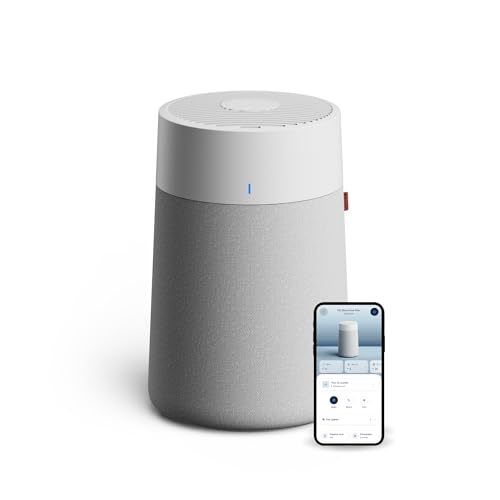
The 511i Max is the Max generation scaled to the bedroom — verified for rooms up to 1,138 ft² — designed around a 19dB night mode, 360-degree intake, and the same sensor-and-app intelligence as its larger siblings. That capacity figure deserves a moment’s attention: it means the unit can hold a bedroom’s air on its silent settings with the same headroom logic this guide preaches for living rooms, rather than straining audibly at the top of its range beside a sleeping person’s head. Bedroom purification is a noise discipline before it is a filtration one — the unit runs eight hours beside sleeping people — and this model’s design brief starts from that fact.
Strengths
- Bedroom-first design: quiet night operation is the headline, not a footnote.
- 360-degree intake makes placement forgiving in tight rooms.
- Max-generation auto mode and app control carry down from the flagships.
Trade-offs
- Bedroom capacity is bedroom capacity; it will not rescue a living room.
- Small units tempt buyers to undersize; measure the room honestly.
Best for: bedrooms and nurseries where silence is the first requirement. / Not suited for: living spaces. Check on Amazon
Blue Pure 411 — Best Small-Space Classic
The Blue Pure 411 is the model that introduced many households to Blueair: a compact cube with a washable fabric pre-filter — famously offered in colors — simple controls, and enough capacity for small bedrooms, dorms, and offices. It is listed unlinked here: the fresh catalog verification on 2026-11-22 returned replacement filters for the 411 series but no listing for the 411 unit itself, and the current range has largely moved to the Max generation, so buyers should confirm current availability before planning around this model.
Strengths
- Compact footprint and simple operation — the low-friction entry into the brand.
- Washable colored pre-filters made the purifier a designed object, not an appliance to hide.
- A long production history means filters and knowledge are widely available.
Trade-offs
- No unit listing was returned by the 2026-11-22 catalog verification — only 411-series replacement filters; the model is legacy and listings change.
- No sensor-driven auto mode in its classic form — it runs where you set it.
- Small-room capacity only; oversizing the room is its common failure.
Best for: dorms, small offices, and first purifiers in small rooms. / Not suited for: automation seekers or medium-to-large rooms.
Blueair Classic 605 / 680i Line — Best Heavy-Duty
The Classic line is Blueair before the design era: big steel-bodied units with very large filters, long replacement intervals, and capacities aimed at large spaces and heavy particle loads. The 605 and its connected 680i sibling represent the family here as a pick without a link: the 2026-11-22 catalog verification returned only Classic 500/600-series replacement filters, not a listing for either unit. Where the Blue line is furniture, the Classics are infrastructure — bought for workshops-adjacent spaces, smoking-adjacent households of the past, large basements, and anyone whose filter-size math favors changing a huge filter rarely over a small one often.
Strengths
- Very large filters and long service intervals — the lowest maintenance frequency in the brand.
- Heavy-duty construction and large-room capacity.
- Filter options in the family have historically included enhanced gas and odor configurations.
Trade-offs
- No unit listing was returned by the 2026-11-22 catalog verification — only replacement filters; confirm current model availability and filter supply before buying.
- Large, heavy, and visually industrial next to the Blue line.
- Big filters cost more per change, even if changes are rarer.
Best for: large spaces, heavy loads, and owners who prize long intervals. / Not suited for: design-led rooms or buyers wanting the newest sensor features.
Blueair HealthProtect 7470i — Best Flagship
HealthProtect is Blueair’s flagship family, and the 7470i its representative here, unlinked: the 2026-11-22 catalog verification returned only 7400-series replacement filters for it, not a listing for the unit itself. The family’s pitch is maximal filtration engineering — enhanced filter architecture and germ-focused design claims — in a unit sized for large rooms, wrapped in the brand’s most finished industrial design. It is the Blueair for the buyer who has decided the category matters to their household and wants the top of the range without leaving the brand.
Strengths
- The most advanced filtration platform Blueair sells, with flagship fit and finish.
- Large-room capacity with the full smart feature set.
- Designed to run continuously as a home’s primary air appliance.
Trade-offs
- No unit listing was returned by the 2026-11-22 catalog verification — only its replacement filters; flagship purchases especially deserve a confirmed current listing.
- The flagship premium is real; the Max line covers most households’ measured needs.
- Flagship filters are flagship-priced consumables.
Best for: buyers who want Blueair’s best, for large primary spaces. / Not suited for: value-focused buyers or single small rooms.
Comparison Table
| Pick | Badge | Key spec | Best for |
|---|---|---|---|
| BLUEAIR Blue 211i Max — Check on Amazon | Best Overall | AHAM Verified to 3,235 ft², WiFi, auto mode, 23dB low | Large living spaces, pets |
| BLUEAIR Blue 311i Max — Check on Amazon | Best for Most Rooms | AHAM Verified to 2,107 ft², washable pre-filter | Living rooms, large bedrooms |
| BLUEAIR Blue Pure 511i Max — Check on Amazon | Best for Bedrooms | Up to 1,138 ft², 19dB night mode, 360° intake | Bedrooms, nurseries |
| Blue Pure 411 | Best Small-Space Classic | Compact cube, colored washable pre-filters | Dorms, small offices |
| Blueair Classic 605 / 680i | Best Heavy-Duty | Very large filters, long intervals | Large spaces, heavy loads |
| Blueair HealthProtect 7470i | Best Flagship | Flagship filtration platform | Top-of-range buyers |
How to Choose a Blueair for Your Room
Start with the room’s square footage and be honest about its ceiling height and openness, because purifier capacity ratings assume a standard room exchanging its air a set number of times per hour. The discipline that matters: choose a unit whose verified capacity comfortably exceeds your room, so it can hold air quality on its low, quiet settings. A purifier running at half capacity is a quiet purifier; a purifier at its limit is a noisy one that still falls behind when a door opens or a dog shakes off the yard. This is why the 211i Max, not the 311i, is recommended for open plans even where the 311i’s number technically reaches.
Next, match the family to the job. The Blue Max family is the default: modern sensors, app control, washable pre-filters, and designs meant to be seen. The Classic family answers a different brief — maximum filter volume and minimum intervention — and suits spaces where the purifier is infrastructure rather than furniture. HealthProtect answers the buyer who wants the strongest platform and accepts flagship consumable costs as the subscription price of that decision. None of these is a wrong door; choosing the family by the job, then the size by the room, is the whole method.
Then price the ownership, not the unit. A purifier’s true cost is the machine plus a filter every several months to a year, plus the electricity of continuous running, for years. Blueair’s washable pre-filters genuinely help here — they intercept the hair and coarse dust that choke main filters early — but the main filter remains a recurring purchase, and larger units carry larger filter costs. Before buying, check the current replacement filter’s price and stated life for your exact model, and write the annual consumable figure next to the purchase price. Buyers who do this arithmetic rarely regret their tier; buyers who skip it sometimes discover their flagship’s filters at the first replacement alarm.
Finally, place it like you mean it. A purifier needs clearance around its intake, a position in the room’s actual air path rather than behind a sofa, and — for sensor models — placement where its readings represent the air you breathe, not the air beside a window or a kitchen door. The 360-degree-intake designs forgive placement sins; directional units do not. Measure the footprint against the intended corner before ordering, because a purifier that does not fit its planned spot ends up exiled to a hallway, purifying the hallway beautifully.
HEPASilent, Explained Without the Brochure
Blueair’s signature technology pairs two capture methods. Air first passes a charging section that gives particles an electrostatic charge; the charged particles are then caught by a mechanical filter that can be less dense than a traditional true-HEPA filter while achieving comparable capture — and a less dense filter lets air through more quietly and with less fan power. That is the honest core of the claim: the hybrid trades filter density for electrostatic assistance, and the dividend is paid in decibels and watts.
What this means in a home is specific. At the low speeds used overnight, a HEPASilent unit moves meaningful air at noise levels that purely mechanical rivals of similar capacity struggle to match. At maximum speed — the post-cooking, post-renovation purge — everything is loud, and the hybrid’s advantage narrows. Judge the technology by the night, not the demo. It also means the filter is a designed component, not a commodity: replacements should be genuine Blueair filters matched to the model, because the system’s balance of charge and media is engineered as a pair.
Odors and gases deserve a separate sentence, because particle filtration — hybrid or not — does not capture gases. Blueair addresses smoke and odor loads with carbon-enhanced filter options in parts of its range. Households whose problem is primarily odor — cooking, pets, a fireplace — should confirm their chosen model has a carbon path available, and should treat particle-only configurations as the wrong tool for that specific job, however excellent they are at dust and dander.
How to Set Up and Run a Blueair
Unbox, remove every piece of plastic from the filter — the number of purifiers run for months with a wrapped filter is a standing joke in this industry because it happens constantly — fit the washable pre-filter, and place the unit with clearance on its intake sides. Run it on its highest speed for the first hour to clear the room’s standing load, then hand control to auto mode if your model has it, or settle on the highest speed you cannot hear from where you sit and sleep. Purifiers reward continuity: they are designed to run around the clock, and air quality is a level they maintain, not a state they achieve once and keep.
Maintenance is a short calendar. Vacuum or wash the pre-filter monthly in pet households, less often in others; it is the cheapest performance you will ever recover. Watch the filter indicator rather than the calendar for the main filter, but sanity-check it — indicators estimate, and a household with a shedding dog in a dusty climate lives faster than the estimate. When the main filter is due, replace it with the genuine model-matched filter and reset the indicator per the manual. Keep the sensor lens clean on auto models; a dust-filmed sensor makes confident, wrong decisions.
Placement adjustments are the free upgrade. If a room still feels dusty, move the unit into the room’s traffic path of air — near the door by which air enters, not sealed behind furniture. If noise bothers you at night, move the unit farther from the bed before turning it down; distance quiets without surrendering airflow. And if you run two units, put the larger where the load is generated — living space, pets, kitchen adjacency — and the smaller where the sensitivity is: the bedroom.
Common Buying Mistakes
Undersizing to save money. A too-small purifier runs loud, falls behind, and gets switched off — the most expensive outcome of all. Size for quiet headroom.
Ignoring filter economics. The purchase is a subscription in disguise. Price the replacement filter and its interval before choosing the tier.
Expecting particle filters to remove odors. Gases need carbon. Match the filter configuration to the actual problem — dust, dander, smoke, or smell.
Hiding the unit. A purifier behind a sofa or inside a cabinet nook is furniture storage, not air treatment. Intakes need open air on every side the design draws from, and a unit starved by furniture will underperform a smaller unit standing in the open — placement is the cheapest capacity there is.
Running it only when the air “feels bad.” By the time air feels bad, the load is established. Continuous low-speed running is the design case and the cheapest quality you can buy.
Final Recommendation
Buy the 311i Max if your rooms are ordinary and your expectations are high — it is the Blueair the majority of households should own. That holds across the situations readers bring to this guide most often: the allergy household that needs a bedroom it can trust, the pet household tired of visible dust settling between cleanings, the apartment dweller whose one large room does everything. The 311i Max answers all three without the flagship’s footprint or filter bill, at noise levels that let it live where the people are rather than where noise is merely tolerated. Buy the 211i Max if the room is large, open, or pet-ruled, and you want the purifier to disappear into quiet competence. Choose the bedroom-sized 511i Max for sleep-first rooms, the 411 for small simple spaces if you find a current listing, the Classic line for heavy-duty, low-intervention duty, and HealthProtect only if you have consciously decided to buy the flagship and its consumables. The three remaining unlinked models were re-checked on 2026-11-22 and no unit listings were returned for them — only replacement filters — so verify their availability directly before planning a purchase around them; the three Max models are confirmed and linked. Comparing across the wider category? See Best Air Purifiers For Large Spaces and Best Air Purifiers Under $200 for the cross-brand picture, and Best 2 Pack Air Purifiers if two smaller rooms are the real problem.
A Room-by-Room Blueair Plan
Most households do not need a purifier in every room; they need one where the air is made dirty and one where the people are most vulnerable. The load room is the living space — cooking adjacency, pet residence, fireplace, the front door’s dust — and it takes the big unit: the 211i Max for open plans, the 311i Max for enclosed rooms. The vulnerability room is the primary bedroom, where occupants breathe the air for a third of their lives at the moment their defenses are down; it takes the quietest unit that covers it, which in this range means stepping a size up from the bare calculation so the night speed is the silent one.
Children’s rooms follow the bedroom logic with a safety overlay: stable placement out of climbing geometry, cords managed, and a unit whose controls can be locked or ignored. Home offices follow the load logic at small scale — a purifier there is really about dust on equipment and the occupant’s allergy afternoons — and are the natural home of the compact slots in this guide. Hallway placement, often proposed as a compromise, purifies the hallway; air does not round corners out of politeness, and a unit should live in the room it serves.
Sequencing the purchases is the budget-friendly path. Buy the load room’s unit first and live with it for a season; its app data and your own nose will tell you whether the bedroom needs its own unit or whether the problem was always the living space. Households that reverse the order often discover they bought a quiet bedroom unit for a problem that lived in the kitchen.
Filter Economics: The Second Price Tag
Every purifier in this guide has two prices: the one on the listing and the one that arrives in installments. The installment price is a main filter on its replacement cycle, a pre-filter’s occasional replacement beyond washing, and continuous electricity. Blueair’s design softens the first installment honestly — washable pre-filters extend main filter life by intercepting the coarse load — but no design abolishes it, and the flagship and large-capacity models carry proportionally larger filters.
The comparison that matters is annual: divide each candidate’s filter cost by its service interval in years of your actual usage, and add a realistic electricity figure for continuous low-speed running. Ranked that way, the range reorders itself — the 311i Max frequently beats the 211i on annual cost for rooms both can serve, the Classic line’s huge filters amortize impressively for large spaces, and the flagship’s premium shows up honestly as a premium rather than hiding in the purchase price. None of this argues against any tier; it argues for choosing the tier with the second price tag visible, which is the only way the first one means anything.
One more discipline: buy filters from the brand’s own channel or a clearly authorized listing, matched to the exact model. The hybrid filtration balance described earlier is engineered around the genuine media, and the market for look-alike filters is brisk. A purifier is a long relationship with a consumable; counterfeit consumables are how that relationship quietly stops working while the fan still spins.
Blueair in the Wider Market: Why Buy the Brand at All?
An honest guide should answer the shopper who asks why not simply buy a cheaper box with a HEPA sticker. The Blueair premium buys four things: the hybrid system’s quiet-at-capacity performance, which is real and measurable in bedrooms; verified capacity figures on the mainstream line, so sizing math can be trusted; the washable pre-filter system, which is both an economy and a design language; and industrial design that households are willing to keep in sight — which matters, because a purifier exiled to a closet purifies the closet. Rivals compete hard on raw capacity per dollar, and for a workshop or a rental property that may be the right trade. For the rooms people live and sleep in, the quiet and the willingness to keep the unit present are functional features, not vanity.
The brand’s weakness is the mirror of its strength: the ecosystem is proprietary, the filters are brand-locked, and the premium compounds across years of consumables. Buyers should walk in with that understood. A Blueair is a decision to rent clean air from one company’s system at a quality level that system genuinely delivers — and for the households this guide’s picks serve, that is a fair and satisfying bargain.
Noise, Decibels, and the Bedroom Test
Purifier noise figures are quoted at each speed, and the only figure that decides satisfaction is the one at the speed the unit will actually run while you sleep. The Max models in this guide quote a floor around 23dB — near the threshold of hearing in a quiet room — and that figure is the hybrid system’s whole argument: at that speed, with that little noise, the unit is still exchanging the room’s air at a useful rate. When comparing any two purifiers, compare their airflow at the same low decibel level, never their maximum airflow against the other’s minimum noise. Listings invite that mismatched comparison; this guide refuses it.
Bedroom placement tunes the result further. A purifier across the room is dramatically quieter at the pillow than one on the nightstand, and its intake works just as well — another reason to size up, place far, and run low. Auto mode earns special trust in bedrooms: it idles at the silent floor through the night and answers disturbances — a door opened, a pet arriving — with a brief, purposeful surge instead of a fixed compromise speed. Sleepers who have rejected purifiers as noisy have usually rejected a fixed medium speed two feet from the bed, which is a placement and settings failure, not a category failure.
Through the Year: Pollen, Smoke, Dust, and Winter
A purifier’s hardest seasons are not the ones in the advertisements. Spring pollen season is the bedroom unit’s showcase: windows closed at night, the purifier scrubbing the room’s recirculated air, and the difference measured in mornings. The pre-filter earns its keep weekly in this season — pollen loads it visibly — and a thirty-second vacuum of the fabric is the cheapest performance in home maintenance.
Wildfire smoke season, where it applies, inverts the priorities: capacity and carbon matter more than quiet, windows stay shut, and the big unit moves to the room the household lives in, running higher than usual. This is the scenario the 211i Max’s headroom exists for, and the scenario in which odor-capable filter configurations stop being optional. Winter is the quiet season for load but the long one for running hours — heating systems stir dust continuously, houses stay sealed, and the purifier becomes the home’s only air exchange of consequence; filter indicators tend to come due in late winter for exactly this reason, and owners should not be surprised by the timing.
Summer’s contribution is dust and the open-window paradox: the same windows that cool the house import the particles the purifier then must catch. Households running window fans at night — a strategy this site’s window fan guide covers in depth — should expect the bedroom purifier to work harder on those nights and its pre-filter to show it. None of these seasons requires a different machine. They require the same machine, sized with headroom, filtered on schedule, and run continuously — which is, in one sentence, the entire Blueair ownership philosophy this guide has been describing.
Understanding Capacity Ratings Before You Trust Them
Room-size claims are the most gamed numbers in this category, so a buyer’s short course is warranted. The meaningful standard is AHAM verification: the Association of Home Appliance Manufacturers tests purifiers and publishes CADR — clean air delivery rate — figures for tobacco smoke, dust, and pollen, from which a room size is derived at a standard number of air changes per hour. Both linked picks in this guide carry AHAM Verified room figures in their catalog data, which is why this guide quotes those specific numbers — 3,235 ft² for the 211i Max and 2,107 ft² for the 311i Max — and treats unrated marketing figures elsewhere with suspicion.
Two cautions keep those numbers honest. First, the derived room size assumes the unit running at its tested — usually highest — speed. A purifier that covers your room on paper at full speed covers it at full noise; the quiet-coverage of the same room is smaller, which is the entire basis of this guide’s size-up advice. Second, air changes matter by purpose: a bedroom for an allergy sufferer wants more exchanges per hour than a hallway, so the same square footage can demand different units in different rooms of one house. Ratings are the beginning of the sizing conversation, not its end.
Ceiling height and room openness bend the math further. The standard derivation assumes ordinary ceilings; a vaulted living room holds far more air than its floor plan suggests, and an open plan means the purifier is really serving the whole connected volume, not the rug it sits on. Measure the air, not the floor: length by width by height, compared honestly against the unit’s class. Buyers who do this once buy correctly once — and in a category where the wrong size announces itself nightly, that is the whole game.
One Year In: What Blueair Ownership Actually Feels Like
The first week with a purifier is theater: the sensor reacts to cooking, to the dog, to a shaken rug, and the owner watches the air quality readout like a new parent. The theater fades, and what remains — the thing owners actually report a year in — is a set of absences. Less dust settling on dark furniture between cleanings. Fewer mornings that start with the stuffed, slept-in feeling. A bedroom that smells like nothing, which turns out to be the smell people were paying for. A purifier that works becomes invisible, and the honest measure of the purchase is that the household notices it only when it is off — traveling, or during the day the filter finally comes due.
The year’s frictions are equally predictable. The filter replacement arrives as a small financial ambush for owners who skipped the economics section of this guide, and as a scheduled non-event for those who priced it in. The app, delightful in week one, gets opened monthly by year one — which is fine, because auto mode was always the point. The pre-filter becomes a small household ritual, and the main unit acquires the status of furniture: dusted around, vacuumed occasionally, and argued about only when someone proposes moving it to a worse position for aesthetic reasons. Resist that proposal. The purifier’s corner was chosen by airflow logic, and it has earned tenure.
Regret, when it appears, follows one pattern: the undersized unit in the big room, still audible, still behind. It is the only common regret in this category, it is entirely preventable at purchase, and it is why this guide repeats its sizing sermon in every section. Buy the headroom. A year later, nobody wishes their purifier were smaller, louder, or working harder.
Smart Features, Judged Honestly
The app and sensor package on the Max line invites two opposite mistakes: dismissing it as a gimmick, or buying it as the product itself. The truth is narrower and more useful. The particle sensor is the valuable half — it converts the purifier from a fan with a filter into a system that responds to events: the cooking surge, the renovation dust, the pollen-heavy evening when the windows were open. Auto mode built on a trustworthy sensor is the feature owners actually use daily, precisely by never touching it. The app is the convenience half: remote checks, filter status, and scheduling for the household that travels. It is genuinely pleasant and genuinely optional, and a buyer who knows they will never open it should weight the Classic line’s simplicity more heavily rather than paying for connectivity they will ignore. What neither half does is change the filtration physics — the same room, load, and filter discipline govern a smart unit and a dial-controlled one, which is why this guide sizes first and automates second.
Related guides
- Best Cost Effective Air Purifiers
- Best Cooling Fan And Air Purifiers
- Best Air Purifiers For Birds
- Best And Affordable Air Purifiers
Frequently Asked Questions
What is the difference between the Blue 211i Max and 311i Max?
Scale and capacity. The 211i Max is AHAM Verified for larger rooms — up to 3,235 ft² — while the 311i Max covers up to 2,107 ft². Both share the Max generation’s WiFi, auto mode, HEPASilent filtration, and washable pre-filter concept. Choose by room size, keeping headroom for quiet running.
How often do Blueair filters need replacing?
Main filters are consumables with model-specific service lives, generally measured in months of continuous running; the unit’s indicator tracks it. The washable pre-filter should be cleaned regularly — monthly in pet homes — which protects the main filter’s life. Always confirm the interval and replacement cost for your exact model. Treat the indicator as an estimate informed by runtime rather than a measurement of the filter’s actual loading: a dusty household can load a filter ahead of its schedule, and when air quality visibly slips or the unit works audibly harder to hold it, believe the room over the light and inspect the filter directly.
Are Blueair purifiers good for pet hair and dander?
Yes — the washable pre-filter is particularly well suited to hair, intercepting it before the main filter, and the filtration handles the dander fraction. Size generously for pet households, because the particle load is continuous, and keep the pre-filter cleaning cadence honest.
Can a Blueair remove cooking and smoke odors?
Particle filtration alone does not capture gases and odors. Blueair offers carbon-enhanced filter options in parts of the range for smoke and odor duty; confirm your model’s carbon path if odor is a primary concern, and ventilate cooking smoke at the source as well.
Should I run my air purifier all the time?
Yes. Purifiers maintain air quality rather than creating it once, and their low speeds are designed for continuous, quiet, low-power operation. Auto mode exists precisely to manage this — surging when the sensor sees a load, idling when the air is clean. The households that get the least from a purifier are the ones that treat it like a vacuum cleaner, deployed occasionally against a visible problem; the households that get the most switch it on at installation and think about it again at filter time. Continuous running also keeps the sensor’s picture of the home honest, so the surges it does make are the right ones.
Is the flagship HealthProtect worth it over the Max line?
For most households, the Max line covers the measured need at a lower total cost of ownership. HealthProtect is worth it for buyers who specifically want Blueair’s most advanced platform and accept flagship filter costs as part of the decision. In this guide it remains without a link, because the 2026-11-22 catalog check returned only its replacement filters, not a unit listing — verify current availability before committing.


