Disclosure: airfryerkitchensupply.com is reader-supported. When you buy through links on our site, we may earn an affiliate commission at no extra cost to you.
Where to buy
Every cooker on this list was confirmed on Amazon before it earned a place here. Use the links below to check the current price on Amazon for each pick: the Oklahoma Joe’s Highland Offset, the Char-Griller Smokin Pro, the Masterbuilt Gravity Series 800, the Char-Griller AKORN Kamado, the Royal Gourmet CC1830S, and the Dyna-Glo Wide Body Vertical Offset. Prices on outdoor cookers move with the season, so the live listing is the only number worth trusting.
Introduction: One Fire, Two Jobs
Shoppers searching for the best wood grill and smokers usually want one machine that does two jobs honestly: sear a steak over a live wood fire on Friday, then hold a brisket at a steady smoking temperature all day Sunday. That sounds simple, but the grill-and-smoker category is full of compromises. A thin barrel grill with a bolt-on firebox can technically smoke, yet it leaks so much heat that you spend the cook feeding it splits instead of eating. A dedicated vertical smoker holds temperature beautifully but gives you no direct-fire grilling surface at all. The cookers that genuinely do both jobs share a few traits: steel thick enough to hold heat, dampers that actually meter airflow, a firebox or fire chamber sized for real wood splits rather than chips, and grates that sit close enough to the coals for a proper sear.
This roundup separates the designs by how they burn wood. Offset smokers move heat and smoke sideways from a separate firebox, which produces the cleanest smoke flavor and a real grilling chamber once the fire is built in the main barrel. Kamado cookers burn lump charcoal and wood chunks in an insulated ceramic-style body that grills at ripping-hot temperatures and still settles down for low-and-slow work. Gravity-fed charcoal cookers automate the fire with a fan and a hopper while still burning real charcoal and wood chunks, which makes them the easiest path to wood flavor for people who do not want to manage a fire every half hour. Vertical offsets stack the cooking chamber above the fire for a small footprint and huge capacity. Each design has a real trade-off, and this guide names it for every pick instead of pretending one cooker wins at everything.
A word on fuel honesty: every cooker here burns wood in a meaningful form — splits, chunks, lump charcoal, or a charcoal-and-wood mix. None of them is an electric box with a chip tray dressed up as a wood smoker. If your goal is the flavor that only a real fire makes, these six are the designs worth your money, and each one below is matched to the backyard and the cook it genuinely suits best, with its weaknesses stated as plainly as its strengths.
In this guide
Quick Picks
- Best Overall: Oklahoma Joe’s Highland Offset Charcoal Smoker Grill — a true offset with 900 square inches of cooking area that grills in the main chamber and smokes from the side firebox. Check the current price on Amazon.
- Best for Big Cookouts: Char-Griller Smokin Pro Charcoal Grill and Offset Smoker — 1,130 square inches with a side fire box and dual damper control for crowds. Check the current price on Amazon.
- Best Set-and-Forget Wood Fire: Masterbuilt Gravity Series 800 — a gravity-fed charcoal hopper with digital control and a griddle insert, so the fan manages the fire while you manage the food. Check the current price on Amazon.
- Best Kamado: Char-Griller AKORN 20-Inch Kamado — triple-wall insulated steel with cast iron grates that sears hard and sips fuel on long cooks. Check the current price on Amazon.
- Best Budget: Royal Gourmet CC1830S Charcoal Grill and Offset Smoker — 783 square inches of barrel grill plus offset firebox at an entry-level tier. Check the current price on Amazon.
- Best Vertical: Dyna-Glo Wide Body Vertical Offset Charcoal Smoker — a wide-body vertical chamber that stacks racks of ribs and whole birds in a compact footprint. Check the current price on Amazon.
How These Picks Were Chosen
Selection started with the fuel, not the marketing. Each candidate had to burn wood as a primary fuel — splits in a firebox, chunks over charcoal, or lump charcoal — and had to offer both a credible grilling mode and a credible smoking mode in the same unit. Cookers that only smoke, or that only grill with an optional chip box, were cut.
From there, the judging criteria were practical. Steel gauge and build quality decide whether an offset holds temperature or eats fuel, so construction weighed heavily. Damper design mattered because airflow is the only throttle a wood fire has. Cooking area was judged against realistic food — a full packer brisket, four racks of ribs, two whole chickens — rather than headline square inches that count warming racks twice. Grilling performance was judged on grate material and distance to the coals, because a smoker that cannot sear is only half of what this search promises. Finally, each pick had to own a distinct job: overall winner, capacity pick, automated pick, kamado pick, budget pick, and vertical pick, so the list reads as six answers to six different backyards rather than six near-identical barrels.
One honesty note: thin-steel budget offsets, including one pick here, need gasket tape and a tuning plate to perform at their best. That is stated openly in the relevant review rather than hidden, because a cheap offset plus a Saturday of sealing work is still the cheapest honest route into stick-burning.
The 6 Best Wood Grill and Smokers

Oklahoma Joe’s Highland Offset Charcoal Smoker Grill — Best Overall
The Highland is the cooker this category is really about: a horizontal offset with a 900-square-inch cooking chamber and a separate side firebox, built in the pattern of the classic Oklahoma smokers that taught a generation of backyard cooks what clean smoke tastes like. Build a fire of splits in the firebox and the heat draws sideways across the meat, exiting at the far chimney — that cross-draft is what produces the deep, clean smoke ring and bark that gas and electric cookers imitate but never match. When you want to grill, build the fire directly in the main chamber and cook over it like any barrel grill, or sear in the firebox itself over a small grate for a two-steak weeknight cook.
Strengths
- True offset airflow gives the cleanest wood smoke flavor of any design in this roundup.
- 900 square inches fits a full packer brisket with room for a second rack of food.
- Heavy steel construction for the tier, with a large firebox door that swallows real splits.
Trade-offs
- Offset cooking is hands-on: expect to tend the fire every 30 to 45 minutes on a long cook.
- The temperature gradient runs hotter near the firebox, so rotating meat is part of the craft.
- It is heavy and has a large footprint; apartment balconies need not apply.
In practice, the Highland rewards the cook who enjoys the process. A coal bed built from lump charcoal, maintained with one split at a time, holds a steady smoking range for hours, and the learning curve is the honest price of admission to stick-burning. New owners should budget for a gasket kit for the cooking chamber door — a near-universal offset improvement — and a second thermometer at grate level, because lid thermometers read the hottest air in the chamber, not the air your brisket sits in. Searing performance in the main chamber is genuinely good: cast-iron-friendly heat, plenty of room, and the direct wood-fire flavor that makes a ribeye cooked this way taste different from gas in a way guests notice immediately.
Best for: cooks who want real offset flavor and enjoy tending a fire / Not suited for: anyone who wants to set a temperature and walk away for eight hours
Check the current price on Amazon

Char-Griller Smokin Pro Charcoal Grill and Offset Smoker — Best for Big Cookouts
The Smokin Pro takes the same offset idea and stretches it: 1,130 square inches of cooking space, a side fire box, dual damper control, and a chrome-plated warming rack up top. This is the pick for the cook who hosts — the one whose brisket day also includes two chickens, a pan of beans, and sausages for the people who cannot wait. The main chamber grills like a big barrel when the fire is built under the grates, and the firebox doubles as a small direct grill for searing a couple of steaks while the big chamber smokes.
Strengths
- The largest cooking area in this roundup, with a warming rack that adds real holding space.
- Dual damper control gives finer airflow adjustment than single-vent rivals.
- Cast iron cooking grates hold sear heat well for a cooker in this tier.
Trade-offs
- The steel is thinner than premium offsets, so it burns more fuel in cold or windy weather.
- Door fit on budget offsets varies; a gasket kit is close to mandatory for tight temperature control.
- Assembly is a genuine two-person, multi-hour job.
What the Smokin Pro teaches is that capacity and craft can coexist at a modest tier if you accept the maintenance rhythm of a lighter-gauge offset. It will smoke a holiday spread in one load, and the dual dampers let a careful cook flatten the hot spot better than most budget barrels. Wind is its enemy: park it out of the breeze, keep the fire small and hot rather than large and smoldering, and it produces food that embarrasses cookers costing far more. For grilling duty, the adjustable charcoal tray height on this class of Char-Griller barrel is the feature you will use most — raise the coals for searing, drop them for gentler direct cooking.
Best for: hosts cooking for a crowd on a budget / Not suited for: solo cooks who will never fill a third of the grate
Check the current price on Amazon

Masterbuilt Gravity Series 800 — Best Set-and-Forget Wood Fire
The Gravity Series 800 answers the offset’s one big weakness — attention — without giving up real fire. A vertical hopper holds charcoal (with wood chunks layered in for smoke), gravity feeds it onto a grate at the bottom, and a digitally controlled fan holds your set temperature by metering air. It reaches grilling temperatures fast, holds smoking temperatures for hours on a hopper load, and this 800 model adds a griddle insert to its 800 square inches of cooking space, so breakfast on the flat top is part of the deal. The smoke flavor is charcoal-and-chunk smoke: real, satisfying, and a step below a clean-burning offset on brisket, which is the honest trade for sleeping through the night while a pork butt cooks.
Strengths
- Digital temperature control with app connectivity on a real charcoal-and-wood fire.
- Heats to searing temperatures far faster than any offset or kamado here.
- Griddle insert adds a third cooking style none of the other picks offer.
Trade-offs
- It needs electricity for the fan and controller — no power, no cook.
- More moving parts than a steel barrel: fan, switches, and hopper seals to maintain.
- Smoke flavor is milder than a true stick-burner running clean splits.
The Gravity 800 is the pick we recommend to the most people who ask about this category, because most people overestimate how much fire-tending they will enjoy at 3 a.m. in February. Layer wood chunks through the hopper — a chunk every few inches of charcoal — and the smoke profile stays present through the whole cook. Shutdown is its party trick: close the slides, starve the fire, and the remaining charcoal is saved for next time, something no offset can do. Grease management deserves respect; scrape the manifold and empty the tray on schedule, because a fan-driven cooker moves a lot of air past a lot of drippings.
Best for: cooks who want wood flavor with pellet-grill convenience / Not suited for: off-grid cooking or purists chasing offset-level smoke
Check the current price on Amazon

Char-Griller AKORN 20-Inch Kamado — Best Kamado
The AKORN takes the kamado concept — an insulated, egg-shaped charcoal cooker — and builds it from triple-wall insulated steel instead of heavy ceramic, which keeps the weight and the price down while holding heat remarkably well. Its cast iron grates sear as hard as any cooker here, the insulated body sips lump charcoal on long smokes, and with a deflector in place it settles into a steady low-and-slow groove that produces excellent pork shoulder and ribs. It is also the most fuel-efficient cooker in this roundup by a wide margin: a single load of lump can run a whole brisket cook with charcoal left over.
Strengths
- Triple-wall insulation holds temperature in winter weather that defeats thin offsets.
- Cast iron grates deliver the best steak sear in this lineup.
- Extremely fuel-efficient; a little lump charcoal and a few wood chunks go a long way.
Trade-offs
- Cooking area is the smallest here — one brisket or a few racks of ribs, not a party spread.
- Steel body needs its seasoning maintained and the ash pan emptied to prevent rust.
- Kamado temperature overshoot is easy; bringing heat down is slow, so approach target temps gradually.
The AKORN’s real competition is ceramic kamados at several times its tier, and for most backyard cooks the honest answer is that the food difference is small while the price difference is enormous. Wood chunks buried in the lump give a steady, gentle smoke that suits poultry and pork especially well. Its grilling mode is where it quietly beats the offsets: direct radiant heat in an insulated dome produces steakhouse crusts, and the same dome bakes pizza and bread at temperatures barrels cannot reach. If your cooking is mostly for four to six people, this is the most satisfying cooker on the list.
Best for: small households wanting one cooker that sears, smokes, and bakes / Not suited for: cooking whole spreads for large gatherings
Check the current price on Amazon

Royal Gourmet CC1830S Charcoal Grill and Offset Smoker — Best Budget
The CC1830S is the entry ticket: a 783-square-inch barrel charcoal grill with an attached offset smoker, front and side tables, and an adjustable charcoal pan. It does both jobs in the mechanical sense — the firebox feeds smoke into the main chamber for low-and-slow cooking, and the main barrel grills directly — and it does them at the lowest tier in this roundup. The honest framing is that you are buying a learning platform. Sealed with gasket tape and cooked on with a small, clean fire, it makes genuinely good smoked food; left stock and overloaded with wood, it will teach you what dirty smoke tastes like, which is also a lesson, just a less tasty one.
Strengths
- Lowest entry tier here for a true grill-plus-offset combination.
- Adjustable charcoal pan helps manage grilling heat in the main chamber.
- Front and side tables give real working space that many budget barrels skip.
Trade-offs
- Thin steel and loose door fit mean temperature swings until you seal it up.
- Paint inside the firebox area will not survive high heat long-term; expect patina, maintain against rust.
- Capacity figures include the firebox chamber; plan main-chamber space conservatively.
Buyers who treat the CC1830S as a kit — cooker plus gasket, plus a grate-level thermometer, plus a weekend of seasoning — consistently get more from it than buyers who treat it as finished. Its grilling side is straightforwardly good: a big barrel, a height-adjustable coal bed, and enough grate space for a family cookout. As a smoker it rewards small fires and patience. If you catch the stick-burning bug on this cooker, you will know exactly which features to pay for in your next one, and if you do not, you have spent the least possible to find out.
Best for: first-time stick-burners testing the hobby at the lowest tier / Not suited for: unattended overnight cooks or competition ambitions
Check the current price on Amazon
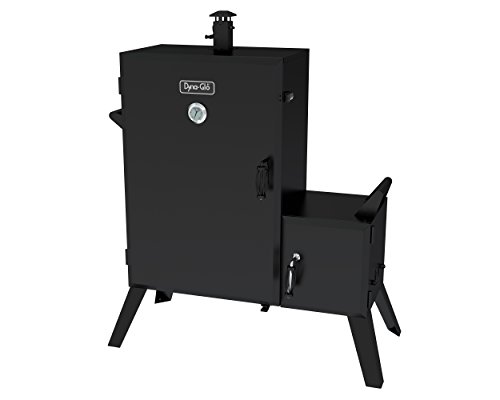
Dyna-Glo Wide Body Vertical Offset Charcoal Smoker — Best Vertical
The Wide Body takes the offset layout and stands it up: the firebox sits low and to the side, and smoke rises through a tall, wide chamber fitted with multiple racks. Vertical space is the point — whole chickens, rib racks hung or stacked, and pans of sides all fit in a footprint smaller than a horizontal barrel needs. As a grill it is the most limited pick here; the firebox offers a small direct-grilling surface, and the main chamber is a smoker, full stop. It earns its place because for pure smoking capacity per square foot of patio, nothing else on this list comes close.
Strengths
- Stacked racks fit far more food than its footprint suggests.
- Rising heat and smoke bathes food evenly across the chamber.
- Wide body fits full racks of ribs flat, which narrower verticals cannot.
Trade-offs
- Grilling ability is minimal — a small firebox grate, not a real grill.
- Vertical doors leak smoke until gasketed, like most cookers in this tier.
- Temperature varies by rack height; rotating food between levels is part of the routine.
For the cook whose “grill and smoker” search really means “smoker first, and I will sear on the stove or a small grate,” the Wide Body is the capacity answer. It runs on charcoal with wood chunks — or small splits in the firebox — and once sealed, it holds a steady smoking range with less fuss than a horizontal budget offset because the vertical draft is naturally strong. Ribs are its signature: rack after rack laid flat, basted by rising smoke, in a cooker that parks in a corner of the patio. Pair it with any small grill for searing duty and the combination covers the whole keyword better than most single units.
Best for: smoking volume in a small footprint / Not suited for: anyone whose priority is direct-fire grilling
Check the current price on Amazon
Comparison Table
| Pick | Badge | Key spec | Best for |
|---|---|---|---|
| Oklahoma Joe’s Highland Offset | Best Overall | 900 sq in, side firebox offset | True offset flavor plus main-chamber grilling |
| Char-Griller Smokin Pro | Best for Big Cookouts | 1,130 sq in, dual dampers | Crowd-sized cooks on a budget |
| Masterbuilt Gravity Series 800 | Best Set-and-Forget | 800 sq in, gravity hopper, griddle insert | Wood flavor without fire-tending |
| Char-Griller AKORN Kamado | Best Kamado | 20-inch, triple-wall insulated steel | Searing, smoking, and baking for small households |
| Royal Gourmet CC1830S | Best Budget | 783 sq in, offset firebox | Learning stick-burning at the lowest tier |
| Dyna-Glo Wide Body Vertical Offset | Best Vertical | Wide-body vertical chamber, multi-rack | Maximum smoking capacity per patio footprint |
How to Choose a Wood Grill and Smoker Combo
Start by deciding how you actually want to spend a Saturday. The defining split in this category is not brand or size — it is attention. A stick-burning offset asks for a small fire-tending decision every half hour or so, and in exchange gives the deepest smoke flavor there is. A gravity-fed cooker automates that attention with a fan, trading a measure of smoke intensity for your afternoon back. A kamado splits the difference: it needs little tending once stabilized, because insulation does the work, but its capacity is capped by its round grate. None of these is the “right” answer in the abstract; the right answer is the one whose rhythm matches your life. Cooks who buy an offset as a status object and then resent the fire-tending sell it within a year, while cooks who buy automation and then chase deeper smoke end up buying an offset anyway. Be honest about which cook you are before you spend.
Steel thickness is the second decision, and it matters most for offsets. Thick steel is a thermal battery: it absorbs the temperature dip when you open the door or add a cold brisket, and it smooths out the spikes when a fresh split catches. Thin steel follows every gust of wind. You cannot see gauge in a product title, but weight is a fair proxy — among cookers of similar size, the heavier one almost always holds temperature better. Door fit is the other half of the equation. Smoke should exit through the chimney, not around the door; every leak is heat and smoke your food never sees, and it is why gasket tape is a standard first upgrade rather than an admission of failure.
Size the cooker by your largest regular cook, not your largest imaginable one. A brisket needs roughly two feet of unobstructed grate length; four racks of ribs laid flat need a chamber most 500-square-inch barrels cannot honestly offer once you leave airflow gaps. Warming racks count for holding cooked food, not for smoking raw meat, so mentally subtract them when comparing headline numbers. Finally, check the firebox door size on any offset: if it cannot swallow the splits your local supplier sells, you will spend your cooks with a hatchet instead of a cold drink.
Grilling vs. Smoking: Getting Both Right on One Cooker
The two techniques want opposite fires. Grilling wants a shallow bed of coals close under the grate, high radiant heat, and short cook times. Smoking wants a small, clean fire burning off to the side, with heat and smoke washing gently over food for hours. A combo cooker earns its name when it can arrange both geometries: fire directly under the grate for steaks, fire in the firebox (or behind a deflector in a kamado) for brisket. The most common disappointment in this category comes from cookers that arrange neither well — a barrel too deep to sear properly and a firebox too small to smoke cleanly.
Smoke quality deserves its own paragraph because it is where beginners lose the most food. A wood fire should burn hot and clean, with thin blue or nearly invisible smoke at the chimney. Thick white smoke means the wood is smoldering — starved of air or too green — and it deposits bitter, ashy flavors no rub can fix. The counterintuitive rule is that a smaller fire with more airflow tastes better than a big fire choked down. Build a coal bed first, add one split at a time, and let each split fully ignite before judging the smoke. Every cooker in this roundup can burn clean; the variable is almost always the size of the fire the cook builds, not the cooker.
How to Run Your First Cook on a Wood Grill Smoker
Season the cooker before any food goes in. Wipe the interior, coat the grates and inner walls lightly with a high-heat cooking oil, and run a moderate fire for two to three hours. This burns off manufacturing residues and lays down the first protective layer against rust. While it runs, practice: adjust the dampers, watch how the temperature responds, and learn how long your cooker takes to recover after the door opens. That practice session is worth more than any manual.
For your first real cook, choose pork butt. It is forgiving of temperature swings, cheap if things go sideways, and it teaches the full rhythm — fire building, smoke management, wrapping, resting — in one day. Start with a chimney of lump charcoal as your coal bed. Once it is fully lit and settled in the firebox (or in the kamado’s fire bowl, under a deflector), add two wood chunks or one small split, wait for the smoke to thin and turn pale, and only then put the meat on. Keep a simple log: time, temperature, what you added, what the fire did. Six cooks with a notebook will make you better than sixty cooks from memory. Rest the finished butt wrapped for at least an hour; the rest is not optional downtime, it is where the juices redistribute and the cook finishes.
Common Buying Mistakes
The first mistake is buying capacity you will never use. A giant offset is not better than a right-sized one; it burns more wood to heat empty space, takes longer to stabilize, and turns a two-rack Tuesday cook into a production. Buy for your regular crowd and rent or borrow for the annual blowout. The second mistake is trusting the lid thermometer. On nearly every cooker in this tier it reads the air at the top of the chamber, which can differ wildly from grate level where the food sits. A decent dual-probe thermometer is not an accessory; it is the instrument that makes everything else in this guide work.
Third, buyers routinely spend their whole budget on the cooker and nothing on the ecosystem: no cover, no gasket, no chimney starter, no decent wood supply. A cooker left uncovered in the rain rusts from the outside while its firebox rusts from ash left sitting in it — ash plus moisture is corrosive, and emptying the firebox after every cook is the single highest-value habit in wood cooking. Fourth, do not judge a cooker by its first cook. Offsets and kamados both have a learning curve measured in cooks, not hours, and most “this smoker is junk” verdicts are really “my third-ever fire was too big” verdicts. Finally, beware any listing that promises competition results from a cooker with paper-thin steel and a single damper. The physics of fire does not care about marketing, and neither should your money.
Managing Temperature Zones Across a Combo Cooker
Every wood cooker in this roundup is really several temperature zones wearing one lid, and learning your zones is what separates a good cook from a frustrated one. On a horizontal offset, the firebox end of the chamber can run dramatically hotter than the chimney end during the first hours of a cook. That gradient is a tool once you expect it: sear sausages near the firebox while ribs cruise at the cool end, or park a brisket at the cool end and rotate it a quarter turn every hour so each side takes its turn facing the heat. On a kamado the zone split is vertical — the grate over the coals is a searing surface while the raised rack above it cooks gently — which is how one small cooker can crisp chicken skin over direct heat while a drip pan of beans simmers at the edge. The Gravity Series hides its zones behind the fan, but they exist: the lower rack near the manifold runs hotter than the top rack, and knowing that tells you where the chicken thighs go and where the delicate fish does not.
The practical method is a biscuit test, and it takes twenty minutes. Run the cooker at a steady medium smoking temperature and cover the grate with cheap canned biscuits, spaced evenly. After fifteen minutes, the biscuits map your heat: dark ones mark hot zones, pale ones mark cool zones, and the pattern will stay roughly consistent for the life of the cooker. Photograph the result. Every future cook — where to place the thick end of the brisket, which corner crisps potatoes, where the thermometer probe tells the truth — gets easier with that map in hand. No review, including this one, can give you your cooker’s map; only the biscuit test can, which is why experienced cooks do it on day one and beginners wish they had.
Maintenance That Keeps a Wood Cooker Alive for Years
Wood cookers die from neglect, not from cooking. The kill sequence is almost always the same: ash sits in the firebox, rain finds its way in, the ash turns to a corrosive paste, and the thinnest steel in the cooker — the firebox floor — rusts through in a few seasons. The prevention is a two-minute habit: after the cooker is fully cold, empty the ash, every time. Ash left in a kamado’s bowl holds moisture against the steel the same way. A stiff brush on the grates while they are still warm from the next cook keeps buildup from becoming the kind of carbon crust that flakes onto food.
Exterior care is simpler than owners expect. A cover that actually fits — and is actually put back on — does more for longevity than any paint. Touch up exterior rust spots early with high-heat paint after a wire-brush pass, because surface rust is cosmetic while neglected rust becomes structural. Once or twice a year, run a hot, clean fire with the cooker empty to burn creosote out of the chimney and chamber walls; a cooker that smells sweet and woody when hot is healthy, while one that smells like an ashtray is telling you its fires have been too dirty or its cleaning too rare. Season the grates after that burn with a light coat of oil and the cooker is reset for another season. None of this is glamorous, but the difference between a five-year cooker and a fifteen-year cooker is almost entirely these small habits.
What Each Budget Tier Actually Buys in This Category
Money in wood cooking buys three things, in this order: steel, sealing, and automation. The entry tier — where the Royal Gourmet in this roundup sits — buys you the correct shapes: a real firebox, a real chamber, dampers that move air. What it does not buy is thickness or tight tolerances, which is why entry-tier cookers reward owners who seal them and punish owners who expect them to behave like appliances. The honest way to read an entry-tier price is as a cooker plus a small project, and judged that way it is excellent value: the food ceiling of a sealed budget offset is far higher than most people expect.
The mid tier buys steel and fit. Cookers like the Highland and the Smokin Pro hold temperature with less fuss, need less fuel on a windy day, and survive more seasons before rust becomes a structural question. This is the tier where most backyard cooks should land, because the jump in day-to-day cooking pleasure from entry to mid is the largest in the category. Above that, the premium tier buys automation and refinement: the Gravity Series’ fan and controller, thicker materials, better casters, doors that seal from the factory. Automation is genuinely transformative for overnight cooks, but it does not raise the flavor ceiling — a skilled cook on a mid-tier offset matches it — it lowers the effort floor. Spend on automation if your constraint is time and attention; spend on steel if your constraint is weather and fuel; spend on neither until you have cooked enough to know which constraint is actually yours.
One final budgeting truth: the cooker is roughly two-thirds of the real first-year cost of this hobby. Wood or charcoal by the bag, a chimney starter, a dual-probe thermometer, a cover, gasket tape, gloves that can handle a hot grate, and the meat itself all belong in the plan. Buyers who reserve that last third enjoy their cooker from the first weekend; buyers who spend everything on the cooker spend their first cooks improvising tools, and improvisation around a live fire is how small burns and ruined briskets happen.
Final Recommendation
For most backyards, the Oklahoma Joe’s Highland is the right first serious wood grill and smoker: real offset flavor, real grilling room, and a build that respects the craft. If your Saturdays are spoken for and attention is the scarce resource, the Masterbuilt Gravity Series 800 delivers genuine charcoal-and-wood cooking on autopilot. Small households that grill more than they smoke should take the AKORN Kamado and never look back, while hosts feeding a crowd on a budget will get the most from the Smokin Pro. Testing the hobby cheaply points to the Royal Gourmet CC1830S, and pure smoking volume points to the Dyna-Glo Wide Body.
Keep exploring the cluster: Best Wood Grills, Best Wood Meat Smokers, Best Wood Smoker Grills, Best Wood Pellet Grill Smokers, Best Wood Burning Bbq Smokers, and Best Wood Smokers For Beginners each take one branch of this category deeper.
Frequently Asked Questions
Can one cooker really grill and smoke well, or is a combo always a compromise?
A combo is a compromise in peak performance but not in quality of results. A dedicated offset smokes slightly better than the best combo, and a dedicated kettle grills slightly better — but a well-chosen combo like an offset with a full-size main chamber produces food most guests cannot distinguish from dedicated gear. The compromise to avoid is the cooker that does both jobs poorly: too small a firebox to smoke cleanly, too deep a chamber to sear.
What wood should I burn in a wood grill smoker?
Start with oak as your base fuel wood — it burns long, hot, and neutral — and add fruit woods like apple or cherry for pork and poultry, or hickory in moderation for beef. Wood must be seasoned and dry; green or wet wood smolders and makes bitter smoke. Avoid softwoods like pine entirely, and never burn lumber offcuts, which can carry treatments you do not want on food.
How long does a wood fire need tending during a long smoke?
On an offset, plan to check the fire every 30 to 45 minutes and add a split as the coal bed thins. A kamado, once stabilized, can run many hours untouched. A gravity-fed cooker runs a full hopper for an extended cook with no intervention beyond a glance at the app. Your tolerance for that rhythm should drive which design you buy.
Why does my smoked meat taste bitter?
Almost always dirty smoke: wood smoldering instead of burning. Build a smaller, hotter fire with more airflow, let each split fully ignite, and wait for thin pale smoke before the meat goes on or more wood goes in. Creosote buildup from repeated dirty fires can also taint a cooker, which a hot seasoning burn usually clears.
Do I need to seal a new offset smoker with gaskets?
On most cookers in the budget and mid tiers, yes — it is the cheapest performance upgrade available. Smoke leaking around the door is heat and flavor leaving the cook. High-temperature gasket tape on the cooking chamber and firebox doors, plus a latch adjustment, typically transforms temperature stability.
How do I smoke in cold or windy weather?
Wind is harder on a wood cooker than cold. Park the cooker out of the breeze, keep the fire small and hot rather than large and lazy, and expect to burn more fuel than a summer cook. Insulated designs like kamados shrug off winter almost entirely, while thin offsets benefit from a welding blanket draped over the chamber (never over the firebox or chimney). Start the cook earlier than you think; a brisket that finishes early rests happily wrapped for hours, while one that runs late cannot be rushed without consequences.
Can I use wood pellets in a stick-burning offset or kamado?
Not as the main fuel. Pellets are engineered for auger-fed burn pots; in an offset firebox they smolder in a pile and produce exactly the dirty smoke this guide warns against. If you want pellet convenience, buy a pellet grill — several appear in the companion guides linked above. In a stick-burner, burn splits and chunks; in a kamado or gravity cooker, burn lump charcoal with wood chunks mixed in.
What is the easiest first meat to smoke on a new cooker?
Pork butt (shoulder). It tolerates temperature swings, stays moist across a wide doneness window, and teaches fire management in a single cook. Ribs are a good second cook; brisket, which punishes every mistake, should wait until you know your cooker’s habits.


