Disclosure: airfryerkitchensupply.com is reader-supported. When you buy through links on our site, we may earn an affiliate commission at no extra cost to you.
Where to buy
Every smoker in this guide was confirmed as a current Amazon listing before we wrote a word about it. These are large, heavy appliances, so read the delivery and assembly terms on the listing itself, and if a third-party seller is offering a model, prefer the listing sold or shipped by Amazon or the manufacturer where you have the choice.
Quick links to the verified picks in this guide: Masterbuilt Gravity Series 1050 · Masterbuilt Gravity Series 600 · Masterbuilt Gravity Series 1150 · Masterbuilt Gravity Series 800 · Masterbuilt 710 WiFi Digital Electric Smoker · Pit Boss 4-Series Vertical Pellet Smoker. Every product link in this article points to a listing we confirmed before writing; anything we could not confirm is discussed in plain text only, with no link.
The best wifi smokers are not all the same kind of machine, and understanding that is the key to this whole category. Under this one keyword sit three genuinely different technologies: gravity-fed charcoal smokers that burn real lump or briquettes under digital control, vertical electric smokers that use a heating element and wood chips, and vertical pellet smokers that feed pellets into a cabinet. What unites the picks below is the Wi-Fi layer — each one connects to your home network and reports to an app, so you can monitor a cook from the couch, the store or bed, and adjust temperature without opening a door and dumping heat. What separates them is flavor, fuel and effort. Charcoal gravity smokers taste the most like traditional barbecue. Electric verticals are the easiest machines in all of smoking. Pellet verticals split the difference with huge rack capacity. This guide explains which technology fits which cook, then ranks the six connected smokers we verified for this roundup. A word on expectations before the picks: a Wi-Fi smoker will not turn a bad cut into a great one, and it will not rescue a cook you seasoned carelessly. What it removes is uncertainty — and in barbecue, uncertainty is most of the difficulty.
In this guide
Quick Picks
Masterbuilt Gravity Series 1050 — Best Overall: Gravity-fed charcoal flavor with digital Wi-Fi control and 1,050 sq in — the connected smoker most people should buy first. — Check the current price on Amazon
Masterbuilt Gravity Series 600 — Best for Most Patios: The same gravity-charcoal system and Wi-Fi control in a smaller, friendlier footprint — the sweet spot for typical households. — Check the current price on Amazon
Masterbuilt Gravity Series 1150 — Best for Big Cooks: The largest Gravity smoker: 1,150 sq in, Wi-Fi app control and a hopper built for feeding a crowd without refueling drama. — Check the current price on Amazon
Masterbuilt Gravity Series 800 — Best Grill-Smoker Combo: 800 sq in of gravity-charcoal cooking plus a griddle insert in the box — the most versatile footprint in the Gravity line. — Check the current price on Amazon
Masterbuilt 710 WiFi Digital Electric Smoker — Best Electric WiFi Smoker: A vertical electric cabinet with Wi-Fi, four racks and a side wood chip loader — the easiest connected smoking there is. — Check the current price on Amazon
Pit Boss 4-Series Vertical Pellet Smoker — Best High-Capacity Vertical: Six racks and 1,320 sq in in a vertical pellet cabinet with Wi-Fi and Bluetooth — maximum hanging and rack space per footprint. — Check the current price on Amazon
How These Picks Were Chosen
Wi-Fi was the gate, not a garnish. A smoker only made this list if its factory controller connects to a home Wi-Fi network and a phone app for monitoring and adjustment — Bluetooth-only models, however good, were excluded, because the whole point of this search is checking a cook from beyond the patio. App-connected charcoal, electric and pellet machines all qualified; the fuel did not matter, the connection did.
Every candidate was then verified on this site’s Amazon integration: search by brand and model, match the returned listing title to the smoker we meant to recommend, and only then record the ASIN. Models the API could not confirm as current listings were left out rather than linked on faith. That verification discipline is why this list leans heavily on Masterbuilt’s Gravity line — it is, at the time of writing, the most complete family of genuinely Wi-Fi-connected smokers actually listed.
Finally, we weighted the things that decide long cooks: fuel capacity against burn rate, rack area against realistic load size, temperature range (can it cold-smoke-adjacent low, and can it run hot enough to finish poultry skin?), and how the app handles probes and alerts. A smoker is a machine you live with for years of Saturdays; the ranking reflects ownership, not spec-sheet theater.
We also deliberately mixed cabinet styles. A reader smoking mostly briskets and butts needs different geometry than a reader smoking jerky, sausage and fish, and a guide that only lists one shape would fail half its audience. The verdicts call out plainly which loads each machine suits.
The 6 Best WiFi Smokers

Masterbuilt Gravity Series 1050 — Best Overall
The Gravity Series 1050 is the machine that made this category make sense. A vertical charcoal hopper feeds briquettes or lump down into a small fire by gravity, a fan stokes that fire to hold whatever temperature the digital controller commands, and the result is real charcoal smoke flavor with pellet-grill manners — set it, watch it from your phone, and go live your life. The 1,050 square inches handle serious loads, and it heats fast enough to grill at high temperature when the smoking is done.
It suits the cook who grew up on charcoal flavor but is done babysitting vents. Overnight briskets, pork butts for a crowd, ribs by the slab — it takes them all, and the Wi-Fi app covers monitoring, temperature changes and probe alerts. It is less suited to the set-and-forget electric purist: charcoal ash is real, the hopper needs loading with actual fuel rather than chips, and the fan-and-gravity system has more moving parts than a heating element. For most buyers, that trade is worth it every single cook.
Ownership notes: learn the hopper’s rhythm — a full hopper of briquettes runs a long cook, lump burns hotter and a little faster, and mixing sizes can bridge-feed unevenly, so consistent fuel gives consistent results. Keep the ash bin emptied and the intake slide stored correctly between cooks; the Gravity system is robust, but it is a small fire managed by airflow, and clean airflow paths are what make the temperature graph flat.
Strengths
- Real charcoal flavor with digital, app-controlled temperature
- Large 1,050 sq in capacity across multiple racks
- Heats quickly and can run hot enough to grill, not just smoke
Trade-offs
- Charcoal ash and hopper management are more hands-on than electric
- Fan and gravity feed are mechanical systems that need basic care
- App is capable but less polished than the best pellet-grill apps
| Cooking area | 1,050 sq in (per Amazon title) |
| Fuel | Charcoal, gravity-fed hopper |
| Control | Digital with Wi-Fi app connectivity |
The 1050’s party trick is the flavor-to-effort ratio. Blind-taste its brisket against an electric smoker’s and the difference is not subtle — charcoal and wood chunks in the ash bin give a depth that chips over an element approximate but rarely match. Yet the effort gap versus a traditional charcoal smoker is enormous: no vent fiddling, no 3 a.m. temperature panic, just an app graph and alerts. That combination is why the Gravity line keeps converting both pellet owners who miss charcoal flavor and charcoal owners who miss sleeping.
Best for: charcoal-flavor lovers who want digital control and big capacity / Not suited for: buyers wanting the absolute lowest-maintenance smoker
Check the current price on Amazon

Masterbuilt Gravity Series 600 — Best for Most Patios
If the 1050 is the Gravity line’s big brother, the 600 is the one sized for real life. The same GravityFed hopper, the same fan-driven digital control, the same Wi-Fi app — in a 600 square inch package that fits a normal patio, a normal budget tier, and the normal reality that most cooks are one brisket or two racks of ribs, not a catering load.
It suits couples and small families, first-time smoker buyers who want room to grow, and anyone whose patio space is measured in feet rather than yards. It is less suited to batch cooks: two full packer briskets at once is beyond it, and holiday production cooking will have you running sequential loads. Within its size, though, it gives up nothing in flavor or control to its bigger siblings — the fire does not know the cabinet is smaller.
Ownership notes: the 600 heats fast and recovers quickly after door openings because the chamber is compact, which makes it a forgiving teacher for beginners learning the gravity system. It is also the easiest Gravity model to keep under a cover in a corner. Buy the fuel in the format you will actually use — if lighting and loading briquettes feels like a chore you will skip, you will cook less; the machine rewards a simple routine.
Strengths
- Full gravity-charcoal flavor and Wi-Fi control in a compact footprint
- Fast heat-up and quick temperature recovery
- Same app and control system as the larger Gravity models
Trade-offs
- 600 sq in caps your biggest cooks
- Hopper sized for long cooks, not weekend-long sessions
- Still requires charcoal handling and ash cleanup
| Cooking area | 600 sq in (per Amazon title) |
| Fuel | Charcoal, GravityFed hopper |
| Control | Digital with Wi-Fi technology (per Amazon title) |
Most smoker buyers oversize. The honest question is how often you truly cook for fifteen people, and for most households the answer is twice a year — occasions you can solve with an early start and a holding oven. The other fifty weekends, the 600 is simply a nicer machine to live with: quicker to heat, cheaper to fuel, easier to clean. If your ambitions grow, it also makes an excellent second smoker beside a big grill. As a first connected smoker, it is the Gravity line’s best-balanced buy.
Best for: small households, beginners and compact patios / Not suited for: batch cooking for large crowds
Check the current price on Amazon
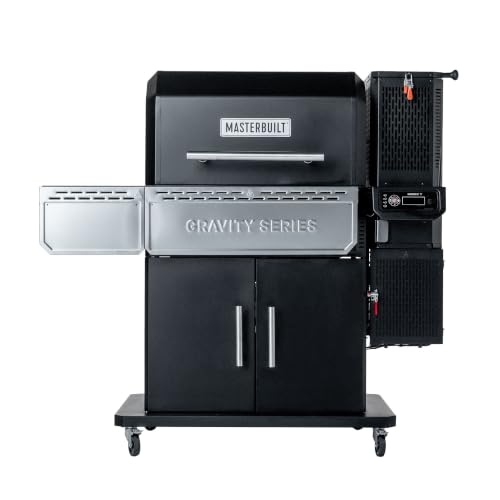
Masterbuilt Gravity Series 1150 — Best for Big Cooks
The 1150 takes the Gravity formula and stretches it to its biggest form: 1,150 square inches of cooking area, the same gravity-fed charcoal hopper and fan control, and Wi-Fi app oversight for cooks that are measured in dozens of servings. This is the model for the family cook who does the holidays, the neighborhood party and the team meal, and is tired of running two smokers to do it.
It suits high-volume cooks who already know they love the gravity system — or who are certain their cooking volume justifies it. The extra area over the 1050 is meaningful for whole-event loads: multiple briskets plus racks of ribs plus trays of sides in one cabinet, one fire, one app. It is not suited to small households or small patios; heating 1,150 square inches to cook two chicken halves wastes fuel and time, and the machine’s physical footprint is a real estate decision.
Ownership notes: plan the 1150’s home before it arrives — a level spot with power for the controller, clearance from structures, and a cover that fits. Its size also makes grease management a bigger job; stay ahead of it with tray liners and regular cleaning, because a big cook renders a lot of fat. Owners who cook big and often call it the last smoker they will buy; owners who cook small call it a lot of smoker. Both are right.
Strengths
- Largest cooking area in the Gravity family
- One fire, one app for whole-event loads
- Charcoal flavor at a scale electric cabinets cannot match for grilling heat
Trade-offs
- Big footprint and premium-tier positioning
- Inefficient for small everyday cooks
- More grease and ash to manage than smaller models
| Cooking area | 1,150 sq in (per Amazon title) |
| Fuel | Charcoal, GravityFed hopper |
| Control | Wi-Fi app control with digital fan (per Amazon title) |
Capacity arguments are really arguments about your calendar. If four or five times a year you cook for a crowd and resent it, the 1150 turns those days into the smoker’s best days. The Wi-Fi layer matters more, not less, at this scale: a cook this big is a financial investment in meat, and remote monitoring with probe alerts is insurance on that investment. For the right household, this is not an extravagance — it is the tool that finally matches the job.
Best for: holiday and party cooks feeding large groups / Not suited for: small households or tight patios
Check the current price on Amazon

Masterbuilt Gravity Series 800 — Best Grill-Smoker Combo
The 800 is the Gravity line’s versatility play: a mid-large 800 square inch charcoal smoker-grill that ships with a griddle insert, turning the same fire into a flat-top for smash burgers, breakfast, fajitas and fried rice. One machine that smokes a brisket on Saturday and does a diner breakfast on Sunday covers a lot of households’ entire outdoor cooking life.
It suits the one-cooker buyer — the household that wants a single outdoor appliance to do everything and has the patio discipline to keep just one. The app connectivity covers the smoker duties; the griddle covers the weeknight duties that smokers usually sit out. It is less suited to the specialist: a dedicated griddle is bigger, a dedicated big smoker is bigger, and the insert-swap routine, while simple, is still a routine. For generalists, it is the smartest box in this guide.
Ownership notes: the griddle insert rewards seasoning and care like any flat-top — keep it oiled, scrape it while warm, and store it dry. The swap between grates and griddle takes minutes once you have done it twice. Because the 800 invites daily use, it also accumulates grease faster than a weekend-only smoker; build the quick-clean habit and it stays a pleasure.
Strengths
- Griddle insert included — two appliances in one footprint
- 800 sq in is a genuinely useful middle size
- App-connected digital charcoal control
Trade-offs
- Insert swapping is an extra step specialists will skip
- Not the largest smoker nor the largest griddle — a deliberate compromise
- Charcoal ash management still applies
| Cooking area | 800 sq in (per Amazon title) |
| Included | Griddle insert (per Amazon title) |
| Control | Digital with app connectivity |
Versatility is underrated in smoker buying because enthusiasts optimize for one perfect cook. Households optimize for Tuesday. The 800’s insight is that the same controlled charcoal fire that smokes beautifully also runs a griddle beautifully, and that a machine used four times a week earns its patio space in a way a specialist used twice a month does not. If your outdoor cooking is varied and your space is not, start your shortlist here.
Best for: one-appliance households wanting smoke, grill and griddle / Not suited for: specialists wanting maximum size in one discipline
Check the current price on Amazon

Masterbuilt 710 WiFi Digital Electric Smoker — Best Electric WiFi Smoker
The 710 is the other end of the effort spectrum from the Gravity line: a vertical electric smoker where heat comes from an element, smoke comes from wood chips in a side loader, and your entire job is seasoning meat and occasionally adding chips. The Wi-Fi control means even that minimal job comes with full remote monitoring. For apartment-adjacent patios, HOAs wary of charcoal, and cooks who want smoke flavor without fire management, this is the machine.
It suits beginners, set-and-forget cooks, and anyone smoking fish, cheese-adjacent low cooks, jerky and sausage where gentle, steady heat matters more than bark. The four racks stack vertically, so it holds more than its footprint suggests. It is less suited to brisket traditionalists: electric smokers make good brisket, but the bark and depth differ from charcoal, and maximum temperatures are modest, so poultry skin needs a hot finish elsewhere. Know which camp you are in and the 710 is either perfect or not for you.
Ownership notes: the side chip loader is the feature to love — you add smoke wood without opening the door and dumping heat, which is the classic electric-smoker flaw this design fixes. Chips smolder for a limited window, so long cooks get their smoke mostly in the early hours; that matches how meat absorbs smoke anyway. Keep the water pan routine consistent and the cabinet’s results are remarkably repeatable.
Strengths
- Easiest smoking format there is — element heat, chip smoke
- Wi-Fi monitoring with a true set-and-forget routine
- Side chip loader adds smoke without opening the door
Trade-offs
- Smoke depth and bark differ from charcoal or pellet fuel
- Modest top temperature; poultry skin needs a finishing step
- Vertical racks suit some cuts better than others
| Cooking area | 711 sq in, 4 racks (per Amazon title) |
| Fuel | Electric element with wood chip loader |
| Control | Wi-Fi digital (per Amazon title) |
Electric smokers get dismissed by purists and loved by everyone who actually uses one weekly. The 710 with Wi-Fi is the format at its best: load it, set it, watch it from your phone, and produce ribs, salmon, jerky and pulled pork with almost zero skill barrier. It is also the friendliest choice where open-flame rules are tight. If your goal is maximum smoke flavor at any effort cost, buy the Gravity. If your goal is smoked food woven into normal life, buy this.
Best for: beginners, low-effort cooks, fish and jerky, restricted patios / Not suited for: charcoal purists chasing maximum bark
Check the current price on Amazon

Pit Boss 4-Series Vertical Pellet Smoker — Best High-Capacity Vertical
Vertical pellet smokers are the capacity kings of the connected world, and the Pit Boss 4-Series is the format done big: six racks, 1,320 square inches, a pellet hopper feeding a cabinet designed for hanging sausage, stacking jerky trays and loading rack after rack of ribs. Wi-Fi and Bluetooth control with an LCD controller runs the show, and the cabinet footprint stays patio-friendly because all that area points up, not out.
It suits production cooks: jerky makers, sausage makers, hunters processing a season, and families who batch-cook and freeze. The vertical geometry is also excellent for whole birds and hams that hang or stand. It is less suited to grilling — there is none — and to cooks whose loads are one brisket at a time, for whom a barrel smoker’s layout is more natural. Pellet cabinets also run their smoke profile lighter than charcoal, which jerky and sausage makers often prefer.
Ownership notes: six racks mean six racks of cleanup; foil and tray discipline pays off double here. The big cabinet takes longer to preheat than a barrel, so build that into cook timing, and in cold weather the large surface area loses heat faster — a blanket or a sheltered spot helps. Keep the hopper dry and the burn pot vacuumed, and the 4-Series will run the kind of multi-tray marathons it was built for.
Strengths
- Huge 1,320 sq in across six racks in a small footprint
- Ideal geometry for jerky, sausage, hanging and batch cooks
- Wi-Fi plus Bluetooth with a clear LCD controller
Trade-offs
- Smoker only — no grilling or searing
- Slower preheat and more cleaning surface than barrel smokers
- Lighter smoke profile than charcoal machines
| Cooking area | 1,320 sq in, 6 racks (per Amazon title) |
| Fuel | Wood pellets |
| Control | Wi-Fi & Bluetooth, LCD digital controller |
Judge this machine by the foods it was born for. A barrel smoker doing jerky is a compromise; this cabinet doing jerky is a system. Same for sausage links hung in rows, for a dozen racks of ribs for the freezer, for a hunter’s deer season. If your smoking life is about volume and variety in a cabinet, the 4-Series is the most capable connected option we verified, and its footprint-to-capacity ratio embarrasses every horizontal design.
Best for: jerky, sausage, batch cooking and processing / Not suited for: grilling or single-brisket minimalists
Check the current price on Amazon
Comparison Table
| Pick | Badge | Key spec | Best for |
|---|---|---|---|
| Masterbuilt Gravity Series 1050 | Best Overall | 1,050 sq in, gravity charcoal, Wi-Fi | charcoal-flavor lovers who want digital control and big capacity |
| Masterbuilt Gravity Series 600 | Best for Most Patios | 600 sq in, gravity charcoal, Wi-Fi | small households, beginners and compact patios |
| Masterbuilt Gravity Series 1150 | Best for Big Cooks | 1,150 sq in, gravity charcoal, Wi-Fi | holiday and party cooks feeding large groups |
| Masterbuilt Gravity Series 800 | Best Grill-Smoker Combo | 800 sq in + griddle insert, app control | one-appliance households wanting smoke, grill and griddle |
| Masterbuilt 710 WiFi Digital Electric Smoker | Best Electric WiFi Smoker | 711 sq in electric vertical, Wi-Fi | beginners, low-effort cooks, fish and jerky, restricted patios |
| Pit Boss 4-Series Vertical Pellet Smoker | Best High-Capacity Vertical | 1,320 sq in, 6-rack pellet vertical, Wi-Fi | jerky, sausage, batch cooking and processing |
How to Choose a WiFi Smoker: Start With Fuel, Not Features
The most common mistake in this category is shopping by app features when the decision that shapes every cook is the fuel. Charcoal gravity smokers deliver the deepest, most traditional smoke flavor and double as capable grills, at the cost of ash, fuel handling and mechanical parts. Electric verticals deliver the easiest experience in smoking and the gentlest learning curve, with a lighter smoke profile and no grilling. Pellet verticals deliver capacity and consistency with real wood smoke, in a cabinet that only smokes.
Work backwards from your food. Brisket-and-ribs traditionalists: gravity charcoal. Weeknight-easy ribs, fish, jerky and ‘I want smoked food without a hobby’: electric. Jerky, sausage and batch production: pellet vertical. The Wi-Fi layer is equally good across all three — it is the fuel that decides whether you are happy in month six.
- Charcoal gravity = deepest flavor + grilling, most upkeep
- Electric vertical = easiest, gentlest smoke, no grilling
- Pellet vertical = capacity and consistency for batch foods
- Choose fuel by your menu first, then compare apps within that fuel
What Wi-Fi Actually Does on a Smoker (and What It Does Not)
On a smoker, Wi-Fi earns its keep in three specific moments. First, the start: you confirm ignition and stable temperature remotely before committing expensive meat. Second, the long middle: probe alerts tell you the stall has broken or a target is near, wherever you are. Third, the end: you adjust temperature to hold finished food safely, or shut down, without a patio trip. Those three moments cover most of what goes wrong or gets inconvenient in a long cook.
What Wi-Fi does not do is make smoke, manage grease, or rescue a badly trimmed brisket. It also depends entirely on your home network reaching the patio — these devices use the 2.4 GHz band, and a weak signal at the smoker’s spot is the number one cause of ‘the app is terrible’ reviews across every brand. Check your signal where the smoker will live before you buy, and budget a mesh node if it is marginal.
Capacity, Racks and the Geometry of Real Loads
Square inches lie politely. A vertical smoker’s racks are typically narrower than a barrel’s grate, so a full packer brisket may need trimming or a rack to itself, while six racks of jerky fit beautifully. Before choosing, picture your three most common loads and physically map them onto the rack layout in the listing photos. Hanging hooks, rib racks and tray spacing matter more than the headline number.
Also consider door and access design. Every door opening dumps heat and extends the cook, which is why side chip loaders and app monitoring — checking without opening — genuinely improve results on verticals. The less you open, the steadier the cabinet, and steadiness is the whole game in smoking.
Running Costs and Upkeep by Fuel Type
Charcoal gravity smokers burn briquettes or lump at a rate that makes an overnight cook a modest fuel cost, with ash to empty after every cook or two. Electric smokers cost pennies in electricity and a handful of chips per smoke session, with the water pan and racks as the main cleanup. Pellet verticals burn roughly a pound of pellets an hour at smoking temperatures, more in winter, and need periodic vacuuming of the burn pot.
None of these is expensive to run; all of them punish neglected cleaning. Grease is the common enemy — it goes rancid, it smokes dirty, and in the worst case it burns. A five-minute clean routine after each cook is the cheapest performance upgrade in this entire guide.
Wood Choice: Matching Smoke Flavor to Food
Smoke is an ingredient, and like salt it should be dosed, not dumped. Fruitwoods — apple and cherry — are mild and slightly sweet, flattering pork, poultry and fish. Hickory is the classic American barbecue wood, assertive and bacon-like, built for pork shoulder and ribs but capable of overwhelming delicate food. Oak is the middle path: clean, medium smoke that suits beef and almost everything else. Mesquite is the strongest common smoke wood; used sparingly on short cooks it is magnificent on beef, and used heavily on long cooks it turns bitter.
On a gravity smoker you dose smoke by adding wood chunks to the ash bin or mixing them into the hopper; on an electric, by the chip tray’s load; on a pellet vertical, by the pellet blend itself. In all three, most smoke absorption happens while the meat is cold and its surface is moist, in the first hours. Late smoke adds surface bitterness more than depth — another reason the early, unopened hours matter most.
Safety and Placement for Connected Smokers
A smoker that runs for fourteen hours deserves a deliberate home. Place it on a non-combustible surface, with the clearances the manual specifies from walls, eaves and fencing, and out of the wind’s direct path — wind is the enemy of temperature stability on every fuel type. Keep the power cord’s run protected from foot traffic and weather, and never run any smoker in a garage or enclosed porch: carbon monoxide is colorless, odorless and unforgiving.
Grease discipline is the other half of safety. A drip system that is emptied and a cabinet that is wiped down cannot flare; a neglected one eventually can. The app helps here too — an unexpected temperature spike alert on your phone is often the first sign of a grease event, and it is a good reason to keep alerts turned on even when you are home.
Probes, Alerts and Learning Your Smoker’s Personality
Every smoker has a personality: a grate that runs a few degrees warmer than the display claims, a corner that cooks faster, a temperature band where it settles most happily. The Wi-Fi app’s history graph is how you learn that personality without standing outside with a notebook. After each cook, look at where the temperature wandered — during door openings, during the stall, in wind — and patterns emerge within three or four cooks.
Use probes with the same discipline. The factory meat probe is a good servant and a bad master: place it in the thickest part of the cut, away from bone and fat pockets, and treat its number as a prompt to check tenderness rather than a verdict. If your smoker supports a second probe, use it on a second cut or a second spot; the disagreement between two probes teaches you more about doneness than either number alone. Calibrate occasionally in ice water if your model allows it, and replace a probe that reads erratically — it is a consumable, not a lifetime part.
How to Run Your First Cook on a WiFi Smoker
Your first cook should be a pork butt: it is forgiving, inexpensive, and teaches you your machine’s personality in one session.
- Burn in the smoker first if the manual calls for it — a short empty run at moderate heat to cure seals and burn off manufacturing residue, with no food involved.
- Set up the app in daylight: connect the smoker to your 2.4 GHz home network, update firmware if offered, and confirm you can read the chamber temperature from inside the house.
- Load fuel properly for your type: a full, settled charcoal hopper; a measured handful of chips for electric (more is not better — oversmoking is bitter); a hopper of dry pellets for a vertical.
- Season the pork butt generously, insert the meat probe into the thickest part away from bone, and place it on the middle rack with a drip tray beneath if your smoker’s layout allows.
- Set your smoking temperature, set a probe alert below your target so you are warned before it arrives, and then leave the door shut. Check the app, not the meat.
- When the butt probes tender — the probe sliding in with almost no resistance — rest it wrapped for at least an hour before pulling. Log what you did: fuel, temperature, time, result. That log is your first recipe.
After the cook, let the smoker cool, dispose of ash and grease while they are contained, wipe the racks, and leave the cabinet dry. Then read your app graph once with fresh eyes: where temperature wandered is where your machine’s habits live, and knowing them is the difference between your first cook and your tenth.
Finally, resist upgrading your technique and your equipment at the same time. Run the same pork butt cook three times before you change anything major. Connected smokers are repeatable enough that consistency teaches you fast — and a cook who knows one machine deeply will out-cook a cook with three machines they half-know, on any Saturday you choose.
Common Buying Mistakes
Mistake 1: Shopping by app instead of by fuel. The app is the same kind of good on every pick here; the fuel decides flavor, effort and what the machine can cook. Decide charcoal, electric or pellet first, or you will compare machines that were never rivals.
Mistake 2: Oversmoking with chips or chunks. Meat takes smoke best early, and thin, clean smoke beats billowing smoke every time. New electric-smoker owners especially tend to reload chips constantly and produce bitter, ashy food. Less smoke wood, applied early, is the professional pattern.
Mistake 3: Opening the door to look. Every peek costs heat and time and resets the cabinet’s rhythm. You bought a connected smoker — use the app. If you are looking, you are not cooking, as the old pitmaster saying goes.
Mistake 4: Cooking to temperature instead of tenderness. A probe number is a guide; tenderness is the verdict. Brisket and butt are done when the probe slides in easily, which happens across a range of temperatures. Pulling by the number alone gives you technically cooked, practically tough meat.
Mistake 5: Ignoring grease until it matters. Rancid grease ruins flavor and a grease fire ruins weekends. Tray liners, drip management and a quick clean after fatty cooks are not fussiness — they are the maintenance that keeps a smoker safe and good-tasting.
Mistake 6: Blaming the smoker for a dead patio signal. If the app drops, test the 2.4 GHz signal at the smoker’s location. Most connection complaints across all brands trace to patio dead zones, and one mesh node fixes them permanently.
Mistake 7: Running the smoker under an eave or in the garage “just this once”. Long cooks produce hours of low-level smoke and carbon monoxide. Enclosed and semi-enclosed spaces are genuinely dangerous, and eaves collect grease-laden vapor. Keep the smoker in open air with proper clearances every single time.
Final Recommendation
A practical word on ordering: smokers are among the most damage-prone large items to ship, arriving with bent racks or dented doors more often than anyone likes. Inspect the cabinet and door seal before you assemble anything, photograph any damage, and deal with it immediately — a door that does not seal will haunt every cook with temperature swings you will wrongly blame on the controller.
For most buyers, the Masterbuilt Gravity Series 1050 is the Wi-Fi smoker to get: real charcoal flavor, honest capacity and digital control that removes the work from charcoal cooking. Choose the 600 if your patio and household are smaller, the 1150 if your cooks are events, and the 800 if one machine must also be your griddle. Choose the Masterbuilt 710 if effortlessness is the priority, and the Pit Boss 4-Series if your smoking is about racks, batches and processing.
Whichever direction you go, you are buying the same core promise: a long cook that reports to you instead of the other way around. Pick the fuel that matches your food, keep the machine clean, and let the app do the watching.
Related guides on this site:
Best Wifi Pellet Smokers Best Electric Smokers With Bluetooth Best Electric Smokers With Windows Best Gas Smokers Under $500 Best Electric Wood Pellet Smokers
Frequently Asked Questions
What is the difference between a WiFi smoker and a Bluetooth smoker?
Range and independence. Bluetooth connects your phone directly to the smoker within a short distance. Wi-Fi puts the smoker on your home network, so your phone can monitor and adjust it from anywhere with internet. For overnight and away-from-home cooks, Wi-Fi is the meaningful upgrade.
Do gravity charcoal smokers really hold temperature like a pellet grill?
Yes — that is their entire design. A fan stokes the gravity-fed charcoal fire under digital control, so the smoker holds a set temperature for hours with charcoal flavor. You manage ash and fuel loading; the controller manages the fire.
Can an electric WiFi smoker make good brisket?
It can make good brisket, with a different character: tender and smoky, but with a softer bark and lighter smoke depth than charcoal or pellet fuel. Many owners finish with a brief hot sear or accept the trade for the effortlessness. Judge by your priorities, not by purist rules.
How much does Wi-Fi add to the cost of a smoker?
Connected models sit in a higher tier than their manual equivalents from the same brand, but the gap has narrowed as controllers have standardized. Given that a smoker is a multi-year appliance and the app is used on every cook, most owners find the connected version the better value over the machine’s life. Check the current price on Amazon for the model you are considering.
What happens to my cook if the power or Wi-Fi cuts out?
A Wi-Fi dropout changes nothing at the smoker — it holds its last set temperature. A power cut stops fans and elements; when power returns, most digital smokers need a manual restart for safety, so a brief outage on an overnight cook is worth guarding against with alerts and, in outage-prone areas, common-sense timing of cooks.
Which WiFi smoker is best for jerky and sausage?
A vertical cabinet — the Pit Boss 4-Series for pellet capacity, or the Masterbuilt 710 for electric gentleness. Jerky and sausage want low, steady, well-ventilated heat across many trays, which is exactly the geometry verticals provide.
Can I cold smoke cheese or fish on a WiFi smoker?
True cold smoking needs smoke without cooking heat, which most of these machines approximate rather than achieve: electrics on their lowest settings with the element cycling minimally come closest, and owners often add a separate smoke tube and use the cabinet unheated. The Wi-Fi monitoring is genuinely useful here, because cold smoking is about holding a narrow, low band for hours — exactly what the app graph shows you.
How long do these smokers take to assemble and set up?
Plan on an unhurried hour or two for the cabinet and stand assembly on the larger models, less for the verticals, plus fifteen minutes for app pairing and any firmware update. Build on a flat surface, keep the hardware sorted, and do not force door hinges — alignment done patiently at assembly is temperature stability for years.


