Disclosure: airfryerkitchensupply.com is reader-supported. When you buy through links on our site, we may earn an affiliate commission at no extra cost to you.
Where to buy
Every purifier below was confirmed before earning a link, with its verified coverage figure and filter type taken from the live listing. Smoke is the hardest job in home air cleaning, so filter construction — not just room size — decided the order of this list.
Austin Air HealthMate Plus Air Purifier, White (B450) (Best for Smoke Odour): check price on Amazon
COWAY Airmega 400 Air Purifier (AP-2015F) (Best True Large-Space): check price on Amazon
BLUEAIR Blue 211i Max Air Purifier (Best Quiet Large-Room): check price on Amazon
WINIX 5520 Air Purifier (Best Balanced for Smoke): check price on Amazon
Medify MA-50 Air Purifier V3.0 (Best Coverage per Room): check price on Amazon
LEVOIT Core 600S-P Smart Air Purifier (Best Smart Value): check price on Amazon
The search for the best whole house air purifier for smokers starts with a truth the marketing would rather skip: no single box purifies a whole multi-room house evenly, because air does not flow through doorways the way it flows through a filter. What the best whole house air purifier for smokers can do — and the six machines below genuinely do — is anchor the room where smoking happens and the rooms around it with enough clean-air delivery and, critically, enough activated carbon to attack smoke odour and gases, not just particles.
That distinction between particles and gases is the whole ballgame for smokers. Cigarette and cigar smoke is two pollutants wearing one name: fine particles, which any true HEPA filter catches well, and a cloud of gaseous compounds that cause the smell that soaks into curtains, paint and upholstery. HEPA does nothing for gases. Only a serious weight of activated carbon — ideally with zeolite or a carbon blend aimed at smoke — adsorbs them. Several famous purifiers are excellent particle machines with a token carbon sheet; for a smoker’s house, that is the wrong machine wearing the right badge.
So this guide ranks by smoke fitness first: carbon mass and filter design for odour, verified coverage and clean-air delivery for particles, then the ownership questions — filter replacement cost and interval, noise at the speed you will actually run, and whether the machine reports air quality honestly. Every coverage figure quoted comes from the verified listing; treat all such figures as ‘in one hour, in ideal conditions’ and size up, not down.
In this guide
Quick Picks
Austin Air HealthMate Plus Air Purifier, White (B450) — Best for Smoke Odour. The smoke specialist: a four-stage filter built around a deep bed of activated carbon and zeolite, covering up to 1,500 sq ft, with a filter rated to last years rather than months.
COWAY Airmega 400 Air Purifier (AP-2015F) — Best True Large-Space. The largest verified coverage in this guide — up to 3,120 sq ft — with washable pre-filter, HEPA for smoke particles, AQI sensing, auto mode and a five-year warranty.
BLUEAIR Blue 211i Max Air Purifier — Best Quiet Large-Room. Verified coverage up to 3,235 sq ft with HEPASilent filtration at a whisper-quiet 23dB, WiFi and auto mode — the large-room machine you can hold a conversation beside.
WINIX 5520 Air Purifier — Best Balanced for Smoke. True HEPA plus a high-deodorisation carbon filter, verified to 1,882 sq ft, with an air quality monitor and auto mode — the balanced smoke all-rounder.
Medify MA-50 Air Purifier V3.0 — Best Coverage per Room. A tower rated for 2,640 sq ft in an hour with HEPA filtration aimed at smoke, wildfire and odours — strong clean-air delivery for big rooms.
LEVOIT Core 600S-P Smart Air Purifier — Best Smart Value. Levoit’s large-room flagship: up to 2,933 sq ft verified coverage, AHAM Verifide, app and voice control, and a quiet HEPA sleep mode at a mainstream tier.
How These Picks Were Chosen
Verification ran for every model: coverage figure, filter stack and control features had to match the live listing before a buy link was attached. Purifiers whose listings could not confirm a real carbon stage were excluded from a smokers’ guide regardless of their particle credentials.
Judging then weighted the smoke-specific evidence. Carbon quantity and type came first — a deep carbon bed or a high-deodorisation carbon filter outranks a carbon-coated pre-filter every time. Particle performance came second, using the makers’ verified coverage claims as the comparable figure. Third came liveability: noise at medium speed (the speed a machine can actually run all evening), auto mode behaviour with a real air-quality sensor, and filter life, because a purifier whose filter costs a fortune every three months becomes an ornament by month four.
As throughout this programme, no static prices and no fixed ratings appear here. Purifiers are promoted in bundles constantly; each pick is placed in its tier in words, and the links let you check the current price on Amazon — and, just as importantly, the current price of its replacement filters — before you commit.
The 6 Best Whole-House Air Purifiers for Smokers

Austin Air HealthMate Plus Air Purifier, White (B450) — Best for Smoke Odour
If the problem is the smell of smoke — in the room, in the soft furnishings, in the hallway carpet — this is the machine the rest of the list is chasing. The HealthMate Plus’s ‘Plus’ is its filter: a substantial bed of activated carbon blended with zeolite, the mineral that specifically targets the chemical compounds in smoke and household gases. Particles meet a proper multi-stage stack; odours meet a filter with the sheer mass to adsorb them for years. The verified listing puts coverage at up to 1,500 sq ft and filter life at five years, and that second number transforms the ownership maths.
Strengths
- Deep activated carbon and zeolite bed — the strongest odour weapon here
- Five-year filter life makes long-term cost the lowest in this roundup
- Steel, no-nonsense build designed for continuous duty
Trade-offs
- No app, no air-quality display — it is a dial and a filter, proudly
- Large and heavy; choose its room and let it live there
- Particle-room coverage is mid-pack — it wins on gases, not raw airflow
| Detail | Verified from the listing |
|---|---|
| Coverage | Up to 1,500 sq ft (per Amazon title) |
| Filtration | 4 stage, activated carbon and zeolite |
| Filter life | 5 year filter (per Amazon title) |
| Model | B450, White |
Living with the Austin is living with an appliance from an earlier, better school of design: a speed dial, a hum at working speed, and air that steadily stops smelling of last night’s cigarettes. It will not tell you a particle count, and it does not care about your phone. Place it in the smoking room — that is where whole-house strategies are won — and let it run continuously; carbon works by contact time, and a machine that runs all day at medium beats a smarter machine that runs for an hour at turbo. For smoke odour specifically, this is the first recommendation in this guide.
Best for: Homes where smoke odour is the main complaint / Not suited for: Buyers who want app data and particle dashboards
Check the current price on Amazon
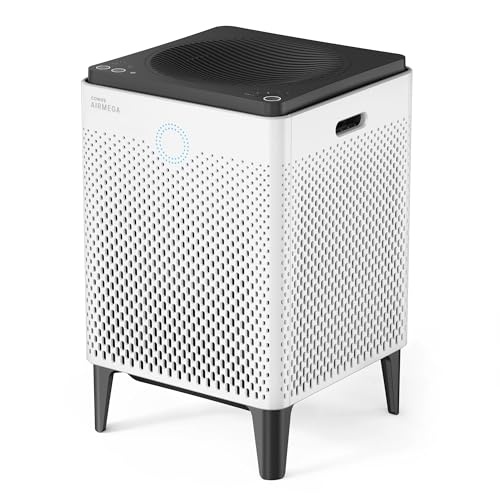
COWAY Airmega 400 Air Purifier (AP-2015F) — Best True Large-Space
The Airmega 400 is the pick for the open-plan house: one large living space where the smoking happens and life happens around it. Its verified coverage of up to 3,120 sq ft is the biggest figure in this roundup, delivered through a washable pre-filter that takes the ash-adjacent dust and pet hair before the HEPA stage handles smoke particles. The air-quality indicator and auto mode mean it works harder when a cigarette is lit and settles down when the air clears — exactly the behaviour a shared living space needs.
Strengths
- Largest verified coverage here — up to 3,120 sq ft
- Washable pre-filter cuts consumable costs and handles coarse dust
- AQI display, auto and sleep modes suit a main living space
Trade-offs
- Carbon stage is lighter than the Austin’s — particles are its strength, odour is good rather than class-leading
- A big machine: measure its corner before it arrives
- Replacement HEPA/carbon sets are a real ongoing cost to budget
| Detail | Verified from the listing |
|---|---|
| Coverage | Up to 3,120 sq ft (per Amazon title) |
| Filtration | Washable pre-filter and HEPA filter |
| Controls | AQI, auto & sleep mode, timer |
| Warranty | 5yr (per Amazon title) |
In a large open-plan room, the Airmega 400’s combination of airflow and manners is hard to beat: it clears the visible haze of a smoking session quickly, the AQI ring tells the truth about it, and sleep mode keeps it welcome overnight. Pair its particle power with realistic odour expectations — in a heavy-smoking household it manages smell well, while the Austin remains the odour champion — and it is the most complete single-unit answer for a big space. The five-year warranty signals how the maker expects it to be used: continuously, for years.
Best for: Large open-plan homes and heavy particle loads / Not suited for: Small flats where its scale is wasted
Check the current price on Amazon

BLUEAIR Blue 211i Max Air Purifier — Best Quiet Large-Room
Blueair’s party trick is moving serious air without sounding like it. The 211i Max’s verified coverage runs to 3,235 sq ft in an hour, its HEPASilent approach pairs mechanical and electrostatic capture to keep noise down, and at its quiet end it runs at 23dB — library territory. For a smoking household, that matters more than specifications suggest: the purifier that gets switched off during films and conversations is the purifier that is not cleaning anything. This one stays on, stays in auto, and stays welcome.
Strengths
- Huge verified coverage with genuinely low noise
- AHAM Verified performance — the claim is independently checked
- WiFi and auto mode make it a fit-and-forget living-room machine
Trade-offs
- Carbon capacity is not its headline — heavy odour homes should compare the Austin
- HEPASilent is not a sealed true-HEPA in the traditional sense; particle results are excellent, purists should know the design
- Filters are proprietary and should be priced into the decision
| Detail | Verified from the listing |
|---|---|
| Coverage | Up to 3,235 sq ft (per Amazon title) |
| Noise | Quiet 23dB (per Amazon title) |
| Filtration | HEPASilent, AHAM Verified |
| Controls | WiFi, auto mode |
The 211i Max suits the household where smoking shares space with everything else — television, homework, guests who do not smoke. It scrubs particles fast, keeps background odour in check, and its pre-filter catches the hair and dust of a lived-in home before the main filter. In a dedicated smoking room with a serious odour problem, the Austin’s carbon bed is the heavier artillery; in the family living room, the Blueair’s blend of coverage, quiet and automation is the one that will actually run 24 hours a day, which is the only schedule that works.
Best for: Living rooms where noise decides whether it runs / Not suited for: Dedicated smoking rooms with severe odour
Check the current price on Amazon
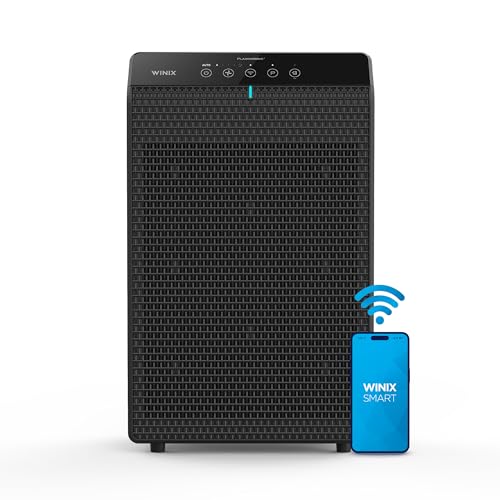
WINIX 5520 Air Purifier — Best Balanced for Smoke
The Winix 5520 is what a balanced smokers’ purifier looks like on a spec sheet: true HEPA for the particles, and — the phrase that matters — a high deodorisation carbon filter for the gases, sized for large rooms up to 1,882 sq ft in an hour. Winix built its reputation in exactly this niche, and the 5520’s air quality monitor drives an auto mode that responds visibly when smoke enters the room. It lacks the Austin’s carbon mountain, but it counters with modern sensing and a filter design that treats odour as a first-class job.
Strengths
- True HEPA plus high-deodorisation carbon — both halves of smoke addressed
- Air quality monitor and responsive auto mode
- Large-room coverage in a mainstream, supportable platform
Trade-offs
- Carbon bed is smaller than the Austin’s — expect good, not total, odour control in heavy use
- Filter replacements are periodic and should be budgeted
- Design is functional rather than furniture-like
| Detail | Verified from the listing |
|---|---|
| Coverage | Up to 1,882 sq ft in 1 hr (per Amazon title) |
| Filtration | True HEPA, high deodorization carbon filter |
| Controls | Air quality monitor, auto mode |
| Targets | Smoke, dust, allergens (per Amazon title) |
For most smoking households, the 5520 is the sensible centre: place it in the main room, run it on auto, and both the haze and most of the smell are handled without a thought. It is also the easiest recommendation for a first purifier, because its behaviour teaches you how the category works — watch the monitor react to a cigarette, settle as the room clears, and you understand your home’s air within a week. Step up to the Austin if odour defeats it in a dedicated smoking room; step to the Coway or Blueair if the room is enormous. For the typical large living room, start here.
Best for: Main living rooms in smoking households / Not suited for: Extreme odour in a dedicated smoking room
Check the current price on Amazon

Medify MA-50 Air Purifier V3.0 — Best Coverage per Room
Medify built its name in medical and wildfire country, and the MA-50 shows it: a tall tower with a large HEPA filter area, verified coverage of 2,640 sq ft in an hour, and marketing that talks about smoke and odours because its customers’ air genuinely contains both. For a smoking household in a big room, that filter area is the story — more media, more air changes, faster clearing after a session. It is a working machine in white, sized like a small piece of furniture and honest about it.
Strengths
- 2,640 sq ft verified coverage with a large HEPA filter area
- Designed and sold for smoke — including wildfire smoke — not just dust
- Tower format fits a corner and serves open-plan spaces well
Trade-offs
- Carbon provision is lighter than dedicated odour machines
- Its size and airflow are wasted on small rooms
- Replacement filters for a big tower are a significant consumable
| Detail | Verified from the listing |
|---|---|
| Coverage | 2,640 ft² in 1hr (per Amazon title) |
| Filtration | HEPA filter, removal to 0.3 microns |
| Targets | Smoke, wildfires, odors, pollen, pets |
| Finish | White |
The MA-50 earns its place on clearing power: after a smoky evening it returns a large room to neutral faster than the subtler machines here, and for households that also face seasonal wildfire smoke it does double duty with the same filter set. Odour from tobacco is handled respectably rather than supremely — pair it with source habits (smoking near the machine, not across the house) and it holds the line. Choose it when the room is big, the air burden is mixed, and raw clean-air delivery is the priority.
Best for: Big rooms and mixed smoke burdens including wildfire season / Not suited for: Odour-first smoking rooms
Check the current price on Amazon

LEVOIT Core 600S-P Smart Air Purifier — Best Smart Value
The Core 600S-P is the purifier for the household that runs its home from a phone. Verified coverage stretches to 2,933 sq ft, the performance carries AHAM verification, and the app plus Alexa control means the machine can be scheduled around smoking habits — turbo while the poker game runs, sleep mode after. Its HEPA stage handles smoke particles properly, and the 3-in-1 filter includes the carbon layer for everyday odour. It is the most connected and the most affordable route into large-room purification in this guide.
Strengths
- Large verified coverage with AHAM Verifide performance
- App, remote and voice control with useful scheduling
- Quiet sleep mode keeps it running overnight
Trade-offs
- Carbon layer in a 3-in-1 filter is modest — heavy smoke odour will outlast it
- Consumable filter swaps are more frequent than the Austin’s years-long cycle
- Plastic build feels mainstream next to the steel Austin
| Detail | Verified from the listing |
|---|---|
| Coverage | Up to 2,933 sq ft (per Amazon title) |
| Filtration | HEPA, 3-in-1 filter |
| Controls | App, Alexa, remote control |
| Modes | HEPA sleep mode, AHAM VERIFIDE |
Judge the 600S-P as a system: strong particle cleaning, smart scheduling, honest verification, mainstream price tier — and a carbon provision sized for light-to-moderate odour. For a household where smoking is occasional, or mostly one person in one room with the door habits to match, it is genuinely sufficient and the easiest machine here to live with. For daily heavy smoking, treat it as the particle-and-convenience half of the answer and let the Austin’s carbon do the odour half in the smoking room itself. Knowing which half your house needs is the real buying skill, and this guide’s comparison table lays it out.
Best for: Smart-home households with light-to-moderate smoking / Not suited for: Heavy daily smoke odour
Check the current price on Amazon
Comparison Table
| Pick | Badge | Key spec | Best for |
|---|---|---|---|
| Austin Air HealthMate Plus Air Purifier, White (B450) | Best for Smoke Odour | Carbon + zeolite bed, 1,500 sq ft, 5-yr filter | Homes where smoke odour is the main complaint |
| COWAY Airmega 400 Air Purifier (AP-2015F) | Best True Large-Space | 3,120 sq ft, HEPA + washable pre-filter, AQI | Large open-plan homes and heavy particle loads |
| BLUEAIR Blue 211i Max Air Purifier | Best Quiet Large-Room | 3,235 sq ft, 23dB, HEPASilent, WiFi | Living rooms where noise decides whether it runs |
| WINIX 5520 Air Purifier | Best Balanced for Smoke | 1,882 sq ft, True HEPA + deodorisation carbon | Main living rooms in smoking households |
| Medify MA-50 Air Purifier V3.0 | Best Coverage per Room | 2,640 sq ft, HEPA tower, smoke-rated | Big rooms and mixed smoke burdens including wildfire season |
| LEVOIT Core 600S-P Smart Air Purifier | Best Smart Value | 2,933 sq ft, smart app control, AHAM verified | Smart-home households with light-to-moderate smoking |
How to Choose a Whole-House Purifier for a Smoker’s Home
Begin with the two-pollutant rule: smoke particles need HEPA (or an AHAM-verified equivalent), and smoke gases need activated carbon in real quantity. When you read a listing, look for the carbon’s description. ‘High deodorisation carbon filter’ and a carbon-and-zeolite bed describe odour equipment; a ‘carbon pre-filter’ or ‘carbon sheet’ describes a courtesy. In this guide the Austin HealthMate Plus carries the deepest carbon provision, the Winix 5520 the strongest balanced carbon claim among the smart machines, and the rest handle odour at a level matched to lighter smoking — the reviews say which is which, plainly.
Second, translate coverage claims into your floor plan. A figure like ‘up to 3,120 sq ft in 1 hour’ describes one open space under test conditions, not a three-bedroom house with doors. The workable whole-house strategy is: one strong purifier in the smoking room (this is non-negotiable — purify at the source), a second for the main living or sleeping area if the budget allows, and doors used as the tools they are. A single machine from this list will transform the room it sits in and help the rooms adjoining it; promising more than that would be marketing, not advice.
Third, do the filter maths before the purchase maths. Note each model’s filter life and replacement cost: the Austin’s five-year filter makes its higher tier the cheapest five-year ownership here, while high-performance towers and smart purifiers trade lower entry tiers for more frequent filter swaps. A purifier is a subscription disguised as an appliance — choose the subscription you will actually keep paying, because a clogged, exhausted filter cleans nothing and an odour-saturated carbon bed can start returning smells.
Finally, weight noise and automation by your real evenings. The purifier must run during and after smoking, in the room where people sit. A machine quiet at working speed (the Blueair’s 23dB floor is the benchmark) and an auto mode driven by a real sensor (Winix, Coway, Levoit) are what turn good specifications into air that is actually clean at 11 p.m.
Placement and Running Discipline: Where Whole-House Strategies Win
Placement is free performance. Put the purifier in the smoking room, near the usual smoking spot but not so close that ash and heat reach it, with clearance around its intakes — not wedged behind a sofa or inside a cabinet. Air should be able to complete the loop: in through the room, through the filter, back out across the room. In the smoking room, run the machine continuously at the highest speed conversation allows, and give it an hour of higher speed after the last cigarette; carbon adsorption is a contact sport and it is won on hours, not minutes.
Support the machine with the habits that cost nothing: smoke in the one room the purifier guards rather than throughout the house, keep that room’s door closed while smoking and for a while after, and empty ashtrays promptly — yesterday’s ashtray is an odour source no filter fully defeats. Soft furnishings in the smoking room will still gather smell over months; washable throws and curtains are a smoker’s best interior-design friends, and they make the purifier’s job visibly easier.
Understanding CADR, Air Changes and What the Numbers Promise
Coverage claims become honest when you translate them into air changes. A purifier’s clean-air delivery describes how much filtered air it returns to the room per hour; divide that by the room’s volume and you get air changes per hour — the number that actually predicts how a room feels. For a smoking room, more changes are better, and the practical consequence is the sizing advice this guide keeps repeating: choose a machine whose headline coverage comfortably exceeds your room, so it can deliver those changes at a speed you can talk over, not at a turbo roar reserved for demonstrations.
This is also why the ‘up to X square feet in 1 hour’ figures on the verified listings should be read as a comparison tool rather than a promise. They let you rank the Coway’s 3,120 against the Winix’s 1,882 against the Austin’s 1,500 on a consistent basis — and then your floor plan, ceiling height and door habits adjust the ranking into reality. A tall-ceilinged open-plan space eats coverage; a small smoking den with a closing door multiplies it. Measure your rooms, do the honest division, and let the machine be oversized for its room rather than heroic for the house.
AHAM verification, carried by the Blueair and Levoit picks here, deserves its reputation: it means the delivery claims were independently tested to a standard method rather than composed by a marketing department. It does not certify odour performance — no equivalent standard governs the carbon side — which is why this guide treats verified particle numbers and carbon construction as two separate judgements, and why a smokers’ guide must make both.
The Carbon Question in Depth: Beds, Blends and Breakthrough
Activated carbon works by adsorption: smoke gases stick to the carbon’s immense internal surface as air passes through. Two variables decide real-world performance — how much carbon the air meets, and how long it spends meeting it. A deep bed, like the Austin’s carbon-and-zeolite fill, wins on both: more media, slower passage, more complete capture, and a far longer time before the carbon is saturated. A thin carbon sheet in a combined filter meets the air briefly and saturates quickly, which is why such filters can test well on day one and disappoint by month two in a smoking home.
Zeolite’s presence in the Austin’s blend is not decoration: this mineral’s structure targets specific chemical families, including several prominent in tobacco smoke and household solvents, complementing carbon’s broad appetite. Impregnated and blended carbons exist for the same reason — plain carbon is a generalist, and smoke is a specific chemical crowd. When you compare purifiers for a smoker’s house, you are really comparing philosophies of this paragraph: depth and specialisation versus thinness and convenience.
Breakthrough is the end of every carbon filter’s story: the moment its surface is full and gases begin passing through untouched — or worse, previously captured compounds are displaced by new ones. There is no gauge for it; the signal is your nose, in the room, over days. This is the practical argument for generous carbon mass and for the filter calendar in the setup section: replace on schedule or at the first honest return of smell, because a purifier running on exhausted carbon is a fan with a HEPA attached, solving only the half of smoke you can see.
Living With the System: Noise, Light and Household Diplomacy
A whole-house plan succeeds socially or not at all. The purifier in the smoking room shares that room with conversation, television and guests, so its working-speed noise becomes a household negotiation: the Blueair’s quiet engineering exists precisely for this, and every pick here should be auditioned in your head at its medium speed, in the evening, under dialogue. Light matters too — status rings and displays that cannot dim will be taped over within a week in a bedroom; check the sleep modes before the machine takes up residence where people sleep.
Guests are the plan’s honest auditors. A smoking household can become nose-blind to its own background; the purifier’s real report card is the visitor who says nothing about smoke at all. Expect that victory to take weeks, not days, because the furnishings are exhaling stored odour the whole time the machine is preventing new deposits — the system is winning a war of attrition against every cushion in the room, and wars of attrition are measured in months.
Finally, keep the peace with the non-smokers by making the system’s discipline visible and shared: the smoking room is a real boundary, the machine’s running is non-negotiable background like the fridge, and the filter calendar lives on the household calendar, not in one person’s memory. Air is the most shared thing in a house; a plan everyone understands is a plan that survives its first busy month.
Secondhand Smoke, Thirdhand Residue and Realistic Expectations
It helps to name the three forms the problem takes. The smoke in the air during a cigarette is the easy third: any purifier here clears it visibly and quickly. The odour that lingers for hours afterwards — gases adsorbing into and releasing from furnishings — is the carbon filter’s war, fought over weeks of continuous running. The residue that has built up in paint, fabric and dust over years is the slow third: no purifier extracts it, which is why this programme’s painting guide exists, and why a heavily smoked-in room wants both projects — purify the air going forward, seal the walls’ history under a blocker — rather than either one asked to do the other’s job.
Set expectations by the calendar accordingly: days for the air to clear and stay clear, weeks for the room’s background smell to fall as furnishings off-gas into cleaned air, and a painting project for the deep history. Owners who understand that timeline call their purifiers transformative; owners promised an overnight miracle by an advertisement call theirs disappointing, running the identical machine. This guide would rather you bought the Austin with a month’s patience than any machine on earth with a weekend’s.
Costs of Ownership: The Five-Year Ledger
Lay the five-year costs out before choosing and the ranking surprises most buyers. The machine’s purchase tier is only the first line: add replacement filters across five years at each maker’s stated intervals, electricity for continuous running (modest for modern machines, but real, and higher for the big towers run at speed), and the pre-filters and small consumables of daily life. Run that ledger and the Austin’s five-year filter makes it the ledger’s winner despite a serious purchase tier, while some friendly-priced smart purifiers quietly overtake it by year three on filter swaps alone.
The ledger has a credit column too: a purifier that keeps a smoking household’s air neutral protects everything else in the home — repainting cycles lengthen when nicotine stops depositing, soft furnishings last longer before they hold smell, and the eventual resale or rental conversation changes character entirely. None of that appears on a receipt, but it is the honest arithmetic of a smoker’s house, and it is why this guide treats the purifier as infrastructure rather than as a gadget purchase.
Children, Pets and the Shared-Air Household
In a house with children or pets, the purifier plan gains two footnotes. Placement should keep intakes and cords out of the curious zone — behind the smoking room’s furniture line is wrong for airflow, but a stable corner with the machine’s weight low and its cord managed is right for both. Pet hair loads pre-filters faster than any manufacturer’s schedule assumes, so the washable pre-filter on the Coway and the accessible pre-filters on the Blueair and Levoit picks are practical virtues: rinse or vacuum them monthly and the main filters live their full rated lives. And keep the smoking-room boundary absolute where children sleep — the bedroom zone, if you add a second machine, is where the household’s cleanest air should be guaranteed first.
Renting, Guests and the Two-Week Turnaround
Sometimes the deadline is real: a rental inspection, a family visit, a grandchild’s first stay. A two-week turnaround on a smoked-in room is achievable with the system run at full discipline — purifier on high in the closed smoking room for the first days, then continuous; soft furnishings washed or aired; hard surfaces wiped down; ashtrays and smoking paraphernalia removed entirely, because a room cannot stop smelling of a habit it still hosts. The purifier does the heavy lifting in that fortnight, but it is the combination — and the removal of the source — that gets a room across the line from ‘smoker’s house’ to ‘house’.
For guests specifically, the bedroom outranks the smoking room in the final days: move the strongest machine to where the guest sleeps for the last two nights if a second unit is not available, because a guest judges the house by the room they wake in. Then return it to its post when they leave. It is a small choreography, but it is how a single-machine household punches at a two-machine weight — and it only works because the smoking-room discipline held the rest of the house clean in the first place.
How to Set Up a Whole-House Purification Plan for a Smoking Home
A plan beats a purchase. These steps turn one or two machines into a house-wide result, in the order that matters.
- Choose the smoking room officially — the room where smoking happens from now on — and measure it. Match it to a purifier whose verified coverage comfortably exceeds the room’s area.
- Place the main purifier near the smoking spot with clear airflow around it, following the maker’s clearance guidance, and remove all filter packaging and transport tabs before first run (a classic silent failure).
- Run the machine on its higher speed for the first full day to pull the room’s standing particle load down, then settle into continuous auto or medium running.
- Add the second zone if the budget allows: the bedroom is the highest-value second room, because eight hours of clean air a night is where a purifier most improves how a house feels.
- Set a filter calendar on day one: note the maker’s stated filter life, set a reminder a month early, and price the replacements now so the cost never arrives as a surprise.
- Establish the smoking-room routine: door closed while smoking, machine boosted during and for an hour after, ashtrays emptied the same evening.
- Review after a month: if odour persists in the smoking room despite clean filters and good discipline, the honest fix is more carbon in that room — which in this guide means the Austin’s carbon-and-zeolite bed.
Resist the urge to judge the system in the first week by sniffing the smoking room mid-session. Judge it by the hallway outside the room, by guests’ unprompted comments, and by how the house smells when you return from a weekend away. Whole-house purification is a background victory; it announces itself in the rooms the smoke never reaches.
Common Buying Mistakes
Buying HEPA alone for a smoke problem. HEPA catches particles and leaves the gases — the smell — untouched. A smokers’ purifier must show a serious carbon stage in its verified spec, or it is solving half the problem beautifully.
Believing one box covers a whole house evenly. Closed doors defeat airflow. Purify at the source room first, then add zones. A single machine honestly placed beats a single machine magically believed in.
Sizing to the claim instead of the room. Coverage figures assume ideal conditions and full speed. Choose a model whose claim comfortably exceeds your room so it can do the job at a civilised noise level.
Running it only during smoking. Odour compounds adsorb slowly and off-gas from furnishings for hours. Continuous running at modest speed outperforms occasional turbo blasts, for both particles and smell.
Forgetting the filter subscription. Exhausted carbon stops adsorbing and saturated HEPA chokes airflow. Price replacements before buying the machine, and keep the calendar you set on day one.
Placing it in a corner behind furniture. Starved intakes halve real performance. Give the machine the clearance its manual asks for and a position where the room’s air actually circulates through it.
Final Recommendation
If smoke odour is the enemy, buy the Austin Air HealthMate Plus and put it in the smoking room — its carbon-and-zeolite bed and five-year filter make it the odour champion and the cheapest long-term ownership here. For a large open-plan space, the COWAY Airmega 400’s coverage leads; for a quiet, connected living room, the BLUEAIR 211i Max; for the balanced mainstream choice, the WINIX 5520; for raw big-room clearing, the Medify MA-50; and for smart scheduling at a friendly tier, the LEVOIT Core 600S-P.
Whatever the machine, the plan is the product: purify at the source, run continuously, keep the filter calendar. Do those three things and a smoker’s house can smell like a house again — the purifier just has to be the right one, in the right room, actually switched on.
Related reading: Best Air Purifier For Smokers · Best Air Purifier For Smokers House · Best Air Purifier For Smokers Home · Best Filterless Air Purifier For Smokers · Best Desktop Air Purifier For Smokers · Best Ceiling Paint For Smokers
Frequently Asked Questions
Can one air purifier really clean a whole house?
Not evenly, and any seller claiming otherwise is stretching. Air purifiers clean the air that passes through them, which means the room they are in, plus real help to adjoining spaces with doors open. The effective whole-house strategy is a strong unit in the smoking room first, then additional zones like the bedroom as budget allows — that is the approach this guide’s picks are chosen for.
Why does the smell of smoke linger even with a HEPA purifier?
Because smell is gas, and HEPA filters catch particles, not gases. Smoke odour needs activated carbon — the more, the better — to adsorb the compounds. That is why this guide ranks the Austin’s deep carbon-and-zeolite bed first for odour and checks every other pick’s carbon provision explicitly.
How long should a purifier run in a smoker’s home?
Continuously is the honest answer, at the highest speed that remains comfortable, with a boost during and for about an hour after smoking. Carbon adsorption and the slow off-gassing of furnishings are hours-long processes; a purifier that only runs during a cigarette is fighting with one hand tied.
How often do filters need replacing?
It varies by model from months to — in the Austin’s case — a rated five years. Check each model’s stated filter life and replacement cost before buying, and set a calendar reminder when you install. A saturated carbon filter stops removing odour and an overloaded HEPA strangles airflow, so the calendar is part of the machine’s performance.
Where should the purifier go in the smoking room?
Near the usual smoking spot, with the maker’s recommended clearance around its intakes and out of direct ash and heat. Not behind furniture, not in a closed cabinet. The goal is a clean loop: room air in, filtered air out across the room, all session long.
Will a purifier remove smoke smell from curtains and furniture?
It prevents most new deposition and steadily reduces airborne odour, but compounds already soaked deep into fabrics need washing or cleaning — the purifier cannot reach inside a cushion. Pair the machine with washable throws and curtains in the smoking room, and the combination gets a room genuinely neutral over time.


