Disclosure: airfryerkitchensupply.com is reader-supported. When you buy through links on our site, we may earn an affiliate commission at no extra cost to you.
Where to buy
Every machine below was confirmed on Amazon before it earned a link, and Amazon is where you can check the current price on Amazon for each model. The shortlist: the COMFEE’ 24″ Washer and Dryer Combo (2.7 cu.ft) for the best all-round apartment machine, the BLACK+DECKER Washer and Dryer Combo (BCW27MW) for brand-backed value, the Equator 24″ 110V Convertible Compact Combo Washer Dryer for the smallest spaces and RV-adjacent installs, the KoolMore 2-in-1 Front Load Washer and Dryer Combo (FLC-3CWH) for cycle variety, the Contoure 2.7 Cu Ft Ventless Washer Dryer Combo (RV-WD900S) for RV and marine life, and the Hamilton Beach 2.65 Cu Ft All-In-One Washer and Dryer Combo for a familiar name in a compact format.
The best washer dryer combo 110 volt machines exist for a specific and common problem: you need real laundry — washed and dried, in your own space — but your space has no 240-volt dryer circuit, no vent run, and often no laundry room at all. A 110-volt (standard household outlet) all-in-one combo solves it by washing and condensing-drying in a single drum, plugged into a normal outlet, needing only water in and a drain. The trade-offs are equally specific, and this guide will not hide them: drying on 110 volts is slow, loads are small, and a full wash-and-dry cycle is measured in hours, not minutes. For the right household — apartments, condos, RVs, tiny homes, in-law suites, anyone escaping the laundromat or the basement stairs — those trade-offs are not flaws but the price of admission, gladly paid. This guide compares six verified 110V combos, explains the ventless drying physics that govern all of them, and helps you decide by household size and laundry rhythm whether a combo, a compact separate pair, or a portable setup fits your life.
A final framing before the reviews, because this category is unusually prone to review whiplash — the same model adored by one owner and despised by another, with both telling the truth. The dividing line is almost never the machine; it is the match between the machine and the household’s laundry rhythm. A single person in a studio who runs three small loads a week experiences a combo as pure liberation from the laundromat. A family of five that bought the identical machine experiences it as a bottleneck that never sleeps. Every review below therefore names its household explicitly — who the machine serves, at what weekly volume — and the most useful thing you can do as a reader is locate your own household in those descriptions before weighing any feature. Capacity numbers, cycle counts, and spin speeds all matter less than that match, and they matter in its service.
In this guide
Quick Picks
- Best Overall — COMFEE’ 24″ Washer and Dryer Combo (2.7 cu.ft): The largest drum class in this guide with steam care and an overnight dry program, in a standard 24-inch footprint. Check the current price on Amazon
- Best Value Brand — BLACK+DECKER Washer and Dryer Combo (BCW27MW): A 2.7 cu.ft all-in-one with LED display and 16 cycles from a household name. Check the current price on Amazon
- Best for Smallest Spaces — Equator 24″ 110V Convertible Combo: A 1.6 cu.ft, 15 lb convertible venting/condensing combo with a pet cycle, built for apartments, condos, RVs, and tiny homes. Check the current price on Amazon
- Best Cycle Variety — KoolMore 2-in-1 Combo (FLC-3CWH): Sixteen wash cycles and four dry cycles in a 2.7 cu.ft compact aimed at apartments, dorms, and RVs. Check the current price on Amazon
- Best for RVs — Contoure RV-WD900S Ventless Combo: A 2.7 cu.ft ventless combo with steam, designed for RV and tiny-home life in a titanium finish. Check the current price on Amazon
- Best Familiar Name — Hamilton Beach 2.65 Cu Ft All-In-One: A front-load apartment-size combo with 12+ wash programs, LED display, and delay start. Check the current price on Amazon
How These Picks Were Chosen
Every machine in this guide was verified — most were confirmed in an earlier verified pass over this exact product group and held in the project’s API cache with their listing titles and check dates, and each was matched by brand, model, capacity, and voltage before receiving a link. Voltage verification is the soul of this category: a combo that needs 240 volts is useless to the reader of this guide no matter how good it is, so every pick is a 110/120-volt machine that runs from a standard household outlet, as its verified listing states.
Selection criteria followed the realities of combo ownership. Capacity came first, expressed honestly: combo drums are rated by wash weight, but drying capacity is always lower, so each review discusses loads in practical terms — what a week of one person’s laundry, or a couple’s, actually looks like in that drum. Second, drying system: all six are ventless condensing designs or, in the Equator’s case, convertible between venting and condensing, because ventlessness is what makes 110V combos placeable anywhere with water. Third, cycle design for real life — overnight programs, steam refresh, delay start — because a machine whose cycle takes hours must fit around sleep and work, not against them. Fourth, footprint: every pick is a 24-inch-class compact that fits a closet, a kitchen run, or an RV bay. Fifth, maker support: laundry appliances need parts and service over a decade, so established appliance names and specialists were weighted. Price was excluded from scoring; tiers are described in words, and you can check price on Amazon when you shop.
The 6 Best Washer Dryer Combos 110 Volt

COMFEE’ 24″ Washer and Dryer Combo (2.7 cu.ft) — Best Overall
The COMFEE’ is the most complete expression of the 110V combo idea in this guide. Its 2.7 cubic foot drum is the large class for this category — rated in the verified listing at 26 lbs of washing — and it adds two features that directly address combo ownership’s pain points: steam care, which refreshes and softens loads and helps with wrinkles, and an overnight dry program designed around the machine’s slow-drying nature. That overnight program is the tell of a manufacturer that understands its own product: instead of pretending drying is fast, it schedules drying while you sleep, so laundry is simply done in the morning. The listing also calls out a no-shaking design focus, which matters in apartments where a vibrating machine is a neighbor problem, not just a noise problem.
Strengths
- Large 2.7 cu.ft drum with 26 lb wash capacity — the practical ceiling for 110V combos.
- Steam care and an overnight dry program designed around real combo rhythms.
- Standard 24-inch footprint fits closets and kitchen installations.
Trade-offs
- Drying capacity is lower than wash capacity; full wash loads should be split before drying.
- Cycle times are long, as with all 110V ventless machines.
- COMFEE’ is a value-oriented brand; long-term parts networks are thinner than the biggest appliance names.
Key specs (from verified listing): 24-inch, 2.7 cu.ft, 26 lbs wash, steam care, overnight dry, front load, 110V class.
Choose the COMFEE’ if the combo will be your household’s only laundry machine and there are two of you, or one of you with a serious wardrobe. Its drum and programs are sized for that duty, and its design acknowledges the category’s physics instead of fighting them. For a single person in a small apartment it is more machine than strictly needed — the Equator below exists for that case — but as a primary appliance, this is the guide’s benchmark.
Best for: couples and small households making a 110V combo their only laundry machine. / Not suited for: families with children, whose laundry volume defeats any combo. Check the current price on Amazon
BLACK+DECKER Washer and Dryer Combo (BCW27MW) — Best Value Brand
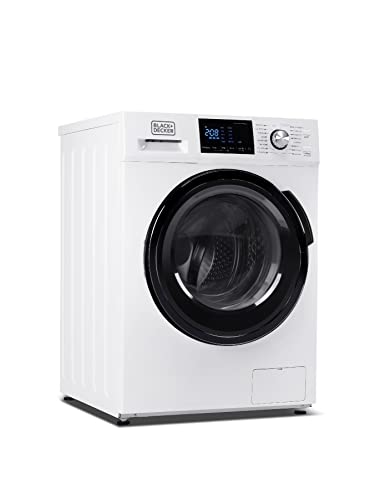
BLACK+DECKER brings a familiar household name to the same 2.7 cubic foot format: an all-in-one with an LED display and 16 cycles, rated to wash up to 25.6 lbs and dry up to 13.2 lbs — and that pair of numbers, printed plainly in the verified listing, is the most honest sentence in this category. The dry rating is roughly half the wash rating, which is true of every combo here whether the listing says so or not; BLACK+DECKER says so. Sixteen cycles cover the realistic wardrobe range without menu absurdity, and the brand’s retail footprint matters for an appliance category where a control board in year six decides whether the machine lives or dies.
Strengths
- Honest published wash and dry capacities (25.6 lb wash / 13.2 lb dry).
- 16 cycles and LED display in the large 2.7 cu.ft format.
- Established household brand with broad retail presence.
Trade-offs
- The 13.2 lb dry limit means disciplined load-splitting for full washes.
- No steam feature headline, unlike the COMFEE’.
- Same long ventless dry times as the class.
Key specs (from verified listing): 2.7 cu.ft, washes up to 25.6 lbs, dries up to 13.2 lbs, LED display, 16 cycles (Model: BCW27MW).
The BCW27MW is the pick for buyers who think in decades and service networks. Its feature set is a half-step behind the COMFEE’ — no steam headline, no overnight branding — but its capacity honesty and brand backing make it the easiest combo here to recommend to a cautious buyer, a landlord equipping a unit, or anyone whose last appliance died for want of a part.
Best for: cautious buyers, landlords, and brand-and-service-first shoppers in the 2.7 class. / Not suited for: buyers who specifically want steam care. Check the current price on Amazon

Equator 24″ 110V Convertible Compact Combo Washer Dryer — Best for Smallest Spaces
Equator specializes in compact and off-grid-adjacent appliances, and its combo is the specialist’s answer: a 1.6 cubic foot, 15 lb machine that is explicitly 110V, explicitly convertible between venting and condensing drying, and fitted with a pet cycle for the hair-heavy loads of pet households. The convertible drying is unique in this guide — vent it if your install allows and drying speeds up; run it condensing where it does not. At 1400 rpm, its spin is the strongest here, and spin speed is a hidden drying feature: the more water extracted mechanically, the less the slow 110V dryer must evaporate. The target homes are named in the listing itself — apartment, condo, RV, tiny home, small spaces — and the machine is honestly sized for them: this is a one-person or light-couple machine.
Strengths
- Convertible venting/condensing drying adapts to the installation you actually have.
- 1400 rpm spin reduces drying burden — the smart way to fight 110V dry times.
- Compact 1.6 cu.ft format and a pet cycle for small-space, pet-owning households.
Trade-offs
- 15 lb capacity is the smallest here; couples with heavy laundry will run it constantly.
- Premium-for-its-size positioning as a specialist product.
- Convertible venting only helps if your space can actually vent.
Key specs (from verified listing): 24-inch, 110V, 1.6 cu.ft / 15 lbs, 1400 rpm, convertible venting/condensing, pet cycle.
Buy the Equator when space, not laundry volume, is your binding constraint: the studio where the combo lives in a kitchen cabinet run, the tiny home where every cubic foot is argued over, the RV that sometimes has a vent path and sometimes does not. Its design intelligence — spin speed, convertibility, honest sizing — is the best in this guide; it simply serves a smaller household than the 2.7 cu.ft picks.
Best for: singles, tiny homes, RVs, and the tightest installs. / Not suited for: couples or anyone washing bulky items regularly. Check the current price on Amazon
KoolMore 2-in-1 Front Load Washer and Dryer Combo (FLC-3CWH) — Best Cycle Variety
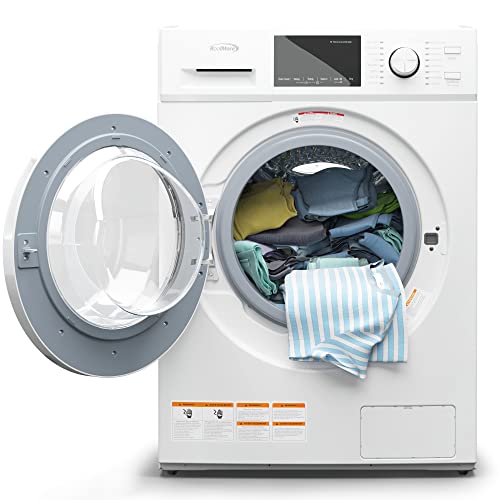
KoolMore’s entry competes on program breadth: 16 wash cycles and 4 dry cycles in a 2.7 cu.ft, 120V compact pitched at apartments, dorms, and RVs. Cycle variety is sometimes dismissed as marketing, but in a combo it has a real function — the machine handles everything from delicates to bedding in one drum, and well-separated programs let you match water, agitation, and dry intensity to loads that a three-program machine would treat identically. For a wardrobe with range — work clothes, gym gear, delicates, the occasional comforter attempt — that breadth is the difference between a machine that serves the whole closet and one that serves most of it.
Strengths
- 16 wash and 4 dry cycles — the broadest program set here.
- Full 2.7 cu.ft capacity in a compact 24-inch-class body.
- Explicitly aimed at apartments, dorms, and RVs, with sizing to match.
Trade-offs
- KoolMore is a smaller appliance brand; service networks are developing rather than established.
- Cycle breadth does not change ventless drying physics — dry times remain long.
- Bedding and bulky items remain tight fits in any 2.7 combo drum.
Key specs (from verified listing): 2.7 cu.ft, 16 wash cycles, 4 dry cycles, front load, 120V (Model: FLC-3CWH).
The KoolMore suits the varied-wardrobe single or couple in a dorm-adjacent or apartment setting who wants one machine to treat every fabric respectfully. It is also a sensible pick where the combo supplements — rather than replaces — a building’s laundry room: the combo handles the frequent, personal loads, and the big building machines handle the monthly bedding, a division of labor that plays to every machine’s strengths.
Best for: varied wardrobes, dorm and apartment living, supplementing a shared laundry room. / Not suited for: buyers prioritizing the deepest service network. Check the current price on Amazon

Contoure 2.7 Cu Ft Ventless Washer Dryer Combo (RV-WD900S) — Best for RVs
The Contoure is designed where its model name says: RV-WD — recreational vehicles. It is a 2.7 cu.ft ventless combo with steam, in a titanium finish, built to wash and dry in a moving home where venting is impractical and space is measured in inches. Ventless operation is not a preference in an RV; it is the enabling feature, because cutting a dryer vent through an RV wall is a weatherproofing and warranty adventure nobody wants. The steam function earns its place on the road too, refreshing clothes that have lived in small wardrobes. Back on land, the same virtues serve tiny homes and boat-adjacent living, anywhere venting is the obstacle.
Strengths
- Purpose-built for RV installation: ventless, compact, steam equipped.
- Full 2.7 cu.ft capacity — large for an RV appliance.
- Titanium finish suits visible installations in living space.
Trade-offs
- RV-focused distribution means home-appliance service channels differ from the big brands.
- Ventless-only: no convertible venting option like the Equator’s.
- RV power and water systems impose their own limits the machine cannot fix.
Key specs (from verified listing): 2.7 cu.ft, ventless, steam, 120V, titanium (Model: RV-WD900S).
If your laundry problem has wheels, this is your pick; the Contoure’s design brief matches the RV reality of no vent, limited space, and laundry that must happen on your schedule rather than a campground facility’s. Apartment buyers are also well served by it — the constraints are cousins — but RVers should start here and compare outward, rather than starting with a home machine and discovering its assumptions.
Best for: RVs, motorhomes, tiny homes, and other ventless-by-necessity installs. / Not suited for: installs that can vent and want faster drying. Check the current price on Amazon

Hamilton Beach 2.65 Cu Ft All-In-One Washer and Dryer Combo — Best Familiar Name
Hamilton Beach applies its small-appliance familiarity to a front-load, apartment-size combo: 2.65 cu.ft, more than 12 wash programs, an LED display, delay start, and an 800 rpm spin, on 120V. Delay start deserves emphasis in this category: a machine whose full cycle runs for hours should run them at 2 a.m. or during work hours, and delay start is the feature that makes that scheduling effortless. The 800 rpm spin is gentler than the Equator’s 1400 — kinder to delicates, but it leaves more water in the load for the dryer to remove, which lengthens dry times; that is the honest trade this model makes, and buyers should choose it knowingly.
Strengths
- Delay start and 12+ programs fit laundry around a working schedule.
- Near-full 2.65 cu.ft capacity from a widely recognized brand.
- Gentler spin suits delicate-heavy wardrobes.
Trade-offs
- 800 rpm spin leaves wetter loads, extending already-long dry cycles.
- No steam headline feature.
- Feature set is a half-step behind the COMFEE’ overall package.
Key specs (from verified listing): 2.65 cu.ft, 12+ wash programs, LED display, delay start, 800 rpm spin, 120V.
The Hamilton Beach is the comfort pick: a known name, a sensible program set, and scheduling features that suit working households in apartments. If your wardrobe leans delicate and your laundry happens overnight or during the workday, its particular balance of trade-offs may fit you better than the spec-sheet leaders — which is exactly why this guide presents trade-offs instead of a single crowned winner for everyone.
Best for: working apartment households scheduling laundry around jobs, delicate-heavy wardrobes. / Not suited for: buyers wanting maximum spin extraction or steam. Check the current price on Amazon
Comparison Table
| Pick | Badge | Key spec | Best for |
|---|---|---|---|
| COMFEE’ 24″ Combo | Best Overall | 2.7 cu.ft, steam care, overnight dry | Couples, primary machine |
| BLACK+DECKER BCW27MW | Best Value Brand | 2.7 cu.ft, 16 cycles, 25.6/13.2 lb wash/dry | Brand and service first |
| Equator 110V Convertible | Best for Smallest Spaces | 1.6 cu.ft, 1400 rpm, venting/condensing | Tiny homes, studios |
| KoolMore FLC-3CWH | Best Cycle Variety | 2.7 cu.ft, 16 wash + 4 dry cycles | Varied wardrobes |
| Contoure RV-WD900S | Best for RVs | 2.7 cu.ft, ventless, steam | RVs and tiny homes |
| Hamilton Beach All-In-One | Best Familiar Name | 2.65 cu.ft, delay start, 800 rpm | Scheduled laundry |
How to Choose a 110 Volt Washer Dryer Combo
Begin by confirming the combo premise fits your household, because it is a genuine fork in the road rather than a detail to optimize later. A combo is one drum that washes, then dries, sequentially. That means one load occupies the machine for its full wash-plus-dry duration — hours on 110 volts — and the next load cannot start until it finishes. A household doing two loads a week experiences this as freedom; a household doing two loads a day experiences it as a queue. Count your weekly loads honestly. One to four modest loads a week: a combo is a delight. Five or more, or any household with children: look at a compact separate washer and dryer instead, or keep the combo as a supplement to another laundry option.
Second, size by drying, not washing — the single most consequential sizing rule in this category, and the one most often skipped in the excitement of a large wash number. Every combo dries less than it washes — roughly half by weight is the working rule, and the BLACK+DECKER’s published 25.6 lb wash / 13.2 lb dry figures state the class’s truth plainly. In practice this means washing full loads and splitting them for drying, or washing half-loads when you want a single unattended wash-to-dry run. Choose capacity by your typical dry load: singles live well in the Equator’s 1.6 cu.ft; couples should start at the 2.7 class. Third, verify the install: a standard outlet (ideally a dedicated or lightly shared circuit), a water supply with a way to split or share the faucet feed, and a drain — a sink, standpipe, or floor drain — within hose reach. Ventless design removes the vent question entirely, which is the whole point, but water in and water out remain non-negotiable. Fourth, weight the features that manage time: overnight programs, delay start, and fast spin speeds all exist to move the machine’s slowness into hours you are asleep or away. A combo without scheduling features forces its schedule onto you; a combo with them disappears into your routine.
Ventless Condensing Drying: The Physics of 110 Volts
Understanding why these machines dry slowly turns frustration into planning — and planning, in this category, is the entire difference between owners who praise their combo and owners who curse it. A conventional 240V dryer heats air with a large element and blows moisture out a vent; power is abundant, so drying is fast. A 110V combo has roughly a quarter of that electrical power available and no vent at all. It dries by condensing: warm air circulates through the drum, picks up moisture, then passes a condenser where cool water strips the moisture out and sends it down the drain. The system works — clothes genuinely dry — but the physics cap the speed, and no brand’s engineering repeals it. Three levers do help, and this guide’s picks were chosen partly on them. Spin speed: water removed mechanically at 1400 rpm never needs evaporating, which is why the Equator’s spin is a drying feature. Load size: a half drum of laundry dries dramatically faster than a packed one, because air must move through the load, not around it. Fabric mix: synthetics and light cottons dry quickly; heavy denim and towels set the pace for everything in the drum with them, so separating one heavy item can shorten a whole cycle. Owners who internalize those three levers report satisfaction; owners who load the drum like a laundromat machine and expect laundromat times write the angry reviews. The machine is not slow for its class — the class is slow by physics, and the class exists because in-unit laundry at any speed beats the laundromat at every speed.
One more physics note explains the category’s most confusing sensation: clothes that feel almost dry, then finish quickly once removed. Condensing drying brings laundry to a hot, humid equilibrium; items emerge steaming slightly and can feel damper than they are, because warm fabric holds perceptible moisture that flashes off in the first minutes of air exposure. Experienced combo owners exploit this deliberately — pulling loads at the very end of the cycle, shaking each item out, and giving everything five minutes of air before folding — and consistently report better results than owners who judge dryness inside the drum and extend cycles unnecessarily. The related habit is unloading promptly in general: laundry left sitting in a sealed drum after drying reabsorbs ambient moisture and wrinkles, undoing the cycle’s last and best work. None of this is a workaround for a broken machine; it is the operating technique of a mature appliance category that most of the world outside North America has used for decades, in apartments where the alternative was never a vented 240V dryer but a drying rack and patience. Judged against that alternative — which is the comparison its actual buyers are making — the 110V combo is not the slow option. It is the fast one.
How to Install and Live With a 110V Combo
Installation is the gentlest in the laundry world, which is much of the appeal — no vent to cut, no gas line, no 240-volt circuit to commission, just water, drainage, and a household outlet treated with respect. Place the machine on a firm, level floor — leveling is not fussy detail, because an unlevel combo walks and vibrates, and in an apartment that is a neighbor-relations issue; adjust the feet until the machine is rock-solid, and consider an anti-vibration pad in upstairs installs. Remove the shipping bolts before first use — the single most common and most destructive setup error with front-load machines. Connect water in (a Y-splitter lets the machine share a sink faucet feed in improvised installs, though proper supply valves are better), route the drain hose to a sink, standpipe, or drain with the height and securing the manual specifies, and plug into the outlet without an extension cord. Run an empty hot wash first to clear the drum. Living with the machine afterward is a rhythm: smaller, more frequent loads beat weekly marathons; leave the door and detergent drawer ajar between uses so the drum dries and stays fresh, as with any front-loader; clean the lint and drain filters on the schedule the manual sets, because condensing dryers collect lint in places vented dryers blow away; and use the scheduling features — overnight and delay start — as the default, not the exception. Do those things and a 110V combo becomes the most quietly life-improving appliance in a small home.
Common Buying Mistakes
The first mistake is expecting full-size, full-speed performance: a 110V combo is a small, slow machine by design, and buyers who miss that sentence in the category description are disappointed by physics, not by any product. The second is sizing by wash capacity and ignoring the dry rating, then wondering why a “26 lb” machine struggles with a full load’s drying. The third is family-scale laundry: combos serve singles and couples; households with children will queue loads all weekend and blame the machine for a mismatch chosen at purchase. The fourth is forgetting the drain — combos need water out as surely as water in, and a closet with an outlet but no drain path is not an install location, however perfect its dimensions. The fifth is leaving shipping bolts in, then concluding the machine is defective as it tries to walk across the room on its first spin. The sixth is sealing the door shut between uses, growing the musty odor front-loaders are unfairly famous for, when a door left ajar prevents it entirely. A seventh mistake is subtler: running every load as a full wash-and-dry when half the week’s laundry — gym clothes, work uniforms, the items in constant rotation — would move faster as small, frequent cycles, reserving the long unattended programs for bedding and towels. Combo ownership rewards rhythm, and the rhythm is learnable in the first month if the buyer expects to learn it.
Final Recommendation
For most couples and small households, the COMFEE’ 24″ Washer and Dryer Combo is the right primary machine; brand-and-service-first buyers should take the BLACK+DECKER BCW27MW. The tightest spaces belong to the Equator 110V Convertible, varied wardrobes to the KoolMore FLC-3CWH, RV life to the Contoure RV-WD900S, and schedule-driven households to the Hamilton Beach All-In-One. For the other voltage-specific guides in this cluster, see Best Wall Heaters 208 Volt and Best Wall Mounted 240 Volt Fan Forced Heater; for the rest of the small-home cluster, Best Washable Furnace Filter For Smokers covers the maintenance side of compact living.
Combo vs. Portable Washer Plus a Compact Dryer: The Real Alternative
Before committing to a combo, weigh the setup many small-space households actually run: a portable or compact washer paired with a compact 110V dryer as separate units. The separate dryer’s advantage is parallelism — while it dries load one, the washer runs load two — and its drying, while still slow by 240V standards, is usually somewhat faster per load because the dryer is a dedicated appliance with its own airflow design. The costs are two footprints (or a stacking arrangement), two machines to buy and maintain, and, for vented compact dryers, a venting question the combo never asks; ventless compact dryers exist but narrow the field. The combo’s counter-argument is simplicity and space: one footprint, one set of hookups, one machine, and laundry that runs unattended from dirty to dry in a single program — the overnight load that a two-machine setup cannot match without a human transfer at midnight. Households with a spare closet and modest volume often prefer the pair’s throughput; households counting every square foot, or valuing set-and-forget operation above all, prefer the combo. Neither answer is wrong, and this guide’s picks assume you have already weighed it — but if your weekly load count is creeping upward, re-run this comparison before ordering, because it is the decision that determines satisfaction more than any choice among the six combos themselves.
Running Costs, Water, and Noise: The Ownership Details
Three ownership realities deserve plain numbers-free discussion, since this guide does not print prices and utility rates vary. Energy: a 110V combo uses modest electricity per cycle — its heating element is small — but runs for a long time, so per-load energy lands in a middle ground: more than a cold wash alone, less than many assume, and strongly influenced by how full and how heavy your loads are. Water: condensing dryers use water as part of the drying process itself, in addition to wash water, which surprises owners the first month; total water per full wash-dry cycle is higher than a washer alone, a real consideration in metered or drought-conscious households, and one more argument for right-sized loads over constant small ones. Noise and vibration: combos spin like front-load washers — respectably when level and loaded sensibly, objectionably when unlevel or overloaded — and the long drying phase is a low, steady presence rather than a loud one. In practice, upstairs apartment owners should budget for an anti-vibration pad and ruthless leveling, and light sleepers should use the scheduling features so the spin cycle lives in waking hours while the quiet drying phase runs at night. None of these details are reasons to avoid the category; all of them are reasons the satisfied owners in this category are the ones who were told the truth before purchase, which is the standard this guide has tried to keep.
Troubleshooting Slow Drying and Other Combo Complaints
Nearly every combo complaint traces to a short list of causes, most of them fixable in minutes. Clothes still damp after drying: the load was too large for the dry rating — split it — or too heavy in composition, or the lint and drain filters need cleaning, which on a condensing machine throttles the very airflow drying depends on. The fix sequence is always load size first, filters second, fabric separation third. Cycle seems endless: the machine is sensing moisture and extending dry time, which is correct behavior for an overfilled drum; smaller loads end the drama. Wrinkles: combos crease clothes that sit in the drum after the cycle, so use the steam refresh where fitted, remove loads promptly, and shake items out before the dry phase when you are present — the overnight user trades a few wrinkles for total convenience, knowingly. Musty smell: the door has been kept shut between uses; leave it ajar, wipe the gasket fold where water sits, and run a hot empty cycle periodically. Vibration or walking: re-level, confirm the shipping bolts are out, and check the load is not a single heavy item slinging around alone. Water use higher than expected: that is the condenser working as designed. A combo understood this way stops being a temperamental appliance and becomes a predictable one — and predictable, in laundry, is most of what anyone actually wants.
Budget Tiers: What the Money Buys in 110V Combos
The tiers in this category buy capacity and time-management, in that order. The compact tier — the Equator’s 1.6 cu.ft class — buys the smallest footprint and specialist features like convertible venting, at a price that reflects specialization rather than size; it is not the cheap tier so much as the small tier, and singles should not assume bigger is better value for a household of one. The mainstream 2.7 cu.ft tier, where most of this guide lives, divides by philosophy: value-brand machines like the BLACK+DECKER buy capacity and brand backing with a straightforward feature set; feature-forward machines like the COMFEE’ buy steam and overnight programming that manage the category’s slowness; cycle-rich machines like the KoolMore buy wardrobe versatility. The honest way to shop the tier is to name your dominant frustration in advance — Is it space? Slow drying? A delicate-heavy wardrobe? No service network? — and let that answer pick the machine, because within the tier the drums are similar and the philosophies are the product. One cross-tier warning: installation and accessories are real costs too. A combo that needs a stand, a drain solution, or a stacking-free floor plan should be compared on installed totals, and the machine that fits your existing hookups without modification is cheaper than its sticker suggests relative to one that does not.
Frequently Asked Questions
Can a 110 volt combo really dry clothes?
Yes — ventless condensing drying genuinely dries clothes, and millions of these machines serve apartments worldwide as their owners’ only laundry appliance. The honest caveat is speed: drying takes considerably longer than a 240V vented dryer, and loads must be smaller than the wash capacity. Dry a half-load and the results are properly dry, not damp-compromised; dry a packed drum of towels and you will meet the category’s limits in a single afternoon. The technology is proven — it is the load discipline that is new to most buyers.
How long does a full wash and dry cycle take?
Plan on hours rather than minutes for a complete unattended wash-to-dry cycle — the exact time depends on load size and fabric, with heavy cottons at the long end and small synthetic loads at the short end. This is why overnight programs and delay start matter so much in this category: the machine’s hours should be your sleeping or working hours, and a household that schedules that way stops experiencing the cycle length as a cost at all. If your laundry life requires a load washed, dried, and worn within a single hour, no 110V combo is your machine, and a laundromat or a 240V setup is the honest recommendation.
Do I need a vent or special plumbing?
No vent — that is the point of these ventless designs, and it is what lets them live in closets, kitchens, and RVs where a vent run is impossible. You need a standard outlet, a water supply, and a drain within hose reach; a sink serves as the drain in many improvised apartment installs, while a standpipe or floor drain is tidier where available. The Equator additionally offers a venting option if your installation happens to allow one, which speeds drying — an option, never a requirement.
What size loads can I actually do?
Wash up to the rated capacity — 15 lbs in the compact Equator, around 26 lbs in the 2.7 cu.ft models — but dry roughly half that weight per cycle for good results. In practice: a week of one person’s regular laundry is two to three comfortable cycles; a couple’s is three to five smaller, more frequent ones. Translate that into objects and it becomes intuitive: a full set of queen bedding is a wash load that becomes two dry loads; a week of gym clothes is a single easy cycle; towels, the heaviest common load, should always travel in small batches. Owners who think in these units stop overloading by instinct within a month.
Is a combo or a compact separate pair better?
A separate pair washes and dries simultaneously and usually dries faster, but needs two footprints, often a 240V circuit for the dryer, and a vent or its own condensing setup. A combo needs one footprint, one outlet, and no vent, and runs a load from dirty to dry with no transfer. Space and wiring decide for most buyers; volume decides against the combo for large households. There is also a lifestyle question hidden in the comparison: the pair rewards someone present to move loads along, while the combo rewards someone who wants to load it, leave, and return to finished laundry — choose for the person you are, not the person the appliance brochure imagines.
Can I put a combo in a closet or RV?
Yes — closet and RV installs are core use cases for this category, and the Contoure is purpose-built for RVs, where ventless operation and compact dimensions are necessities rather than conveniences. Ensure the closet has water and drain access, a level and sturdy floor, and enough air circulation for the condensing system to breathe; in an RV, secure the machine properly for travel and respect the vehicle’s own water and power limits. In both settings, an anti-vibration pad and careful leveling pay for themselves immediately.