Disclosure: airfryerkitchensupply.com is reader-supported. When you buy through links on our site, we may earn an affiliate commission at no extra cost to you.
Where to buy
Every mixer below was confirmed on Amazon before it earned a link, and Amazon is where you can check the current price on Amazon for each model. The shortlist: the Soundcraft Signature 22MTK for multitrack recording with a classic British console sound, the Soundcraft Signature 16 for the same character in a smaller format, the Allen & Heath ZED-14 for touring-grade build and musical EQ, the Allen & Heath ZED12FX for compact channels with onboard effects, the Yamaha MG20XU for larger live rigs, and the Yamaha MG12XU for the best value in a warm-leaning workhorse.
Ask a room of engineers for the best warm mixers and you will start an argument, because “warm” is the most used and least defined word in audio. Stripped of mystique, warmth describes a sound that is full in the low mids, smooth rather than brittle in the top end, and forgiving when signals run hot — the opposite of the thin, harsh, fatiguing character people associate with cheap digital conversion and sterile preamps. In the analog mixer world, warmth comes from identifiable engineering: preamps with generous headroom and gentle overload behavior, EQ circuits voiced musically rather than surgically — the famous British EQ tradition is the benchmark — and a summing path that glues a mix together instead of merely adding channels. This guide compares six verified analog mixers known for that character, from Soundcraft’s Ghost preamps and Sapphyre EQ to Allen & Heath’s touring-grade ZED series and Yamaha’s D-PRE equipped MG line, and explains how to choose by channel count, recording needs, and the kind of warmth your music actually wants.
A word about how to audition these boards if you can, because warmth reveals itself in comparisons, not in isolation. Run the same vocal microphone, at the same gain, singing the same phrase, through two candidate boards into the same speakers, with EQ flat. What you are listening for is not which is louder or brighter, but which keeps the voice’s body intact as it gets loud, and which top end stays smooth when the singer pushes. Then apply the same gentle low-mid lift on each board’s EQ: the warmer board will make the voice bigger; the sterile board will make it boxier. That five-minute test, done honestly, teaches more than a month of forum reading, and it explains in one sitting why engineers develop loyalty to a preamp-and-EQ combination the way guitarists develop loyalty to an amplifier.
In this guide
Quick Picks
- Best Overall — Soundcraft Signature 22MTK: A 22-channel analog mixer with Ghost preamps, Sapphyre British EQ, Lexicon effects, and multitrack USB recording — the fullest expression of the warm console brief. Check the current price on Amazon
- Best for Studios — Soundcraft Signature 16: The same preamp and EQ character in a 16-channel format sized for project studios and smaller live rigs. Check the current price on Amazon
- Best British EQ — Allen & Heath ZED-14: A 14-channel touring-quality mixer with USB I/O and the responsive, musical EQ the ZED line is known for. Check the current price on Amazon
- Best Compact with FX — Allen & Heath ZED12FX: Six mono and three stereo channels with onboard effects and USB, in a footprint for small bands, churches, and creators. Check the current price on Amazon
- Best for Live Bands — Yamaha MG20XU: Twenty inputs, six buses, D-PRE preamps, and 24 SPX effects for full-band live work and recording. Check the current price on Amazon
- Best Value — Yamaha MG12XU: Twelve inputs, four buses, D-PRE preamps, and USB in the MG line’s sweet spot of size and price tier. Check the current price on Amazon
How These Picks Were Chosen
Every mixer in this guide was verified: we searched by brand and model, matched the listed title to the mixer described — channel count, series, key features — and only then assigned a link. Mixer model names are a minefield of near-identical variants differing by a letter and an entire feature set, so verification is what guarantees the 22MTK in this guide is the multitrack version and the ZED-14 is the USB model, not their close siblings.
Selection started with the warmth brief itself. Each pick is an analog mixer whose preamps and EQ are known for a musical, forgiving character: Soundcraft’s Ghost preamps are explicitly designed with wide headroom and a smooth overload curve, paired with Sapphyre EQ drawn from the company’s British console heritage; Allen & Heath’s ZED preamps and EQ carry the company’s live-sound reputation for warmth under pressure; Yamaha’s D-PRE preamps use an inverted Darlington circuit design associated with a natural, uncolored-but-full low end, and the MG series is the warm-leaning workhorse of countless small venues. Second came format fit: the guide spans compact creator rigs to full-band live boards so channel count can be matched to real ensembles. Third, recording path: USB-equipped models were favored because most buyers in this category record at least occasionally, and the 22MTK’s multitrack capability is a genuine differentiator. Fourth, build and support: these are long-lived tools from the industry’s established live-sound makers. Price was excluded from scoring; tiers are described in words, and you can check price on Amazon when you shop.
A frank caveat belongs here: warmth is partly the mixer and partly the engineer. Gain staging, microphone choice, and EQ discipline will make any of these boards sound warm or harsh. The mixers below were chosen because their design makes the warm outcome the easy outcome — headroom that forgives, EQ that flatters — not because any board can rescue a clipped, badly staged signal.
The 6 Best Warm Mixers
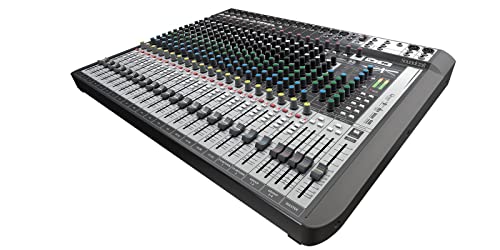
Soundcraft Signature 22MTK — Best Overall
The Signature 22MTK is what the warm-mixer brief looks like when a heritage console maker commits to it fully. Its Ghost mic preamps — named for Soundcraft’s flagship Ghost console — offer wide dynamic range and an overload character that rounds transients instead of shattering them, and the Sapphyre EQ brings the asymmetrical British EQ curves that engineers reach for when a vocal needs body or a guitar needs its edges taken off without going dull. Onboard Lexicon effects supply the reverbs and delays that finish a warm mix, and the MTK’s multitrack USB interface records every channel to a DAW individually, which makes this as much a studio front end as a live board. Twenty-two channels cover a full band with room to spare.
Strengths
- Ghost preamps and Sapphyre British EQ deliver the guide’s benchmark warm character.
- Multitrack USB recording captures every channel separately for proper studio mixing.
- Lexicon effects onboard, from a name that defines studio reverb.
Trade-offs
- The largest and most committed format here; overkill for a duo or a podcast desk.
- Multitrack recording rewards a proper DAW workflow — casual users may never use its depth.
- Premium tier within this guide.
Key specs (from verified listing): 22-channel analog mixer, Ghost preamps, Sapphyre EQ, Lexicon effects, multitrack USB (Model: Signature 22MTK).
Choose the 22MTK when the mixer is the center of a musical life: a band that gigs and records, a project studio built around live takes, a church or venue that wants one board to serve both. Its warmth is not a preset but a property of the signal path, present on every channel, every night. For buyers torn between a live board and a studio interface, this is the rare product that honestly ends the argument.
Best for: bands, project studios, and venues wanting warm analog character plus multitrack recording. / Not suited for: solo creators or small duos who need four channels, not twenty-two. Check the current price on Amazon

Soundcraft Signature 16 — Best for Studios
The Signature 16 carries the same Ghost preamps, Sapphyre EQ, and Lexicon effects as its bigger sibling into a 16-channel format that fits the project studio and the smaller live rig. Sixteen channels is the sweet spot for a serious home or project studio: a full drum kit miked properly, a small band tracked live, or a live rig for an acoustic ensemble with guests. The USB interface here is stereo rather than multitrack — an honest distinction we flag clearly — which suits studios that record live-to-two-track, mix on the board, or track in overdubs through a couple of channels at a time.
Strengths
- Same warm preamp and EQ character as the 22MTK in a more manageable size.
- 16 channels cover drum kits and small bands without compromise.
- Lexicon effects and Soundcraft build for studio and stage alike.
Trade-offs
- Stereo USB only: no per-channel multitrack capture, unlike the 22MTK.
- Still a substantial board for a bedroom desk; measure your space.
- Buyers who later need multitrack will outgrow it toward the MTK.
Key specs (from verified listing): 16-channel analog mixer, Ghost preamps, Sapphyre EQ, Lexicon effects, USB interface (Model: Signature 16).
The Signature 16 is the connoisseur’s project-studio pick: the warmth is identical where it matters — the preamps and EQ that shape every sound — and the compromises sit in recording architecture rather than in tone. Studios that mix as they track, print effects, and commit to sounds will find that workflow not a limitation but a discipline, and the board’s live capability means the same console can run the band’s gigs on weekends.
Best for: project studios and small live rigs wanting flagship warm character. / Not suited for: engineers who need multitrack USB capture of full bands. Check the current price on Amazon

Allen & Heath ZED-14 — Best British EQ
Allen & Heath built its name in live sound, and the ZED-14 carries that DNA: a 14-channel, touring-quality analog mixer with USB I/O and EQ that engineers consistently describe as musical. The ZED EQ’s character is the reason this board is in a warmth guide — boosts feel broad and flattering rather than clinical, and the preamps hold together gracefully when a singer leans in harder than soundcheck suggested. The build is a step into professional territory: this is a mixer designed to be transported, set up, and struck repeatedly without developing the crackles and dead channels that end budget boards.
Strengths
- Musical, forgiving EQ and robust preamps with a warm live character.
- Touring-quality build for working musicians and venues.
- USB I/O for straightforward stereo recording and playback.
Trade-offs
- No onboard effects section comparable to the Soundcraft and Yamaha picks; external or DAW effects fill the gap.
- 14 channels suit small-to-medium acts; full bands should look at the MG20XU or 22MTK.
- Professional build comes at a professional tier.
Key specs (from verified listing): 14-channel analog mixer, USB I/O, touring quality (Model: AH-ZED-14).
The ZED-14 is for the engineer who hears warmth as an EQ philosophy. If your mixes live or die on how a vocal sits after a 3 dB low-mid lift, or how an acoustic guitar’s top end behaves when you open it up, this board’s voicing will feel like home. It is equally at home as a small venue’s installed mixer, where its reliability and sound make it the piece of equipment nobody thinks about — the highest praise in live sound.
Best for: live engineers, small venues, and recording musicians who prioritize EQ character and build. / Not suited for: buyers who need onboard effects or more than 14 channels. Check the current price on Amazon

Allen & Heath ZED12FX — Best Compact with FX
The ZED12FX compresses the ZED formula for smaller rigs: six mono channels and three stereo channels, onboard effects, and USB I/O, in a multipurpose format aimed at small bands, churches, schools, and creators. The onboard FX matter at this scale — a solo performer or a small worship band gets serviceable reverb and delay without carrying a rack — and the channel layout reflects real small-rig life, where stereo sources like keyboards and playback devices are as common as microphones. The warmth brief is honored through the same ZED preamp and EQ lineage as its bigger sibling.
Strengths
- Onboard effects plus USB in a compact, gig-friendly format.
- Sensible channel mix of six mono and three stereo inputs for small acts.
- ZED build quality and EQ character at a smaller scale.
Trade-offs
- Six mic inputs cap the size of band it can serve.
- Effects are convenient rather than studio-grade; demanding users will supplement.
- Not expandable — outgrowing it means replacing it.
Key specs (from verified listing): 6 mono + 3 stereo channels, onboard FX, USB I/O (Model: AH-ZED12FX).
Picture the ZED12FX in a small church, a duo-plus-playback live act, a school hall, or a creator’s desk that sometimes becomes a stage. In each, its channel count is sufficient, its effects remove a box from the load-in, and its sound keeps the ZED family’s warmth. It is the pick for buyers whose ensemble is defined and stable, and who value arriving with one case instead of three.
Best for: small bands, churches, schools, and creators with modest channel needs. / Not suited for: full bands or drum-kit-heavy recording. Check the current price on Amazon

Yamaha MG20XU — Best for Live Bands
Yamaha’s MG series is the default workhorse of small-venue live sound, and the MG20XU is its full-band configuration: 20 inputs, 6 buses, D-PRE mic preamps, 24 SPX effects, and a USB interface for recording performances, rehearsals, and lectures. The D-PRE preamps deserve their place in a warmth guide: their circuit design is known for a natural, solid low end and clean headroom that keeps vocals and bass instruments full rather than thin — the foundation warmth is built on. The bus structure suits real live work, with subgroups and monitor mixes that smaller boards cannot offer.
Strengths
- 20 inputs and 6 buses handle full bands and proper monitor mixes.
- D-PRE preamps with a full, natural low-end character.
- 24 SPX effects and USB recording in one stage-ready package.
Trade-offs
- Character is cleaner and more neutral than the Soundcraft’s overtly British warmth; engineers seeking color may prefer the Signature.
- Size and weight suit a dedicated live rig, not a desktop.
- Stereo USB recording rather than multitrack.
Key specs (from verified listing): 20-input, 6-bus mixer, D-PRE preamps, 24 SPX effects, USB interface (Model: MG20XU).
The MG20XU is the band-practice-space and small-venue answer: enough channels for drums, backline, and vocals, enough buses for monitors, effects that cover a set without a rack, and Yamaha’s reliability reputation behind all of it. Its warmth is the honest, unhyped kind — full lows, no harshness, nothing exaggerated — which is precisely what a working band needs at volume, three sets deep.
Best for: full live bands, rehearsal spaces, and small venues. / Not suited for: desktop creators, or engineers seeking strongly colored British EQ character. Check the current price on Amazon

Yamaha MG12XU — Best Value
The MG12XU is the MG line’s sweet spot: 12 inputs, 4 buses, D-PRE preamps, SPX effects, and USB, in a format that covers the majority of real-world small rigs at the line’s most accessible tier. Twelve inputs handle a singer-songwriter with a band, a small worship team, a podcast-plus-music desk, or a rehearsal rig, and the four buses give a taste of the subgroup and monitor flexibility of the bigger board. For buyers whose warmth requirement is “full and never harsh, from a name I trust, without paying for channels I will never patch,” this is the guide’s most efficient answer.
Strengths
- D-PRE preamps and MG build at the line’s value tier.
- 12 inputs / 4 buses cover most small-rig realities.
- Effects and USB included — no accessory purchases required to start.
Trade-offs
- Growing bands will reach its channel ceiling; the MG20XU is the headroom buy.
- Character leans clean-neutral rather than colored.
- Stereo USB only, like most of this class.
Key specs (from verified listing): 12-input, 4-bus mixer, D-PRE preamps, SPX effects, USB interface (Model: MG12XU).
Value picks earn their badge by being the board most buyers should actually purchase, and the MG12XU fits that description for small acts and multi-purpose desks. It will not flatter a mix the way the Soundcraft’s EQ does, and it will not multitrack like the 22MTK, but it will sound full, work every time, and leave budget for the microphones and monitors that shape your sound at least as much as the mixer does.
Best for: small bands, worship teams, podcast-and-music desks, and rehearsal rigs on a budget. / Not suited for: full bands, multitrack recordists, or seekers of strong console color. Check the current price on Amazon
Comparison Table
| Pick | Badge | Key spec | Best for |
|---|---|---|---|
| Soundcraft Signature 22MTK | Best Overall | 22 channels, Ghost preamps, Sapphyre EQ, multitrack USB | Bands + studio multitracking |
| Soundcraft Signature 16 | Best for Studios | 16 channels, Ghost preamps, Lexicon FX, stereo USB | Project studios |
| Allen & Heath ZED-14 | Best British EQ | 14 channels, USB I/O, touring build | Live engineers, venues |
| Allen & Heath ZED12FX | Best Compact with FX | 6 mono + 3 stereo, onboard FX, USB | Small bands, churches |
| Yamaha MG20XU | Best for Live Bands | 20 inputs, 6 buses, D-PRE, 24 SPX FX | Full live bands |
| Yamaha MG12XU | Best Value | 12 inputs, 4 buses, D-PRE, USB | Small rigs on a budget |
How to Choose a Warm Mixer
Start with channel count, counted honestly. List every input your largest realistic session needs — each microphone, each DI, each stereo source as a pair — then add a small margin for the guest vocalist or the extra keyboard that reality always supplies. That arithmetic, not aspiration, should pick your format: duos and creators live happily in ZED12FX territory, small bands in MG12XU or Signature 16 territory, full bands in MG20XU or 22MTK territory. Buying two sizes too large wastes money and desk space; buying one size too small ends in a second purchase, which is the most expensive outcome of all. If your sessions vary wildly — a duo most weeks, a full band twice a year — buy for the weekly reality and rent or borrow for the exceptions; a mixer sized for the exception will annoy you fifty weeks a year to serve you for two.
Next, decide what “warm” means for your music, because the picks split into two philosophies. The Soundcraft Signature boards offer colored warmth: British-voiced EQ and preamps that flatter, glue, and gently round — ideal for rock, folk, soul, and anything recorded live in a room. The Allen & Heath and Yamaha boards offer architectural warmth: headroom, full low end, and EQ that stays musical under pressure, but with a cleaner starting point that you color with microphones, instruments, and processing. Neither is superior; singer-songwriters tracking live often love the first, while engineers mixing many genres often prefer the second as a neutral-warm platform.
Third, settle the recording question before you fall in love with a board’s knobs. If you record full bands and mix afterward, the 22MTK’s multitrack USB is a category of its own in this guide and worth building the budget around. If you record stereo — live-to-two-track, streams, rehearsals, stereo demos — every pick here serves you. Fourth, count your effects and monitor needs: onboard FX (Soundcraft, ZED12FX, Yamaha XU models) remove outboard gear from small rigs, and bus counts decide how many independent monitor mixes your band can have, which matters more to live comfort than almost any tonal nuance. Finally, weigh build and service: a mixer is a ten-year tool, and the three makers in this guide all support that expectation; the cheapest anonymous board is the one that fails at a gig.
What “Warm” Actually Means in a Mixer
Since the search promises warmth, it deserves a technical grounding rather than a poetic one. Three mechanisms produce most of what listeners call warmth in an analog mixer. The first is harmonic behavior under level: analog preamps driven toward their headroom limit generate gentle, predominantly even-order harmonic content and soft compression of peaks, which the ear reads as thickness and smoothness; driven past it, or built with too little headroom, the same stage turns harsh — which is why the generous headroom of the Ghost and D-PRE designs matters more than any marketing adjective. The second is EQ voicing: broad, interacting curves — the British tradition — shift a sound’s body and presence in a way that feels like the instrument got better, while narrow surgical curves are tools for fixing problems. Warm mixers ship with the first kind as their native language. The third is low-frequency integrity: a summing path and preamp design that keep bass full and defined rather than thin or smeared, because perceived warmth lives disproportionately in the low mids. None of this requires tubes or transformers, though both can contribute; it requires engineering priorities, and the six boards here were chosen because their makers prioritized exactly these mechanisms.
There is a fourth, unglamorous contributor: consistency across channels. A board whose sixteenth preamp sounds like its first, and whose EQ behaves identically on every strip, lets an engineer build a warm mix predictably instead of fighting channel personalities. The established makers in this guide hold that consistency across a production run and across years, which is part of what their price buys. When a budget board sounds fine on channel one and different on channel nine, the mix never quite settles — and unsettled is the opposite of warm, whatever the brochure says.
How to Set Up and Gain-Stage a Warm Mix
Technique decides whether a warm mixer sounds warm, so work this sequence. First, gain-stage each channel properly: bring the input gain up until the signal is healthy and strong with peaks comfortably below clipping — on these analog boards, a strong-but-not-red signal is where the preamps sound fullest, while timid gain staging wastes their character and hot staging breaks it. Second, high-pass what does not need low end: vocals, guitars, and overheads usually benefit from removing rumble below their real content, which clears the low mids where warmth lives and stops mud from masquerading as warmth. Third, EQ subtractively first — cut the frequencies that box or grate before boosting the ones that flatter — and when you do boost, use the broad musical curves these boards provide, a little at a time. Fourth, use effects as atmosphere, not weather: a Lexicon or SPX reverb at a level you notice only when muted adds the space that reads as warmth and polish. Fifth, mind the master: leave the mix bus headroom to breathe rather than slamming it, because a summing path loafing along sounds bigger than one straining. Finally, record a reference mix of a familiar song through your setup and compare against the original on the same speakers; that habit calibrates your ears to your room faster than any tutorial, and it turns “warm” from a vibe into a repeatable result you can dial in on any of these boards.
Common Buying Mistakes
The first mistake is buying channels for a fantasy band: a 22-channel board for a duo is money that should have gone to microphones, which shape the sound before the mixer ever hears it. The second is the reverse — counting only today’s inputs and forgetting the drum kit, the guest, or the playback rig arriving next year. The third is chasing warmth as a spec while ignoring gain staging; the warmest board in this guide will sound harsh when clipped and thin when starved, and no purchase fixes a level problem. The fourth is overlooking the recording architecture — discovering after purchase that your board records stereo only when your workflow needed multitrack, or paying for multitrack you will never open. The fifth is ignoring monitor and bus needs for live work, which causes more on-stage misery than any tonal shortfall. The sixth is treating the mixer as the whole sound: speakers, microphones, and the room shape what the audience hears at least as much, and a mid-tier board with good transducers beats a flagship board with poor ones every night. A seventh, quieter mistake is buying on a forum’s consensus instead of your own genre and workflow: the board that flatters a metal band’s dense guitars is voiced differently from the one that flatters a string quartet, and both camps will swear theirs is simply “the warm one.” Use the genre mapping in this guide, audition if you can, and let your music — not the loudest opinion — make the final call.
Final Recommendation
For the fullest warm-console experience with multitrack recording, choose the Soundcraft Signature 22MTK. Project studios that mix as they track should take the Soundcraft Signature 16, live engineers who live on EQ the Allen & Heath ZED-14, and small acts needing compact FX the Allen & Heath ZED12FX. Full bands belong on the Yamaha MG20XU, and value-focused small rigs on the Yamaha MG12XU. Explore the wider cluster with Best Small Kitchen Mixers if your mixing is culinary rather than audio, compare against Best Sounding Analog Mixers for the wider analog field, and see Best Small Usb Mixers for compact recording-first alternatives.
Warmth by Genre: Matching the Board to the Music
Different music asks for different flavors of warmth, and the picks divide naturally once you think in genres. Rock, folk, Americana, and soul — music recorded with a band in a room, where glue and grit are virtues — lean toward the Soundcraft Signature boards, whose British EQ and preamp character were practically designed for electric guitars, Hammond-style keys, and voices that need body. Jazz and acoustic music ask for a lighter touch: warmth as low-end integrity and unhyped top end rather than color, which is the Allen & Heath ZED-14’s home ground, its EQ able to open an acoustic guitar or a ride cymbal without brittleness. Worship and corporate live work — many voices, playback tracks, spoken word, long services — reward the Yamaha MG boards’ clean-warm reliability and bus flexibility, because the job is intelligibility plus fullness at volume, week after week, often run by volunteers who benefit from a forgiving board. Electronic and hip-hop production rigs, where the mixer is often a summing and performance hub for synths and samplers, benefit from headroom above all: signals arrive hot and layered, and the boards with the most graceful overload — the Signature line again, or the D-PRE Yamahas — keep dense low end from turning to mush. None of this is a rule that should override your ears, but it is a useful first sort: name your genre honestly and two of the six picks usually step forward on their own.
Live vs. Studio: Where the Priorities Split
A mixer that crosses between stage and studio — as all six picks can — still forces priority choices. Live work punishes fragility and rewards immediacy: the ZED-14’s touring build and the MG20XU’s bus structure exist because a live board must survive transport, be patched in minutes, and give the band monitor mixes that keep them playing well. In live sound, warmth is also a safety feature: a forgiving board keeps an energetic singer’s peaks musical instead of painful at volume. Studio work punishes noise and rewards architecture: the 22MTK’s multitrack USB and the Signature 16’s print-as-you-go workflow are studio arguments, and in the studio, warmth is a production decision made once per track rather than a nightly act of survival. The practical advice is to name your primary room. If the board lives in the studio and visits the stage, buy the Soundcraft that fits your channel count. If it lives in a case and visits the studio, buy the ZED or MG that fits your band. Buyers who genuinely split fifty-fifty should weight the recording architecture, because a live shortfall can be patched around for a night, while a missing multitrack path cannot be patched at all.
Cables, Power, and Care: Keeping a Warm Mixer Warm
A mixer’s character survives only if the infrastructure around it does. Use balanced cables for microphones and long runs — an unbalanced shortcut injects the buzz and interference that no EQ can remove and that listeners misread as the board sounding bad. Power the rig from a clean, single distribution point where possible, because ground loops between separately powered mixer, speakers, and computers are the other great source of “my mixer hums” complaints that are not the mixer’s fault. Care itself is light: keep dust out of faders and pots with a cover when the board is idle — dust in a fader becomes the crackle that makes a warm board sound old — work each knob and fader through its travel occasionally on stored boards, and transport the mixer in a case or padded bag rather than loose in a vehicle. Faders and pots on the established lines in this guide are rated for years of this treatment. Do those few things and a warm mixer stays warm for a decade; neglect them and the finest preamps in the world will be blamed for a dirty cable’s sins.
Budget Tiers: What Each Level Buys in Analog Mixers
The tiers here buy capability in a fairly strict order, and knowing the order prevents both overspending and false economy. The value tier — the MG12XU’s ground — buys trustworthy preamps, usable effects, USB, and a board that will work for years; what it does not buy is channel headroom for growth or strong tonal color. The mid tier, where the ZED12FX, ZED-14, and MG20XU sit, buys specialization: compact convenience with effects, touring build with superior EQ, or full-band format with real bus structure. Mid-tier money is best spent by buyers who can name their specialization — most working musicians can. The premium tier, the Soundcraft Signature boards, buys character and architecture together: the Ghost-and-Sapphyre signal path plus, in the 22MTK, multitrack recording that replaces a separate interface entirely. That last point reframes the premium comparison: a 22MTK is not merely a mixer priced against other mixers, but a mixer plus a multitrack interface priced against the pair. Buyers who would otherwise purchase both should do that math before calling it expensive. Across all tiers, remember that the mixer is one element in a chain — microphones, speakers, and room treatment each claim budget with equal legitimacy, and the warmest board cannot outrun the weakest link in front of an audience.
Buses and Monitor Mixes, Explained for Buyers
Channel count gets the headlines, but bus architecture is what separates a mixer a band can work with from one it merely plays through. A bus is a path that carries a mix of channels somewhere — to the main speakers, to a subgroup, to a monitor wedge, to an effects unit. Auxiliary sends feed monitors and effects: each aux is effectively a second, independent mixer inside the first, letting the drummer hear mostly kick and vocals while the singer hears mostly piano and themselves. This is where warmth becomes practical rather than tonal: musicians who hear themselves clearly and comfortably play better and sing better, and the mix out front improves more from a confident band than from any EQ curve. When you compare the picks, read the bus counts against your band’s reality. The MG20XU’s six buses support the multi-monitor, subgrouped workflow of a full band; the MG12XU’s four buses cover a smaller act’s one or two monitor mixes plus effects; the compact ZED12FX serves a duo or trio whose monitoring is simple. Subgroups, found on the larger boards, let you ride all the drums or all the backing vocals on one fader — a live-sound luxury that becomes a necessity the first time a set gets loud. Buyers planning to record should also note how the USB feed is sourced: a board that can send the main mix pre- or post-fader gives the recording a fighting chance of matching what the room heard. None of this appears in the glamorous parts of a listing, and all of it decides whether the mixer still fits your life in year three.
Frequently Asked Questions
What makes a mixer sound “warm”?
Mainly preamp headroom and overload behavior, musical EQ voicing, and solid low-frequency performance. Analog boards designed with generous headroom and broad, flattering EQ curves — the British tradition in particular — produce the full, smooth character listeners call warm. It is worth adding what warmth is not: it is not darkness or dullness. A warm mix still has air and detail; it simply presents them without the brittle edge that makes listeners turn the volume down, and a well-run warm board will keep a bright source sounding bright — just never harsh.
Are analog mixers warmer than digital mixers?
They tend to be more forgiving, because analog stages overload gradually and musically while digital clipping is abrupt and harsh. Good digital mixers can sound excellent and even model warmth convincingly, but in this price territory a well-designed analog board makes the warm result easier to reach, especially live, where levels surprise you. There is also a workflow argument: analog boards put every control under a hand with no menus, which keeps an engineer’s attention on the music — and attention, honestly applied, is a warmth feature too.
How many channels do I need?
Count every microphone, DI, and stereo source in your largest realistic session, then add a small margin for the guest, the extra keyboard, or the drum overheads you will eventually want. Duos and creators often need 6–10 inputs, small bands 12–16, and full bands with drum kits 20 or more. Buying one size up is cheaper than buying twice, but buying three sizes up wastes money that microphones would have used better — the honest count, plus one step of headroom, is the rule that survives contact with real bands.
What is the difference between stereo USB and multitrack USB?
Stereo USB sends the finished two-channel mix to your computer — fine for streaming, demos, rehearsal archives, and live-to-two-track recording, and genuinely the right tool when the performance and the mix happen at the same time. Multitrack USB, offered by the Signature 22MTK here, sends every channel separately, so you can mix a live performance properly afterward in a DAW, fixing balances that the room disguised on the night. Choose by workflow, not by spec envy: engineers who love mixing later need multitrack; engineers who commit in the moment are honestly served by stereo.
Do I need onboard effects?
For live work and simple recording, onboard reverb and delay — Lexicon on the Soundcrafts, SPX on the Yamahas, the ZED12FX’s effects — remove extra gear and are entirely serviceable; a small act that can leave the effects rack at home travels lighter and sets up faster. Studios with plug-in collections may never open them, which is fine; they cost you nothing when unused. The honest exception is the engineer with a signature outboard sound — a beloved plate or a specific delay — who will carry it regardless, and for whom onboard effects are a backup rather than a feature.
Can I use one of these mixers for podcasting?
Yes — the ZED12FX and MG12XU are popular overkill-in-a-good-way podcast desks, with warm preamps that flatter voices and USB for direct recording. If podcasting is the only job, a smaller USB mixer may suffice, but for podcast-plus-music work — theme songs, live performances, multi-guest panels with instruments — these boards are ideal, and their headroom means a laughing guest or an excited panel never turns into clipped audio that no editor can rescue.
Do I need a separate audio interface with these mixers?
Not for stereo work: every pick here includes USB that functions as a basic interface for recording the mix and playing back from a computer. You need a separate interface, or the multitrack 22MTK, only when you want each channel recorded on its own track, or when you need specialized features like multiple headphone mixes from the DAW. Many owners start with the mixer’s USB and add an interface later only if their recording ambitions outgrow it.


