Disclosure: airfryerkitchensupply.com is reader-supported. When you buy through links on our site, we may earn an affiliate commission at no extra cost to you.
Where to buy
A vinyl mixer lives or dies on its phono stage, so every linked mixer below was confirmed against its Amazon listing as the actual mixer — not a case, a controller or a pair of headphones from the same brand. Check the listing’s channel count and phono inputs against your turntable setup before you buy; the reviews explain which decks each mixer truly serves.
- Pioneer DJ DJM-450 (Best Overall Vinyl Mixer) — check price on Amazon
- Allen & Heath Xone:96 (Best for Sound Quality) — check price on Amazon
- Pioneer DJ DJM-S11 (Best for Scratch and DVS) — check price on Amazon
- Allen & Heath Xone:92 Mk2 (Best Club Classic, Renewed) — check price on Amazon
- Pioneer DJ DJM-250MK2 (Best Value Vinyl Mixer) — check price on Amazon
- Allen & Heath Xone:43 (Best Four-Channel Value) — check price on Amazon
Choosing the best vinyl mixers starts with a fact the DJ industry keeps rediscovering: playing records well is an analog discipline. A vinyl mixer is judged by its phono preamps — the sensitive, easily ruined stage that turns a cartridge’s whisper into line level — by the honesty of its EQ and filters, and by whether its crossfader and layout serve the way you actually mix: long blends, quick cuts, or the rotary slow-burn of a disco-era purist. Controllers can imitate the gestures. The sound of a good phono stage, they cannot.
This roundup is built for turntable DJs in the real world: two-deck battlers, four-deck selectors, house and disco mixers who blend for minutes, and collectors whose home listening rig is secretly a DJ setup. Every pick is a current, verified mixer with genuine phono inputs — no controller pretending, no mixer whose ‘phono’ badge hides a stage that hums when the room gets quiet. The badges divide them by mixing religion, because in vinyl DJing the layout is a belief system.
Read the phono discussion in the buying guide before the reviews if your records matter to you. It explains why two mixers with identical feature lists can make the same record sound like different pressings.
In this guide
Quick Picks
Six verified mixers for six kinds of turntable DJ — from two-channel scratch discipline to four-channel rotary-adjacent blending.
- Pioneer DJ DJM-450 — Best Overall Vinyl Mixer. The two-channel club standard in miniature: proper phono inputs, the familiar Pioneer layout and effects, and DVS when you want it. — Check on Amazon
- Allen & Heath Xone:96 — Best for Sound Quality. The audiophile’s club mixer: an analog signal path, revered filters and phono stages that make records sound expensive. — Check on Amazon
- Pioneer DJ DJM-S11 — Best for Scratch and DVS. The battle flagship: a performance mixer whose pads, screen and fader turn a two-deck vinyl rig into an instrument of cuts and tricks. — Check on Amazon
- Allen & Heath Xone:92 Mk2 — Best Club Classic, Renewed. The Mk2 of the mixer that defined the techno-era booth: four channels, the famous filters, analog soul, refreshed for current rigs. — Check on Amazon
- Pioneer DJ DJM-250MK2 — Best Value Vinyl Mixer. The honest entry to real vinyl mixing: club-style layout, a proper crossfader, colour FX and a rekordbox DVS unlock, at the class’s friendliest tier. — Check on Amazon
- Allen & Heath Xone:43 — Best Four-Channel Value. Four-plus-one analog channels with the Xone filter at a working DJ’s tier — the blend rig for selectors running extra decks and sources. — Check on Amazon
How These Picks Were Chosen
Verification came first, as always on this site: each mixer below matches a Amazon listing for the unit itself. Selection then ran on vinyl-specific criteria that generic mixer roundups ignore. Phono stage quality — gain structure, noise behaviour with real cartridges, grounding that works — was weighted above raw feature count. EQ and filter character came next, because a vinyl DJ’s mix is mostly EQ decisions. Then layout honesty: does the channel count serve real turntable workflows, are the phono/line switches where hands expect them, and will the faders survive the technique the badge implies?
Digital features were treated as servants, not masters. DVS support and effects earn their place when they extend a vinyl rig — playing control records alongside real pressings — and were discounted when they replaced the analog core rather than serving it. The result spans the faiths: battle, club, blend and audiophile-leaning home setups, each represented by the mixer its own community actually respects.
The 6 Best Vinyl Mixers

Pioneer DJ DJM-450 — Best Overall Vinyl Mixer
The DJM-450 is the mixer most vinyl DJs mean when they say ‘just get the Pioneer’. It compresses the club-standard layout into two channels with phono stages that treat records respectfully, the colour effects workflow generations of DJs have memorised, and a crossfader that handles both blends and cuts without complaint. For a two-turntable rig — the format most vinyl DJing actually happens in — it is the complete, no-asterisk answer.
Its DVS readiness is the thoughtful part: run real records on Monday, control vinyl with a laptop on Friday, same mixer, same hands. The limits are the format’s limits — two channels is two channels, and four-deck selectors should look down the list — and Pioneer’s house EQ voicing, which is a taste some DJs marry and others divorce. As a default recommendation for a serious two-deck vinyl setup, nothing here displaces it.
Strengths
- Proper phono stages in the club-standard two-channel layout
- Beat FX and colour effects workflow DJs already know
- DVS-ready for hybrid real-record and control-vinyl rigs
Trade-offs
- Two channels only — no room for a third or fourth deck
- Pioneer EQ voicing is a taste not every DJ shares
- Premium position within the two-channel class
| Detail | What to know |
|---|---|
| Format | 2-channel DJ mixer, Beat FX, DVS/rekordbox (per Amazon listing title) |
Check on Amazon — check the current price on Amazon before you decide, because bundle contents and included accessories change between listings.
Best for: two-deck vinyl DJs wanting the club standard at home / Not suited for: four-deck selectors or rotary purists
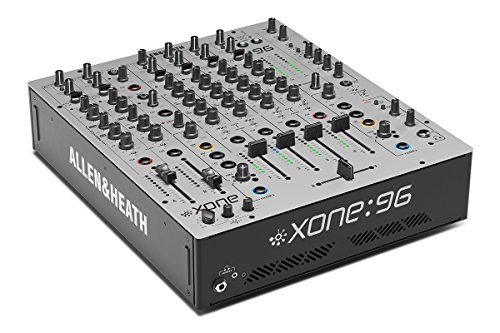
Allen & Heath Xone:96 — Best for Sound Quality
The Xone:96 is where vinyl DJing meets hi-fi values. Its analog mixing path, dual filters with their famous resonance behaviour, and phono stages voiced by a company that cares about sound the way turntable makers do, produce the most flattering record playback in this roundup. Long-blend DJs — house, disco, the slow arts — treat its EQ and filters as instruments, riding mixes for minutes on filter movement alone. If your records are good pressings and your room can hear, this mixer will show you why you bought them.
The Xone way asks commitment: the layout rewards study, the filter discipline takes practice, and the mixer is a serious purchase aimed at serious rigs. Scratch DJs will find their home further down the list; this is a mixer’s mixer for blending. For the vinyl DJ whose first question is always ‘how does it sound?’, the 96 is not one option among six. It is the answer the other five are measured against.
Strengths
- Superb analog sound with phono stages that flatter good pressings
- Dual filters with the revered Xone resonance character
- Six-channel flexibility for decks, returns and hybrid sources
Trade-offs
- Layout and filters demand practice to master
- Serious-tier purchase aimed at serious rigs
- Not voiced for battle/scratch technique
| Detail | What to know |
|---|---|
| Format | 6-channel analog DJ mixer (per Amazon listing title) |
Check on Amazon — check the current price on Amazon before you decide, because bundle contents and included accessories change between listings.
Best for: sound-first DJs playing long blends on quality rigs / Not suited for: scratch DJs or buyers wanting instant familiarity

Pioneer DJ DJM-S11 — Best for Scratch and DVS
The DJM-S11 is what happens when the battle mixer grows up without growing soft. Built for Serato and rekordbox performance, it wraps a competition-grade crossfader, performance pads and a touch screen around two channels that still take real records through proper phono inputs — so a turntablist can warm up on pressings and battle on control vinyl without changing rigs. The fader feel is the headline for hands: this is a mixer designed to be attacked, daily, by professionals.
Its centre of gravity is performance, and pure vinyl traditionalists should know the trade: you are paying for a digital performance engine that a records-only DJ will use at half strength. But for the DJ whose vinyl love and turntablism are the same love — cuts over classics, routines built on real wax and DVS alike — the S11 is the flagship the category points to, and its phono stage means the records themselves never feel like guests at a digital party.
Strengths
- Competition-grade crossfader built for serious scratch technique
- Performance pads and screen for modern turntablist routines
- Real phono inputs alongside full DVS performance
Trade-offs
- Performance engine is wasted on records-only traditionalists
- Flagship-tier pricing within the two-channel class
- Feature depth has a learning curve for new battlers
| Detail | What to know |
|---|---|
| Format | 2-channel scratch-style mixer for Serato DJ Pro / rekordbox (per Amazon listing title) |
Check on Amazon — check the current price on Amazon before you decide, because bundle contents and included accessories change between listings.
Best for: turntablists mixing real vinyl and DVS performance / Not suited for: long-blend selectors or four-deck DJs

Allen & Heath Xone:92 Mk2 — Best Club Classic, Renewed
Few mixers have a genre named in their honour by association, but the Xone:92 spent so long atop techno and house booths that its filter sound is part of those musics’ recorded history. The Mk2 renews the formula — four channels, dual VCF filters, four-band EQ that DJs mix with like a fifth deck — for current production, keeping the analog character that made the original a rider requirement. For vinyl DJs, its phono-equipped channels and blend-friendly layout are the classic club toolkit, restored to new-purchase status.
Choosing between the 92 Mk2 and the 96 above is a genuine fork: the 92 is the purist’s four-channel performance instrument, the 96 the expanded, sound-maximalist flagship. Neither is the sensible budget option, and both assume a DJ who mixes with EQ and filters as primary tools. If your technique is fader-and-blend, look at the Pioneers. If your technique is sculpting, the Xone family is your church, and the 92 Mk2 is its most storied pew.
Strengths
- The classic four-channel club layout with dual VCF filters
- Four-band EQ that functions as a mixing instrument
- Analog character with new-unit reliability in Mk2 form
Trade-offs
- Filter-and-EQ technique demands real practice
- Premium club-tier positioning
- Less digitally integrated than Pioneer performance models
| Detail | What to know |
|---|---|
| Format | 4-channel analog DJ mixer, Mk2 (per Amazon listing title) |
Check on Amazon — check the current price on Amazon before you decide, because bundle contents and included accessories change between listings.
Best for: club DJs mixing with EQ and filters on four channels / Not suited for: scratch DJs or laptop-first performers

Pioneer DJ DJM-250MK2 — Best Value Vinyl Mixer
The DJM-250MK2 is the mixer that starts real vinyl rigs. It keeps the essentials honest — two phono-equipped channels in the club layout, a crossfader with proper curve control, a colour FX filter per channel for the blends beginners dream about — and trims the flagship extras rather than the fundamentals. Crucially for a growing DJ, it unlocks rekordbox DVS, so the same mixer that plays your first records can grow into a control-vinyl rig without replacement.
Its compromises are visible and fair: fewer effects, a simpler feature set, and a build aimed at home and small-venue life rather than nightly club warfare. None of them touch the core job of mixing two records well. For a first serious mixer, a second rig, or a home setup where the big booth mixer is overkill, the 250MK2 is the value pick this guide makes without a single asterisk — the cheapest door into the real thing, held open by the brand that defines the booth.
Strengths
- Real phono channels and club layout at the friendliest tier here
- rekordbox DVS unlock included for future-proof growth
- Colour FX filter makes musical blends accessible to beginners
Trade-offs
- Trimmed effects and features versus the flagship models
- Build aimed at home and small venues, not club warfare
- Two channels cap multi-deck ambitions
| Detail | What to know |
|---|---|
| Format | 2-channel DJ mixer with Sound Color FX and rekordbox DVS unlock (per Amazon listing title) |
Check on Amazon — check the current price on Amazon before you decide, because bundle contents and included accessories change between listings.
Best for: new and growing vinyl DJs, second rigs and home setups / Not suited for: DJs needing four channels or flagship effects

Allen & Heath Xone:43 — Best Four-Channel Value
The Xone:43 is the selector’s value play: four full channels plus an additional channel for a mic or extra source, an analog path, and the signature Xone filter, at a tier a working DJ can justify from gig money. For the vinyl DJ who runs two turntables plus a third deck, a sampler or a guest’s source — the real shape of many club and bar rigs — that channel count at this sound quality is the whole argument, and it is a strong one.
It sits deliberately below its glamorous siblings: no dual-filter theatrics, a plainer feature set, and a working-tool finish. What it keeps is the thing that matters — Allen & Heath’s analog voicing and a filter that makes long blends feel composed rather than merely overlapped. If the 92 and 96 are the dream, the 43 is the honest job, and a great many excellent nights have been mixed on exactly this class of honesty.
Strengths
- Four-plus-one channels for real multi-source rigs
- Signature Xone filter and analog voicing at a working tier
- Straightforward layout a guest DJ can play instantly
Trade-offs
- Single filter versus the dual-filter flagship models
- Plainer feature set than Pioneer performance mixers
- Working-tool finish rather than flagship glamour
| Detail | What to know |
|---|---|
| Format | 4+1-channel analog DJ mixer (per Amazon listing title) |
Check on Amazon — check the current price on Amazon before you decide, because bundle contents and included accessories change between listings.
Best for: selectors and working DJs needing channels and sound on a budget / Not suited for: battlers or DJs wanting dual filters and performance pads
Comparison Table
| Pick | Badge | Key spec | Best for |
|---|---|---|---|
| Pioneer DJ DJM-450 | Best Overall Vinyl Mixer | 2-channel, phono + DVS | two-deck vinyl DJs wanting the club standard at home |
| Allen & Heath Xone:96 | Best for Sound Quality | 6-channel analog, dual filters | sound-first DJs playing long blends on quality rigs |
| Pioneer DJ DJM-S11 | Best for Scratch and DVS | 2-channel battle flagship | turntablists mixing real vinyl and DVS performance |
| Allen & Heath Xone:92 Mk2 | Best Club Classic, Renewed | 4-channel analog, VCF filters | club DJs mixing with EQ and filters on four channels |
| Pioneer DJ DJM-250MK2 | Best Value Vinyl Mixer | 2-channel value, DVS unlock | new and growing vinyl DJs, second rigs and home setups |
| Allen & Heath Xone:43 | Best Four-Channel Value | 4+1 channel analog, Xone filter | selectors and working DJs needing channels and sound on a budget |
How to Choose a Vinyl Mixer: Phono Stages, Faders and Faith
The phono stage is the mixer’s soul and its most lied-about specification. A cartridge outputs a tiny signal that must be amplified enormously and corrected with RIAA equalisation; a cheap stage adds hiss you hear in quiet passages, hum you hear everywhere, and a tonal thinness that makes good pressings sound like bad ones. You cannot judge it from a feature list. You judge it from the mixer’s lineage — companies with hi-fi or serious club heritage voice their phono stages like they mean it — and from the community of record-players who actually use the model. Every mixer in this guide passed that community test before it passed verification.
Faders are the second faith. Battlers need a crossfader that is light, precise and replaceable, with curve control that goes truly sharp. Blenders need smooth, longer-throw channel faders and EQ that subtracts gracefully. Rotary DJs — not represented by a rotary pick here, a gap this guide admits — need neither, and should shop that specialist market deliberately. Buy for the technique you actually practise at 1 a.m., not the technique you perform in your imagination.
Finally, count your real sources. Two turntables is a two-channel life. Two turntables plus DVS plus a third source is a four-channel life wearing a two-channel mixer’s clothes, and the upgrade path from a cramped mixer costs more than buying the channels once. The cheapest vinyl mixer is the one you only buy once.
Setting Up a Vinyl Rig That Does Your Records Justice
Grounding is the first sacrament: the turntable ground wire lands on the mixer’s ground terminal, firmly, every time, or the hum you chase for a month will be that one lazy connection. Keep phono cables short and away from power supplies; the phono signal is the most fragile thing in the building and it appreciates the courtesy. Set cartridge tracking and deck levelling before you judge any mixer — a badly set-up turntable has libelled more good phono stages than any reviewer.
Gain staging is the second sacrament. Run the channel gain so the mixer’s meters live in their healthy middle on your loudest records, trim quieter pressings up rather than driving the master into its ceiling, and remember that vinyl’s dynamic range is the point — a rig set up to make every record equally loud has deleted the music’s weather. Record your own mixes and listen on another system; the rig that sounds honest in the room and honest on the recording is set up correctly, and the one that only flatters itself is not.
How to Set Up and Care for a Vinyl DJ Mixer
Install the mixer where hands, not drinks, live: level, ventilated, with cable runs that keep phono leads short and power leads separate. Connect decks to the phono inputs — never line inputs, whose missing RIAA correction will make records sound like they are playing underwater in another room — attach grounds, and set each channel’s phono/line selector before the first record drops, because the loudest sound in DJing is a line-level signal arriving at a phono input.
Calibrate the crossfader curve to your technique and check it weekly if you scratch; faders collect the room’s dust and your hands’ history, and a fader-care rhythm — compressed air, appropriate fader lubricant where the maker allows it, and covers on when the rig sleeps — is the difference between a five-year fader and a five-month one. Keep the mixer’s dust cover or a cloth on it; vinyl rigs live in dusty air by definition, since the records themselves are dust’s favourite furniture.
Once a season, audit the whole chain with a record you know by heart: cartridge wear, deck pitch accuracy, phono cable integrity, channel balance. A vinyl rig drifts as a system, and the DJ who audits it owns a reference. The DJ who does not owns a mystery that deepens one quiet compromise at a time.
Common Buying Mistakes
Plugging turntables into line inputs. Without RIAA correction and phono gain, records sound thin and wrong. It is the most common vinyl-rig error and the easiest to fix.
Skipping the ground wire. The hum is not character, and it is not the mixer’s fault. Ground every deck, every time.
Buying features instead of a phono stage. Pads and screens do not play records. For a vinyl mixer, the phono section is the product; everything else is furniture.
Under-buying channels. A third source is in your future whether you plan it or not. Channels bought once are cheaper than a mixer bought twice.
Neglecting fader care. Dust and grit are a scratch DJ’s rust. Covers, air and maker-approved care keep a fader competition-fast for years.
Judging a mixer with a badly set-up deck. Tracking force, levelling and cartridge condition libel good equipment daily. Set the turntable up before you review anything downstream of it.
Final Recommendation
Most two-deck vinyl DJs should buy the DJM-450 and stop shopping. Sound-first blenders should save for the Xone:96, with the Xone:92 Mk2 as the classic four-channel alternative and the Xone:43 as its working-value sibling. Battlers belong on the DJM-S11, and new or budget-conscious DJs get the honest start of the DJM-250MK2. Every one of them will play your records properly — which, in a market full of controllers wearing vinyl as a costume, is the entire point.
Set the rig up with the care the guide describes, ground everything, and then do the only thing that ever really mattered: play the records.
Keep exploring the cluster: Best Dj Mixers For Vinyl Best Analog Mixers Best Audio Mixers Under $500 Best Allen And Heath Mixers Best Vinyl Mixers
Phono Stages in Depth: What Your Records Are Really Asking For
A phono cartridge is a tiny generator with an unreasonable job: its output is measured in millivolts, its frequency response is deliberately skewed at the pressing stage, and the mixer’s phono stage must amplify it enormously while applying the RIAA curve that restores tonal balance. Every flaw in that stage is amplified with the music. Hiss that would be inaudible at line level becomes the quiet passage’s wallpaper. Hum from a careless ground becomes a duet partner. A stage voiced without care makes expensive pressings sound like they were cut in a hurry, and the DJ blames the record, the cartridge and the room before suspecting the two small circuits doing the hardest work in the building.
This is why the mixers in this guide were chosen by lineage as much as by specification. Allen & Heath’s hi-fi-adjacent culture and Pioneer’s decades of booth feedback produce phono stages that treat the signal with respect — gain structured sensibly, grounding that works in real rooms with real decks, and a tonal balance that lets a great pressing sound like one. When you audition a vinyl mixer, bring the quietest record you own and a loud one, and listen to the spaces in the music as much as to the music. The spaces are where phono stages confess.
Cartridge matching is the refinement layer: moving-magnet cartridges are the DJ standard and every stage here serves them properly, while exotic low-output designs belong to hi-fi rigs with dedicated stages. Keep the DJ chain honest — good styli, correct tracking, clean records — and a quality mixer’s phono stage will repay the care audibly, in the only currency that matters: you will hear more of what is actually in the grooves.
Mixing Technique by Layout: Battle, Blend and Everything Between
A mixer’s layout is a technique syllabus in disguise. The battle layout — two channels, a light crossfader with sharp curve options, performance features within thumb’s reach — teaches the hands speed and precision: cuts, scratches, transforms and routines where the fader is a percussion instrument. DJs formed on battle mixers develop a relationship with the crossfader that no other layout produces, and the DJM-S11 in this guide exists to serve that formation at the highest level.
The blend layout teaches the opposite virtues: long channel faders, deep EQ, filters with musical resonance, and the patience to let two records converse for minutes. Xone-formed DJs mix with EQ the way battle DJs mix with the crossfader — basslines exchanged like dialogue, filters opening like curtains — and their sets are architecture rather than athletics. Neither formation is superior; they are different instruments that happen to share a name, and the most complete DJs eventually learn to respect both, even if their hands remain loyal to one.
The practical advice is to buy for your formation and borrow for your education. A blend DJ on a battle mixer will fight the crossfader’s hair trigger for years; a battler on a blend mixer will find the faders muddy and the layout slow. Your hands know which DJ you are by the second record. Trust them over the feature list, over the forum consensus and over this guide — then choose the pick that matches, confident that every layout here is represented by its best current example.
Records, Styli and the Chain Around the Mixer
A vinyl mixer is one link in a chain that begins in a groove, and the chain’s other links set the ceiling on everything the mixer can do. The stylus is the first link and the most perishable: a worn stylus does not merely sound dull, it damages records permanently while sounding dull, which makes stylus inspection and scheduled replacement the cheapest insurance in the entire rig. DJ styli live hard lives — back-cueing is controlled abrasion — and the honest rhythm is to replace on hours and symptoms, not on hope.
The turntable itself is the second link: levelled, isolated from the booth’s vibration, with pitch that holds and a tonearm whose bearings have not been argued with. Feedback — the low howl that builds when speakers excite the deck — is a placement and isolation problem long before it is a mixer problem, and the DJ who learns to isolate decks properly will be hired back by rooms that defeated other DJs. Slipmats, record weights and cartridge alignment each contribute their few percent, and in vinyl, percents are the whole game.
Records are the final link and the library itself: cleaned records sound better and wear slower, sleeves and storage protect the investment, and a DJ’s handling — edges only, always — is the difference between a collection and a compost heap in twenty years. The mixer picks in this guide deserve that chain, and the chain deserves them. Vinyl rewards systems thinkers, which is perhaps why its DJs tend to stay for decades.
DVS and Real Records: Running a Hybrid Vinyl Rig
The hybrid rig — real records and control vinyl sharing two turntables — is how most working vinyl DJs actually live now, and the Pioneer picks in this guide are built for exactly that double life. The setup discipline is simple: the mixer’s phono inputs take the decks, the DVS box or built-in interface takes the computer, and the channel selectors become the border crossing between your crates and your library. A hybrid DJ can open with pressings, rescue a missing track from the laptop mid-set, and close with the record that only exists on wax — one rig, no apologies in either direction.
The hybrid life’s pitfalls are organisational rather than technical: control records worn smooth by the same hands that baby the pressings, laptop power and cable discipline at the booth’s edge, and the temptation to let the library’s infinity dissolve the set’s shape. The DJs who hybrid best treat the two sources as two crates with different virtues — the physical crate for identity, the digital crate for reach — and programme accordingly. The mixer does not care which you choose. That indifference, engineered properly, is the feature.
Caring for Faders and Crossfaders: A Working Ritual
Faders die of environment, not of use: dust, drink mist, smoke-era residue in older venues and the simple grit of a thousand hands. The ritual that saves them is boring and total. Covers on whenever the rig is idle — the mixer’s own cover, a cloth, anything that keeps the room off the fader slots. Compressed air along the slots monthly, more often in dusty rooms. Lubricant only where the manufacturer blesses it, in the quantity the manufacturer blesses, because a drowned fader is as dead as a dry one and smells worse.
Crossfaders in battle service deserve their own calendar: inspect for the crackle that announces wear, keep a spare if your income depends on the fader — the performance mixers here are designed for fader replacement as a service event rather than a funeral — and practise the swap before you need it at a venue. The deeper truth is that fader care is a proxy for the whole vinyl discipline: small, regular, unglamorous acts of maintenance that separate the rigs that last a decade from the ones that last a season. Records, styli, decks and mixers all ask the same tithe. Pay it gladly; it is cheaper than the alternative in every currency.
Building the Booth: Isolation, Monitoring and Room Sense
A vinyl booth is an acoustic negotiation between speakers that must be loud and turntables that must not hear them. Isolation is the first clause: decks on solid, level surfaces, isolated from the structure that carries the bass, positioned where the monitors’ direct blast does not rake the platters. The low howl of feedback building under a quiet passage is the booth announcing that this negotiation failed, and no mixer feature fixes it — only placement, isolation and gain discipline do.
Monitoring is the second clause: the DJ hears a booth monitor at close range, balanced so the mix can be judged without the room’s echo voting, and headphones that isolate enough to cue in a loud room without destroying the ears wearing them. The third clause is room sense — the experienced vinyl DJ reads a room’s acoustics in the first three records and adjusts EQ ambitions accordingly, because a set mixed for the brochure photograph of a club sounds very different in the club. The mixers in this guide give that DJ honest tools. The booth, set up with this care, lets the tools tell the truth.
Collecting and Playing: The Home Vinyl Rig as a Serious Setup
Not every vinyl mixer in this guide will see a club; many will anchor home rigs where the audience is friends, the records are a collection, and the mixing is the evening’s entertainment rather than its employment. The home rig deserves the same seriousness in miniature: a mixer with phono stages that flatter good pressings — the Xone family’s home reputation is built on exactly this — decks maintained like instruments, and speakers positioned for listening rather than for furniture symmetry.
The home context changes the buying weights honestly: channel count matters less, sound quality and build matter more, and the mixer’s own pleasure of use — the feel of its knobs at midnight — becomes a legitimate specification. Collections grow into rigs, and rigs into the room friends ask to visit. Buy the home mixer the way you buy the records: for the decades, not the season, and the collection and the equipment will age into each other gracefully.
Needles and Numbers: Setting Up Turntables to Deserve the Mixer
A mixer’s phono stage can only amplify what the cartridge delivers, and the cartridge delivers what its setup allows. Tracking force set to the maker’s specification — measured with a gauge, not guessed from a counterweight’s optimism — is the foundation: too light and the stylus rattles in loud passages, mistracking audibly and wearing the groove; too heavy and it ploughs. DJ cartridges forgive more than hi-fi ones, which is a reason to respect their specifications, not to ignore them.
Levelling and alignment follow: a deck that is not level asks its bearings and its anti-skate to work against gravity’s bias, and a cartridge misaligned in its headshell smears the stereo image that good records work hard to create. None of this needs laboratory equipment — a small level, a protractor, a stylus gauge and twenty unhurried minutes — but it needs doing before the mixer is judged, because a badly set deck has libelled more good phono stages than any critic.
Pitch is the DJ-specific sacrament: check it against a strobe or a trusted reference, because a deck that runs fast makes every record sound hurried and every blend a negotiation. The rig that is set up as a system — decks honest, mixer honest, monitoring honest — disappears, and what is left is the records. That disappearance is the entire goal, and it is achievable at every price point in this guide.
The Social Contract of the Booth: Guest DJs and Shared Rigs
Vinyl rigs are often shared — between residents and guests, between the venue and the visiting act — and a shared rig runs on etiquette that is really engineering in social form. The resident’s mixer settings, gain structure and phono/line assignments are the house’s reference; the guest who re-patches the booth to their own theology and leaves it re-patched has not performed individuality, they have performed sabotage. Play the rig as it stands, adjust what your set needs at the channel level, and return every control to the house position when you finish.
Records carry their own clause: handle by edges, return sleeves to their owners, and never — in any booth, at any hour — place a drink within the turntables’ parish. The mixers in this guide are built to survive professional life, but their faders’ worst enemy has always been the beverage that believed it belonged on the equipment. Venues remember the DJs whose rigs and records survive the night intact, and they rebook them, which makes etiquette a career technology.
For home rigs the contract is simpler and the stakes are sentimental: the collection is a library, the mixer is its reading room, and friends who learn the house rules — clean hands, edges only, the cover back on the idle deck — become the audience the room was built for. A vinyl setup is a small culture. Tend it like one.
Where Vinyl DJing Goes Next: Analogue at the Centre
Vinyl’s revival has matured from novelty into infrastructure: pressing plants with waiting lists, clubs rewiring booths for turntables, and a generation of DJs who learned on controllers choosing records as a deliberate discipline. The mixers in this guide sit at that movement’s centre because they refuse the false choice the last decade offered — they are analog where the record is analog, digital where the library is digital, and honest about which is which. That honesty, more than any feature cycle, is why the format’s equipment keeps improving.
The skills compound in the same direction. A DJ formed on records owns timing, touch and musical memory that transfer to every medium; a collector’s rig becomes a listening room; a listening room becomes the place a community gathers. The equipment decisions in this guide — phono stage first, layout by formation, channels for the real rig — are small acts of respect toward that larger fact.
Buy the mixer that respects your records, set the chain up to deserve it, and the future of the format takes care of itself one side at a time — which is, and has always been, vinyl’s natural unit of time.
Frequently Asked Questions
What makes a mixer good for vinyl?
Its phono stage: quiet, honest RIAA amplification with working grounding, plus EQ and faders suited to your technique. Feature lists impress; phono stages decide.
Can I play vinyl through a controller or line mixer?
Only with a proper phono stage somewhere in the chain. Turntables need RIAA correction and phono-level gain; every mixer in this guide provides it natively.
Two channels or four for a vinyl DJ?
Two for pure two-deck DJing, four the moment a third deck, DVS source, sampler or guest input enters your real life. Most DJs who under-buy channels re-buy within two years.
Is an analog DJ mixer better for vinyl?
For many ears, yes — the Xone models here show why, with phono voicing and filters that flatter records. Digital performance mixers answer with DVS and effects. The guide’s picks respect both religions.
What is DVS and do vinyl DJs need it?
Digital Vinyl System: control records on your turntables steer music files in software. Purists skip it; working DJs love the library it unlocks. The Pioneer picks here support it when you want it.
How do I stop hum from my turntables?
Ground wire firmly on the mixer’s terminal, phono cables short and away from power supplies, and cartridge connections clean. Ninety percent of vinyl hum is one of those three.


