Disclosure: airfryerkitchensupply.com is reader-supported. When you buy through links on our site, we may earn an affiliate commission at no extra cost to you.
Where to buy
Five of the six mixers in this guide exist only in the used, dealer and restoration world, so they carry no product links — their reviews explain where each actually changes hands. The sixth is a current, listing-verified analog mixer included deliberately as the living heir: the one you can buy new today if the vintage hunt, on honest reflection, is not for you.
- Soundcraft Signature Plus 22 (Best Modern Heir — Buy It New) — check price on Amazon
The best vintage mixers — the small, serious mixing desks and broadcast workhorses of the tube and early solid-state era — occupy a peculiar corner of audio. They are too old to be appliances and too useful to be antiques. A good one, serviced and understood, will mix a voice, a small ensemble or a broadcast chain with a colour and a tactile pleasure that no software session quite reproduces. A bad one will eat a year of your life in hum, crackle and forum posts. This guide exists to help you buy the first kind.
Unlike the flagship-console story told in the vintage analog companion piece, this guide lives at the human scale: the broadcast consoles that ran American radio, the little tube mixers that sat beside tape machines, the compact desks that taught a generation of engineers signal flow with their hands. These are the vintage mixers a home or project studio can actually adopt — physically, financially and electrically — and that accessibility is exactly why their market is full of traps for the unwary.
Every vintage pick here is not linked, because none trades new. What the guide gives you instead is the thing that actually protects a vintage buyer: model knowledge, inspection discipline and an honest account of who should walk away and buy the modern heir at the end of the list.
In this guide
Quick Picks
Five genuine vintage mixers at adoptable scale, plus one verified modern heir — each badge says which world it belongs to.
- RCA BC-3 Broadcast Console — Best Vintage Broadcast Console — no link. The radio-era desk: a tube broadcast console whose channels carried American radio voices, and whose preamps are still prized as colour. — sold through used and specialist channels; see the buying notes in its review below
- Altec 1567A Tube Mixer Amplifier — Best Vintage Tube Colour — no link. The little green legend: a compact tube mixer-preamplifier whose channels became a secret weapon on generations of records. — sold through used and specialist channels; see the buying notes in its review below
- Gates Studioette Broadcast Console — Best Vintage Project Console — no link. The approachable broadcast desk: a smaller Gates console that brings radio-era tube mixing within a project studio’s reach and budget. — sold through used and specialist channels; see the buying notes in its review below
- Collins Broadcast Mixing Consoles — Best Vintage Rarity — no link. The connoisseur’s broadcast iron: Collins-built mixing consoles, engineered to an aerospace standard and hunted accordingly. — sold through used and specialist channels; see the buying notes in its review below
- Lang PEQ-era Small Mixer Configurations — Best Vintage Value Project — no link. The engineer’s route in: small mixer paths assembled from Lang-era professional electronics — substance over badge, for technical buyers. — sold through used and specialist channels; see the buying notes in its review below
- Soundcraft Signature Plus 22 — Best Modern Heir — Buy It New. The verified modern answer: a 22-channel analog desk with Lexicon effects and USB-C, voiced in the British tradition the vintage desks created. — Check on Amazon
How These Picks Were Chosen
Selection favoured mixers that meet three tests. First, historical reality: the model must have genuinely worked — in radio stations, small studios and broadcast chains — rather than merely being old stock with a romantic listing description. Second, adoptability: size, power and channel count that a modern project studio can house and feed without facility staff. Third, a survivable service story: schematics that circulate, components a technician can source or substitute honestly, and a community that still answers questions about the model by name.
The modern heir was chosen by the opposite discipline: current production, verified, genuinely analog in control and signal philosophy, and voiced with enough heritage warmth to be a credible answer for the buyer who loves the vintage idea but needs a warranty. Throughout, condition outranks badge, and the reviews say so wherever a model’s reputation tempts buyers to forget it.
The 6 Best Vintage Mixers
RCA BC-3 Broadcast Console — Best Vintage Broadcast Console — no link
The RCA BC-3 is what ‘vintage mixer’ means to the broadcast generation: a tube console built for radio stations, where it mixed announcers, turntables and remotes through long days with professional reliability. Its microphone channels have the classic RCA virtues — transformer character, a midrange that flatters the spoken voice almost suspiciously well, and gain staging that forgives a hot announcer. Studios that adopt a BC-3 usually do so for exactly that voice magic, patching its channels as a front end for narration, podcasting’s serious end and vocal tracking.
Adoption is a commitment with a friendly face. The console is large by project-studio standards, its wiring belongs to another era’s conventions, and a safe, quiet BC-3 is one that a technician has already loved for several bench hours. Connectors, levels and grounding all need translating into a modern room. Do that work once, properly, and the desk becomes what its owners claim: the most charismatic voice channel most studios will ever own, wearing the shape of the console it honestly is.
Strengths
- Legendary spoken-voice channels with classic RCA transformer character
- Broadcast build quality designed for decades of daily service
- A genuine piece of radio history that still earns its place sonically
Trade-offs
- Facility habits: size, heat, period wiring and connectors
- Professional service is a prerequisite, not an upgrade
- Channel count and layout serve broadcast logic, not modern tracking
This pick is written unlinked: there is no verified new-retail listing to link, so judge it on the used-market and dealer guidance in this guide rather than on a buy button.
Best for: voice-focused studios and broadcast-history devotees with technician support / Not suited for: buyers wanting a compact, plug-and-play desk
Altec 1567A Tube Mixer Amplifier — Best Vintage Tube Colour — no link
The 1567A is the vintage mixer for people who collect sounds, not furniture. Altec’s compact tube mixer-amplifier — famous in its green finish — offered a handful of microphone inputs mixed to a single output, and engineers discovered early that driving it with intent produced a saturation and weight that flattered everything from drums to bass to entire rough mixes. Units and their channels have been racked, cloned and mythologised ever since, which tells you most of what you need to know about the sound.
Buying one is buying a component, not a system: you will integrate it, level-match it and house it as the colour device it is. Original transformers and honest tubes decide value; a cosmetically perfect unit with substituted iron is a tribute act at an original’s price. For the studio that already owns clean preamps and wants one unmistakable vintage voice to patch in on the days that call for it, the 1567A remains the most concentrated dose of the era available at any scale.
Strengths
- Concentrated tube-and-transformer saturation engineers have chased for decades
- Compact format integrates as a colour path in any hybrid studio
- Simple circuit that good technicians understand deeply
Trade-offs
- A colour component, not a full mixing solution
- Value lives in original iron — substitutions must be priced as such
- Clean examples are contested and pricing reflects it
This pick is written unlinked: there is no verified new-retail listing to link, so judge it on the used-market and dealer guidance in this guide rather than on a buy button.
Best for: studios wanting one definitive vintage colour channel / Not suited for: anyone needing a complete multi-channel mixer
Gates Studioette Broadcast Console — Best Vintage Project Console — no link
If the RCA consoles are the cathedrals, the Gates Studioette is the parish church — and for many buyers the better purchase. Built for smaller stations and production rooms, it carries the broadcast virtues — robust construction, sensible layout, channels voiced for voice — in a frame a project studio can actually house. Its market position is the other attraction: less auction heat than the famous badges, which means a patient buyer can still find an honest example at project money rather than monument money.
The project’s shape should be clear-eyed. Expect the full vintage liturgy — service, recap decisions, connector translation, a warm relationship with a technician — applied to a desk whose ultimate ceiling is charm and voice character rather than flagship glory. For a studio building a vintage corner deliberately, the Studioette is the rational first console: real broadcast DNA, real tube colour, and a scale of commitment that teaches you whether the vintage life suits you before you marry a flagship.
Strengths
- Broadcast build and voice-first channels at an adoptable scale
- Less collector heat than the famous console badges
- An ideal first vintage console for learning the ownership reality
Trade-offs
- Full vintage service liturgy still applies
- Ceiling is character, not flagship-console authority
- Examples vary enormously; inspection discipline is essential
This pick is written unlinked: there is no verified new-retail listing to link, so judge it on the used-market and dealer guidance in this guide rather than on a buy button.
Best for: first-time vintage console buyers with a project mindset / Not suited for: studios needing a flagship or a warranty
Collins Broadcast Mixing Consoles — Best Vintage Rarity — no link
Collins Radio built equipment the way aviation demanded — over-engineered, beautifully wired, and specified without visible interest in cost — and its broadcast mixing consoles carry that DNA into audio. Engineers who have worked on Collins iron describe the same qualities in every unit: layout logic, component quality and a clean, authoritative sound that belies its tube-era origins. In the vintage mixer market, Collins is the name that makes experienced buyers stop scrolling.
Rarity is the governing fact. These consoles surface infrequently, sell through specialist channels, and reward buyers who have done their network homework long before an example appears — the time to meet the dealers and technicians of this world is while you are saving, not while a listing is live. Condition and completeness rule pricing even more than usual, because parts and knowledge are concentrated. For the right studio, a Collins console is a lifetime instrument. For everyone else, it is the correct answer to a trivia question and a pleasant daydream.
Strengths
- Aerospace-grade build and wiring, unmatched in broadcast audio
- Clean, authoritative sound with genuine collector gravity
- A lifetime instrument for the studio that lands a good one
Trade-offs
- Genuinely rare; buying is a network, not a search
- Parts and knowledge concentrated in few hands
- Premium pricing when documented examples surface
This pick is written unlinked: there is no verified new-retail listing to link, so judge it on the used-market and dealer guidance in this guide rather than on a buy button.
Best for: connoisseur studios with dealer networks and service support / Not suited for: buyers on a deadline or a first-vintage budget
Lang PEQ-era Small Mixer Configurations — Best Vintage Value Project — no link
Not every vintage path begins with a console badge. The professional electronics of the Lang era — built for studios that measured everything — can be assembled into small mixing and front-end configurations that deliver genuine period sound at the least heated prices in this guide. This is the value end of vintage, and it belongs to buyers who read schematics the way other buyers read reviews: the components are excellent, the descriptions in the wild are unreliable, and the spread between those two facts is where the value lives.
The discipline is verification. Completeness — power supplies, correct cabling, matched modules — decides whether you bought a mixer path or a shelf of intentions, and a technician’s pre-purchase opinion is worth more here than anywhere else in the guide. Buyers who do that work assemble front ends with authentic period character for a fraction of console money, and tend to become the people the rest of the market calls for advice. That transformation is, honestly, part of the product.
Strengths
- Genuine period professional sound at the market’s least heated prices
- Modular approach builds exactly the small path you need
- Deep satisfaction for the technically inclined buyer
Trade-offs
- Seller descriptions are unreliable; verification is on you
- Completeness varies and missing power supplies sink projects
- No badge glamour — value is in substance only
This pick is written unlinked: there is no verified new-retail listing to link, so judge it on the used-market and dealer guidance in this guide rather than on a buy button.
Best for: technical buyers building a bespoke vintage front end / Not suited for: buyers wanting a finished, guaranteed console
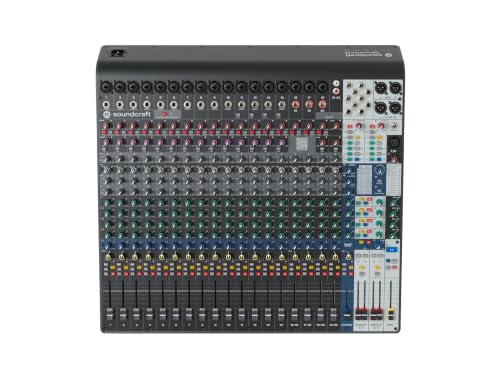
Soundcraft Signature Plus 22 — Best Modern Heir — Buy It New
Every vintage guide owes its readers an exit ramp, and this is it — a current analog mixer that keeps the faith where it matters. The Signature Plus 22 gives you a real channel strip under every finger, a British-voiced analog path, Lexicon effects with their own genuine heritage, and USB-C connectivity for the century we live in. It is what the vintage masters were reaching for, minus the sixty years of component ageing, and it arrives with a warranty instead of a service mystery.
Be clear about the exchange. You give up transformer patina, historical gravity and the saturation behaviour of driven period iron. You gain a desk that works every morning, records and streams without adapters, and frees your budget for the microphones and room treatment that will improve your sound more than any mixer vintage. For most project studios reading a vintage guide with stars in their eyes, this — or its smaller siblings — is secretly the correct purchase, and there is no shame in the guide saying so.
Strengths
- Genuine analog control and British voicing, brand new with warranty
- Lexicon effects and USB-C for modern recording workflows
- Frees budget for microphones and acoustics, where gains are bigger
Trade-offs
- No vintage transformer saturation or historical patina
- Character is a voicing, not period iron
- Purists will still hear the difference on driven sources
| Detail | What to know |
|---|---|
| Format | 22-channel analog mixer, Lexicon FX, USB-C (per Amazon listing title) |
Check on Amazon — check the current price on Amazon before you decide, because bundle contents and included accessories change between listings.
Best for: project studios that love the vintage idea but need modern reliability / Not suited for: collectors and studios committed to genuine period equipment
Comparison Table
| Pick | Badge | Key spec | Best for |
|---|---|---|---|
| RCA BC-3 Broadcast Console | Best Vintage Broadcast Console — no link | Tube broadcast console | voice-focused studios and broadcast-history devotees with technician support |
| Altec 1567A Tube Mixer Amplifier | Best Vintage Tube Colour — no link | Compact tube mixer-amplifier | studios wanting one definitive vintage colour channel |
| Gates Studioette Broadcast Console | Best Vintage Project Console — no link | Compact tube broadcast console | first-time vintage console buyers with a project mindset |
| Collins Broadcast Mixing Consoles | Best Vintage Rarity — no link | Tube-era broadcast console, low production | connoisseur studios with dealer networks and service support |
| Lang PEQ-era Small Mixer Configurations | Best Vintage Value Project — no link | Modular professional electronics, configurable | technical buyers building a bespoke vintage front end |
| Soundcraft Signature Plus 22 | Best Modern Heir — Buy It New | 22-channel analog, Lexicon FX, USB-C | project studios that love the vintage idea but need modern reliability |
How to Choose a Vintage Mixer That Suits Your Real Life
Begin with the unglamorous audit: space, power, heat and help. A tube broadcast console is a piece of furniture that warms a room and expects a technician the way a classic car expects a mechanic. If your studio is a spare bedroom with a breaker that already negotiates with a kettle, your vintage mixer is a racked channel or a compact tube unit, not a console — and choosing it at that scale is wisdom, not surrender. The Altec path and the Lang-style project exist precisely for real rooms.
Next, name the sound you are actually missing. Voice-forward broadcast warmth points to RCA and Gates. Saturation-as-an-effect points to the Altec. Engineering purity points to Collins. Most disappointed vintage buyers skipped this step and bought a famous badge whose character duplicates what they already owned, in a format their room resents. The happiest bought a defined colour at a defined scale and patched it in with intent.
Finally, price the whole first year, not the purchase: service, connectors and cabling translation, a sensible power arrangement, and the spares you will inevitably hunt. A vintage mixer bought with its first year funded is a joy that compounds. The same mixer bought at the edge of a budget is an anxiety with knobs. The modern heir at the end of the list exists for the honest outcome of that arithmetic, and choosing it is a decision this guide respects completely.
The Vintage Mixer Inspection: Ten Minutes That Save Ten Months
Warmth first: power the unit and give it time, because tube equipment tells the truth slowly. Hum that settles is a personality; hum that builds is a power supply introducing itself. Work each channel with the same source at the same level and listen for the family resemblance — channels that sound like strangers to each other mean service, and service means money, and money belongs in the negotiation, not in your surprises.
Then the hands: every pot through its travel, every switch through its cycle, listening for the crackle that exercise cures versus the crackle that stays for dinner. Smell matters too — the sweet, hot smell of cooking dust is normal in a long-stored unit and a warning in a supposedly serviced one. Ask what was replaced, by whom, and what remains original, and write the answers down in front of the seller; memories improve suspiciously after payment.
Close with the paperwork test: schematics available, service history offered, identity plates consistent. A seller who produces documents before you ask is selling a maintained instrument. A seller who produces adjectives is selling a story, and stories, in this market, are priced exactly like mixers until you get them home.
How to Set Up a Vintage Mixer in a Modern Studio
Placement is engineering: ventilation for tube heat, distance from your recording position for the faint mechanical and electrical noises old equipment makes, and a power feed you trust, ideally with the studio’s audio grounding thought through as one system rather than as a pile of adapters. Vintage and modern gear disagree about grounding by default; a technician’s hour at installation prevents the hum safari that ruins so many vintage honeymoons.
Level translation is the second installation. Period inputs expect period levels, and modern interfaces run hot by comparison; pad or stage the gain so the vintage mixer works in its designed range, where its colour is warmth rather than distortion you did not order. Label everything — channels, patches, the settings that sang on the first great session — because a vintage mixer’s value multiplies when its behaviour in your room is documented rather than remembered.
Then adopt the rituals: warm-up before critical work, a session log, spares bought in calm seasons, and an annual professional once-over. Vintage equipment rewards owners who behave like broadcast engineers — the people who kept this gear working for forty years the first time around — and quietly punishes everyone else.
Common Buying Mistakes
Romancing the badge. A tired famous mixer loses to a serviced humble one every session of the week. Condition is the product; the badge is the packaging.
Forgetting the translation costs. Connectors, levels, grounding and power all need adapting to a modern room. Budget them or meet them as emergencies.
Buying a console for a channel’s job. If you need one great voice path, a racked channel or compact tube unit delivers it without adopting a furniture-scale commitment.
Demanding modern silence. Vintage noise floors are real. Gain-staged with respect they sit below the music; hunted with modern expectations they will make you miserable and the mixer innocent.
Skipping the warm-up truth test. Cold demos hide hum, drift and tired tubes. An hour of warm operation is the minimum honest audition.
Having no technician. The recurring sentence of this guide, because it is the recurring cause of vintage regret. Line up service before the purchase, not after the fault.
Final Recommendation
Voice-first studios should hunt the RCA BC-3 or start, wisely, with the Gates Studioette. Colour collectors want the Altec 1567A. Connoisseurs with networks wait for Collins. Technical buyers assemble Lang-era value. And the many readers whose honest audit ends at reliability should buy the Soundcraft Signature Plus 22, spend the difference on microphones, and make records while the rest of us are still warming up tubes — a sentence written with love by a guide that would, on most mornings, do exactly the same.
Whichever door you choose, choose it with the inspection discipline above, and the vintage question will have been answered the way it deserves: by your ears, in your room, on your records.
Keep exploring the cluster: Best Vintage Analog Mixers Best Vintage Ampex Mixers Best Analog Mixers Best Ampex Mixers Best Alternative Audio Mixers
Broadcast DNA: Why Radio Consoles Sound Right for Voice
The small vintage mixers in this guide were mostly born in radio, and radio’s demands explain their enduring virtues. A broadcast console was built to run all day, every day, operated by announcers who were not engineers, carrying voices that had to remain intelligible through car radios and kitchen sets. That brief produced equipment with forgiving gain staging, channels voiced around the spoken voice’s actual frequencies, and construction that treated a decade of daily use as a starting point. Modern voice work — podcasting, narration, streaming — is radio’s brief reincarnated, which is why these desks keep being adopted by people who have never worked in a station.
The voice voicing is the heart of it. Broadcast channels emphasise the presence region where speech intelligibility lives, handle a close microphone’s warmth without muddiness, and saturate so gently that an announcer’s excited peaks round off instead of splintering. A modern clean preamp reproduces a voice accurately; a good broadcast channel reproduces it flatteringly, and audiences have been trained by a century of radio to hear the flattering version as the professional one.
There is a discipline lesson in the broadcast heritage too. These consoles assumed an operator with a free hand and a programme to run, so their controls are few, decisive and laid out for touch. Voice creators drowning in plugin menus often find their first vintage mixer liberating for exactly that reason: the desk makes three decisions available, all of them good, and the show gets made. Limitation, properly engineered, is a workflow feature.
Tubes vs Early Solid-State: The Two Vintage Flavours
Vintage mixers divide into two great flavour families, and choosing between them is the buyer’s first real decision. Tube designs — the RCA, Altec and Gates generation — offer the softest saturation, the most forgiving overload behaviour and a low-end generosity that flatters voice and bass. Their costs are heat, warm-up, tube maintenance and a noise floor that must be managed with gain discipline. For a colour path used with intent, those costs buy the most distinctive sound in this guide.
Early solid-state designs — the transistor generation that followed — trade some of that softness for definition: tighter low end, lower noise, instant readiness and a punch that suits drums and rhythm sources. Their maintenance story is different rather than lighter — ageing capacitors and transistors with their own failure manners — but their operating rhythm suits busier rooms. Many experienced owners end with one of each, patched for different jobs, and describe the pairing the way guitarists describe two good amplifiers.
The beginner’s error is to shop the families as a hierarchy, with tubes as the ‘real’ vintage and transistors as the consolation. The correct frame is a palette. Decide which sources your studio records most, audition both families on those sources if you possibly can, and let the music — not the mythology — assign the budget. The mixer you reach for weekly is the best one, whatever its devices are made of.
Building a Vintage Corner: The Supporting Cast
A vintage mixer does not move into a studio alone; it brings requirements that are best planned as a small system — the vintage corner. Power comes first: clean, stable mains, sensible grounding shared with the modern chain, and surge protection sized for equipment that cannot be replaced at a shop. A corner built on a power strip and optimism will hum its dissatisfaction into every recording, and the hum will be blamed on the mixer, which is innocent.
Interconnection is the second system: period connectors adapted properly — not with a drawer of mystery adapters — levels translated deliberately, and a small patchbay that lets the vintage path be inserted or bypassed in seconds. The patchbay is what turns a vintage mixer from a permanent commitment into a daily tool; colour you must rewire to use is colour you will stop using. Add the documentation habit: a notebook or file per unit, holding serials, service records, tube dates and the settings that sang, stored where the next owner — or the next engineer — will find it.
Finally, the corner wants one modern companion: a clean, quiet interface and monitoring path that tells the truth about what the vintage gear is doing. Vintage equipment judged through vintage monitoring is a hall of flattering mirrors. Judged through an honest modern chain, it becomes what it should be — a known, repeatable, glorious ingredient in a studio that understands itself.
From Station to Studio: How Broadcast Mixers Got Adopted
The migration of broadcast mixers into recording studios is one of audio’s quieter recycling triumphs. When radio stations modernised, their tube consoles and small mixers — built to a standard commercial production rarely matched — entered the used market at prices musicians could reach, and engineers discovered what broadcasters had always known: equipment designed to carry a voice all day, every day, carries a recorded voice beautifully. Studios began racking the channels, then adopting whole small consoles, and a preservation culture formed around equipment that was never designed to be collectible, only to be dependable.
That origin shapes today’s market in the buyer’s favour. Broadcast gear was maintained by professionals on schedules, retired by upgrades rather than failures, and built in numbers that keep a real market alive — three advantages most vintage categories cannot offer simultaneously. It also shapes the gear’s manners: these mixers expect to be used daily and forgive daily use, which makes them the most livable vintage purchases a working studio can make. The adoption story is still being written, now by podcasters and streamers who are, knowingly or not, radio’s heirs.
Racking a Channel: The Smallest Complete Vintage Purchase
For many buyers the right first vintage mixer is not a mixer at all, but one channel of one, professionally racked. A broadcast channel — microphone preamp, its transformers, its gain structure — mounted with a power supply and proper connections becomes a self-contained colour channel that patches into any modern studio. It delivers the essential vintage experience, the sound and the ritual, at the smallest possible commitment of money, space and maintenance, and it teaches the owner whether the vintage life suits them before a console makes the question academic.
Quality in racked channels lives in the racking: clean power, correct loading, honest wiring and the original iron intact. Buy from rackers with names, ask what was replaced and why, and audition the channel on your own voice or your most-recorded source. A good racked channel holds its value, pairs happily with a second when the first proves itself, and has started more vintage collections than any console ever sold — because it is the purchase whose consequences a buyer can actually foresee.
The Home Studio Vintage Setup: Small Room, Real Iron
A home studio adopts vintage differently from a commercial room: one or two pieces, chosen for the sources recorded most, integrated tightly and used daily. The pattern that works is a vintage front end for the hero source — usually the voice — feeding a clean modern interface, with the modern chain handling everything else. This gives the home recordist the vintage sound where it is heard most, in the format their room and budget can keep healthy, without pretending a spare bedroom is a facility.
The disciplines scale down gracefully: one technician relationship, one warm-up ritual, one logbook, spares for one unit rather than a fleet. What does not scale down is the inspection standard — a home buyer’s money is as real as a studio’s, and the same questions about iron, service and identity protect it. The home vintage setup, done this way, is not a compromise version of the professional one. It is the professional one’s logic, correctly sized.
When to Walk Away: Deals That Are Not Deals
Vintage markets reward the buyer who can leave, so here is the leaving list. Walk away from units whose sellers resist internal photographs or warm demonstrations; from badges whose serials do not match their stories; from ‘recently serviced’ claims with no name attached to the service; from prices justified entirely by rarity when the unit’s condition would embarrass a commoner. Each of these is a story being sold at an instrument’s price, and the market contains enough honest instruments to make stories unnecessary.
Walk away, too, from the purchase your life cannot keep: the console your room cannot power, the project your calendar cannot finish, the restoration your budget waves at rather than funds. The vintage mixer you decline today remains available to your future, better-prepared self — these machines have waited sixty years, and they are patient. The one you buy wrong becomes the reason a good machine gets a bad name. Leaving is not losing. In this market, it is the master skill.
The Service Ecosystem: Finding Your Technician Before You Need One
Every vintage mixer purchase is secretly two purchases: the equipment, and the relationship that will keep it alive. The technician ecosystem for vintage audio is a word-of-mouth economy — broadcast engineers who maintain heritage gear as a vocation, studio techs who take outside work selectively, and a small number of specialists whose names recur in every serious conversation about a given brand. Finding yours begins before the purchase: ask in the communities that own your target model, expect a waiting list, and treat the first paid inspection as the relationship’s foundation rather than as an emergency expense.
A good technician changes the economics of everything in this guide. They tell you which listing is a bargain and which is a bonfire, what a fair service costs, which parts to hoard and which fears to retire. Owners routinely report that their technician’s pre-purchase opinion saved more than the mixer’s purchase price across a decade of decisions. That is not an exaggeration available to many professions, and it is the strongest argument in this guide for slowing a purchase down by the two weeks a consultation takes.
Maintain the relationship like the asset it is: pay promptly, describe faults honestly and in writing, keep the logbook your technician will ask for, and never let a small symptom age into a large one out of optimism. Vintage equipment does not usually fail suddenly; it fails gradually, in whispers, to owners who have someone listening. Be one of those owners.
Small Mixers, Big Lessons: What Vintage Teaches a Modern Recordist
A vintage mixer is a curriculum disguised as equipment. It teaches gain staging, because its headroom is finite and its sweet spot must be found by ear. It teaches commitment, because there is no undo on a performed balance and no preset for a house curve. It teaches listening in the pauses, because its noise floor makes silence an audible material rather than an absence. Modern recordists raised on infinite tracks and total recall often describe their first vintage sessions as harder and their tenth as liberating — the constraints turned out to be a teacher with a strict manner and excellent results.
It also teaches maintenance as a creative act: the warm-up ritual that slows the session’s start into attentiveness, the logbook that turns memory into knowledge, the relationship with a technician that models how all craft communities actually work. Studios are not only signal paths; they are cultures, and vintage equipment imports a culture of care that improves everything it touches, including the modern gear sharing the room.
None of this requires a flagship. The smallest pick in this guide teaches the same lessons as the largest, which is why the guide’s structure — start at your scale, with your technician, on your sources — matters more than any single model in it. The diploma is the same size at every scale. Only the tuition varies.
A Buyer’s Final Checklist for Any Vintage Mixer
Identity verified: model, serial and internal photographs agree, and the badge’s story survives arithmetic. Iron assessed: what is original is named, what is replaced is priced as replaced, and the transformers — the value’s core — are accounted for by name. Service state documented: who, when, what was done and what was declined, in writing, from someone whose reputation is reachable. Warm audition completed: an hour powered, every channel exercised, silences listened to, overload behaviour heard.
Ownership funded: the first year’s service, translation and spares are budgeted separately from the purchase, and the room — power, heat, space — has been measured rather than imagined. Technician engaged: a named human has seen the unit or its evidence and agreed to know it. Purpose defined: the mixer’s job in your studio can be said in one sentence, and the sentence is about sound, not about status.
If every line is answered, buy with confidence and keep the checklist with the unit’s papers — the next owner will thank you, possibly in currency. If several lines are blank, the correct purchase is patience, which this market rewards more reliably than any model it sells. The mixers in this guide have waited decades for the right owners. They can wait for you to become one.
Frequently Asked Questions
What is the best vintage mixer for vocals?
For spoken voice and sung vocals alike, the broadcast channels lead: RCA BC-3 for the full console experience, Gates Studioette at project scale, and the Altec 1567A when saturation colour is the goal.
Are vintage mixers reliable enough for a working studio?
A professionally serviced one, kept on a maintenance rhythm, can be dependable for decades — broadcasters proved it. An unserviced one is a project. The difference is not the model; it is the service history.
Why are most picks in this guide not linked?
Vintage mixers are not sold new, so there are no verified retail listings to link. The guide links only the current-production modern heir, verified through the API, and explains real buying routes for the rest.
How much should I budget beyond the purchase price?
Plan for initial professional service, connector and level translation, and a contingency for the first year’s surprises. Studios that fund the first year up front report a completely different ownership experience.
Can a vintage mixer work with a modern DAW setup?
Yes — through sensible level matching and grounding, usually patched in as a front end or colour path. The integration section above covers the approach; a technician’s installation hour is money well spent.
Is a modern analog mixer a cop-out?
No. It is the vintage philosophy — hands-on, one-knob-per-function, performed mixing — with modern reliability. The guide’s heir pick exists because for many studios it is simply the right tool.


