Disclosure: airfryerkitchensupply.com is reader-supported. When you buy through links on our site, we may earn an affiliate commission at no extra cost to you.
Where to buy
If you are shopping for the best stand mixers for cookies, start with this verified shortlist. Every mixer in this cookie guide was verified as a current Amazon listing before a link was attached, with bowl sizes, speed counts and included beaters taken from the listings themselves. We do not print prices — use each link to check price on Amazon and confirm the beater set in the box, since cookie baking lives and dies by the flat beater.
- KitchenAid Artisan 5-Qt Tilt-Head Stand Mixer KSM150PS, Contour Silver — Best Overall for Cookies
- Cuisinart Precision Pro Digital Stand Mixer SMD-50, 5.5-Qt — Best for Big Cookie Batches
- KitchenAid 5.5-Qt Bowl-Lift Stand Mixer KSM55, Porcelain White — Best for Stiff Cookie Doughs
- Hamilton Beach 4-Qt Electric Stand Mixer, 7 Speeds, Black — Best Budget for Cookies
- SMEG SMF04 Classico Stand Mixer, Cream — Best Looking Cookie Station
- KitchenAid Classic Series 4.5-Qt Tilt-Head Stand Mixer K45SS, Onyx Black — Best Classic for Cookies
The best stand mixers for cookies are decided in the first three minutes of a recipe, long before the dough gets stiff. Cookie quality is creaming quality: butter and sugar beaten until genuinely pale and fluffy trap the air that makes a cookie rise and crumble properly, and that stage is where weak mixing quietly ruins more batches than any oven ever has. A cookie mixer therefore needs a beater that reaches the bowl properly, speeds that cream steadily without flinging sugar, and a bowl sized for the double batches that cookie season always demands.
Then comes the second test, the one that breaks lightweights: the finished dough. Flour in, chips in, oats in — a full batch of oatmeal or a stiff shortbread is heavy, dense work, and the mixer must power through the last additions without straining or leaving a floury layer sulking at the bottom of the bowl. The six verified machines below were chosen for both halves of the cookie job: the creaming finesse and the finishing strength.
Whether you bake a dozen on a Sunday or two hundred for the school fair, there is a pick here at your scale — the benchmark all-rounder, a digital batch machine, a bowl-lift for stiff doughs, an honest budget option, a design piece that creams beautifully, and the classic that has started a million cookie traditions.
In this guide
Quick Picks
Best Overall for Cookies — KitchenAid Artisan 5-Qt Tilt-Head Stand Mixer KSM150PS, Contour Silver: The cookie benchmark: superb creaming, a bowl that fits double batches, and a flex-edge ecosystem that ends scraping. Check the current price on Amazon.
Best for Big Cookie Batches — Cuisinart Precision Pro Digital Stand Mixer SMD-50, 5.5-Qt: Programmed consistency for batch after identical batch — the bake-sale and freezer-dough specialist. Check the current price on Amazon.
Best for Stiff Cookie Doughs — KitchenAid 5.5-Qt Bowl-Lift Stand Mixer KSM55, Porcelain White: Bowl-lift composure for the stiffest doughs — shortbread, oatmeal and double batches without the drama. Check the current price on Amazon.
Best Budget for Cookies — Hamilton Beach 4-Qt Electric Stand Mixer, 7 Speeds, Black: The budget cookie answer: proper planetary creaming for cakes-and-cookies kitchens at the lowest tier here. Check the current price on Amazon.
Best Looking Cookie Station — SMEG SMF04 Classico Stand Mixer, Cream: Smooth Start and retro charm; creams properly and looks like the cookie station of a magazine kitchen. Check the current price on Amazon.
Best Classic for Cookies — KitchenAid Classic Series 4.5-Qt Tilt-Head Stand Mixer K45SS, Onyx Black: The classic starter: 4.5 quarts of single-batch cookie tradition with the full KitchenAid speed range. Check the current price on Amazon.
How These Picks Were Chosen
Cookie-specific selection weighted three things. Creaming came first: beater-to-bowl coverage and the planetary touchpoints that decide whether butter and sugar aerate evenly or smear. Bowl capacity for realistic cookie batches came second — a standard batch is roughly a kilo of dough, a double batch is where average mixers start to complain, and December exists. Finishing strength came third: the ability to incorporate the last flour and the heavy add-ins without leaving dry pockets or straining audibly.
All six machines were verified as current listings, and every specification quoted comes from the listing. We kept the set honest across tiers: a budget planetary machine that creams properly is a better cookie pick than a premium machine bought for the wrong reasons, and the reviews say which is which.
Cookie selection also prized a quality that never appears on a specification sheet: how a machine treats the last two minutes of a batch. Cookie dough finishes fast and punishes distraction — flour incorporated in twenty seconds becomes flour overworked in sixty — so we favoured machines whose slowest speeds are genuinely slow and whose controls a baker with buttery hands can operate without a second thought. In cookie baking, the interface is an ingredient.
The 6 Best Stand Mixers for Cookies — Reviewed

KitchenAid Artisan 5-Qt Tilt-Head Stand Mixer KSM150PS, Contour Silver — Best Overall for Cookies
The Artisan fits the all-purpose cookie baker: weekly batches, holiday doubles, every style from whipped shortbread to chunky oatmeal. Its bowl is the size cookie recipes are written for, and the available flex-edge beater ecosystem answers the one chore cookie dough always imposes — scraping.
Cookie dough is a sneaky load: cold butter, heavy sugar and a final addition of chips that turns the bowl stiff all at once. The KitchenAid Artisan 5-Qt Tilt-Head Stand Mixer KSM150PS, Contour Silver creams properly first — which is where cookie texture is actually decided — and then works the finished dough without complaint.
Strengths
- The benchmark bowl size: written into a generation of recipes, so quantities just work
- A stir-to-whip speed range that covers the whole home repertoire without gaps
- Ownership infrastructure — spares, bowls, beaters, service — that no rival matches for depth
Trade-offs
- Its popularity means colour pricing is a lottery; patience finds the same machine cheaper
- A tilt-head will always be less rigid than a bowl-lift at the extremes of dough
- It is the default choice, which makes it the least personal one on this list
| Specification | Detail |
|---|---|
| Bowl | 5 qt, stainless steel |
| Design | Tilt-head |
| Speeds | 10 speed settings |
| Included | Pouring shield, flat beater, dough hook, wire whip (per listing) |
Ask a room of experienced home bakers what mixer they own and the Artisan is the answer you will hear most — not because it tops every specification, but because it has no weak chapter. Creaming: excellent. Whipping: excellent. Dough at home scale: capable and calm. Support in year nine: a phone call, not a research project. Machines become defaults by accumulating years of unremarkable reliability, and the Artisan has accumulated more of those years, in more kitchens, than anything else in this guide.
Best for: weekly cookie baking and holiday double batches / Not suited for: the very stiffest oversized dough loads
Check the current price on Amazon
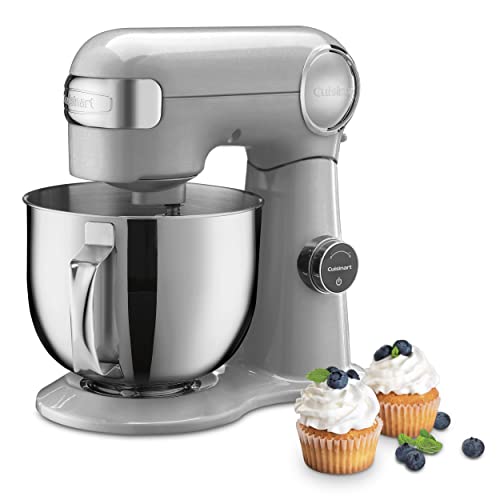
Cuisinart Precision Pro Digital Stand Mixer SMD-50, 5.5-Qt — Best for Big Cookie Batches
The SMD-50 fits the batch-systematic cookie baker: the one who makes dough in multiples, freezes it in logs and bakes to order. Programmed settings mean batch twelve creams exactly like batch one, and the digital readout turns a good recipe into a repeatable process.
For cookies, the Cuisinart Precision Pro Digital Stand Mixer SMD-50, 5.5-Qt earns its keep at the creaming stage, beating butter and sugar to the pale, fluffy point that recipes demand and cheap mixing so often short-changes; everything after that is easy work by comparison.
Strengths
- Three preprogrammed settings turn recipes into repeatable routines
- The digital dial gives exact, returnable speeds — batch twelve matches batch one
- Shares the strong 5.5-quart, 12-speed hardware of its manual sibling
Trade-offs
- Bakers who mix by ear and eye may find the programs a language they never speak
- A digital control is a future service consideration a lever never poses
- Costs a step above the manual SM-50 for the same bowl and tools
| Specification | Detail |
|---|---|
| Bowl | 5.5 qt |
| Design | Digital control dial |
| Speeds | 12 speeds, 3 preprogrammed food prep settings |
| Included | Whisk, flat mixing paddle, dough hook, splash guard |
The SMD-50 is the mixer for bakers who keep notebooks. Its programs encode the boring parts of technique — the timed knead, the staged whip — so attention can go to the parts that cannot be encoded: the look of the dough, the smell of the bake. In batch work the consistency is almost unfair; in daily work the dial’s precision becomes a habit you miss on other machines. It is the same kitchen tool as its manual sibling, tuned for a more systematic mind.
Best for: systematic batch baking and freezer dough production / Not suited for: bakers who dislike digital controls
Check the current price on Amazon
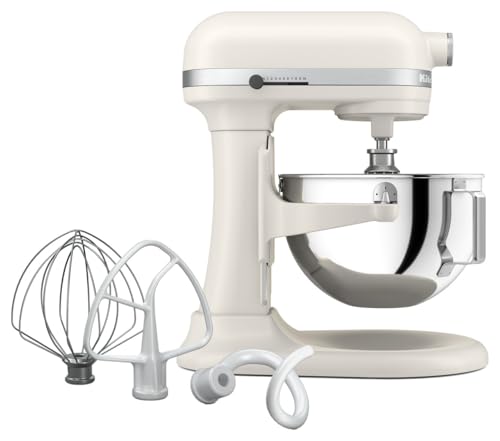
KitchenAid 5.5-Qt Bowl-Lift Stand Mixer KSM55, Porcelain White — Best for Stiff Cookie Doughs
The KSM55 fits the stiff-dough specialist: shortbread pressed hard, oatmeal loaded with additions, gingerbread rolled thick. The bowl-lift frame keeps the machine composed through the finishing stage where tilt-heads start to nod, and the gentle fold speed protects delicate doughs at the other extreme.
Cookie dough is a sneaky load: cold butter, heavy sugar and a final addition of chips that turns the bowl stiff all at once. The KitchenAid 5.5-Qt Bowl-Lift Stand Mixer KSM55, Porcelain White creams properly first — which is where cookie texture is actually decided — and then works the finished dough without complaint.
Strengths
- Bowl-lift rigidity that turns long kneads from a performance into a process
- Eleven speeds with a fold setting — power at the top, tact at the bottom
- The KitchenAid hub and spares ecosystem, on the stronger frame
Trade-offs
- Height and weight commit you: measure first, love it second
- Bowl handling is a deliberate two-hand job compared with tilt-head casualness
- For pure cake work in small batches, a tilt-head is frankly friendlier
| Specification | Detail |
|---|---|
| Bowl | 5.5 qt, stainless steel |
| Design | Bowl-lift |
| Speeds | 11 mixing speeds |
| Included | Flat beater, dough hook, wire whip |
The KSM55 is the answer to a specific baker’s sentence: ‘I love my tilt-head, but…’ — but the dough walks it, but the head nods, but the batch must be split. The lift frame answers every clause of that sentence while keeping the platform, the speeds and the ecosystem that made the tilt-head lovable. It is less an upgrade than a correction, aimed at bakers whose repertoire outgrew a design rather than a brand, and it lands precisely on that target.
Best for: stiff, heavy cookie doughs and double batches / Not suited for: tiny counters or cupboard storage
Check the current price on Amazon

Hamilton Beach 4-Qt Electric Stand Mixer, 7 Speeds, Black — Best Budget for Cookies
The Hamilton Beach fits the cheerful home cookie baker — a batch on Sunday, brownies for the bake sale, frosting for birthdays — whose budget prefers to be spent on good chocolate. It creams properly, finishes standard doughs, and asks for moderation only with the stiffest doubles.
For cookies, the Hamilton Beach 4-Qt Electric Stand Mixer, 7 Speeds, Black earns its keep at the creaming stage, beating butter and sugar to the pale, fluffy point that recipes demand and cheap mixing so often short-changes; everything after that is easy work by comparison.
Strengths
- Planetary coverage means the beater reaches the bowl’s edges without constant scraping
- Suction-friendly light weight plus a carry handle — built to be fetched and stored
- A full three-tool set and splash guard included at the lowest tier in this guide
Trade-offs
- Keep dough batches small and soft; the 300-watt drive is honest about its limits
- The 4-quart bowl is a ceiling, not a suggestion, for batch size
- On glossy counters it can travel under load without a mat beneath it
| Specification | Detail |
|---|---|
| Bowl | 4 qt |
| Design | Planetary mixing action, easy-carry handle |
| Speeds | 7 speeds |
| Power | 300 watts (per listing) |
| Included | Whisk, flat beater, dough hook, splash guard |
Judged on its own brief — affordable, light, planetary — this Hamilton Beach is a small triumph of priorities. The money went into the mixing action and the tool set, not into mass or theatre, and the result is a machine that makes the weekly bake dramatically easier for the price of a few bags of flour over a hand mixer. It will not be the last mixer a keen baker owns, but as the first one, or the cupboard one, or the holiday-home one, it understands its assignment completely.
Best for: standard cookie batches on a budget / Not suited for: stiff double batches at maximum fill
Check the current price on Amazon

SMEG SMF04 Classico Stand Mixer, Cream — Best Looking Cookie Station
The SMEG fits the baker whose cookie ritual is also a pleasure of place: the machine lives out, looks wonderful, and its Smooth Start keeps the sugar in the bowl during those first seconds. Under the styling is a real 600W planetary drive that creams and finishes credibly.
Cookie dough is a sneaky load: cold butter, heavy sugar and a final addition of chips that turns the bowl stiff all at once. The SMEG SMF04 Classico Stand Mixer, Cream creams properly first — which is where cookie texture is actually decided — and then works the finished dough without complaint.
Strengths
- Smooth Start brings dry ingredients up to speed without the cloud
- Steady Mix gearing keeps the chosen speed honest under changing loads
- A 5-quart steel bowl and 600W drive — substance sized for real baking, not display
Trade-offs
- The design premium is real; specification-for-money rivals undercut it
- Colour choice is a commitment — this machine will be seen every day
- Attachment range is a short list next to the hub platforms
| Specification | Detail |
|---|---|
| Bowl | 5 qt, stainless steel |
| Design | Planetary mixer, retro 50s styling |
| Power | 600W motor (per listing) |
| Speeds | 10 speeds, Smooth Start and Steady Mix system |
It is easy to file the SMEG under ‘style’ and miss the engineering brief: a planetary drive with a soft-start system and load-steady speed control, wrapped in the most considered industrial design in the category. In the kitchen it behaves like what it is — a serious mid-size mixer — while changing the room like a piece of furniture. Bakers who cook in designed kitchens are not being frivolous when they choose it; they are buying the one appliance that is looked at daily and asking it to deserve the attention twice over.
Best for: bakers who want the ritual to look as good as it tastes / Not suited for: maximum capacity per pound spent
Check the current price on Amazon

KitchenAid Classic Series 4.5-Qt Tilt-Head Stand Mixer K45SS, Onyx Black — Best Classic for Cookies
The Classic fits the single-batch traditionalist: one recipe, one bowl, perfect cookies, done. Its 4.5-quart bowl is exactly a standard batch, its speeds are the full KitchenAid range, and it is the machine most likely to be handed down with the recipe cards still tucked in its box.
For cookies, the KitchenAid Classic Series 4.5-Qt Tilt-Head Stand Mixer K45SS, Onyx Black earns its keep at the creaming stage, beating butter and sugar to the pale, fluffy point that recipes demand and cheap mixing so often short-changes; everything after that is easy work by comparison.
Strengths
- Full 10-speed range and 59-point planetary coverage at the lowest KitchenAid tier
- Metal construction that can be serviced rather than a sealed unit that cannot
- The same attachment hub as the flagship models, so accessories bought later still fit
Trade-offs
- A 4.5-quart bowl is a single-batch world; plan doubles as two singles
- Fewer bundled extras than the Artisan — the shield and spare tools are later purchases
- The design is deliberately plain; you are buying mechanism, not jewellery
| Specification | Detail |
|---|---|
| Bowl | 4.5 qt |
| Design | Tilt-head, metal construction |
| Speeds | 10 speeds |
| Mixing action | 59 touchpoints around the bowl (per listing) |
There is a reason the Classic has introduced more bakers to stand mixing than any other machine: it removes every decision except the baking. The speeds are the real range, the bowl is the recipe-book size, the hub accepts the whole accessory future, and the price of entry is the lowest that still buys the genuine article. Bakers who start here and stay with it for a decade are not settling — they are demonstrating that the centre of the KitchenAid range was the right address all along.
Best for: single standard batches, baked often / Not suited for: regular double batches
Check the current price on Amazon
Comparison Table
| Pick | Badge | Key spec | Best for |
|---|---|---|---|
| KitchenAid Artisan 5-Qt Tilt-Head Stand Mixer KSM150PS, Contour Silver | Best Overall for Cookies | 5 qt, stainless steel | weekly cookie baking and holiday double batches |
| Cuisinart Precision Pro Digital Stand Mixer SMD-50, 5.5-Qt | Best for Big Cookie Batches | 5.5 qt | systematic batch baking and freezer dough production |
| KitchenAid 5.5-Qt Bowl-Lift Stand Mixer KSM55, Porcelain White | Best for Stiff Cookie Doughs | 5.5 qt, stainless steel | stiff, heavy cookie doughs and double batches |
| Hamilton Beach 4-Qt Electric Stand Mixer, 7 Speeds, Black | Best Budget for Cookies | 4 qt | standard cookie batches on a budget |
| SMEG SMF04 Classico Stand Mixer, Cream | Best Looking Cookie Station | 5 qt, stainless steel | bakers who want the ritual to look as good as it tastes |
| KitchenAid Classic Series 4.5-Qt Tilt-Head Stand Mixer K45SS, Onyx Black | Best Classic for Cookies | 4.5 qt | single standard batches, baked often |
How to Choose a Stand Mixer for Cookies
Match the bowl to your batch habit, honestly counted. A standard cookie recipe makes roughly 24–36 cookies and about a kilo of dough; a 4.5 to 5.5-quart bowl handles it with room for proper mixing action. If your habit is doubling — for freezers, fairs or families — step to the bowl-lift or digital batch picks, because a doubled stiff dough in a small bowl mixes unevenly no matter how good the machine is, leaving flour pockets that bake into white streaks.
Creaming geometry matters more for cookies than for almost anything else. The beater must pass close to the bowl’s bottom and sides across its whole orbit — this is what ‘planetary touchpoints’ marketing is reaching for — because butter left in a dead zone is butter that never aerated, and the cookies know. A flex-edge beater, standard or accessory depending on the model, converts that geometry into continuous scraping and is the single most cookie-relevant feature a mixer can offer.
Speed behaviour at the start is the third test. Cookie making begins with dry-ish, splash-prone ingredients twice per batch — sugar at the creaming, flour at the finish. A machine with a gentle start or a genuinely slow first speed keeps both in the bowl. The SMEG’s Smooth Start and the bowl-lift KitchenAid’s half-speed fold are designed answers to exactly this, and they matter more to cookie bakers than any top-speed figure.
The Cookie Dough Loads, Ranked by What They Ask of a Mixer
Easiest: drop cookies with soft doughs — chocolate chip at standard batch, peanut butter — which ask for good creaming and a calm finish. Middle: cut-out sugar cookies and gingerbread, where the dough firms as flour hydrates and chilling does half the work. Hardest: stiff shortbread, loaded oatmeal and any double batch, where the final dough is closer to a soft brick than a batter and the mixer’s frame, not its speed dial, decides success. Choose your machine for the hardest dough you make regularly, and everything easier is a pleasure.
Add-ins deserve a word. Chips, nuts and dried fruit should be folded in at the lowest speed for a few turns, or by hand, whatever the recipe’s romance says — a mixer at working speed will smash chocolate chips into shards and turn nuts into gravel at the bowl’s edge. The fold-speed machines in this guide genuinely shine here; on other machines, the spatula is the right tool and there is no shame in it.
Freezer Dough: The Batch Baker’s System
The stand mixer’s greatest cookie gift is not any single batch — it is the freezer system it enables. A free afternoon, a capable machine and three recipes become a freezer stocked with portioned dough: logs for slice-and-bake, scooped balls for drop cookies, ready for the oven at twenty minutes’ notice for a month. This is why batch capacity and repeatable settings matter, and why the SMD-50’s programmed consistency earns its place in a cookie guide: the system only works if batch one and batch five are the same dough.
Portion before freezing, freeze on trays before bagging, and label with the recipe and the bake temperature — future you is a stranger who will not remember. Dough made in a mixer creams more thoroughly than hand-mixed dough, and thorough creaming freezes and re-bakes more evenly, which is one more quiet reason the machine improves cookies it never sees baked.
Cookie Styles and the Machines That Suit Them
Drop cookies — chocolate chip, oatmeal, peanut butter — are the democratic centre of cookie baking: they need honest creaming and a calm finish, and every pick in this guide serves them. Cut-out cookies — sugar cookies, gingerbread — add a firmness test: the dough must come together without warming, then chill and roll without a fight; mid-tier machines and above handle the firmer doughs at single-batch scale, and the bowl-lift pick takes over when the recipe doubles for a decorating party. Whipped and meringue-based cookies invert the test entirely: the whisk and the bowl’s coverage matter, the motor’s muscle is irrelevant, and the mid-size picks shine.
Bar cookies and brownies are the mixer’s easiest work and the beginner’s best friend — one bowl, one beater, no portioning — while sandwich cookies and filled cookies are really two mixing jobs (cookie plus filling) and quietly argue for the second bowl we keep recommending. Read your own cookie repertoire the way you would read a recipe: the styles you bake most should choose the machine, and the styles you bake at Christmas should merely be possible in it.
Portioning, Chilling and Baking: The System Around the Mixer
A scoop is the cookie baker’s second machine. Portioning dough with a consistent scoop makes every cookie in the batch the same thickness, which makes them bake at the same rate, which eliminates the tray of mixed fates — burnt edges at the back, raw centres at the front — that bakers blame on ovens. The mixer gives you a uniform dough; the scoop gives you uniform cookies; the oven merely finishes the argument. Buy the scoop in the size your favourite recipe wants and the system’s weakest link disappears.
Chilling is the other half of the system, and the mixer enables it by making dough fast enough that chilling never feels like a delay. Chilled dough spreads less, handles better and — because the flour hydrates and the flavours marry — tastes more like itself. The freezer-dough system in the buying guide is chilling taken to its logical end: the machine’s speed converts a free afternoon into a month of cookies, and the only discipline required is labelling, because frozen doughs are anonymous in a way that has embarrassed every baker at least once.
How to Mix Cookie Dough in a Stand Mixer, Stage by Stage
Stage one, the creaming, decides the cookies. Butter at cool room temperature and the sugars go in together on a medium speed for a full three to four minutes — longer than most recipes bother to say — until the mixture is noticeably paler, fluffier and increased in volume. Scrape the bowl once halfway. This is not mixing; it is aeration, and it is the step the machine exists to make effortless. Eggs follow one at a time, each fully absorbed, with the vanilla; a curdled look at this stage is fixed by a spoonful of the recipe’s flour, not by panic.
Stage two, the dry ingredients, is where restraint lives. Flour, raising agents and salt go in together, in two additions, at the lowest speed, mixing only until the flour disappears — ten to twenty seconds per addition. Every turn beyond that develops gluten and turns tender cookies tough. If your machine’s slowest speed is brisk, pulse it; if the bowl is small and the batch big, finish the last streaks by hand. The dough should look just-combined and slightly shaggy, not polished.
Stage three, the add-ins: chips, nuts, fruit, in at the lowest speed for three or four turns of the beater, or folded with a spatula. Then stop. Rest the dough if the recipe asks — many cookie doughs improve with a chill that firms the butter and hydrates the flour — and portion with a scoop so the batch bakes evenly.
Stage four is the habit that keeps cookie baking pleasant: wash the bowl and beater while the first tray bakes. Cookie dough dries like cement, and a clean station is the difference between ‘let us make another batch’ and ‘never again’. The machine did the hard minutes; the baker’s discipline is in the minutes around them.
Calibrate your creaming once, properly, and the knowledge lasts forever. Weigh butter and sugar into the bowl, cream at your usual speed, and stop every minute to look — really look — at the colour and texture. Note the minute at which the mixture turns pale and fluffy in your machine, with your butter, in your kitchen. That number, give or take the seasons, is your creaming time for every cookie recipe that does not specify one, and it will serve you longer than any attachment you ever buy.
Finally, learn your oven’s tray geography with the test-cookie habit: two cookies, one at the tray’s centre and one at its corner, baked alone. Their difference in spread and colour is your oven’s map — where the hot spots live, whether trays need rotating, whether the back row wants a minute less. A uniform dough from a good mixer makes the map legible, because the dough stops being a variable; what remains is the oven, telling the truth at last.
The December Test: Planning a Holiday Baking Day
December is when cookie mixers are audited. A serious holiday session — four recipes, doubled, across one day — tests everything this guide has discussed: creaming quality at repetition, bowl capacity at the double, the frame’s composure with stiff gingerbread, and the baker’s system around the machine. Plan it like a production day: butter softening in waves, dry ingredients pre-measured per recipe, the freezer-dough logic applied in reverse — bake the slice-and-bake logs first while the big doughs chill, and sequence the oven so the mixer is never the idle station.
The machines separate themselves honestly on such a day. The batch picks — the SMD-50’s programmed consistency, the KSM55’s composure — turn the day into a rhythm. The mid-tier all-rounders handle it with a mid-day pause and a split batch or two. The budget pick asks for singles and patience, and delivers them cheerfully if the plan respects its scale. None of this is a verdict on the machines; it is a description of fit, which is all a good guide can offer and all a wise buyer needs.
And bake two test cookies from the first batch of the day, before the production begins in earnest. December’s ingredients are expensive, the recipients are beloved, and the test cookies are the cheapest insurance in the whole operation — a principle that, like most of the principles in this guide, turns out to be about attention rather than equipment.
Scaling Recipes: The Cookie Baker’s Multiplication Rules
Cookie recipes scale, but not by simple multiplication of everything. Dough quantities double cleanly — flour, butter, sugar, eggs — and a mixer sized for the double batch handles them as one dough. Leavening scales nearly cleanly at home quantities, though very large batches sometimes want a whisper less soda as mixing distributes it more thoroughly than hand work does. Salt and spices scale by taste rather than arithmetic: double them, then taste the dough — bakers have permission — and expect the second doubling to want less than double again, because a big, thoroughly mixed dough presents flavour more efficiently.
Mixing time does not scale. A double batch creams in roughly the same minutes as a single, because the beater’s work per revolution covers more dough at the same aeration rate — watch the colour, not the clock, and expect the finish stage to want a few extra turns for the larger mass to circulate. Chilling time scales upward: a doubled log is thicker, and a thicker log needs longer to chill through. Portioning before chilling abolishes the problem, which is one more argument for the scoop-and-tray system.
Oven time does not scale at all — a cookie bakes in its minutes regardless of how many siblings wait their turn — which is why production cookie days are oven-limited, not mixer-limited, and why the smart batch baker mixes the next dough while the current tray bakes. Master these asymmetries and the double batch stops being an act of optimism and becomes what it should be: the same cookies, twice, on purpose.
Decorating and Finishing: Where the Mixer Helps Twice
A cookie is not finished when it leaves the oven, and the mixer returns for the second act: frostings, glazes, sandwich fillings and the whipped toppings that turn a batch into an occasion. This is the quiet argument for keeping the bowl and beater washed between acts — the same machine that made the dough makes the filling, and a cook who plans the sequence (dough, chill, bake, wash, frost) finds the mixer working three times in one recipe without ever feeling like the bottleneck.
Frosting rewards the same discipline as creaming, because it is creaming: butter beaten properly first, sugar added gradually at a modest speed to keep it in the bowl and the texture smooth, liquid by the spoonful at the end. Sandwich fillings want the opposite — brief, gentle combining that keeps texture — and glazes want only the whisk and thirty seconds. The cookie baker who learns the machine across both acts owns the whole recipe, from first creaming to final swirl.
Common Buying Mistakes
Stopping the creaming when the mixture merely looks combined. Combined is not creamed. Butter and sugar need minutes to turn pale and aerated, and that air is the cookie’s crumb. The mixer makes the full time free — take all of it, every batch.
Mixing the flour stage at working speed. Speed after flour means gluten, and gluten means tough cookies. Lowest speed, briefest time, finish by hand if needed. tenderness is lost in seconds and cannot be recovered.
Letting the machine demolish the add-ins. Chips become shards and nuts become gravel at beater speed. Fold add-ins at the slowest setting for a few turns or by hand — the distribution will be better and the texture will survive.
Doubling a stiff recipe into a small bowl. The dough cannot circulate, the bottom stays floury and the machine strains. Either split the batch or use a machine sized for doubles — this guide marks which picks those are.
Skipping the mid-creaming scrape. A ring of unaerated butter at the bowl’s edge becomes streaks in the dough and uneven spread in the oven. One scrape, halfway through creaming, is the cheapest quality step in cookie baking.
Baking the whole batch to ‘test’ the dough. Bake two test cookies first. Spread, thickness and timing reveal themselves on two cookies; the rest of the dough can still be chilled, floured or portioned differently. The mixer gave you a uniform dough — the test bake tells you what your oven will do with it.
Final Recommendation
For most cookie bakers the Artisan is the complete answer — creaming, capacity and the flex-edge ecosystem in one machine. Batch bakers should take the SMD-50’s programmed repeatability, stiff-dough specialists the KSM55’s bowl-lift composure, budget bakers the Hamilton Beach without a qualm, and traditionalists the Classic. The SMEG is for the baker who wants the station beautiful as well as capable. Widen the view with Best Stand Mixers For Baking and Best Stand Mixers For Beginners, or compare everything in Best Kitchen Stand Mixers.
Check the beater set on the live listing before you order, and if a flex-edge beater is available for your chosen model, it is the one addition a cookie baker will use on literally every batch.
The shortlist, if you are deciding today: KitchenAid Artisan 5-Qt Tilt-Head Stand Mixer KSM150PS, Contour Silver for the headline recommendation, Cuisinart Precision Pro Digital Stand Mixer SMD-50, 5.5-Qt as the value alternative, and KitchenAid 5.5-Qt Bowl-Lift Stand Mixer KSM55, Porcelain White where the specific need in this guide is strongest. Each name links to its verified listing, where you can check price on Amazon and confirm the exact configuration before you commit.
Frequently Asked Questions
What size mixer do I need for a double batch of cookies?
A double batch of a standard recipe is roughly two kilos of dough. A 5.5-quart bowl handles most double batches of soft dough; for stiff doughs doubled, step up to a bowl-lift machine like the KSM55 in this guide. In a 4.5-quart bowl, split the double into two singles — the cookies will mix more evenly and taste better for it.
Why do my cookies spread too much when I use a stand mixer?
Usually over-creaming or warm butter. A powerful machine creams faster than your arm did, so the same minutes can overshoot into butter that is too aerated and warm. Use cool room-temperature butter, cream to pale and fluffy — not to soft and glossy — and chill the portioned dough before baking if spread persists.
Is a flex-edge beater worth it for cookies?
Yes — it is the most cookie-specific accessory there is. It scrapes the bowl continuously during creaming and mixing, eliminating the unaerated ring of butter that causes streaky dough. If your model offers one and you bake cookies monthly, it pays for itself in consistency within a few batches.
Can a stand mixer handle stiff shortbread dough?
The right ones can: bowl-lift frames and strong mid-tier machines finish stiff shortbread at sensible batch sizes. Lightweight budget mixers should keep shortbread to single, moderate batches. Bring butter to cool room temperature rather than cold — the machine should work firmly, not fight a brick.
Should I mix chocolate chips in with the beater?
Only briefly, at the lowest speed — three or four turns — or fold them in by hand. Extended machine mixing breaks chips and smears chocolate through the dough. The exception is a machine with a true fold speed, which can distribute add-ins gently for a few extra turns.
How do I stop flour flying everywhere when adding it to cookie dough?
Add flour in two portions, start at the lowest speed each time, and use a pouring shield or drape a tea towel over the bowl for the first seconds if your machine starts briskly. Machines with a gentle-start feature or a half-speed fold setting — two picks in this guide have them — make the problem mostly disappear.
How do I keep cookie dough from sticking to the beater and bowl?
A light film of dough on the beater is normal and harmless; dough that wraps the beater and climbs is usually too warm or slightly under-floured. Chill the bowl of dough for fifteen minutes and finish mixing cold, scrape the beater down once during the finish, and resist adding flour beyond the recipe — stickiness at mixing often resolves completely in the chill the recipe probably already asks for.
Why do my cookies brown unevenly even with a good mixer?
Because the mixer only guarantees a uniform dough; the oven decides the bake, and most home ovens have hot spots. Rotate trays halfway, bake one tray at a time for important batches, and use the two-cookie test from this guide to map your oven once. When the dough is consistent — which is the mixer’s whole contribution — oven behaviour becomes predictable, and predictable can always be managed.

