Disclosure: airfryerkitchensupply.com is reader-supported. When you buy through links on our site, we may earn an affiliate commission at no extra cost to you.
Where to buy
Film sound is a promise made to the edit: every line of dialogue captured cleanly, in sync, on its own track, with a mix track for dailies and the metadata to find it all again. The mixer-recorders below were verified against their current listings — several verified live for this guide — and the spec boxes state only what the listings claim: inputs, tracks, float recording, timecode and sync features.
- Sound Devices MixPre-10 II (Best Overall for Film) — Check the current price on Amazon
- Zoom F8n Pro (Best Value Professional) — Check the current price on Amazon
- Zoom F6 (Best Compact Production Rig) — Check the current price on Amazon
- Sound Devices MixPre-3 II (Best for Solo Shooters) — Check the current price on Amazon
- Zoom F3 (Best Plant and Backup Recorder) — Check the current price on Amazon
- TASCAM Portacapture X8 (Best for Beginners and Second Units) — Check the current price on Amazon
No fixed prices are printed here, because professional audio pricing moves with bundles and seasons; check the current price on Amazon for the exact model and confirm whether a listing is the recorder alone or a kit with media and accessories. On a film, the recorder is the cheapest insurance on the call sheet — buy for the production scale in the guide below.
The best sound mixers film productions rely on are bag-worn mixer-recorders, and the job they do is more specific than ‘record audio’. A production sound mixer delivers isolated tracks for every microphone, a real-time mix for dailies and the director’s headphones, timecode that marries sound to picture across every camera, and reports that let post-production navigate thousands of files. The recorders in this guide are ranked on that full deliverable — not merely on how good a single microphone can sound through them.
Two technologies define the modern film recorder. The first is 32-bit float recording, which has effectively abolished the clipped take: whispered lines and sudden shouts both survive to the mix, and the recordist’s attention moves from defensive gain-riding to listening, booming and problem-solving. The second is serious timecode and sync infrastructure — the difference between an edit that assembles itself and an edit that burns days on manual sync. Every pick here offers float; the professional picks add the sync depth scripted production demands.
Scale is the deciding variable, and this guide is honest about it. A solo shooter with a boom and two lavaliers needs a different station from a scripted production running eight wireless channels, two booms and a playback feed. The six picks span that range deliberately — from the MixPre-10 II’s full production capacity down to the F3 as a plant and backup recorder — because professional kits are built in layers, and today’s second unit is tomorrow’s A-rig.
If your work is documentary or events rather than scripted film, the companion field guide in this cluster overlaps heavily and leans further toward run-and-gun virtues. This guide leans the other way: toward sync, tracks, metadata and the discipline of the set.
There is a temptation, reading professional gear guides, to treat the flagship as the aspiration and everything else as compromise. Resist it in this category. Film sound departments are ecosystems of specialised layers — the A-rig, the plant unit, the second-unit recorder, the backup — and a kit assembled thoughtfully across the tiers in this guide will out-produce a single flagship standing alone with inadequate wireless, power and media around it. The rankings that follow are therefore best read as a kit list as much as a contest: each badge names the layer that pick serves best.
In this guide
Quick Picks
- Sound Devices MixPre-10 II — Best Overall for Film. The fullest MixPre: Kashmir preamps, 32-bit float multitrack and capacity for a complete wireless dialogue rig — the recorder a scripted production builds its sound department around. Check the current price on Amazon
- Zoom F8n Pro — Best Value Professional. Eight inputs, ten tracks, dual SD recording, Ambisonics mode and Bluetooth control per its listing — a professional film feature set at a fraction of flagship money. Check the current price on Amazon
- Zoom F6 — Best Compact Production Rig. Six XLR inputs, up to 14 tracks, float recording and timecode I/O in the smallest professional footprint here — the documentary-feature and small-crew film station. Check the current price on Amazon
- Sound Devices MixPre-3 II — Best for Solo Shooters. Boom plus two lavaliers, Kashmir preamps, float recording — the solo film shooter’s rig, built to flagship standards in a three-input body. Check the current price on Amazon
- Zoom F3 — Best Plant and Backup Recorder. Two locking inputs and float recording in a mount-anywhere body — the professional’s secret weapon for car rigs, hidden plants and a backup that actually saves days. Check the current price on Amazon
- TASCAM Portacapture X8 — Best for Beginners and Second Units. Built-in microphones, XLR inputs, float multitrack and preset-driven operation — the recorder a small production can hand to a second unit or a beginner without fear. Check the current price on Amazon
How These Picks Were Chosen
Candidates were verified, most of them live for this guide, confirming exact model, stated inputs and tracks, 32-bit float recording and timecode features. Consumer handheld recorders without professional inputs or sync were excluded from the main ranking — film sets are unforgiving environments for toys — as were studio consoles and live boards, which belong to other guides in this cluster. What remains is the equipment a production sound department actually specifies.
Ranking weighed, in order: preamp quality (dialogue is captured once, at whatever level the moment gives you), input and track capacity against scripted-production realities, timecode and sync integrity, power and media workflow across a twelve-hour day, and the control surface’s usability in a bag, on a cart, at speed. Brand service and post-house familiarity acted as the tiebreaker they genuinely are in professional life: a recorder the rental houses stock and the editors trust carries an advantage no specification can print.
The 6 Best Sound Mixers for Film

Sound Devices MixPre-10 II — Best Overall for Film
The MixPre-10 II is the flagship of this guide because scripted film is a capacity game played at the highest quality level. Sound Devices’ listing states a portable 32-bit float multichannel recorder/mixer and USB interface; in production terms that means enough inputs for a full cast of wireless lavaliers plus booms, Kashmir preamps on every channel, float recording across the multitrack, and the metering and reporting discipline post-production expects by name.
Strengths
- Input capacity for a complete dialogue rig — multiple lavaliers, booms and utility channels without a second recorder
- Kashmir preamps give dialogue the quiet, refined gain that survives the final mix’s scrutiny
- 32-bit float across the multitrack abolishes the clipped take on unpredictable performances
Trade-offs
- The premium is real: this is a professional’s capital purchase, amortised across productions
- Capacity invites a bigger bag — power, wireless receivers and cabling scale with the channel count
- Solo and micro-crew work will rarely use half of it; smaller MixPre and Zoom picks serve those days better
- Format: 32-bit float multitrack (as listed)
- Preamps: Sound Devices Kashmir class
- Roles: Recorder/mixer + USB audio interface
- Class: Full production capacity
Scripted dialogue is recorded once, under schedule pressure, with performances that cannot be exactly repeated — and then it is listened to, alone, at cinema volume. That is the environment the MixPre-10 II is built for. Its preamps keep a whispered confession and a shouted argument equally clean; its track count means every performer is isolated for the dialogue edit; its workflow produces the sound reports and metadata that keep a feature’s post-production sane.
The USB interface role matters between productions more than buyers expect: the same unit becomes the ADR-adjacent, voiceover and remote-session station, so the capital purchase keeps working on non-shooting days. Professional tools justify themselves in utilisation, and few recorders are this utilisable.
Against the Zoom F8n Pro below, the contest is refinement and ecosystem against value and track-count generosity. Productions with the budget choose Sound Devices for the preamps and the name on the sound report; productions without it lose surprisingly little with the Zoom. Both judgements are respectable, and this guide’s badges simply record which side of the line the majority of scripted work falls on.
Best for: scripted features, series and commercials running full wireless dialogue rigs / Not suited for: micro-crews and solo shooters whose rigs never exceed three or four inputs
Check the current price on Amazon
Zoom F8n Pro — Best Value Professional
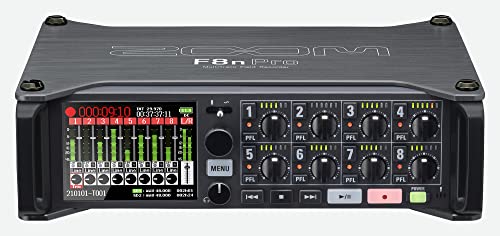
The F8n Pro is Zoom’s direct challenge to the professional establishment, and its listing reads like a production sound checklist: eight inputs, ten tracks, 32-bit float clip-free recording, dual SD card slots, an Ambisonics mode and wireless Bluetooth control. Dual media alone — simultaneous recording to two cards — is a feature productions pay flagship money for, because it makes the day’s audio exist twice from the moment it is captured.
Strengths
- Dual SD recording gives instant media redundancy — the professional feature money usually cannot buy at this tier
- Eight inputs and ten tracks cover most scripted rigs, with Ambisonics for VR and immersive work
- Bluetooth control suits bag and cart work where the recorder is not always within arm’s reach
Trade-offs
- Preamps are very good rather than Kashmir-class; the quietest dialogue work hears the difference
- The control surface and menus reward study — it is a professional tool, not an intuitive toy
- Sound Devices’ rental-house ubiquity still eases crewing and spares in a way Zoom is building toward
- Inputs: 8 (as listed)
- Tracks: 10
- Format: 32-bit float
- Media: Dual SD cards
- Extras: Ambisonics mode, Bluetooth control
Judge the F8n Pro by a shooting day and it keeps answering correctly. Eight inputs swallow a six-lav cast plus two booms. Dual cards end the backup anxiety at the recorder level. Float recording removes the gain gamble. Timecode support in this class keeps the edit honest. The compromises live in the last degrees — preamp refinement on the quietest material, and the tactile luxury of flagship controls — which many productions will never shoot material quiet enough to expose.
Its Ambisonics mode is a genuine second career: immersive, VR and 360 productions are a growing specialism, and owning a recorder that serves both conventional and immersive work widens the jobs its owner can accept. Versatility is a business feature, and this recorder has it in depth.
For independent features, series work and owner-operator sound departments, the F8n Pro is the rational flagship: professional deliverables, professional redundancy, and a price that leaves budget for the microphones and wireless systems that flank it — which, as the guide sections argue, is where balanced money belongs.
Best for: independent features and series needing eight inputs, dual media and float at a working price / Not suited for: productions specifying Sound Devices by name, or the quietest dialogue work at any cost
Check the current price on Amazon

Zoom F6 — Best Compact Production Rig
The F6 compresses the professional film brief into a remarkably small bag. Its listing states six XLR inputs, up to 14 tracks, dual A/D converters for 32-bit float, timecode I/O and wireless control. For the enormous middle of film work — short films, documentaries with scripted elements, commercials, corporate features — six inputs with proper sync and float is not a compromise; it is the correct size.
Strengths
- Timecode I/O at this size and tier keeps small crews professionally synced
- Fourteen-track capacity records iso tracks, mix and safeties with room to spare
- Compact bag footprint suits the mobile, small-crew reality of most modern production
Trade-offs
- Six inputs is the ceiling — a seventh simultaneous microphone needs a different station
- Compact controls are less tactile than flagship faders for active cart mixing
- Preamp refinement sits a step below the Sound Devices picks on the quietest dialogue
- Inputs: 6 XLR (as listed)
- Tracks: Up to 14
- Format: 32-bit float, dual A/D
- Sync: Timecode I/O
The F6’s track generosity deserves attention: beyond the six iso inputs, its capacity accommodates the mix track and safety copies that professional delivery requires, so the small rig produces a full-size deliverable. Editors receiving F6 media from a competent recordist get everything they would get from a flagship — synced, isolated, reported — at a fraction of the production’s equipment line.
Its size changes what crews attempt. A recorder this compact lives on the sound recordist rather than on a cart, which suits the location-hopping grammar of contemporary production: smaller units, faster moves, fewer vehicles. The F6 did not merely shrink the film recorder; it matched it to how films are now actually shot.
The ceiling is the honest caveat, and productions should count their busiest dialogue day before choosing: a full-cast scene with six lavaliers leaves no boom input, and that arithmetic, not brand preference, is what should send a production to the F8n Pro or MixPre-10 II.
Best for: short films, documentaries, commercials and small crews needing pro sync and float in a compact bag / Not suited for: large-cast dialogue days exceeding six simultaneous inputs
Check the current price on Amazon

Sound Devices MixPre-3 II — Best for Solo Shooters
Most films by count are made by tiny crews, and the MixPre-3 II is their professional station: Sound Devices’ listing states a portable 32-bit float multichannel recorder/mixer and USB interface, in the line’s smallest form. Three inputs cover the canonical solo rig — boom and two wireless lavaliers — with the same Kashmir preamps the flagship carries, because a two-hander’s dialogue deserves the same capture quality as an ensemble’s.
Strengths
- Flagship preamps on the classic three-input film rig — no quality apology for small crews
- Float recording lets a solo operator boom and monitor without riding gain
- Sound Devices workflow and reporting keep even micro-productions post-friendly
Trade-offs
- A third lavalier or second boom exceeds it instantly — count the cast before the shoot, and before the purchase
- Premium pricing per input is the highest here, as professional miniaturisation always is
- No built-in microphones or Ambisonics — it is a focused dialogue tool
- Format: 32-bit float multitrack (as listed)
- Preamps: Sound Devices Kashmir class
- Roles: Recorder/mixer + USB interface
- Class: Compact professional
The two-hander is cinema’s most common dialogue configuration, and the MixPre-3 II treats it with full seriousness: each performer isolated on a Kashmir-fed track, the boom as both primary and safety, float headroom forgiving the performance that suddenly plays bigger. Short films and indie features shot on this class of rig routinely reach festivals with dialogue that embarrasses bigger productions’ — because capture quality is about preamps and discipline, not channel counts.
Its limits are a feature of its honesty. It does not pretend to scale; it perfects a defined rig. Owners whose work grows past three inputs keep it as the B-rig, the plant recorder and the interface — roles it fills for a career, which softens the premium considerably.
Choose it when your films are small and your standards are not. Choose the F6 when headcount is uncertain, and the MixPre-10 II when the productions themselves have already grown.
Best for: solo shooters and micro-crews filming two-handers and small scenes to a professional standard / Not suited for: ensemble scenes or any production whose cast count is still growing
Check the current price on Amazon

Zoom F3 — Best Plant and Backup Recorder
Every experienced film recordist owns a recorder like the F3, whether or not it is their main station. Its listing states two locking XLR/TRS inputs, dual A/D converters with 32-bit float, battery power and wireless control. That combination — tiny, locking, float, unattended-safe — makes it the plant recorder for car dialogue, the hidden unit in a practical set, and the backup that turns a main-recorder failure from a lost day into a footnote.
Strengths
- Locking connectors and float format make unattended placement genuinely safe
- Mounts anywhere: rigs, vehicles, furniture, boom poles — positions a main recorder cannot occupy
- Wireless control allows level checks and roll commands without disturbing the set or the plant
Trade-offs
- Two inputs only — it complements a main station rather than replacing one
- No timecode of its own in the flagship sense; sync plants by slate or waveform as the workflow allows
- Its very simplicity tempts under-budgeting: it still deserves proper microphones and power
- Inputs: 2 locking XLR/TRS (as listed)
- Format: 32-bit float, dual A/D
- Power: Battery powered
- Control: Wireless control support
Car dialogue is the F3’s showcase. Rigging a main recorder into a picture car is slow and intrusive; an F3 with two plant microphones, set before the drive and recovered after, captures the scene with the vehicle actually moving and the actors actually performing. Float recording is what makes the gamble sane — road roar and shouted lines both survive — and wireless control lets the recordist verify from the follow vehicle.
As insurance it is unmatched value. A main recorder is a single point of failure on a day that costs a production vastly more than an F3; running the little Zoom as a parallel safety on the boom feed is the cheapest risk management in the sound budget. Professionals do not buy it instead of a station; they buy it because they have seen the day it saves.
Its presence in a film guide, badged honestly as a specialist, reflects how film kits actually work: layers of capability, each sized to its task. The F3 is the layer that is always in the bag.
Best for: plant recording, vehicle rigs, hidden positions and parallel backup on any film set / Not suited for: serving as a production’s only recorder beyond two-microphone work
Check the current price on Amazon

TASCAM Portacapture X8 — Best for Beginners and Second Units
Not every film task can wait for the sound department, and the Portacapture X8 covers the rest: its listing states a 32-bit float, 8-channel multitrack field recorder, and the design pairs built-in stereo microphones with XLR inputs under a preset-driven touchscreen. Second units grabbing ambience, behind-the-scenes crews, student films and micro-productions get real multitrack float recording with a learning curve measured in minutes.
Strengths
- Built-in microphones capture ambience, wild sound and BTS audio with zero rigging
- Presets make correct operation achievable by non-specialists — a genuine production asset
- XLR inputs and multitrack depth let it step up when a real microphone rig is available
Trade-offs
- It is not a dialogue station for scripted A-unit work — the picks above exist for that
- Onboard mics hear the recorder’s handling and position; placement discipline matters
- Touchscreen-first control is less certain in rain, gloves and dark bags than physical controls
- Format: 32-bit float, 8-channel multitrack (as listed)
- Microphones: Built-in stereo pair + XLR inputs
- Interface: Touchscreen presets
- Audience: Second units, students, micro-productions
Productions run on parallel work: while the A-unit shoots dialogue, someone should be capturing the location’s ambience, the crowd’s wild tracks, the specific sounds the location will never offer again. The X8 is the recorder that someone can actually operate — presets set, float forgiving, built-in mics ready — and the material it gathers routinely saves mixes and wins sound-design options in post.
For student and first-time filmmakers it is also the honest recommendation: its ceiling is lower than the professional picks, but its floor — the worst result a beginner can get from it — is dramatically higher, because float and presets remove the classic beginner failures. Learning film sound on forgiving equipment builds the judgement to deserve unforgiving equipment later.
Treat it as what it is — the production’s utility recorder and the beginner’s school — and it earns its place in a film guide without pretending to the A-unit’s chair.
Best for: second units, ambience and BTS capture, student films and micro-productions / Not suited for: primary dialogue recording on scripted professional productions
Check the current price on Amazon
Comparison Table
| Pick | Badge | Key spec | Best for |
|---|---|---|---|
| Sound Devices MixPre-10 II | Best Overall for Film | 32-bit float, Kashmir preamps, full production capacity | scripted features, series and commercials running full wireless dialogue rigs |
| Zoom F8n Pro | Best Value Professional | 8 inputs, 10 tracks, dual SD, 32-bit float | independent features and series needing eight inputs, dual media and float at a working price |
| Zoom F6 | Best Compact Production Rig | 6 XLR, 14 tracks, timecode I/O, 32-bit float | short films, documentaries, commercials and small crews needing pro sync and float in a compact bag |
| Sound Devices MixPre-3 II | Best for Solo Shooters | 32-bit float, Kashmir preamps, 3-input pro rig | solo shooters and micro-crews filming two-handers and small scenes to a professional standard |
| Zoom F3 | Best Plant and Backup Recorder | 2 locking inputs, 32-bit float, mount-anywhere | plant recording, vehicle rigs, hidden positions and parallel backup on any film set |
| TASCAM Portacapture X8 | Best for Beginners and Second Units | 32-bit float multitrack, built-in mics + XLR, presets | second units, ambience and BTS capture, student films and micro-productions |
How to Choose the Best Sound Mixers for Film Production
Start from the script, not the catalogue. Count the speaking cast in the largest dialogue scene, add booms (one for most work, two for wide-and-tight coverage or noisy locations), then add the utility channels productions forget: playback for music scenes, a plant for the car, a spare for the microphone that fails at 4 p.m. That total is your input requirement, and it maps directly onto this guide: three for two-handers, six for small ensembles, eight to ten-plus for full productions. Buying below the script’s number rents the difference back at daily rates.
Then weigh the deliverable infrastructure. Timecode that jams reliably with the camera department, sound reports and metadata the editor can navigate, dual media or a disciplined backup ritual, and power that spans the shooting day — these unglamorous systems decide whether the edit praises or curses the sound department. Float recording, present across this guide, has simplified the gain question; the remaining professional differentiators are exactly these workflow systems, plus the preamp quality that dialogue at cinema volume will eventually expose.
Bag versus cart: two working styles
Bag work — recorder worn, following the camera — suits documentaries, small crews and mobile locations, and favours the compact picks: F6, MixPre-3 II, F3 plants. Cart work — a stationary sound station with faders, monitors and a boom operator on comms — suits scripted production at scale and favours capacity and control surface: MixPre-10 II, F8n Pro. Many recordists own toward one style and rent toward the other; buying your dominant style first is the economical order.
The mix track still matters
In an iso-track world it is tempting to treat the mix track as vestigial. Directors, dailies and editors disagree: the mix is what everyone hears until the final sound edit, and a good real-time mix — booms favoured, lavaliers tucked beneath — shapes the production’s confidence in its own footage. Choose a recorder whose mixing and monitoring you can actually perform at speed, not merely one that records many tracks and mixes none.
Timecode and Sync: The Invisible Deliverable
Sync is where amateur film sound becomes professional, because its absence is paid for in the edit at hourly rates. A proper workflow jams timecode between recorder and cameras at the day’s start and after every battery change or power cycle, verifies drift at lunch, and delivers files whose timecode matches the picture’s. The recorders at the top of this guide are built for that discipline; the smaller picks serve productions whose scale lets a slate and waveform sync carry the load.
Whichever tier you work at, adopt the verification habit: shoot a clap, sync it in the edit that evening, and confirm the system before day two. Sync problems discovered on day one are a settings change; discovered in post, they are a budget line and a reputation. The recorder cannot supply the habit, but the professional picks here are designed to reward it.
Power, Media and the Twelve-Hour Day
Film days are long, and a recorder ecosystem must be sized for the longest one, not the average. Professional bags centralise power — smart batteries or sled systems feeding recorder, wireless receivers and timecode boxes — with hot-swap discipline so no single change silences the rig mid-take. Media follows the same logic: cards sized for a full day of multitrack float files, dual recording where the recorder offers it, and a lunch-and-wrap offload ritual to two destinations, verified before any card cycles back.
Build these systems when you buy the recorder, not after the first failure. The recorder’s price is the visible part of a film sound budget; power, media, wireless and microphones are the rest of the iceberg, and the guide’s FAQ gives the honest proportion. Productions forgive many things; lost or unsynced dialogue is not among them, and the systems in this section are how professionals make sure it never happens.
Working With the Boom: The Mixer’s Other Half
Half of every dialogue track is decided above the frame line. The production mixer’s craft includes cueing the boom operator — through comms, through the mix itself, through the quiet choreography of rehearsal — so the microphone is close, on-axis and ahead of the line. Recorders support this with low-latency monitoring, talkback and return feeds; the professional picks here assume that ecosystem. When you evaluate a film recorder, evaluate how it treats the boom channel: its metering visibility, its headphone mix priority, its limiter or float strategy. The boom is usually the hero track of the final mix, and the recorder should behave as if it knows that.
Lavaliers, by contrast, are the insurance that became a co-star. Modern audiences hear lav-fed dialogue constantly, and the mixer’s job is to keep the two sources’ characters compatible — matched levels, matched tone, and iso tracks clean enough for the dialogue editor to choose per line. Multitrack capacity, per-channel control and honest metering are what make that possible at cast scale, and they are the practical reasons the top of this ranking looks the way it does.
The Sound Report: Small Document, Large Career
Every professional delivery includes a sound report: the map between files, scenes, takes and notes — which microphone was on whom, which take had the aeroplane, which wild line lives where. Recorders that generate structured metadata and reports save post-production hours and mark their operator as a professional. It is an unglamorous criterion that never appears in marketing, and experienced producers ask about it by name.
Build the habit whatever recorder you choose: consistent file naming, scene/take metadata entered at the slate rather than reconstructed at wrap, and notes made in the moment. The recorder is the filing cabinet; the recordist is the librarian. Post-production remembers the librarians whose deliveries assemble themselves, and rehires them — which makes metadata discipline, oddly, one of the highest-return skills in this entire guide.
Dialogue Craft: What the Recorder Cannot Do for You
A film recorder captures what microphones give it, and microphone craft remains the sound department’s core skill: the boom placed close and on-axis without shadowing the frame, lavaliers dressed against clothing noise, plants hidden where the scene’s sound actually happens. The best recorder in this guide, fed a distant boom and rustling lavaliers, produces pristine recordings of bad sound. Budget and rehearsal time allocated to microphone craft return more audible quality than any recorder upgrade — a truth worth printing in a guide that sells recorders.
Monitoring is the craft’s other half. The recordist’s headphones are the production’s only real-time quality control; problems heard are problems fixable — a repositioned lav, a silenced appliance, a take flagged for ADR while the set still stands. Every pick here drives proper location headphones. Wear them, always, and let the recorder’s excellence be the last line of defence rather than the only one.
How to Set Up a Film Sound Rig for a Shooting Day
A film sound day is won before the first slate. This sequence commissions the rig in the order that protects the production.
- The night before: charge every battery in the ecosystem, format cards in the recorder, and review the call sheet and script sides for the day’s cast count, locations and special needs (playback, vehicles, water).
- Build the bag or cart: recorder, wireless receivers scanned and coordinated for the location, boom and plant microphones rigged, timecode boxes ready.
- Jam timecode with the camera department and verify by recording a test clap that will be checked — not assumed — at the first offload.
- Set recorder project parameters: float format, track naming and routing (iso tracks plus mix), metadata fields for scene and take, and headphone monitoring you trust.
- Dress and test every lavalier on its performer, listening solo to each channel for clothing noise and placement before the first rehearsal ends.
- Record room tone at every location — a minute of the set’s silence with everyone still — before the company moves; editors will bless your name for it.
- Offload at lunch and at wrap to two destinations, verify playback from the copies, and complete the sound report while the day is fresh.
- Reset for tomorrow before you rest: batteries on charge, cards accounted for, faults noted and spares ordered while there is still time to get them.
Notice that recording talent appears nowhere in that list — it is assumed. What separates professional film sound is the system around the talent: power, sync, media and reporting, executed identically on the tired Friday as on the fresh Monday. Choose a recorder that supports the system, then be the recordist who runs it.
And keep a personal fault log across productions: every cable that crackled, every battery that underperformed, every setting that confused a day-one assistant. Equipment memory is a competitive advantage in a freelance craft — the recordist who has already made a mistake once, on paper, rarely makes it twice on a set where a hundred people are waiting on sound.
Common Buying Mistakes
- Counting cast, forgetting booms and utilities. Inputs serve microphones, not actors alone. Booms, plants, playback and spares all consume channels.
- Treating timecode as optional on multi-camera work. Manual sync at scale is an edit-budget bonfire. Jam properly, verify early, every day.
- Running a single card with no backup ritual. Dual media or disciplined offloads — one of the two must exist. Hope is not a media strategy.
- Under-powering the rig. A recorder ecosystem dies as a system. Size batteries for the longest day and hot-swap before empty, not after.
- Letting the mix track slide. Dailies and directors judge the production by the mix. Iso tracks are for post; the mix is for today.
- Upgrading the recorder before the microphones. Capture quality is set at the microphone. Balance the chain before gilding its centre.
Final Recommendation
For scripted production at full scale, the Sound Devices MixPre-10 II is the station: capacity, Kashmir preamps, float and the workflow post-production trusts. The Zoom F8n Pro delivers the professional checklist — eight inputs, dual media, float — at the value end of professional money, and the F6 compresses the same virtues for small crews and documentary-features. The MixPre-3 II perfects the solo two-hander rig, the F3 disappears into plants and backups, and the Portacapture X8 arms the second unit and the beginner.
Choose from the script outward: cast count, booms, sync discipline, media safety. A film’s dialogue is recorded exactly once, on a day that cannot be recalled, and the recorder is where that day is either preserved or apologised for. Buy the station your productions actually need, build the systems around it, and the sound department becomes what it should be — invisible, because nothing ever goes wrong.
If the budget forces a choice between the recorder you want and the system it needs, fund the system: a mid-tier recorder inside a complete ecosystem — power, media, wireless, sync, spares — outperforms a flagship starved of its supporting cast on every measurable day of production. The rankings above assume their ecosystems; honour that assumption in the budget, and any of the six will serve the film in front of it.
Keep exploring the cluster: Best Sound Mixers Field Best Sound Mixers Best Sound Mixers For Podcasting Best Sound Mixers For Churches
Frequently Asked Questions
What is the difference between a film sound mixer and a field recorder?
In modern practice they have merged: the film ‘mixer’ is a mixer-recorder that combines preamps, a real-time mix, isolated multitrack recording, timecode and reporting in one bag-worn unit. The film-specific emphasis versus general field recording is sync discipline, track capacity for casts, mix tracks for dailies and metadata for post — which is how this guide’s ranking is weighted.
How many inputs does a feature film need?
Count the largest dialogue scene’s cast, add one or two booms, a plant channel and a spare: most independent features land between six and ten inputs, which is why the F8n Pro and MixPre-10 II anchor this guide. Two-handers and shorts live happily at three to six. The script, read honestly, is the only reliable sizing tool. Read it with the AD’s schedule in hand, too: the day that stacks the wedding scene, the car work and the playback number into one unit day is the day your input count, power and media plans are all tested at once — size for that day and the rest of the schedule feels easy.
Why is 32-bit float such a big deal for film?
Performances are unpredictable and unrepeatable: a whisper can become a shout inside one take. Float recording captures both without clipping or noise penalty, so the recordist can concentrate on microphone placement and listening instead of defensive gain-riding. On a film set, where a ruined take costs the whole unit’s time, that insurance is transformative rather than merely convenient. It has also changed set etiquette for the better: actors no longer need to ‘give one for level’ at performance intensity, and directors hear in dailies a dynamic honesty that older workflows, gained cautiously against clipping, rarely captured.
Do I need dual SD card recording?
You need the outcome it provides — the day’s audio existing twice — by one method or another. Dual recording provides it at the moment of capture, which is the safest version. A rigorous lunch-and-wrap offload to two verified destinations is the accepted alternative. What is not acceptable on a paid production is a single card carrying the only copy of a day’s dialogue until someone gets around to it. Media itself is the cheapest line in the entire sound budget; productions that economise there are saving pennies against the cost of reshooting a day, which is the only alternative when the single copy fails.
Can one person handle film sound alone?
For small productions, yes — that is the MixPre-3 II and F6 brief: boom operated by the recordist or a stand, lavaliers dressed at call time, float forgiving the levels nobody can ride. As cast and camera counts grow, the boom operator becomes a separate human necessity; no recorder repeals the geometry of being in two places at once. Honest crewing is a sound-quality decision. It is also a safety and morale one: the solo recordist who is also booming, dressing mics and managing media across a fourteen-hour day will make the day’s one mistake in its final hour, which is precisely when the schedule can least afford it.
What else does a film sound budget need besides the recorder?
Microphones (boom, lavaliers, plants), wireless systems, a boom pole and suspension, wind protection, timecode boxes where the workflow needs them, power systems, media, headphones and a bag or cart. As a working proportion, the recorder is commonly a third to a half of a professional kit’s cost. Budgeting the recorder as the whole purchase produces a fine recorder listening to inadequate microphones — the most expensive way to record mediocre sound.


