Disclosure: airfryerkitchensupply.com is reader-supported. When you buy through links on our site, we may earn an affiliate commission at no extra cost to you.
Where to buy
Shopping for the best small 120 volt electric dryers? The fastest way to buy any pick in this guide is through Amazon, where stock, delivery and returns are handled in one place. Start with our top recommendation, the BLACK+DECKER 3.5 Cu. Ft. Portable Dryer BCED37 (Check the current price on Amazon), then compare it against the other five picks below before you decide. Prices move with stock and season, so we never print a fixed price in the article itself — use the check-price links to see the current figure on Amazon.
If you are searching for the best small 120 volt electric dryers, you are probably trying to solve a very specific problem rather than browse a whole category. A small 120 volt electric dryer is the appliance that gives apartments, studios, RVs and small homes a real laundry: a vented tumble dryer that runs from a standard household outlet instead of demanding the dedicated 240V circuit of a full-size machine.
The trade is written into the physics and this guide will not hide it: on 120V, drying takes longer than on 240V. What you get in return is installation freedom — no electrician, no rewiring, no landlord negotiations — and drums that now reach genuinely useful sizes. Every pick below runs on standard voltage and was verified against its live listing.
This guide narrows the field to six picks that genuinely fit the brief behind the best small 120 volt electric dryers — not six near-misses padded out to fill a table. Each pick earned its place for a different reason, each one carries an honest limitation, and the buying-guide and hands-on sections further down explain the trade-offs in plain language so you can match a pick to your own setup instead of guessing.
In this guide
Quick Picks
- BLACK+DECKER 3.5 Cu. Ft. Portable Dryer BCED37 — Best Overall. The BCED37 is the largest of the true 120 volt portables and the natural top pick: a 3.5 cubic foot drum that takes a real household load, on a normal outlet, from a brand with a service network. Check the current price on Amazon
- Panda 3.5 Cu. Ft. Portable Clothes Dryer — Best Alternative Full-Size Portable. Panda is the portable-laundry specialist brand, and its 3.5 cubic foot dryer matches the class leaders on capacity with a stainless tub and a long track record in apartment laundry. Check the current price on Amazon
- BLACK+DECKER 2.65 Cu. Ft. Portable Dryer BCED26 — Best Mid-Size. The BCED26 splits the difference: meaningfully smaller than its 3.5 sibling for tighter spaces, meaningfully larger than the mini dryers for real loads, with the same brand support behind it. Check the current price on Amazon
- Euhomy Portable Clothes Dryer 1.5 Cu. Ft. — Best Compact. Euhomy’s 1.5 cubic foot dryer is the compact end done properly: a genuine tumble dryer for small loads, delicates and the one-or-two-person household, in a box that fits where laundry was previously impossible. Check the current price on Amazon
- COSTWAY 1.5 Cu. Ft. Portable Clothes Dryer (850W) — Best Low-Power Compact. Costway’s compact runs at a gentler 850W, which makes it the pick for circuits that cannot spare much — older wiring, shared supplies, RV and boat-adjacent laundry — in the same useful 1.5 cubic foot size. Check the current price on Amazon
- ROVSUN 110V Portable Clothes Dryer — Best Value Front-Loader. ROVSUN’s front-load portable is the value route into tumble drying on a standard circuit, with a stainless tub and the front-loading layout many buyers prefer over top-access designs. Check the current price on Amazon
How These Picks Were Chosen
We started from the real-world shortlist that buyers of the best small 120 volt electric dryers actually cross-shop: the established brands in this niche, the current value challengers, and the specialist models that solve one problem unusually well. From that long list we applied four filters. First, the product had to match the core specification in the search itself — voltage, size class and intended use — with no stretching of the definition to make a pick fit. Second, it had to be a product a buyer can actually obtain through normal retail channels today, not a discontinued listing kept alive by third-party markups. Third, the design had to suit the way these products are really used, which for this category means true standard-voltage running, drum capacity matched to real load sizes rather than marketing pounds, a venting arrangement your space can actually provide, and brand support proportionate to how long you plan to keep it. Fourth, we weighed ownership as heavily as first impressions: parts availability, documentation quality, warranty support and how forgiving the product is when something goes wrong six months in.
Products that failed any filter were cut, even when they were heavily marketed. Where a tier of the market turned out to be thin or effectively empty, we say so openly in the relevant review instead of inventing a filler pick. Specifications quoted in the mini spec boxes come from the verified catalog listing for that exact model; where a figure could not be confirmed for a specific pick, we left the box out rather than guess. The result is six picks that divide the market by job, not by marketing label.
The 6 Best Small 120 Volt Electric Dryers
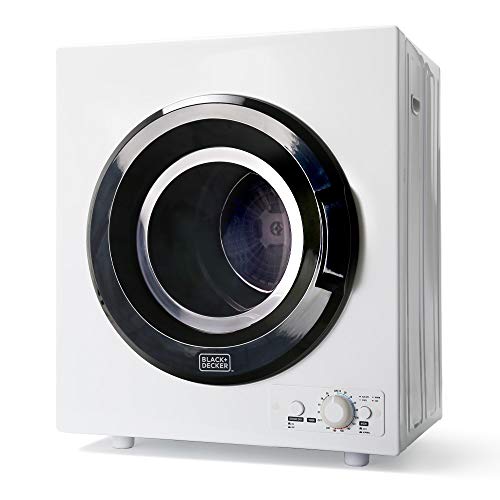
BLACK+DECKER 3.5 Cu. Ft. Portable Dryer BCED37 — Best Overall
The BCED37 is the largest of the true 120 volt portables and the natural top pick: a 3.5 cubic foot drum that takes a real household load, on a normal outlet, from a brand with a service network.
Strengths
- Biggest drum in the 120V class — fewer, fuller loads
- Standard 120V running: no electrician, no special circuit in most homes
- Brand support and parts availability lead this category
Trade-offs
- Vented design needs a window or vent solution — plan it before buying
- 120V drying is slower than a full-size 240V dryer; loads take longer
- At the large end of ‘small’: measure your laundry corner honestly
Key specs: 3.5 cu. ft., 13.2 lb capacity class, 120V, 1500W, vented
Most portable-dryer disappointment comes from drums that hold half a wash load, forcing double cycles. The BCED37’s capacity is its argument: a normal load from a compact washer dries in one go, which restores the rhythm of laundry day. It remains a 120V appliance, so set time expectations accordingly — but within the physics of its circuit, this is the most complete small dryer in the guide, and the one most households should start from.
Best for: most households wanting one-cycle loads / Not suited for: homes that cannot vent or fit the largest footprint
Check the current price on Amazon

Panda 3.5 Cu. Ft. Portable Clothes Dryer — Best Alternative Full-Size Portable
Panda is the portable-laundry specialist brand, and its 3.5 cubic foot dryer matches the class leaders on capacity with a stainless tub and a long track record in apartment laundry.
Strengths
- Full portable capacity with a stainless steel drum
- Panda’s whole business is compact laundry — the focus shows in the details
- 120V, 1500W running suits standard circuits
Trade-offs
- Vented, like its rivals — allow for the hose
- Controls are functional rather than luxurious
- Compare delivered configuration and vent kit contents before ordering
Key specs: 3.5 cu. ft., 13.2 lb capacity class, 1500W, 120V, stainless steel tub
If BLACK+DECKER is the mainstream choice, Panda is the specialist’s, and in compact laundry the specialist brand has earned its following over many apartment cycles. The stainless tub shrugs off the zips and buttons of real life, and the machine’s cycles are tuned by a company that sells nothing else into this niche. Choose between this and the BCED37 on availability, vent-kit details and which control layout you prefer; the drying fundamentals are peers.
Best for: buyers who prefer the specialist laundry brand / Not suited for: shoppers wanting the most mainstream support
Check the current price on Amazon
BLACK+DECKER 2.65 Cu. Ft. Portable Dryer BCED26 — Best Mid-Size
The BCED26 splits the difference: meaningfully smaller than its 3.5 sibling for tighter spaces, meaningfully larger than the mini dryers for real loads, with the same brand support behind it.
Strengths
- Footprint suits closets and corners the 3.5 model cannot claim
- Capacity still covers a small household’s normal load
- Same brand ecosystem as the top pick
Trade-offs
- Mid-size means mid compromises: big bedding still goes in shifts
- Vented installation still required
- Longer cycle times than 240V machines, as with all here
Key specs: 2.65 cu. ft., 8.8 lb capacity class, 1400W, 120V
Apartment laundry is a geometry problem before it is a capacity problem. The BCED26 exists for the homes where the 3.5 cubic foot machine physically will not go but a 1.5 cubic foot mini would mean three cycles per wash. In that common middle, it is the rational buy: real loads, one cycle, a corner it actually fits. Measure your space, including door swing and vent run, and if the numbers land here, stop shopping — this is the size your home asked for.
Best for: tight spaces that still need real capacity / Not suited for: large households with big weekly loads
Check the current price on Amazon

Euhomy Portable Clothes Dryer 1.5 Cu. Ft. — Best Compact
Euhomy’s 1.5 cubic foot dryer is the compact end done properly: a genuine tumble dryer for small loads, delicates and the one-or-two-person household, in a box that fits where laundry was previously impossible.
Strengths
- Truly compact footprint for studios, RVs and small flats
- Lower power draw suits shared and older circuits
- Ideal second dryer for delicates and small daily loads
Trade-offs
- 1.5 cu. ft. means small loads only — sheets and towels go one or two at a time
- Cycle times stretch if you overload it, which is tempting and counterproductive
- Vented exhaust still needs a path out
Key specs: 1.5 cu. ft., 120V, compact portable class
The honest way to judge a 1.5 cubic foot dryer is by the loads it is for: work clothes for one, gym kit, baby clothes, the delicates you would never send to a laundromat. For those, the Euhomy is transformative — laundry at home, on your schedule, in a corner of a studio. For a family’s weekly wash it is the wrong tool, and no review should pretend otherwise. Bought for its real job, it is one of the most satisfying small appliances on this page.
Best for: singles, couples, delicates and second-dryer duty / Not suited for: family laundry in a single machine
Check the current price on Amazon

COSTWAY 1.5 Cu. Ft. Portable Clothes Dryer (850W) — Best Low-Power Compact
Costway’s compact runs at a gentler 850W, which makes it the pick for circuits that cannot spare much — older wiring, shared supplies, RV and boat-adjacent laundry — in the same useful 1.5 cubic foot size.
Strengths
- 850W draw is kind to marginal circuits
- Stainless tub at the compact end of the market
- Same practical small-load capacity as its compact rivals
Trade-offs
- Lower power means longer drying; patience is the trade
- Small loads only, as with all 1.5 cu. ft. machines
- Vent hose routing still needs planning
Key specs: 1.5 cu. ft., 850W, 110V class, stainless steel tub, vented
Power is the forgotten constraint in small-space laundry: not every studio or older home can offer a dryer a hearty circuit. The Costway’s modest draw opens doors the stronger machines cannot, at the cost of time. For a single person’s rhythm — a small load in the evening, dry by morning’s routine — that trade is invisible. For anyone in a hurry, it is the wrong pick, and this guide would rather tell you now than read your review later.
Best for: older or shared circuits with little spare power / Not suited for: anyone in a hurry
Check the current price on Amazon

ROVSUN 110V Portable Clothes Dryer — Best Value Front-Loader
ROVSUN’s front-load portable is the value route into tumble drying on a standard circuit, with a stainless tub and the front-loading layout many buyers prefer over top-access designs.
Strengths
- Front-load format suits under-counter and stacked-corner placements
- Stainless tub at a value position
- Standard-voltage running keeps installation simple
Trade-offs
- Challenger brand: support depth trails the household names
- Confirm capacity and vent kit against your exact load and space
- Cycle sophistication matches its price tier
Key specs: 110V class, front-load tumble dryer, stainless steel tub
ROVSUN serves the buyer who has done the maths and chosen value deliberately: a real tumble dryer, a stainless drum, a standard plug, and money left over. The ownership questions to ask are the challenger-brand ones — who stocks the belt, the element, the answers — and if you are comfortable with those answers, the machine’s proposition is sound. In compact laundry, today’s value brands are often tomorrow’s specialists; Panda started somewhere too.
Best for: value-first buyers comfortable with challenger brands / Not suited for: buyers who want decades-deep parts networks
Check the current price on Amazon
Comparison Table
| Pick | Badge | Key spec | Best for |
|---|---|---|---|
| BLACK+DECKER 3.5 Cu. Ft. Portable Dryer BCED37 (Check the current price on Amazon) | Best Overall | 3.5 cu. ft., 13.2 lb capacity class, 120V, 1500W, vented | most households wanting one-cycle loads |
| Panda 3.5 Cu. Ft. Portable Clothes Dryer (Check the current price on Amazon) | Best Alternative Full-Size Portable | 3.5 cu. ft., 13.2 lb capacity class, 1500W, 120V, stainless steel tub | buyers who prefer the specialist laundry brand |
| BLACK+DECKER 2.65 Cu. Ft. Portable Dryer BCED26 (Check the current price on Amazon) | Best Mid-Size | 2.65 cu. ft., 8.8 lb capacity class, 1400W, 120V | tight spaces that still need real capacity |
| Euhomy Portable Clothes Dryer 1.5 Cu. Ft. (Check the current price on Amazon) | Best Compact | 1.5 cu. ft., 120V, compact portable class | singles, couples, delicates and second-dryer duty |
| COSTWAY 1.5 Cu. Ft. Portable Clothes Dryer (850W) (Check the current price on Amazon) | Best Low-Power Compact | 1.5 cu. ft., 850W, 110V class, stainless steel tub, vented | older or shared circuits with little spare power |
| ROVSUN 110V Portable Clothes Dryer (Check the current price on Amazon) | Best Value Front-Loader | 110V class, front-load tumble dryer, stainless steel tub | value-first buyers comfortable with challenger brands |
How to Choose a Small 120 Volt Electric Dryer
The 120V bargain: time for freedom
A full-size dryer on 240V throws several kilowatts at a load; a 120V portable works with roughly a third of that power or less, so the same load takes meaningfully longer to dry. That is the entire compromise, and for millions of renters and small-home owners it is a bargain: an extra stretch of cycle time in exchange for laundry at home, tonight, with no installation project. Plan loads a little earlier in the day and the compromise mostly disappears into routine.
What 120V does not compromise is the result: tumble drying with heated air produces the same soft, fully dry clothes as any vented dryer. Sensor and timed cycles on the better models prevent both damp disappointment and over-dried waste. The technology is mature; only the power budget is smaller.
Capacity: cubic feet over marketing pounds
Judge these dryers by drum volume in cubic feet and by your actual load, not by the largest pound figure a listing can defend. A compact washer’s full load needs roughly the 2.65-3.5 cubic foot class to dry in one cycle; the 1.5 cubic foot machines are for partial loads, small households and delicates. Overloading any dryer — but especially a lower-powered one — is the fastest route to wrinkled, still-damp frustration, because tumbling clothes need air space to release moisture.
Measure the destination space with the same care: width and depth for the machine, swing for the door, and a route for the vent hose to a window or vent. A dryer that fits but cannot vent is a humidifier with ambitions. Indoor vent kits exist for some situations, but they add moisture and lint management to your routine; a real vent path is always the better plan.
Venting, lint and living with it
All the picks in this guide are vented dryers: they exhaust warm, moist, lint-bearing air, and where that air goes is an installation decision, not an afterthought. A short, straight hose run to a window vent is the classic apartment solution. Keep the run short, keep it smooth-walled where possible, and clean the lint filter every single load — on a small dryer, a clogged filter is not a minor inefficiency, it is half your airflow apologising.
Lint discipline is also fire discipline, in any home, with any dryer. Filter every load, check the hose run periodically for build-up, and never run a dryer in a space where the exhaust simply dumps behind the machine against a wall. Small dryers ask little, but they ask that without exception.
How to Install and Use a 120V Portable Dryer
No electrician is required, but thirty minutes of care at installation repays itself on every load.
- Place the dryer on a level, firm floor near the washer, with clearance for the door and for air to reach the machine.
- Connect the vent hose with the shortest, straightest run you can manage to a window vent or existing vent outlet, and seal the joints.
- Plug directly into a sound household outlet — no power strips or extension leads for a heating appliance.
- Run an empty short cycle to confirm airflow at the vent exit and that no joints leak warm air into the room.
- Sort loads by fabric weight; a mixed load of towels and synthetics dries unevenly on any dryer and worse on a gentle one.
- Clean the lint filter, then load loosely to about two-thirds of the drum for a normal load, choose the cycle, and let it finish rather than opening to check repeatedly.
For the first weeks, note which cycle settings suit your real fabrics; portable dryers reward owners who learn their two or three standard loads and then stop experimenting. Delicates and heat-sensitive prints belong on the gentlest settings regardless of impatience.
If drying times creep up over the months, suspect airflow before electronics: filter, hose, vent exit, in that order. Nine times out of ten the machine is fine and the path is furry.
Common Buying Mistakes
Overloading the drum. Air space is a drying ingredient. Two honest loads beat one stuffed, damp, wrinkled one.
Venting into the room by default. You are exporting moisture and lint; give them a route outside or accept the management an indoor kit demands.
Skipping the lint filter ‘just this once’. Every load, every time — performance and safety share this habit.
Plugging into a power strip. Heating appliances draw sustained current. Wall outlet, direct, always.
Expecting 240V speed. The freedom of 120V is paid for in minutes. Plan the laundry rhythm around it and the trade vanishes.
Pairing With a Compact Washer: the Apartment Laundry System
A small dryer reaches its potential paired with a compact washer of matching capacity, because the system’s rhythm is set by the smaller drum. Match sizes honestly — a washer that produces loads the dryer must split doubles your cycle count and your Saturday. The 3.5 cubic foot dryers pair with the larger portable washers; the 1.5s pair with twin-tubs and small automatics owned by small households.
Placement is the other half of the system: washer and dryer side by side or stacked where the design allows, vent and hoses planned as one installation, and a folding surface — even a board across the pair — within reach. Apartment laundry succeeds as furniture planning as much as appliance buying, and the households that plan it once enjoy it for years.
Energy, Time and the Rhythm of Small Laundry
Small dryers use less power per hour but run longer; the honest comparison is energy per load, where a well-loaded 120V dryer drying a full drum is respectable and a half-empty one is wasteful whatever its voltage. The practical rule is to dry full, sorted loads and let the machine’s own cycle logic finish the job rather than adding speculative extra minutes.
Rhythm matters more than arithmetic. Households that wash and dry in a steady small-load cadence — a load most days — find portable laundry invisible. Households that save a mountain for Sunday find the same machines slow. The appliance did not change; the system around it did.
Fabric Care on Gentler Heat
Lower-powered drying is, almost by accident, kinder drying: less aggressive heat is gentler on elastic, prints and delicate fibres, provided loads are sorted and not left tumbling long past dry. Use the gentlest cycle that finishes the load, remove promptly, and shake out while warm — the small-dryer owner’s substitute for a steam cycle.
The exception is heavy cottons: towels and denim need the full-strength cycle and their full time, and mixing them with light synthetics guarantees one fabric is wronged. Sorting is the cheapest fabric-care technology ever invented, and it is entirely free.
Living With a Small 120 volt electric dryer: the First Season and Beyond
The first month with a small 120 volt electric dryer teaches you the gap between the brochure and the routine. Controls that seemed fiddly become automatic, the sounds the dryer makes become a background language you read without thinking, and the one specification you obsessed over at purchase time turns out to matter less than the two you barely noticed. This is normal, and it is why this guide weighted ownership factors — support, parts, documentation and forgiveness — as heavily as headline performance when the picks were chosen.
By the end of the first season, patterns settle. You will know the settings you actually use, the accessories that earned their storage space and the ones still in their packaging. You will also know whether your original sizing decision was right: owners of the best small 120 volt electric dryers who bought for their real pattern rather than their imagined one report the appliance disappearing into their routine, which is the highest praise any product in this category can earn. Owners who bought for an imagined life spend the season working around the mismatch.
Year two and beyond is where the picks in this guide separate from the market’s disposable tier. The established brands publish documentation, stock consumables and answer questions; the products keep performing because their wear items were designed to be serviced rather than sealed away. None of that appears in a first-week review, and all of it decides whether you are still satisfied — or shopping again — three seasons from now.
The Maintenance Rhythm That Actually Works
Every product behind the best small 120 volt electric dryers has a maintenance rhythm, and the owners who thrive are not the ones with the longest checklist — they are the ones whose short checklist actually happens. Anchor the routine to events that already exist in your life: the start of a trip, the first weekend of the month, the change of a season. A check tied to a calendar abstraction gets skipped; a check tied to packing the vehicle or opening the pool gets done.
Keep the consumables on hand before they are needed. The pattern repeats across this whole category: the part is inexpensive, the shipping delay is the expensive part, and the failure chooses the least convenient weekend of the year. A small spares kit bought calmly in advance — informed by the specific pick you own and its manual — converts most mid-season failures from trip-ending events into twenty-minute interruptions.
Finally, keep a notebook or a notes file. Dates, settings that worked, parts replaced, the dealer’s name, the exact model variant: ownership knowledge compounds, and the owner who can say precisely what was done and when gets better help from every support line, forum and technician they ever call. The notebook is also what turns a future replacement decision from guesswork into arithmetic.
Troubleshooting: Reading Symptoms Before Spending Money
When a small 120 volt electric dryer misbehaves, work the symptom ladder from the free end upward. First, power and connections: is the supply actually delivering what the product expects, at the plug, under load? A remarkable share of ‘failures’ in every category in this guide are supply problems wearing the product’s clothes. Second, the consumables and the airflow, water flow or signal path — whichever medium the dryer works in — because blockages imitate breakdowns perfectly. Third, settings: a mode changed by a guest, a child or your own elbow can produce symptoms indistinguishable from a fault.
Only after those three should money move. When it does, spend it on diagnosis before parts: a technician’s hour that names the fault is cheaper than a sequence of hopeful components. And use the symptom’s timing as evidence — faults that appear after a move, a storm, a service or a new accessory are usually about that event, not about the product’s age. Tell whoever helps you the whole timeline; it is the most diagnostic information you own.
Know, too, when a symptom is a retirement notice rather than a repair ticket. Every category has a component whose failure, on an old and heavily used example, costs a meaningful fraction of replacement — and whose replacement reveals the next tired component behind it. The picks in this guide were chosen partly for graceful ageing, but no product escapes the arithmetic forever, and recognising the moment keeps money in your pocket.
Who Should Skip This Purchase Entirely
An honest guide to the best small 120 volt electric dryers should name the buyers it cannot help. Skip this purchase if your real need belongs to the neighbouring category — the guide’s own comparisons point at those neighbours repeatedly, and forcing this product class to do that job produces the disappointed reviews that litter every marketplace. Skip it, too, if the supporting system it depends on — the power supply, the space, the venting, the water, the vehicle — cannot be made right: a good product on a bad foundation performs badly and takes the blame.
Skip it if you are buying for a single event with no life afterwards. Hiring, borrowing or buying the cheapest adequate option serves one-off needs better than a quality purchase that will sit unused, ageing, in a cupboard. And skip it if the honest reason is a sale rather than a need: the discount on the wrong product is the most expensive money in this entire category.
For everyone else — the buyers whose pattern matches what these products genuinely do — the picks above are ordered so that the first one is the default and each subsequent one exists for a named reason. If none of the named reasons is yours, the default is your answer, and the time to stop researching and start using is now.
Resale, Spares and the End of the Story
Products bought well in this category hold a second life. The established brands’ examples sell on used markets because buyers trust the badge and can verify the model — another quiet return on choosing the names in this guide over anonymous alternatives. Keep the manual, the receipt and any spare consumables together; a complete, documented example is worth visibly more than a bare one, and costs you nothing but a drawer.
When the end does come, dispose of the product through the proper channel for its type — several categories in this guide involve materials that local rules govern — and let the replacement decision reuse everything you learned. Your notebook of settings, sizes and mistakes is the real asset you carry into the next purchase; the hardware was always just renting your attention.
That is the perspective this guide was written from: the best small 120 volt electric dryers is not a trophy purchase but a working part of a vehicle, a home, a pool or a stage. Bought with clear eyes, maintained with a light rhythm and replaced without sentimentality when the arithmetic says so, it is one of the more satisfying corners of ownership — a problem genuinely solved, season after season.
The Cost of Ownership, in Plain Terms
The purchase price of a small 120 volt electric dryer is the entry fee, not the cost. The real ledger adds the consumables it eats on schedule, the energy it draws across a season, the accessories that turned out to be necessities rather than luxuries, and — the line nobody budgets — the cost of the cheap first purchase replaced early. Worked through honestly, that ledger is why this guide’s ordering puts durable, supported products first: their per-season cost is routinely lower than the bargain alternative’s, even when the till receipt says otherwise.
Energy deserves a specific mention because it is the cost owners feel monthly rather than once. The efficient picks in this guide were not chosen for their green credentials but for their arithmetic: a product that runs every day, or all night, or all season, repays efficiency in the currency of smaller supporting systems — smaller batteries, smaller bills, fewer compromises elsewhere. When you compare two finalists, compare them as systems across a year, not as stickers across a counter.
The final line of the ledger is your own time. Products that need constant adjustment, rescue and research tax the hours they were bought to free. A small 120 volt electric dryer that simply works — set up once, maintained lightly, understood completely — is worth a premium measured in weekends, and owners consistently undervalue that premium at purchase time and overvalue it ever after.
Accessories: the Short List That Earns Its Keep
Every small 120 volt electric dryer attracts an ecosystem of accessories, most of which exist because they can, not because they should. The ones that earn their keep share a trait: they remove a recurring friction you have actually felt. Buy accessories in that order — after the friction, not in anticipation of it — and your storage stays as lean as your routine.
The exceptions are protective and consumable items, which should be bought with the product itself: the cover, the filter, the spare, the correct cable or fitting whose absence on the first weekend turns a new purchase into a sculpture. Those are not accessories in the shopping sense; they are the second half of the product, and the listings and manuals of the picks above name them plainly.
Resist, finally, the bundle. Kits that package the essential with the ornamental price the ornamental as if it were essential. Buy the product, live with it for a month, and let your own routine write the accessories list. It will be shorter than the manufacturer’s, cheaper than the bundle, and — uniquely — composed entirely of things you use.
A Seasonal Checklist You Can Actually Finish
Once a season, give the dryer an hour of deliberate attention. Work from outside in: the surfaces and seals the weather touches, the connections that carry power or signal, the consumables whose wear is a schedule rather than a surprise. Clean what the manual says to clean, with what the manual says to use — improvisation with solvents and pressure is how good products acquire cosmetic and functional scars.
Then run the dryer through its full working range, not just the setting you live on. Modes and functions that sit unused for years are the ones that fail silently and announce themselves on the one occasion they are needed. A seasonal full-range run is both a test and a rehearsal: you relearn the controls in calm conditions, and any developing fault appears while there is still time to address it on your schedule rather than its own.
Close the checklist by updating the notebook: what was done, what was noticed, what will be needed next season. Five lines, written once, that convert next year’s checklist from an inspection into a confirmation. Ownership at this level is not a hobby — it is an hour a season — and it is the entire difference between products that age and products that merely get old.
Head to Head: Separating the Picks in This Guide
Readers who reach this section usually have the shortlist down to two, so here is the honest separation. The first pick, the BLACK+DECKER 3.5 Cu. Ft. Portable Dryer BCED37, is the default because it balances the most factors for the most buyers; it is the answer when no special circumstance argues otherwise. The moment a special circumstance does argue — a tighter space, a smaller budget, a bigger load, a specific feature — the pick built for that circumstance overtakes it, and each review above names its circumstance in its first paragraph.
Between the remaining picks, the differences are of emphasis rather than quality: one trades capacity for compactness, another trades features for simplicity, another trades brand depth for value. That is deliberate. A guide whose picks are merely ranked from best to worst best serves nobody, because buyers’ constraints differ more than products do. Match the constraint you cannot change — the space, the circuit, the vehicle, the channel count — and the correct pick selects itself.
If you are still torn between two finalists after that, decide on ownership rather than specification: whose documentation is clearer, whose consumables are easier to source where you live, whose support answers in a way you trust. Specifications tie more often than brochures admit; ownership never does.
Drying Schedules for Real Households
The households that love their 120 volt dryers run a rhythm rather than an event: a load washed in the evening dries while dinner happens, or a morning load dries across the working day, so the dryer’s longer cycles never sit in anyone’s way. The households that fight their dryers save laundry into a weekend mountain and then queue at a machine that was designed for flow, not backlog. Same appliance, opposite experiences — the variable is the schedule, not the dryer.
Singles and couples can run the smallest machines in this guide on that rhythm indefinitely: a 1.5 cubic foot drum cycling most days is a laundry system, not a compromise. Families on the 3.5 cubic foot models do the same at larger scale, with bedding and towels given their own slot in the week rather than ambushing a Sunday.
Build the rhythm around the machine’s strengths: full sorted loads, the gentlest cycle that finishes the job, and a lint filter cleaned without exception. Do that for a month and the 120 volt trade — minutes for freedom — stops feeling like a trade at all. It just feels like laundry, at home, which is what you bought.
Final Recommendation
Start with the BLACK+DECKER BCED37 if it fits and you can vent it — capacity is the quality that cannot be added later. The Panda is its specialist-brand peer, the BCED26 is the geometry compromise, and the Euhomy, COSTWAY and ROVSUN compacts serve small loads, gentle circuits and value budgets respectively. Whichever you choose, vent it properly and clean the filter every load, and a 120V dryer will quietly end your laundromat era.
Related guides on this site: Best 120 Volt Ventless Dryer Best 120 Volt Washer And Dryer Combo Best Small 110 Volt Hot Tub Best 12 Volt Batteries For An Rv
Frequently Asked Questions
Can a 120V dryer really dry clothes properly?
Yes — completely, given time. It uses the same heated tumble-drying method as a full-size vented dryer with a smaller power budget, so loads take longer. Clothes come out fully dry; your schedule, not your laundry, absorbs the difference.
Does a portable dryer need a special outlet?
No — that is the point of the category. These machines run from a standard household outlet. Plug directly into the wall, never via a power strip or extension lead, and give the circuit the same respect you would give any heating appliance.
How do I vent a dryer in an apartment?
The usual route is a short hose to a window vent kit, which takes minutes to fit and removes cleanly when you move. Keep the run short and straight, seal the joints, and clean the lint filter every load. Purpose-made indoor vent kits exist but add humidity and lint management to the room.
What size dryer do I need for a family?
For family loads in single cycles, the 3.5 cubic foot class at the top of this guide. The 1.5 cubic foot compacts serve singles, couples and partial loads; a family using one would run several cycles per wash day, which most households find wears thin.
Why are my drying times getting longer?
Almost always airflow: a clogged lint filter, a crushed or lint-lined hose, or a blocked vent exit. Work through those in order before suspecting the machine. On a small dryer the filter alone can account for most of a slowdown.
Can I put a portable dryer in an RV or boat?
Many owners do, watching three things: the circuit’s capacity (the low-power COSTWAY in this guide exists for such cases), a safe vent route, and secure placement for travel. Confirm your supply and space honestly and the format suits mobile laundry well.