Disclosure: airfryerkitchensupply.com is reader-supported. When you buy through links on our site, we may earn an affiliate commission at no extra cost to you.
Where to buy
Start with the shortlist for best stainless steel chopsticks below, then use this section to buy the right one. Stainless chopsticks vary more than their simple shape suggests — steel grade, hollow versus solid core, tip texture and length all differ between listings that look alike. Buy by the exact set: confirm the grade (316 and 18/8 are the listings worth trusting), the pair count and the length on the listing itself. Every set below was verified brand-and-model, and each link invites you to check price on Amazon rather than quoting a figure that will drift.
- 316 Stainless Steel Chopsticks, Square, 5 Pairs — Best Overall: Check the current price on Amazon
- Metal Chopsticks 18/8 Stainless Steel, Laser Engraved, 5 Pairs — Best Balanced Classic: Check the current price on Amazon
- MUYOS Stainless Steel Chopsticks, 5 Pairs, Silver — Best Lightweight: Check the current price on Amazon
- MUYOS Stainless Steel Chopsticks, 5 Pairs, Black — Best Black Finish: Check the current price on Amazon
- BALWOO Korean Chopsticks, 430 Premium Stainless, 5 Sets — Best Authentic Korean: Check the current price on Amazon
- Stainless Steel Long Cooking Chopsticks, 15.3in, 2 Pairs — Best for Cooking: Check the current price on Amazon
The case for the best stainless steel chopsticks is a care case. Wood wants hand washing and drying rituals; bamboo splits and stains; plastic raises heat questions at the wok. Stainless goes in the dishwasher with the forks, comes out unchanged, and will do so for a decade. That is why Korean households — where metal chopsticks are the daily standard, not the novelty — settled the question generations ago, and why stainless is the default recommendation for families, restaurants and anyone whose chopsticks work daily.
The honest trade-offs are two: metal is slippery when new and polished, and it conducts heat. Both are solved problems in good sets. Grip is engineered with laser engraving, textured tips, square or flattened profiles and matte finishes — the picks below were chosen partly on exactly those features. Heat matters only when sticks double as cooking tools over open flame, which eating-length steel should never do; long cooking chopsticks are a separate purchase.
This guide ranks six verified sets across the real decision space: a 316-grade square family set, a balanced 18/8 engraved set, a hollow-core lightweight pair of options, an authentic Korean-made set, and a long cooking pair for the stove. Every set was matched before earning a link, with grade and length taken only from what the verified listing states.
In this guide
Quick Picks
316 Stainless Steel Chopsticks, Square, 5 Pairs — Best Overall. The full specification in one listing: 316-grade steel, a square non-slip profile, laser engraving, Korean 9.45-inch length and five dishwasher-safe pairs. — Check price on Amazon
Metal Chopsticks 18/8 Stainless Steel, Laser Engraved, 5 Pairs — Best Balanced Classic. The classic configuration done properly: 18/8 stainless, laser-engraved non-slip shaping, 9¼-inch Japanese-Korean length and five pairs, all confirmed in the verified listing. — Check price on Amazon
MUYOS Stainless Steel Chopsticks, 5 Pairs, Silver — Best Lightweight. MUYOS builds its sticks around a hollow core — the verified listing’s own words — so the set feels feather-light while keeping non-slip tips and full dishwasher safety. — Check price on Amazon
MUYOS Stainless Steel Chopsticks, 5 Pairs, Black — Best Black Finish. The same hollow-core, non-slip MUYOS design in a black finish — for tables where silver steel clashes with the setting, verified as its own listing through the API. — Check price on Amazon
BALWOO Korean Chopsticks, 430 Premium Stainless, 5 Sets — Best Authentic Korean. Made in Korea per the verified listing, in 430 premium stainless with the flatter Korean profile — the authentic article for Korean tables and mukbang-style eating alike. — Check price on Amazon
Stainless Steel Long Cooking Chopsticks, 15.3in, 2 Pairs — Best for Cooking. The exception that proves the heat rule: 15.3-inch extra-long steel sticks with threaded non-slip shaping, built per the verified listing for hot pot, noodles and frying — length is the insulation. — Check price on Amazon
How These Picks Were Chosen
Candidates were screened on what the listing itself declares: steel grade where stated (316 above 18/8 above unspecified), profile and grip treatment, length, pair count and dishwasher safety. Each pick was then verified on this site’s Amazon connection, matching the returned title to the set before assigning an ASIN; sets we could not match were excluded.
We weighted grip engineering most heavily, because slipperiness is the one legitimate complaint about steel sticks and the difference between a set that converts a household and a set that migrates to the back of the drawer. Care burden scored second — everything here is dishwasher safe per its listing — and length appropriateness third, with Korean, Japanese and cooking lengths judged against their own cuisines.
The 6 Best Stainless Steel Chopsticks
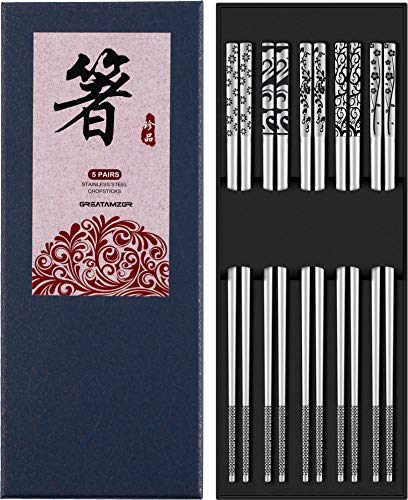
316 Stainless Steel Chopsticks, Square, 5 Pairs — Best Overall
This is the set to buy when the household is converting to steel for good. The 316 grade is the more corrosion-resistant steel, the square profile stops rolling and rotation, and the laser engraving gives fingertips and food something to hold. Five pairs equip a family table, the Korean length suits noodle and rice cuisines, and the gift-set presentation makes the conversion feel like an upgrade rather than a utility purchase.
Strengths
- 316 stainless — the higher corrosion-resistant grade
- Square profile plus laser engraving: grip solved twice
- Five pairs, dishwasher safe, 9.45-inch length
Trade-offs
- Steel conducts heat — not a stove tool
- Metal sound on ceramic at quiet tables
- Engraved pattern is decorative, not minimal
| Specification | Detail |
|---|---|
| Grade | 316 stainless steel |
| Pairs | 5 |
| Length | 9.45 inches |
| Profile | Square, laser engraved (per Amazon title) |
Most stainless sets solve one problem. This one stacks the solutions: better steel, better profile, better surface. In daily use the engraving is the difference people notice — noodles stop sliding, dumplings stop rotating, and beginners stop blaming their hands. The 316 grade is the long-game benefit, resisting the pitting that acidic foods and years of dishwashing eventually visit on lesser steel. As a single purchase to equip a table for years, nothing else in this guide is as complete.
Best for: families converting to metal chopsticks permanently / Not suited for: cooking over open flame
Check on Amazon — check price on Amazon before ordering, because configurations and included accessories change between listings.
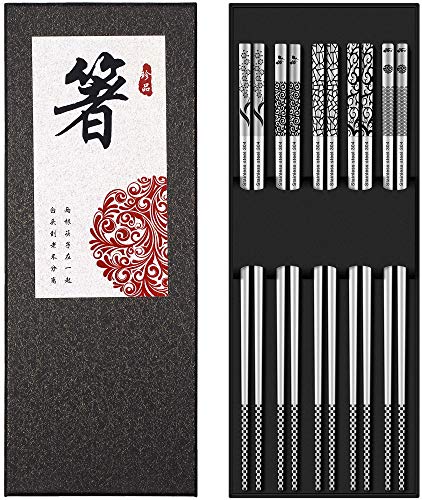
Metal Chopsticks 18/8 Stainless Steel, Laser Engraved, 5 Pairs — Best Balanced Classic
Buyers who want the standard, proven set without the square profile’s learning curve should land here. The 18/8 grade is the food-service standard, the engraving handles the grip question, and 9¼ inches is the middle length that serves both Japanese and Korean tables comfortably. It is the least surprising set in this guide, which for many households is the highest praise available.
Strengths
- 18/8 food-grade stainless, dishwasher safe
- Laser-engraved non-slip grip
- Versatile 9.25-inch length, five pairs
Trade-offs
- Round-style profile can still roll on the table
- 18/8 is a step below 316 for corrosion resistance
- Decorative engraving may not suit plain tastes
| Specification | Detail |
|---|---|
| Grade | 18/8 stainless steel |
| Pairs | 5 |
| Length | 9 1/4 inches |
| Grip | Laser engraved, non-slip (per Amazon title) |
There is a reason this configuration is the category’s center of gravity: it asks nothing and handles everything. The engraving is fine enough to help without feeling busy, the length splits the difference between cuisines, and the steel grade is the one commercial kitchens standardized on. Choose it over the 316 square set if your table prefers classic round handling; choose the square set if rolling and rotation are your known frustrations.
Best for: households wanting the classic all-round set / Not suited for: users specifically seeking a square profile
Check on Amazon — check price on Amazon before ordering, because configurations and included accessories change between listings.
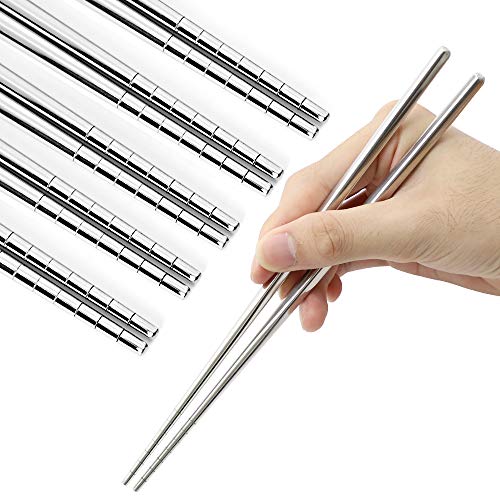
MUYOS Stainless Steel Chopsticks, 5 Pairs, Silver — Best Lightweight
Weight-sensitive users start here: smaller hands, older family members, children transitioning to adult sticks, and anyone who finds solid steel tiring across a long meal. The hollow-core design, stated plainly in the listing, cuts the heft that is steel’s other common complaint, while non-slip tips keep the light sticks competent on noodles and smooth foods.
Strengths
- Hollow-core lightweight design per the listing
- Non-slip tips for smooth foods
- Dishwasher safe; five pairs in silver
Trade-offs
- Light sticks feel less planted to users who like heft
- Hollow construction is less abuse-proof than solid
- Silver finish is the plain option (a black variant exists in the same line)
| Specification | Detail |
|---|---|
| Brand | MUYOS |
| Pairs | 5 |
| Construction | Hollow-core, lightweight |
| Tips | Non-slip (per Amazon title) |
A chopstick is lifted hundreds of times per meal, and MUYOS is the set designed by someone who counted. The hollow core changes the fatigue equation completely while the tip texture preserves function — the usual lightweight failure mode, where light also means slippery, is engineered out. Households with mixed hand sizes often end up here because the same set serves the teenager and the grandparent without either adapting much.
Best for: smaller hands and long meals / Not suited for: users who prefer a weighty, planted feel
Check on Amazon — check price on Amazon before ordering, because configurations and included accessories change between listings.

MUYOS Stainless Steel Chopsticks, 5 Pairs, Black — Best Black Finish
Choose the black variant when the table is the argument: modern matte dinnerware, dark stoneware and minimalist settings where bright steel looks like cutlery that wandered in from the wrong drawer. Functionally it is the silver set — hollow-core lightness, non-slip tips, dishwasher safety — with a finish that also hides the micro-scratches years of drawer life print on bright steel.
Strengths
- Black finish suits modern dark tableware
- Same hollow-core lightweight build as the silver set
- Finish disguises everyday drawer wear
Trade-offs
- Dark finishes deserve gentler handling than bare steel to stay even
- Black sticks are easier to lose in a dark drawer (a real, if small, annoyance)
- Identical lightness trade-off as the silver version
| Specification | Detail |
|---|---|
| Brand | MUYOS |
| Pairs | 5 |
| Finish | Black |
| Construction | Hollow-core, lightweight (per Amazon title) |
It would be easy to dismiss a color variant as a non-pick, but tableware is visual and the black MUYOS is a genuinely separate verified listing solving a real styling problem — the growing number of kitchens plated on black and charcoal stoneware. It also serves households that want two distinguishable sets (his and hers, home and guest) without mixing designs. Buy it for the table it will sit on; the engineering underneath is already proven by its silver sibling.
Best for: modern dark table settings / Not suited for: buyers wanting maximum finish durability over looks
Check on Amazon — check price on Amazon before ordering, because configurations and included accessories change between listings.

BALWOO Korean Chopsticks, 430 Premium Stainless, 5 Sets — Best Authentic Korean
Korean households, and anyone eating Korean food weekly, should consider the genuine article. Korean metal chopsticks are flatter and slightly shorter than Chinese styles, designed for kimchi, grilled meats and rice in metal bowls — and a Korean-made set gets those proportions right by default rather than by approximation. The listing’s ‘Milky Way’ design variant adds a decorative touch to the table.
Strengths
- Made in Korea — authentic proportions and profile
- 430 premium stainless per the listing
- Five sets with a decorative design option
Trade-offs
- 430 grade is magnetic and slightly less corrosion-resistant than 316/18/8
- Flatter Korean profile is a preference, not universal
- Design variant may sell through separately
| Specification | Detail |
|---|---|
| Origin | Made in Korea |
| Grade | 430 stainless steel |
| Sets | 5 |
| Style | Korean flat profile (per Amazon title) |
Provenance is a specification in this category. Korean makers have refined metal chopsticks over decades of daily national use — the flatness that grips kimchi, the length that suits metal rice bowls, the weight that balances against a spoon. BALWOO’s set carries that inheritance, and the 430 grade, while a step below 316 on corrosion charts, is the traditional choice that Korean manufacturers know how to form well. For Korean tables it is the most correct purchase in this guide.
Best for: Korean households and Korean-food devotees / Not suited for: buyers prioritizing the highest steel grade
Check on Amazon — check price on Amazon before ordering, because configurations and included accessories change between listings.
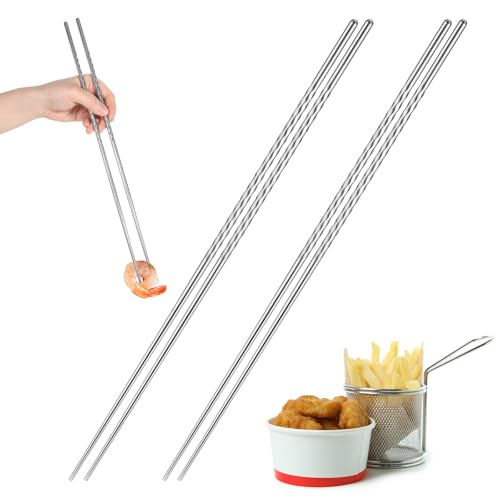
Stainless Steel Long Cooking Chopsticks, 15.3in, 2 Pairs — Best for Cooking
Every other pick in this guide is for eating; this one is for the stove. Fifteen-plus inches keeps hands clear of frying oil, boiling noodle water and hot-pot broth while the threaded grip controls slippery ingredients. Steel is the right cooking material precisely where wood is not: it does not scorch, absorb oil or degrade in the dishwasher after a greasy service. Buy these alongside an eating set, not instead of one.
Strengths
- 15.3-inch length keeps hands off the heat
- Threaded non-slip grip for frying and hot pot
- Steel shrugs off oil, heat and dishwashing
Trade-offs
- Far too long for comfortable eating
- Steel still conducts some heat on long frying sessions
- Two pairs only — a tool purchase, not table service
| Specification | Detail |
|---|---|
| Length | 15.3 inches |
| Pairs | 2 |
| Grip | Non-slip threaded |
| Use | Hot pot, noodles, frying (per Amazon title) |
Cooking chopsticks are the professional’s tongs — finer control than any spatula for turning, separating and retrieving food in hot liquid or oil. The steel construction suits the frying and hot-pot work the listing names, and the length is honestly specified rather than implied. Every serious Asian kitchen owns a pair of these next to the stove; if yours does not, this is the gap in the drawer, and it is a different gap from the eating sets above.
Best for: frying, hot pot and noodle cooking / Not suited for: eating at the table
Check on Amazon — check price on Amazon before ordering, because configurations and included accessories change between listings.
Comparison Table
| Pick | Badge | Key spec | Best for |
|---|---|---|---|
| 316 Stainless Steel Chopsticks, Square, 5 Pairs | Best Overall | 316 steel, square, 5 pairs | families converting to metal chopsticks permanently |
| Metal Chopsticks 18/8 Stainless Steel, Laser Engraved, 5 Pairs | Best Balanced Classic | 18/8 steel, engraved, 5 pairs | households wanting the classic all-round set |
| MUYOS Stainless Steel Chopsticks, 5 Pairs, Silver | Best Lightweight | Hollow-core, non-slip tips | smaller hands and long meals |
| MUYOS Stainless Steel Chopsticks, 5 Pairs, Black | Best Black Finish | Hollow-core, black finish | modern dark table settings |
| BALWOO Korean Chopsticks, 430 Premium Stainless, 5 Sets | Best Authentic Korean | Made in Korea, 430 steel | Korean households and Korean-food devotees |
| Stainless Steel Long Cooking Chopsticks, 15.3in, 2 Pairs | Best for Cooking | 15.3in cooking length | frying, hot pot and noodle cooking |
How to Choose the Best Stainless Steel Chopsticks
Grade first. 316 is the premium corrosion-resistant grade and worth it for daily dishwasher households near the coast or heavy acidic-food use. 18/8 is the food-service standard and entirely sufficient for most homes. 430 is the traditional Korean forming grade — magnetic, a little less corrosion-proof, and perfectly proven in Korean daily service. Unspecified ‘stainless’ with no grade stated is the listing to skip.
Grip second, because it decides whether the set gets used. Look for at least one engineered answer to slipperiness: laser engraving, textured or threaded tips, a square or flat profile, or a matte finish. Mirror-polished round steel with none of these is the set beginners abandon. Weight third: hollow-core sets suit light grips and long meals; solid-feeling sets suit users who like a planted tool. Length last, matched to cuisine — roughly 9¼ inches for Japanese-Korean tables, longer only for cooking.
Why Korean Tables Standardized on Metal
Korea’s metal chopsticks are not a fashion but an adaptation: metal rice and soup bowls conduct heat, shared grilled meats are cut and moved at the table, and kimchi’s brine punishes porous materials. Flat-profile steel answers all three — it grips slippery fermented vegetables, survives the dishwasher after every meal, and never absorbs a previous dinner’s flavors.
The lesson for any household is material honesty: choose the stick for the food you actually serve. If your table runs hot, acidic, oily and dishwasher-dependent — most family tables do — steel is not the austere option. It is the fitted one.
Stainless vs Titanium vs Wood: The Short Version
Stainless is the value-and-care champion: cheapest per decade of service, dishwasher-proof, heavy enough to feel substantial. Titanium is the premium step — lighter than solid steel, utterly corrosion-proof, and priced like the lifetime purchase it is; the titanium guide in this cluster covers it fully. Wood is the feel champion: warm, quiet, naturally grippy, and the only material that asks a care ritual in return. None of the three is wrong; they are ranked by what you want to stop worrying about — money, maintenance or feel.
Steel Grades Explained Without the Metallurgy Degree
The grade numbers describe what is mixed into the iron. 18/8 — also sold as 304 — contains chromium and nickel in the proportions its name states, and it is the grade commercial kitchens standardized on because it resists rust, takes a polish and forms easily. For chopsticks eaten from daily and washed for a decade, 18/8 is fully sufficient, which is why the classic set in this guide wears it without apology.
316 adds molybdenum to the recipe, which specifically hardens the steel against chlorides — salt, coastal air, dishwasher detergents over years. The difference is invisible when new and visible in year eight, when a lesser set may show pitting at the tips. Buyers equipping a household once, for the long term, are the ones who should care about 316; buyers outfitting a rental or a first apartment can save the difference.
430 is the grade without nickel, which makes it magnetic and slightly less corrosion-resistant, and it is the traditional Korean forming steel — chosen there because it draws into the flat Korean profile beautifully and has served daily national use for generations. Grade snobbery that dismisses 430 ignores that record. The honest ranking is by fit: 316 for the buy-once household, 18/8 for the classic all-rounder, 430 for authentic Korean service.
Profiles and Tips: Where Stainless Design Actually Happens
Two stainless sticks of the same grade can eat completely differently, and the differences live in profile and tip. Round sticks roll and rotate; flat Korean profiles grip and rest; square profiles index in the fingers. None is a gimmick — each is a handling philosophy, and the guide’s picks are deliberately spread across them so a buyer can choose by the frustration they know best: rolling, slipping or rotating.
Tips matter as much as handles. A tapered, textured tip closes on a noodle strand or a pea with authority; a blunt polished tip skates. Laser engraving near the tip, threaded zones and matte etching are all the same idea at different prices — interrupt the polish where food is met. When comparing two similar sets, zoom the listing photos on the last inch of the stick; that inch decides more meals than the logo end ever will.
Length interacts with both. Korean lengths around 9.4 inches in flat or square profiles suit rice-and-grill tables; Japanese-influenced 9.25-inch engraved rounds suit mixed dining; cooking lengths above 14 inches are tools, not tableware. The set that matches your cuisine’s length and your hand’s profile preference will feel custom within a week.
Stainless for Restaurants, Rentals and Institutions
Commercial buyers read this category differently, and their logic is instructive for homes. A restaurant needs sticks that survive a commercial dishwasher’s chemistry hundreds of times a year, that do not absorb flavors between covers, and that can be replaced in identical sets forever. Stainless is the only material that answers all three, which is why Korean restaurants issue it by default and why fusion restaurants increasingly follow.
Rentals and furnished apartments make the same calculation at smaller scale: a stainless five-pack equips a unit permanently, survives tenant turnover, and never presents a hygiene question that wood eventually raises. Hosts running short-stay properties have quietly standardized on metal for exactly these reasons, and the home buyer with frequent guests is solving a miniature version of the same problem.
The institutional lesson for a family is about total cost of ownership. A wooden set replaced every year or two, however inexpensive, eventually outspends a stainless set bought once — and the stainless set spends those years asking for nothing. Kitchens are full of small recurring purchases that masquerade as savings; chopsticks are one place the buy-once math is unambiguous.
Stainless Chopsticks for Beginners: An Honest Starter Path
Metal has a reputation as the expert’s material, and the reputation is half wrong. Polished round steel is indeed the hardest configuration to learn on — but engraved, squared or flat-profile steel gives a beginner more grip feedback than polished wood does, and it never splinters, stains or needs replacing mid-education. The starter path is not ‘wood first, metal later’; it is ‘grip engineering first, whatever the material’.
Start with the set whose grip features match your known weakness. Sticks rotate on you? Square or flat profile. Food slides off the tips? Engraved or textured tips. Your hand tires? Hollow-core lightness. The picks in this guide are organized by exactly these diagnoses, and a beginner who buys by diagnosis usually skips the drawer of failed sets that trial-and-error learners accumulate.
Give the switch two weeks of daily meals before judging. The first days feel foreign because steel’s weight distribution differs from wood’s, not because it is worse. By the second week the dishwasher-only care routine starts paying its dividend, and by the third the old wooden set feels oddly fragile. Most households that convert do not convert back.
Heat, Noise and Table Manners With Metal Sticks
Metal’s table presence is the objection romantics raise, and it deserves a fair hearing. Steel clicks against ceramic where wood whispers; at a quiet formal dinner that sound is a real aesthetic cost, and households that dine formally often keep a wooden set for those evenings — the two-system drawer this cluster’s guides keep recommending. For the other three hundred dinners a year, the click is simply the sound of a working kitchen.
Heat behavior is the practical half. In normal dining — even soup and hot pot at the table — the held section of an eating-length steel stick stays comfortable, because the tip’s heat dissipates along the metal before it reaches fingers in any dangerous amount. The exception is leaving sticks standing in a boiling pot or resting across a wok, which is cooking behavior, not dining behavior, and is what long cooking chopsticks exist to prevent.
Manners cut in metal’s favor in one underappreciated way: stainless always looks and is clean. A wooden set can carry the ghost of a previous meal in a way a host cannot see and a guest cannot unsee. Steel’s hygiene is visible, and at a table where guests are served, visible hygiene is a form of courtesy.
The Economics of Buy-Once Chopsticks
Run the decade math honestly. A household that replaces a mid-range wooden set every eighteen months buys six or seven sets in ten years, plus the meals eaten with the tired final months of each. A stainless set bought once — even the premium 316 square set in this guide — typically costs less than that sequence by the third replacement, and it eats identically in year ten as in week one. The savings are not dramatic; the absence of recurring minor purchases, drawer clutter and degraded meals is the real return.
Environmental arithmetic points the same way. Reusable anything beats disposable, but among reusables, the set that is never replaced is the lightest footprint a household can buy. Stainless production has an upfront cost that a decade of service amortizes into insignificance, and the sticks are recyclable at the end of a life most owners will not live to see end.
The buy-once logic has one condition: buy the right set first. A stainless set bought in the wrong length or profile becomes the permanent wrong set, which is worse than a replaceable wooden mistake. Use the diagnosis method in this guide — grade, grip, weight, length — and the permanence becomes the virtue it is supposed to be.
The Drawer Audit: What Your Chopsticks Say About Your Kitchen
Open the chopstick drawer of any household and you can read its cooking life. A drawer of matched stainless says the household cooks Asian food weekly, washes without ceremony and buys tools the way it buys knives — once, deliberately. A drawer of mismatched wooden singles says enthusiasm outrunning systems: good meals happen there, amid small daily frictions nobody has bothered to fix. Neither drawer is a moral verdict, but only one of them is a finished decision.
The audit worth performing is functional, not aesthetic. Count the pairs your table actually needs on its biggest regular night. Check how many of the drawer’s sticks you would hand a guest without a flicker of apology. Notice which pair your hand chooses when you cook alone — that pair is your true preference, whatever the drawer claims, and its length, weight and profile are the specification of your next set.
Households that perform this audit usually discover the stainless case on their own: the guest-worthy count is short, the favorite pair is the metal one or wishes it washed like it, and the replacements bought over the years outnumber the original set. The fix is a single deliberate purchase from this guide’s picks, matched to the favorite pair’s lessons. A drawer that closes on five matched, dishwasher-proof, grippy stainless sets is a small thing — and it is the kind of small thing that makes a kitchen feel finished.
A Stainless Set for Every Table: Matching the Picks to Real Households
Consider the household of new converts: two adults, one teenager, a dishwasher that runs nightly and a takeout habit becoming a cooking habit. Their set is the 316 square five-pack — grip engineered for learners, steel graded for a decade of nightly washing, five pairs that cover the table and the inevitable friend. Every feature answers a sentence in their description, which is what a correct purchase looks like when it is described back.
Consider the single cook in a small apartment, eating at a counter, washing by hand half the time because the dishwasher is a drawer that fills by Friday. The MUYOS hollow-core sets were drawn for this life: light in a tired hand at the end of a workday, non-slip without effort, indifferent to being washed now or tomorrow. The black variant exists for the version of this cook whose kitchen is a considered place, where the tools on the counter are part of how the room looks and therefore part of how it feels to live in.
Consider the Korean household — or the household that eats like one — where metal bowls ring, the grill sits mid-table and kimchi appears at breakfast. BALWOO’s made-in-Korea set is not a style choice there; it is the correct tool in the correct proportions, from the culture that debugged metal chopsticks across a century of daily use. And consider the cook — every serious kitchen has one — whose domain is the stove itself: for them the set in this guide is the 15.3-inch cooking pair, and the eating sets are what other people use to receive the results.
The pattern across all four households is that ‘best’ was never a property of a set; it was a match between a set and a life. This guide ranked the 316 square set first because it matches the most lives with the fewest caveats, but the right purchase for your table is the one whose review paragraph described your kitchen back to you. When you find that paragraph, you have found your set — confirm its grade and grip on the listing when you check price on Amazon, and the drawer problem that brought you here is solved for a decade.
Care Myths and Real Maintenance for Stainless Sticks
Myth one: stainless needs no care at all. Nearly true — but the honest version is that stainless needs no special care, while still rewarding the ordinary kind. Rinse after acidic and salty meals rather than leaving sticks soaking overnight in tomato broth; dry before drawer storage in humid climates if water spots offend you; and keep black finishes out of abrasive scrubbers’ reach. That is the entire liturgy, and it is shorter than the care instructions for a wooden spoon.
Myth two: dishwasher heat damages them. It does not — every set in this guide is listed dishwasher safe, and commercial Korean service dishwashes its steel thousands of times. What dishwashers can do over years is cosmetic: water spots, a gradual dulling of mirror polish, and, on the cheapest unspecified steels, the first freckles of corrosion at the tips. Stated grades — the 316, 18/8 and 430 sets here — are precisely the insurance against that slow cosmetic decline.
Myth three: a magnet test tells you quality. It tells you grade family — 430 is magnetic, 316 and 18/8 generally are not — and nothing about whether the set is well made. Korean 430 sets are excellent and magnetic; anonymous non-magnetic sets can still be poor. Judge by stated grade, grip engineering and maker, as this guide does, and let the magnet stay on the refrigerator where it belongs. Real maintenance for stainless chopsticks, in the end, is mostly a matter of not losing them — the one failure mode no grade can engineer away, and the reason five-pair sets outsell pairs.
What to Do When a Stainless Set Arrives: The First-Week Checklist
Unbox and wash everything before first use — manufacturing and packing residues are normal, and a hot soapy wash or a dishwasher cycle makes the set table-ready. Inspect the tips under good light: engraving and texture should be consistent across pairs, and any stick with a rough edge should be exchanged now, while the return window is open, rather than tolerated for a decade. Run the three-lift test from the square guide in this cluster — heavy and smooth, small and round, the rest test — with each pair, because consistency across a set is a quality signal in itself.
Then give the set its first real week before judging it. Cook the slippery meal on day three, not day one. Let every household member use the set at least twice, because hands adapt at different speeds and the teenager’s verdict on day one is not the family’s verdict on day seven. Keep the old set in the drawer during the trial — not as a fallback to reach for nightly, which defeats the adaptation, but as the control in the experiment. By the second week, most households find the drawer has quietly reorganized itself around the steel, and the checklist’s last item completes itself: move the old set to the guest-and-picnic box, where its remaining life can be honorable, and let the stainless take the daily station it was bought for.
One Last Test: The Noodle-Shop Standard
There is a simple benchmark professionals use, worth borrowing at home: could this set serve a noodle shop’s lunch rush? That means a hundred covers, a commercial dishwasher’s heat and chemistry, slippery loads at speed, and no patience for a tool that needs to be understood. Stainless is the only common material that passes without qualification, which is why the noodle shops of Seoul run on it. Your household’s rush is smaller — a family dinner, a hot pot night — but it is the same test at a kinder scale. A set that would survive the shop will find your kitchen restful, and a set bought to that standard stops being a purchase and becomes infrastructure: unconsidered, uncomplained-about, and in service every single day. That is the highest praise a chopstick can earn, and it is earned in steel.
How to Get Used to Stainless Steel Chopsticks (and Keep Them Grippy)
The switch to steel takes most people a few meals. These habits shorten it and keep the grip features working for years:
- Start with grippy foods — roasted vegetables, meat, thick noodles — while your fingers learn the new weight and surface.
- Hold the sticks slightly higher than you held wooden ones; steel’s balance rewards a lighter, higher grip.
- Use the engraved or textured zone as your fingertip home — that is where the maker put the grip on purpose.
- Practice the smooth-food test (a grape, a cherry tomato) after a few meals, not on day one.
- Wash in the dishwasher freely, but dry the sticks before drawer storage in humid climates to keep water spots off the finish.
- Never use eating-length steel over open flame; reach for long cooking chopsticks and keep the eating set’s tips unwarped.
If a polished set still slips after a week, the fix is a profile change, not more practice: move to an engraved or square set from this guide and the problem usually disappears in one meal. Grip is engineering, and the right engineering beats determination.
Common Buying Mistakes
Buying mirror-polished round steel as a first set. It is the hardest possible configuration — slippery on food and in fingers — and the reason many people wrongly conclude they dislike metal chopsticks.
Ignoring the steel grade. ‘Stainless’ alone is not a specification. Sets that state 316, 18/8 or 430 are telling you what you are buying; sets that hide the grade are telling you something too.
Using eating sticks at the wok. Eating length plus steel conduction equals burned fingers and warped tips. Cooking chopsticks are long for a reason.
Assuming all metal sets feel the same. Hollow-core and solid sets differ as much as two different materials. Choose the weight deliberately instead of discovering it at the table.
Storing them loose in a cutlery drawer for years. Steel survives it, but finishes — especially black coatings — stay smarter with a tray or organizer. A decade-long tool deserves a drawer that respects it.
Final Recommendation
Buy the 316 square five-pack if you want the most complete answer in one purchase. The 18/8 engraved set is the classic alternative, the MUYOS hollow-core sets (silver or black) serve light grips and modern tables, BALWOO is the authentic Korean choice, and the 15.3-inch pair belongs by the stove. Whichever you choose, the grade and grip features are stated on its verified listing — confirm them when you check price on Amazon, because lookalike sets with unstated grades sit one click away.
Keep researching the cluster: Best Square Chopsticks To Buy Best Ti Chopsticks Best Stainless Steel Chopsticks Best Purple Cookware Sets Best Oven Air Fryers
Frequently Asked Questions
Are stainless steel chopsticks slippery?
Plain polished ones can be. Engraved, textured-tip, square or flat-profile sets — most of this guide — grip food and fingers well. Choose the grip engineering, not just the metal.
What is the best steel grade for chopsticks?
316 offers the highest corrosion resistance, 18/8 is the proven food-service standard, and 430 is the traditional Korean grade. Any stated grade beats an unstated one.
Can stainless chopsticks go in the dishwasher?
Yes — every set in this guide is listed as dishwasher safe, which is the material’s main advantage over wood. Dry before storing in humid climates to avoid water spots.
Do metal chopsticks get hot in soup or hot pot?
The tips warm in hot liquid but eating-length sticks keep the held section comfortable in normal dining. For cooking in hot oil or broth, use long cooking chopsticks instead.
Are metal chopsticks too heavy?
Solid sets have a planted heft some users love; hollow-core sets like the MUYOS are feather-light. Weight is a preference with options on both sides, not a fixed property of steel.
How long do stainless chopsticks last?
Effectively indefinitely under home use — no splitting, staining or coating to fail. A good set is one of the few true buy-once items in a kitchen.


