Disclosure: airfryerkitchensupply.com is reader-supported. When you buy through links on our site, we may earn an affiliate commission at no extra cost to you.
Where to Buy
Every cooktop below was verified against Amazon’s catalogue data for this site — brand, model and size matched exactly — before earning a link. Gas cooktops are built-in appliances: confirm fuel type, cutout dimensions and whether the propane conversion kit is included before ordering any of them. Where a model is sold in more than one fuel configuration, the listing’s exact configuration — not the model’s glossy sales brochure — is the very one that will arrive at your door on delivery day, so read the configuration line twice before paying anything at all.
- Samsung 30 Inch Smart Gas Cooktop (NA30N7755TS) — check price on Amazon
- Thermador 30 Inch Gas Cooktop (SGS305TS) — check price on Amazon
- Frigidaire Gallery 30 Inch Gas Cooktop (GCCG3047AS) — check price on Amazon
- Empava 30 Inch Gas Cooktop (Black Tempered Glass) — check price on Amazon
- ThermoMate 30 Inch Gas Cooktop (5 Sabaf Burners) — check price on Amazon
- FORIMO Gas Cooktop 22 Inch (4 Burners) — check price on Amazon
This guide prints no fixed prices; appliance pricing moves with promotions and configuration. Use the links to check the current price on Amazon, and measure your cutout twice — returns on built-in gas appliances help nobody. If the cooktop is a replacement, photograph your current data plate before ordering anything; half the compatibility questions a seller will ask are answered on that one label.
The best quality gas cooktops are not necessarily the most expensive ones, and they are definitely not the ones with the largest numbers on the box. Quality in gas cooking is a compound of burner engineering — even flames, a true low simmer, a centre burner with real authority — construction that stays tight and true for fifteen years, safety hardware that shuts the gas when a flame dies, and a maker who will still sell you an igniter in year ten. Judged on that compound, this category splits into two honest camps: established appliance brands selling refinement and support, and value engineers building around Italian Sabaf burners and selling hardware per dollar.
This guide ranks six verified cooktops across the main sizes and both camps. Samsung’s smart 30-inch with its 22K dual-power burner leads on outright cooking capability; Thermador represents the premium German-engineered tradition; Frigidaire’s Gallery is the mainstream all-rounder; Empava’s black-glass model carries design into the value tier; ThermoMate is the heavy-duty Sabaf workhorse; and a compact FORIMO covers the small-kitchen and galley-adjacent end. If you already know you want the 36-inch format specifically, our dedicated 36-inch guide goes deeper on that size — this one is the whole-category map.
How to use this guide alongside its companions: start here to choose your size class and philosophy, then go deep in the size-specific roundup — the 36-inch guide if that is your format — before you order. The picks overlap deliberately at the level of brands and burner families, because the same engineering keeps winning at every size; the reviews here are written for the whole-category decision, not repeated from the size guides.
In this guide
Quick Picks
Six verified gas cooktops spanning premium, mainstream and value engineering. Shortlist first; the quality argument for each follows below. Sizes and support philosophies are badged on every pick, because in this category those two facts predict owner satisfaction better than any single specification.
Samsung 30 Inch Smart Gas Cooktop (NA30N7755TS) — Best Overall Quality. A 22K BTU dual-power centre burner, five burners, continuous grates and smart connectivity in stainless — the most capable mainstream gas cooktop in this guide. Check the current price on Amazon.
Thermador 30 Inch Gas Cooktop (SGS305TS) — Best Premium. Thermador’s 30-inch five-burner in stainless: precision low-heat control and premium construction from one of the category’s founding luxury brands. Check the current price on Amazon.
Frigidaire Gallery 30 Inch Gas Cooktop (GCCG3047AS) — Best Mainstream All-Rounder. The current Gallery 30-inch: five burners, continuous grates and Frigidaire’s support network in the sensible centre of the market. Check the current price on Amazon.
Empava 30 Inch Gas Cooktop (Black Tempered Glass) — Best Design-Led Value. Five Italian Sabaf sealed burners set into black tempered glass — the design statement of the value tier, with NG/LPG conversion included. Check the current price on Amazon.
ThermoMate 30 Inch Gas Cooktop (5 Sabaf Burners) — Best Heavy-Duty Value. A heavy 30-inch cooktop in 304 stainless with five Sabaf power burners, CSA certification and thermocouple protection — substance over styling, again. Check the current price on Amazon.
FORIMO Gas Cooktop 22 Inch (4 Burners) — Best Compact. A 22-inch four-burner built-in in stainless with an NG/LPG conversion kit and thermocouple protection — real gas cooking for small kitchens, cabins and galley-adjacent spaces. Check the current price on Amazon.
How These Picks Were Chosen
Verification came first, as in all our cooktop guides: every model was matched against Amazon’s catalogue data — brand, model and size confirmed — before receiving a link. Ranking then followed the quality compound defined in the introduction: burner engineering and range, construction, flame-failure and certification hardware, and the maker’s support horizon. Raw BTU totals were treated as one input among several, never as the ranking itself.
The list spans the category deliberately: one smart flagship (Samsung), one heritage premium (Thermador), one mainstream anchor (Frigidaire), two Sabaf-hardware value plays with different characters (Empava’s glass design, ThermoMate’s steel workhorse), and one compact (FORIMO) for the kitchens the standard sizes abandon. Size-specific depth lives in the companion guides — the 36-inch roundup in particular — while this page maps the whole territory for buyers still choosing a format.
One more filter deserves stating: every pick had to be a model with a stable identity — the same name, maker and specification a buyer will find when they search for parts in five years. Marketplace cooktops that rotate names seasonally were excluded however strong a single listing looked, because an appliance you cannot identify cannot be serviced, and an unserviceable appliance is not a quality appliance.
- Every linked ASIN verified against Amazon catalogue data for this site
- Quality ranked as a compound — burners, build, safety, support — not as a BTU contest
- Both category philosophies represented: established brands and Sabaf-hardware challengers
- No fixed prices or star ratings printed anywhere in this guide
The 6 Best Quality Gas Cooktops

Samsung 30 Inch Smart Gas Cooktop (NA30N7755TS) — Best Overall Quality
Samsung’s 30-inch flagship earns the top slot on cooking substance: the dual-power centre burner runs from a rolling boil down to a true simmer by using inner and outer rings, which solves the oldest gas compromise in a single burner. Five burners under continuous cast-iron grates, sealed burners for cleaning, and Wi-Fi monitoring that alerts you to a burner left on complete a very modern package. It suits keen cooks in standard 30-inch kitchens. The smart features are garnish rather than the meal, and Samsung’s appliance support, while national, is a consumer-electronics style network rather than a traditional dealer web.
Strengths
- 22K BTU dual-power burner gives boil and simmer in one position
- Continuous grates and sealed burners make cooking and cleaning easy
- Smart alerts for burners left on add a genuine safety convenience
Trade-offs
- Electronics and connectivity are features some cooks neither need nor want to maintain
- Stainless surface shows every fingerprint
- Premium mainstream pricing against Sabaf-based challengers
| Size | 30 inch, built-in |
| Burners | 5 burners |
| Centre burner | 22K BTU dual power burner |
| Grates | Continuous cast iron |
| Extras | Smart (Wi-Fi) monitoring, stainless steel |
The dual-power burner deserves the headline. Gas cooktops traditionally make you choose: a power burner that cannot simmer, or a simmer burner that cannot boil. Samsung’s dual-ring design runs both rings for maximum output and the inner ring alone for a gentle, stable low — and it works in the pan, holding sauces that scorch on lesser centre burners while still boiling the big pot fast. Around it, the supporting burners are sensibly graduated, the grates are heavy and continuous, and ignition is instant and reliable.
The smart layer divides opinion, so judge it plainly: remote monitoring cannot turn a burner off from your phone in most configurations, but an alert that a burner is still on has real value in a busy household, and the app costs nothing to ignore if you dislike it. As the most complete cooking instrument among mainstream 30-inch gas cooktops, this is the quality pick when the format is standard.
Best for: keen cooks wanting the most capable mainstream 30-inch gas cooktop / Not suited for: buyers wanting purely mechanical appliances or the lowest price
Check on Amazon — verify the current price on Amazon first; sellers refresh these listings regularly.

Thermador 30 Inch Gas Cooktop (SGS305TS) — Best Premium
Thermador invented the built-in cooktop category in America, and the SGS305TS is its mainstream-premium expression: five sealed burners under continuous grates, electronic re-ignition, and low settings engineered for the sauces and melts that expose lesser burners. It suits cooks who value control finesse and brand heritage, and kitchens being built for the long term. It does not chase headline BTU or smart features, and its pricing reflects the badge’s tier — you are paying for engineering culture and dealer support as much as for hardware.
Strengths
- Exceptional low-end control for delicate cooking
- Premium construction, fit and finish throughout
- Luxury-brand dealer network and long parts tradition
Trade-offs
- Premium pricing without headline-grabbing maximum output
- No smart features — deliberately mechanical in spirit
- Five burners in 30 inches still crowds very large pan combinations
| Size | 30 inch, built-in |
| Burners | 5 sealed burners |
| Grates | Continuous cast iron |
| Safety | Electronic re-ignition |
| Finish | Stainless steel |
Cook a béarnaise on the Thermador and then on a budget top and the premium case makes itself: the flame holds at a level where the sauce trembles rather than breaks, and the knob’s travel maps proportionally to the flame instead of jumping. That low-end civilisation, plus burners that re-ignite themselves if a draft kills them, is what decades of cooking-first engineering look like. Maximum output is competitive rather than class-leading — a deliberate balance, because most cooking happens between simmer and medium.
Ownership is the luxury pattern: dealer support, available parts, an appliance that installers and future buyers recognise. If your quality definition leans toward finesse and permanence over spectacle, the Thermador is the gas cooktop in this guide that speaks your language — and it will still be speaking it, with parts available, long after trendier tops are landfill.
Best for: cooks valuing low-heat finesse, heritage engineering and dealer support / Not suited for: maximum-BTU hunters or smart-home completists
Check on Amazon — verify the current price on Amazon first; sellers refresh these listings regularly.

Frigidaire Gallery 30 Inch Gas Cooktop (GCCG3047AS) — Best Mainstream All-Rounder
The Gallery line is where mainstream quality lives: five burners with a strong centre, continuous cast-iron grates, sealed burners, and the parts-and-service infrastructure of one of America’s biggest appliance makers, at the price the market’s middle actually pays. It suits family kitchens replacing a builder-grade cooktop with something that will cook properly for a decade. It concedes the Samsung’s dual-power cleverness and the Thermador’s finesse, and its trim is honest rather than luxurious — the definition of the sensible buy.
Strengths
- Balanced five-burner layout with continuous grates
- Mainstream brand support and parts availability
- Sealed burners keep cleanup to a wipe-down
Trade-offs
- No standout feature — competence is the pitch
- Centre burner output is strong, not class-leading
- Stainless finish needs regular attention to look its best
| Size | 30 inch, built-in |
| Burners | 5 burners |
| Grates | Continuous cast iron |
| Design | Gallery series, stainless |
| Fuel | Natural gas, LP convertible (kit per listing) |
There is a reason the all-rounder slot matters: most households need a cooktop that boils pasta water quickly, simmers a sauce without drama, fits four pans on a Sunday and cleans up in minutes, every week for years. The Gallery does all of that with no weak point to apologise for, and when a knob or igniter eventually needs replacing, the part exists and a local technician knows the machine. That serviceability is a quality feature as real as any burner.
Choose it when the decision should be boring in the best way: measured cutout, ordered, installed, forgotten about while it cooks. Kitchens are full of appliances competing for attention and budget; the Gallery’s virtue is that it asks for neither after installation day, which is why it anchors the mainstream of this guide.
Best for: family kitchens wanting balanced, supported, no-drama quality / Not suited for: feature hunters or cooks wanting a signature burner
Check on Amazon — verify the current price on Amazon first; sellers refresh these listings regularly.
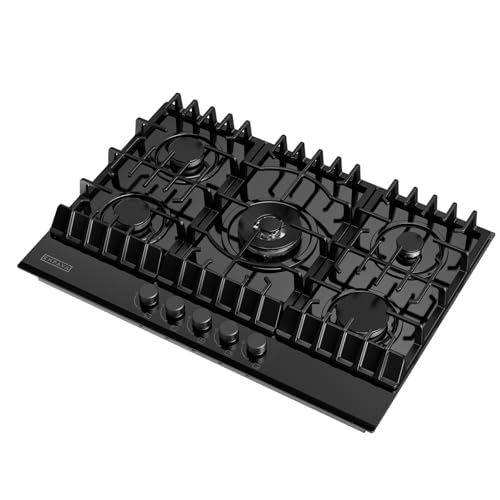
Empava 30 Inch Gas Cooktop (Black Tempered Glass) — Best Design-Led Value
Empava’s glass-top model proves value cooktops do not have to look like rental equipment: five Sabaf burners — the Italian burner engineering shared across the industry — mounted in a black tempered-glass surface that wipes clean and photographs like a premium appliance. It suits design-conscious renovators on real budgets. Glass demands the same respect as a smoothtop — heavy pans placed, not dropped — and Empava’s support is seller-based rather than a dealer network.
Strengths
- Genuine Italian Sabaf burners with even, controllable flames
- Black tempered glass looks premium and wipes clean
- NG/LPG convertible with conversion hardware for propane homes
Trade-offs
- Glass surface requires care with heavy cookware
- Seller-based support, not a dealer network
- Glass shows dust and water marks between cleans
| Size | 30 inch, built-in |
| Burners | 5 Italy Sabaf sealed burners |
| Surface | Black tempered glass |
| Fuel | NG/LPG convertible |
| Grates | Cast iron over glass |
The Sabaf burners are the substance under the style: flame rings are even, low settings hold, and the sealed design keeps spills on the glass where they wipe away instead of migrating into the appliance. In cooking terms this cooktop performs like the hardware tier above its price, because its burners literally come from that tier’s supply chain. The glass, meanwhile, changes the kitchen’s look more per dollar than anything else in this guide.
Treat the surface as you would a ceramic smoothtop — felt pads under stored grates, pans set down rather than slid heavily, spills cleaned once cool — and it will keep its looks. Owners who cook with very heavy cast iron daily and without ceremony might prefer the all-metal ThermoMate below; owners who want the kitchen to look designed will accept the small discipline gladly.
Best for: design-conscious renovators wanting Sabaf hardware in a glass format / Not suited for: rough-and-tumble cooks who slam heavy pans around
Check on Amazon — verify the current price on Amazon first; sellers refresh these listings regularly.

ThermoMate 30 Inch Gas Cooktop (5 Sabaf Burners) — Best Heavy-Duty Value
ThermoMate’s 30-inch follows its 36-inch sibling’s philosophy: 304 stainless construction, five Sabaf burners, thermocouple flame-failure protection and CSA certification, in a package that feels overbuilt for its price. It suits high-volume households, keen cooks on budgets, and anyone fitting a kitchen meant to work rather than pose. The styling is industrial, the brand support is seller-based, and the surface wants regular wiping — the standard challenger trade, stated once more because it is the actual decision.
Strengths
- 304 stainless build and Sabaf burners at a value price
- CSA certified with thermocouple flame-failure protection
- Burner range covers simmer-to-power daily cooking completely
Trade-offs
- Industrial looks will not flatter every kitchen
- Seller-based support rather than dealers
- Stainless shows marks and asks for upkeep
| Size | 30 inch, built-in |
| Burners | 5 Italy Sabaf power burners |
| Body | 304 stainless steel |
| Safety | Thermocouple protection, CSA certified |
| Fuel | NG/LPG convertible |
The ThermoMate’s quality case is tactile: pick up a grate, turn a knob, watch a low flame hold its shape. Everything feels specified a notch above the price — because the money went into steel and burners instead of marketing and trim. For households that cook twice a day and measure appliances in decades, that allocation is exactly right, and the certification paperwork backs the safety story for inspectors and insurers.
It will not win a showroom beauty contest and does not try to. Buy it as equipment: install it properly, keep the stainless wiped, and expect it to be cooking hard long after prettier appliances have needed their second service call. In a guide about quality, that is a first-rank argument.
Best for: high-volume households wanting certified, heavy-duty hardware per dollar / Not suited for: design-first kitchens or dealer-support loyalists
Check on Amazon — verify the current price on Amazon first; sellers refresh these listings regularly.
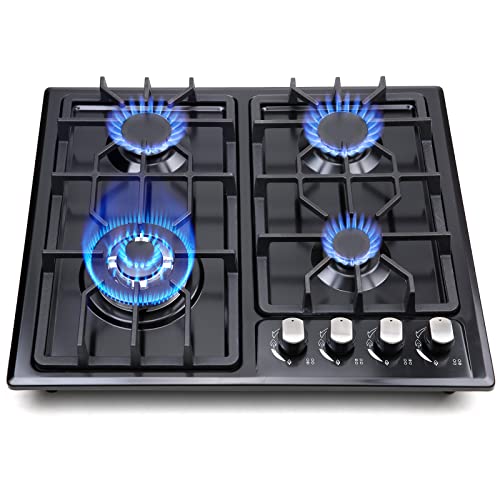
FORIMO Gas Cooktop 22 Inch (4 Burners) — Best Compact
Not every quality kitchen is 30 inches wide. The FORIMO packs four burners into a 22-inch built-in body — the format for small apartments, accessory dwelling units, cabins and compact refits — with the safety and conversion hardware (thermocouple protection, NG/LPG kit) that compact cooktops often skip. It suits small households that cook real food in small spaces. Four burners in 22 inches means small pans and honest expectations: this is choreography cooking, not banquet production.
Strengths
- Four real burners in a 22-inch built-in footprint
- Thermocouple protection and conversion kit included
- Stainless build suits kitchens, cabins and compact refits
Trade-offs
- Burner spacing limits pan sizes — plan cookware accordingly
- Value brand with seller-based support
- Total output is modest; large pots take their time
| Size | 22 inch, built-in |
| Burners | 4 burners |
| Safety | Thermocouple protection |
| Fuel | NG/LPG conversion kit included |
| Body | Stainless steel |
Compact cooktops are where quality claims usually evaporate — burners shrink to toys and safety hardware vanishes. The FORIMO keeps the adult features: flame-failure protection, a proper conversion kit, sealed-style construction in stainless. Its burners handle the small-pan repertoire — eggs, sauces, a pasta pot, vegetables — with genuine flame control, which is more than the two-burner hotplates it replaces ever offered.
Buy it with the pan discipline its size demands and it is a small kitchen’s liberation: four flames, real cooking, no countertop appliances colonising the workspace. Households that regularly cook for six should read the 30-inch picks above instead; households of two in a small flat have found their cooktop.
Best for: small kitchens, ADUs and cabins wanting four protected burners in 22 inches / Not suited for: large households or big-pan cooking
Check on Amazon — verify the current price on Amazon first; sellers refresh these listings regularly.
Comparison Table
| Pick | Badge | Key Spec | Best For |
|---|---|---|---|
| Samsung 30 Inch Smart Gas Cooktop (NA30N7755TS) | Best Overall Quality | 22K BTU dual-power centre burner, 5 burners, smart | keen cooks wanting the most capable mainstream 30-inch gas cooktop |
| Thermador 30 Inch Gas Cooktop (SGS305TS) | Best Premium | 5 sealed burners, precision low-heat control, premium build | cooks valuing low-heat finesse, heritage engineering and dealer support |
| Frigidaire Gallery 30 Inch Gas Cooktop (GCCG3047AS) | Best Mainstream All-Rounder | 5 burners, continuous grates, mainstream support | family kitchens wanting balanced, supported, no-drama quality |
| Empava 30 Inch Gas Cooktop (Black Tempered Glass) | Best Design-Led Value | 5 Sabaf burners, black tempered glass, dual-fuel | design-conscious renovators wanting Sabaf hardware in a glass format |
| ThermoMate 30 Inch Gas Cooktop (5 Sabaf Burners) | Best Heavy-Duty Value | 304 stainless, 5 Sabaf burners, CSA, thermocouple | high-volume households wanting certified, heavy-duty hardware per dollar |
| FORIMO Gas Cooktop 22 Inch (4 Burners) | Best Compact | 22-inch 4-burner, thermocouple, conversion kit | small kitchens, ADUs and cabins wanting four protected burners in 22 inches |
Sort the table by your constraint first — size, then philosophy. Within 30 inches, the Samsung cooks hardest, the Thermador controls finest, the Frigidaire balances best, and the two challengers trade blows on design versus durability. The FORIMO stands apart as the compact answer. Every row is a legitimate quality cooktop; the badges mark where each one’s quality concentrates. Prices will tempt a final sort, and that is legitimate — within a size and philosophy, the cheaper of two quality cooktops is usually the right buy. Across philosophies, price is comparing different products: hardware now versus service for a decade, both honestly sold. Keep the size badge in view as you compare prices across rows: a compact and a 30-inch model at similar money are answers to different kitchens. Keep the size badge in view as you compare prices across rows: a compact and a 30-inch model at similar money are answers to different kitchens, different households and different decades of cooking.
How to Choose a Quality Gas Cooktop
Begin with the physical facts: your cutout’s dimensions, your fuel (natural gas or propane), and your ventilation. Those three eliminate most of the market before preference speaks, and they are the source of nearly every bad cooktop purchase story. Then evaluate burner range — one true power burner, one true simmer burner — because that pair defines daily cooking more than the middle burners ever will.
Then judge construction with your hands where possible: grate weight and stability, knob action through its travel, cap fit, the gauge of the stainless. Check the safety specification for thermocouple flame-failure protection and a CSA or UL listing. Finally, price the support: a brand with dealers and parts catalogues is selling you year-ten serviceability, and a challenger is selling you year-one hardware — both honest, priced accordingly, and the real choice this category asks you to make.
- Power burner: look for the high teens of thousands of BTU for serious boiling and searing
- Simmer burner: a stable, low, even flame matters more than its printed minimum
- Continuous grates: they multiply usable space and pan stability
- Sealed burners: spills stay out of the works; cleaning becomes a wipe
- Conversion: propane homes must confirm the LP kit and jets are included or available
Gas vs Electric: The Honest Comparison
Buyers cross-shopping this guide with our electric cooktop coverage deserve the short, true version. Gas gives instant, visible, infinitely adjustable heat that works with every pan and keeps cooking through a power cut (with match-lighting where ignition is electric); it also puts combustion moisture and byproducts into the kitchen and demands real ventilation. Electric — radiant and especially induction — offers easier cleaning, steadier low control in induction’s case, and no combustion at the point of use, at the price of pan requirements and total dependence on the grid.
Neither wins in the abstract. Cooks raised on gas who sear and wok daily will feel at home here; households prioritising air quality, wipe-clean surfaces and simmer precision increasingly land on induction. This guide’s job is to make the gas side of that decision as good as it can be — and the picks above are where gas quality currently lives at each size and philosophy.
Knobs, Ignition and the Small Controls That Decide Daily Life
Specifications end at the burners, but ownership is lived at the controls. Knob quality announces itself in the first turn: a quality knob travels smoothly through a proportional range with no dead zone at the bottom, where simmer lives. Electronic ignition should be instant and boring; an igniter that clicks five times is a small daily tax that compounds into hatred of an otherwise good appliance. Re-ignition systems, which relight a flame a draft has killed, are a safety feature disguised as a convenience and worth seeking at any tier.
When you compare finalists, spend your attention there — on the controls you will touch three thousand times — rather than on the fourth decimal of a specification you will use twice. This guide’s picks were chosen partly on that tactile evidence, which is why the mainstream flagships, whose control feel is a solved problem, hold their places against cheaper hardware with stronger paper numbers.
Ventilation and Gas: The Non-Negotiable Partner
Every quality claim in this guide assumes the cooktop can breathe. Gas burners consume oxygen and produce heat, moisture, carbon dioxide and nitrogen dioxide; a hood that captures at the source is not an accessory but the second half of the appliance. Size the hood to the cooktop, favour capture depth and real ducting over recirculation, and run it whenever burners run — including the simmer that feels too small to matter.
Households with high-output picks like the Samsung should treat the hood budget as part of the cooktop budget. The finest burner in this guide under a decorative hood produces a greasy, steamy kitchen and degraded air; the same burner under proper extraction is the best cooking most homes ever get. Quality, in gas, is a system property.
Keeping a Gas Cooktop at Its Best
Gas cooktops reward a light, regular hand. Wipe spills before they bake; lift burner caps monthly, clear their ports with a brush or wooden pick (never a drill or wire that enlarges them), and reseat caps exactly — a mis-seated cap is the leading cause of the ‘weak burner’ that is not weak at all. Keep igniter electrodes clean and dry, and check that every flame burns blue with a defined cone; persistent yellow tipping means air or pressure needs a technician’s eye.
Once a year, confirm the knobs’ full travel still maps to the flames, test any flame-failure device by letting a gust — or a careful breath through a straw — kill a low flame and listening for the valve’s click, and inspect the flexible connector and shut-off for accessibility. Fifteen-year cooktops are not built differently from ten-year ones; they are maintained differently, starting in year one.
Reading a Gas Flame: A Field Guide in One Section
A healthy gas flame is blue, with a lighter blue inner cone, steady edges and no yellow tipping at any setting. That picture tells you the gas-air mix is right and combustion is complete. Flames that lift off the burner ports, roar, or gutter in still air are running too much primary air or pressure; flames that are lazy, yellow and sooty are starved of air or burning through dirty ports. Most ‘weak burner’ complaints are port blockages or a mis-seated cap; most ‘noisy burner’ complaints are a cap seated a few degrees off its index.
Learn your cooktop’s correct flame picture in its first week, at minimum and maximum on every burner, and you own a diagnostic instrument for the appliance’s whole life. Any change from that picture is information — about cleaning due, about a regulator drifting, about a conversion done carelessly — and catching it early is the cheapest maintenance there is.
Sealed vs Open Burners, and Other Construction Choices
Sealed burners — where the burner assembly closes against the cooktop surface so spills cannot enter — dominate quality modern cooktops for a simple reason: they convert cleanup from a disassembly into a wipe, and they protect igniters and valves from the boil-overs that kill them. Open-burner designs persist in some professional-style equipment, where their serviceability and raw output suit commercial kitchens with daily deep-cleaning staffs. In a home, sealed is the quality choice for all but the most committed traditionalists.
Grate material divides similarly. Cast iron is the quality standard — heavy, stable, tolerant of sliding pans — with enamel coatings trading a little durability for easier cleaning. Continuous grates, where the iron runs uninterrupted across burners, multiply the benefit by letting pans move without lifting. When you compare two cooktops at a tier, grate weight in the hand is one of the most honest specifications available to you, and this guide weighted it accordingly.
The Case for One Size Up — and When Not To Make It
Buyers between 30 and 36 inches should hear both sides plainly. The case for 36 is pan geometry: two large pans stop competing, the centre burner gains real estate, and entertaining stops being a scheduling problem. The case for 30 is everything else — smaller cutout disruption, cheaper ventilation demands, lower purchase cost, and a format every installer and parts catalogue knows intimately. Households that cook for two with one large pan gain nothing from width they will use monthly.
This guide’s structure reflects that honesty: the 36-inch format has its own dedicated roundup for households whose cooking justifies it, while this page’s centre of gravity sits at 30 inches, where most quality-per-dollar lives. Choose the size your pans and your parties dictate — not the size that photographs largest.
What Happens in Year Ten: A Service Story
Imagine two cooktops at year ten. On the first, an igniter fails: the owner searches the model number, finds the part listed by the maker and a dozen suppliers, watches a ten-minute video, and is cooking again by the weekend for the price of a pizza. On the second, the same failure begins a archaeology expedition — the brand has renamed itself, the part is ‘compatible with’ three models and identical to none, and the fix is a technician’s hourly rate spent mostly on identification. Both cooktops cooked identically in year one. The difference is what quality means over an appliance’s actual life.
That story is why this guide weighted support philosophy as heavily as burner hardware, and why it states each pick’s support model in its review rather than hiding it. You are not only buying flames; you are buying the year-ten version of a small problem. Choose which story you want to live in, and the category’s two camps stop looking like a puzzle and start looking like what they are: two different, honestly priced products.
How to Measure for a Gas Cooktop Replacement
Replacement failures are measurement failures. Settle the physical facts in this order and the rest of the purchase becomes preference.
- Measure the existing cutout precisely — width, depth, corner radius if visible — from above with the grates removed and, if possible, from the cabinet below
- Record the counter thickness and the clearance from the cutout to the wall behind and any side wall
- Photograph the old cooktop’s data plate and the gas connection: fuel type, required pressure, connector size
- Locate the shut-off valve and confirm it is reachable after installation; if it is not, budget its relocation
- Check the electrical outlet position for the igniter supply below the counter
- Compare every candidate’s specified cutout range against your measurements — the new unit’s range must include your cutout, not merely resemble it
- Confirm ventilation: hood width, duct path and capture capacity against the new cooktop’s total output
With that sheet filled in, take it to the listings: any pick in this guide whose cutout range excludes yours is eliminated honestly, and the best of what remains is your cooktop. File the sheet with the appliance paperwork you keep from delivery day; when a valve, igniter or grate is needed in year nine, that single page will tell the parts counter more than the cooktop’s badge will.
Common Buying Mistakes
Ranking cooktops by total BTU. Totals hide distribution. One strong centre burner and one true simmer burner outperform five medium burners every day of the week.
Forgetting the cutout. Gas cooktop cutouts vary by brand and era. A beautiful cooktop that does not fit your counter is a return, not an upgrade.
Skipping flame-failure protection. Thermocouple protection is the difference between a dead flame and a gas leak. At any quality level, insist on it.
Under-venting. A powerful gas cooktop under a weak hood degrades your kitchen’s air and coats it in grease. Budget the hood with the cooktop.
Converting fuels casually. Propane conversion requires the correct jets and settings, recorded on the data plate. It is a procedure, not a preference — have it done properly.
Final Recommendation
One recommendation, plainly: for a standard 30-inch kitchen, the Samsung is the best quality gas cooktop in this guide on cooking capability, with the Thermador the connoisseur’s alternative for low-heat finesse and permanence, and the Frigidaire Gallery the balanced mainstream buy. The Empava and ThermoMate prove that Sabaf-hardware challengers now deliver genuine quality per dollar — in glass or in steel, according to taste — and the FORIMO extends that quality to kitchens the standard sizes forgot.
Measure the cutout, settle the ventilation, decide which philosophy of support you are buying, and then choose by burner range. A gas cooktop chosen that way stops being an appliance purchase and becomes what it should be: the fixed point your cooking organises itself around for the next fifteen years.
A closing note on patience: quality gas cooktops are among the longest-lived appliances in a home, and the market for them moves slowly. A model that is right today will be right after a month of measuring, comparing and reading — while a cooktop bought in a weekend to fill a hole in the counter will be judged at three meals a day for fifteen years. Take the month.
Do the measuring, choose the philosophy, and then stop researching: at some point the marginal review teaches nothing, and the cooking — which is the entire point — is waiting on the other side of the decision.
The shortlist in one line: Samsung 30 Inch Smart Gas Cooktop (NA30N7755TS), Thermador 30 Inch Gas Cooktop (SGS305TS), Frigidaire Gallery 30 Inch Gas Cooktop (GCCG3047AS), Empava 30 Inch Gas Cooktop (Black Tempered Glass), ThermoMate 30 Inch Gas Cooktop (5 Sabaf Burners), FORIMO Gas Cooktop 22 Inch (4 Burners). Check the current price on Amazon for the one that matches your kitchen, then commit to learning it properly for a month before judging it.
Keep researching inside this cluster: Best Quality 36 Gas Cooktops Best 30 Gas Cooktops Best 5 Burner Gas Cooktops Best Cooktops Gas 36 Best Affordable Gas Cooktops Best Chef Cooktops
Frequently Asked Questions
What makes a gas cooktop ‘quality’ rather than just expensive?
Burner engineering (even flames, true simmer, real power), heavy and stable grates, flame-failure protection, certification, and a maker who supports parts for a decade or more. Price correlates loosely; this guide ranked the compound, which is why two value brands stand beside three famous ones.
Are Italian Sabaf burners really a quality marker?
Yes — Sabaf is a specialist burner manufacturer supplying many established brands, and its designs give even flames and reliable low-end control. A challenger cooktop built on genuine Sabaf burners shares engineering with appliances costing far more; what you give up is the big brand’s support network, not burner quality.
How many BTUs should the main burner have?
For serious boiling and searing, look for a centre or power burner in the high teens of thousands of BTU — the Samsung in this guide reaches 22K with its dual rings. Just as important is the smallest burner’s stability at low flame, which no headline ever advertises.
Is a smart gas cooktop worth it?
The cooking hardware is what you are really buying; smart monitoring adds burner-left-on alerts and remote awareness, which some households value and others ignore. Judge the Samsung in this guide first as a cooktop — it leads on burners — and treat the connectivity as a bonus that costs nothing to leave unused.
Can a gas cooktop be converted to propane later?
Most quality models support conversion with the correct jet kit and regulator adjustment, and many include the kit. The conversion must be done properly and recorded on the data plate; confirm kit availability for your exact model before buying if propane is in your future.
How long should a quality gas cooktop last?
Fifteen years is a fair expectation for the established brands and heavy-duty challengers in this guide, with igniters and valves as the likely service items. Longevity tracks maintenance and parts availability more than purchase price — another reason support philosophy is part of the quality ranking.
Should I choose knobs at the front or on top?
Front-facing knobs on a cooktop’s apron keep hands away from rising heat and read at a glance, but they need cabinet clearance below and can be reached by determined toddlers. Top-mounted knobs sit within the cooking surface’s footprint and suit flush installations. Neither affects the burners; choose by your kitchen’s geometry and your household’s height distribution.


