Disclosure: airfryerkitchensupply.com is reader-supported. When you buy through links on our site, we may earn an affiliate commission at no extra cost to you.
Where to buy
The fastest way to buy the best quality kitchen faucets two handle picks in this guide is through Amazon, where each verified model below is sold with its full finish and configuration options on one listing page. Start with the shortlist:
- Delta Windemere 21996LF Two-Handle Kitchen Faucet, Stainless — Best Overall Two-Handle. Check the current price on Amazon before you decide, because finish choices change the total.
- Delta Windemere 21996LF Two-Handle Kitchen Faucet, Oil Rubbed Bronze — Best Bronze Two-Handle. Check the current price on Amazon before you decide, because finish choices change the total.
- Moen Belfield 7255ORB Two-Handle Kitchen Faucet — Best Premium Traditional. Check the current price on Amazon before you decide, because finish choices change the total.
- Moen Banbury CA87000SRS Two-Handle Kitchen Faucet — Best Value Two-Handle. Check the current price on Amazon before you decide, because finish choices change the total.
Some models below are covered as unlinked because verification found no trustworthy Amazon listing for them; they are assessed on their merits in the text, with no buy link attached.
The best quality kitchen faucets two handle buyers choose share a philosophy the single-lever world forgot: separate, precise control of hot and cold, delivered through mechanisms you can service one side at a time. A two-handle faucet lets you dial temperature by feel, keeps a classic kitchen looking correct, and — in bridge and widespread formats — turns the faucet into the room’s centrepiece rather than an appliance. This guide ranks six verified two-handle models from Delta, Moen, Kingston Brass, and American Standard by build quality: cartridge systems, body materials, sprayer provision, and the finish discipline that separates a heritage faucet from a costume.
Two-handle quality has its own failure map. Cheap two-handle faucets weep at stem packings, their handles develop wobble as set screws loosen in soft metal, and their side sprayers — still common in this format — fail at the diverter. The picks below were chosen against that map: established cartridge ecosystems from Moen and Delta, solid-brass bridge construction from Kingston Brass, and a professional-line American Standard, each verified against its Amazon title before linking.
Fit is the other half of this search. Two-handle kitchen faucets come in 4-hole configurations with side sprayers, 8-inch centreset decks, and true bridge mounts that need only two holes but specific spacing — and the wrong guess is an installation-day disaster. Each review states its configuration plainly, and the guide section walks through measuring your sink before you fall for a silhouette.
In this guide
Quick Picks
- Best Overall Two-Handle: Delta Windemere 21996LF Two-Handle Kitchen Faucet, Stainless — the Windemere in stainless — Delta’s traditional two-handle, four-hole design with a side sprayer, in the finish most kitchens need.
- Best Bronze Two-Handle: Delta Windemere 21996LF Two-Handle Kitchen Faucet, Oil Rubbed Bronze — the same proven Windemere platform in oil rubbed bronze — the finish farmhouse and Tuscan kitchens actually ask for.
- Best Premium Traditional: Moen Belfield 7255ORB Two-Handle Kitchen Faucet — Moen’s Belfield high-arc two-handle in oil rubbed bronze — premium traditional styling with a side spray and Moen’s cartridge support.
- Best Value Two-Handle: Moen Banbury CA87000SRS Two-Handle Kitchen Faucet — the Banbury’s high-arc two-handle design in Spot Resist Stainless — Moen quality and finish technology at the accessible tier.
- Best Bridge Faucet: Kingston Brass Heritage Bridge Kitchen Faucet KS1278ALBS — the Heritage bridge in brushed nickel — solid-brass bridge construction with exposed pipework styling and a separate sprayer tradition.
- Best Professional Workhorse: American Standard Colony Pro Two-Handle Kitchen Faucet 7074551.002 — the Colony Pro’s two-handle high-arc design with integrated spray — a professional-line faucet built for unglamorous, dependable service.
How These Picks Were Chosen
Selection required, first, a genuine two-handle kitchen configuration — widespread, centreset, or bridge — verified in the Amazon title or model record, not a single-handle model with decorative cross handles. Second, a serviceable valve story: ceramic or established cartridge systems from makers with parts support, since a two-handle faucet has two valves to maintain over its life. Third, construction credibility: solid brass where the design claims heritage status, metal handles, and a sprayer arrangement — side spray or bridge sprayer — whose diverter design comes from a maker with a track record.
The final six spread across the format’s real range: Delta’s Windemere in two finishes for the classic 4-hole-with-sprayer kitchen, Moen’s Belfield and Banbury for traditional quality at two tiers, Kingston Brass’s Heritage bridge as the solid-brass centrepiece, and American Standard’s Colony Pro as the professional-line workhorse. Finishes were treated as quality features — oil rubbed bronze and brushed nickel from established lines resist the flaking that exposes cheap bronze-look faucets within a few heating seasons.
The 6 Best Quality Two-Handle Kitchen Faucets

Delta Windemere 21996LF Two-Handle Kitchen Faucet, Stainless — Best Overall Two-Handle
The Windemere in stainless (brushed nickel tone) is the two-handle default: a traditional 4-hole configuration with a separate side sprayer, two lever handles for precise mixing, and Delta’s parts ecosystem behind both valves. It suits the enormous installed base of four-hole kitchen sinks.
Strengths
- Four-hole layout with side sprayer matches classic sink decks without adapters
- Delta cartridge availability makes both valves serviceable for years
- Stainless tone coordinates with modern appliances in a traditional shape
Trade-offs
- Side sprayer adds a diverter and hose — two more parts than a pull-down design
- Traditional styling only; no modern variant of this model
- Four holes must all be present or covered — not for single-hole sinks
| Model | 21996LF-SS family (Amazon title) |
| Configuration | Two-handle, 4 hole, side sprayer (Amazon title) |
| Style | Traditional (Amazon title) |
The Windemere’s quality argument is ecosystem plus format honesty. Two-handle faucets live or die by their cartridges, and Delta’s are stocked wherever plumbing parts are sold, so a drip in year eight is a small repair, not a replacement. The side sprayer, unfashionable in pull-down era marketing, remains the best tool for rinsing a sink’s corners and washing produce, and Delta’s diverter design is a known quantity. In stainless, the Windemere bridges the gap for traditional kitchens full of stainless appliances — the shape respects the room’s age while the finish respects its equipment. For the classic American four-hole sink, this is the two-handle quality benchmark the rest of this list is measured against.
Best for: four-hole traditional sinks wanting serviceable Delta quality / Not suited for: single-hole sinks or pull-down devotees
Check the current price on Amazon for the Delta Windemere 21996LF Two-Handle Kitchen Faucet, Stainless.

Delta Windemere 21996LF Two-Handle Kitchen Faucet, Oil Rubbed Bronze — Best Bronze Two-Handle
This is the Windemere’s bronze expression, chosen separately because finish is a quality decision in two-handle land: oil rubbed bronze from Delta’s line carries the depth and edge-wear character that cheap bronze-look coatings fake for a season before flaking to bright metal at the handle edges.
Strengths
- Authentic oil rubbed bronze depth from an established finish line
- Same serviceable Delta two-valve platform as the stainless Windemere
- Side sprayer and traditional profile complete the farmhouse brief
Trade-offs
- Bronze is a living-look finish — edges lighten with handling by design
- Dark finish shows hard-water spots more visibly than stainless
- Four-hole requirement applies exactly as with the stainless version
| Model | 21996LF-ORB family (Amazon title) |
| Finish | Oil Rubbed Bronze (Amazon title) |
| Configuration | Two-handle, 4 hole, side sprayer (Amazon title) |
Bronze finishes separate quality makers from decorators faster than any other test, because a bronze look is easy to spray on and hard to make durable. Delta’s oil rubbed bronze has the tonal variation and wear behaviour of a real finish system: it deepens in low-touch areas and warms at the handles, ageing like hardware rather than expiring like paint. Mechanically this is the Windemere platform — two serviceable valves, a proper side sprayer, traditional proportions — so the bronze buyer sacrifices nothing in function for the farmhouse or Tuscan brief. Maintain it gently, never with abrasives or vinegar soaks, and it will look intentional for a decade. If your kitchen’s metals are bronze and black, this is the two-handle quality pick; if they are stainless and chrome, its stainless sibling above is the same faucet in your finish.
Best for: farmhouse and Tuscan kitchens with bronze hardware / Not suited for: stainless-led kitchens or abrasive cleaners
Check the current price on Amazon for the Delta Windemere 21996LF Two-Handle Kitchen Faucet, Oil Rubbed Bronze.

Moen Belfield 7255ORB Two-Handle Kitchen Faucet — Best Premium Traditional
The Belfield is the premium traditional option: a high-arc, two-handle Moen with a side spray, finished in oil rubbed bronze, for kitchens where the faucet must carry period design weight while still clearing stockpots and roasting pans.
Strengths
- High-arc spout gives two-handle format modern pot clearance
- Moen cartridge ecosystem backs both handles with easy parts access
- Belfield detailing reads genuinely premium in traditional rooms
Trade-offs
- Premium tier position within the two-handle market
- Oil rubbed bronze asks for gentle, non-abrasive care
- Side-spray format means a four-hole deck commitment
| Model | 7255ORB (Amazon title) |
| Finish | Oil Rubbed Bronze (Amazon title) |
| Configuration | Two handle, high arc, side spray (Amazon title) |
Moen’s Belfield line is where the company’s traditional design gets serious: the proportions are taller, the handle detailing finer, and the arc genuinely useful rather than merely decorative. Quality-wise it inherits Moen’s greatest practical asset — the most widely stocked cartridge ecosystem in North American plumbing — applied twice, once per handle, which matters in a format with two valves ageing in parallel. The bronze finish is Moen’s established system, with the same graceful wear character as the Delta bronze above. Choose the Belfield over the Windemere when the kitchen is a designed traditional space and the faucet is expected to be noticed; choose the Windemere when serviceability-per-dollar leads the brief. Both are honest quality — the Belfield simply spends more of its budget on presence.
Best for: designed traditional kitchens wanting premium presence / Not suited for: budget-led replacements or modern rooms
Check the current price on Amazon for the Moen Belfield 7255ORB Two-Handle Kitchen Faucet.

Moen Banbury CA87000SRS Two-Handle Kitchen Faucet — Best Value Two-Handle
The Banbury brings Moen’s Spot Resist Stainless finish to the two-handle, high-arc format at the value end of quality: the pick for landlords, flippers, and homeowners who want a name-brand two-handle faucet that stays presentable without premium pricing.
Strengths
- Spot Resist finish keeps a hard-working two-handle faucet looking clean
- High-arc design suits everyday pot filling in standard kitchens
- Moen parts support gives a value model an flagship-grade safety net
Trade-offs
- Value-tier detailing is simpler than Belfield-class models
- No side sprayer in this configuration — deck rinsing is spout-only
- Traditional styling limits it to classic kitchen schemes
| Model | CA87000SRS (Amazon title) |
| Finish | Spot Resist Stainless (Amazon title) |
| Configuration | Two-handle, high arc (Amazon title) |
Value two-handle faucets usually cut the finish first, which is why the Banbury’s Spot Resist Stainless matters: it is a genuine Moen finish system on an accessible model, resisting the fingerprints and spotting that make budget stainless look tired within a year. The high arc covers modern cookware, the two handles give the format’s signature precise mixing, and Moen’s cartridge support means the value purchase is not a disposable one. What you give up versus the Belfield is presence and the side sprayer — detailing is plainer, and rinsing the sink’s far corners is a spout-and-cup exercise. For rental-grade durability with a retail-grade appearance, that is the right trade, and the Banbury is the two-handle value benchmark in this guide.
Best for: rentals and value renovations wanting Moen support and finish / Not suited for: buyers who need a side sprayer or premium detailing
Check the current price on Amazon for the Moen Banbury CA87000SRS Two-Handle Kitchen Faucet.
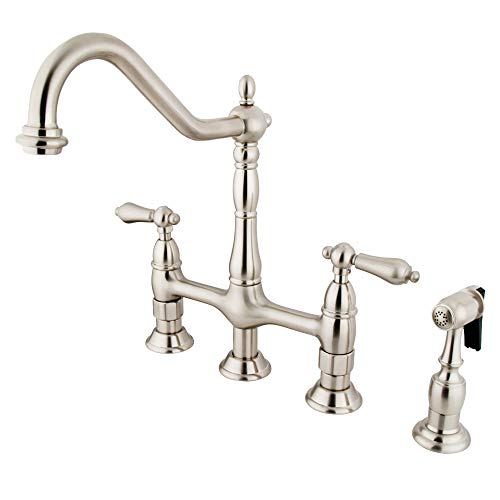
Kingston Brass Heritage Bridge Kitchen Faucet KS1278ALBS — Best Bridge Faucet
The bridge faucet is the two-handle format’s masterpiece, and Kingston Brass’s Heritage KS1278ALBS is its accessible flagship: an 8-inch bridge mount in brushed nickel, where the hot and cold supplies join in an exposed bridge above the deck — the defining silhouette of farmhouse and heritage kitchens.
Strengths
- Bridge format delivers the authentic heritage silhouette no deck-mount can imitate
- Kingston Brass specialises in solid-brass traditional construction
- Brushed nickel tempers the period look for kitchens with modern appliances
Trade-offs
- Bridge mounts need correct hole spacing and a confident installation
- Exposed bridge pipework adds cleaning surface around the deck
- Heritage styling is total commitment — it will define the sink area
| Model | KS1278ALBS (Amazon title) |
| Finish | Brushed Nickel (Amazon title) |
| Spout reach | 8-3/4 inch (Amazon title) |
| Format | Bridge, two-handle (product line) |
A bridge faucet is plumbing as furniture: the supplies rise through two deck holes and meet in the open, which is why the format demands honest materials — there is nowhere to hide thin construction. Kingston Brass built its name on exactly this category, casting traditional faucets in solid brass with period-correct detailing, and the Heritage in brushed nickel is the versatile member of the family, traditional in form but neutral enough in finish to sit with stainless appliances. Installation deserves respect: spacing must be exact, and the deck must be solid. Get those right and the Heritage becomes the piece visitors ask about — while still offering two-handle precision and a serviceable cartridge design. For a farmhouse renovation brief, this is the quality answer the keyword is really asking for.
Best for: farmhouse and heritage renovations wanting the true bridge format / Not suited for: renters, modern kitchens, or imprecise hole spacing
Check the current price on Amazon for the Kingston Brass Heritage Bridge Kitchen Faucet KS1278ALBS.

American Standard Colony Pro Two-Handle Kitchen Faucet 7074551.002 — Best Professional Workhorse
American Standard’s Colony Pro line is specified by professionals for buildings that cannot afford callbacks, and its two-handle high-arc kitchen model with spray brings that ethos home: polished chrome, straightforward engineering, and a brand whose parts are in every trade counter in the country.
Strengths
- Professional-line design prioritises serviceability and uptime
- High-arc spout with spray covers working-kitchen tasks without frills
- American Standard parts availability is as deep as the industry offers
Trade-offs
- Polished chrome shows spots and asks for regular wiping
- Styling is utilitarian — it will not star in a design magazine
- Pro-line plainness means fewer finish choices than retail lines
| Model | 7074551.002 (Amazon title) |
| Finish | Polished Chrome (Amazon title) |
| Configuration | Two-handle, high-arc, with spray (Amazon title) |
There is a quality argument that only professionals make: the best faucet is the one that never generates a second visit. The Colony Pro is built to that standard — ceramic disc cartridges, metal construction where it counts, and a design that any plumber can service blindfolded with parts from the van. In a home kitchen, that translates to a two-handle faucet that asks nothing of its owner for years, mixes precisely, and clears tall pots under its high arc. It will not win a beauty contest against the Belfield or the Heritage bridge, and chrome’s spotting is the daily tax. But for a working family kitchen, a rental portfolio, or any buyer who equates quality with absence of drama, the Colony Pro is the most professional answer in this guide.
Best for: working kitchens and landlords who value uptime over ornament / Not suited for: design-led renovations wanting a statement faucet
Check the current price on Amazon for the American Standard Colony Pro Two-Handle Kitchen Faucet 7074551.002.
Comparison Table
| Pick | Badge | Key spec | Best for |
|---|---|---|---|
| Delta Windemere 21996LF Two-Handle Kitchen Faucet, Stainless | Best Overall Two-Handle | 21996LF-SS, 4-hole, side sprayer | four-hole traditional sinks wanting serviceable Delta quality |
| Delta Windemere 21996LF Two-Handle Kitchen Faucet, Oil Rubbed Bronze | Best Bronze Two-Handle | 21996LF-ORB, oil rubbed bronze | farmhouse and Tuscan kitchens with bronze hardware |
| Moen Belfield 7255ORB Two-Handle Kitchen Faucet | Best Premium Traditional | 7255ORB, high arc, side spray | designed traditional kitchens wanting premium presence |
| Moen Banbury CA87000SRS Two-Handle Kitchen Faucet | Best Value Two-Handle | CA87000SRS, Spot Resist, high arc | rentals and value renovations wanting Moen support and finish |
| Kingston Brass Heritage Bridge Kitchen Faucet KS1278ALBS | Best Bridge Faucet | KS1278ALBS, bridge mount, brushed nickel | farmhouse and heritage renovations wanting the true bridge format |
| American Standard Colony Pro Two-Handle Kitchen Faucet 7074551.002 | Best Professional Workhorse | 7074551.002, Colony Pro, chrome | working kitchens and landlords who value uptime over ornament |
How to Choose a Two-Handle Kitchen Faucet: Format Before Finish
Two-handle shopping starts under the sink, not in the showroom. Count your holes and measure their spread: the classic four-hole deck (two handles, spout, side sprayer) takes faucets like the Windemere and Belfield directly; an 8-inch widespread or centreset pattern suits deck-mounted two-handle designs; a true bridge faucet like the Kingston Heritage needs two holes at the correct spacing and rewards exact measurement with the format’s unmatched silhouette. If your sink has the wrong pattern, decide honestly whether a deck plate, a new sink, or a different format is the real answer — adapters and optimism are not.
Next, judge the two-valve reality: you are buying two cartridges, two handle mechanisms, and twice the stem seals of a single-lever faucet, so the maker’s parts ecosystem matters double. Delta, Moen, and American Standard cartridges are stocked nationally; specialist heritage makers like Kingston Brass support their lines online. Finally, choose the sprayer strategy: a side sprayer is the best sink-rinsing tool ever fitted to a kitchen, at the cost of a diverter and hose to maintain, while sprayer-free high-arc models trade that reach for simplicity. Match the strategy to how you actually clean, not to how the showroom photographs.
Why Two Handles Still Win on Temperature Control
A single lever mixes temperature and flow on one axis, which is fast but coarse — the perfect washing-up warmth hides in a millimetre of lever travel. Two handles separate the variables: set the mix once with both hands, then adjust flow on either side while the ratio roughly holds, and return to a known-good temperature by handle position memory. For households that hand-wash delicate items, fill bottles to a safe warmth, or run a double-bowl routine at different temperatures, that precision is a daily quality feature no specification sheet advertises. It is also a repairability feature: a dripping hot side is serviced alone, with the cold side still in service, which is how kitchens stayed running for a century before cartridges became cartridges.
How to Install a Two-Handle Kitchen Faucet (and a Bridge) Without Leaks
Begin by verifying the deck: clean it fully, confirm hole count and spacing against the faucet’s specification with the actual product in hand, and dry-fit everything — handles, spout or bridge, sprayer — before any sealant or final tightening. Two-handle installs fail at alignment, so sight down the handles and spout from the room side and adjust until the geometry is true; a bridge faucet especially must sit level, because its exposed pipework advertises every degree of tilt.
Connect supplies to the correct sides — hot left, cold right, by convention and by every future user’s expectation — hand-tight plus a measured turn, keeping flexible lines free of kinks. Fit the side sprayer’s hose and diverter exactly as the manual sequences them, since diverter order decides sprayer pressure. Flush both lines into a bucket before final assembly so debris never reaches the new cartridges, then test each handle independently and together, checking every joint with a dry paper towel. Operate the sprayer repeatedly to seat the diverter, re-check handle set-screw tightness after the first week, and keep the cartridge model numbers with your home records — with two valves to service over the years, documentation is half the maintenance plan.
Two-Handle Formats Decoded: Centerset, Widespread, and Bridge
The two-handle family contains three architectures that photographs blur together. A centerset mounts handles and spout on a shared base at a fixed spread — compact, forgiving, and common on smaller sinks. A widespread separates the components: handles and spout mount individually through their own holes at eight inches or more, giving the installer layout freedom and the counter a cleaner, furniture-like spread of separate pieces. The bridge, represented here by the Kingston Heritage, joins the supplies above the deck in an exposed horizontal run — the oldest architecture of the three, and the only one whose plumbing is itself the decoration.
Quality implications differ by architecture. Centersets concentrate their seals in one body and are the simplest to service. Widespreads add flexible connections between valves and spout that must be routed without kinks. Bridges expose their pipework to the room’s air and the cleaner’s cloth, which is why solid brass matters so much in the format — there is no cabinet shadow for thin materials to hide in. Choose the architecture by your deck’s holes first and your design brief second; a bridge forced onto the wrong spacing is the most expensive mistake in this entire guide.
The Side Sprayer: In Defence of the Fourth Hole
Fashion declared the side sprayer dead when pull-down wands arrived, and fashion was half wrong. A pull-down rinses what the spout can reach; a side sprayer rinses everything else — the sink’s far corners, a bucket on the floor, produce in a colander on the counter, a pet’s paws at the back door. Its hose is longer, its angle is free, and its failure modes are honest: a diverter that weakens with scale, and a hose that ages under the sink. Both are serviceable with parts the major makers stock, which is why the Windemere and Belfield in this guide keep the format with confidence.
The quality buyer evaluates a sprayer by its diverter behaviour — spray should engage fully when triggered and cut off cleanly when released, without the spout dribbling in sympathy — and by hose quality, since a supple, kink-resistant hose is the difference between a tool and an annoyance. If your household fills, rinses, and washes beyond the bowl, the fourth hole is not a relic; it is the hardest-working hole in the deck. If your rinsing life happens entirely inside the bowl, a high-arc two-handle without a sprayer, like the Banbury here, spends the same money on finish instead — an equally rational allocation.
Handle Design: Levers, Crosses, and Wrists
Two-handle faucets ask your hands to work twice per use, so handle ergonomics are a quality dimension the single-lever world can ignore. Lever handles are the accessible standard — operable with a wrist, an elbow, or the back of a floury hand, and the right choice for ageing hands and busy cooks. Cross handles are the period-authentic alternative, beautiful on bridge and traditional designs, but they demand a grip and a twist that wet, soapy hands perform worst; households choosing crosses for looks should test them with honest hands before committing a whole kitchen.
Quality shows in handle mechanics: rotation should be smooth through its quarter-turn, with a positive stop that does not invite over-torquing; the handle should sit without wobble, because wobble is set-screw wear announcing itself in soft metal. Ceramic disc valves have standardised the quarter-turn feel across the good makers in this guide, which is why a Delta, Moen, or American Standard handle feels related despite different styling. When you service a handle — and over fifteen years you may — that standardisation is the difference between a stocked cartridge and a special order. Handles are the faucet’s handshake; judge the whole maker by it.
Mixing Temperatures Safely: Scald Awareness in Two-Handle Homes
Separate hot and cold control carries one responsibility single-lever thermostatic designs handle for you: scald awareness. A two-handle faucet can deliver water at the heater’s full temperature with the cold side closed, so households with young children or elderly residents should set the water heater to a safe delivery temperature at the tank rather than policing handles at the sink. The same precision that makes two handles wonderful for filling a baby bottle to a tested warmth makes them unforgiving of a careless full-hot blast.
In practice, households develop the safe ritual quickly — cold on first, hot added to taste, hot off first — and the format’s tactile feedback helps: each handle’s position is a visible, memorable temperature setting in a way a single lever’s angle is not. Grandparents’ kitchens ran this way for generations without incident, on the strength of habit plus a sensibly set heater. Add the modern cartridge’s smooth, predictable response — no sudden surges as a washer gives way — and the quality two-handle faucet is as safe as the household’s habits make it, which is to say, entirely safe in a house that sets its heater correctly and teaches its ritual once.
Two-Handle Faucets in Accessible and Ageing-Friendly Kitchens
Two-handle design carries an accessibility argument that deserves more attention than it gets. Lever handles can be operated with a closed fist, a wrist, or an elbow, demanding no grip strength and no pinch — which is why lever-style two-handle models like the Windemere and Banbury in this guide suit households planning for ageing hands, arthritis, or temporary injuries. The separated controls also give unambiguous feedback: temperature is read from two handle positions at a glance, without interpreting a single lever’s angle, which many users with cognitive or visual impairments find easier to verify.
The honest counterpoints belong here too. Cross handles, however beautiful on a bridge faucet, are the least accessible control ever fitted to a kitchen and should be chosen only by households whose hands welcome them. And any two-handle faucet asks for two operations where a lever asks for one, which matters at 3 a.m. with a crying infant and one free hand. Accessibility is personal, not categorical: the quality choice is the control your household’s hands perform best, tested honestly before the boxes are opened — a principle this guide applies to every format it covers.
Restoring vs Replacing an Old Two-Handle Faucet
Many readers of this guide own an old two-handle faucet and face the restorer’s question. Restoration is rational when the body is solid brass, the finish is honest, and the maker still stocks cartridges and stems — conditions met by generations of Delta, Moen, and American Standard installations, whose parts ecosystems this guide keeps praising because they make old faucets immortal. A cartridge pair, new seals, a diverter refresh, and a deep descale can return a thirty-year-old faucet to full service for a fraction of replacement, with its patina — an asset no new finish can counterfeit — intact.
Replacement wins when the body itself is compromised: cracked castings, threads worn smooth, finishes failed to the base metal across broad areas, or an obscure maker whose parts vanished with it. It also wins when the format is wrong — a low spout over a modern deep sink will annoy daily no matter how faithfully it is restored. Judge your incumbent by the same audit this guide applies to new models, and let the verdict be mechanical rather than sentimental in either direction. The six picks here stand ready if replacement wins; the parts channels stand ready if it does not.
The Two-Handle Kitchen Through a Day
A format earns its place by surviving a day, so walk the two-handle kitchen from dawn. The first fill of the kettle is a one-handle judgement — cold only, full flow, no mixing required — and the format’s separation makes it thoughtless. Breakfast washing-up finds the two-bowl rhythm the format was born for: hot suds on one side at a temperature set by handle position and remembered by muscle, a cooler rinse on the other, the side sprayer rinsing the sink itself clean in seconds at the end. Midday bottle-warming shows the precision case — a tested warmth dialled by two positions you can see and repeat exactly tomorrow.
The evening’s serious cooking is where sceptics convert. A stockpot fills under the high arc while hands stay free; a pan soaks on one side while the other side stays in service for rinsing boards and knives; the sprayer washes down the whole station at the end, corners included, in a way no fixed spout imitates. Nothing in the day required speed the format lacks, and several moments used control the single lever approximates poorly. Formats survive for a century by fitting days like this one. The two-handle faucet’s day is not a re-enactment — it is a working pattern that modern households keep choosing on its merits, and the six quality models in this guide are its current best instruments.
Two-Handle Faucets and Water Efficiency
Efficiency conversations usually belong to single-lever marketing, but two-handle faucets hold an underappreciated card: separation itself saves water. Tasks that need only cold — filling the kettle, rinsing produce, the dog’s bowl — run on one handle with the hot side never opened, which means no mixed water is drawn, cooled in the pipe, and wasted warming up for nobody. Modern two-handle models from the makers in this guide are built to the same regulated flow standards as their single-lever siblings, with aerators that shape a full-feeling stream at economical volumes, and their ceramic cartridges hold those settings precisely instead of drifting richer as washers age.
The household’s half of the bargain is habit: the two-bowl washing rhythm, done properly, uses a sink of hot water for a whole load of dishes rather than a running tap’s continuous draw, which is how generations washed economically before dishwashers. Add the format’s repairability — a dripping side is a cartridge, not a replacement, and every avoided replacement is manufacturing waste that never happens — and the two-handle faucet’s environmental case is stronger than its traditional image suggests. Efficiency, in the end, is a system of product and practice; this format, in quality hands, runs both halves well.
Two-Handle Faucets in Bed-and-Breakfast and Hospitality Kitchens
Small hospitality kitchens — guesthouses, bed-and-breakfasts, holiday rentals with real cooking — have standardised on quality two-handle faucets for reasons their owners can recite. Guests understand them instantly, with no lever logic to misread and no electronics to defeat a tired traveller at midnight. Staff can service a dripping side between check-outs with a stocked cartridge, keeping the room in service instead of awaiting a full replacement. The traditional silhouettes photograph as character in listings, which in hospitality is revenue, not vanity. And the format’s separation of hot and cold lets a property set safe temperatures at the heater while guests retain honest control at the sink.
The specification that emerges matches this guide’s picks closely: a serviceable Delta or American Standard for the workhorse rooms, a Belfield-class or bridge model where the kitchen is the property’s photographed centrepiece, and finishes chosen for survival under unknown cleaning regimes — which in practice means the established systems from established makers, never a fashion coating. Hospitality is simply domestic quality with the volume turned up and the excuses removed, and it keeps arriving at the same conclusion this guide reached: two handles, real cartridges, stocked parts, and a silhouette that suits the house.
Refinishing and Refreshing a Two-Handle Installation
A quality two-handle faucet rewards a mid-life refresh that stops short of replacement. Begin with the consumables: both cartridges, the diverter if a sprayer is fitted, aerator, and every seal the maker’s kit lists — ordered by model number in one parcel, so the faucet is opened once rather than weekly. While the handles are off, clean their undersides and the deck beneath them, the two places a decade of kitchen film accumulates unseen, and inspect the handle stems for the wobble that new set screws and bushings cure cheaply. Reassemble with the handles aligned to each other before final tightening, because a refreshed faucet whose handles sit at mismatched angles looks older than an untouched one.
Finish the refresh at the sprayer: run it at full pressure, confirm the diverter cuts over cleanly in both directions, and replace the sprayer hose if its suppleness has gone — hoses are wear items and priced like them. What emerges is functionally a new faucet wearing its original, honestly aged finish, at a small fraction of replacement cost and with none of the installation risk. This is the two-handle format’s deepest quality argument, available only because its makers kept the parts coming: a faucet designed to be refreshed is a faucet designed to be kept.
One sentence of this guide deserves repeating at the point of purchase: in the two-handle world, the cartridge ecosystem is the faucet, because two valves serviced cheaply for decades will always outlast two valves that cannot be serviced at all. Choose the maker whose parts your plumber already carries, and the format will repay you in the only currency that matters at a sink — uneventful years.
Before ordering any model in this guide, perform the deck ritual one final time: count the holes aloud, measure the spread with the tape on the deck rather than beneath it, and photograph both for the record. Two-handle formats reward that minute of discipline more than any other faucet family, because their architectures — four-hole, widespread, bridge — differ by exactly the dimensions a guess gets wrong. Then order with the cartridge numbers for your chosen model noted alongside it, so the faucet arrives in your home already documented as the serviceable, decade-long fixture this guide intends it to be.
Common Buying Mistakes
Guessing the hole pattern. Four-hole, widespread, and bridge formats are not interchangeable. Measure count and spacing before ordering; a beautiful faucet that does not fit your deck is wall art.
Buying bronze-look coatings from unknown makers. Cheap bronze finishes flake at handle edges within a year. Established finish systems — as on the Delta and Moen picks here — age gracefully instead.
Forgetting there are two cartridges. Budget for the format’s reality: two valves to service over the life. Makers with stocked cartridges turn that into a virtue; obscure makers turn it into a replacement.
Misaligning handles at installation. Two-handle faucets are judged visually by handle symmetry every day. Dry-fit, sight from the room, and only then tighten.
Skipping the sprayer diverter check. A weak or chattering sprayer is usually a diverter or debris issue from installation day. Flush lines first and test the sprayer repeatedly before closing up.
Final Recommendation
The stainless Delta Windemere is the two-handle default for classic four-hole sinks, its bronze sibling owns the farmhouse finish brief, the Moen Belfield takes premium traditional, the Banbury value-with-support, the Kingston Heritage the true bridge brief, and the Colony Pro the professional-uptime brief. Measure your deck before choosing among them — in this format, fit is quality. Related reading: Best Quality Kitchen Faucets, Best Quality Faucets, Best Kitchen Faucets, and Best Bridge Kitchen Faucets.
Frequently Asked Questions
Are two-handle faucets outdated?
No — they remain the precision choice for temperature control and the correct format for traditional, farmhouse, and bridge designs. Single levers are faster; two handles are finer, and in heritage kitchens they are also the visually right answer.
What sink holes does a two-handle kitchen faucet need?
It depends on the format: classic models with side sprayers use four holes, widespread and centreset designs use their stated spreads, and bridge faucets use two holes at a specific spacing. Measure your deck’s count and spread and match the model’s specification exactly.
Is a side sprayer better than a pull-down sprayer?
For rinsing the sink itself and washing produce, a side sprayer’s free hose is excellent and arguably better. Pull-downs win for filling pots and integrated looks. The trade is maintenance: a side sprayer adds a diverter and hose to service.
How do I stop a two-handle faucet dripping?
Usually by replacing the cartridge or seals on the dripping side only — one advantage of the format. Shut off that side’s supply, follow the maker’s cartridge procedure, and use the exact cartridge for your model, which is why keeping model documentation matters.
Does oil rubbed bronze hold up?
From established makers, yes — it is a finish system designed to deepen and warm with handling. From unknown makers, bronze-look coatings can flake quickly. Brand and finish system, not colour, decide durability.
Can I install a bridge faucet on any two-hole sink?
Only if the hole spacing matches the bridge’s specification and the deck is solid enough for the exposed assembly. Measure precisely; bridge faucets are unforgiving of approximate spacing.


