Disclosure: airfryerkitchensupply.com is reader-supported. When you buy through links on our site, we may earn an affiliate commission at no extra cost to you.
Where to buy
Every one of the best searing gas grills below links to its verified Amazon listing, where you can check the current price on Amazon and confirm the fuel configuration — most of these grills come in propane and natural gas versions under near-identical names, and ordering the wrong one is the most common and most avoidable mistake in this category. Check the listing title for LP or NG before you check anything else. While you are there, note the grate material line as well: cast iron or heavy stainless grates are what turn a searing burner from a specification into a crust, and every pick in this guide was chosen with its grates in mind.
- Napoleon Rogue PRO 425 Propane Grill with Infrared Side Burner — check price on Amazon
- Weber Spirit E-325 Gas Grill — check price on Amazon
- Weber Spirit E-435 Gas Grill (LP) — check price on Amazon
- Char-Broil Pro Series Amplifire 4-Burner Gas Grill — check price on Amazon
- Broil King Baron S 590 Pro IR — check price on Amazon
- Kenmore 5-Burner Gas Grill with Searing Zone — check price on Amazon
The best searing gas grills solve the ordinary gas grill’s one real weakness: most patio grills roast beautifully but sear politely, because their burners spread moderate heat across a wide grate and their lids trap steam against the steak. A true searing gas grill concentrates heat — through a dedicated sear zone with boosted burners, an infrared side burner that runs far hotter than the main box, or an infrared emitter system that turns flame into radiant intensity — so the crust forms properly in the first two minutes of contact instead of the tenth.
The six picks below represent the three working technologies. Weber’s Sear Zone models add boosted burners inside the main firebox. Napoleon’s infrared side burner — the famous Sizzle Zone approach — puts a small, ferociously hot ceramic burner beside the main grate. Char-Broil’s Amplifire infrared system replaces open flame under the whole grate with emitter plates. Each approach has its own honest trade-offs, strengths, and maintenance rhythm, and every pick was verified against Amazon’s catalog data, with BTU and area figures quoted from those listings where they state them.
In this guide
Quick Picks
The Napoleon Rogue PRO 425 is the searing specialist’s pick, the Weber Spirit E-325 is the value sweet spot, and the Char-Broil Amplifire is the flare-up-free infrared route. Full shortlist below, with the searing system of each pick named and judged first, and the rest of the grill — area, burners, build, and support — judged with equal honesty after it.
- Napoleon Rogue PRO 425 Propane Grill with Infrared Side Burner — Best Overall. The complete searing package: three main burners plus a dedicated infrared side burner for crust-first cooking, 716 sq in of total area, cast iron grates, and 56,000 BTU on tap. Check on Amazon to check price on Amazon.
- Weber Spirit E-325 Gas Grill — Best Value Sear Zone. Weber’s sear-zone formula at the friendliest tier: three burners with a boosted Sear Zone in the main box, in the compact Spirit footprint that fits most patios. Check on Amazon to check price on Amazon.
- Weber Spirit E-435 Gas Grill (LP) — Best for Families. The family-size Sear Zone: four burners, the boosted sear section, and a side burner for sauces — the E-325’s formula scaled for bigger households and bigger cooks. Check on Amazon to check price on Amazon.
- Char-Broil Pro Series Amplifire 4-Burner Gas Grill — Best Infrared, No Flare-Ups. Infrared everywhere: the Amplifire emitter system puts radiant heat under the entire grate — searing heat with virtually no flare-ups, in a four-burner cabinet grill with side burner. Check on Amazon to check price on Amazon.
- Broil King Baron S 590 Pro IR — Best Premium. The heavyweight: five burners in stainless, an infrared side burner for searing, and a rear rotisserie burner — a premium grill for people who cook everything outside. Check on Amazon to check price on Amazon.
- Kenmore 5-Burner Gas Grill with Searing Zone — Best Big Grill on a Budget. Size and searing at a value tier: five burners, a dedicated searing zone, 644 sq in and a verified 66,000 BTU — the most sheet metal per dollar in this guide. Check on Amazon to check price on Amazon.
How These Picks Were Chosen
We screened for concentrated heat, not total BTU. A big grill with six mild burners sears worse than a smaller grill with one fierce zone, so headline BTU counts were ignored until we had identified the searing hardware: a boosted sear zone, an infrared burner, or a full infrared emitter system. Every pick here has at least one of the three, stated in its verified listing.
Second, grate material. Searing is contact plus radiation, and heavy grates — porcelain-enameled cast iron or stainless rod — hold and deliver heat in a way thin wire grates cannot. The picks reflect that: cast iron appears throughout, and where a listing names its grate material, the spec box quotes it.
Third, the rest of the grill still has to be a good grill. A sear zone is two minutes of a cook; the other twenty are roasting, warming, and finishing, so we required competent main burners, usable total area, and brands with real parts support. A one-trick sear burner bolted to a mediocre grill did not make this list.
Every product name and ASIN was cross-checked against Amazon’s catalog, and only exact brand-and-model matches are linked. Figures in the spec boxes — total BTU, cooking area — come from those verified listing titles, not from review roundups or retailer summaries, which disagree with each other often enough to be useless as a source.
One more screen deserves naming: we required the searing feature to be integral to the grill as sold, not an accessory promise. Aftermarket sear plates and bolt-on gadgets have their fans, but a buyer searching for a searing gas grill deserves a machine whose manufacturer engineered, warranted, and plumbed the searing system at the factory. Every pick here meets that bar, which is also why their searing hardware carries the brands’ own names — Sear Zone, Amplifire, infrared side burner — rather than a third party’s.
The 6 Best Searing Gas Grills That Actually Crust a Steak
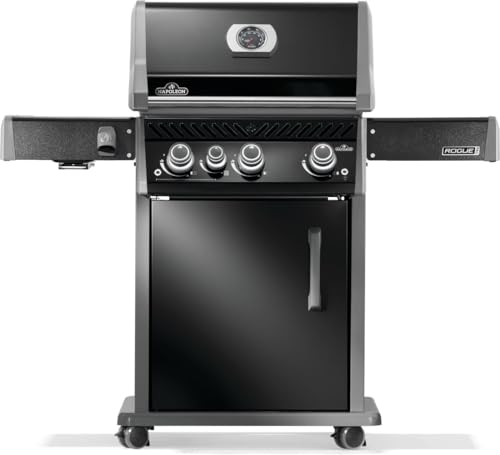
Napoleon Rogue PRO 425 Propane Grill with Infrared Side Burner — Best Overall
The Rogue PRO 425 is built around the smartest searing layout in home gas grilling: do the violent work on a small infrared side burner, and keep the main box for everything else. The verified listing gives the full picture — three main burners, an infrared side burner, 56,000 BTU total, 716 square inches of cooking area, cast iron grates, backlit knobs, and a folding shelf for smaller patios.
Strengths
- Dedicated infrared side burner sears at temperatures the main box cannot reach
- Cast iron grates hold heat for deep marks on the main surface too
- Folding shelf and locking casters suit real-world patios and storage
Trade-offs
- Sear-zone capacity is a couple of steaks at a time — it is a station, not a surface
- Premium tier pricing within the mid-size class
- Infrared burner ceramics reward gentle cleaning — no aggressive scraping
Key specs
- Model: Napoleon Rogue PRO 425 (Propane)
- Total output: 56,000 BTU (per verified listing title)
- Total area: 716 sq in (per verified listing title)
- Searing: Infrared side burner
The workflow this grill teaches is the steakhouse workflow: sear each steak hard and fast on the infrared burner — a minute or two per side over ceramic heat that dwarfs any main burner — then move it to the main grates to finish gently to temperature. Crust and doneness stop competing with each other, which is the entire problem of steak on a conventional grill, solved by architecture rather than technique.
As a daily grill it wants for little: three burners zone the main box properly, the cast iron grates are the right material, and the folding shelf acknowledges that most patios are not showrooms. If searing is a weekly event in your house, this is the most capable tool in the guide, and the one whose searing hardware you will use most because it asks the least compromise of the rest of the grill.
Best for: Steak-first households that also need a complete mid-size family grill / Not suited for: Buyers who sear rarely, or who need to sear for eight at once
Check on Amazon — check the current price on Amazon before you buy.

Weber Spirit E-325 Gas Grill — Best Value Sear Zone
The Spirit E-325 puts Weber’s Sear Zone — an extra-boosted burner section inside the main firebox, per the verified listing — into the compact three-burner Spirit that is already one of the most sensible grills in home cooking. No side station, no second appliance: the searing happens where the cooking happens.
Strengths
- Sear Zone with Boost concentrates heat inside the main box — no workflow change
- Compact Spirit footprint suits smaller patios and decks
- Weber’s parts and support ecosystem is the deepest in home grilling
Trade-offs
- In-box sear zones run cooler than a dedicated infrared burner
- Three burners means modest total area for large gatherings
- No side burner for sauces and sides
Key specs
- Model: Weber Spirit E-325 (LP)
- Burners: 3, with Sear Zone w/Boost (per verified listing)
- Grates: Porcelain-enameled cast iron (Spirit line)
- Fuel: Liquid propane
The in-box sear zone is the convenience play: preheat with the boost on, lay the steaks over the hot section, and the crust forms without moving food between stations. It will not match the Napoleon’s infrared ferocity degree-for-degree — no in-box zone does — but it closes most of the gap between a standard grill and a searing grill while keeping one cooking surface to manage, which weeknight cooks genuinely prefer.
The Spirit platform underneath is the safe pair of hands of this category: even main burners, honest build, and a decade-deep parts catalog. For the buyer whose brief is “a good grill that also sears properly,” rather than “a searing machine that also grills,” the E-325 is the balanced answer and the value anchor of this guide.
Best for: Most households wanting real searing without a second station or premium tier / Not suited for: Searing purists chasing infrared temperatures, or very large gatherings
Check on Amazon — check the current price on Amazon before you buy.

Weber Spirit E-435 Gas Grill (LP) — Best for Families
Everything the E-325 does, the E-435 does with more room and one more burner. The verified listing spells out the upgrade path: four burners, Sear Zone with Boost, and a side burner, in the larger Spirit frame — the configuration family cooks actually need when steaks for six share the evening with corn, peppers, and a pan of sauce.
Strengths
- Four burners give real zoning: sear zone plus gentle zones simultaneously
- Side burner handles sauces, sides, and searing small pans outdoors
- Same Weber support and parts depth as the E-325
Trade-offs
- Larger footprint and price than the E-325 — buy it for the area, not the badge
- In-box sear still a step below dedicated infrared heat
- Side burner lids and shelves consume patio width
Key specs
- Model: Weber Spirit E-435 (LP)
- Burners: 4, with Sear Zone w/Boost (per verified listing)
- Extras: Side burner
- Fuel: Liquid propane
Capacity changes technique. On the E-435 you can run the sear zone at full boost for steaks while the far burners hold vegetables at a gentle roast and the side burner keeps chimichurri warm — a whole dinner orchestrated on one appliance, which is the actual family use case and the reason to step up from the three-burner model.
Choose between the two Spirits by headcount and menu breadth, not by searing power, which is equivalent in kind. Two to four people, simpler menus: E-325, and save the money. Five-plus, or a cook who runs sides and sauces alongside: the E-435 earns its size every weekend.
Best for: Families of five-plus and cooks who run full dinners on one grill / Not suited for: Small households, for whom the E-325 is the same searing at less cost
Check on Amazon — check the current price on Amazon before you buy.

Char-Broil Pro Series Amplifire 4-Burner Gas Grill — Best Infrared, No Flare-Ups
Char-Broil’s Amplifire system takes the opposite approach to a sear zone: instead of one hot corner, the entire grate sits over infrared emitter plates that convert burner flame into intense radiant heat. The verified listing describes the result — a four-burner propane cabinet grill with side burner built around that system.
Strengths
- Whole-grate infrared heat: sear anywhere, not just in one zone
- Emitter plates block drippings from the flame — flare-ups are nearly eliminated
- Juicier results on lean proteins, a known infrared advantage
Trade-offs
- Emitter plates need regular cleaning to keep pores open and heat even
- Infrared character differs from open-flame char — some cooks miss the flame-kissed edge
- Cabinet format is a larger, less mobile appliance
Key specs
- Model: Char-Broil Pro Series Amplifire 463281024
- Burners: 4 plus side burner
- System: Amplifire infrared emitter plates
- Format: Cabinet, propane
The flare-up point deserves emphasis, because it changes who can sear what. On an open-flame grill, fatty ribeyes and skin-on chicken flare exactly when they are searing best; over Amplifire emitters, drippings vaporize on the plate instead of igniting, so the cook manages heat rather than fire. For households that grill fatty cuts often — or that have been scared off searing by flare drama — this is the most forgiving route to a serious crust.
Maintenance is the honest trade: emitter plates accumulate residue in their pores, and a neglected plate heats unevenly and smokes. A brush-and-burn-off routine after fatty cooks keeps them open. Accept that rhythm and the Amplifire delivers the most uniform searing surface in this guide, edge to edge, steak after steak.
Best for: Flare-up-weary cooks and fans of fatty cuts, chicken, and even infrared heat / Not suited for: Open-flame traditionalists, or anyone who will not clean emitter plates
Check on Amazon — check the current price on Amazon before you buy.

Broil King Baron S 590 Pro IR — Best Premium
The Baron S 590 Pro IR is the maximalist pick: the verified listing describes a five-burner stainless propane grill with an infrared side burner for searing and a rear rotisserie burner for slow-roasting — three cooking systems in one heavy appliance, from a brand whose reputation rests on hot, even fireboxes.
Strengths
- Infrared side burner plus five main burners plus rear rotisserie burner
- Stainless construction and Broil King’s even-heating firebox design
- Capacity for large gatherings without giving up a searing station
Trade-offs
- Premium pricing and a genuinely large, heavy appliance
- More burners and systems to maintain than simpler grills
- Over-specified for households that grill twice a month
Key specs
- Model: Broil King Baron S 590 Pro IR (678344)
- Burners: 5 main, infrared side, rear rotisserie
- Construction: Stainless steel
- Fuel: Propane
Broil King’s party trick across its range is heat evenness — its burner and heat-plate design is engineered to flatten the hot-spot map that plagues big grills — and in a five-burner box that matters more, not less. Add the infrared side burner as the dedicated searing station and the rear burner for rotisserie birds, and the Baron is less a grill than an outdoor cooking platform.
The buyer for this is the household whose patio is a second kitchen: big gatherings, mixed menus, rotisserie on Sundays, steaks seared to order on the side burner while the main box roasts. If that is your life, the premium is rational. If it is your aspiration for two weekends a year, the Rogue PRO above delivers the same searing architecture at a saner scale.
Best for: High-volume home chefs wanting searing, roasting, and rotisserie in one unit / Not suited for: Occasional grillers or small patios
Check on Amazon — check the current price on Amazon before you buy.

Kenmore 5-Burner Gas Grill with Searing Zone — Best Big Grill on a Budget
The Kenmore makes the size-for-money argument with a searing zone included. The verified listing gives the numbers plainly: five burners plus a side burner and searing zone, 644 square inches of cooking area, 66,000 BTU total, stainless steel construction — a specification that would cost considerably more under the premium badges in this guide.
Strengths
- Verified 66,000 BTU and 644 sq in — the biggest spec sheet at its tier
- Dedicated searing zone plus side burner at a value price point
- Five burners allow genuine multi-zone cooking for crowds
Trade-offs
- Value-tier fit, finish, and long-term parts depth versus Weber and Napoleon
- Large footprint demands a large patio corner
- Stainless grade and component quality are a step below the premium picks
Key specs
- Model: Kenmore 5-Burner with Searing Zone
- Total output: 66,000 BTU (per verified listing title)
- Cooking area: 644 sq in (per verified listing title)
- Burners: 5 plus side burner and searing zone
Judged purely as a searing appliance per dollar, the Kenmore is hard to argue with: the searing zone concentrates real heat, the five-burner box zones a big cook properly, and the area swallows a party’s worth of steaks and vegetables at once. For a large family or a social household on a firm budget, it delivers the experience that matters — hot, capacious, capable — at the tier that fits.
The compromises live in longevity and refinement: thinner materials in places, a shallower parts pipeline, controls that feel a class below Weber’s. None of that changes a single dinner this summer; all of it matters across a decade. Buy it as a high-capacity grill for its first several years of hard use, and it is an honest bargain. Buy it expecting a fifteen-year heirloom, and the premium picks exist for you.
Best for: Large households and party hosts on a firm budget / Not suited for: Buyers prioritizing decade-long parts support and premium finish
Check on Amazon — check the current price on Amazon before you buy.
Comparison Table
| Pick | Badge | Key spec | Best for |
|---|---|---|---|
| Napoleon Rogue PRO 425 Propane Grill with Infrared Side Burner | Best Overall | Infrared side burner, 56,000 BTU, 716 sq in | Steak-first households that also need a complete mid-size family grill |
| Weber Spirit E-325 Gas Grill | Best Value Sear Zone | 3 burners, Sear Zone w/Boost, compact footprint | Most households wanting real searing without a second station or premium tier |
| Weber Spirit E-435 Gas Grill (LP) | Best for Families | 4 burners, Sear Zone w/Boost, side burner | Families of five-plus and cooks who run full dinners on one grill |
| Char-Broil Pro Series Amplifire 4-Burner Gas Grill | Best Infrared, No Flare-Ups | Full-grate Amplifire infrared, 4 burners, side burner | Flare-up-weary cooks and fans of fatty cuts, chicken, and even infrared heat |
| Broil King Baron S 590 Pro IR | Best Premium | 5 burners + infrared side burner + rotisserie burner | High-volume home chefs wanting searing, roasting, and rotisserie in one unit |
| Kenmore 5-Burner Gas Grill with Searing Zone | Best Big Grill on a Budget | 5 burners, searing zone, 644 sq in, 66,000 BTU | Large households and party hosts on a firm budget |
The table compresses the architecture choice. Two philosophies compete: in-box boosted zones (both Webers, the Kenmore) that sear where you cook, and dedicated infrared stations (Napoleon, Broil King) that sear hotter in a smaller space — with Char-Broil’s Amplifire as the third way, infrared across the whole grate. If your searing is mostly steaks for two to four, the infrared-station grills are the specialists. If it is mixed family cooking with searing woven through, the in-box zones integrate better. The Kenmore is the capacity-per-dollar outlier; the Broil King is the everything-at-once flagship. None of the six is a bad grill — the decision is about which searing rhythm fits your kitchen.
How to Choose the Best Searing Gas Grills
Pick your searing architecture first. Three systems dominate, and they suit different cooks. A boosted in-box sear zone (Weber Spirit) is the simplest — one surface, no workflow change, very good crust. A dedicated infrared side burner (Napoleon, Broil King) reaches the highest temperatures and enables the sear-then-finish method, at the cost of a small searing capacity. A full infrared emitter system (Char-Broil Amplifire) sears anywhere on the grate and kills flare-ups, with emitter maintenance as its tax. Decide which rhythm matches your cooking before comparing anything else.
Then size the main grill honestly. The sear is two minutes; dinner is the rest. Total area and burner count should match your typical crowd — three burners and a compact box for most households, four to five for families and hosts. Oversizing buys you longer preheats and more cleaning for area you use twice a year.
Check grates and firebox, not badges. Cast-iron or heavy stainless grates and a well-sealed firebox determine how much of the burners’ output becomes searing heat at the food. These are stated in listings and spec sheets; read them. A famous badge over thin grates sears worse than a modest badge over cast iron.
Confirm the fuel version twice. Propane and natural gas variants of the same grill sit side by side in search results with nearly identical names. The listing title states LP or NG; match it to your supply before ordering, because conversion after the fact ranges from a kit to a return.
Searing Science: Why Crust Needs Concentrated Heat
A crust is chemistry with a deadline. The browning reactions that create steakhouse flavor accelerate dramatically at high surface temperatures, but the steak’s interior is cooking the whole time the surface climbs. A mild grill takes so long to brown the outside that the inside overshoots — grey band, lost juices, polite flavor. Concentrated searing heat wins the race: the surface browns in a minute or two per side while the interior is still catching up, and then the cook finishes the steak gently to the exact doneness intended.
Three physical factors decide a grill’s searing quality. Radiant intensity — infrared burners and emitter plates radiate directly at the food rather than merely heating air, which is why they crust so fast. Grate mass — heavy cast iron stores heat and brands the surface on contact, recovering between steaks instead of cooling. Dryness — a surface that steams cannot brown, which is why searing zones are small and fierce: they drive moisture off the contact zone instead of trapping it under a lid.
Technique multiplies hardware. Dry the steak’s surface, salt it, preheat the sear zone fully, and do not crowd — each steak needs radiant room around it. The grills in this guide supply the heat; those four habits are how you collect on it.
How to Sear on a Gas Grill: The Two-Stage Method
Stage one — the crust. Preheat the sear zone, infrared burner, or full grate (on the Amplifire) until it is fully fierce. Pat the steaks dry, season, and lay them down without crowding. Give each side uninterrupted contact — roughly one to two minutes per side on infrared, a little longer over a boosted zone — until the crust is deep and dark. Resist moving the meat; crust releases when it is ready, and tearing it early leaves the best part on the grate.
Stage two — the finish. Move the steaks to a moderate zone of the main grill, close the lid, and let them coast to your target doneness. This separation is the entire advantage of searing architecture: the crust was made at one temperature, the interior finished at another, and neither compromised the other. On a single-zone grill, stage two is the far side away from the sear burners, turned down.
Rest like you mean it. Five to ten minutes under loose foil lets juices redistribute and the temperature equalize. Slice against the grain for flank and skirt; serve ribeyes and strips whole. The two-stage method works on every pick in this guide — it is, in a sense, the recipe the hardware was designed around — and once it becomes your habit, ordinary one-temperature grilling feels like cooking with one hand tied.
Infrared Burner Care: Keeping the Fiercest Part of Your Grill Fierce
Infrared burners — the ceramic-tile burners in the Napoleon and Broil King picks — produce their extreme heat through thousands of tiny ports, and those ports are their one vulnerability. Grease and marinade residue clog them gradually, and the symptom is a burner that heats unevenly, with cool patches where the crust will not form. Prevention is simple: sear relatively clean proteins on the infrared station, keep sugary marinades for the main box (sugar chars into port-blocking residue fastest), and brush the surface only with the softest touch when cold — the ceramic is durable against heat, not against scraping.
Most manufacturers prescribe a periodic high-heat burn-off: run the infrared burner at full for several minutes to incinerate residue out of the ports, then let it cool completely before any contact. Follow your manual’s version of that ritual and the burner holds its ferocity for years. Emitter-plate systems like Amplifire ask the analogous discipline — keep the plate pores open with brushing and burn-offs — because the principle is identical: infrared heat depends on a clear path from flame to food.
The payoff for this modest care is the longest-lived searing performance in home grilling. An infrared burner that is kept clear does not fade the way thin grates and tired burners do; it sears in year five the way it did in week one, which is a large part of what the premium picks in this guide are charging for.
Matching a Searing Grill to Your Patio, Tank, and Habits
Space first. Searing grills run hot at their edges as well as their centers; give any of them the manual’s clearances from siding, railings, and overhangs, and measure the patio with the lid open and side shelves up — the Broil King and Kenmore in particular are honest large appliances. A folding-shelf model like the Napoleon exists precisely because most patios punish optimism.
Fuel logistics second. A hard-working sear zone drinks propane faster than gentle grilling does, and nothing ends a steak night like a tank dying mid-crust. Keep a spare tank if you are on propane — it is the cheapest insurance in grilling — or choose the natural gas variant where a line exists and never think about fuel again. Whichever you choose, decide at purchase: the variant names differ by two letters and the regret is identical every time.
Habits third. Be honest about frequency. A household searing twice a week will feel the difference between an in-box zone and an infrared station in the first month, and should buy toward the fierce end. A household searing twice a month is buying the rest of the grill — area, burners, build — with searing as a bonus, and the value picks serve it perfectly. The most common error in this category is not buying too little grill; it is buying a specialist for a generalist’s life, or the reverse.
What to Sear Besides Steak: The Sear Zone’s Wider Menu
A searing station earns its keep across the whole menu once you think of it as a high-heat tool rather than a steak accessory. Tuna and swordfish are transformed by it — thirty to sixty seconds per side over infrared gives a crusted exterior and a rare center that a gentle grill cannot achieve before the fish cooks through. Scallops likewise: dry them thoroughly, sear fast, and they caramelize instead of steaming.
Burgers take a diner-worthy crust on a sear zone, especially smashed thin against cast iron. Chicken thighs — skin-on, started skin-down on the sear zone, finished gently in the main box — emerge with shattering skin and juicy meat. Vegetables with natural sugars — corn, peppers, onion slabs, pineapple — char at their edges in the fierce zone in a way that reads as sweetness, not burning, and bread for bruschetta takes thirty seconds to become the course people remember.
The pattern to internalize: anything that benefits from a fast, hard exterior and a gentler interior belongs on the sear zone first. Once that reflex forms, the searing hardware stops being a special-occasion feature and becomes the most-used square foot of the grill — which is the real return on the picks in this guide.
Gas Grill Searing Myths, Corrected
“More total BTU means better searing.” No — concentration means better searing. A compact grill with a boosted zone will out-crust a sprawling grill whose larger total output is spread thin. Judge searing by the zone, the burner type, and the grates, never by the headline sum.
“You need the lid open / closed.” Both, at different moments: sear with the lid open or the food on the open side station so steam escapes and the crust dries; finish with the lid closed so the interior roasts evenly. The myth is that one position is always right.
“Searing seals in the juices.” It does not — this durable myth has been tested to death; seared meat loses comparable moisture to unseared. Searing is worth doing for flavor and texture, which are reasons enough. Juiciness comes from not overcooking and from resting, not from any seal.
“Only charcoal can truly sear.” Charcoal sears superbly, and so does a ceramic infrared burner running at temperatures most charcoal beds match only at their peak. The honest statement is that bad gas grills sear badly. The six in this guide are not bad gas grills, and their crusts stand up in any company.
How to Set Up a Searing Gas Grill for Its First Steak Night
Step 1 — Assemble, level, and leak-check. Build the grill on a level surface, connect the propane tank or natural gas line per the manual, and leak-test every connection with soapy water before the first ignition. Confirm the sear burner or zone ignites reliably — it is the component you are paying for, and day one is when to discover any issue.
Step 2 — Burn off and season the grates. Run the whole grill on high with the lid closed for a thorough burn-off to clear manufacturing residues. Then, with the grates hot, wipe them with a thin coat of high-heat oil to begin the seasoning that keeps cast iron releasing food and resisting rust.
Step 3 — Map your zones. On the first cook, use an inexpensive batch — burgers or chicken thighs — to learn the geography: where the sear zone’s true edge is, how the main box’s corners run, how fast recovery is after loading. Every grill has a map; one cheap cook draws it.
Step 4 — Set the maintenance rhythm. Brush grates while hot after each session, empty the grease tray regularly, and give the sear burner or emitter plates their prescribed burn-off on a schedule. Searing hardware lives at thermal extremes; the small rituals in the manual are what keep extreme performance ordinary. Write the first month’s cooks off as tuition — by the second month, zone geography, timing, and the two-stage rhythm will be reflexes, and the grill will be producing the crusts you bought it for on demand.
Common Buying Mistakes
- Judging searing grills by total BTU. Concentration, burner type, and grate mass decide crust. A boosted zone beats a big diffuse firebox every time.
- Ordering the wrong fuel version. LP and NG variants share names. Read the listing title’s fuel line before anything else.
- Crowding the sear zone. Steaks packed edge to edge steam each other and crust nothing. Sear in batches; the zone recovers fast, that is its job.
- Putting sugary marinades on infrared burners. Sugar chars into the ceramic ports and dulls the burner. Marinated and glazed items belong on the main grates; the infrared station is for clean, dry surfaces.
- Skipping the finish stage. Searing to doneness entirely at maximum heat gives a burnt crust and a raw or overshot center. Sear, then finish gently — the two-stage method is the point of the architecture.
- Searing everything at maximum, always. Delicate fish, vegetables, and bread want the edge of the fierce zone or a shorter exposure. The sear station is a range, not a switch — learn its geography instead of treating it as a blast furnace for all foods.
- Neglecting emitter plates and burner burn-offs. Infrared systems fade when their pores clog. The burn-off ritual takes minutes and preserves the performance you paid for.
Final Recommendation
Buy the Napoleon Rogue PRO 425 if searing is the headline of your cooking: its infrared station is the most capable crust-maker here, wrapped in a complete mid-size grill. Buy the Weber Spirit E-325 for the balanced mainstream choice, the E-435 when family scale demands it, and the Char-Broil Amplifire if flare-ups have been your enemy and whole-grate infrared sounds like freedom. The Broil King Baron S 590 Pro IR is the premium everything-machine, and the Kenmore is the big-grill bargain with a real sear zone. Whichever you choose: confirm LP or NG in the listing title, then check price on Amazon.
And a closing thought from the testing logic behind this whole guide: the best searing gas grill is not the one with the most violent specification — it is the one whose searing system matches the way you actually cook, sized to your crowd, fueled the way your patio is plumbed, and built by a brand that will still sell you a burner in ten years. Get those four things right and the crust takes care of itself.
More buying guides from the wider grills cluster on this site:
- Napoleon Rogue PRO 425 Propane Grill with Infrared Side Burner — check price on Amazon
- Weber Spirit E-325 Gas Grill — check price on Amazon
- Weber Spirit E-435 Gas Grill (LP) — check price on Amazon
Best Searing Grills Best Searing Gas Charbroiler Grills Best Selling Gas Grills Best Selling Bbq Grills Best 10 Grills
Frequently Asked Questions
What makes a gas grill good at searing?
Concentrated heat at the food: a boosted sear-zone burner, a ceramic infrared burner, or infrared emitter plates — plus heavy grates that store and deliver that heat. Total BTU spread across a big box matters far less than intensity in the zone where the steak actually sits.
Is an infrared side burner better than an in-box sear zone?
It reaches higher temperatures and enables the sear-then-finish method with a perfectly crusted exterior, but it sears only a couple of steaks at a time. An in-box zone is more convenient and capacious, a step less fierce. Specialists choose infrared; integrators choose the zone.
Can a searing gas grill also cook low and slow?
Within gas-grill limits, yes: multi-burner models zone down to a single low burner for gentle roasting, and the premium picks hold low temperatures respectably. True barbecue smoking is a different appliance’s gift, but weeknight roasting and finishing are squarely in these grills’ range.
Why do my steaks steam instead of sear on a regular grill?
Usually three causes together: the surface was wet, the grill was not fully preheated, and the meat was crowded so steam could not escape. A searing grill fixes the heat side of the equation; dry surfaces and uncrowded batches remain the cook’s contribution.
Do infrared grills use more gas?
Infrared burners are intense but small and used briefly — a sear takes minutes. In practice, total consumption tracks how long and how hot you run the whole grill, and efficient infrared systems often finish searing faster than the conventional alternative.
How do I maintain cast-iron grates on a searing grill?
Brush them hot after cooking, keep them lightly oiled, and never let them sit wet. Their seasoning is a living surface: heat, oil, and use maintain it. Rust spots yield to a brush, a re-oil, and a hot run — prevention is simply easier than the cure.


