Disclosure: airfryerkitchensupply.com is reader-supported. When you buy through links on our site, we may earn an affiliate commission at no extra cost to you.
Where to buy
All of the best sailboat grills in this guide are sold through Amazon, and each verified pick below links straight to its Amazon listing so you can check the current price on Amazon and confirm the exact model before ordering. Marine grills sell in two parts — the grill itself and the mount — so use the listing to confirm whether a rail mount, rod-holder mount, or pedestal is included or sold separately. If a listing shows a different model suffix than the one named here, treat it as a different grill and re-check the cooking area and fuel type before buying.
- Magma Marine Kettle Gas Grill, Original Size 15-Inch (A10-205) — check price on Amazon
- Magma Marine Kettle Gas Grill, Party Size 17-Inch (A10-215) — check price on Amazon
- Magma Catalina II Classic Gourmet Series Gas Grill (A10-1218-2) — check price on Amazon
- Magma Cabo Gas Grill 9 x 18 (A10-703) — check price on Amazon
- Kuuma Stow N’ Go 160 Gas Grill — check price on Amazon
- Kuuma Stow N’ Go 216 Elite Propane Grill (58155) — check price on Amazon
Finding the best sailboat grills is a different problem from shopping for a backyard grill. Space is measured in inches, everything has to survive salt spray, the grill must lock down securely enough to cook in a chop, and it runs on small disposable propane canisters rather than a patio tank. A grill that is perfect on a dock can be a liability on a stern rail, which is why this guide only includes purpose-built marine grills from brands that design for boats first.
The honest shape of this market: two names dominate it. Magma builds the widest range of rail-mount kettle and rectangular grills, and Kuuma (sold under Camco) covers the value end with compact stainless boxes that stow flat. There is no meaningful budget tier below these brands that is genuinely marine-grade — cheap camping grills rust out in a single season on salt water — so the picks below span the real marine range from compact value models to a large rectangular party grill, and each one was verified against the manufacturer listings available on Amazon.
In this guide
Quick Picks
Short on time? These are the six marine grills worth your money, split by boat size and cooking style. Every pick is stainless, rail- or mount-ready, and runs on standard 1 lb propane canisters.
- Magma Marine Kettle Gas Grill, Original Size 15-Inch (A10-205) — Best Overall. The classic round rail-mount kettle that most cruising sailors start with: even heat, a lid that locks for cooking in a seaway, and a size that suits two to four people without eating the cockpit. Check on Amazon to check price on Amazon.
- Magma Marine Kettle Gas Grill, Party Size 17-Inch (A10-215) — Best for Bigger Crews. The same proven kettle design scaled up to a 17-inch grate, for skippers who anchor out with another boat or two and end up feeding the whole raft-up. Check on Amazon to check price on Amazon.
- Magma Catalina II Classic Gourmet Series Gas Grill (A10-1218-2) — Best Rectangular Grill. A rectangular 12 x 18 inch marine grill with a warming rack and serious heat, for sailors who cook like they are at home and want a proper two-zone grate on the rail. Check on Amazon to check price on Amazon.
- Magma Cabo Gas Grill 9 x 18 (A10-703) — Best Compact Rectangular. A slim 9 x 18 inch rectangular grill that splits the difference: more useful shape than a kettle, smaller and lighter than the Catalina II, with legs for dock and cockpit-table use. Check on Amazon to check price on Amazon.
- Kuuma Stow N’ Go 160 Gas Grill — Best Budget. The value pick: a 160 sq in stainless grill with a built-in thermometer and igniter that folds up and stows flat, from the brand that owns the affordable end of marine grilling. Check on Amazon to check price on Amazon.
- Kuuma Stow N’ Go 216 Elite Propane Grill (58155) — Best for Versatile Mounting. The big Kuuma: 216 sq in of grate, a removable warming rack, fold-away legs, and compatibility with rail and pedestal mounts — the most flexible grill here per dollar. Check on Amazon to check price on Amazon.
How These Picks Were Chosen
We chose these picks the way a sailor actually shops. First, the grill had to be designed for marine use: marine-grade stainless steel construction, a lid that latches or locks for cooking under way, and a mounting system made for rails, rod holders, or pedestals rather than a picnic table. Second, it had to run on the 1 lb disposable propane canisters that fit in a sailboat locker, or offer a practical conversion path. Third, the cooking area had to be honest — we compared grate size against the number of people each grill can realistically feed, because a “party size” label means nothing if four burgers crowd the grate.
Every product name and ASIN in this article was cross-checked against Amazon’s own catalog data, and only listings whose returned title matched the exact brand and model are linked. Where a spec is quoted in a mini spec box, it comes from that verified listing title or the manufacturer’s model designation — nothing is estimated. We also weighted wind performance heavily: on open water, a grill that blows out at anchor ruins dinner, so designs with protected burners, deep fireboxes, and hinged locking lids scored ahead of open tabletop designs.
Finally, we spread the six picks across the real decision points: round kettle versus rectangular grate, rail mount versus tabletop legs, and compact two-person cooking versus feeding a raft-up crowd. If your boat and crew size match one of the use cases below, that pick is the one to shortlist first.
One more filter deserves stating plainly: we excluded every grill that is merely a land grill with an accessory clamp. If the firebox, burner, and fasteners were not stainless and the lid did not secure for a seaway, it did not make this list regardless of price — because on salt water, those shortcuts are not savings, they are a countdown to a rusted-out replacement purchase, usually discovered the weekend you most wanted to grill.
The 6 Best Sailboat Grills for Cooking on the Water

Magma Marine Kettle Gas Grill, Original Size 15-Inch (A10-205) — Best Overall
The 15-inch Marine Kettle is the grill you will see hanging off stern rails in almost every marina, and it earns that ubiquity. The round kettle shape sheds wind better than boxy grills, the hinged lid locks down so it can stay mounted while you sail, and the burner is sheltered deep in the bowl where gusts cannot reach it easily. For a couple or a small family on a 25- to 35-foot boat, this is the default recommendation.
Strengths
- Marine-grade stainless construction throughout, built to live outdoors on a rail full-time
- Locking hinged lid and balanced handle make it safe to leave mounted while under way
- Kettle shape and sheltered burner give unusually even heat and good wind resistance at anchor
Trade-offs
- Round 15-inch grate limits you to roughly four burgers or two small steaks at once
- Rail mount is sold separately, which adds real cost to the headline price
- Runs on 1 lb canisters, so long slow cooks mean swapping bottles
Key specs
- Model: Magma A10-205
- Grate diameter: 15 in round kettle
- Fuel: 1 lb disposable propane canisters
- Construction: Marine-grade stainless steel
What separates the Marine Kettle from a camping grill with a clamp is the details. The radiant plate above the burner evens out hot spots so fish fillets cook without scorching at the center, and the grease stays contained in the bowl instead of dripping toward the waterline. Temperature control is a simple valve, but the kettle holds a steady medium heat well once it is warmed through, which is exactly the range most boat cooking — burgers, chicken thighs, vegetables, fresh catch — actually needs.
Mounting is the decision to get right. Magma’s rail mounts clamp to standard round or square stern rails, and the grill can also sit on folding tabletop legs in the cockpit or on the dock. Buy the mount that matches your rail diameter the first time; the wrong clamp size is the single most common return reason for this grill. With the right mount, the kettle is a fit-and-forget appliance: rinse it when you wash the boat, and it will outlast several sets of sails.
Best for: Couples and small crews on 25- to 35-foot sailboats who want one dependable rail grill / Not suited for: Skippers regularly cooking for six or more, or anyone who wants a flat rectangular grate
Check on Amazon — check the current price on Amazon before you buy.
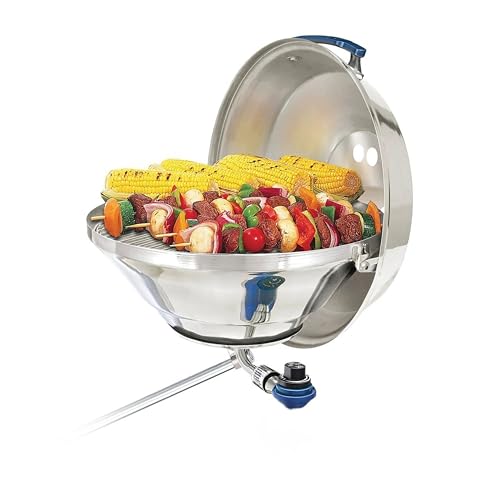
Magma Marine Kettle Gas Grill, Party Size 17-Inch (A10-215) — Best for Bigger Crews
If the 15-inch kettle is the couple’s grill, the 17-inch Party Size is the social sailor’s version. The extra two inches of diameter translate into meaningfully more grate area — enough for six burgers, a full load of kebabs, or a couple of flank steaks with room to spare — while keeping the same locking lid, sheltered burner, and rail-mount system as its smaller sibling.
Strengths
- Noticeably more cooking area for raft-ups and family crews without jumping to a rectangular grill
- Same wind-shedding kettle shape and locking lid as the 15-inch model
- Shares mounts and accessories with the rest of the Marine Kettle line
Trade-offs
- Bigger bowl hangs further off the rail and catches more wind load on a small stern
- Consumes 1 lb canisters faster when run wide open for a crowd
- Overkill — and extra weight aloft on the rail — for solo sailors and couples
Key specs
- Model: Magma A10-215
- Grate diameter: 17 in round kettle
- Fuel: 1 lb disposable propane canisters
- Construction: Marine-grade stainless steel
Underway behavior matters more as grills get bigger, and the Party Size still behaves: the lid locks, the center of gravity stays close to the rail, and the deep bowl keeps flare-ups contained. Where you feel the size is at anchor on a breezy evening — a larger lid presents more area to the wind when open, so position the boat or yourself to shield it while loading food, a small habit that becomes automatic after a few uses.
Choose this size if your typical cook is four to six people, or if you grill whole fish and larger cuts that feel cramped on the 15-inch grate. Choose the smaller kettle if it is usually two of you: the Party Size costs more, burns more fuel, and takes more locker space when stowed. Both are the same quality; this is purely a sizing decision, and getting it right is the difference between a grill you love and one you leave ashore.
Best for: Crews of four to six and raft-up hosts on mid-size cruisers / Not suited for: Solo sailors or couples who rarely cook for guests
Check on Amazon — check the current price on Amazon before you buy.

Magma Catalina II Classic Gourmet Series Gas Grill (A10-1218-2) — Best Rectangular Grill
The Catalina II is what you buy when the kettle shape stops working for your cooking. Its rectangular 12 x 18 inch grate lays out steaks, chops, and skewers in orderly rows, supports a genuine two-zone fire — food over the burner, food resting off it — and adds a warming rack above for buns and finished portions. It is the closest thing to a home grill that still belongs on a boat.
Strengths
- Rectangular grate suits steaks, skewers, and two-zone cooking far better than a round kettle
- Warming rack keeps finished food hot without overcooking it
- Strong burner output for a marine grill, with good searing heat for its class
Trade-offs
- Larger footprint demands a sturdy mount and more stern space than a kettle
- Rectangular lid is less aerodynamic under way; many owners stow it below in rough weather
- Premium pricing within the marine category
Key specs
- Model: Magma A10-1218-2
- Grate size: 12 x 18 in rectangular, plus warming rack
- Fuel: 1 lb disposable propane canisters
- Construction: Marine-grade stainless steel
The Catalina II’s party trick is control. The long burner and rectangular firebox let you run one end hot and the other gentle, so you can sear steaks then slide them aside to finish while vegetables cook — a technique round kettles make awkward. The snap-out radiant plate lifts out for cleaning, which matters on a boat where yesterday’s fish oil becomes today’s flavor whether you want it or not.
It mounts on the same family of Magma rail, rod-holder, and pedestal mounts as the kettles, and it can also stand on its own legs on a dock table. On boats under about 30 feet, measure your stern rail run before ordering: the Catalina II is a substantial box, and on a narrow transom it can crowd a swim ladder or outboard bracket. On 32-foot-plus cruisers it looks and cooks entirely in proportion.
Best for: Serious cooks on larger cruisers who want two-zone rectangular grilling / Not suited for: Small boats with tight stern rails or minimal storage
Check on Amazon — check the current price on Amazon before you buy.

Magma Cabo Gas Grill 9 x 18 (A10-703) — Best Compact Rectangular
The Cabo is the middle child of the Magma rectangular line and, for many sailors, the sweet spot. The 9 x 18 inch grate is long rather than wide, which suits sausages, skewers, asparagus, and fish fillets laid side by side, and the whole unit is light enough to move between rail mount and cockpit table without a struggle.
Strengths
- Long, slim grate shape is ideal for skewers, sausages, and fillets
- Light enough to swap between rail mount and tabletop legs easily
- Marine-grade stainless build at a step down in price from the Catalina II
Trade-offs
- Narrow grate crowds wide items like full racks of ribs or big burgers for a crowd
- No warming rack, unlike the Catalina II
- Single burner means two-zone cooking is more suggestion than system
Key specs
- Model: Magma A10-703
- Grate size: 9 x 18 in rectangular
- Fuel: 1 lb disposable propane canisters
- Construction: Marine-grade stainless steel
Think of the Cabo as a grilling strip rather than a grilling field. For two to four people eating the kind of food boats actually serve — grilled fish, chicken skewers, corn, peppers — the shape is arguably better than a round kettle because everything lines up over the burner evenly and nothing hides in a cold corner. Heat-up is quick, and the lid’s balanced handle makes one-handed operation realistic while your other hand holds a plate, which on a moving deck is not a trivial feature.
Where it gives ground to the Catalina II is batch cooking for groups and true two-zone work. If your anchorages involve six people and a mixed grill of thick cuts, step up. If it is two to four and the menu is fillets and skewers, the Cabo saves money, weight, and rail space while giving up very little that you will actually miss.
Best for: Two to four people on small-to-mid cruisers who grill fillets and skewers / Not suited for: Large crews or cooks who need a warming rack and true two zones
Check on Amazon — check the current price on Amazon before you buy.

Kuuma Stow N’ Go 160 Gas Grill — Best Budget
Kuuma’s Stow N’ Go line exists for sailors who refuse to pay Magma money, and the 160 is the size most of them should buy. It packs a 160 square inch grate, a lid thermometer, and push-button ignition into a stainless box whose legs fold away so it slides into a locker or lazarette when it is not on the rail.
Strengths
- Real marine stainless construction among the entry options in this guide
- Folding legs and compact body stow flat in a locker between trips
- Built-in thermometer and igniter — features the kettle competition charges more for
Trade-offs
- Thinner-feeling fit and finish than Magma; latches and hinges are less refined
- Wind protection is adequate rather than excellent in a stiff breeze
- Mounts are available but the ecosystem is smaller than Magma’s
Key specs
- Model: Kuuma Stow N’ Go 160
- Cooking area: 160 sq in
- Output: 13,000 BTU (per verified listing title)
- Fuel: 1 lb disposable propane canisters
Performance is the pleasant surprise: 13,000 BTU under a 160 square inch grate is a strong power-to-area ratio, so the Kuuma gets properly hot for burgers and chicken and recovers heat quickly after the lid opens. The trade-off for the price is refinement — the lid fit, latch feel, and grate finish are a notch below Magma — but nothing about it feels unsafe or flimsy, and the stainless body shrugs off salt spray with the same rinse-and-dry routine as any marine grill.
The stowage story is the real reason to buy it. On trailer sailors and small cruisers without a permanent rail setup, a grill that lives in a locker and comes out at anchor beats a rail-mounted grill that does not fit the boat. If your boat lives on a trailer or you daysail more than you cruise, the Stow N’ Go 160 is not the cheap compromise — it is the correct tool.
Best for: Budget-conscious sailors and trailerable boats that stow the grill between trips / Not suited for: Full-time cruisers who want the most refined hardware and widest mount range
Check on Amazon — check the current price on Amazon before you buy.

Kuuma Stow N’ Go 216 Elite Propane Grill (58155) — Best for Versatile Mounting
The 216 Elite is Kuuma’s answer to the Catalina II at a friendlier price. You get a 216 square inch main grate, a removable warming rack, a lid thermometer, and push-button ignition, in a body that works on fold-away legs, a rail mount, or a pedestal — genuinely three grills in one depending on where you anchor.
Strengths
- Largest grate in the Kuuma line plus a warming rack for buns and resting meat
- Works on legs, rail mount, or pedestal, so it follows you from boat to dock to beach
- Thermometer and push-button igniter included as standard
Trade-offs
- Bigger body needs a bigger locker if you stow rather than mount it
- Like all Kuumas, hardware refinement trails Magma
- Warming rack reduces lid clearance for tall items like beer-can chicken
Key specs
- Model: Kuuma Stow N’ Go 216 Elite (58155)
- Cooking area: 216 sq in plus warming rack
- Fuel: 1 lb disposable propane canisters
- Construction: Stainless steel
Capacity is honest here: 216 square inches feeds four easily and six at a push, and the warming rack earns its place the first time you toast buns while burgers finish. Heat distribution across the rectangular grate is even enough for batch cooking, and the lid thermometer — a small thing — removes the guesswork that ruins fish on unfamiliar grills.
Versatility is the buying argument. The same grill that rail-mounts on your boat can pedestal-mount on a dock box or stand on legs at a beach picnic, which makes the 216 Elite the pick for sailors whose cooking happens in several places. If the grill will live permanently on one rail, Magma’s Catalina II is the more polished tool; if it will travel, the Kuuma is the smarter buy.
Best for: Sailors who split cooking between boat, dock, and shore / Not suited for: Owners who want a permanent, premium rail installation
Check on Amazon — check the current price on Amazon before you buy.
Comparison Table
| Pick | Badge | Key spec | Best for |
|---|---|---|---|
| Magma Marine Kettle Gas Grill, Original Size 15-Inch (A10-205) | Best Overall | 15 in round kettle grate, 1 lb propane | Couples and small crews on 25- to 35-foot sailboats who want one dependable rail grill |
| Magma Marine Kettle Gas Grill, Party Size 17-Inch (A10-215) | Best for Bigger Crews | 17 in round kettle grate, 1 lb propane | Crews of four to six and raft-up hosts on mid-size cruisers |
| Magma Catalina II Classic Gourmet Series Gas Grill (A10-1218-2) | Best Rectangular Grill | 12 x 18 in rectangular grate plus warming rack | Serious cooks on larger cruisers who want two-zone rectangular grilling |
| Magma Cabo Gas Grill 9 x 18 (A10-703) | Best Compact Rectangular | 9 x 18 in rectangular grate, tabletop legs included | Two to four people on small-to-mid cruisers who grill fillets and skewers |
| Kuuma Stow N’ Go 160 Gas Grill | Best Budget | 160 sq in grate, 13,000 BTU, folding legs | Budget-conscious sailors and trailerable boats that stow the grill between trips |
| Kuuma Stow N’ Go 216 Elite Propane Grill (58155) | Best for Versatile Mounting | 216 sq in grate plus removable warming rack | Sailors who split cooking between boat, dock, and shore |
Read the table as a sizing chart first and a quality chart second. Every grill here is stainless and genuinely marine; they differ mainly in grate geometry and capacity. Round kettles (the two Magmas at the top of the table) shed wind best and suit simple menus. Rectangular grates (Catalina II, Cabo, Kuuma 216) lay food out in rows and suit skewers, fillets, and mixed batches. The Kuuma 160 is the outlier on size and price — the stow-away option — while the Catalina II is the outlier on features, with the only true warming rack and two-zone layout in the group. If two picks look tied for your boat, choose by mount compatibility with your rail before you choose by grate size; a grill that mounts securely gets used, and a grill that wobbles gets left ashore.
How to Choose the Best Sailboat Grills for Your Boat
Start with the mount, not the grill. A sailboat grill is only as good as its attachment to the boat. Stern rail mounts are the classic choice and keep cooking smells and grease out of the cockpit; rod-holder mounts suit boats with flush rod holders and no free rail; pedestal mounts work on larger stern decks. Measure your rail diameter before ordering anything — rails come in several standard sizes and the clamp must match. If your boat has no suitable rail, choose a grill with proper folding legs and plan to cook on the cockpit table or ashore.
Match grate size to crew size, honestly. As a working rule, a 15-inch kettle or roughly 160 square inches feeds two to four; 200-plus square inches or a 17-inch kettle feeds four to six. Buying bigger “just in case” costs you locker space, fuel, and wind load on the rail every single trip, while buying too small only hurts on the rare big night. Most sailors overbuy; size for your typical crew, not your biggest raft-up.
Fuel is a system decision. Nearly all marine grills run on 1 lb disposable propane canisters because they are compact, sealed, and safe to stow. If you cook daily on a long cruise, look for a grill whose valve accepts an adapter hose to a refillable tank, and carry spare canisters regardless — running out mid-cook at an anchorage with no chandlery is a rite of passage you can skip. Charcoal marine kettles exist and give classic flavor, but ash disposal and open-coal rules in marinas make propane the practical default for most sailors.
What Makes a Grill Truly Marine-Grade?
The difference between a marine grill and a camping grill with a clamp is corrosion engineering. Salt spray attacks fasteners, burners, and hinges first, so look for stainless steel throughout — ideally the higher grades of stainless on the firebox and hardware — with no painted steel panels to chip and rust. Every pick in this guide is stainless-bodied for exactly this reason.
Wind is the second test. At anchor in a 15-knot breeze, an unprotected burner blows out or cooks on one side only. Deep fireboxes, lids that close over the burner zone, and radiant plates that shield the flame are what keep a marine grill lit and even. The third test is security: a locking or latching lid and a mount that clamps positively, so the grill — and its contents — stay put when the boat rolls in a wake. If a grill fails any of these three tests, it is a patio grill near water, not a sailboat grill.
Maintenance is the fourth, quiet test. Marine grills that come apart without tools — lift-out grates, snap-out radiant plates, accessible grease trays — actually get cleaned, and a clean grill does not flare up or rust from the inside. Factor five minutes of rinse-and-wipe into every washdown and any of these grills will serve for years.
Propane, Charcoal, or Electric: Which Fuel Belongs on a Sailboat?
Propane is the default for good reasons. It lights instantly in a breeze with a push-button igniter, reaches cooking temperature in minutes, and — critically on a boat — shuts off completely the moment you close the valve. There is no ash, no lingering coals to guard, and no conflict with the no-open-flame rules many marinas apply to charcoal. Every pick in this guide runs on propane for these reasons, using the same 1 lb canisters you can buy at any chandlery or hardware store.
Charcoal is a flavor choice with real costs. Marine charcoal kettles exist and produce unmistakably better smoke flavor, but they demand a safe place to light a chimney, somewhere to store charcoal dry, and a plan for ash — which cannot go overboard in a marina and must be fully cold before it goes in a bin. On passage-making boats that anchor out for weeks, some sailors accept all of that happily. For weekend sailing, most conclude the ritual outweighs the reward.
Electric only works at the dock. Shore-power electric grills are clean and simple alongside, but useless at anchor without a large inverter and battery bank, and their appetite makes them impractical for most cruising sailboats. If your boating is marina-to-marina with shore power every night, an electric grill is a legitimate convenience; for everyone else it answers a question nobody at anchor is asking. Decide by where you actually cook: if the answer is “at anchor,” propane is the fuel, and the only real choice left is kettle or rectangular.
Rail, Rod-Holder, or Pedestal: Choosing the Right Mount
Rail mounts are the default because the stern rail is the best seat in the house. Cooking happens outside the cockpit, smoke blows away over the stern, and the grill lives there permanently, ready in seconds. The catch is fit: rails come in round and square profiles in several diameters, and a clamp sized for one will rock on another. Measure with calipers or a wrap of tape, buy the matching clamp, and position the grill where the lid opens fully without striking the backstay, flag staff, or an outboard on its bracket.
Rod-holder mounts suit fishing boats and clean sterns. A stainless post drops into a standard flush rod holder and locks the grill above the gunwale — ideal if your stern rail is crowded with a barbecue’s natural enemies: davits, solar panels, and a dinghy motor. The trade-off is that the grill must be mounted and dismounted for each use unless you leave it in the holder, and not every sailboat has a holder positioned where cooking makes sense.
Pedestal mounts are the big-boat solution. A fixed pedestal on the stern deck or in the cockpit of a larger cruiser gives the most solid platform of all and suits the bigger rectangular grills like the Catalina II. It is also the most permanent decision — you are drilling into the deck — so it belongs on boats where the grill is a fixture of life aboard, not an experiment.
Whichever system you choose, apply the same test before the first cook: hang the grill, load it with a full grate of imaginary food, and push firmly sideways on the lid handle. Any rotation, creep, or flex you find at the dock will be ten times worse in a wake at anchor. Fix it now, with the right clamp or a backing plate, and the mount disappears from your mind — which is exactly what a good mount should do.
How to Make a Marine Grill Last: Care, Covers, and Off-Season Storage
Marine grills die from neglect between trips, not from cooking. The routine that prevents it takes five minutes: while the grate is still warm, brush it clean; once cool, wipe the exterior with a freshwater-dampened cloth to remove salt film; empty any grease tray before it overflows into the firebox. Salt left sitting on hinges, latches, and burner ports through a working week does more damage than a season of cooking.
Monthly, or after any rough passage, check the burner for blocked ports — spider webs and salt crust are the usual culprits behind a lazy, yellow flame — and clear them with a soft brush or pin. Check the regulator connection for the white corrosion crust that signals a weeping seal, and confirm the mount clamp has not crept; a quarter-turn of preventive tightening in the marina beats fishing for a wrench at anchor.
Off-season, the kindest storage is off the boat: remove the grill, clean it thoroughly, dry it completely, and store it in a dry locker or garage with the lid cracked open so condensation does not pool inside. If it must winter on the rail, a fitted cover is worthwhile, but trap no moisture under it — cover a clean, dry grill only. Looked after this way, a stainless marine grill is a ten-year appliance; neglected, the same grill is a three-year one. The difference is entirely in the five-minute routine.
How to Set Up and Use a Rail-Mount Grill Safely
Step 1 — Fit the mount on a calm day. Clamp the rail mount at the stern, clear of the swim ladder swing and any outboard tiller arc, and snug it to the torque where the grill cannot rotate when you press on the lid handle. Hang the grill, open and close the lid several times, and confirm nothing fouls lines, the flag staff, or the pushpit gate.
Step 2 — Do a dockside burn-in. Before the first anchorage cook, run the grill empty on high for ten minutes at the dock to burn off manufacturing oils, check the igniter, and learn how the valve maps to heat. This is also when you confirm the lid thermometer, if fitted, reads sensibly.
Step 3 — Cook with the wind in mind. At anchor the boat swings to face the wind, which means the stern grill sits in the cleanest air on the boat — good for smoke, hard on flames. Close the lid for most cooking, open it briefly and deliberately, and keep a spray bottle of water for flare-ups from fatty cuts. Never grill in an enclosed cockpit or under a bimini pocket where heat can pool, and keep the grill clear of sails, covers, and fuel vents.
Step 4 — Shut down and secure. Turn off the valve, let the grill cool with the lid closed, wipe the grate while it is still warm, and latch the lid before getting under way. Remove the propane canister for long passages and store it in a vented locker — never in the cabin or bilge. A thirty-second routine after each cook is what keeps a marine grill from becoming a rusty ornament.
Common Buying Mistakes
- Buying the grill before the mount. The mount is half the system. Confirm your rail diameter and style first, or budget for the correct mount in the same order.
- Oversizing for imaginary crews. A party-size grill on a two-person boat burns more fuel, catches more wind, and hogs the locker on every trip.
- Using a non-marine camping grill to save money. Painted steel and plated hardware rust within a season on salt water; the replacement cycle costs more than buying stainless once.
- Stowing propane canisters in the cabin. Canisters belong in a vented locker, upright, away from heat — never below decks or in the bilge.
- Grilling under way in a seaway. Even with a locking lid, cook at anchor or in calm conditions; a rolling boat plus hot grease is a burn waiting to happen.
- Skipping the rinse. Salt left on hinges and burners after a weekend quietly corrodes all week. A freshwater rinse at washdown takes seconds.
Final Recommendation
For most sailors, the Magma Marine Kettle 15-Inch is the right first and possibly last boat grill: it mounts securely, shrugs off wind and salt, and cooks beautifully for two to four. Step up to the Party Size 17-Inch if your typical crew is four to six. If you cook in rows and zones rather than in a circle, the Catalina II is the premium rectangular choice and the Cabo its lighter sibling. On a budget, or on a boat that stows its grill in a locker, the Kuuma Stow N’ Go 160 is genuinely good rather than merely cheap, and the 216 Elite adds the size and mounting flexibility to follow you from rail to dock. Whichever you choose, buy the correct mount in the same order — then check price on Amazon for both pieces together.
Keep exploring the cluster before you decide:
- Magma Marine Kettle Gas Grill, Original Size 15-Inch (A10-205) — check price on Amazon
- Magma Marine Kettle Gas Grill, Party Size 17-Inch (A10-215) — check price on Amazon
- Magma Catalina II Classic Gourmet Series Gas Grill (A10-1218-2) — check price on Amazon
Best Saltwater Resistant Grills Best Selling Bbq Grills Best Selling Grills Best Searing Grills Best 10 Grills
Frequently Asked Questions
Can you leave a sailboat grill mounted on the rail all season?
Yes — that is what marine grills are designed for, provided the lid latches and the mount is correctly sized for your rail. A cover helps in harsh climates, and a freshwater rinse after use keeps hinges and burners free of salt. Remove the propane canister and store it in a vented locker between trips.
What size grill does a 30-foot sailboat need?
For the typical crew of two to four, a 15-inch kettle or a grill around 160–216 square inches is the sweet spot. It handles burgers, chicken, and fish for four without dominating the stern rail. Only step up to a 17-inch kettle or a large rectangular grill if you regularly cook for five or six.
Are charcoal grills practical on a sailboat?
They can be, and marine charcoal kettles exist, but most sailors choose propane: it lights instantly, shuts off completely, produces no ash to dispose of, and avoids the open-coal restrictions many marinas enforce. Charcoal is a flavor preference that costs convenience and storage.
Do marine grills work with refillable propane tanks?
Many do, via an adapter hose that replaces the 1 lb canister connection — but the tank then needs a secure, vented home on deck, which most small sailboats lack. For weekend and holiday cruising, spare 1 lb canisters in a vented locker are simpler and safer.
Why do marine grills cost more than camping grills?
You are paying for stainless steel throughout, corrosion-resistant burners and hardware, locking lids, and engineered mounting systems — all in low production volumes. A camping grill in painted steel is cheaper because it is built for a field, not for salt spray.
How do I stop my boat grill blowing out in the wind?
Cook with the lid closed as much as possible, choose a grill with a deep firebox and shielded burner, and anchor so the grill sits out of the direct gust line where you can. If blowouts persist, a windscreen positioned safely clear of the grill — never enclosing it — usually solves it.

